

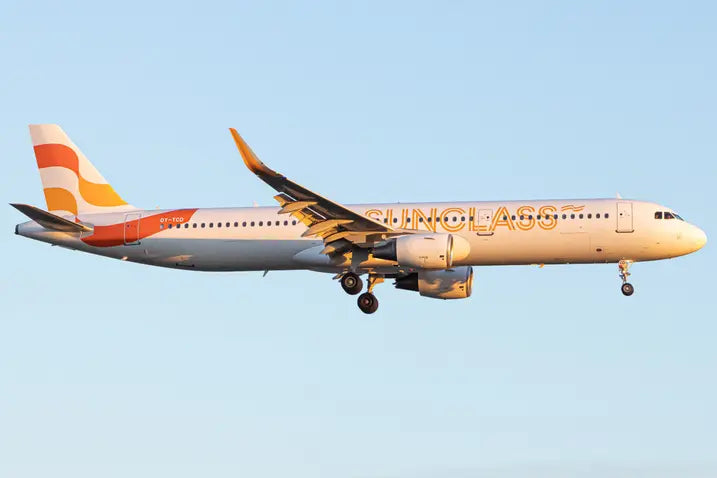
Sunclass Airlines Overview & Company Profile
Sunclass Airlines (IATA DK, ICAO VKG, callsign VIKING) is a Danish leisure carrier headquartered at Copenhagen Airport South in Dragør, just south of the main terminal complex at Kastrup. It is the in-house airline of the Nordic package holiday industry, flying almost exclusively for the tour operator brands owned by its parent group: Spies in Denmark, Ving in Sweden and Norway, Tjäreborg in Finland, and Globetrotter.
The airline's roots go back to September 1993, when the Danish charter operator Conair of Scandinavia merged with the Swedish carrier Scanair. The combined company began trading on 1 January 1994 as Premiair. It became MyTravel Airways in May 2002, then Thomas Cook Airlines Scandinavia in May 2008. When Thomas Cook Group entered administration on 23 September 2019, the Scandinavian tour operating and airline businesses were carved out and bought by a consortium of Altor Equity Partners, Petter Stordalen's Strawberry group and TDR Capital. The airline was rebranded Sunclass Airlines and has traded under that name since late 2019.
Today Sunclass sits inside Nordic Leisure Travel Group (NLTG), which is owned by Altor (39.74 percent), Strawberry (39.73 percent), TDR Capital (19.87 percent) and staff (0.66 percent). That ownership structure is about to change: in June 2026 Norwegian Air Shuttle agreed to buy the entire group, a transaction covered in detail in the next section. For any pilot weighing up an application, that pending change of control is the single most important variable in the whole picture.
Operationally, Sunclass is a small but genuinely capable airline. It runs 12 Airbus aircraft across seven Nordic crew bases and around 24 secondary departure airports, carrying just over 2 million passengers a year at a 91 percent load factor. That is a very high load factor by any measure, and it reflects the charter model: seats are sold as part of a package holiday well in advance, so the aircraft leave full. Roughly 20 to 25 destinations feature in each summer and winter programme, split between Mediterranean and Canary Islands short and medium haul on the A321 family, and genuine long haul to Thailand, Cape Verde and (in some seasons) the Caribbean on the A330-900neo.
Financially the airline has turned a corner. According to the company's own results announcement, Sunclass posted a profit before tax of DKK 123 million in financial year 2024/25, up from DKK 4 million the previous year, on turnover of roughly DKK 4.07 billion. CEO Valdemar Warburg attributed the improvement to stronger operations and high demand from the group's tour operators. The company also reports a 30 percent improvement in on-time performance over recent years and was named best charter airline at the Danish Travel Awards in 2025 for the second consecutive year. In December 2025 it launched a five-year strategy called Altitude 2030, targeting revenue, punctuality and customer experience. In early 2026 Sunclass joined the European Regions Airline Association, its first industry association membership under the Sunclass name.
The Seven Crew Bases
Unlike most flag carriers, Sunclass does not concentrate its crews at a single hub. The airline's own careers portal and public company records list seven base airports spread across four countries. This is one of the more attractive structural features of the job for Nordic-resident pilots, because it removes the commuting problem that dominates careers at single-base airlines.
| Base | Country | Airport Code | Notes |
|---|---|---|---|
| Copenhagen | Denmark | CPH | Head office and main base. A330neo long-haul departures. |
| Billund | Denmark | BLL | Jutland base. Direct winter departures including Cape Verde. |
| Malmö-Sturup | Sweden | MMX | Southern Sweden, within commuting distance of Copenhagen. |
| Gothenburg-Landvetter | Sweden | GOT | West coast Sweden. Included in the 2026 first officer campaign. |
| Stockholm-Arlanda | Sweden | ARN | Largest Swedish base. Long-haul departures to Phuket and Krabi. |
| Oslo-Gardermoen | Norway | OSL | Norwegian base. A330neo long-haul operates from here. |
| Helsinki-Vantaa | Finland | HEL | Finnish base serving the Tjäreborg programme. |
Base list compiled from the Sunclass Airlines careers portal, public company records and the 2026 first officer vacancy. Individual base openings depend on the recruitment campaign in progress.
Sunclass Airlines is not owned by TUI Group, and never has been. Third-party job boards and aggregator sites frequently list it that way, probably because both companies operate Nordic leisure flying and both use Boeing or Airbus narrowbodies on similar routes. Sunclass descends from Thomas Cook, not TUI. Applications go through the airline's own portal at career.sunclassairlines.dk and not through TUI Careers. Getting this wrong on an application is an avoidable own goal.
Sunclass does not publish a pilot headcount. The figure of roughly 200 pilots is derived from the airline's own careers material, which has referenced eight female pilots alongside approximately 200 male pilots. Separately, the collective agreement concluded with FPU covered 169 pilots employed in Denmark, Norway and Finland, with Swedish-based pilots negotiating under a separate arrangement. Treat 200 as an order of magnitude, not an audited number, and ask recruitment directly if the exact figure matters to your seniority calculations.
The Norwegian Takeover: What Pilots Need to Know
No honest assessment of Sunclass Airlines as an employer can skip this. On 16 June 2026, Norwegian Air Shuttle ASA announced an agreement to acquire Nordic Leisure Travel Group, the holding company that owns Sunclass Airlines along with Ving, Spies, Tjäreborg and Globetrotter. If you sign a contract with Sunclass in 2026, there is a strong probability that your employer will be part of the Norwegian group before your line check is dry.
Deal Structure and Timeline
| Element | Detail |
|---|---|
| Announcement date | 16 June 2026 |
| Headline value | Approx. SEK 7.94 billion |
| Consideration | SEK 3.5 billion cash plus 300 million new Norwegian shares, with up to 30 million further shares contingent on share price performance in Q4 2026 |
| Shareholder approval | Obtained at EGM on 8 July 2026 |
| Remaining condition | Regulatory clearance, including EU competition approval |
| Target closing | Q4 2026 |
| Sellers post-deal | Strawberry, Altor and TDR become major Norwegian shareholders |
| Combined group | Norwegian, Widerøe, Sunclass Airlines plus the NLTG tour operators and hotels |
Figures per Norwegian Air Shuttle's press release and Q2 2026 reporting. Verify current status on the Norwegian Group media centre before making a decision.
What Norwegian Has Said, and What It Has Not
Norwegian's stated rationale is commercial rather than operational consolidation. Management has pointed to network coordination between Sunclass and Norwegian, procurement efficiencies across fleet and fuel, and the ability to sell integrated flight and hotel holiday packages. It expects roughly a 2 percent operating margin improvement in 2027 relative to the twelve months to Q1 2026, with further gains beyond. Norwegian has also cited the gradual introduction of more efficient A321neo and A330neo aircraft as part of the value case, which reads as an endorsement of the existing Sunclass fleet plan rather than a signal to unwind it.
What Norwegian has not publicly stated, as of August 2026, is anything definitive about the future of the Sunclass AOC, the Sunclass brand, the pilot group's employment contracts, or how (or whether) the Sunclass and Norwegian seniority lists would ever be combined. No public statements from FPU, the Norwegian Pilot Union or Parat on seniority integration have surfaced either. That silence is not necessarily ominous, since deals of this size routinely close before integration planning is communicated, but it is a genuine information gap and you should treat it as one.
How to Read This as a Candidate
There are three plausible outcomes, and they have very different career implications:
Scenario one, the AOC is retained. Sunclass keeps its Danish AOC and continues as the group's dedicated leisure and long-haul charter arm. This is the most likely near-term outcome given that Norwegian operates an all-Boeing 737 fleet and has no Airbus infrastructure, no A330 widebody operation and no charter tour-operator flying culture. Absorbing 12 Airbus aircraft into a 737 operator would destroy value rather than create it. Under this scenario your terms, union, and seniority position are largely unaffected.
Scenario two, gradual convergence. The AOC survives but pay scales, rostering systems and crew planning slowly align with the wider group. This would be normal and could go either way for pilots, depending on where the eventual reference point sits.
Scenario three, deeper integration. A single Nordic pilot group emerges over several years. This is where seniority list integration becomes the defining issue, and it is the scenario in which a pilot joining at the bottom of the Sunclass list in 2026 has the most to gain or lose. Historically, Norwegian's own pilot group has had a turbulent industrial relations record, including strike action over which legal entity should hold the collective agreement.
Ask three specific questions before signing: first, is the offered contract with Sunclass Airlines ApS on the Danish AOC, and does that survive change of control. Second, what happens to your seniority date if the group later merges pilot lists. Third, what is the status of the FPU collective agreement, which runs to March 2027, after closing. Put these to both the recruitment team and to FPU directly. A union that represents 100 percent of the covered pilot group will give you a straighter answer on integration risk than any recruiter can.
Norwegian is not acquiring from a position of unlimited strength. In Q2 2026 the group reported an operating profit of NOK 213 million excluding other losses but a net loss of NOK 555 million, after jet fuel costs rose 33 percent year on year and an emissions-related charge landed. Unit cost excluding fuel improved 5 percent to NOK 0.48 per available seat kilometre, and full-year production is guided up around 3 percent. A leveraged buyer in a high fuel cost environment is a factor to weigh when assessing long-term job security, even though the target itself is profitable and, at group level, was described as debt-free at the last results.
Fleet Composition & Type Ratings
Sunclass operates an all-Airbus fleet of 12 aircraft built around two families: the A321 for Mediterranean, Canary Islands and North African flying, and the A330-900neo for long haul and high-density Mediterranean routes. For an airline of this size, the equipment is unusually modern and the mix is unusually interesting. There are Nordic pilots flying much larger airlines who will never touch a widebody, whereas a Sunclass first officer can realistically operate both narrowbody and widebody types within the same career.
The fleet renewal programme has been the airline's central capital project since 2022. All three of the A330s in service are now the A330-900neo variant. The A330-200 registered OY-VKF flew its final passenger service on 7 April 2024, an Oslo to Tenerife return, and the remaining A330-300 has since left the fleet as well. On the narrowbody side, three of the nine A321s are now neos, and the airline's stated objective, communicated through the Spies and Ving press offices, is that the entire current fleet will be replaced by neo models before the end of 2030.
| Aircraft Type | Role | In Service | Seats | Notes |
|---|---|---|---|---|
| Airbus A321-200 (ceo) | Narrowbody | 6 | 212 | CFM56-5B4 engines, 45 m length, approx. 7,500 km range. Being progressively replaced by A321neos. |
| Airbus A321neo | Narrowbody | 3 | 218 | CFM LEAP-1A engines, approx. 5,600 km range at max payload. Registrations OY-VKA, OY-VKB, OY-VKE. |
| Airbus A330-900neo | Widebody | 3 | 385 summer / 373 winter | Rolls-Royce Trent 7000 engines, 64 m length, up to 17,000 km range. Registrations OY-VKO, OY-VKP, OY-VKR. |
| Total | 12 | All-Airbus, all-neo widebody fleet as of August 2026. |
Fleet data compiled from the official Sunclass Airlines fleet page and company press releases, August 2026. Charter fleets fluctuate with seasonal wet-lease in and out, so short-term variations are normal.
The A330-900neo Operation
The A330neo is the reason many pilots look at Sunclass in the first place. The type replaced the older ceo A330s with a claimed reduction of up to 23 percent in CO2 per seat kilometre and a 33 percent reduction in noise footprint. The cabin is reconfigured seasonally: a two-class winter layout at 373 seats for long-haul leisure routes, and a denser 385-seat summer layout with 12 additional seats for Mediterranean flying.
The third aircraft, OY-VKR, was accepted from Airbus in Toulouse in May 2026, arrived in Copenhagen in mid-May, and flew its first commercial rotation from Copenhagen to Chania in Crete on 23 May 2026. The airline expects that single airframe to carry roughly 300,000 passengers in its first full operating year, based out of Copenhagen with additional operations from Stockholm Arlanda and Oslo Gardermoen. That utilisation figure is worth reading carefully as a pilot: three widebodies moving that volume implies high daily utilisation and long duty days, not a relaxed schedule.
Narrowbody Renewal
The A321neo transition began in December 2023 with OY-VKA, followed by OY-VKB in April 2024 and OY-VKE in July 2025. In a March 2026 interview, CEO Valdemar Warburg confirmed that two further A321neos are due within approximately eighteen months and explicitly described them as replacement aircraft rather than growth. Public company records also list a larger longer-term A321neo backlog, but the firm near-term commitment communicated by the airline is two frames.
The strategic read is straightforward: Sunclass is not a growth airline in fleet-count terms. It is a replacement airline. That distinction matters enormously for career progression, because upgrade opportunity in a static fleet is driven almost entirely by retirement and attrition rather than by new aircraft deliveries. Section seven examines this in more depth.
The A320 family is the entry point. Sunclass's published first officer vacancy states a preference for candidates who already hold an Airbus A320 family type rating, and third-party listings for the role have described it as a type-rated position. The vacancy text does not state whether a non-rated candidate would receive a company-funded rating, a bonded rating, or would be expected to self-fund. This is the single most expensive unknown in the whole recruitment package and you should get a written answer before accepting an offer. The airline advertises "mixed fleet flying on long and short haul routes", which indicates that A321 and A330 flying is available across the pilot group rather than being permanently segregated, but the mechanics of how a pilot moves between the two are not published.
Pilot Salary & Compensation Breakdown
Sunclass Airlines does not publish a pilot pay scale. The company confirms only that remuneration, pension and other terms are governed by a collective agreement negotiated with Flyvebranchens Personale Union (FPU) and the local Sunclass pilot association. That agreement was concluded at the end of 2024, runs until March 2027, and according to reporting in the Danish aviation press it delivered an improved salary structure alongside better time-off and parental leave provisions. The actual numbers in that structure are not in the public domain.
This is normal for Danish airlines and is not a red flag in itself, but it does mean that anything you read online presenting a precise "Sunclass pay scale" is either an estimate or an invention. What follows is a set of Danish market benchmarks from published sources, presented so you can sanity-check an offer, not so you can predict one.
The figures below are Danish and Nordic market reference points, not a Sunclass pay scale. No verified Sunclass first officer or captain salary table exists in the public domain. The only firm anchor is SAS, which publishes first officer salary ranges openly. Everything else in the tables comes either from published Danish salary guides or from cross-airline reporting, and should be treated as indicative. Request the actual scale, the seniority step credit for your previous experience, and the allowance structure in writing from Sunclass recruitment, and cross-check it with FPU before you sign.
Danish Market Reference Points (Monthly Gross, DKK)
| Airline / Segment | First Officer | Captain | Source Character |
|---|---|---|---|
| SAS Denmark | DKK 37,915 – 44,342 | DKK 75,000 – 95,000 | FO range published by SAS itself, before tax, with daily allowances paid on top. Captain range from a published 2026 salary guide. |
| Norwegian (Danish/Nordic base) | DKK 45,000 – 58,000 | DKK 70,000 – 88,000 | Published 2026 Danish salary guide, not an official contract table. |
| Jettime (Danish charter) | DKK 35,000 – 48,000 | DKK 55,000 – 72,000 | Published 2026 Danish salary guide. |
| Danish charter / regional segment | DKK 38,000 – 48,000 | DKK 58,000 – 78,000 | Segment benchmark most closely matching Sunclass's operating profile. |
Monthly gross before pension and allowances. Published Danish salary guidance indicates that pension contributions typically add 12 to 16 percent on top, and per diem and duty allowances a further 5 to 15 percent depending on flying pattern.
Where Sunclass Is Likely to Sit
Sunclass occupies the Danish charter segment but with a widebody long-haul component that Jettime does not have. The one unofficial data point that has circulated among Swedish pilots places established Sunclass first officers at roughly SEK 700,000 to SEK 900,000 per year, which converts to broadly the same territory as the Danish charter and regional segment benchmark once pension and allowances are added. That is consistent with the airline's position: better than a pure narrowbody charter operator, below SAS or Norwegian at captain level, and heavily dependent on how much long-haul flying a given pilot picks up in a given season.
The Danish Tax Reality
Gross figures in Denmark need heavy discounting before they mean anything. Per the Danish Tax Agency, the labour market contribution (AM-bidrag) is 8 percent and is deducted first. Top-bracket tax of 7.5 percent applies above DKK 777,900 of income after AM-bidrag in 2026, on top of base tax and municipal tax, where the average municipal rate in 2026 is around 25 percent. The practical outcome is that a captain-level gross salary attracts a marginal burden well above 50 percent once all layers are combined. You can model your own position using the official calculators at skat.dk.
The offset is what that tax buys: comprehensive public healthcare, subsidised childcare, and a labour-market framework that is genuinely protective in ways that are hard to price. Nordic pilots comparing a Sunclass offer against a Gulf or Asian contract should compare net purchasing power and total employment security, not gross headline numbers. Comparing against SAS or Norwegian, however, is a like-for-like comparison and the gross figures do tell you something real.
Salary information in this section is compiled from the SAS Group careers site (which publishes first officer ranges openly), published Danish pilot salary guides for 2026, the Danish Tax Agency, and Danish aviation press reporting on the 2024/25 Sunclass collective agreement. No official Sunclass Airlines pay scale has been published and none is reproduced here. Any figure presented elsewhere as a definitive Sunclass salary table should be treated with suspicion. Always verify with the airline and with FPU before making a financial decision.
Roster Pattern & Quality of Life
Sunclass does not publish a fixed roster pattern, and no verified figure exists for guaranteed monthly days off. Charter flying does not lend itself to the clean 5-on/4-off or 6-on/3-off structures common at scheduled low-cost carriers, because the flying programme is dictated by tour operator departure days rather than by an evenly repeating timetable. Saturday and Sunday are the classic charter turnaround days, and summer weekends in the Mediterranean are relentless.
What the airline does say, directly in its own recruitment material, is that pilots should expect frequent days away from home base. That sentence is the most honest description of the job available and it should be taken at face value. The operation mixes same-day turnarounds to Mediterranean and Canary Islands destinations with genuine multi-day long-haul rotations to Thailand and Cape Verde, plus positioning duties across the 24 secondary departure airports that feed the seven crew bases.
A sample roster grid has been deliberately omitted from this article. Sunclass Airlines has not published a monthly roster pattern, a minimum days-off figure, or an average block-hour target for its pilots, and none could be verified from the collective agreement, the airline's own material, or independent reporting. Publishing an invented sample month would misrepresent the job. What is known is that the collective agreement concluded with FPU explicitly improved the fritid (time off) provisions, that the operation combines turnarounds with layovers, and that the regulatory ceilings below apply. Ask for a real anonymised roster from the last twelve months during your interview process, and ask specifically about weekend protection and summer peak workload.
The Regulatory Framework That Does Apply
Even without a published company pattern, the outer limits of what Sunclass can roster are fixed by EU and EASA law and enforced by the Danish regulator. These are ceilings, not targets, and a well-run airline rosters well inside them, but they define the worst case.
Limits per EASA ORO.FTL and EU working time rules for mobile civil aviation staff. Danish leave entitlement per the Holiday Act (ferieloven). Oversight by Trafikstyrelsen.
What the Flying Actually Feels Like
Three characteristics define the lifestyle at Sunclass, and none of them appear in a recruitment brochure.
Seasonality is the dominant rhythm. The summer Mediterranean programme and the Christmas and February long-haul peaks are the pressure points. Sunclass carries just over two million passengers a year on twelve aircraft at a 91 percent load factor, which is high asset utilisation by any standard. Expect the summer to be hard work and the shoulder seasons to be considerably lighter.
Circadian disruption is structural, not occasional. Charter operators fly at hours scheduled carriers avoid, because holiday departure slots at leisure airports are cheap at night and the aircraft has to be back for the next rotation. Long-haul flying to Phuket from Stockholm is an 11 hour 30 minute sector, and the return to Copenhagen is roughly 12 hours 40 minutes, with a six-hour time zone shift in winter. Employee reviews of the airline, though drawn from a very small sample and not pilot-specific, consistently mention jet lag, extended periods away from family, and uncomfortable working hours alongside positive comments about the culture and colleagues.
Multiple bases genuinely help. Seven bases across four countries is a real structural advantage for a Nordic-resident pilot. Most European legacy carriers require you to move to a single hub. Sunclass allows a pilot to live in Gothenburg, Helsinki, Billund or Malmö and still hold a base. Against that, the airline's use of 24 secondary departure airports means positioning and out-of-base duties are part of the normal working week even for based crew.
Copenhagen is the head office and principal base, and it is an expensive city, though noticeably less so than Oslo. Billund, Malmö, Gothenburg and Helsinki all offer materially lower housing costs than the capitals. Because Sunclass employment is with a Danish company, all pilots regardless of base go through a Danish police background and security check, and the airline's Danish AOC means Danish regulatory oversight applies to the operation. Whether payroll, tax residency and social security follow your base country or Denmark depends on your contract and on EU posting rules, and that is a question worth putting to a Nordic tax adviser before you accept, not after.
Benefits, Pension & Danish Employment Law
Sunclass's benefits package is less about airline-specific perks and more about the Danish and Nordic employment framework it sits inside. That framework is, in international terms, unusually strong. It is also unusually opaque from the outside, because the detail lives inside a collective agreement that is not published.
Danish Employment Protection
Pilots employed by a Danish company as salaried employees fall under the Danish Salaried Employees Act (funktionærloven), which provides a notice structure considerably more protective than the European average. The employer's notice period is one month during the first six months of employment, rises to three months thereafter, and increases by one additional month for every three years of service up to a ceiling of six months. The employee's own notice is generally one month to the end of a calendar month. In an industry where furloughs and rapid downsizing are common, a statutory six-month employer notice period for a long-serving pilot is a material asset.
Layered on top of that is the collective agreement itself. FPU reports that 100 percent of the covered Sunclass pilots are organised, which is an extraordinary density figure and one that gives the union real leverage in any restructuring conversation. The agreement runs to March 2027.
Three of the most financially consequential benefits for an airline pilot are not publicly documented at Sunclass: the pension contribution percentage, the loss-of-licence insurance schedule (insured sum, waiting period, and who pays the premium), and staff travel entitlement. This is not evidence that they are poor. It is evidence that the collective agreement is a private document. Every candidate should request these three specific items in writing, ideally cross-referenced against the collective agreement text, before comparing an offer against a competing one. A loss-of-licence policy with a low insured sum or a long waiting period can be worth more or less than an entire year's salary difference.
Nordic pilots sometimes undervalue the framework because they have never worked outside it. Consider the package as a whole: statutory five weeks of paid holiday, a collectively bargained pension paid on top of salary rather than deducted from it, statutory notice periods scaling to six months, strong parental leave, public healthcare, and a union with full density and a live agreement. Against a nominally higher gross salary at a carrier with no collective agreement, an at-will employment relationship and a self-funded pension, the Danish package is frequently the better deal in total value even when the headline number is lower. This is the argument that keeps Nordic pilots in Nordic airlines.
Career Progression & Seniority
This is the weakest-documented area of the entire Sunclass proposition, and also the one where the airline's small size cuts both ways.
Sunclass's public recruitment is for first officers only. No direct-entry captain campaign is publicly advertised, and no standing direct-entry captain policy could be identified. The reasonable inference is that command vacancies are normally filled internally, with a direct-entry campaign only appearing if operational need demands it. If you are an experienced captain elsewhere, this means joining Sunclass almost certainly means a step back into the right seat, with no published timeline for getting the fourth stripe back.
The detailed seniority rules sit inside the collective agreement and are not public. In practice, at an airline of this scale, base allocation, fleet allocation and command progression will be influenced by a combination of seniority, vacancy availability, base requirement, training performance and licence status. Ask precisely how these interact, because at a 200-pilot airline the difference between a pure seniority system and a management-discretion system is enormous for an individual career.
| Career Milestone | Published Position | Notes |
|---|---|---|
| Entry rank | First Officer | The only rank publicly recruited. A320 family type rating preferred. |
| Minimum experience to join | 1,500 hours total time | Preference for 1,000 or more jet hours with recent jet currency. |
| Widebody access as F/O | Not published | The airline advertises mixed fleet flying on both short and long haul. Mechanics and timing of A330 access are not disclosed. |
| Captain upgrade time | Not published | No company service minimum, hours threshold or current waiting time is publicly stated. Cannot be responsibly estimated. |
| Direct entry captain | No public policy or active campaign | Command vacancies appear to be filled internally under normal circumstances. |
| Training roles (TRI / TRE) | Exist on both A321 and A330 | Evidence of A321 and A330 instructor and examiner positions plus chief pilot roles within the company. |
| Cadet / ab initio programme | None publicly advertised | The 1,500 hour minimum means current recruitment targets experienced pilots, not new graduates. |
Compiled from the Sunclass Airlines careers portal and public recruitment material, August 2026. Items marked "not published" are genuine information gaps and should be raised directly with the airline.
The Small Airline Trade-Off
The advantage: at roughly 200 pilots and 12 aircraft, an individual is visible. Access to the A330 widebody comes from a much smaller pool than at a major carrier, where thousands of pilots queue for longhaul seats. A first officer at Sunclass sits within a pilot group where three widebodies represent a quarter of the fleet, which is a far higher widebody-to-pilot ratio than almost any comparable Nordic operator. Instructor and management roles are reachable rather than theoretical.
The disadvantage: a static fleet produces static command opportunity. Sunclass's own CEO has described the incoming A321neos as replacement aircraft, not growth aircraft. In an airline that is renewing rather than expanding, captain vacancies are created by retirements and resignations, not deliveries. With approximately 200 pilots, the number of command slots opening in a normal year is small in absolute terms, and a single senior pilot deciding to stay another three years measurably changes your position.
The pending Norwegian acquisition is a genuine wildcard for progression, and the direction of the effect is unclear. On the upside, Norwegian has cited coordination between Sunclass and Norwegian networks as a source of synergy, which could mean more flying and more aircraft for the Sunclass AOC over time. Norwegian has also endorsed the A321neo and A330neo introduction as part of the value case. On the downside, group-level restructuring could see the leisure widebody operation reshaped, and any eventual merger of pilot seniority lists would fundamentally reset the progression maths for everyone. Nothing has been publicly stated by Norwegian, FPU, Parat or the Norwegian Pilot Union on seniority integration as of August 2026. If command timeline is your primary decision criterion, this uncertainty is a reason to wait for clarity rather than to guess.
Several third-party pilot job sites publish upgrade-time figures for small European airlines. For Sunclass, no such figure is verifiable from any primary source: not from the airline, not from FPU, and not from Danish aviation press reporting. Any number you see quoted is an extrapolation. Ask the airline directly during the interview process how many command upgrades were awarded in each of the last three years and what the average company service was at upgrade. Those two numbers tell you more than any published estimate.
Recruitment Process & Requirements
Sunclass recruits experienced first officers through its own careers portal at career.sunclassairlines.dk. There is no cadet or ab initio pathway currently advertised, and the 1,500 hour minimum makes clear that the airline is hiring qualified line pilots rather than training them from scratch. Campaigns are run when crew planning requires them rather than on an annual cycle, and the base list attached to a given campaign varies.
The most recent published campaign advertised first officer positions for Stockholm-Arlanda, Gothenburg, Oslo and Helsinki, which is a notable point: the two Danish bases and Malmö were not on that particular list. If you are targeting a specific base, campaign timing matters as much as your qualifications.
First Officer Requirements
The Application Journey
Monitor the Careers Portal
Sunclass posts vacancies on its own recruitment platform with defined application deadlines. The 2026 first officer campaign closed in late July 2026. Between campaigns the pilot department page carries no open positions but allows candidates to register a connection request and be notified of future openings. Registering is worth doing: charter recruitment windows are short and are not always widely publicised outside the Nordics.
Application & Document Screening
Submit through the portal with licence, medical, logbook summary and evidence of ATPL theory, MCC and IR/ME currency. Total time and jet time are hard filters at 1,500 and 1,000 hours respectively. Nordic language ability is checked at this stage: it is stated as a requirement, not a preference, and there is no indication of an English-only route into the airline.
Assessment & Interview
Sunclass does not publish the structure of its assessment process. For an experienced-entry European operator of this size, the normal shape is a competency-based interview covering the listed personal attributes, a technical discussion, and a simulator assessment. Prepare for standard Airbus scenarios and expect CRM and decision-making to be examined closely. Confirm the format with recruitment when invited, since it is not documented publicly.
Security Clearance & Offer
Because employment is with a Danish airline, a Danish police background and security check is required. This is a standard aviation security clearance and adds lead time to the process. The offer stage is where you must resolve the open questions on type rating funding, seniority step credit, pension percentage and loss-of-licence cover.
Type Rating & Line Training
Candidates already holding an A320 family rating go directly to differences and line training. For non-rated candidates the funding position is not published. Line training on a charter operator means exposure to Mediterranean and Canary Islands airfields with a substantial variety of approach types and a demanding seasonal traffic environment.
Three things separate strong Sunclass applicants from weak ones. First, Nordic language ability is not negotiable: the requirement to speak at least one Nordic language is stated explicitly, and it reflects the reality of an airline whose customers are Danish, Swedish, Norwegian and Finnish package holidaymakers. Second, demonstrate that you understand and want charter flying specifically: night departures, weekend peaks, seasonal intensity and frequent nights away are the job, and an applicant who talks only about the A330 will not convince. Third, evidence recent jet currency, because the vacancy explicitly asks for recent jet experience rather than raw hours. A candidate with 2,000 hours mostly historic will rank below one with 1,600 hours flown in the last three years.
The published vacancy states that an A320 family type rating is preferred and does not state what happens if you do not hold one. Third-party listings have described the position as type-rated, which suggests the airline expects most successful candidates to arrive already qualified. Before accepting any offer, obtain in writing whether the rating is company-funded, bonded (and if so, over what period and with what repayment schedule), or self-financed. An A320 rating represents a five-figure sum and a multi-year bond materially changes the value of the whole package.
Top 5 Long-Haul Layover Destinations
The long-haul network is what distinguishes Sunclass from every other Nordic charter operator. Three A330-900neos generate a genuinely exotic route map for an airline of this size, and the destinations are driven entirely by where Nordic holidaymakers want to go in the depths of a Scandinavian winter. Thailand, Cape Verde and the Canary Islands form the backbone of the winter programme, with the Caribbean appearing in some seasons.
The important caveat: because Sunclass is a charter operator working to tour operator demand, the network changes season by season, and Nordic Leisure Travel Group also sells some packages using partner airlines. A destination appearing in a Spies, Ving or Tjäreborg brochure is not automatically a Sunclass-operated route. The five below are those with the strongest public evidence of Sunclass operation.
Sunclass does not publish crew layover durations, hotel standards, transport arrangements or per diem rates for any destination. This article therefore makes no claim about them. What is regulated and therefore certain is the EASA rest framework: away from home base, operators must provide a minimum rest opportunity governed by ORO.FTL, and long sectors of the length flown to Thailand require either augmented crew or an appropriate duty and rest structure. For a route of 11 to 13 hours block time, an overnight at destination and augmented crew operation are the normal industry arrangements, but you should verify the specific pattern with the airline. Ask directly: how long is a typical Phuket rotation door to door, how many pilots operate it, and what is the destination allowance.
Long haul is the headline, but the majority of Sunclass flying is Mediterranean and Canary Islands narrowbody work. Sunclass's tour operator brands have identified Cyprus, Turkey, Rhodes, Crete and Mallorca as the most popular summer destinations, and public route data also shows Copenhagen services to Heraklion, Chania, Kos, Skiathos, Preveza and Sitia, alongside Egypt and Hurghada in the wider group programme. Several of these, notably Skiathos and Sitia, are challenging airfields with short runways and demanding approach environments. For a first officer building experience, that variety is a genuine professional asset and is worth more to a future employer than an equivalent number of hours flown between major hubs.
How Sunclass Compares: Airline Radar Chart
The two most relevant comparisons for a pilot weighing a Sunclass offer are Norwegian Air Shuttle, the incoming parent and the largest Nordic operator a pilot might realistically move to, and Jettime, the other Danish charter carrier and Sunclass's closest structural peer. SAS is referenced in the analysis below as a salary benchmark, since it is the only Nordic carrier that publishes pilot pay openly. Scores are editorial estimates derived from the research in this article.
Side-by-Side Facts
| Metric | Sunclass Airlines | Norwegian Air Shuttle | Jettime |
|---|---|---|---|
| Fleet | 12 Airbus (A321ceo/neo, A330-900neo) | All Boeing 737 family | 12 to 13 Boeing 737 family |
| Widebody flying | Yes, three A330-900neo | No | No |
| Pilots | Approx. 200 | 690 covered by the 2024 Norway agreement | Approx. 130 |
| Nordic bases | 7 (DK, SE, NO, FI) | Oslo, Bergen, Stavanger, Trondheim, Stockholm, Copenhagen, Helsinki | Copenhagen, Billund, Helsinki, Stockholm |
| Pilot union | FPU plus local pilot association | Norwegian Pilot Union, Parat, FPU depending on entity | Collective agreement in place |
| Agreement expiry | March 2027 | Varies by entity | End of October 2026 |
| Roster pattern | Not published | Reported as 5 on / 4 off for Scandinavian bases | Not published; time-off system improved in 2025 |
| Latest result | DKK 123m profit before tax (FY24/25) | Net loss NOK 555m in Q2 2026 | DKK 75m profit before tax (FY24/25), best ever |
| Business model | Integrated leisure charter | Scheduled low cost, plus Widerøe regional | Charter and ACMI |
Compiled from company reporting, Danish aviation press and published salary guidance, August 2026. Figures on different accounting periods are not directly comparable.
Key Takeaways from the Comparison
Sunclass wins decisively on fleet and equipment. This is the only one of the three with widebody flying, and the only one with an all-neo widebody fleet. A pilot who wants A330 time without joining a flag carrier and waiting a decade has one realistic option in Danish charter aviation, and this is it. The commitment to a fully neo fleet before the end of 2030 also means the equipment will keep improving.
Norwegian has the edge on published pay and roster transparency. Published 2026 Danish salary guidance places Norwegian first officers above the Danish charter and regional benchmark, and Norwegian's Scandinavian roster is publicly reported as a 5 on, 4 off pattern with a documented annual leave entitlement. Sunclass publishes none of this. Transparency itself is worth something when you are deciding between offers.
Jettime is the closest structural peer and generally the weaker package. Similar fleet size, similar Danish charter model, similar base footprint, but narrowbody only, fewer pilots, and published salary guidance placing it at the lower end of the Danish range. Its financial performance has been strong recently, with a record DKK 75 million profit before tax, though its balance sheet carries a low equity ratio. For a pilot choosing between Danish charter operators, the widebody exposure at Sunclass is the differentiator.
Job security is a genuinely close call. Sunclass has 100 percent union density, an agreement to March 2027, profitability and a strong operational record, but faces a change of control with unresolved integration questions. Norwegian is much larger and more diversified but posted a substantial net loss in Q2 2026 and is now taking on a leveraged acquisition. Jettime is small and profitable but thinly capitalised. None of the three is a clear winner.
SAS remains the salary benchmark. SAS publishes first officer salaries of DKK 37,915 to 44,342 per month gross before allowances, and published guidance places SAS captains at DKK 75,000 to 95,000. That is the reference point every Nordic pilot uses. Sunclass does not publish a scale, so a candidate should establish where an offer sits relative to that benchmark before accepting.
Radar scores are editorial estimates, not measured values. They are derived from the research in this article: published company results, official careers pages, published Danish salary guidance for 2026, Danish aviation press reporting on collective agreements, and regulatory frameworks. Sunclass in particular does not publish salary scales, roster patterns, pension percentages or benefit schedules, so its scores on Salary, Work-Life Balance and Benefits carry higher uncertainty than those of comparators with more public data. Scores represent a general assessment for an experienced Nordic-resident pilot considering a medium to long-term move. Individual experience will vary substantially with base, fleet allocation and season.
Union & Industrial Relations
Industrial relations at Sunclass are, by aviation standards, unusually calm and unusually well organised. Understanding the structure matters, because the union is the only body that can give you reliable answers on the terms the company does not publish.
Who Represents Sunclass Pilots
The Current Collective Agreement
The current pilot agreement was concluded at the end of 2024 and runs until March 2027. According to Danish aviation trade press reporting, it delivered three headline improvements: an enhanced salary structure, better fritid (time off) provisions, and a modernised pregnancy and parental leave scheme. The local association chairman singled out the parental provisions as a deliberate negotiating priority, stating that strengthening rights for members becoming parents was the focus of the round, and describing the process as close and constructive cooperation between the local association and FPU.
Two features of that agreement are worth a candidate's attention. First, the expiry date of March 2027 sits shortly after the target closing of the Norwegian acquisition in Q4 2026. The first bargaining round under new ownership is therefore likely to be an important one, and joining before it concludes means joining without visibility of the terms that will follow. Second, the exclusion of Swedish-based pilots from this particular agreement means that a pilot based at Stockholm Arlanda, Gothenburg or Malmö is covered by a different arrangement. Confirm exactly which agreement applies to the base you are offered.
Industrial Action History
No documented Sunclass pilot strike exists for the current agreement period. The disputes on record involve cabin crew, not the pilot group, and the most recent pilot agreement was settled by negotiation rather than conflict. Combined with 100 percent union density, this points to a functional and constructive bargaining relationship, which is a genuine positive when comparing against carriers with more adversarial histories. Join FPU on day one. At an airline where salary scales, pension rates, loss-of-licence terms and seniority rules are all held privately in the collective agreement, the union is not an optional extra: it is the only route to seeing the document that governs your employment. FPU's English-language site is at flyvebranchen.dk/en.
The most consequential industrial relations question at Sunclass is not historical, it is prospective. If the Norwegian acquisition closes as targeted in Q4 2026, the group will contain at least three distinct pilot populations: Sunclass under FPU, Norwegian's pilots under the Norwegian Pilot Union and Parat depending on entity, and Widerøe's crews. Norwegian's own history includes strike action specifically over which legal entity should hold the collective agreement, a structural dispute that goes to the heart of how a multi-AOC group organises its pilots. No public statement from any of these unions on seniority integration or agreement structure has been made as of August 2026. This is the question to press hardest during any recruitment conversation.
Verdict: Who Is Sunclass Airlines For?
🎯 Our Take
Sunclass Airlines offers something no other Danish or Nordic charter operator can: widebody long-haul flying at a small, profitable, fully unionised airline with seven bases across four countries. Three A330-900neos on routes to Thailand, Cape Verde and the Canary Islands, alongside an A321 fleet transitioning to neo standard, gives a first officer a genuinely varied logbook. The airline is financially healthy, with DKK 123 million profit before tax in FY2024/25 on a 91 percent load factor, a 30 percent improvement in on-time performance, and a strategy running to 2030 that commits to a fully neo fleet.
The employment framework is a real asset. Danish salaried employment brings notice periods scaling to six months, five weeks of statutory paid holiday, collectively bargained pension paid on top of salary, and a union with 100 percent density and an agreement running to March 2027 that improved pay structure, time off and parental leave without a strike. Seven bases means most Nordic-resident pilots can work without relocating.
The reservations are equally real and should not be glossed over. Almost nothing about the package is published: no salary scale, no roster pattern, no minimum days off, no pension percentage, no loss-of-licence schedule, no staff travel terms, no captain upgrade timeline, and no stated position on who pays for the type rating. The airline's own recruitment material warns of frequent days away from home base, and charter flying means night departures, weekend peaks and heavy circadian disruption. Fleet renewal is replacement rather than growth, which constrains command opportunity at a roughly 200-pilot airline. And the pending Norwegian acquisition, targeted to close in Q4 2026, leaves the medium-term future of the AOC, the brand and the seniority list genuinely unresolved.
This is a good airline with an information problem. If you can get straight answers to the open questions before signing, the case is strong. If you cannot, you are accepting a job on terms you have not seen.
1 Is Sunclass Airlines owned by TUI?
No. Sunclass Airlines has never been owned by TUI Group, and the two are competitors in the Nordic leisure market. Sunclass descends from Premiair, which became MyTravel Airways and then Thomas Cook Airlines Scandinavia. After Thomas Cook Group collapsed in September 2019, the Scandinavian business was bought by a consortium of Altor, Strawberry and TDR Capital and renamed Sunclass Airlines. Its current parent is Nordic Leisure Travel Group. In June 2026, Norwegian Air Shuttle agreed to acquire that group, with closing targeted for Q4 2026 subject to regulatory clearance. Apply through the airline's own portal at career.sunclassairlines.dk, not through TUI Careers.
2 What will the Norwegian acquisition mean for Sunclass pilots?
As of August 2026, Norwegian has not made any public statement on the future of the Sunclass AOC, brand, pilot contracts, or seniority list integration. What Norwegian has said is that it expects synergies from network coordination between Sunclass and Norwegian, procurement efficiencies, and integrated flight-and-hotel packaging, and it has cited the ongoing A321neo and A330neo introduction as part of the value case. Norwegian operates an all-Boeing 737 fleet with no Airbus or widebody infrastructure, which makes retention of the separate Sunclass AOC the most operationally logical near-term outcome. But nothing is confirmed. No statements from FPU, the Norwegian Pilot Union or Parat on seniority integration have been made public. Ask the airline and FPU directly before signing.
3 Do I need to speak a Nordic language to fly for Sunclass?
Yes. The published first officer vacancy states the ability to speak at least one Nordic language as a requirement, alongside spoken and written English proficiency. Danish, Swedish and Norwegian are mutually intelligible to a large degree, so any one of them satisfies the requirement in practice; Finnish speakers should confirm their position with recruitment. There is no advertised English-only pathway. This reflects the operation: passengers are Danish, Swedish, Norwegian and Finnish package holidaymakers, and cabin announcements and customer interaction are conducted in Nordic languages.
4 How many flight hours do I need to apply?
The published minimum is 1,500 hours total time with recent jet experience, and the airline states a preference for candidates with 1,000 or more jet hours. You also need a valid EASA flight crew licence, a valid multi-engine instrument rating, completed ATPL theoretical examinations, an MCC course, and a valid EASA Class 1 medical certificate. An Airbus A320 family type rating is stated as preferred but not as mandatory. Note the emphasis on recent jet experience: a candidate whose jet time is historic will be weaker than one with fewer but more current hours.
5 Does Sunclass Airlines pay for the type rating?
This is not stated publicly and it is the most important unanswered question in the recruitment package. The vacancy lists an A320 family type rating as preferred, and third-party listings have described the position as type-rated, which suggests the airline expects most successful applicants to arrive already qualified. Whether a non-rated candidate would receive a company-funded rating, a bonded rating, or would need to self-finance is not disclosed anywhere. Get this in writing before accepting an offer, including bond length and repayment terms if a bond applies.
6 Can I fly both the A321 and the A330 at Sunclass?
The airline explicitly advertises "mixed fleet flying on long and short haul routes" in its own recruitment material, which indicates that both narrowbody and widebody flying is available to the pilot group rather than being permanently segregated. This is one of the airline's genuine selling points: with three A330-900neos in a twelve-aircraft fleet, the widebody-to-pilot ratio is far higher than at most European carriers. However, the mechanics of how a pilot gains A330 access, how long it takes, and whether it is seniority-driven or vacancy-driven are not published. Ask specifically what proportion of first officers currently hold A330 qualification and how long it typically takes to get there.
7 What does a Sunclass Airlines pilot earn?
Sunclass does not publish a pay scale. Salary is governed by the collective agreement with FPU, which is not a public document. Danish market benchmarks provide context: SAS publishes first officer salaries of DKK 37,915 to 44,342 per month gross before allowances; published 2026 Danish salary guidance places the charter and regional segment at DKK 38,000 to 48,000 for first officers and DKK 58,000 to 78,000 for captains, with pension typically adding 12 to 16 percent on top and allowances a further 5 to 15 percent. One unofficial figure circulating among Swedish pilots places established Sunclass first officers at roughly SEK 700,000 to 900,000 annually. Treat all of these as reference points, not as a Sunclass scale, and request the actual figures from the airline and FPU.
8 Does Sunclass hire cadets or direct entry captains?
Neither is currently advertised. There is no publicly advertised Sunclass cadet or ab initio programme, and the 1,500 hour minimum makes clear that current recruitment targets experienced line pilots. On the command side, no direct entry captain campaign or standing policy could be identified, and published recruitment is for first officers only, which suggests command vacancies are normally filled internally. An experienced captain joining Sunclass should expect to enter as a first officer, with no published timeline for regaining command.
9 What is the roster like, and how many days off will I get?
Sunclass does not publish a roster pattern or a guaranteed minimum number of days off per month, and no verified figure exists from any source. The airline's own recruitment material states that pilots should expect frequent days away from home base. The collective agreement concluded at the end of 2024 improved the fritid (time off) provisions, though the specifics are not public. What is certain is the regulatory ceiling: EASA limits of 100 flight hours per 28 days, 900 per calendar year and 1,000 per 12 consecutive months, with duty limits of 60 hours per 7 days, 110 per 14 days and 190 per 28 days, plus the EU cap of 2,000 total annual working hours for mobile aviation staff. Danish law provides 25 paid holiday days as a statutory minimum. Ask to see a real anonymised roster from a recent summer month during your interview.
Official Links & Resources
Because so much of the Sunclass employment package is held privately in the collective agreement, primary sources matter more here than at a carrier that publishes everything. These are the organisations and pages worth going to directly before you apply or accept.
Contact FPU before your interview, not after your offer. The union holds the collective agreement that governs pay scale, seniority step credit, pension contribution rate, loss-of-licence cover and time-off rules, none of which Sunclass publishes. A twenty-minute conversation with FPU will tell you more about what you are actually being offered than any amount of research on job boards, and it costs nothing. Danish aviation trade outlets such as luftfart.dk are also worth following: they reported the substance of the 2024/25 Sunclass pilot agreement well before it appeared anywhere in English.
- 01Overview & Company Profile
- 02The Norwegian Takeover
- 03Fleet & Type Ratings
- 04Salary & Compensation
- 05Roster & Quality of Life
- 06Benefits & Pension
- 07Career Progression
- 08Recruitment & Requirements
- 09Top 5 Layover Destinations
- 10Airline Comparison
- 11Union & Industrial Relations
- 12Verdict & FAQ
- 13Links & Resources