

Israir Overview & Company Profile
Israir Airlines and Tourism Ltd. (IATA 6H, ICAO ISR) is Israel's second-largest airline after El Al, and by its own description the country's largest integrated outbound tourism group. It was founded in 1989 as Kanfei HaEmek (Valley Wings), flying domestic routes linking Tel Aviv, Haifa and Eilat, and adopted the Israir name in 1996. International charter flying began in 1999, and scheduled international services followed. The airline's corporate offices are in the Tel Aviv metropolitan area (Givatayim), and effectively all crew flying is based at Ben Gurion Airport (TLV).
Israir is not a legacy flag carrier and it is not a pure low-cost carrier either. It sits in a category that is common in Israel but rare elsewhere in Europe: a scheduled and charter airline welded to a large holiday-package and travel-retail business. That structure matters for pilots, because a meaningful share of the flying is driven by tour-operator demand rather than by a stable point-to-point timetable. Seasonality is severe, and capacity is topped up with seasonal wet leases that do not create Israir pilot jobs.
Ownership passed from IDB to BGI Investments in 2021, controlled by Israeli retail entrepreneur Rami Levy. The vehicle was reorganised as publicly traded Israir Group Ltd. and listed on the Tel Aviv Stock Exchange (ticker ISRG) in June 2022. Control sits with Shay Odem Ltd., owned by Rami Levy and Shalom Haim, holding roughly 39% of the group. Because the company is listed, its financial disclosures are public and unusually detailed for a carrier of this size, which is useful when you are assessing employer stability. Financial statements and investor presentations are published on the group's investor relations site.
The financial picture is genuinely mixed and worth understanding before you apply. FY2025 was strong: revenue of approximately US$690 million, net profit of roughly US$17 million, and about 2.1 million passengers, equal to around 11% of Ben Gurion Airport's traffic. The third quarter of 2025 was the best in company history, with roughly US$258 million revenue, about US$35 million net profit and 807,000 passengers. The first half of 2026 was the opposite: revenue of approximately US$249.5 million on 640,000 passengers, with a reported net loss in the region of US$32 million to US$35 million, and Ben Gurion market share falling to 7.6% in Q1 2026 from 9.9% a year earlier. The swing reflects regional conflict, airspace closures and the resulting collapse in scheduled flying, not a structural business failure. Management's stated targets are approximately 2.5 million passengers in 2026 and more than 3 million passengers with roughly US$1 billion revenue in 2027.
The most important number for a pilot reading this: Israir disclosed 68 pilots in its 2025 operating data, within an airline workforce of roughly 547 people (the wider Israir Group figure is around 841). That is a very small seniority list by any European or North American standard. It is smaller than a single fleet at many mid-size carriers. Everything about career planning at Israir flows from that number, including the upside (you are not one of thousands) and the downside (there are very few command slots, and a single aircraft disposal moves the list).
Israir does not publish a pilot pay scale, a roster pattern, a staff travel policy or a bidding system. Its collective agreements are negotiated through the Histadrut and are not made public in numerical form. That means a large part of what a pilot would normally want to know is genuinely not in the public domain. Throughout this guide, verified figures are stated as such, and derived estimates are labelled as estimates. Where nothing reliable exists, that is said plainly rather than filled in. If you reach offer stage, the numbers in your contract are the only ones that count.
Fleet Composition & Type Ratings
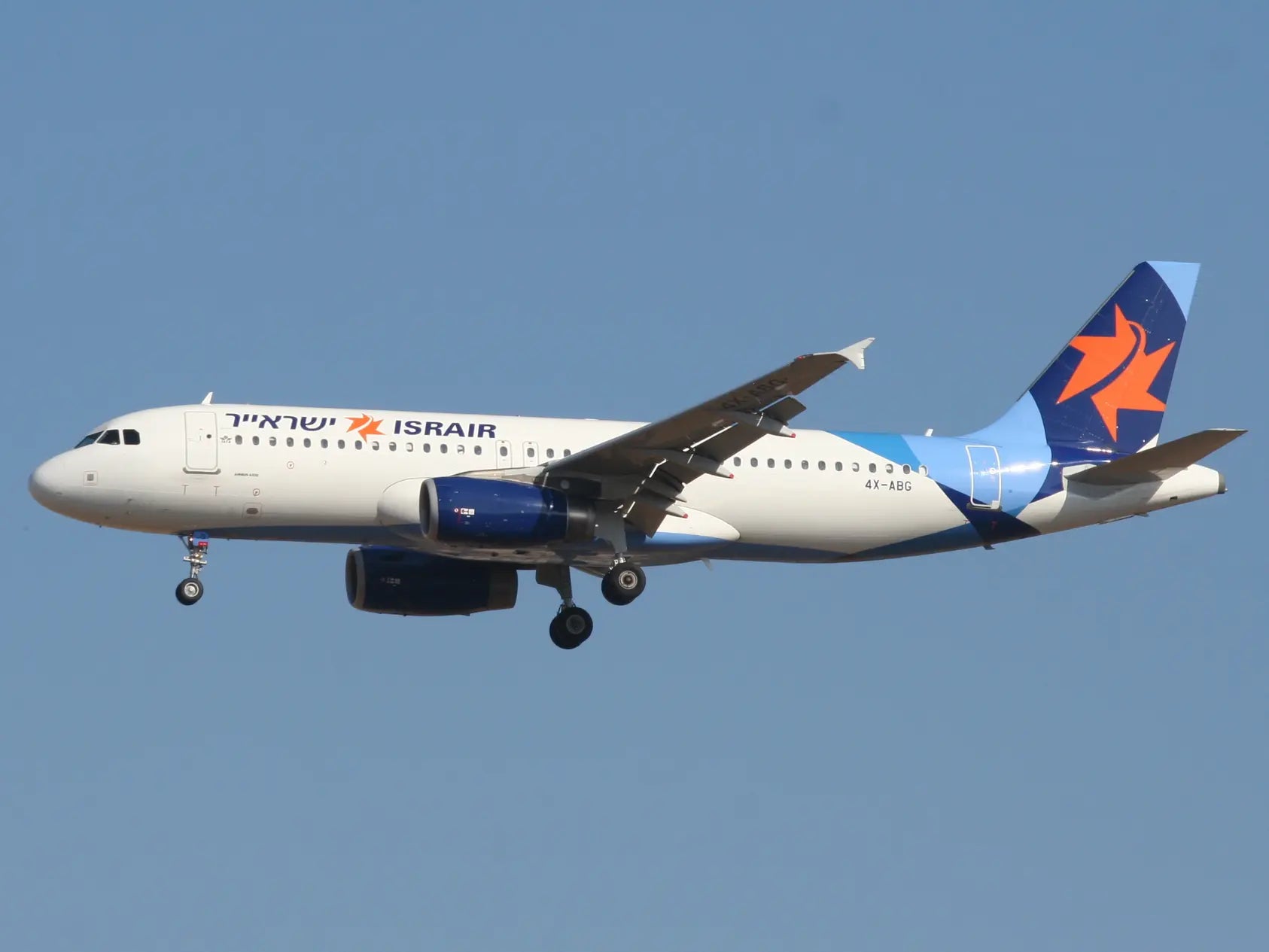
Israir runs an all-Airbus operation built around eight Airbus A320-200 aircraft (all A320-232 variants, IAE V2500 powered) and, since mid-2026, two Airbus A330-200 widebodies. That is a core fleet of ten aircraft. The company has no publicly disclosed firm order for new-build Airbus neo-family aircraft. Growth has been achieved through second-hand purchases, multi-year dry leases and seasonal wet leases, not through an OEM orderbook.
The all-jet fleet is relatively recent. Israir operated ATR 42-300 turboprops from the 1990s until around 2013, and ATR 72-500s on Eilat and domestic flying until March 2023, when the last two aircraft (4X-ATH and 4X-ATI) were sold for approximately US$13 million. Israir stated at the time that its ATR pilots would be retrained onto the A320, preserving jobs while consolidating the fleet. For a pilot joining today, that history is relevant only as evidence of how the company has handled fleet transitions: it retrained rather than released.
| Aircraft Type | Role | In Service | Registrations & Notes |
|---|---|---|---|
| Airbus A320-232 | Narrowbody | 8 | 4X-ABF, 4X-ABG, 4X-ABI, 4X-ABS, 4X-ABT, 4X-ABW, 4X-ABX, 4X-ABY. Mix of owned and leased. |
| Airbus A330-200 | Widebody | 2 | 4X-BAK (MSN 1095, ex-N284AY), 4X-BAL (MSN 1100, ex-N285AY). Ex-American Airlines, Rolls-Royce Trent 700. |
| Seasonal wet leases | Capacity top-up | Variable | Reported between 3 and 7 aircraft for summer 2026. Operated by third-party crews, not Israir pilots. |
| ATR 72-500 | Regional (retired) | 0 | Last two aircraft sold March 2023. Pilots retrained onto A320. |
| ATR 42-300 | Regional (retired) | 0 | Approximately five aircraft, retired by 2013. |
Core fleet as of August 2026. Summer operating fleet has been reported at up to 18 aircraft including owned, long-term leased and seasonal leased capacity.
A320 Fleet Detail
The A320s are not a homogeneous sub-fleet. Cabin configurations reported across the eight aircraft range from 170 to 180 seats, most commonly 174 all-economy, with 4X-ABI configured with an extra-legroom section. Ages vary sharply: 4X-ABF entered service with Israir in July 2010 and 4X-ABG in September 2010, both built new for the airline; 4X-ABI arrived from Toulouse in May 2016 and is the youngest of the group, fitted with sharklets; 4X-ABS came from Singapore (ex-Tigerair) in May 2018 and was purchased outright in December 2024; 4X-ABT arrived on lease in July 2021; 4X-ABW joined in December 2022; and 4X-ABX and 4X-ABY arrived in July and August 2024 respectively. Several of the second-hand airframes are approaching or past 19 years old.
The practical read for a pilot: you will fly a classic-generation A320 with a genuinely varied cabin and equipment fit across the fleet, not a standardised neo sub-fleet. Two of the aircraft carry special liveries, including the Peace Partnership scheme applied in September 2020 to mark the Abraham Accords.
The A330-200 Widebody Programme
This is the single most significant development for Israir pilots in over a decade. Israir signed binding agreements on 29 April 2026 to purchase two Airbus A330-200s for US$74 million for the pair, financed with a roughly ten-year bank facility and supported by a 12-year engine services agreement. Both aircraft were built in 2010 for US Airways, passed to American Airlines and had been stored since 2020. The first, 4X-BAK, arrived at Ben Gurion on 19 June 2026, with the second following shortly after. Both are approximately 16.5 years old.
The cabin has been retained largely in its former American Airlines configuration: 247 seats comprising 20 lie-flat business class seats in a reverse-herringbone 1-2-1 layout with direct aisle access, 21 premium economy seats, and 206 economy seats (of which roughly 50 to 54 are extra-legroom). The Israel Civil Aviation Authority approved Israir's A330-200 operation on 29 July 2026. US Department of Transportation authority to sell tickets followed around 18 August 2026, and final FAA authorisation for scheduled commercial passenger operations was announced on 24 August 2026. The announced Tel Aviv to New York JFK launch date is 19 October 2026, with up to six weekly frequencies planned.
Israir did briefly operate an A330-200 before (4X-ABE, MSN 822, in 2008), so this is technically a return to type rather than a first. But the 2026 programme is on a completely different footing: two owned aircraft, a dedicated long-haul route, and a collective agreement addendum negotiated specifically to cover widebody flying.
New pilots enter on the A320. Israir's published recruitment material treats an existing A320 or A330 type rating as an advantage, not a mandatory requirement, and the company runs its own conversion course for selected candidates. That course has been publicly described as lasting approximately three to six months, covering ground school, theoretical examinations, simulator training and supervised line flying. The A330 is a second-fleet opportunity reached from within, and the mechanism for allocating those seats (company seniority, fleet seniority or bid) has not been published. Ask about it explicitly at interview, and ask whether a training bond applies to either the initial type rating or the A330 conversion.
Israir's summer operating fleet has been reported at up to 18 aircraft, well above its ten-aircraft core fleet. The difference is seasonal wet leases, which arrive with their own crews. Those aircraft add capacity and revenue without adding Israir pilot jobs or Israir flying hours. This has been a recurring point of concern in Israeli airline labour discussions, and it is a legitimate question to raise before signing: how much of the peak-season programme is planned on Israir metal with Israir crews, and what protections, if any, does the collective agreement provide against wet-lease substitution of scheduled flying?
Pilot Salary & Compensation
Israir does not publish a captain or first officer pay table, and neither does any Israeli airline. Pilot pay at Israir is set by collective agreement negotiated between company management, the elected pilot committee and the Histadrut. The June 2026 agreement, signed to accommodate the arrival of widebody flying, was publicly announced as delivering a significant improvement in pilot compensation, but no percentage, scale or effective date was disclosed. The 2023 four-year agreement, running to August 2027, was reported as delivering an increase of approximately 8%.
What follows is therefore split into two parts: the documented public evidence, and a clearly labelled derived estimate. Treat the second table as a planning range, not as an Israir pay scale.
Documented Public Reference Points
| Reference Point | Figure | Source Context & Date |
|---|---|---|
| Israir international captain | ₪40,000 / month | Israeli industry estimate published in 2014. Historic, pre-dates three subsequent pay agreements. |
| Israir international first officer | ₪25,000 / month | Same 2014 industry estimate. |
| Israir domestic captain | ₪25,000 / month | Same 2014 estimate, reflecting Eilat and domestic flying. |
| Israir domestic first officer | ₪18,000 – ₪20,000 / month | Same 2014 estimate. |
| Israeli narrowbody captain benchmark | ~US$178 per credited flight hour | Published cross-airline Israeli average covering the narrowbody fleets of Arkia, Israir and much of El Al. Not an Israir contractual rate. |
| 2017 Israir agreement | ~22% increase (reported) | Reported in Israeli coverage alongside command courses and an employment-security floor. Not independently confirmed in current sources. |
| 2021 Israir agreement | -15% temporary | Temporary reduction across all pay components through February 2023, after which pay reverted to pre-COVID level. |
| 2023 Israir agreement | ~8% increase | Four-year agreement to August 2027. Company stated the cost was not material to results. |
| June 2026 Israir agreement | Undisclosed increase | Announced as a significant pay improvement plus widebody duty, rest, training and promotion provisions. No figures published. |
Every figure above is a published third-party report or an announced agreement outcome. None is an official Israir pay scale.
2026 Planning Estimate: First Officer
| Stage | Estimated Monthly Gross | Estimated Annual Gross | Basis |
|---|---|---|---|
| New-entry F/O, A320 | ₪30,000 – ₪35,000 | ~₪360,000 – ₪420,000 | 2014 baseline uplifted by subsequent agreements; lower end reflects the domestic/short-sector mix. |
| Established F/O, A320 | ₪35,000 – ₪45,000 | ~₪420,000 – ₪540,000 | Seniority steps plus credited hours and productivity components. |
| F/O, A330 long-haul | Not published | Not published | The June 2026 agreement covers widebody flying but no rate table is public. |
2026 Planning Estimate: Captain
| Stage | Estimated Monthly Gross | Estimated Annual Gross | Basis |
|---|---|---|---|
| New captain, A320 | ₪50,000 – ₪57,000 | ~₪600,000 – ₪684,000 | 2014 ₪40,000 international captain benchmark compounded through the 2017, 2023 and 2026 agreements. |
| Senior captain, A320 | ₪57,000 – ₪65,000 | ~₪684,000 – ₪780,000 | Adds seniority steps and typical instructor or examiner supplements. |
| Captain, A330 long-haul | Not published | Not published | Expected to sit above the A320 scale, but no public evidence establishes the differential. |
Estimates only. Actual pay depends on rank, seniority date, credited hours, productivity formulas, instructor and check duties, and the confidential 2026 rate tables.
What Actually Makes Up an Israir Payslip
Israeli airline pay is not a simple monthly salary. Based on the structure visible in comparable Israeli airline agreements, including the Arkia 2022 agreement which itemised its components publicly, expect a package built from several distinct elements:
- Base salary by rank and seniority. The guaranteed component, driven by your service date and rank.
- Credited flight and duty hours. International flight time in Israeli airline agreements has historically attracted special pay-credit formulas that differ from domestic sectors. This is often where the real earnings difference between an Eilat-heavy month and a European-heavy month appears.
- Command, instructor and examiner supplements. Arkia's agreement expressly identified seniority, instructor, examiner and simulator supplements. Israir's structure is likely comparable but is not published.
- Per diem and expenses. Layover subsistence and transport reimbursement sit outside salary. Notably, during Israir's temporary 50% COVID-era wage reduction in 2020, per diems and work-related reimbursements were expressly excluded from the cut.
- Cancellation and disruption compensation. Arkia's agreement introduced explicit compensation for cancelled duties and for Eilat night stops. Whether Israir has an equivalent provision is not public.
- Widebody qualification pay. Strongly implied by the June 2026 agreement, but unquantified.
The only fully documented Israir pay figures in the public domain date from 2014. Everything more recent is either an announced percentage change without a base, or a third-party estimate. The ranges presented above were derived by applying the publicly reported 2017, 2023 and 2026 agreement outcomes to the 2014 baseline, and cross-checked against broader Israeli market estimates (roughly ₪20,000 to ₪40,000 per month for first officers and ₪50,000 to ₪100,000-plus for captains across all Israeli carriers). They are a reasonable planning range and nothing more. Israeli income tax is progressive to 47% plus a 3% surtax on high earners, so gross-to-net erosion at captain level is substantial. Before accepting an offer, request the actual rate table, the credited-hour guarantee, the overtime formula and the definition of pensionable salary in writing.
Roster, Duty Limits & Quality of Life
Israir does not publish a roster pattern, and no verified fixed cycle (5-on/4-off or similar) exists in the public record. This section therefore sets out what is regulated and what is documented, and explicitly avoids presenting an invented sample month. What can be established is the legal framework, the historical workload evidence, and the structural character of the flying.
The defining feature of Israir rostering is that the great majority of the network is within same-day out-and-back range of Tel Aviv. Athens, Larnaca, Rhodes, Heraklion, Tbilisi, Batumi, Baku, Budapest, Prague, Rome and Dubai are all routinely operable as a return duty. For a pilot with a family in central Israel, this is a genuine quality-of-life advantage over a network carrier: you sleep at home most nights. The trade-off is the shape of those days. Short-haul leisure flying from a single base means early reports, late finishes, multiple sectors and duty days that push toward the regulatory ceiling during peak season, plus the Eilat shuttle which stacks up take-offs and landings.
Documented Workload Evidence
CAAI Flight and Duty Time Limitations
Israir's A320 and A330 passenger operations fall under the Israeli fatigue regime for large commercial aircraft, administered by the Civil Aviation Authority of Israel (CAAI). The modern framework was modelled on the US FAA Part 117 rule rather than on EASA Subpart FTL, which is an important distinction for pilots coming from a European background: the tables, terminology and acclimatisation logic are American in structure, not European.
| Limit | Framework Value | Notes |
|---|---|---|
| Flight time, 28 days | 100 hours / 672 consecutive hours | Part 117-derived cumulative flight time cap. |
| Flight time, annual | 1,000 hours / 365 days | Hard annual ceiling. |
| Flight duty period, weekly | 60 FDP hours / 168 hours | Cumulative duty limit. |
| Flight duty period, 28 days | 190 FDP hours / 672 hours | Cumulative duty limit. |
| Daily FDP | ~9 – 14 hours | Determined by report time, acclimatisation and number of sectors. Augmented crew provisions extend this. |
| Pre-duty rest | 10 consecutive hours minimum | Must include an opportunity for 8 uninterrupted hours of sleep. |
| Weekly recovery | 30 consecutive hours in any 168 | Free from all duty. |
| Post-duty rest (legacy table) | 8h / 9h / 10h | For duty up to 10h, 10 to 11h, and 11 to 12h respectively. Duty over 16 hours requires 14 hours plus the excess. |
Regulatory maxima under the Israeli framework, not Israir's rostering practice. The operator's CAAI-approved operations manual and fatigue risk management system are the controlling documents.
Shabbat, Leave and the Israeli Calendar
Israir announced in 2021 that it would stop flying on Saturdays. That policy did not endure. As of 2026, Israir operates on Shabbat, as does Arkia; El Al remains the only major Israeli carrier that does not. For observant pilots this is a material consideration, and it also means Israir does not offer the structurally predictable Friday-evening-to-Saturday-evening block that El Al crews get. Israir's 2026 flying attracted an ultra-Orthodox boycott campaign over exactly this issue, so the policy is not entirely settled and could change again.
On annual leave, Israeli statutory entitlement is thin by European standards and is expressed in calendar days rather than working days. Under the Annual Leave Law, employees in years one to five accrue 16 calendar days per year, which for a five-day week works out to roughly 12 actual working days. This rises to 18 days in year six, 21 in year seven, and then by one day per year to a maximum of 28. Aviation regulation adds a separate requirement of 30 days off per year including at least one block of ten consecutive days, and a collective agreement may improve on both. These are three different legal concepts (statutory paid vacation, regulatory days off, and rostered non-duty days) and they should not be conflated. Israir's contractual leave entitlement is not published.
Many airline guides publish a four-week sample roster grid. For Israir there is no reliable public source for monthly days off, bid periods, standby structure or trip construction, so any grid on this page would be invention presented as fact. It is omitted for that reason. When you interview, ask for a redacted copy of an actual current line pilot roster for both a peak month (July or August) and a low month (February). That single document will tell you more about the job than any published summary, including Israir's own.
There is one base: Ben Gurion Airport. There is no base bidding, no commuter policy in the public record, and no realistic prospect of either at a 68-pilot airline. You need to live in Israel, and the recruitment advertisement makes permanent Israeli residence an explicit condition of employment rather than a preference. Central Israel housing costs are high, comparable to major Western European cities, which materially affects how far the salary ranges in Section 3 actually go. The upside is that TLV is a genuinely compact single-base operation with a short commute for most crew and a network built around returning there.
Benefits, Pension & Legal Protections
Israir's benefits package is not published. What can be established is the Israeli statutory floor that applies to every salaried employee, plus specific protections that have appeared in Israir collective agreements over the years and are documented in reporting on those agreements. The gap between the two is where you need to do your own diligence.
The Statutory Israeli Floor
Israir-Specific Protections in the Record
Several pilot-specific provisions have appeared in Israir agreements and are documented:
| Provision | What Is Documented | Status |
|---|---|---|
| Pension continuity during pay cuts | During the temporary 50% wage reduction in 2020, social and pension contributions continued to be calculated on the unreduced salary. | Documented 2020 |
| Per diem protection | Per diems and work-related reimbursements were excluded from the 2020 temporary wage reduction. | Documented 2020 |
| Employment security floor | The 2017 agreement provided new pilots a 50% position-security floor in year one and a full defined-position floor thereafter. | Documented 2017 |
| Age 65 transition | A 2016 agreement allowed pilots reaching the flight age limit to move into non-flying aviation roles (safety officer, fleet instructor or examiner, operational management) or take enhanced voluntary retirement. | Documented 2016 |
| Widebody terms | The June 2026 agreement expressly regulates flight and rest hours, training and promotion paths for long-haul operations, alongside improved benefits. | Announced June 2026, unquantified |
| Staff travel | No current public Israir staff travel policy exists. Some form of employee and family concessional travel is very likely, but eligibility, priority, service charges and any interline access cannot be verified. | Not verifiable |
| Loss of licence insurance | No policy, insured sum or wording is in the public domain. | Not verifiable |
Unlike France with the CRPN or the UK with union-brokered schemes, Israel has no aviation-specific national pension or loss-of-licence fund. Israeli pilots rely on the general statutory pension system plus whatever cover the employer or their own union arranges. Because Israir publishes nothing on this, treat it as an open question at offer stage and get answers in writing: who is the insurer, is the cover permanent loss only or does it include temporary incapacity, what is the waiting period, what salary is insured, are mental health conditions excluded, and are premiums employer-paid or deducted from salary. For a career pilot this is worth more scrutiny than a few thousand shekels on the base rate. ISRALPA is the natural first call for independent guidance on Israeli pilot loss-of-licence arrangements.
In Israeli pilot pay structures, a large share of earnings sits in credited-hour, productivity and supplement components rather than in base salary. The employer's 6.5% pension and 8.33% severance contributions are calculated on the pensionable salary, which may be defined much more narrowly than your gross. Two offers with identical gross figures can differ by a substantial amount in retirement value depending on how that definition is drawn. Ask specifically: what percentage of typical monthly gross is pensionable, and is Section 14 of the Severance Pay Law applied to the severance deposit?
Career Progression & the A330 Opportunity
Career progression at Israir is governed by a combination of seniority and company qualification decisions, within a collective agreement framework. There is no published upgrade timeline, no published bidding rules and no public seniority list. What there is, unusually, is a very small denominator: approximately 68 pilots. That single fact shapes everything.
The arithmetic cuts both ways. A ten-aircraft fleet supports a limited number of commands, so in a static year there may be almost no upgrade opportunities at all. But when the fleet moves, it moves proportionally hard. Adding two A330s to a ten-aircraft operation is a 20% fleet expansion and creates an entirely new type with its own captain and first officer requirement. Israir's announced recruitment of roughly 16 pilots to support the A330 and network expansion represents close to a quarter of the existing pilot body. At a 4,000-pilot carrier, that scale of change would be invisible. At Israir it is transformative.
| Career Milestone | What Is Documented | Notes |
|---|---|---|
| Entry as A320 First Officer | Day 1 after conversion course | Course publicly described as approximately 3 to 6 months: ground school, theory exams, simulator, supervised line flying. |
| Command upgrade timeline | Not published | No reliable Israir-wide figure exists. Depends entirely on fleet growth, retirements and vacancy creation. |
| Command course frequency | 3 courses planned in one year (2017 agreement) | The 2017 collective agreement guaranteed continued command courses and specified three in the following year. This is the only concrete public data point on upgrade throughput. |
| Direct-entry Captain | No standing public policy | Recruitment adverts are framed generically as "pilots" and emphasise experienced jet or ex-IAF candidates. A DEC pathway should not be assumed, though A330 growth may produce individual cases. |
| A330 conversion | Regulated by the June 2026 agreement | The agreement formalises training and promotion paths for widebody flying. The allocation mechanism for A330 seats is not public. |
| Instructor / examiner track | Exists, selection basis not public | Comparable Israeli agreements identify instructor, examiner and simulator supplements, indicating a defined track. |
| End of flying career | Age 65 transition option | 2016 agreement provides for movement into non-flying aviation roles or enhanced voluntary retirement. |
Israir announced recruitment of approximately 16 pilots and 50 cabin crew to support the A330 programme and network expansion. A recent intake reportedly attracted around 150 applicants for 14 pilot positions, roughly eleven candidates per seat. That is competitive but nothing like the 30-to-1 ratios seen at European legacy cadet programmes, largely because the eligibility criteria (Israeli citizenship, Israeli licence, 1,000 PIC hours or substantial airline first officer experience) narrow the pool sharply before applications are even counted. If you meet the criteria, your odds are considerably better than the raw headline suggests.
A 68-pilot seniority list has no shock absorbers. There is no large narrowbody fleet to retreat into if the widebody programme underperforms, no second base, and no parent-group seniority list to fall back on. Israir's own recent history illustrates the volatility: a record quarter in Q3 2025 with US$35 million net profit, followed by a first half of 2026 with a loss of roughly US$32 million to US$35 million and a market share drop from 9.9% to 7.6% as regional conflict shut down flying. In 2020, roughly 60 pilots kept their jobs only in exchange for a temporary 50% wage reduction. Company disclosures also record a 2010 dispute in which management proposed pilot dismissals before Histadrut intervention reduced the number. None of this makes Israir a bad employer, but it does mean your personal financial planning should assume more variance than a legacy-carrier career would.
Realistic Progression Sequence
Based on the documented structure, the likely path is: entry as A320 first officer after the company conversion course; several years accumulating seniority and line experience on the A320; then either an A320 command when a vacancy opens, or an A330 first officer seat if widebody expansion outpaces command creation; then, over a longer horizon, A320 or A330 command with an instructor or examiner track available in parallel. Whether A330 seats are awarded on company seniority, fleet seniority or a bid basis is genuinely unknown from public sources, and it is the single most valuable thing you can clarify at interview if the widebody operation is what attracts you.
Recruitment Process & Requirements
Israir does not run a zero-hours ab-initio cadet programme. Every publicly advertised pilot intake has been for already-licensed and experienced commercial or military pilots. If you are looking for a sponsored route from zero hours to an airline flight deck, Israir is not that route, and no Israeli airline currently offers one at scale. Israeli pilots typically come either from the Israeli Air Force flight course or from self-funded civilian training followed by hour-building in general aviation, instruction or smaller commercial operations.
Core Eligibility Requirements
Selection Stages
Application & Document Screening
Applications are submitted by email against a specific job reference number, historically to recruit@israir.co.il, with the reference number in the subject line. Required documentation includes CV, licence, valid Class 1 medical, aviation English certificate, Group C theory confirmation and logbook evidence. Israir works to fixed application deadlines rather than rolling recruitment: a recent campaign closed applications on 30 November for a course starting the following spring.
Screening & Selection Window
Screening and selection have been scheduled as a defined multi-week window rather than as continuous processing. In the most recent documented cycle, applications closed in November and screening ran through December and January for a course beginning at the end of the first quarter. Israir has also published intake calendars listing multiple course start dates (for example October, January and April) against a single application deadline.
Interviews & Professional Assessment
Interviews and professional screening follow. Israir does not publish a detailed assessment syllabus, so the exact sequence of aptitude testing, psychometric assessment, simulator evaluation and technical interview is not in the public domain. Candidates should prepare for a conventional airline selection: technical knowledge, multi-crew and CRM assessment, and a structured competency interview. Given the emphasis on ex-IAF and experienced jet candidates, expect significant weight on operational judgement and command potential rather than on raw aptitude testing.
Medical & Regulatory Clearance
A valid Class 1 medical is a stated prerequisite, issued under the CAAI medical framework. Licence conversion or validation through the CAAI flight crew licensing department must be complete: Israir requires an Israeli licence, not a foreign one. If you hold an EASA or FAA licence and are relocating to Israel, budget realistically for the conversion process before you are eligible to apply.
Company Conversion Course
Successful candidates enter Israir's own pilot course, publicly described as lasting approximately three to six months and comprising theoretical studies across multiple subjects, written examinations, full-flight simulator training, and line flying under the supervision of instructor pilots. Whether a training bond applies, and on what terms, is not published and should be established in writing before you sign.
Three things separate viable candidates from the rest. First, the licence: an Israeli CPL or ATPL with Group C theory is non-negotiable, and there is no sponsorship or work-permit pathway for non-Israelis. Second, the hours: the 700-hour alternative pathway is only open if you have genuine airline first officer experience, so document your multi-crew jet time precisely rather than presenting a total-time figure. Third, the timing: because Israir advertises against hard deadlines and specific course dates rather than recruiting continuously, monitoring is the whole game. Follow the airline's LinkedIn page, which is where recent pilot campaigns were published, and check Israeli job boards where the postings are mirrored. A campaign that closes on 30 November will not reopen for months.
Israeli citizenship and a commitment to permanent residence in Israel are explicit published conditions, and an Israeli-issued licence is required. There is no publicly documented visa sponsorship route, no expatriate contract structure and no non-Hebrew-speaking pathway. Hebrew at native or high level is listed among the requirements, and Israir's internal operating environment functions in Hebrew. Foreign pilots considering Israir realistically need to be planning aliyah or already hold Israeli citizenship, and to have completed licence conversion, before an application is worth submitting.
Network, Base & Layover Reality
Israir's 2026 schedule covers approximately 47 destinations across 23 countries, split between 45 international points and two domestic. The overwhelming majority of it is short-haul leisure flying from Ben Gurion into the Mediterranean, the Caucasus and Central and Eastern Europe, structured as same-day out-and-back duties. This is not a layover airline in the way a legacy long-haul carrier is, and any pilot joining primarily for hotel nights in interesting cities will be disappointed. The honest picture is that Israir has historically been a home-every-night operation with a handful of exceptions, and that this is only now beginning to change with the A330.
The 2026 network expansion added Heraklion (six weekly from April), Tashkent (four weekly from May), Bari and Bologna (two weekly each from May), Düsseldorf (from 15 May, increasing to twice weekly from 25 May), Oslo (weekly through June to August), Madrid (three weekly from 25 October) and New York JFK (planned launch 19 October, up to six weekly). The workhorse routes remain Athens, Larnaca, Batumi, Tbilisi, Budapest, Rome, Prague and the Greek islands, plus the Tel Aviv to Ramon (Eilat) domestic operation.
On 27 August 2026, Israir began operating the Eilat public service obligation contract, worth approximately NIS 40 million (about US$13 million) over one year, requiring at least four daily round trips between Ramon Airport and Ben Gurion. Israir bid five. That contract guarantees a baseline of high-frequency domestic sector flying regardless of what happens to the leisure market, which is a stabilising factor for pilot hours, though it also means a steady diet of short sectors with a high take-off and landing count.
Most of the network returns to Tel Aviv the same day. The routes most likely to generate an overnight are Tashkent, Marrakech, Zanzibar (which appears in Israir's served-country list) and, from October 2026, New York. Madrid is a notable case: the announced schedule shows an evening Madrid to Tel Aviv sector arriving after midnight, making it a late same-day turn rather than a Spanish overnight. Barcelona, Amsterdam and Berlin are technically same-day feasible but could be rostered as overnights depending on aircraft utilisation. Israir does not publish crew hotel standards, per diem rates or minimum local night rest, so if layover quality matters to you, ask for the specifics on the JFK pattern in particular before accepting an offer.
Any honest assessment of flying from Tel Aviv has to address operational disruption. Israir's own reporting records regularly scheduled flights being cancelled through periods of conflict, airspace restrictions curtailing the network, and market share at Ben Gurion falling from 9.9% to 7.6% in a single year as a result. In March 2026 the airline suspended its regular schedule and operated limited repatriation flying. For pilots this translates into roster instability, sudden route suspensions, standby volatility and, in severe cases, pay and job security pressure of the kind that produced the temporary 50% wage cut in 2020. This is not a reason to avoid Israir, but it is a genuine and recurring feature of the job that pilots relocating from a stable European market should factor in deliberately.
How Israir Compares to El Al & Arkia
Israel has a small and clearly stratified airline market. The realistic comparison set for an Israeli pilot is El Al, the flag carrier and by a wide margin the largest employer, and Arkia, Israir's closest direct competitor in the leisure segment. Air Haifa is a recent and much smaller entrant. The chart below scores all three across the same six dimensions used in the scorecard, based on published data, collective agreement outcomes and industry benchmarks.
| Factor | Israir | El Al | Arkia |
|---|---|---|---|
| Position | Second-largest Israeli airline; leisure and tourism group | Flag carrier, long-haul network | Leisure carrier, direct competitor |
| Pilots employed | ~68 (2025) | 606 (end-2024) | Not publicly disclosed |
| Fleet | 8 A320-200, 2 A330-200 | 737-800, 787-8/-9, 777-200ER; 20 737 MAX ordered (+11 options); ~55 aircraft targeted for 2026 | A321neo, A320, Embraer 195 |
| Widebody opportunity | New, very limited (2 aircraft) | Extensive: 787 and 777 fleets | Limited; leased long-haul capacity |
| Documented pay | No public scale; 2014 benchmark ₪40,000 captain | Historic basic ₪45,000 captain / ₪30,000 F/O; ₪95,000 average actual monthly reported for 2019 | No public scale; 2022 agreement delivered 15-20% increases |
| Shabbat operations | Yes | No | Yes |
| Documented benefits | Limited disclosure | Strongest documented package: six free flights, 90% employee and family discount, dental and other perks | Documented supplements (seniority, instructor, examiner, simulator, cancellation, Eilat stay) |
| Labour relations | Negotiated agreements; 2010 dismissal dispute; 2013 Open Skies strike participation | Historically contentious; repeated disputes over pay and representation | 2022 agreement settled without prolonged action |
| Main employment risk | Small list; wet-lease dilution; geopolitical exposure | Long seniority list; periodic management conflict | Small fleet; dependence on leased capacity |
Key Takeaways from the Comparison
El Al wins decisively on scale, pay ceiling and fleet. With 606 pilots at end-2024, a fleet expanding toward roughly 55 aircraft in 2026, a 20-aircraft Boeing 737 MAX order with 11 options, and established 787 and 777 widebody operations, El Al offers career depth that Israir cannot approach. Its published fleet supports a full narrowbody-to-widebody career path within one company. Its documented benefits, including six free flights annually and a 90% employee and family discount, are the best publicly evidenced package in Israel. El Al is also the only Israeli carrier that does not fly on Shabbat, which is a decisive factor for observant pilots.
Israir's advantage is proportional opportunity, not absolute scale. A 68-pilot list means a new widebody type creates opportunity that would be statistically invisible at El Al. If the A330 programme succeeds and expands, an Israir first officer joining in 2026 is closer to a widebody seat than the equivalent El Al hire at the bottom of a 600-pilot list. That is a real, if risky, proposition.
Israir and Arkia are close substitutes. Both are Tel Aviv-based leisure carriers with Airbus narrowbody fleets, both fly on Shabbat, both bargain through the Histadrut, and both compete for the same tour-operator and outbound holiday traffic. Arkia scores slightly better on fleet because its A321neo and Embraer 195 equipment is newer generation than Israir's classic A320s, and it has documented compensation supplements that Israir has not published. Israir scores better on career progression because of the A330 programme and its stronger recent financial and passenger performance. The gap between them is narrow enough that individual factors (which one is hiring, where you sit in a seniority list, which fleet you would enter) will matter more than any structural comparison.
On work-life balance, all three are broadly similar and all are constrained by the same reality. Single-country, single-base operations with severe seasonality, a thin statutory leave entitlement, and geopolitical disruption that no roster protection can insulate against. Israir edges Arkia marginally on the same-day-return character of its core network; El Al scores lower on this dimension because its long-haul operation generates more nights away, though it compensates with Shabbat predictability.
Radar scores are editorial estimates derived from published company disclosures (Israir Group and El Al filings), reported collective agreement outcomes, aviation trade reporting and industry salary benchmarks. They are not survey data and do not represent any airline's official position. The Israeli market is unusually opaque on pilot compensation: no Israeli carrier publishes a pay scale, and collective agreements are announced in percentage terms without base figures. Arkia in particular has very limited public disclosure, so its scores carry the widest margin of error of the three. Individual experience will vary substantially with seniority, fleet, and the state of the market when you join.
Union & Industrial Relations
Israeli pilot representation operates on two tracks simultaneously, and understanding the difference matters. Collective bargaining at Israir runs through the Histadrut, Israel's general trade union federation, working with the elected company pilot committee. Professional representation, technical advocacy and international affiliation run through ISRALPA, the Israel Airline Pilots Association. They are complementary rather than competing structures: the Histadrut negotiates your contract, ISRALPA represents your profession.
ISRALPA: Structure and Role
How Israir Bargaining Works
Israir pilots are covered by a collective agreement negotiated between company management, the elected pilot committee and Histadrut representatives. Agreements have typically been multi-year and have covered pay, employment security, promotion and command course provision, retirement arrangements and, most recently, widebody-specific operating conditions. Israir is a listed company, so material agreements are disclosed to the Tel Aviv Stock Exchange, though the disclosures state outcomes in percentage or qualitative terms rather than publishing rate tables.
The pattern across the last decade has been negotiated settlement rather than confrontation. Israir pilots have participated in industry-wide action and have had at least one serious company-level dispute, but there has been no prolonged pilot-only strike at the airline in recent years. The genuine day-to-day reliability risk for the operation comes from geopolitical disruption and airport worker action, not from pilot industrial relations.
Documented Agreement and Dispute History
The record shows a union structure that has consistently delivered outcomes in a genuinely difficult operating environment: jobs preserved through the pandemic at the cost of temporary pay, pension contributions protected on unreduced salary during those cuts, employment security floors written into agreement, an age-65 transition pathway, and a widebody agreement negotiated before the aircraft entered service rather than after. That is a stronger track record than the airline's size might suggest. Union coverage is a meaningful part of the value proposition at Israir, arguably more so than at a larger carrier where an individual has less proportional weight. Engage with both tracks: the pilot committee and Histadrut for your contract, and IFALPA-affiliated ISRALPA for professional and technical representation.
Verdict: Who Is Israir For?
🎯 The Assessment
Israir is a small, unionised, expanding Israeli leisure carrier at the most interesting point in its recent history. Eight A320s and roughly 68 pilots make it a modest operation by any international measure, but the acquisition of two A330-200s, the launch of Tel Aviv to New York from October 2026, and a collective agreement negotiated specifically to cover widebody flying together create the most significant career opportunity the airline has offered in over a decade. For a pilot who joins now, the proportional upside is real: at a 68-pilot carrier, a new type and a 16-pilot recruitment campaign are transformative events, not statistical noise.
The trade-offs are equally real and should not be minimised. Pay is almost certainly below El Al and broadly comparable with Arkia, and no published scale exists to verify it. The A320 fleet is ageing, with several airframes approaching or past 19 years, and there is no publicly disclosed new-build order. The A330s themselves are 16.5-year-old ex-American Airlines aircraft. There is one base, no bidding transparency, no published roster pattern, and no documented staff travel or loss-of-licence policy. Israel's statutory leave entitlement is thin by European standards. Israir flies on Shabbat, which will be decisive for some candidates. And the business is exposed to geopolitical disruption in a way that produced a record profit in Q3 2025 and a loss of roughly US$32 million to US$35 million in the first half of 2026.
What Israir does offer, and what the record genuinely supports, is a company that has retrained rather than released pilots through fleet transitions, that preserved every pilot job through the pandemic at the cost of temporary pay, that continued pension contributions on unreduced salary while doing so, and that negotiated widebody terms before the aircraft arrived. For an Israeli pilot with the licence, the hours and the citizenship, that is a credible employer with a genuine growth story attached.
1 Can a non-Israeli pilot fly for Israir?
No. Israir's published pilot recruitment requirements state Israeli citizenship and a commitment to permanent residence in Israel as explicit conditions, and require an Israeli-issued CPL or ATPL rather than a foreign licence. Hebrew at native or high level is also listed. There is no publicly documented visa sponsorship route, expatriate contract structure or English-only pathway. A foreign pilot would need Israeli citizenship and a converted Israeli licence before an application would be considered.
2 How much does an Israir pilot actually earn?
Israir does not publish a pay scale, and the only fully documented figures date from 2014: approximately ₪40,000 per month for an international captain, ₪25,000 for an international first officer, ₪25,000 for a domestic captain and ₪18,000 to ₪20,000 for a domestic first officer. Since then, agreements have delivered a reported 22% increase in 2017, an approximately 8% increase in 2023, and an undisclosed improvement in June 2026, with a temporary 15% reduction between 2021 and February 2023. Applying those to the 2014 baseline produces a planning estimate of roughly ₪50,000 to ₪65,000 per month for an A320 captain and ₪30,000 to ₪45,000 for a first officer. These are estimates, not an Israir pay scale. A330 rates are not public. Request the actual rate table before accepting an offer.
3 Does Israir have a cadet programme for pilots with no experience?
No. Israir does not operate a documented zero-hours ab-initio cadet scheme. Every advertised pilot intake has required an existing Israeli commercial licence plus either 1,000 hours as pilot in command, or 700 hours where accompanied by significant airline first officer experience. Candidates typically come from the Israeli Air Force flight course or from self-funded civilian training with subsequent hour building. Israir does run its own conversion course for selected candidates, publicly described as lasting approximately three to six months, but that is a type and company conversion, not ab-initio training.
4 Does Israir fly on Shabbat?
Yes. Israir announced in 2021 that it would cease Saturday operations, but that policy did not endure. As of 2026, Israir operates on Shabbat, as does Arkia. El Al remains the only major Israeli carrier that does not fly on Shabbat, a position it maintained even during emergency repatriation operations in March 2026. Israir's Shabbat flying attracted an ultra-Orthodox boycott campaign in 2026, so the policy is not entirely settled. For observant pilots, this is currently a decisive difference between Israir and El Al.
5 How long does it take to upgrade to Captain at Israir?
There is no published Israir upgrade timeline, and with a pilot body of around 68 the figure would be highly volatile in any case. The only concrete public data point is the 2017 collective agreement, which guaranteed continued command courses and specified three captain courses in the following year. Upgrade at Israir is a function of vacancy creation rather than a predictable seniority clock: in a static year there may be almost no commands available, while a fleet expansion can open several at once. The A330 programme and the associated recruitment of roughly 16 pilots represent the most significant vacancy-creating event in recent years. Israir has no standing public direct-entry captain policy.
6 What is the roster like, and how many days off will I get?
Israir does not publish a roster pattern, and no verified fixed cycle exists in the public record. What is known: historic reporting put average workload at around 60 block hours per month for domestic pilots and 75 for international pilots, with domestic duty days averaging roughly four sectors. Israeli aviation regulation requires a minimum of four days off per 30-day month with at least one in every ten days, plus 30 days off per year including one block of ten consecutive days. Israeli fatigue rules, modelled on FAA Part 117, also require 30 consecutive hours free of duty in any 168-hour period. Israir's contractual days-off guarantee is not public. Because most of the network is same-day out-and-back from Tel Aviv, you will sleep at home considerably more than at a long-haul carrier, but expect early reports, late finishes and high sector counts in peak season.
7 Is the A330 and New York operation a real long-term opportunity?
It is real but unproven. The commitment is substantial: US$74 million for the two aircraft under binding agreements signed 29 April 2026, financed with an approximately ten-year bank facility and a 12-year engine services agreement, CAAI widebody approval on 29 July 2026, FAA operating authorisation on 24 August 2026, and a collective agreement addendum negotiated specifically for long-haul flying. That is not a speculative gesture. The risks are equally clear: two 16.5-year-old ex-American Airlines airframes, a TLV to JFK market already served by El Al, Arkia, Delta, United and American, and an airline that posted a US$32 million to US$35 million loss in the first half of 2026. Israir's stated ambition is more than 3 million passengers and roughly US$1 billion revenue by 2027. If it works, an early-joining first officer is unusually close to a widebody seat. If it does not, the airline reverts to a ten-aircraft narrowbody operation.
8 Which union represents Israir pilots, and does it matter?
Two structures operate in parallel. Collective bargaining runs through the Histadrut working with the elected Israir pilot committee, which negotiates pay, employment security, promotion and retirement terms. Professional and technical representation runs through ISRALPA, the Israel Airline Pilots Association, founded in 1976, whose members include pilots from El Al, Israir, Arkia, Cargo Air Lines and IAI. ISRALPA is Israel's IFALPA member association and is governed by a National Council elected every two years with proportional airline representation. It matters considerably: the union track delivered job preservation through the pandemic, pension contributions maintained on unreduced salary during the 2020 pay cut, an employment security floor in the 2017 agreement, an age-65 transition pathway, and widebody terms negotiated before the A330s entered service.
9 What should I insist on getting in writing before signing?
Because so little is published, the offer letter carries unusual weight. Get written confirmation of: rank, fleet and salary step with the actual rate table; the credited-hour guarantee and overtime formula; the definition of pensionable salary and whether Section 14 of the Severance Pay Law applies to the severance deposit; whether a keren hishtalmut is provided and at what rates; the loss-of-licence insurer, insured sum, waiting period and exclusions; the staff travel policy and eligibility; the contractual monthly days-off guarantee and annual leave entitlement; your seniority date and the upgrade rules; whether a training bond applies to the initial type rating or A330 conversion; and what protections exist against wet-leased capacity displacing Israir-crewed flying. Ask also for a redacted current line pilot roster for both a peak and a low month.
Official Links & Resources
Because Israir publishes so little pilot-facing detail, primary sources matter more here than at most airlines. These are the organisations and pages worth checking directly before making any career decision:
Israir is a listed company, which gives applicants a rare advantage: fleet plans, headcount, collective agreement announcements and financial trajectory are all disclosed to the Tel Aviv Stock Exchange and published on the investor relations site. Quarterly presentations have disclosed the pilot headcount directly. If you want to know whether the A330 programme is working, whether the pilot body is growing, or how exposed the airline is going into a given season, the quarterly report will tell you months before any recruitment advertisement does.