

AirTanker Overview & Company Profile
AirTanker is unlike any other employer on a UK pilot's shortlist. It is not a scheduled airline, it has no alliance, no frequent flyer programme and no published timetable in the ordinary sense. It is a private consortium that owns fourteen Airbus A330-200 airframes and delivers the Royal Air Force's entire air-to-air refuelling and strategic air transport capability under a Private Finance Initiative contract, while simultaneously holding a full civil Air Operator Certificate and flying commercial charter and lease work with the same aircraft.
The group was incorporated on 14 June 2007, with AirTanker Limited (Companies House number 06279734) as the project company and AirTanker Services Limited (06279646) as the operating airline entity. It is the latter that holds the airline identifiers most pilots will recognise: IATA 9L, ICAO TOW and the radio callsign TOWLINE. Registered offices for both sit at the AirTanker Hub, RAF Brize Norton, Carterton, Oxfordshire OX18 3LX.
The underlying deal is the Future Strategic Tanker Aircraft (FSTA) programme, signed with the UK Ministry of Defence in March 2008. It is a 27-year PFI with a headline value of approximately £10.5 billion, running to March 2035, and it covers not just the aircraft but the infrastructure, the hangars, the training academy, the maintenance organisation and the crews. Parliamentary accounts of the programme have referenced a modelled contract cost closer to £10.4 billion, a presentational difference rather than a different programme. Commercial flight operations began in January 2012, and the contract reached its Full Service Date on 30 September 2016 once all fourteen aircraft had been delivered.
Ownership has shifted considerably since the original consortium. The founding shareholder group included Airbus, Rolls-Royce, Cobham, Babcock and Thales. Cobham exited in 2020; Babcock sold its 15.4 per cent stake in AirTanker Holdings to Equitix for £126 million in 2021; Rolls-Royce sold its 23.1 per cent holding to Equitix for around £189 million. As AirTanker sets out on its own partnership page, the holding structure today rests with Airbus, Thales and Equitix Investment Management. Babcock retained a separate stake of around 23.5 per cent in AirTanker Services Limited, the operating company, even after divesting from the asset holding vehicle.
Scale matters here, and it is the single most important thing an applicant needs to internalise. A 2025 AirTanker publication put direct employment at RAF Brize Norton at 828 people, including more than 270 engineers, more than 130 cabin crew and just over 50 pilots. AirTanker Services Limited reported turnover of approximately £221.2 million and 748 employees for the year to December 2023, with the wider AirTanker Limited group figures reported by Companies House aggregators at around £549 million and roughly 3,200 people. Whichever figure you take, the flight crew community is measured in dozens, not thousands. That single fact drives almost everything about pay progression, command opportunity and roster stability at this operator.
AirTanker's flying splits into three distinct streams that a pilot may rotate through. First, RAF Voyager operations on the Military Aircraft Register, flown alongside Nos. 10 and 101 Squadrons, covering tanking, strategic airlift and aeromedical evacuation. Second, the South Atlantic Airbridge, a twice-weekly MOD charter to the Falkland Islands flown by civil crews on a civil-registered A330. Third, commercial ACMI and damp lease work for third-party airlines, historically Thomas Cook and Jet2, and more recently Neos. Very few operators in Europe offer that combination of military and civil flying within one employment contract.
Fleet Composition & Type Ratings
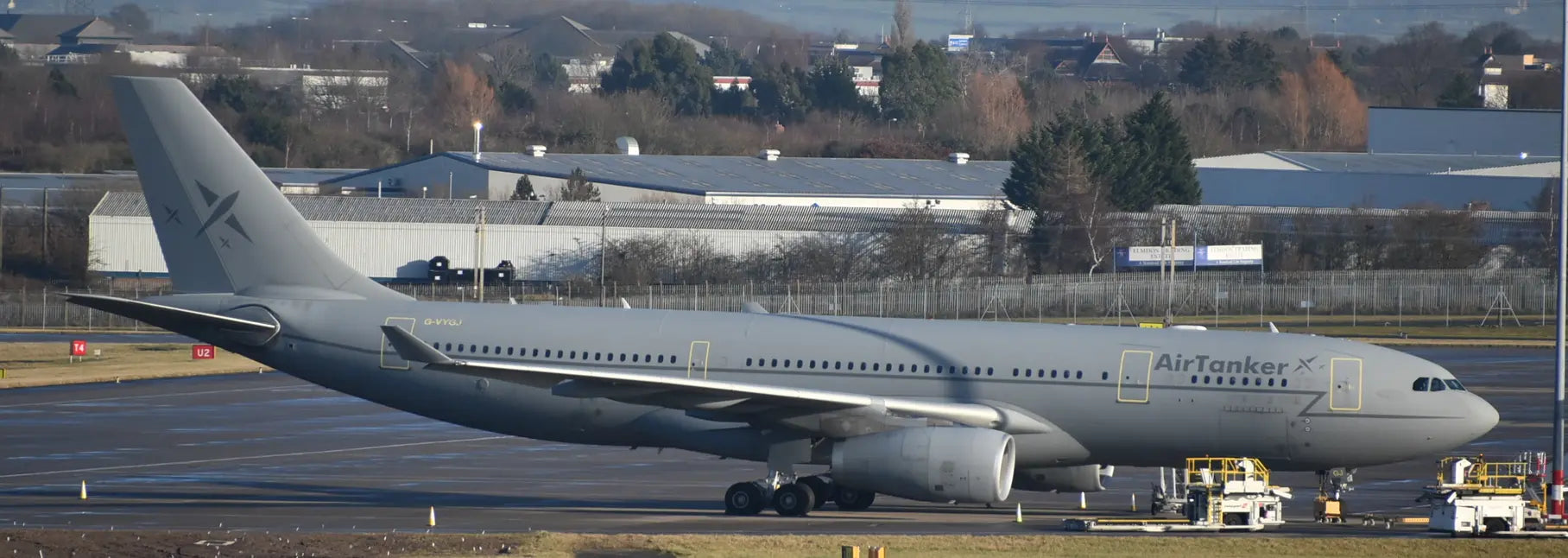
AirTanker is a single-type operator, and that type is the Airbus A330-200, in both its standard commercial configuration and its Multi Role Tanker Transport (MRTT) military form. All fourteen airframes are owned within the FSTA structure. Per AirTanker's own Voyager pages, the fleet divides into a core fleet of nine and a non-core (surge) fleet of five.
Of the nine core aircraft, eight sit on the Military Aircraft Register in full Voyager configuration and one remains on the UK Civil Aircraft Register, dedicated to MOD charter work and forming the backbone of the South Atlantic Airbridge. The five surge aircraft exist to be monetised when the RAF does not need them: three have historically been reconfigured for commercial use and placed on the civil register, while two are retained in military fit so that the nine-aircraft RAF provision can be sustained during deep maintenance.
The tanker fit splits evenly. Seven aircraft are two-point tankers (Voyager KC2), equipped with wing-mounted hose and drogue pods for fast jet receivers. The other seven are three-point tankers (Voyager KC3), adding a centreline Fuselage Refuelling Unit that allows a larger receiver such as an A400M Atlas to take fuel. One KC3, ZZ336 / G-VYGG, carries the VIP "Vespina" cabin used for government and royal transport, fitted with a mixed business and economy layout rather than the standard single-class troop fit.
| Sub-fleet | Configuration | Count | Register & Role |
|---|---|---|---|
| Core Voyager (military) | A330 MRTT, KC2 / KC3 mix | 8 | Military Aircraft Register. RAF tanking, strategic airlift, aeromedical. Flown by RAF crews and AirTanker Sponsored Reservists. |
| Core civil A330 | A330-200, 291 seats single class | 1 | Civil Aircraft Register. Exclusively available to the MOD. South Atlantic Airbridge charter. |
| Non-core / surge (civil) | A330-200, demilitarised passenger fit | 3 | Civil Aircraft Register. ACMI and damp lease to third-party airlines. Recallable to military use. |
| Non-core / surge (military fit) | A330 MRTT | 2 | Retained in military configuration to backfill core fleet availability during maintenance. |
| Vespina (within core) | KC3, 58 business + 100 economy | 1 | ZZ336 / G-VYGG. VIP and government transport cabin fit. Reconvertible to standard roles. |
Fleet structure per AirTanker and RAF published material. The civil and military split is deliberately fluid: surge airframes can be reconfigured, recalled and moved between registers according to MOD demand.
The aircraft themselves are capable machines. Each carries up to 291 passengers in a single-class premium economy cabin, up to 43 tonnes of freight, or up to 40 stretchers in the aeromedical role. The MRTT fuel system means no additional fuselage tanks intrude on the cabin, so the aircraft retains full passenger capacity while carrying tanker fuel. In June 2020 a civil Voyager, G-VYGM, flew Brize Norton to Mount Pleasant non-stop in 15 hours 9 minutes, breaking a 1987 VC10 record, and returned in 13 hours 22 minutes. Airbus subsequently confirmed the outbound sector as the longest A330 commercial flight recorded.
Airframes were built roughly between 2009 and 2014 and entered service progressively from 2011 to 2016, giving an average fleet age of approximately 13 to 14 years in 2026. There is no announced replacement. Instead the fleet is being upgraded: in June 2025 the MOD awarded AirTanker a single-source contract worth £170 million excluding VAT for Voyager Operating System Evolution (VOSE), covering design, development, certification, embodiment and through-life support of a new military mission system, including integration of the Multifunction Information Distribution System and Joint Tactical Radio System. The notice covers a variable quantity of between 10 and 14 aircraft. Separately, Aviation Week has reported the RAF exploring a boom refuelling capability for Voyager, though no programme, timetable or funding has been announced.
AirTanker provides the A330-200 type rating in-house for successful applicants, and successful candidates enter a three-year training bond. The company has not published the bonded amount; an older AirTanker blog about its cadet pathway referenced funding "typically over £40,000" of remaining training against a minimum three-year bond, but that figure predates the current campaign and should be confirmed in writing at offer stage. Training is delivered at the Voyager Academy at RAF Brize Norton, which houses classrooms, lecture theatres, a full-motion simulator with air-to-air refuelling training capability, and a part-task trainer. A serving First Officer described the course publicly as "three weeks in the classroom and three weeks in the simulator," followed by base training of six circuits and then 46 line sectors with a training captain. Older company material described a 50-sector line training programme with the final four sectors as the line check.
Fourteen aircraft of one type is a narrow base. There is no narrowbody fleet to fall back on, no second type to bid onto, and no internal fleet transition to create movement in a seniority order. The upside is that an A330 rating with genuine long-haul, ETOPS and low-visibility experience is highly portable across the European and Gulf market. The downside is that if you want variety within an employer, or you want to build turboprop or narrowbody command hours, AirTanker cannot offer it.
Pilot Salary & Compensation Breakdown
This is the weakest-documented area of AirTanker's offer, and it is important to say that plainly rather than dress it up. AirTanker does not publish a pilot pay scale. There is no publicly available BALPA-negotiated pay table, no year-by-year increments in the public domain, and no advertised salary figure on the company's own vacancy listings. What follows is everything that can actually be evidenced, clearly labelled by source.
The single most specific data point is Indeed's employer page for AirTanker, which reports a First Officer average of £62,709 based on a small number of past and present postings, with a reported spread from roughly £42,357 to £92,839. A separate aggregator listing of the 2025 AirTanker First Officer vacancy carried a predicted salary band of £48,000 to £72,000. Both are estimates derived from third-party submissions and job-board modelling, not contractual scales, and the wide spread almost certainly mixes cadet-entry First Officers, experienced First Officers and different contract arrangements.
AirTanker Reported Pay Figures
| Position | Reported / Estimated Figure | Source Basis | Confidence |
|---|---|---|---|
| First Officer (average) | £62,709 | Indeed employer salary page, small sample of postings | Low to moderate |
| First Officer (reported range) | £42,357 to £92,839 | Indeed reported spread across postings | Low |
| First Officer (job-board estimate) | £48,000 to £72,000 | Aggregator prediction on 2025 AirTanker FO advert | Low |
| Captain | Not published | No AirTanker-specific Captain figure exists in the public domain | None |
| Sector pay | Confirmed as a benefit, value not disclosed | Historical AirTanker First Officer advert listing "Sector Pay" | Existence confirmed |
| Annual bonus | Discretionary, value not disclosed | AirTanker careers benefits page | Existence confirmed |
AirTanker has never published a pilot pay scale. Every figure above is an external estimate or a confirmed-but-unquantified pay element. Treat none of them as contractual.
UK Market Benchmarks for Context
Because AirTanker's own numbers are thin, the honest way to assess the offer is to place it against the UK operators a candidate would realistically be choosing between. The figures below come from published third-party pay tables and recruitment pages and carry their own caveats, but they at least establish the shape of the market.
| Operator | First Officer | Captain | Notes |
|---|---|---|---|
| AirTanker (A330) | ~£62,700 average reported | Not published | Plus sector pay, discretionary bonus and Sponsored Reservist remuneration where applicable. |
| Titan Airways | £66,570 to £70,570 | £104,580 to £110,580 | Published third-party table; source flagged as dated. Duty pay reported at roughly £3k to £4k (FO) and £6k to £7k (Captain). |
| TUI Airways | £68,459 to £102,024 | £140,504 to £171,279 | Published pilot pay scale, entry MPL through year 11 command. Plus duty rig and flight duty allowances. |
| British Airways | ~£73,000 to £89,000 | ~£130,000 to £160,000 | Third-party 2025 estimates covering the airline generally, not fleet-specific. |
| Virgin Atlantic | Not reliably separated | ~£161,000 rising above £200,000 | Broad long-haul estimate including variable pay. |
Comparator figures are third-party published estimates for 2025 and should be verified against current contracts. They are included to frame AirTanker's position, not to state its pay.
The picture that emerges is consistent: on base salary alone, an AirTanker First Officer appears to sit at or slightly below the UK charter market and clearly below the leisure and legacy long-haul carriers. What partially offsets this is the benefits package, which is unusually complete for a UK operator of this size (see section 06), the possibility of additional reserve remuneration for Sponsored Reservists, and a level of contractual job security that no leisure carrier can match.
AirTanker publishes no pilot pay scale and no Captain salary data exists in the public domain for this operator. Everything in this section is drawn from Indeed's employer salary page, job-board salary predictions attached to genuine AirTanker adverts, and published pay tables for comparator UK airlines. Sample sizes on the AirTanker figures are very small. Do not make a career decision on the basis of these numbers. Ask AirTanker recruitment directly for the pay scale, the sector pay rate, the bonus mechanism, the bonded amount and how Sponsored Reservist duty is remunerated on top of basic salary. If you are a BALPA member, ask the company council for the current agreed scale before you interview.
The Sponsored Reservist Model Explained
Nothing about AirTanker matters more to a prospective applicant than understanding the Sponsored Reservist (SR) scheme, because current pilot vacancies have carried "commitment and willingness to be a Sponsored Reservist" as an essential requirement, not a desirable one. This is not an optional add-on. It is a condition of employment.
A Sponsored Reservist is a civilian employed by a contractor, in this case AirTanker, who also carries a formal military liability so that the specialist capability the contractor provides can be delivered in an operational environment. AirTanker's own Sponsored Reservist pilot page describes the arrangement as working "as civilians one day and as military personnel the next." When on military tasking, the pilot wears RAF uniform, operates under military command and discipline, and flies the Voyager on the Military Aircraft Register. When not required, the same pilot returns to civilian flying on the Civil Aircraft Register.
| Aspect | Civilian duty | Sponsored Reservist duty |
|---|---|---|
| Employer | AirTanker Services Limited | AirTanker Services Limited, with separate military liability |
| Register | Civil Aircraft Register (G-VYGx) | Military Aircraft Register (ZZ33x/ZZ34x Voyager) |
| Command structure | Company operations and civil regulatory framework | RAF chain of command, military discipline, RAF uniform |
| Rank | None | RAF reserve rank appropriate to the appointment |
| Typical flying | South Atlantic Airbridge, MOD charter, ACMI lease work | Air-to-air refuelling, strategic airlift, aeromedical evacuation, deployed operations |
| Deployability | Rostered company operations | Mobilisable for RAF operations worldwide |
Dual-status model per AirTanker's published Sponsored Reservist material.
Eligibility for Sponsored Reservist status
AirTanker's careers portal sets out hard eligibility criteria for SR status. Applicants must be British, Irish, a Commonwealth citizen, or hold dual British citizenship. They must be medically and dentally fit and maintain a required fitness standard. Training prior to gaining SR status depends on RAF rank on entry and may include basic military training at RAF Halton, with the company describing military skills training covering first aid, fieldcraft, weapon handling and chemical, biological, radiological and nuclear combat and survival skills for its SR intake. Candidates entering at a supervisory rank receive management and leadership training in line with regular service personnel.
On top of that, AirTanker Services has historically stated that all employees must be security cleared to SC level, with the company supporting successful applicants through the process, and with a published guideline that candidates would normally need to have been a UK resident for the previous five consecutive years. That residency guideline is the single most common disqualifier for otherwise well-qualified overseas applicants.
Do you need prior military service?
The answer depends on the campaign, and this is a genuine inconsistency in the public record that candidates should be aware of. AirTanker's general SR pilot material presents the role as drawing on commercial airline experience, noting that the team includes A330 experience gained in civilian service and that RAF experience features "in many individual cases," which implies prior service is advantageous rather than mandatory. However, a specific 2025 A330 First Officer campaign advertised via Skybound listed "previous service in the UK Military (Army, RAF, Navy etc.)" as an essential requirement for that Sponsored Reservist position. A separate January 2026 listing for the same Manchester A330 First Officer role did not carry a prior-service requirement, instead specifying a minimum of 500 hours on Airbus types and ICAO English Level 6.
AirTanker runs distinct recruitment campaigns with materially different entry criteria. One 2025 campaign required prior UK military service; a 2026 campaign for an apparently similar role did not, but required 500 hours of Airbus time excluding cruise-only hours. Do not assume the criteria you read on a careers overview page apply to the vacancy you are looking at. Read the specific advert, and if it is ambiguous, email AirTanker recruitment before you invest time in an application.
AirTanker does not publish a fixed number of annual reserve training days, a maximum mobilisation length, notice periods for call-out, or how Sponsored Reservist duty is remunerated relative to civilian salary. Its material states that SRs are mobilised "as and when required." For a pilot with a family, a mortgage and a partner's career to consider, these are not optional details. They are the terms that determine whether the job works for your life. Get them in writing before signing, ideally including worked examples of how a mobilisation would affect roster, pay and leave.
Roster Pattern & Quality of Life
AirTanker publishes no roster pattern, no days-off guarantee and no annual leave figure for pilots. Rather than construct a sample month that would be invented, this section sets out what can actually be established about the shape of the flying and what employees report about the working environment.
Unlike most airlines profiled in this series, AirTanker has not published a pilot roster pattern, a minimum days-off figure, a block hour target or a base annual leave entitlement. Its careers material references "additional annual leave based on length of service" and "Service Award Days" at continuous service milestones, but never states the core entitlement. We have deliberately omitted a sample roster grid because no reliable source exists. Any roster figure you see quoted for AirTanker on a third-party site should be treated as unverified.
What the flying actually looks like
Three operational patterns dominate, and a pilot's month will be some mixture of them:
The South Atlantic Airbridge. Twice weekly, typically outbound from Brize Norton on Mondays and Thursdays with returns from Mount Pleasant on Tuesdays and Fridays. The route runs approximately 7,900 miles with a technical stop, and each leg exceeds eight hours. The RAF advises passengers that timings change at short notice, which tells you something about the operational tempo crews work to. This is genuine ultra-long-range flying with substantial time away from base.
MOD charter and trooping. Ad hoc and contracted passenger and logistics movements to locations including RAF Akrotiri in Cyprus and other overseas garrisons. These are not published schedules and can be tasked at relatively short notice.
ACMI and damp lease. Seasonal blocks of commercial flying for third-party airlines. AirTanker established its Manchester Airport crew base in 2017 specifically to support this business. Recent examples include a multi-year Jet2 A330 arrangement running to November 2025 and a winter 2025/26 long-haul programme for Neos out of Rome, Milan and Verona. This work is high-tempo and follows the customer's schedule, not AirTanker's.
What employees report
Review data is limited but consistent. AirTanker holds a 3.9 out of 5 rating on Glassdoor from 69 reviews, with 80 per cent of reviewers saying they would recommend the company to a friend. Reviewers cite flexible working in some roles and support for a healthy work-life balance. Reported negatives are specific and credible: rapidly changing priorities, the need to stay flexible because of the military customer, and practical irritations at Brize Norton including traffic, access delays through the station gate and limited parking. Indeed shows 4.6 out of 5 from five reviews on the AirTanker page with work-life balance at 4.4, and 4.2 out of 5 on the AirTanker Services page with work-life balance at 4.2. All of these samples are small enough that they indicate direction rather than fact.
The base picture has shifted. Historically AirTanker was a Brize Norton operation, and living in west Oxfordshire or the Cotswolds was the norm. Current pilot vacancies, however, are advertised as "Manchester and RAF Brize Norton" and explicitly require a willingness to re-base to Manchester. That reflects where the civil ACMI flying is centred. Candidates should treat the Manchester requirement as real and plan accordingly rather than assuming they will be able to stay at Brize. There is no published base bidding system, and with a pilot body of roughly fifty, there is unlikely to be one.
RAF Brize Norton was scheduled to close for a full runway replacement from approximately 25 July to 15 November 2026 under a reported £180 million works programme. During that window, Falkland Islands Government guidance confirms South Atlantic Airbridge flights relocated to East Midlands Airport, with the first affected northbound flight on 29 July 2026. Voyager aircraft were dispersed to Prestwick, East Midlands and Stansted. For crews, that means several months of positioning, temporary accommodation and disrupted report points. It is a one-off, but it is a good illustration of how much AirTanker roster stability depends on defence estate decisions outside the company's control.
Benefits, Pension & Protection
This is where AirTanker's offer becomes genuinely competitive. For a company with fewer than a thousand direct employees, the benefits package published on its careers portal is broad, and several elements are better than what UK charter operators of comparable size typically provide. Two caveats apply throughout: AirTanker does not publish the employer pension contribution percentage, and it does not publish the core annual leave entitlement.
Two things stand out against the UK market. First, private medical insurance for all employees is a real differentiator; several UK charter operators restrict PMI or offer only a cash plan. Second, the combination of PMI, health cash plan, life assurance, group income protection and loss of licence cover produces a fuller protection stack than many larger airlines provide to a junior First Officer.
What is missing from the public record is the number that matters most for long-term earnings: the employer pension contribution. For comparison, TUI publicly advertises employer contributions of up to 10 per cent for pilots. AirTanker says only "generous." A candidate should treat this as a negotiable, or at minimum a clarifiable, point before accepting.
There is also no staff travel scheme in the conventional sense, and there cannot be: AirTanker operates no scheduled network of its own. The careers portal lists "TIS Travel Discounts" and general discount shopping, which is a third-party travel discount arrangement rather than airline staff travel. If interline and standby travel across a global network is a significant part of what you value in an airline job, AirTanker does not offer it.
AirTanker's non-financial benefits reflect its unusual position inside a working RAF station. Employees have access to battlefield tours designed to build understanding of military culture, adventure training, family fun days, summer festivals and an on-site bar. The company is an Armed Forces Covenant signatory, giving special consideration to veterans and to wounded, injured and sick service personnel, and is a partner organisation of Women in Defence UK. RAF personnel are embedded throughout the operation. For pilots leaving the services, this is a materially softer landing than a conventional airline.
Career Progression & Command
AirTanker is refreshingly direct about this, and prospective applicants should take it at face value. In its own published material about its pilot pathway, the company states that the route to Captain is "significantly slower" than at many major short-haul airlines. It does not publish an upgrade timeline, minimum command hours, a command selection procedure or a vacancy bidding system, and there is no evidenced published seniority list.
The arithmetic explains why. With a pilot body of just over fifty and a fleet of fourteen airframes that has not grown since 2016, command vacancies arise only through retirement, resignation or a genuine increase in flying. There is no second fleet to expand into and no narrowbody operation to feed pilots upward. A pilot joining AirTanker should plan on the assumption that command will take longer than at a growing leisure or low-cost carrier, and should not join expecting a defined upgrade date.
| Career stage | What is documented | What is not documented |
|---|---|---|
| Entry as First Officer | Type rating provided by AirTanker; three-year training bond | Bonded amount; repayment schedule; pro-rata treatment |
| Type conversion | Approx. 3 weeks ground school + 3 weeks simulator, then base training of 6 circuits | Course pass criteria; retraining policy on failure |
| Line training | 46 line sectors with a training captain (per a serving FO). Older material cites 50 sectors with final 4 as check. | Whether sector count varies by prior experience |
| Additional qualifications | ETOPS and low-visibility operations training included in the initial pathway | Timing of AAR qualification for SR pilots |
| Senior First Officer | Not published as a distinct grade | Whether an SFO pay point or role exists |
| Command upgrade | Company states the path is "significantly slower" than major short-haul | Timeline, hours, selection process, seniority mechanism |
| Direct entry Captain | No current or standing DEC stream evidenced in public sources | Whether ad hoc DEC campaigns are ever run |
| Training roles (TRI / TRE) | A training organisation exists at the Voyager Academy; training captains conduct line training | Selection criteria; the formal instructor hierarchy |
Career structure at AirTanker is materially less documented than at larger UK carriers. This table separates what is evidenced from what is not, so applicants know exactly what to ask.
There is a counterpoint worth weighing, and it is not trivial. AirTanker gives a First Officer something very few UK employers can: genuine ultra-long-range command-relevant experience early. Multi-sector 8-hour-plus legs to a remote South Atlantic destination with challenging and rapidly changing weather, ETOPS, low-visibility operations, and for Sponsored Reservists, air-to-air refuelling and deployed military operations. That logbook is unusual and it travels well. Several pilots use AirTanker as a route into wide-body flying that would otherwise be closed to them, then either stay for the lifestyle or move on with an A330 rating and long-haul currency.
Two developments shape the medium-term outlook. The £170 million VOSE contract awarded in June 2025 signals sustained MOD investment in the Voyager mission system, covering between 10 and 14 aircraft, which points to continued reliance on the type well beyond 2025. Against that, the 2025 Strategic Defence Review raised the possibility of greater use of civilian charter for moving personnel and cargo and of additional A400M purchases, without announcing a Voyager successor or a post-2035 FSTA decision. Neither the SDR nor the Defence Investment Plan has confirmed what happens after March 2035. For a pilot joining in their thirties, that is a real planning consideration.
Recruitment Process & Requirements
AirTanker recruits infrequently and in small numbers. Its careers portal frequently shows no live pilot vacancies at all and invites candidates to register interest so they can be contacted when a matching role opens. If you are serious about this operator, register early and monitor the portal, because campaigns open and close quickly and adverts state they may close early if sufficient applications are received.
Published First Officer requirements
The requirements below come directly from AirTanker's advertised A330 First Officer role. They are the firmest published entry criteria available.
Campaign-specific additional criteria
Individual campaigns have layered further requirements on top of the baseline. A January 2026 listing for the Manchester A330 First Officer role specified a minimum of 500 hours on Airbus A320, A330, A350 or A380, explicitly excluding hours flown solely as a cruise pilot, and ICAO English Language Proficiency Level 6. A 2025 Sponsored Reservist campaign required previous service in the UK Military. An older campaign required a type rating on an aircraft above 10 tonnes MTOW with a minimum of 500 hours and 200 sectors, a Jet Orientation Course, and the unrestricted right to live and work in the UK. Read the live advert carefully; the criteria are not stable between campaigns.
Selection stages
AirTanker does not publish a step-by-step selection flow. The sequence below reflects what the company's own material confirms plus the standard structure of a UK wide-body selection. Where a stage is inferred rather than confirmed, it is labelled as such.
Online Application (confirmed)
Submitted through the AirTanker careers portal. Expect to provide a licence summary covering ATPL(f), IR, ME, MCC and UPRT, a current Class 1 medical, and logbook extracts evidencing Airbus time and the 70-hour PIC minimum. Campaign guidance has stated that shortlisting prioritises candidates who clearly meet the Airbus and PIC hour minima, and that cruise-only hours are excluded.
Application Screening (confirmed)
Verification of licence validity, ratings, hours, medical, ATPL theory credits, MCC and UPRT. Eligibility for Manchester basing and for Sponsored Reservist service is assessed at this point. Adverts note roles may close early once sufficient applications are received.
Aptitude and Competency Assessment (inferred)
AirTanker does not publish which tests it uses, the provider or the pass marks. Candidates should prepare for standard airline-style numerical, verbal, logical and multitasking assessments alongside personality and competency inventories. Treat the format as unknown until confirmed by the recruitment team.
Interview (inferred format, confirmed themes)
The published role description emphasises safe and compliant operation, regulatory compliance, threat and error management, CRM, workload management, fuel efficiency and professional representation of the company. Expect competency and motivation questioning around those themes, plus close examination of your understanding of and commitment to Sponsored Reservist obligations.
Simulator Assessment (inferred)
A simulator evaluation is standard practice for a wide-body First Officer appointment. AirTanker does not publish the profile, the simulator standard, grading criteria or whether it precedes or follows interview. Ask recruitment which device and which profile before you prepare.
SC Security Clearance and Vetting (confirmed requirement)
AirTanker Services has stated that all employees must be cleared to SC level, with the company supporting successful applicants through the process, and that candidates would normally need five consecutive years of UK residency. Sponsored Reservist status additionally requires British, Irish, Commonwealth or dual British citizenship, plus medical and dental fitness and maintenance of a required fitness standard. This stage takes time; factor it into your notice period planning.
Training Bond, Type Rating and Line Training (confirmed)
Successful candidates sign a three-year training bond and begin the A330 type rating at the Voyager Academy: approximately three weeks ground school, three weeks simulator, base training of six circuits, then line training of around 46 to 50 sectors with a training captain, including ETOPS and low-visibility operations qualification.
Three things separate strong AirTanker applications from weak ones. First, evidence your Airbus hours properly: campaigns have explicitly excluded cruise-only time, so present your logbook extract in a way that makes qualifying hours obvious. Second, address the Sponsored Reservist commitment head-on in your covering note rather than treating it as a footnote; the company treats it as an essential criterion and will probe your understanding of it. Third, be honest about Manchester. If you cannot re-base, say so before you consume a selection slot, because the requirement is stated as essential.
AirTanker does not publish the training bond amount, the exact assessment stages or their order, direct-entry Captain thresholds, or whether SC is the required clearance for every pilot post specifically. Older company statements confirm SC as the company-wide standard, but the required level ultimately depends on the access associated with the post. Confirm each of these in writing at conditional offer stage rather than relying on third-party pilot job boards, several of which carry outdated AirTanker criteria.
Route Network & Layover Destinations
AirTanker has no fixed route network in the way a scheduled airline does. Its destination set is determined by three separate demands: the twice-weekly MOD airbridge, ad hoc defence trooping and charter tasking, and whichever ACMI customer holds a lease at the time. The result is a genuinely unusual mix, ranging from one of the most remote scheduled destinations on earth to Caribbean leisure flying for an Italian tour operator.
The anchor is the South Atlantic Airbridge, operated since October 2013. The route runs from RAF Brize Norton to RAF Mount Pleasant in the Falkland Islands, a distance of more than 7,900 miles, with a technical stop. That stop was historically at Ascension Island; deteriorating runway condition from 2017 forced a diversion to Cape Verde (and to Dakar during the pandemic), and following full-depth runway replacement funded jointly by the US and UK, refuelling stops resumed at Ascension from May 2023.
Be realistic about this section. AirTanker publishes no crew hotel information, no layover duration standards and no bidding system for destinations. Whether the whole crew night-stops at Mount Pleasant, how long the Ascension ground stop runs, and what accommodation is provided are all unpublished. Technical stops are operational events driven by fuel uplift, handling, weather, customs and duty limitations rather than crew rest. On the ACMI side, the destination list changes with each lease, so a pilot's layover pattern in a Neos winter looks nothing like their pattern on an airbridge rotation. Ask about layover policy at interview; do not assume a legacy-carrier model applies.
How AirTanker Compares: Airline Radar Chart
The realistic alternatives for a UK-licensed pilot considering AirTanker are not the legacy carriers. They are the operators competing for the same candidate pool: Titan Airways, the UK's best-known charter and ACMI specialist with its own government and defence work, and TUI Airways, the large UK leisure carrier that offers a documented wide-body career path on the Boeing 787. The chart below scores all three across the same six-metric framework used in the scorecard, reduced to five axes for readability.
Key Takeaways from the Comparison
TUI wins decisively on pay. Its published scale runs from £68,459 for an entry-level or MPL First Officer to £102,024 at the top of the First Officer scale, and from £140,504 in year one of command to £171,279 at year 11. Titan's published table shows £66,570 to £70,570 for First Officers and £104,580 to £110,580 for Captains. AirTanker's only specific figure, an Indeed-reported First Officer average of £62,709, sits at the bottom of that group, and it has no published Captain figure at all. On base pay, this is not a close contest.
AirTanker wins on contractual job security, and it is not close either. The FSTA PFI runs to March 2035 with a headline value of approximately £10.5 billion, and the MOD reinforced its commitment with a £170 million mission system upgrade in June 2025. No leisure or charter operator can offer a customer relationship of that length. TUI carries the offsetting exposure of seasonal leisure demand; Titan is a smaller operator whose work is contract-by-contract. The caveat is symmetrical: AirTanker's security is concentrated in one customer, and there is no published plan for what happens after 2035.
Benefits are AirTanker's quiet strength. Private medical insurance for all employees, a health cash plan on top, life assurance, group income protection and loss of licence cover form a fuller protection stack than most operators of this size provide. TUI advertises employer pension contributions of up to 10 per cent, which AirTanker does not match publicly because it does not publish a figure at all. Titan's pension and benefit terms are the least documented of the three.
Career progression is AirTanker's clear weakness. The company itself describes the Captain path as significantly slower than at major short-haul carriers, and with roughly fifty pilots and a fleet that has not grown since 2016, that is structurally true rather than a temporary condition. TUI publishes a command-ready First Officer pay category and has the scale to generate vacancies. Titan's progression is vacancy-dependent but the fleet is more varied.
Fleet is a genuine tie with different flavours. AirTanker offers one type but an exceptional one: an A330 MRTT with air-to-air refuelling, aeromedical and ultra-long-range capability, plus civil A330 operations. Titan offers the widest type variety (A320, A321, A330, 737, 757) but with ageing airframes. TUI offers a modern 737 and 787 fleet with real long-haul depth. If your priority is a single portable wide-body rating with unusual operational content, AirTanker delivers it.
Scores are editorial estimates based on published pay tables, official careers pages, Companies House and MOD contract data, Glassdoor and Indeed review aggregates, and airline recruitment material. AirTanker's scores carry materially higher uncertainty than the comparators because the company publishes no pilot pay scale, no roster pattern, no annual leave figure and no upgrade timeline. Titan's published figures derive from a third-party table flagged as dated. Individual experience will vary by seniority, base, contract stream and whether the pilot holds Sponsored Reservist status. Scores will be revised as dedicated guides for Titan Airways and TUI Airways are published.
Union & Industrial Relations
AirTanker pilots are represented by BALPA, the British Air Line Pilots' Association. BALPA announced in November 2017 that it had secured a voluntary recognition agreement with AirTanker, giving it the right to represent pilots collectively and to negotiate on pay and lifestyle matters. That agreement placed AirTanker alongside the great majority of significant UK operators in the BALPA-recognised group.
Beyond the recognition itself, the public record is thin, and it is worth being explicit about what that does and does not mean. There is no publicly reported AirTanker pilot pay settlement, pay dispute, strike ballot or industrial action between 2020 and 2026. The absence of public reporting is not proof that no internal negotiation occurred; a pilot body of roughly fifty at a single employer generates far less press coverage than a dispute at a major carrier. What it does suggest is that industrial relations at AirTanker have been quiet, which for most pilots is the preferred state.
The framework governing your terms
The industrial action question a Sponsored Reservist has to understand
This is a legitimate and important question, and it deserves a straight answer rather than avoidance. Being a Sponsored Reservist does not, by itself, remove a pilot's ordinary employment rights or their right to be a union member. The critical distinction is status at the time:
When not mobilised or called out, an SR pilot is an ordinary civilian employee. They may generally participate in lawful industrial action concerning their civilian employment, subject to the usual UK statutory requirements on ballots, notice periods and the existence of a trade dispute. UK law primarily protects the union's legal immunity rather than creating an unconditional individual right to strike, and properly organised official action carries protection against dismissal for the statutory period.
When mobilised or serving under call-out, the pilot is performing military service. Military obligations take precedence, and military service cannot lawfully be refused by characterising it as a strike. Separately, the sponsorship and reserve service contract may impose notification, availability or deployment obligations that constrain absence from work even before mobilisation.
AirTanker's industrial relations record appears stable, with recognition in place and no public disputes in recent years. But the leverage dynamic here is different from a conventional airline. AirTanker's sole anchor customer is the MOD, its flying supports live defence operations, and a meaningful portion of its pilot body carries a military liability. A pilot considering AirTanker should join BALPA, engage with the company council, and specifically seek clarity on how the recognition agreement interacts with Sponsored Reservist obligations. That is not a reason to avoid the employer; it is a reason to go in with your eyes open about how collective bargaining works in a defence PFI environment.
Verdict: Who Is AirTanker For?
🎯 Our Take
AirTanker is a niche employer that will be either close to perfect or entirely wrong for a given pilot, with very little middle ground. It offers something almost nobody else does: a funded A330 type rating, genuine ultra-long-range flying into one of the most demanding destinations in commercial aviation, air-to-air refuelling and deployed military operations for Sponsored Reservists, all wrapped in the contractual security of a £10.5 billion defence PFI running to March 2035. The benefits package, particularly private medical insurance for every employee alongside a health cash plan, life assurance, group income protection and loss of licence cover, is stronger than most UK operators of this size manage.
The trade-offs are equally real and should not be minimised. Pay is the weakest documented area of the entire offer, with no published scale, no Captain figure in the public domain, and the only specific data point (an Indeed First Officer average of £62,709) sitting below both Titan and TUI. Command progression is, by the company's own description, significantly slower than at major short-haul carriers, and with roughly fifty pilots and a fleet frozen at fourteen airframes since 2016, that is structural. Sponsored Reservist status is an essential requirement on current vacancies, bringing SC clearance, a five-year UK residency guideline, nationality restrictions, fitness and dental standards, and an unpublished mobilisation liability. Current vacancies require willingness to re-base to Manchester. And there is no published answer to what happens after March 2035.
If the military dimension appeals to you rather than concerns you, and if you value a decade of contractual visibility over maximising base pay, AirTanker is one of the more interesting flying jobs in the United Kingdom. If you are optimising for salary, command speed or roster predictability, it is not.
1 Do I have to become a Sponsored Reservist to fly for AirTanker?
On current advertised pilot vacancies, yes. "Commitment and willingness to be a Sponsored Reservist" is listed as an essential requirement, not a desirable one. Sponsored Reservist status means you are an AirTanker civilian employee who also carries a formal RAF reserve liability: you hold an RAF reserve rank, wear uniform and operate under military command when tasked, flying the Voyager on the Military Aircraft Register, then return to civilian flying on the Civil Aircraft Register when not required. AirTanker does not publish the number of annual reserve training days or the maximum mobilisation length, so ask for those terms in writing before accepting an offer.
2 Do I need previous military service to be hired as a pilot?
It depends on the campaign. A 2025 AirTanker Sponsored Reservist A330 First Officer campaign explicitly listed "previous service in the UK Military (Army, RAF, Navy etc.)" as an essential requirement. A January 2026 listing for the Manchester A330 First Officer role did not carry that requirement, instead specifying a minimum of 500 hours on Airbus A320, A330, A350 or A380 (excluding cruise-only hours) and ICAO English Level 6. AirTanker's general Sponsored Reservist material presents RAF experience as common but not universal among its pilots. Read the specific advert and confirm with recruitment before applying.
3 Can non-UK citizens apply?
Only within narrow limits. To qualify for Sponsored Reservist status, AirTanker states applicants must be British, Irish, a Commonwealth citizen or hold dual British citizenship, and must be medically and dentally fit and maintain a required fitness level. Separately, AirTanker Services has stated that all employees require SC security clearance, with a published guideline that candidates would normally need five consecutive years of UK residency. Vacancies also require a UK CAA Commercial Pilot Licence and UK CAA Class 1 medical, so an EASA licence alone should not be assumed to qualify. Between the citizenship, residency and licensing requirements, this is one of the more restrictive UK operators for overseas applicants.
4 Does AirTanker pay for the A330 type rating?
Yes. Advertised First Officer roles state that a full A330 type rating is provided by AirTanker, and successful candidates enter a three-year training bond agreement. The bonded amount is not published. An older AirTanker blog about its cadet pathway referenced funding "typically over £40,000" of remaining training against a minimum three-year bond, but that predates the current campaign. Training is delivered at the Voyager Academy at RAF Brize Norton and runs approximately three weeks of ground school plus three weeks of simulator, followed by base training of six circuits and around 46 to 50 line sectors with a training captain, including ETOPS and low-visibility operations qualification. Ask for the exact bonded sum, the repayment schedule and how redundancy, training failure or loss of medical are treated.
5 How long does it take to become a Captain at AirTanker?
AirTanker does not publish an upgrade timeline, and states in its own material that the Captain path is "significantly slower" than at many major short-haul airlines. The structural reason is scale: the company employed just over 50 pilots at RAF Brize Norton as of 2025, and the fleet has stood at 14 airframes since 2016, so command vacancies arise only through retirement, resignation or genuine growth in flying. There is also no evidence of a published seniority list, and no current or standing direct-entry Captain stream appears in public sources. Anyone joining should plan on a longer command wait than at a growing leisure or low-cost carrier.
6 Where would I be based, Brize Norton or Manchester?
Current pilot vacancies are advertised as "Manchester and RAF Brize Norton" and list a willingness to re-base to Manchester as an essential requirement. AirTanker established its Manchester Airport crew base in 2017 to support its expanding civil ACMI and damp lease business, while RAF Brize Norton remains the operational heart of the company, housing the AirTanker Hub, the Voyager Academy and the military flying. Treat the Manchester requirement as genuine rather than nominal. Note also that during the Brize Norton runway replacement from approximately July to November 2026, South Atlantic Airbridge operations relocated to East Midlands Airport and Voyager aircraft were dispersed to Prestwick, East Midlands and Stansted.
7 What actually happens to AirTanker after the contract ends in 2035?
Nobody has published an answer, and that is the honest position. The FSTA PFI was signed in March 2008 as a 27-year contract worth approximately £10.5 billion, running to March 2035. The MOD's £170 million VOSE mission system upgrade awarded in June 2025, covering between 10 and 14 aircraft with through-life support, signals sustained investment and continued reliance on the type. However, neither the 2025 Strategic Defence Review nor the Defence Investment Plan has announced a Voyager successor, an FSTA extension or a replacement contracting model. The SDR did raise the possibility of greater use of civilian charter for personnel and cargo movement, which cuts both ways. For a pilot in their thirties, this is a genuine planning consideration rather than a theoretical one.
8 Is AirTanker a good first airline job?
It can be an outstanding one for the right candidate, but it is not an accessible one. The published minimum of 70 hours PIC alongside a UK CPL, ATPL theory credits, MCC and Advanced UPRT is low-hours friendly on paper, and AirTanker has previously run a cadet pathway. In practice, recent campaigns have layered on requirements including 500 hours of Airbus time or prior UK military service, plus SC clearance, five years of UK residency and Sponsored Reservist eligibility. Recruitment is infrequent and campaigns are small. If you clear those filters, a funded A330 rating with ETOPS, low-visibility, ultra-long-range and potentially air-to-air refuelling experience is an exceptional first logbook. Register interest on the careers portal early, because vacancies close quickly.
Official Links & Resources
Because AirTanker publishes so little pilot-specific detail, going to primary sources matters more here than at a conventional airline. These are the sites worth checking before you apply or accept an offer:
Because AirTanker recruits so rarely, the highest-value action you can take today is to register your interest on the careers portal even when no pilot vacancy is showing. The company explicitly invites this and uses it to contact candidates when a matching role opens. In parallel, verify your Sponsored Reservist eligibility early: citizenship status, five-year UK residency, medical and dental fitness. Those are the criteria most likely to end an application late in the process, and they are the ones you can check before you invest a single hour in preparation.
- 01Overview & Company Profile
- 02Fleet & Type Ratings
- 03Salary & Compensation
- 04Sponsored Reservist Model
- 05Roster & Quality of Life
- 06Benefits & Pension
- 07Career Progression
- 08Recruitment & Requirements
- 09Routes & Layovers
- 10Airline Comparison
- 11Union & Industrial Relations
- 12Verdict & FAQ
- 13Links & Resources