History and Development of the Martin 4-0-4 Airliner
The Martin 4-0-4 was a pressurized, twin-engine short- and medium-haul airliner built by the Glenn L. Martin Company at its plant near Middle River, Maryland. It was created to correct the shortcomings of Martin's earlier piston twins and to give US domestic carriers a modern, pressurized replacement for the ageing Douglas DC-3 in the early 1950s. In practice, the 4-0-4 became the company's last commercial airliner before Martin concentrated on missiles and military work.
Why the family existed: from the 2-0-2 to the 4-0-4
The story begins with the Martin 2-0-2, an all-metal, unpressurized twin designed as a post-war DC-3 replacement for around 30 passengers. Two problems undermined it: it lacked a pressurized cabin, which left it exposed to the pressurized Convair 240, and early aircraft suffered wing spar fatigue that raised serious structural concerns. Martin's interim response, sometimes referred to as the 3-0-3, gave the aircraft a redesigned, strengthened wing. That reworked wing was then carried into a fully pressurized, stretched derivative designated the Martin 4-0-4. Detailed program history is documented by the Martin 4-0-4 reference record and by the Airline History aircraft database.
Key milestones in the program were:
- 21 October 1950: first flight of the prototype 4-0-4.
- Early 1951: type certification granted.
- 1951: entry into scheduled service with Eastern Air Lines and Trans World Airlines (TWA), the latter marketing it as the Skyliner.
- 1951 to 1953: production run of 103 aircraft, with Eastern ordering 60 and TWA 40.
- 1952: two aircraft delivered to the US Coast Guard as the RM-1, later redesignated VC-3A.
The 4-0-4 was powered by two Pratt & Whitney R-2800 Double Wasp radial engines, specifically the R-2800-CB16 rated at roughly 2,400 hp each. With more power and refined aerodynamics, it offered a cruise speed of about 275 to 280 mph, faster than its Convair rival, though at higher operating cost. Airline careers with the majors ran into the early 1960s, and secondary operators kept examples flying much longer, a durability that reflects the wider history of piston-era commercial aviation discussed alongside modern carriers such as Bulgaria Air.
What sets the 4-0-4 apart from the 2-0-2 and 2-0-2A
The 4-0-4 is best understood as a pressurized, structurally reinforced and stretched evolution of the 2-0-2/2-0-2A rather than an all-new design. The most visible change was the addition of a pressurized, air-conditioned cabin, which the 2-0-2 lacked, allowing higher cruise altitudes and smoother flight over weather. The fuselage was lengthened by roughly 99 cm (about 3 ft) to seat around 40 passengers, compared with about 30 in the 2-0-2. The redesigned, strengthened wing addressed the earlier spar fatigue problems and supported a higher maximum take-off weight, while a rear airstair improved self-contained boarding.
The main variant identifiers that distinguish the Martin 4-0-4 are:
- Engines: two Pratt & Whitney R-2800-CB16 Double Wasp radials, ~2,400 hp each.
- Cabin: fully pressurized and air-conditioned, typically 40 seats (up to 44 in high-density layouts).
- Structure: new strengthened wing curing the 2-0-2 spar fatigue, plus a ~99 cm fuselage stretch.
- Performance: cruise ~275 to 280 mph, range about 1,080 miles (~1,740 km), wingspan about 93 ft (~28.3 m).
- Boarding: integral rear airstair for independent turnarounds.
Because the 4-0-4's improvements were driven directly by the 2-0-2's structural experience and competitive pressure, the program is often cited as a case where fatigue lessons and market demands reshaped a piston airliner into a safer, more capable aircraft. Additional technical figures are compiled by the AeroCorner database and the Flugzeuginfo specification sheet.

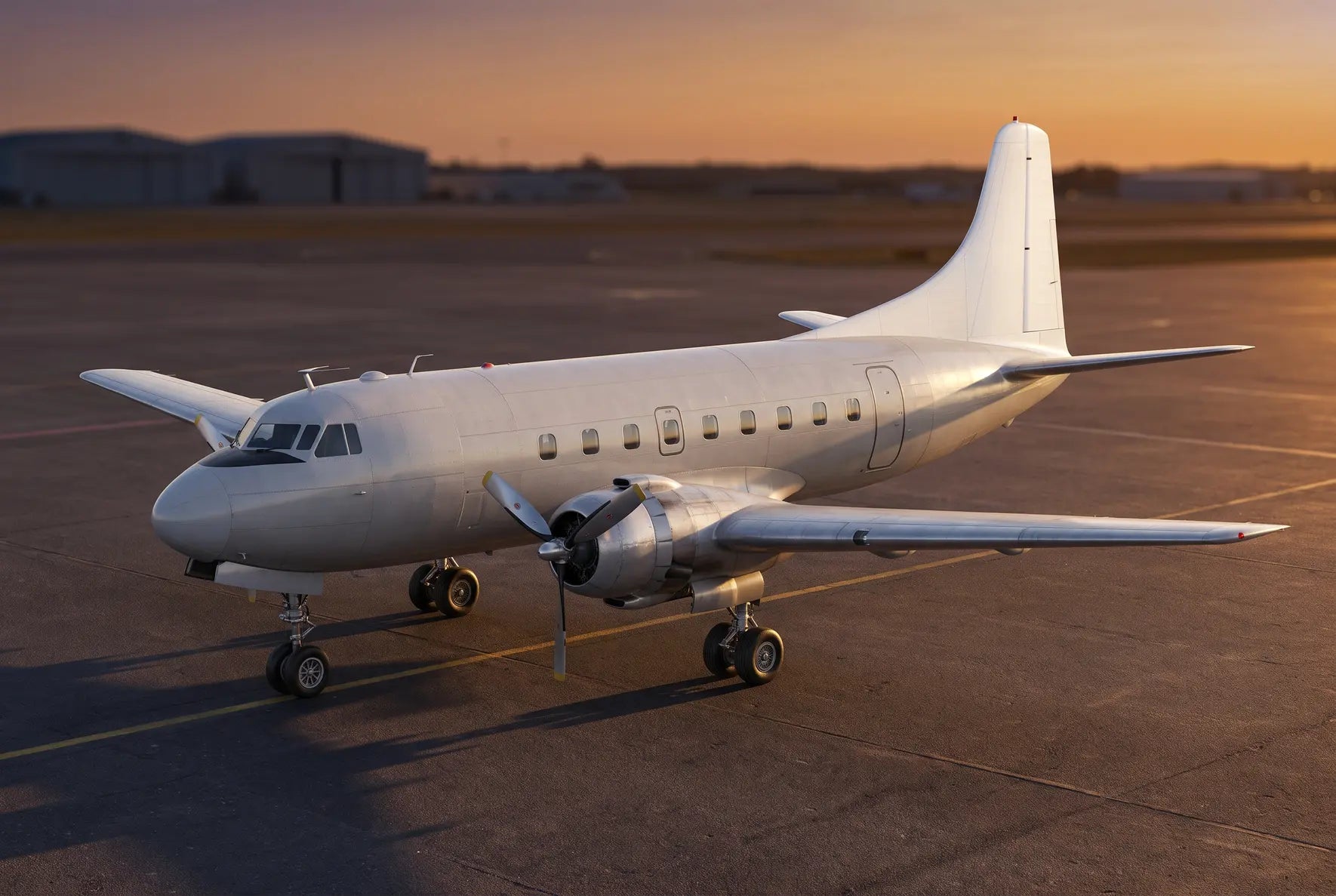
A fleet of Martin 4-0-4 aircraft belonging to Southern Airways is parked on the tarmac at Atlanta Airport in 1972. Ground service equipment, including a Shell fuel truck, is visible.
Martin 4-0-4 Technical Specifications and Systems Highlights
The Martin 4-0-4 was designed as a pressurized short- to medium-range airliner for the busy domestic routes of the early 1950s, competing directly with the Convair 240/340 family. Its mission favored comfort, reliability and quick turnarounds over outright range, and the design carried over the twin-radial layout, low wing and all-metal fuselage of the earlier Martin 2-0-2, while adding a stretched fuselage (about three feet longer) and, most importantly, a pressurized cabin absent on the unpressurized 2-0-2. The main engineering trade-off was payload and comfort against range: with 40 seats filled, the aircraft was optimized for the roughly 1,000-mile stage lengths typical of trunk and feeder operations rather than long transcontinental sectors.
Compared with contemporaries such as later widebody freighters like the Boeing 777F, the 4-0-4 belongs firmly to the piston era, where power came from large air-cooled radials rather than turbofans, and where cruising altitude was limited by engine performance and cabin differential pressure.
- Length: 74 ft 7 in (22.73 m)
- Wingspan: 93 ft 3 in (28.42 m)
- Height: 28 ft 5 in (8.66 m)
- Wing area: 864 sq ft (80.3 m²)
- Empty weight: 29,126 lb (13,211 kg)
- Maximum takeoff weight: 44,900 lb (20,366 kg)
- Passenger capacity: 40 in typical airline configuration, with a flight crew of three to four
- Maximum speed: about 312 mph (502 km/h) near 14,500 ft, per published type data
- Typical cruise speed: around 280 mph (450 km/h)
- Range: roughly 1,080 mi (1,740 km) at typical payload; extended ferry range with reduced load
- Service ceiling: 29,000 ft (about 8,840 m)
- Rate of climb: 1,905 ft/min
- Powerplant: two Pratt & Whitney R-2800-CB16 Double Wasp radials, 2,400 hp each at takeoff
Systems and Handling-Relevant Technology
The 4-0-4 used a retractable tricycle landing gear, a modern arrangement that eased ground handling and improved forward visibility during taxi compared with taildragger transports. Cabin pressurization was the defining systems upgrade over the 2-0-2, allowing the aircraft to cruise at higher, smoother altitudes for passenger comfort. As a piston-era airliner, it relied on hydraulically actuated gear, flaps and wheel brakes, and on the flight engineer's station to manage engine power, mixture, cowl flaps and supercharger settings, a workload distinct from the automated flight decks of modern jets. Performance planning was done manually with charts rather than onboard computers, so pilots calculated takeoff and landing figures against weight, altitude and temperature.
Published performance numbers should be read with care. Figures vary because operators chose different cabin densities, weights and fuel loads, and because speed, range and field-length values depend on atmospheric assumptions and runway condition. The frequently cited difference between roughly 2,000 hp and 2,400 hp per engine, for example, reflects continuous versus takeoff ratings of the same CB16 engine rather than different powerplants.
Engines: The Pratt & Whitney R-2800 Double Wasp
The 4-0-4 was powered by two Pratt & Whitney R-2800 Double Wasp engines in the transport-rated CB16 sub-variant. The R-2800 is an 18-cylinder, two-row, air-cooled radial displacing about 2,804 cu in (roughly 46 L), with a 5.75 in bore and 6.00 in stroke. Developed by Pratt & Whitney in the late 1930s as part of the long-running Wasp family, its two offset rows of nine cylinders gave rise to the Double Wasp name. Demand during the Second World War was such that the engine was also license-built by Ford, as documented by engine-history references at the Aircraft Engine Historical Society.
The R-2800 became one of the most widely used high-power radials of its time, spanning combat and commercial aviation. It powered wartime fighters including the Republic P-47 Thunderbolt, the Vought F4U Corsair and the Grumman F6F Hellcat, as well as the Martin B-26 Marauder and Lockheed PV-1 Ventura. In the postwar airliner era, transport-rated versions like the CB16 powered the Douglas DC-6, the Convair 240/340/440 series and both the Martin 2-0-2 and 4-0-4. Its reputation for durability was the key reason it was chosen for twin-engine airliners, where reliable power on a limited number of engines was essential to safe scheduled service.
Martin 4-0-4 vs Martin 2-0-2 vs Convair 240 vs Douglas DC-3 Specifications Comparison
Scroll horizontally to see more →
| Parameter | Martin 4-0-4 | Martin 2-0-2 | Convair 240 | Douglas DC-3 |
|---|---|---|---|---|
| Entry into service | 1951 | 1947 | 1947 | 1936 |
| Engines | 2 × Pratt & Whitney R-2800-CB16 radial | 2 × Pratt & Whitney R-2800-CB16 radial | 2 × Pratt & Whitney R-2800-CB16 radial | 2 × Pratt & Whitney R-1830 Twin Wasp radial |
| Length | 22.73 m | 21.03 m | 22.78 m | 19.66 m |
| Wingspan | 28.42 m | 28.65 m | 28.96 m | 28.96 m |
| Height | 8.66 m | 8.61 m | 8.46 m | 5.16 m |
| Typical seating and layout (short description + approximate passengers) | Single-class: 40 passengers | Single-class: 40 passengers | 2-class: 40–44 passengers | Single-class: 21–32 passengers |
| MTOW | 20 t | 20 t | 17 t | 11 t |
| Range | 1,783 km | 1,763 km | 2,690 km | 2,400 km |
| Cruise speed | 0.35 Mach | 0.35 Mach | 0.39 Mach | 0.31 Mach |
| Service ceiling | 29,000 ft | 27,000 ft | 30,000 ft | 23,200 ft |
| Program note | Postwar Martin short-haul airliner, developed from the 2-0-2 with a strengthened wing and pressurization after early safety issues. | Earlier baseline Martin twin, the direct predecessor that led to the 4-0-4 after structural changes and added safety margin. | Contemporary competing postwar twin from Convair, positioned as a similar-size feeder airliner with a slightly longer range. | Earlier, smaller baseline transport that set the template for short-haul piston airliners before the pressurized twin-engine postwar generation. |
Scroll horizontally to see more →
The table compares four piston twin airliners on dimensions, payload and performance. The Martin 4-0-4 and 2-0-2 share the same R-2800 engines and similar cruise (0.35 Mach), but the 4-0-4 is longer and has a higher ceiling (29,000 ft vs 27,000 ft). The Convair 240 shows the longest range (2,690 km) and fastest cruise (0.39 Mach) despite lower MTOW (17 t). The DC-3 is smaller and lighter (11 t MTOW) with fewer seats and a much lower ceiling.
Martin 4-0-4 Operations: Routes, Missions and Airlines Worldwide
The Martin 4-0-4 was conceived as a pressurized Douglas DC-3 replacement for short- and medium-haul airline service, and its operating profile reflected that role. With a normal range of about 1,080 mi (1,740 km, 940 nmi) and a cruise of roughly 280 mph (450 km/h) at 18,000 ft, the type was suited to sectors from a few hundred miles up to around 1,000 miles with reserves. In everyday service it flew far shorter legs, typically linking major cities with secondary and regional airports on frequent, multi-stop schedules known at the time as milk runs. Its 40-passenger, pressurized and air-conditioned cabin, powered by two Pratt & Whitney R-2800 Double Wasp radials, offered speed and comfort advantages over the DC-3, though higher operating costs than the rival Convair 240/340 limited its long-term commercial appeal.
Operationally the aircraft fit hub-and-spoke and dense point-to-point networks rather than long-haul routes. Trunk carriers used it to feed and reinforce short-haul schedules, while local-service airlines later deployed it on high-frequency regional runs. The main challenge for operators was economics: the piston twin was relatively costly to run, and the arrival of turboprops and early jets quickly rendered it uncompetitive on primary routes, pushing it toward smaller regional carriers and, eventually, charter and private use. Modern short-haul networks are now the domain of aircraft such as the Airbus A320neo, but in the 1950s the 4-0-4 filled that role on U.S. regional sectors.
Where the Martin 4-0-4 operates
Commercial operation of the type was overwhelmingly concentrated in North America. Available operator records and museum documentation identify U.S. trunk and local-service airlines, plus the U.S. Coast Guard, as the principal users, with no well-documented scheduled airline operators in Europe, Asia or Africa. Missions across North & South America centered on domestic short-haul flying: eastern seaboard and Florida services, Gulf Coast routes, and multi-stop regional networks across the Northeast, Mid-Atlantic, Midwest and Southeast United States.
- Europe: No authoritative source in the historical record documents scheduled European airline operators of the type; production of roughly 103 aircraft was directed almost entirely at the U.S. market.
- North & South America: Eastern Air Lines was the largest operator with 60 aircraft, branded Silver Falcon, flying eastern seaboard and Florida routes; Trans World Airlines (TWA) operated 40 as the Skyliner on domestic short- and medium-haul sectors until 1961. Later regional users included Piedmont Airlines, Mohawk Airlines, Ozark Air Lines, Southern Airways, Pacific Air Lines on high-frequency milk runs, and Provincetown-Boston Airlines on Gulf Coast services in the late 1970s.
- Asia: No documented scheduled commercial airline operators of the type are recorded in authoritative sources.
- Africa: No documented scheduled commercial airline operators of the type are recorded in authoritative sources.
Typical seating and cabin layouts
The standard factory and airline configuration seated 40 passengers in a single-aisle, pressurized cabin with a crew of three or four. Network carriers such as Eastern Air Lines and TWA operated the aircraft in these 40-seat layouts, prioritizing comfort and speed as a DC-3 replacement on trunk feeder routes. Later regional and local-service operators sometimes densified the cabin to around 44 seats to improve short-haul economics, a common pattern where leisure and high-frequency carriers traded pitch for capacity. Detailed period seat maps are sparse, but the ~74 ft 7 in (22.73 m) fuselage and 40-passenger baseline are consistent across manufacturer-derived references such as this technical summary and preserved-airframe records held by the Planes of Fame Air Museum, which maintains a Martin 4-0-4 on display.
In this video, discover what went wrong with the Martin 4-0-4, a lesser-known post-war American airliner, and learn how rapid airline transitions of the era shaped its challenges and legacy.
Martin 4-0-4 Safety Record and How Safe Is This Airliner?
The Martin 4-0-4 was a pressurised, 40-seat piston airliner that entered scheduled service in 1952, with roughly 103 airframes built by the Glenn L. Martin Company. Operated mainly by Eastern Air Lines and Trans World Airlines (TWA), and later by regional carriers such as Mohawk Airlines and Southern Airways, the type stayed in some form of operation into the 2000s. Across nearly six decades of service, databases record about 27 hull losses, of which roughly nine were fatal, causing in the region of 100 deaths. Set against the small fleet, the loss rate looks high in percentage terms, but it is spread over almost 58 years and a wide mix of mainline, charter, corporate and remote operations, many flown in demanding terrain or weather. A useful entry point for these figures is the Aviation Safety Network type record, which indexes individual events for the Martin 404.
Importantly, the 4-0-4 was itself a lessons-learned design. It was a structurally strengthened, pressurised development of the earlier unpressurised Martin 2-0-2, which had suffered wing-spar fatigue problems. The 4-0-4 introduced a redesigned wing structure and a pressurised fuselage, and official investigations of its own accidents did not identify a recurring structural or pressurisation flaw.
Notable accidents and what changed afterwards
- TWA Flight 260 (1955), Sandia Mountains, New Mexico. The aircraft deviated from its departure course and struck rising terrain shortly after leaving Albuquerque, a case of controlled flight into terrain in poor visibility. All 16 on board died. The event reinforced attention to departure-route design, minimum safe altitudes and instrument navigation discipline near mountainous terrain.
- TWA Flight 400 (1956), Greater Pittsburgh Airport, Pennsylvania. Following an engine indication on takeoff, the Civil Aeronautics Board attributed the accident to uncoordinated emergency action that produced a high-drag configuration and insurmountable performance loss; 22 of 36 occupants died. It underlined the value of standardised engine-failure and rejected-takeoff procedures and crew coordination during the critical takeoff phase.
- Golden Eagle Aviation charter (1970), near Silver Plume, Colorado. A Wichita State University charter crashed into terrain after a low-altitude mountain-valley route was selected that the aircraft could not out-climb. The NTSB report AAR-71-04 highlighted route planning, terrain clearance and aircraft performance limits, influencing later guidance on charter operations in high terrain.
These events cluster around flight-crew decision-making, route selection, weather and engine handling rather than airframe design, and each contributed to sharper procedures, training and operational oversight in the piston-airliner era. Readers comparing the type with modern regional aircraft may find it useful to see how design and certification standards evolved by contrast on our COMAC ARJ21-700 overview.
How safe is the Martin 4-0-4?
Judged by the standards of its own period, the Martin 4-0-4 was a solid and structurally conservative aircraft, built specifically to correct the 2-0-2's weaknesses and to add pressurisation. Its fatal accidents track weather, terrain and human factors more than any intrinsic design fault, and its wing and fuselage redesign held up well in service. That said, a 1950s piston twin lacks the redundancy, systems automation, ground-proximity and terrain-awareness technology, and standard operating procedures that define modern airliners, so its accident rate relative to traffic sits well above today's jets. Contemporary safety oversight, reflected in aggregated statistics from bodies such as the International Civil Aviation Organization, together with mature SOPs and continuous airworthiness monitoring, has driven accident rates down dramatically since that era. Even so, and consistently across the decades, commercial aviation remains one of the safest modes of transport.
01 What kind of routes and typical mission profile did the Martin 4-0-4 serve?
The Martin 4-0-4 was designed for short to medium-haul domestic routes, typically flying sectors of about 200 to 800 miles. It was widely used in the United States for city-pair services such as New York–Boston, Chicago–Detroit, and various East Coast and Midwest regional links. Its range of roughly 1,000 miles made it suitable for multi-stop itineraries where frequent takeoffs and landings were part of the schedule. The aircraft’s performance and size made it a natural fit for high-frequency, relatively short commercial and commuter operations.
02 How is the cabin layout and passenger comfort on the Martin 4-0-4?
The Martin 4-0-4 typically seated around 40 passengers in a single-aisle layout with a 2–2 seating configuration, giving most travellers both reasonable shoulder room and good access to the aisle. The cabin was not pressurized as highly as modern jets, and the piston engines generated noticeable vibration and noise, especially for seats near the wings and engines. Overhead storage was limited compared with today’s airliners, but legroom was generally comparable to other 1950s short-haul aircraft. Large, round windows provided good outside views, which contributed positively to the passenger experience on scenic regional routes.
03 Which airlines operated the Martin 4-0-4 and on what kinds of services?
Major early operators of the Martin 4-0-4 included Eastern Air Lines and Trans World Airlines, which used it on busy domestic trunk and feeder routes in the United States. As the aircraft aged, many examples moved to regional and commuter carriers such as Southern Airways and other local-service airlines. These operators relied on the Martin 4-0-4 for linking smaller cities to major hubs, often with multiple stops on a single flight number. The type also saw use in charter, corporate, and later cargo and air-taxi roles once it left front-line scheduled service.
04 How does the performance and role of the Martin 4-0-4 compare with similar aircraft of its era?
The Martin 4-0-4 was an evolution of the earlier Martin 2-0-2, offering improved safety features and systems while keeping similar capacity and mission. In terms of role, it competed with aircraft such as the Convair 240 and 340, serving as a short-haul, medium-capacity piston airliner for domestic markets. Its cruise speed, payload, and range were broadly comparable to these contemporaries, though the exact performance varied with configuration and operator. Compared with later turboprops and regional jets, the Martin 4-0-4 was less fuel-efficient and slower, which ultimately led to its replacement as technology advanced.
05 What is known about the safety record and key design features of the Martin 4-0-4?
The Martin 4-0-4 incorporated structural and design improvements over the 2-0-2, addressing issues that had arisen with the earlier model, including wing and pressurization concerns. Like many piston airliners of the 1950s and 1960s, its safety record reflects a mix of factors: evolving maintenance standards, navigational limitations of the era, and human factors, rather than a single design flaw. Operators valued its robust airframe and straightforward mechanical systems, which were familiar to maintenance crews used to radial engines. As regulations and technology improved, many surviving airframes were retired or moved to less demanding roles rather than continually upgraded.
06 What should a passenger know about seat choice, windows, and ride quality on the Martin 4-0-4?
On the Martin 4-0-4, seats farther from the wing and engines generally experienced slightly less noise and vibration, so travellers concerned about comfort would have preferred positions toward the front of the cabin. Window spacing was relatively generous, and the round windows gave good visibility, though some seats did not align perfectly with a window, as in many small airliners. The aircraft’s relatively low cruising altitude and piston-engine configuration meant passengers could feel more turbulence compared with modern high-flying jets, especially in convective weather. However, for its time, the ride was typical of regional piston airliners, and many passengers appreciated the closer view of the landscape below.