Pacific Coastal Airlines Overview & Company Profile
Pacific Coastal Airlines (IATA 8P, ICAO PCO, callsign PASCO) is a privately owned British Columbia regional carrier operating from the South Terminal at Vancouver International Airport. It holds a Transport Canada CAR 705 air operator certificate, which places it in the same regulatory category as Canada's larger scheduled airlines even though its aircraft are 19-seat and 34-seat turboprops. For a pilot, that distinction matters: CAR 705 flying is multi-crew, dispatch-supported, IFR airline operations, and the hours logged are treated as airline experience by other Canadian operators.
The airline traces back to 1987, when Powell Air merged with the Port Hardy seaplane operation of Air BC and took the Pacific Coastal name. Its founder, Daryl Smith, was a truck logger in the Bella Coola area who obtained a pilot licence and bought a seaplane to reach remote logging camps. The company is still family-owned and is led today by Smith's son, Quentin Smith, as President. That continuity of private ownership is a defining feature of the employment proposition here, for better and for worse: decisions are made quickly and locally, but there is no publicly traded parent, no published financial statements, and no collective agreement setting out what happens when priorities change.
The scheduled network covers 19 airports across British Columbia, from Vancouver and Victoria out to Anahim Lake, Bella Bella, Bella Coola, Masset and Port Hardy on the coast, and inland to Cranbrook, Kamloops, Kelowna, Penticton, Prince George, Trail and Williams Lake. Pacific Coastal's own corporate page describes the airline as the 13th-largest carrier by total outbound seats at YVR and the third-largest by takeoffs and landings, which reflects the operating profile precisely: a very high number of short sectors flown by small aircraft.
Two structural facts shape the current pilot job. First, from 2018 until 26 October 2024, Pacific Coastal flew as WestJet Link under a capacity purchase agreement, operating Saab 340s on Alberta and interior BC routes. WestJet moved that flying to Encore Dash 8-400s, and Pacific Coastal closed its Calgary flight operations base along with customer service bases at Medicine Hat, Cranbrook and Lethbridge. Roughly 100 positions were affected. WestJet's own October 2024 announcement confirms the transition date. Second, since that contraction the airline has redirected capacity into its own BC network and has continued recruiting First Officers and direct-entry Captains at Vancouver throughout 2025 and 2026.
Pacific Coastal retains a reciprocal interline agreement with WestJet covering single-itinerary bookings, through check-in and baggage transfer, and it sells through Hahn Air for international travel agents. It also owns Wilderness Seaplanes, the seaplane division spun out in 2016, which operates from Port Hardy and Bella Bella with a small fleet that includes Grumman Goose amphibians. Wilderness is a separate operation with separate pilot requirements, so applying to Pacific Coastal does not put a pilot in line for floatplane flying.
Pacific Coastal is a private company and does not publish pilot headcount, annual passenger numbers, financial results or a seniority manual. Where a figure in this guide is not sourced from the airline's own website or a current job posting, it is identified as an estimate. Total employees, total pilots and annual passengers could not be verified for 2026 from any authoritative source and are therefore either omitted or clearly flagged. Never treat third-party directory estimates as contractual.
Fleet Composition & Type Ratings
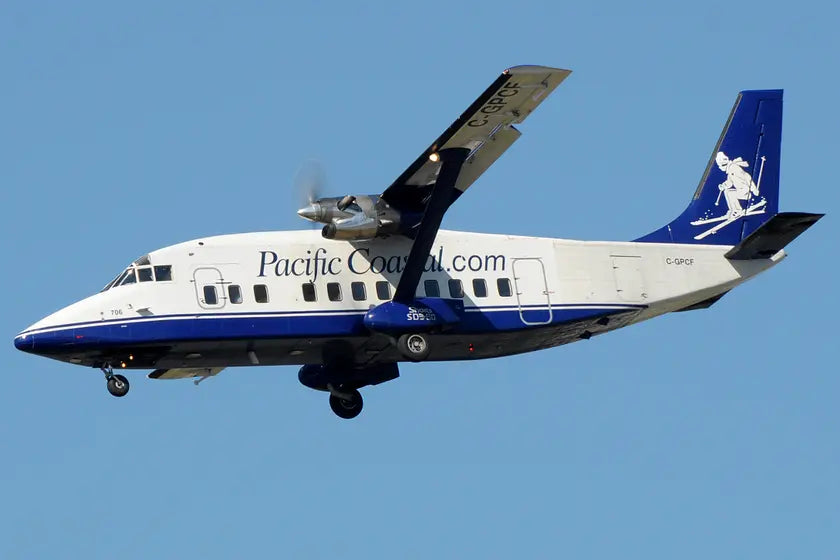
Pacific Coastal operates a two-family turboprop fleet. The airline's own aircraft page states a total of 17 aircraft and lists three variants: the Saab 340B, the Beechcraft 1900D and the Beechcraft 1900C. There are no jets, no turbofan pathway inside the company, and no announced replacement programme for either type as of August 2026.
Both types are out of production. Saab ended 340 manufacturing in 1999 and Raytheon ended Beechcraft 1900D production in 2002, so a pilot joining Pacific Coastal is joining a mature-equipment operator. That is not automatically a negative: the 1900D and Saab 340 are well-understood, well-supported machines, and both are genuine multi-crew IFR platforms with two-pilot cockpits, autopilot, and turbine engines. What they are not is a route to a modern glass-cockpit type rating or a jet endorsement.
| Aircraft Type | Seats | Crew | Cruise / Range | Role & Notes |
|---|---|---|---|---|
| Saab 340B / 340B Plus | 34 | 2 pilots + 1 flight attendant | 25,000 ft / 2,035 km | Pressurised, lavatory equipped. Higher-density trunk routes such as Vancouver to Comox, Powell River, Campbell River and Kelowna sectors. |
| Beechcraft 1900D | 19 | 2 pilots | 25,000 ft / 2,368 km | Stand-up cabin, no lavatory, no cabin crew. The backbone of thin-route and remote-community flying. |
| Beechcraft 1900C | 19 | 2 pilots | 25,000 ft / 1,480 km | Earlier low-cabin variant with shorter range. Small number in the fleet. |
Specifications from the Pacific Coastal aircraft page. Subtype quantities are not published by the airline; see the disclaimer below.
The airline publishes a total of 17 aircraft but does not break down how many of each subtype it operates. Independent fleet trackers disagree at the margins. The AvCentral operator profile lists roughly nine Beechcraft 1900 airframes (eight 1900D plus one 1900C) and eight Saab 340s. A February 2026 registration-level fleet list instead reconciles to ten Beechcraft 1900s and seven Saabs. Both total 17. Treat the split as approximately nine or ten Beech 1900s and seven or eight Saab 340s, and expect it to move with maintenance status and any airframe additions. A Beechcraft 1900D registered C-GPCO is recorded as entering service in July 2025.
What This Means for Type Ratings
Neither the Saab 340 nor the Beechcraft 1900 requires a pilot to arrive type rated. Pacific Coastal's pilot careers page states that all training is conducted in-house, and current job postings confirm that a type rating is not required for either the First Officer or the direct-entry Captain positions, with preference given to candidates who already hold one. Training is company-funded, but a bond applies under the Crew Practices Manual. The amount and repayment schedule are not published in any public posting, which makes the bond terms one of the most important items to obtain in writing before accepting an offer.
Fleet assignment is driven by vacancy rather than pilot choice. Postings are advertised specifically as "Saab First Officer" or "B1900 First Officer" at a named base, so a candidate effectively selects their fleet at the application stage rather than bidding for it later. Moving between the Beech and the Saab later in a career depends on company need and training capacity, not on a published bid system.
Seventeen aircraft across two types is a small operation. Practically, this means limited internal mobility, a short list of upgrade slots opening each year, and no ability to move up to larger equipment within the company. Pilots who want to progress to a Dash 8-400, a CRJ, an E175 or a narrowbody jet will do so by leaving. The counterweight is that a Saab 340 or Beech 1900 logbook at a CAR 705 carrier, with hard IFR, mountain and coastal experience, is well regarded by Canadian regionals and by WestJet Encore, Jazz and Porter recruiters.
Pilot Salary & Compensation Breakdown
Pacific Coastal pilots are paid on a credit-hour system with a guaranteed minimum of 80 flying credits per month. There is no collective agreement, so there is no negotiated pay grid in the public domain. What does exist is a detailed pay scale published by AvCentral's Canadian pilot salary database, which compiles primary-source compensation data for Canadian carriers and was last updated in April 2026, together with the rates stated openly in the airline's own job advertisements.
Two rate structures appear in current public material and pilots should understand the difference. The AvCentral scale reflects the pay steps applied to serving pilots. Separately, the airline's July 2026 Saab First Officer posting on its Dayforce careers portal advertises a headline rate of C$55.00 per credit hour, or C$52,800 per year minimum, which is above the AvCentral year-one and year-two steps and sits close to the top of the published First Officer scale. Earlier 2024 and 2025 postings advertised C$41.03 per credit hour for candidates below 1,000 hours total time, moving to C$52.08 once 1,000 hours was reached or on the first anniversary, whichever came first.
First Officer Pay Scale
| Step | Per Credit Hour | Annual at 80 Credits | Notes |
|---|---|---|---|
| Year 1 (under 1,000 hrs TT) | C$41.03 | ~C$39,389 | Entry rate for lower-experience candidates. |
| Year 2 (1,000 hrs or 1 yr service) | C$52.08 | ~C$49,997 | Applied on reaching 1,000 hrs TT or first anniversary, whichever is first. |
| Year 3 | C$53.92 | ~C$51,763 | Standard annual step. |
| Year 4 (scale maximum) | C$55.82 | ~C$53,587 | First Officer pay tops out at year four. |
| Current advertised new-hire rate | C$55.00 | C$52,800 | Headline rate on the July 2026 Saab First Officer posting. |
Annual figures are the published rate multiplied by the 80-credit monthly guarantee across twelve months. Actual pay varies with credits flown, overtime and per diem.
Captain Pay Scale
| Step | Per Credit Hour | Annual at 80 Credits |
|---|---|---|
| Year 1 | C$79.66 | ~C$76,474 |
| Year 2 | C$86.82 | ~C$83,347 |
| Year 3 | C$90.73 | ~C$87,101 |
| Year 4 | C$94.81 | ~C$91,018 |
| Year 5 | C$99.08 | ~C$95,117 |
| Year 6 | C$103.54 | ~C$99,398 |
| Year 7 | C$108.20 | ~C$103,872 |
| Year 8 (scale maximum) | C$113.07 | ~C$108,547 |
Captain rates per AvCentral's Pacific Coastal pay scale. No aircraft-type differential between the Beech 1900 and the Saab 340 appears in the published scale.
Beyond Base Pay
Three additional components materially change the annual total, and all three are stated in current job postings:
The C$25,000 upgrade retention bonus deserves attention because it is one of the more distinctive elements of the package. It is not paid on upgrade. It is paid after the pilot has completed two full years in the left seat, which makes it a retention tool aimed squarely at the point where newly minted Captains typically leave for a larger carrier. A pilot who upgrades and then departs at eighteen months forfeits it entirely.
The realistic earnings picture for a new hire is therefore roughly C$52,800 in guaranteed base at the current advertised rate, plus per diem that scales with how many duty hours the schedule produces, plus any overtime. A pilot who upgrades at around the two-year mark and then serves a full eight years in command would reach approximately C$108,500 at scale maximum, plus the C$25,000 bonus once the two-year command requirement is met.
These figures come from the AvCentral Canadian pilot salary database and from Pacific Coastal's own advertised job postings, not from a collective agreement. Because the pilot group is non-union, rates can be changed by the employer without negotiation, and the same position has been advertised at different rates within the same eighteen-month period (C$41.03, C$52.08 and C$55.00 per credit hour all appear in postings from 2024 to 2026). Annual totals shown assume exactly 80 credits per month; real credits vary. Always obtain a dated written offer setting out the credit rate, the definition of a credit, the guarantee, per diem, overtime terms, vacation accrual and the exact bond amount before accepting.
Roster Pattern & Quality of Life
Scheduling is one of the areas where Pacific Coastal genuinely outperforms much of the Canadian regional sector, and the airline is unusually explicit about it in its advertising. Current First Officer postings state a hard ceiling of a maximum of 18 duty periods per monthly schedule, with fewer duty periods scheduled when higher-credit duty periods are worked. In a 30-day or 31-day month, that cap produces at least twelve to thirteen calendar days without an assigned duty period.
Three scheduling mechanisms sit on top of the duty-period cap, all named in the airline's job postings:
- Wild Card Day system. Pilots can reserve dates that matter to them, and the monthly schedule is built around those dates. This is a practical substitute for the seniority-based bidding used at larger carriers, and it means a junior pilot is not automatically locked out of protecting a wedding, an exam or a family event.
- Banked statutory holidays. Statutory holidays worked are banked rather than lost, and can be exchanged for Guaranteed Days Off. The postings state these can be grouped together for up to three weeks of paid time off in addition to annual vacation entitlement.
- Peer shift trading. Pilots can trade duty periods with colleagues for further schedule control.
The airline also runs what it calls a socialized preference system for reserve. Its pilot careers page states that once a new pilot completes line indoctrination, they are scheduled for a mix of line flying and reserve duties rather than being parked on reserve until seniority allows a line. For a low-time First Officer trying to build turbine and multi-crew hours quickly, this is a substantive advantage over regionals where a first-year pilot can spend most of a year on reserve.
📅 Illustrative 28-Day Pattern at the 18 Duty-Period Cap (Beech 1900 First Officer, YVR)
This grid is an illustration of what the published 18 duty-period ceiling looks like across a 28-day window, showing 18 duty periods and 10 non-duty days. Pacific Coastal does not publish sample rosters, and this is not a reproduction of an actual company schedule.
Duty Days and Regulatory Limits
Because there is no collective agreement, the binding limits on duty and rest are the ones set out in Part VII, Subpart 700 of the Canadian Aviation Regulations. These are ceilings rather than typical values, but at a non-union carrier they represent the actual outer boundary of what can legally be scheduled, so they are worth knowing precisely.
| CARs 700 Series Limit | Value |
|---|---|
| Cumulative flight time, 28 consecutive days | 112 hours |
| Cumulative flight time, 90 days | 300 hours |
| Cumulative flight time, 365 days | 1,000 hours |
| Maximum flight duty period (1 to 4 sectors, 07:00 to 12:59 start) | 13 hours |
| Maximum FDP, 5 to 6 sectors, same start window | 12 hours |
| Maximum FDP, 7+ sectors, same start window | 11 hours |
| Maximum FDP, late-night start windows | Reduces progressively to 9 hours |
| Minimum rest at home base | 12 hours, or 11 hours plus travel time |
| Minimum rest away from base | 10 hours in suitable accommodation |
| After 3 consecutive FDPs exceeding 12 hours | 24 consecutive hours free from duty |
Prescriptive limits under CARs Subpart 700. The multi-sector reduction is directly relevant at Pacific Coastal, where a Beech 1900 duty period can easily involve five or more short legs.
The multi-sector rule is the one that bites hardest in this operation. A Vancouver-based Beech 1900 day can string together several 25 to 50 minute legs, and each additional sector pulls the maximum flight duty period down. Pilots evaluating this job should expect duty days that feel long relative to the block time logged, because the credit-hour system pays flying credits while the day is consumed by turnarounds at small stations.
Pacific Coastal maintains two pilot bases: Vancouver (YVR South Terminal) and Victoria (YYJ). The Calgary flight operations base closed on 26 October 2024 with the end of WestJet Link. The airline operates a no-cost commuting policy for pilots living anywhere within its own destination network, subject to approval. That is a genuinely valuable benefit in this operation: a pilot can live in Comox, Campbell River, Powell River, Nanaimo, Kelowna or Prince George and position to base at no personal cost, which materially offsets Vancouver and Victoria housing costs. It does not extend to points outside the 8P network, so a pilot living in Alberta or Ontario would be commuting on their own arrangements.
Every scheduling protection described above (the 18 duty-period cap, Wild Card Days, banked statutory holidays, the commuting policy) is a company practice stated in recruitment material and the Crew Practices Manual, not a term in a negotiated collective agreement. Company practices can be revised. Pilots should ask specifically whether these provisions are written into the employment offer or the Crew Practices Manual, and whether the Crew Practices Manual can be amended unilaterally.
Benefits, Travel Perks & Retirement
For a carrier of its size, Pacific Coastal offers a broad benefits package, and the airline lists it openly on its pilot careers page rather than leaving it to the offer stage. The headline items are group health coverage, a matched retirement plan and an unusually generous set of travel privileges relative to a 17-aircraft regional.
Retirement: What Canadian Pilots Should Understand
Pacific Coastal offers RRSP matching and nothing more elaborate. There is no defined benefit pension, no aviation-specific supplementary fund of the sort that exists in some European jurisdictions, and no published contribution formula. In practice, retirement provision for a Pacific Coastal pilot rests on three pillars: the Canada Pension Plan, personal RRSP contributions with whatever the company match provides, and Old Age Security. This is standard for a small Canadian private-sector employer, but it is a meaningful gap against unionized Canadian regionals whose collective agreements set out a defined contribution rate that cannot be varied at the employer's discretion.
The match rate is the single most important unpublished number in the benefits package. Two employers can both advertise "RRSP matching" while one contributes two percent and another eight percent, and across a twenty-year career that difference is worth more than several years of the salary gap discussed in the previous section. Ask for it in writing.
Pacific Coastal's published benefits list includes short-term and long-term disability insurance but does not name a separate pilot loss-of-licence policy. No independent source confirms one exists. Loss-of-licence cover and general disability cover are not the same product: a pilot can fail a Category 1 medical renewal while remaining capable of other work, in which case a standard disability policy may pay little or nothing. Canadian pilots at operators without employer-provided loss-of-licence cover commonly arrange their own through an aviation insurance broker. Confirm the position directly with Pacific Coastal before relying on the disability line item.
Unlimited standby on a 19-airport BC network sounds modest, and on its own it is. The value sits in the reported partner list, which spans WestJet, Air Canada, Porter, Flair, Delta, Alaska, Allegiant, Icelandair and Cathay Pacific. For a pilot at a small regional, access to that spread of interline and jumpseat arrangements is unusual and is one of the more concrete non-cash items in the package. Priority and boarding order on partner carriers are set by each partner, not by Pacific Coastal, so treat availability as opportunistic rather than guaranteed.
Career Progression & Upgrade Timeline
Career progression at Pacific Coastal is the area where the absence of a collective agreement is felt most directly. There is no published seniority list, no published bid award rules, and no contractual upgrade sequence. Advancement is a company decision constrained by vacancies, ATPL eligibility and training capacity.
That cuts both ways. At a unionized carrier, a pilot knows exactly where they sit and can forecast an upgrade within a range. At Pacific Coastal, a strong performer who reaches ATPL eligibility during a period of Captain attrition can move quickly, while a pilot who arrives during a quiet period has no contractual claim to a slot. One publicly visible pilot career history shows a First Officer hired in May 2024 upgrading to Captain in March 2026, approximately 22 months. That is a single documented data point, not a company commitment, and it should be read as evidence that a roughly two-year upgrade is achievable rather than as a promised timeline.
| Career Milestone | Typical Position | Notes |
|---|---|---|
| Hire as First Officer | 500 hrs TT minimum | Beech 1900 or Saab 340, Vancouver or Victoria base. Fleet is selected by which posting you apply to. |
| Ground school & type training | In-house | Company-funded, bond applies. Intakes are advertised with specific ground school start dates. |
| Line indoctrination | On completion of training | After line indoc, pilots enter the socialized preference system with a mix of line flying and reserve. |
| Reach ATPL eligibility | 1,500 hrs TT (TCCA) | A Canadian ATPL is required to hold a Captain seat. The pace of accumulation is helped by the line-plus-reserve model. |
| Upgrade to Captain | ~2 years in a favourable market | Based on one documented 22-month example. No guaranteed timeline is published. Selection is company-driven. |
| Upgrade retention bonus paid | 2 years after upgrade | One-time C$25,000 to eligible internally upgraded Captains. |
| Captain pay scale maximum | Year 8 in command | C$113.07 per credit hour, approximately C$108,547 at the 80-credit guarantee. |
| Training roles | Variable, by selection | Line Training Captain, Ground School Training Captain or Simulator Training Captain. All training is in-house. |
Direct Entry Captain
Unlike many legacy carriers, Pacific Coastal does accept direct-entry Captains, and it advertises for them regularly at Vancouver on both the Beechcraft 1900 and, through third-party recruiters, the Saab 340. The published direct-entry Captain minimums are 2,000 hours total time, 1,000 hours PIC and 1,000 hours of relevant multi-engine, multi-crew, IFR or turbine experience in CAR 600, 702, 703, 704, 705 or military operations, plus a TCCA ATPL, a Class 1 medical and ICAO English Level 4 as a minimum. No type rating is required and training is provided.
For an internal First Officer, the practical implication is that upgrade slots are contested by external candidates as well as by colleagues. The C$25,000 retention bonus is explicitly framed for internally upgraded pilots, which suggests the company has an interest in filling from within, but the direct-entry channel remains open.
This point is frequently misunderstood and is important for career planning. Pacific Coastal has no pilot flow-through or pathway agreement with WestJet, WestJet Encore, Air Canada or Jazz. The WestJet Link arrangement that ran from 2018 to October 2024 was a capacity purchase agreement covering flying, not pilots, and it conferred no hiring preference at WestJet. Jazz operates its Pathways Program with designated flight training institutions, and Pacific Coastal is not among them. A Pacific Coastal pilot who wants to move to a mainline or a larger regional applies through the normal competitive process like any other external candidate. A separate "Fast Track to Success" arrangement with the Pacific Flying Club was announced in 2018, giving selected instructors an early interview and a seniority number, but no confirmation of current intakes under that programme could be found for 2026.
The Canadian regional hiring market in 2026 is uneven rather than uniformly short of pilots. Demand for experienced, IFR-current turbine pilots remains solid, while entry-level competition is heavier when mainline hiring slows. That cycle drives upgrade times at Pacific Coastal more than anything the company does: when Air Canada, WestJet and Porter recruit aggressively, Captains leave and internal upgrades accelerate. When mainline hiring pauses, attrition falls, upgrade slots dry up and each vacancy attracts more applicants. Pacific Coastal's small fleet amplifies this effect, because a handful of departures represents a large proportion of the Captain group. Any upgrade estimate a pilot is given at interview should be understood as a snapshot of current attrition, not a structural feature of the company.
Recruitment Process & Requirements
Pacific Coastal is one of the more accessible entry points into CAR 705 airline flying in Canada. The published First Officer minimum is 500 hours total time, which is low by Canadian regional standards, and the airline states plainly on its careers page that some IFR experience is highly recommended. There is no cadet programme and no ab-initio training pathway: candidates arrive with a Canadian licence already in hand.
First Officer Requirements
Direct Entry Captain Requirements
Selection Stages
Application to a Specific Posting
Pacific Coastal does not run a general pilot pool. Applications are made to a named vacancy such as "SAAB First Officer (Vancouver)" or "B1900 Captains (Vancouver)" through the company's Dayforce careers portal, reachable from the Pacific Coastal careers page. Postings state the ground school date attached to the intake, so applicants know the start date before applying. Questions go to pilotcareers@pacificcoastal.com.
Phone Screen
Candidate reports describe an initial telephone conversation covering recent flying, currency, work history and motivation for joining Pacific Coastal specifically. Expect to be able to explain why a BC coastal and mountain operation appeals to you, and to account for any gaps in currency.
Panel Interview: Behavioural and Technical
Reported as a panel format combining behavioural questions in the "tell me about a time" style with practical IFR and technical scenarios. Candidate accounts consistently describe the technical portion as scenario-based and open-book, with reference to operational publications permitted, rather than a memory test of obscure regulations. Preparation should focus on Canadian IFR procedures, approach planning, holds, minima, alternate requirements and decision-making around weather and terrain.
Simulator Assessment
Historical candidate reports describe an assessment in an unfamiliar twin-engine simulator, commonly a King Air 200 class device, covering instrument procedures such as holds and NDB, VOR or ILS approaches, a missed approach and single-engine handling. The assessment is looking at raw instrument flying, procedural discipline and crew communication rather than type-specific knowledge. This stage is not confirmed for every 2026 intake and may vary by candidate experience.
Pre-Employment Checks and Offer
Licence and medical verification, right-to-work confirmation, references, background check and RAIC eligibility. The written offer is the point at which the credit rate, bond amount, vacation entitlement and RRSP match should be confirmed in writing.
In-House Ground School, Type Training, PPC and Line Indoc
All training is conducted in-house, which the airline highlights as a differentiator. Ground school is followed by simulator and aircraft training, a Transport Canada Pilot Proficiency Check on type, and line indoctrination. On completion of line indoc, the pilot enters the socialized preference system with a mix of line flying and reserve. Ground school durations are not published.
Three points come up repeatedly in Pacific Coastal's own material and in candidate accounts. First, the 500-hour minimum is a floor, not a target: flight instructors are explicitly told to expect consideration at 1,000+ hours, and the pay scale itself steps up at 1,000 hours, so arriving above that threshold improves both competitiveness and first-year earnings. Second, IATRA currency is a hard gate, since the exam must have been completed within the previous 18 months if you are applying on a CPL rather than an ATPL. Third, apply to the fleet you actually want. Because vacancies are advertised separately for the Beech 1900 and the Saab 340, the application is effectively the fleet bid, and moving across later is not governed by any published rule.
Pacific Coastal recruits Canadian citizens, permanent residents and holders of an existing valid Canadian work permit. Direct-entry Captain advertising states explicitly that the role is open to TCCA licence holders only and that visa sponsorship is not provided. A pilot holding an EASA or FAA licence would need to convert to a Transport Canada licence and independently secure the right to work in Canada before applying. There is no conversion or immigration support pathway offered by the airline.
The Flying: BC Coastal & Interior Network
Pacific Coastal does not fly long-haul and has no international layovers, so the traditional layover analysis does not apply. What matters far more to a pilot evaluating this airline is the nature of the flying itself, and on that measure Pacific Coastal offers something most Canadian regionals do not: a network built almost entirely around terrain-constrained, weather-critical, short-sector operations into airports where local knowledge and manual flying skill genuinely count.
The network is entirely within British Columbia and splits into three distinct operating environments. The central and north coast serves Bella Bella, Bella Coola, Anahim Lake, Masset and Port Hardy, communities with limited or no road access where the airline's service is effectively essential infrastructure. Vancouver Island and the Sunshine Coast covers Victoria, Nanaimo, Comox, Campbell River, Tofino and Powell River, high-frequency short hops in marine weather. The southern interior covers Kelowna, Kamloops, Penticton, Cranbrook, Trail, Prince George and Williams Lake, mountain-valley operations with different terrain and different weather problems.
Representative Station Characteristics
| Station | Elevation | Runway | Approach Environment | Principal Challenge |
|---|---|---|---|---|
| Bella Coola (CYBD) | 117 ft | ~4,200 ft asphalt, 05/23 | No published instrument approach in available airport data | Confined valley arrival with steep terrain on both sides. Effectively visual-dependent. |
| Anahim Lake (CAJ4) | ~3,600 ft | ~4,000 ft gravel | Visual dependent, no ILS | High interior plateau, gravel surface, hot and high performance penalties, winter contamination. |
| Trail (CYZZ) | ~1,700 ft | ~4,000 ft paved | RNAV / GNSS, no ILS | Narrow Columbia River valley with rising terrain on the approach and missed approach paths. |
| Bella Bella (CBBC) | ~50 ft | ~4,000 ft paved | RNAV / GNSS | Coastal fog, rain and low ceilings, wet runway, limited alternates. |
| Masset (CZMT) | ~25 ft | ~5,000 ft paved | RNAV / GNSS | Exposed Haida Gwaii location, strong crosswinds, long overwater sectors, few nearby alternates. |
| Port Hardy (CYZT) | ~70 ft | ~5,000 ft paved | RNAV / GNSS | Frequent low ceilings and turbulence, but a useful regional alternate. |
| Powell River (CYPW) | ~425 ft | ~3,000 ft paved | RNAV / GNSS | Short runway. Landing distance and runway condition are live considerations for the Saab. |
| Tofino (CYAZ) | ~80 ft | ~5,000 ft paved | RNAV / GNSS | West coast marine fog, very high rainfall, rapidly changing visibility. |
Representative published airport data compiled from public aeronautical sources, provided for orientation only. Runway availability, declared distances, approach minima, lighting and NOTAMs must be checked against the current Canada Flight Supplement, approach charts and company operations manual. These figures are not operational data.
Two points stand out for a pilot assessing the job. First, this is a GNSS-approach network. Precision ILS approaches are the exception, not the norm, and several destinations rely on LNAV minima with high terrain nearby and limited or absent approach lighting. Instrument flying at Pacific Coastal means being genuinely proficient at RNAV approach planning, terrain awareness on the missed, and disciplined decision-making about when the approach is not going to work. Second, Bella Coola is the defining station. The airport sits in a narrow valley with steep terrain close on both sides and no normal published IFR arrival to the runway in publicly available airport data, meaning the arrival and landing depend on acquiring the valley and runway visually. Crews may hold outside the valley until conditions allow entry, and there is limited room to manoeuvre once committed.
Network Changes to Watch
The network has been in motion since the end of WestJet Link, and the pattern matters for anyone forecasting where crew demand will sit:
| Date | Change | Crewing Implication |
|---|---|---|
| 25 June 2024 | Kelowna to Comox launched, six days per week | Interior to island flying outside the Vancouver hub |
| 26 October 2024 | WestJet Link CPA ended, Calgary flight ops base closed | ~100 positions affected across Calgary, Medicine Hat, Cranbrook and Lethbridge |
| 28 October 2024 | Kelowna to Prince George launched, six days per week | Capacity redirected into the interior after Link |
| 27 October 2025 | Kelowna to Cranbrook launched daily, Beech 1900 | Further non-Vancouver Beech network expansion |
| 30 October 2025 | Vancouver to Quesnel launched, six days per week | Added a network airport, later withdrawn |
| 12 June 2026 | Vancouver to Quesnel suspended | Demonstrates how quickly thin routes are cut |
| 1 July to 5 Sept 2026 | Second daily Kelowna to Comox for the summer season | Seasonal utilisation peak and additional summer crewing demand |
A logbook containing several hundred hours of hard IFR into GNSS-only mountain and coastal stations, flown two-crew under CAR 705, is a strong document. Canadian recruiters at Encore, Jazz, Porter, Calm Air, Canadian North and the northern operators understand what Bella Coola, Trail and Masset represent. The trade-off is that it is demanding, weather-driven flying with a high cancellation and diversion rate, and it is not for a pilot who wants predictable days. Winter on the central coast is genuinely hard work.
Pacific Coastal does not publish overnight patterns, hotel standards, station-by-station crew rest arrangements or the average number of nights away per month. An older pilot forum account described roughly eight overnights a month, but that predates the current network and the end of WestJet Link and should not be relied on. The number of overnights in a current schedule is a question to put directly to the company at interview.
How Pacific Coastal Compares: Airline Radar Chart
Two comparators make sense for Pacific Coastal. Central Mountain Air is the closest direct competitor: a privately held western Canadian regional flying the same Beechcraft 1900D into an overlapping BC network. Jazz Aviation is the benchmark unionized Canadian regional and the most common destination for pilots leaving a small operator, so it sets the ceiling a Pacific Coastal pilot is realistically measuring against. Scores are editorial estimates across the same five axes used in the scorecard.
Where Pacific Coastal Sits on Pay
Bluntly: at the bottom. AvCentral's April 2026 comparison of twelve Canadian carriers, drawn from collective agreements and published pay schedules, places Pacific Coastal last on both axes, with a top Captain rate of C$113 per hour and a top First Officer rate of C$56 per hour. The rest of the table for context: Jazz Aviation C$180 Captain and C$109 First Officer, WestJet Encore C$156 and C$85, PAL Airlines C$147 and C$81, Calm Air C$137 and C$85, Porter C$302 and C$156, WestJet C$345 and C$209, Air Canada C$425 and C$276. A Jazz Captain at scale maximum earns roughly 60 percent more per hour than a Pacific Coastal Captain at scale maximum, and a top-scale Jazz First Officer out-earns a top-scale Pacific Coastal First Officer by roughly the same margin. This is the central trade-off of the job and no amount of lifestyle benefit fully offsets it over a full career.
Fleet and Equipment
Central Mountain Air is materially better equipped. Its fleet stood at 28 aircraft as of June 2026: 14 Beechcraft 1900D, five Dash 8-100, five Dash 8-300, one Dash 8 Q400 and three Dornier 328, spread across passenger, cargo, medevac and combi roles. A pilot at CMA can progress from the Beech onto a Dash 8, which is a real equipment step and a more marketable type. Pacific Coastal's 17 aircraft across two out-of-production turboprop families offer no equivalent internal step up. Jazz operates CRJ and Dash 8-400 equipment on Air Canada Express flying, a different category again.
Entry Barrier and Work-Life
Pacific Coastal is the easiest of the three to get into and, on schedule terms, arguably the most humane. A 500-hour total time minimum is genuinely low; Central Mountain Air's recent Dash 8 First Officer advertising states a preferred 1,500 hours plus 500 IFR, with flight instructors advised to expect consideration at 1,000+ hours. Pacific Coastal's published 18 duty-period monthly cap, Wild Card Day system, banked statutory holidays worth up to three additional weeks off, and no-cost commuting within its own network are unusually explicit commitments for a non-union carrier, and they are stated openly in job advertising rather than hidden in an offer letter. Central Mountain Air's northern and multi-base structure, and reports of heavier reserve exposure, score lower on this axis, though CMA does not publish comparable scheduling detail.
Job Security and Representation
Jazz has the strongest formal protection, with an ALPA collective agreement and a contractual allocation of Air Canada pilot hiring, reported to have been reduced from 60 percent to 30 percent of Air Canada hires in the 2023 revision. Both Pacific Coastal and Central Mountain Air are non-union, meaning pay, vacation, reserve rules, displacement, discipline and seniority protection rest on company policy rather than a negotiable and enforceable contract. Pacific Coastal's 2024 loss of the WestJet Link contract, which closed the Calgary base and affected around 100 positions, is a concrete illustration of what concentration risk looks like at a small carrier without a collective agreement. Central Mountain Air's diversification across medevac, cargo and charter arguably spreads its commercial risk more widely.
Radar scores are editorial estimates, not measured values. Pay comparisons draw on AvCentral's April 2026 Canadian pilot salary database, which compiles primary-source data from collective agreements and published pay schedules; Pacific Coastal's own figures there are drawn from job postings rather than a contract, since none exists. Fleet data for Central Mountain Air is from its own fleet page and public registers as of June 2026. Central Mountain Air does not publish a pilot pay scale, and self-reported salary-site figures for CMA are based on very small samples and were not treated as reliable; its salary and benefits scores are therefore the least certain values on the chart. Jazz figures reflect summary compensation data rather than the full ALPA wage grid. Individual experience varies with base, fleet, seniority and personal priorities.
Union Status & Industrial Relations
Pacific Coastal Airlines pilots are not unionized. No certification by ALPA, CUPE, Unifor or the Teamsters could be identified, no pilot collective agreement is registered in the federal Negotech database, and no verifiable certification campaign has been reported through August 2026. Canadian pilot pay databases classify the carrier's pilots as non-union. There is no recorded history of a Pacific Coastal pilot strike or lockout.
This is the single most consequential structural fact about employment at Pacific Coastal, and it deserves a clear-eyed assessment rather than either alarm or dismissal.
What Governs Working Conditions Instead
The Practical Consequences
Pilots evaluating this should focus on five specific gaps rather than on the abstract question of unionization:
- No enforceable pay scale. The step increases published by third-party databases reflect what the company currently applies, not what it is bound to apply. The same First Officer position has been advertised at C$41.03, C$52.08 and C$55.00 per credit hour within an eighteen-month window.
- No published seniority list or bid award rules. Upgrade selection, fleet transfer and base assignment are management decisions. There is no grievance route if a pilot believes a junior colleague was advanced ahead of them.
- No displacement or furlough protection. When WestJet Link ended in October 2024, roughly 100 positions were affected and the Calgary base closed. A collective agreement would typically govern how such a reduction is allocated across the pilot group.
- No negotiated discipline procedure. Discipline and termination follow company policy and Canada Labour Code minimums, with no union representation at meetings and no arbitration route.
- No union-negotiated bond limits. The training bond is set by the Crew Practices Manual with no published cap or repayment schedule.
The counter-argument is real and should not be dismissed. Non-union operators can move quickly on pay when the market demands it, and the 2026 jump to C$55.00 per credit hour for new-hire First Officers is a case in point: a unionized carrier would generally need to reopen an agreement to make the same move. The scheduling provisions Pacific Coastal advertises (the 18 duty-period cap, Wild Card Days, banked statutory holidays, the commuting policy) are better than what some unionized Canadian regionals actually deliver, and the airline chooses to publicise them, which creates a reputational cost to withdrawing them. Small non-union operators also tend to have shorter lines of communication between line pilots and management than large unionized ones.
Being non-union is not a reason to rule Pacific Coastal out, particularly for a pilot at 500 to 1,000 hours whose immediate objective is CAR 705 turbine time and a command. It is a reason to get everything in writing. Before accepting, obtain a dated written offer stating the credit-hour rate and the definition of a credit, the monthly guarantee, per diem, overtime multiplier and trigger, annual vacation weeks by service year, the RRSP match percentage, the exact bond amount and repayment schedule, the probation period, and whether the 18 duty-period cap and commuting policy are contractual or discretionary. At a unionized carrier those answers are in a public document. Here, they are only in your offer letter. Note also that federally regulated employees in Canada retain the statutory right to organize through the Canada Industrial Relations Board regardless of current status.
The absence of a union, certification drive, collective agreement, strike or lockout at Pacific Coastal is a finding from searches of the federal Negotech collective agreement database, union publications and industry pay databases through August 2026. Absence of public evidence is not the same as certainty that no organizing activity has ever occurred, since early-stage campaigns are frequently not public. Any pilot for whom representation is decisive should ask ALPA Canada directly about the current status of the Pacific Coastal pilot group.
Verdict: Who Is Pacific Coastal Airlines For?
🎯 The Assessment
Pacific Coastal Airlines is a first airline job, and it is a good one. The combination of a 500-hour total time minimum, a CAR 705 operating certificate, two-crew turbine flying, in-house company-funded training and a reserve model that puts new pilots on the line rather than parking them on standby makes it one of the more efficient routes into Canadian airline flying. The published 18 duty-period monthly cap, the Wild Card Day system, banked statutory holidays worth up to three extra weeks off, and the no-cost commuting policy across a 19-airport network are stronger scheduling commitments than many larger carriers offer, and the fact that the airline advertises them openly rather than burying them is itself informative. A documented upgrade in roughly 22 months and a C$25,000 retention bonus after two years in command mean a well-timed career here can produce a Canadian ATPL, a command and a serious mountain and coastal IFR logbook inside four years.
The costs are equally clear. Pay sits at the bottom of the twelve Canadian carriers in AvCentral's April 2026 comparison, with a top Captain rate of C$113 per hour against C$180 at Jazz and C$156 at WestJet Encore, and a First Officer scale that maxes out around C$53,600 at guarantee. The fleet is two out-of-production turboprop families with no jets, no replacement announced and no internal step up in equipment. There is no union, no published seniority list, no enforceable pay scale and no grievance procedure. There is no flow-through to WestJet, Air Canada or Jazz, and the 2024 loss of the WestJet Link contract closed a base and affected around 100 positions. Retirement provision is RRSP matching at an undisclosed rate, and no pilot-specific loss-of-licence policy is confirmed.
The honest framing is this: Pacific Coastal is an excellent place to build the first three to five years of an airline career and a difficult place to spend twenty. A pilot who joins understanding that, builds hours quickly, upgrades, collects the retention bonus and then moves on with a strong logbook will have used the airline well. A pilot who expects the pay curve to keep rising indefinitely will be disappointed by year eight, when the Captain scale tops out.
1 How many hours do you need to get hired at Pacific Coastal Airlines?
The published First Officer minimum is 500 hours total time, with a Canadian CPL plus IATRA (completed within the last 18 months) or an ATPL, a current multi-engine IFR rating and a valid Category 1 medical. The airline states that some IFR experience is highly recommended. Job postings also note that flight instructor candidates should expect serious consideration at 1,000+ hours, and the pay scale steps up at that threshold, so arriving above 1,000 hours improves both competitiveness and first-year earnings. Direct-entry Captain minimums are 2,000 hours total, 1,000 hours PIC and 1,000 hours of relevant multi-engine, multi-crew, IFR or turbine experience, with a TCCA ATPL.
2 How much do Pacific Coastal Airlines pilots earn?
Pay is on a credit-hour basis with a guaranteed minimum of 80 flying credits per month. The July 2026 Saab First Officer posting advertises C$55.00 per credit hour, giving a C$52,800 annual minimum base. The published First Officer scale runs from C$41.03 per credit hour in year one for candidates under 1,000 hours, to a maximum of C$55.82 (approximately C$53,587) at year four. The Captain scale runs from C$79.66 per credit hour in year one (approximately C$76,474) to a maximum of C$113.07 (approximately C$108,547) at year eight. On top of base pay, pilots receive C$5.10 per duty hour in per diem, overtime opportunities, and a one-time C$25,000 upgrade retention bonus paid after two years as Captain.
3 Are Pacific Coastal Airlines pilots unionized?
No. Pacific Coastal pilots are non-union. No certification by ALPA, CUPE, Unifor or the Teamsters was identified, no pilot collective agreement is registered in the federal Negotech database, and no strike or lockout is on record. Working conditions are governed by the Canada Labour Code, the Canadian Aviation Regulations Subpart 700 flight and duty limits, the company's Crew Practices Manual and individual employment agreements. This means pay steps, seniority, reserve rules, displacement and discipline procedures are company policy rather than negotiated contract terms, and can be changed by the employer.
4 How long does it take to upgrade to Captain?
Pacific Coastal does not publish an upgrade timeline and there is no contractual seniority progression. One publicly documented career history shows a First Officer hired in May 2024 upgrading in March 2026, approximately 22 months. That is a single example rather than a company commitment. Actual timing depends on Captain attrition, fleet requirements, training capacity, reaching Canadian ATPL eligibility at 1,500 hours, and company selection. The airline also recruits direct-entry Captains externally, so internal upgrade slots are contested. Upgrade timing at a 17-aircraft operator is highly sensitive to mainline hiring cycles: when Air Canada, WestJet and Porter recruit heavily, Captains leave and upgrades accelerate.
5 Does Pacific Coastal have a flow-through agreement with WestJet or Air Canada?
No. Pacific Coastal has no pilot flow-through or pathway agreement with WestJet, WestJet Encore, Air Canada or Jazz Aviation. The WestJet Link arrangement that ran from 2018 until 26 October 2024 was a capacity purchase agreement covering flying, not pilots, and it did not confer hiring preference at WestJet. Pacific Coastal is not a participant in the Jazz Aviation Pathways Program. Pilots moving to a larger carrier apply through the normal competitive process. A separate "Fast Track to Success" arrangement with the Pacific Flying Club was announced in 2018 for flight instructors, but current intakes under that programme could not be confirmed for 2026.
6 Where are the pilot bases, and does Pacific Coastal allow commuting?
There are two pilot bases: Vancouver (YVR South Terminal, in Richmond) and Victoria (YYJ). The Calgary flight operations base closed on 26 October 2024 when the WestJet Link contract ended. The airline operates a no-cost commuting policy, subject to approval, for pilots living anywhere within its own destination network. That covers points such as Comox, Campbell River, Nanaimo, Powell River, Kelowna, Kamloops and Prince George, and it materially reduces the cost of living outside Vancouver or Victoria. The policy does not extend beyond the 8P network, so a pilot living in another province would commute at their own expense.
7 Is there a training bond, and how much is it?
Yes, a bond applies. Pacific Coastal job postings state that a bond applies under the Crew Practices Manual, but neither the amount nor the repayment schedule is published in any public advertisement or on the careers page. Training is conducted in-house and funded by the company, including the type rating, which is why a bond exists. Because the figure is not public and there is no collective agreement capping it, the bond amount, its duration and the pro-rata repayment terms should be confirmed in writing before accepting an offer. This is the single most important undisclosed number in the package alongside the RRSP match rate.
8 Can pilots with foreign licences apply?
Only if they already hold a Transport Canada licence and the right to work in Canada. Job postings require candidates to be Canadian citizens, Canadian permanent residents, or holders of a valid Canadian work permit, and direct-entry Captain advertising states explicitly that the role is open to TCCA licence holders only and that visa sponsorship is not provided. A pilot holding an EASA or FAA licence would need to complete the Transport Canada licence conversion process and independently secure work authorization before applying. The airline offers no immigration or licence conversion support. Candidates must also be able to travel to and from the United States without restrictions and be eligible for a Restricted Area Identity Card.
Official Links & Resources
Verify every figure in this guide directly against a primary source before making a career decision. Because Pacific Coastal is privately held and non-union, the airline's own postings and Transport Canada's regulatory material are the only authoritative references available.
Monitor Pacific Coastal's newsroom alongside the job postings. Route announcements are the leading indicator of pilot demand at a carrier this size: the Kelowna to Cranbrook launch in October 2025 and the second daily Kelowna to Comox flight for summer 2026 both signalled additional crewing requirements, while the withdrawal of Vancouver to Quesnel in June 2026 showed how quickly thin routes are cut. Because advertised credit rates have moved twice since 2024, always compare the rate on a live posting against the step scale before assuming which applies to you.