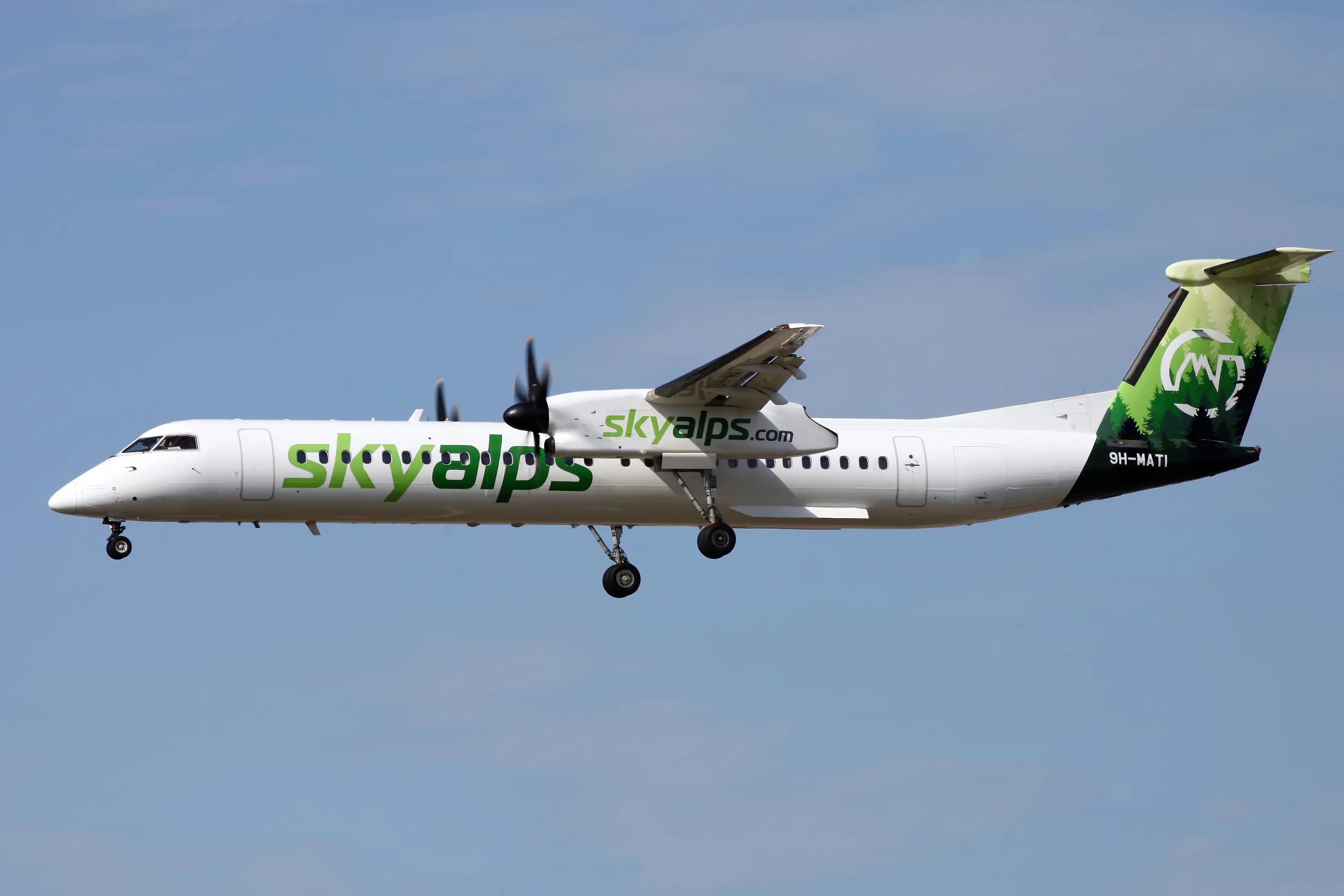
SkyAlps Overview & Company Profile
SkyAlps (legal name Sky Alps S.r.l., IATA BQ, ICAO SWU, callsign SKYALPS) is a small Italian regional carrier based at Bolzano Airport in South Tyrol. It was created by South Tyrolean entrepreneur Josef Gostner, whose ABD Holding acquired Bolzano Airport from the provincial government in 2019, and it sits within the FRI-EL Green Power group, the Gostner family's renewable-energy business. The first revenue flights operated on 17 June 2021 to Olbia and Ibiza, with regular scheduled service beginning on 15 December 2021 once the runway works at Bolzano were complete.
For its first eighteen months the airline flew using partner capacity. ENAC, the Italian civil aviation authority, issued SkyAlps its own Italian Air Operator Certificate and operating licence on 16 January 2023, and the carrier still appears on ENAC's register of national scheduled airlines. Company communications in June 2026 described a workforce of more than 150 professionals, up from 94 employees recorded at 30 September 2024.
Pilots evaluating SkyAlps need to understand what kind of employer this is. It is not a legacy carrier, not a low-cost carrier, and not a Lufthansa-style regional feeder. It is an owner-financed boutique operation of roughly a dozen turboprops, built around a single small alpine airport, carrying under 200,000 passengers a year, with a large and persistent accumulated deficit. That shapes every part of the offer: the pay, the roster, the training, and above all the risk profile. Section 9 covers the finances in detail, and any candidate should read it before reading the salary section.
The commercial positioning is deliberately premium. SkyAlps markets itself as a "boutique" carrier serving South Tyrol's ski and Dolomites tourism market, connecting Bolzano to German, Benelux, Scandinavian, British and Mediterranean cities, and it has expanded beyond its home base into Bosnia and southern Italy. In 2026 the airline scheduled flights to 37 European airports according to Cirium data reported in the Italian trade press, with 29 unique airports appearing in its own published summer timetable.
SkyAlps publishes no pilot pay scale, no collective agreement, no roster policy and no crew headcount. Most of the working-conditions data in this guide therefore comes from three types of source: the airline's own official job advertisements and corporate pages, Italian and German trade press reporting on its finances and regulatory position, and anonymous pilot-submitted data on PilotJobsNetwork that was last substantively updated in May 2024. Where a figure is crowdsourced rather than official, it is labelled as such. Nothing here should be treated as a substitute for a written offer.
Fleet: The All-Q400 Operation
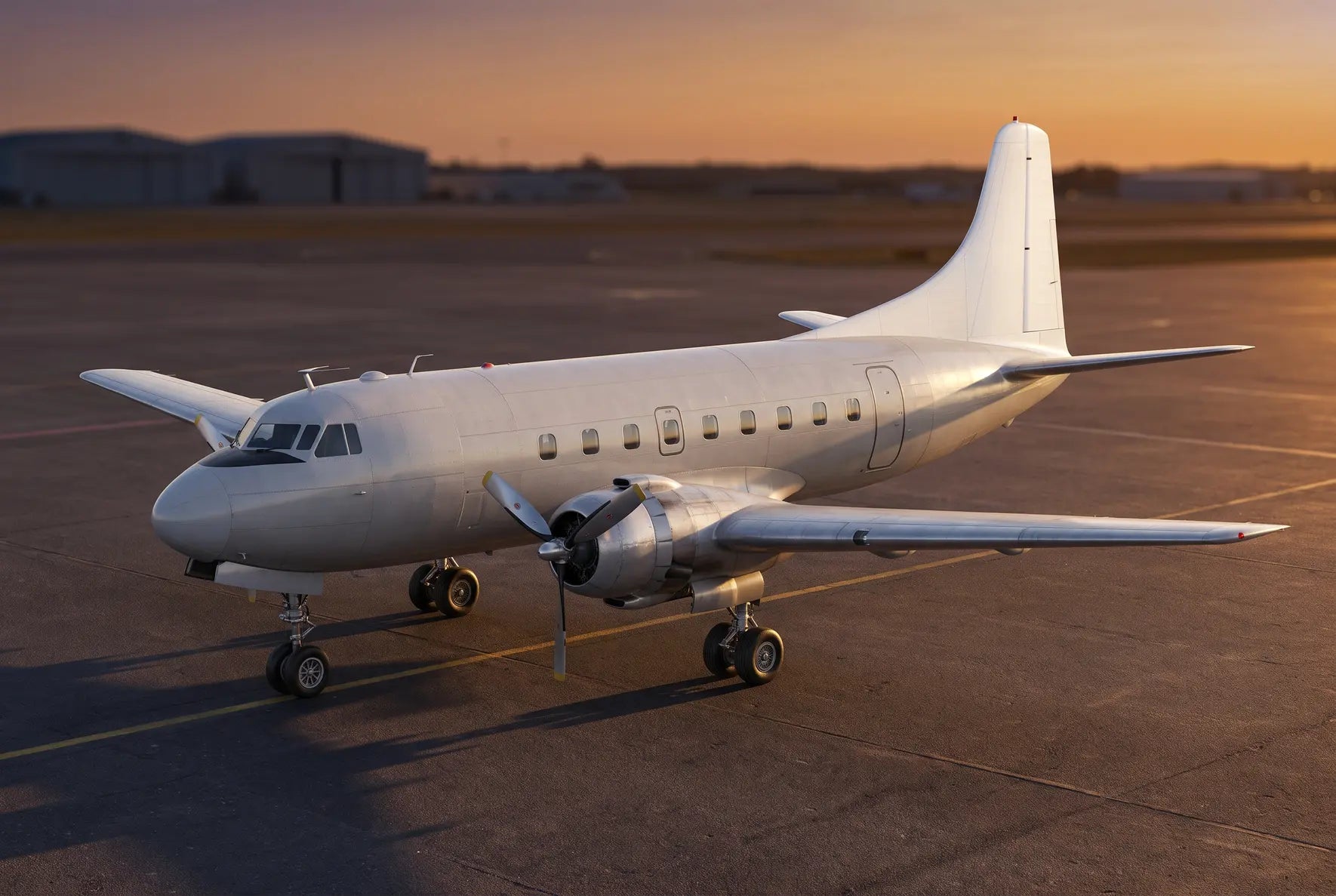
SkyAlps operates a single type: the De Havilland Canada DHC-8-402, universally known as the Dash 8-Q400. The airline's own fleet page confirms the all-Q400 policy and quotes a capacity of up to 76 passengers, with some airframes configured to 78. The choice is presented as an environmental one: the "Q" stands for "quiet", and the company argues that a modern turboprop produces lower emissions and less noise on take-off and landing than a regional jet on the sector lengths it flies.
For a pilot, the operational reality matters more than the marketing. The Q400 is a demanding aeroplane to fly well. It is fast for a turboprop (cruise in the region of 350 knots true), it is a genuine jet-speed competitor on short sectors, and it is unforgiving on landing technique and propeller handling. Its systems are simpler than a modern narrowbody, but the workload in mountain terrain, in icing conditions and on short runways is higher. Pilots who build meaningful Q400 command time acquire a skill set that remains in demand across European, Scandinavian, Middle Eastern and Asian regional operators.
The counterpoint is equally important: Q400 time is not jet time. If your career objective is a European or Gulf narrowbody or widebody seat, a Q400 rating does not shorten that path in the way an A320 or 737 rating would. Some carriers value multi-crew turboprop command highly, others treat it as a partial match. That trade-off should be weighed before accepting a Q400 rating as your first type.
Fleet Composition
| Registration | MSN | Build Year | Register | Owner / Lessor |
|---|---|---|---|---|
| 9H-PET | 4104 | 2005 | Malta | Not stated |
| 9H-MATI | 4157 | 2007 | Malta | DAE Capital |
| 9H-AKE | 4223 | 2008 | Malta | DAE Capital |
| 9H-AKB | 4226 | 2008 | Malta | DAE Capital |
| 9H-BEL | 4230 | 2008 | Malta | Chorus Aviation (ex-Flybe G-ECOK) |
| OE-IMP | 4234 | 2008 | Austria | Ex-LGW / Air Berlin |
| 9H-EVA | 4237 | 2008 | Malta | Chorus Aviation (ex-Flybe G-ECOO) |
| OE-IMQ | 4239 | 2008 | Austria | Ex-LGW / Air Berlin |
| 9H-SOP | 4242 | 2008 | Malta | DAE Capital |
| OE-IMR | 4245 | 2009 | Austria | Ex-LGW / Air Berlin |
| 9H-MAYA | 4248 | 2009 | Malta | DAE Capital |
| OE-IMT | 4250 | 2009 | Austria | Ex-LGW / Air Berlin |
| 9H-PAUL | 4255 | 2009 | Malta | DAE Capital |
Registration-level data from published fleet records dated 29 December 2025, cross-checked against 2026 reporting. Average fleet age is approximately 17.8 years. Individual aircraft status changes faster than public databases update.
Two structural points stand out. First, the fleet is old by European standards: an average age of roughly 17.8 years, with the youngest airframes built in 2009 and the oldest in 2005. This is normal for the used-Q400 market (the type has been out of large-scale production for years), but it means higher maintenance intensity and greater exposure to technical delays than a young narrowbody fleet.
Second, the fleet is not registered in Italy. Nine airframes are on the Maltese 9H register and four on the Austrian OE register, the latter acquired from the former LGW and Air Berlin fleet. Foreign registration is common in leasing structures and is not in itself irregular, but it does mean continuing airworthiness oversight sits partly outside the Italian system, a point that became directly relevant during the 2025 regulatory action described in Section 9.
SkyAlps announced in 2023 that it intended to grow to 14 Q400s, and it did assemble a paper fleet of that size. The reality has been slower: several of the Austrian aircraft were never fully inducted, only eight were operational before the February 2025 audit, and reporting in July 2026 counted seven aircraft active and six parked. In August 2026 the company stated that the entire fleet was operational again. The airline has also worked with Tamarack Aerospace on a Q400 modification package involving active winglets, updated avionics and lighter interiors, though this remains a development project rather than a delivered fleet upgrade.
The position is not uniform. The current official First Officer advertisement does not require a Q400 rating, and external listings for Captain positions have appeared in both type-rated and non-type-rated form, with training reported as provided for non-type-rated commanders. No SkyAlps training-bond amount or repayment schedule is publicly disclosed. Separately, the airline's cadet pathway through AELO Swiss Academy is fully self-funded by the candidate and includes the Q400 rating in its price. Anyone offered a company-funded rating should obtain the training agreement, the bond value, and the linear reduction schedule in writing before signing.
Network, Bases & the Alpine Flying Environment
SkyAlps flying is short-sector, high-cycle, terrain-influenced and strongly seasonal. There are no long-haul rotations, no augmented crews and no multi-day exotic layovers. What there is instead is a genuinely interesting operational environment that many larger European carriers cannot offer, combined with the fatigue profile of a high-cycle turboprop operation.
Bolzano: A Short, Terrain-Constrained Runway
Bolzano Airport (BZO / LIPB) has a single runway, 01/19, measuring approximately 1,432 m by 45 m of grooved asphalt at a field elevation of around 240 m (787 ft), according to the airport's published technical data. It sits in the Adige valley, hemmed in by Dolomite terrain, and the published airport briefing material does not show a precision ILS approach on the runway table.
For a Q400 crew this is not a routine field. A 1,432 m runway with high surrounding terrain means that performance calculations are live constraints rather than paperwork: take-off weight, temperature, wind component, contamination state and obstacle clearance genuinely determine what you can carry on a hot summer afternoon or a snowy January morning. Non-precision approach work in a valley, combined with a winter tourist schedule, produces a workload profile closer to Scandinavian or alpine regional flying than to a flat-field European short-haul operation.
The airport itself is small. It handled 106,629 passengers in 2024 and approximately 123,000 in 2025, a record year for the field. SkyAlps carried around 180,000 passengers in 2025 across its whole network, which tells you how much of the airline's activity now happens away from its home base.
Bases and Operating Stations
| Station | Status | 2026 Operation |
|---|---|---|
| Bolzano (BZO) | Main base and headquarters | Around 20 summer destinations across Germany, Benelux, UK, Greece, Spain and southern Italy |
| Mostar (OMO) | Second operating base | Bari, Milan Bergamo, Palermo and Rome Fiumicino |
| Rome Fiumicino (FCO) | Operating station | Klagenfurt and Salzburg, plus links to Mostar and Crotone |
| Crotone (CRV) | PSO station | Rome Fiumicino under public service obligation |
SkyAlps does not publish a definitive crew-base list. Bolzano is unambiguously the main base and Mostar has been publicly described as an established base. Rome Fiumicino and Crotone appear in the 2026 timetable as operating points; whether crew are contractually based there should be confirmed in writing.
Winter 2026/27 from Bolzano covers Antwerp, Berlin, Billund, Copenhagen, Dresden, Düsseldorf, Gothenburg, Hamburg, Hannover, London Gatwick, Prague and Warsaw, reflecting the ski-season inbound market. Summer swings toward Mediterranean leisure: Olbia, Cagliari, Catania, Brindisi, Lamezia Terme, Ibiza, Menorca, Brač, Corfu, Kefalonia, Preveza and Thessaloniki. The seasonal swing is severe, and pilots should ask directly how the company manages winter and summer crewing levels.
The Crotone to Rome Fiumicino service is a public service obligation (continuità territoriale) route, sold at regulated fares of around €63 to €64 one way. In March 2026 the Calabria regional government allocated approximately €4.6 million to extend the connection through to 31 August 2027 after national budget funding fell short. PSO contracts are the most stable revenue an airline of this size can hold: the flying is contracted, the fare risk is capped, and the schedule is fixed. From a job-security standpoint, subsidised route awards are a meaningfully more reliable base of activity than seasonal leisure charters.
This guide omits the layover-destinations section that appears in guides to legacy carriers, because SkyAlps operates no long-haul flying. Duties are short-sector rotations, some with outstation night stops. Pilot-reported data from May 2024 indicated 10 to 15 nights away from home per month, occasionally up to 21, which is high for a European short-haul operation and should be verified against a current sample roster.
Pilot Salary & Compensation
This is the section where candid treatment matters most. SkyAlps does not publish a pilot pay scale. Its official First Officer and Captain vacancies list requirements and duties but say nothing about compensation, contract type or benefits. There is no publicly accessible company collective agreement. The only pay figures in the public domain are anonymous, pilot-submitted entries on PilotJobsNetwork, last substantively updated in May 2024.
Those figures are reproduced below because they are the only SkyAlps-specific data that exists, not because they are authoritative. They should be treated as a starting point for negotiation and verification, never as a quotation.
Reported SkyAlps Compensation (Crowdsourced, May 2024)
| Item | Reported Figure | Annualised at 12 Payments | Caveat |
|---|---|---|---|
| First Officer (listed as "FO top") | €2,100 / month | ~€25,200 | Gross or net not stated; number of payments not stated |
| Captain (listed as "Captain base") | €3,700 / month | ~€44,400 | Guaranteed flying and payment count not stated |
| First Officer duty allowance / per diem | €40 | Variable | Presented per qualifying day; contractual trigger not stated |
| Captain duty allowance / per diem | €70 | Variable | Same caveat |
| Staff travel | SkyAlps services only | n/a | No published interline or MyID entitlement |
| Contract duration | One-year contracts reported | n/a | Reported June 2024; may not reflect current offers |
Source: anonymous pilot submissions to PilotJobsNetwork, last substantively updated May 2024. Annualised columns are simple arithmetic, not verified total-compensation figures, and exclude any thirteenth or fourteenth monthly payment, flight-hour pay or seasonal bonus.
Where This Sits in the Italian Market
| Carrier | First Officer | Captain | Allowances |
|---|---|---|---|
| SkyAlps (Q400) | €2,100/month reported | €3,700/month reported | €40 / €70 per day reported |
| Air Dolomiti (E190/E195) | €53,390 entry to €78,886 senior (annual base) | €91,345 entry to €135,037 senior (annual base) | €75/day; duty hours above 120 paid at €47/hr, above 170 at €95/hr |
| Aeroitalia (737 / ATR / E-Jet) | ~€45,000 to €70,000 gross (indicative) | Senior captain above €120,000 (indicative) | Fixed daily allowance €46 / €50 under company agreement |
| Wider Italian junior market | ~€28,000 to €35,000 gross at low-entry regional scales | ~€90,000+ at established short-haul carriers | Highly contract-dependent |
Comparison figures are pilot-reported or drawn from recruitment guides and union summaries rather than official payroll documents. They are directionally useful for benchmarking, not precise.
The conclusion is unambiguous. On the only data available, a SkyAlps First Officer earns roughly half of an Air Dolomiti First Officer at entry, and a SkyAlps Captain earns well under half of an Air Dolomiti Captain. Even allowing for uncertainty in crowdsourced numbers, the gap is too wide to be an artefact of measurement. SkyAlps sits at the bottom of the Italian scheduled-airline market for pilot pay.
One indirect cross-check is available from the company's own filed accounts. SkyAlps reported a personnel cost of €6.669 million for 2024 against a headcount in the region of 100 employees. That implies an average total employer cost per employee (across pilots, cabin crew, ground and administrative staff, and including employer social contributions) of roughly €67,000. Employer cost is not salary, and pilots sit above the company average, but the figure is not consistent with a fleet of well-paid commanders.
No official SkyAlps pay scale exists in the public domain. Every SkyAlps figure above is anonymous and dated to 2024. Before accepting any offer, request a complete gross annual illustration covering: base salary and the number of monthly payments (Italian contracts often include a thirteenth and sometimes a fourteenth); guaranteed flight or duty allowance; block-hour or sector pay above threshold; positioning and standby pay; night, Sunday and public-holiday premiums; per diem rates by station; hotel and transport provision; and which elements are pensionable. Also confirm the employing legal entity and the country of the employment contract, because the fleet is registered in Malta and Austria and the group has established a Slovak company (see Section 9).
Roster Pattern & Quality of Life
SkyAlps publishes no roster policy, no fixed pattern and no commuting scheme. Its official vacancies state only that candidates must be "able to work shifts including weekends". The quality-of-life data below is therefore drawn from pilot-submitted reports dated May 2024, supplemented by the statutory floors that apply regardless of what any company offers.
Reported SkyAlps Roster Conditions
Read carefully, this is a mixed picture. A minimum of seven days off per month is exactly the EASA regulatory floor, not an improvement on it. An average of around ten days off is below what most established European short-haul operators provide, where twelve to fourteen is common. The reported 32 days of annual leave, by contrast, is genuinely above the Italian statutory minimum of four weeks and would be a real benefit if confirmed contractually.
The figure that deserves the most attention is nights away from home. Ten to fifteen away nights per month, with reports of up to 21, is a heavy pattern for a short-haul turboprop operation and reflects the outstation-driven network described in Section 3. If you are considering SkyAlps for lifestyle reasons because Bolzano is an attractive place to live, that assumption needs testing against an actual roster.
📅 Illustrative Month, Q400 First Officer (built from reported averages)
This grid is an illustration constructed from the reported average of about ten days off per month. It is not a SkyAlps roster and the airline publishes no fixed pattern. Several of the flying days shown would involve outstation night stops rather than returns to base.
The Regulatory Floor: EASA Flight Time Limitations
Where a company provides no contractual protection above the minimum, the minimum becomes the working condition. The EASA ORO.FTL rules apply to SkyAlps as an EU operator and set the following ceilings.
| Protection | Regulatory Limit |
|---|---|
| Duty hours | 60 hours in 7 consecutive days; 110 in 14 days; 190 in 28 days |
| Flight hours | 100 hours in 28 days; 900 hours in a calendar year; 1,000 hours in 12 consecutive months |
| Rest at home base | At least the length of the preceding duty, or 12 hours, whichever is greater |
| Rest away from base | At least the length of the preceding duty, or 10 hours, whichever is greater |
| Extended recovery rest | At least 36 hours including two local nights, with no more than 168 hours between recovery periods |
| Free days | At least 7 local days free of all duty and standby per calendar month, and 96 per calendar year |
| Italian statutory annual leave | Minimum four paid weeks; at least two taken in the accrual year, the remainder within 18 months |
These are legal ceilings and floors, not a description of a good roster. A company operating consistently near the limits is compliant but demanding.
Ask for a redacted sample roster from both a January and a July, since the seasonal swing at SkyAlps is severe. Establish in writing: how many days off are contractually guaranteed above the regulatory seven; how far in advance rosters are published and how often they change; whether days off are protected once published; how standby is structured and paid; whether outstation night stops count as duty for allowance purposes; and how leave is bid and allocated during the peak ski and summer seasons.
Benefits, Pension & Social Protection
SkyAlps publishes no benefits booklet for flight crew. What follows separates two distinct things: the statutory and sectoral protections that apply automatically to a pilot employed in Italy, and the company-specific benefits that a candidate must verify individually because there is no public evidence of them.
Statutory and Sectoral Protection in Italy
An Italy-employed pilot is enrolled in the INPS Fondo di previdenza per il personale di volo, universally known as the Fondo Volo. This is not a supplementary scheme sitting on top of the ordinary state pension. It substitutes for the general AGO scheme for old-age, invalidity and survivors' benefits for aircrew employed by air navigation companies, and it is one of the genuinely valuable features of an Italian aviation contract. Details are published by INPS.
Two mechanics inside the Fondo Volo matter directly to pilots. First, flight allowances (indennità di volo) generally count at 50% for pensionable-income purposes under the post-1995 rules. A pay package that is heavily weighted toward allowances rather than base salary therefore builds less pension than the headline number suggests, which is another reason to insist on a breakdown of fixed versus variable pay. Second, the Fondo provides a specific occupational invalidity pension where a member becomes permanently unable to exercise the licensed aviation profession, historically subject to a qualifying period of at least ten years' contributions including five compulsory Fondo Volo years. That is a meaningful protection, but the qualifying period means it does very little for a pilot in their first years of an airline career.
1. Loss of licence. This is the single most important insurance a professional pilot holds. Ask for the policy, the insured sum, whether cover is occupational-only or 24-hour, the exclusions, and whether the premium is employer-paid. If the employer does not provide it, budget for an individual policy through ANPAC or a specialist aviation broker before your first line flight.
2. Supplementary pension and health fund. Confirm whether the contract enrols you in Fondaereo and Sanivolo, and at what employer contribution rate. By comparison, Aeroitalia's company collective agreement is publicly reported to include a 2% employer Fondaereo contribution plus Sanivolo cover.
3. Staff travel. Reported as SkyAlps-only. For a pilot commuting into Bolzano or Mostar from elsewhere in Europe, the absence of interline or ZED agreements is a real and recurring personal cost that should be factored into any salary comparison.
Career Progression & Command Upgrade
SkyAlps operates no published seniority list, no bid system and no stated upgrade timeline. There is no "X years to command" figure to quote, because the airline has never published one and the operation is too small and too volatile for a reliable pattern to have emerged. Progression is discretionary and driven by operational need.
That cuts both ways. In a large carrier, seniority protects you and constrains you in equal measure. In a thirteen-aircraft operation, a capable pilot can be noticed quickly, and the company has publicly recruited direct-entry Captains, including non-type-rated candidates, at experience levels that are low by European standards. But the same smallness means there is no queue to protect your position, no guaranteed progression, and no group mobility to another fleet or another airline within a parent company.
| Career Point | SkyAlps Position | Notes |
|---|---|---|
| Entry as First Officer | EASA ATPL + 300 hours in commercial air transport | Per the current official vacancy. Note the advert specifies ATPL, not a frozen ATPL. |
| Cadet entry | Self-funded MPL via AELO Swiss Academy | 18-month programme including Q400 type rating; permanent First Officer contract on successful completion. |
| Direct-entry Captain | Yes, actively recruited | EASA ATPL, 3,000 hours total, 500 hours PIC in CAT, English ICAO Level 4+, European passport. |
| Type-rated Captain (specialist campaign) | 5,000 total / 2,000 MEMC turbine over 20t / 1,500 Q400 command | A separate, much more demanding earlier campaign. Requirements vary substantially between campaigns. |
| Internal upgrade to command | Occurs, but no published timeline or seniority guarantee | Driven by fleet utilisation, vacancies, course capacity, ATPL/PIC eligibility and performance. |
| Instructor roles (TRI / TRE) | Exist within the operation | Small operator, so instructor slots are few but proportionally more accessible. |
| Fleet or long-haul transition | None available | Single-type operator with no jet fleet, no widebody and no group carrier to transfer to. |
The parked-aircraft position is the practical constraint on upgrades. Reporting in July 2026 counted seven aircraft active and six inactive, with the company stating in August 2026 that the full fleet was operational again. Command opportunities scale with aircraft in service and sectors flown, so a pilot joining on the expectation of a fast upgrade should ask specifically how many aircraft are flying, how many commanders are currently employed, and how many command courses ran in the last twelve months.
A Q400 command is a genuinely portable credential in specific markets: European and Scandinavian regional operators, UK and Irish regionals, and turboprop operators in Africa, the Middle East and Asia-Pacific. Multi-crew turbine PIC time above 20 tonnes also satisfies the command-experience gate at many jet operators, even where the type does not match. What it does not do is put you at the front of the queue for an A320 or 737 seat, where operators typically prefer jet time or will require a full type rating and line training investment. Treat a SkyAlps command as a route to command experience rather than a route to a specific next aircraft.
Pilot reports dated 2024 referred to one-year contracts, low morale and captain departures. These reports are now two years old and should not be treated as the current position, but they are specific enough to warrant a direct question. Ask whether the offer is a contratto a tempo indeterminato (permanent) or a tempo determinato (fixed term), what the probation period is, what notice applies on both sides, and what the annual pilot turnover has been. The AELO cadet pathway advertises a permanent First Officer contract on completion, which suggests permanent contracts do exist within the company.
Recruitment Process & Requirements
SkyAlps recruitment is direct and unbureaucratic. There is no online assessment portal for experienced pilots, no psychometric day at a selection centre, and no annual campaign window. Vacancies are posted on the SkyAlps careers page and applications go by email to hr@skyalps.com with a signed privacy notice attached. A separate cadet route runs through an external academy.
First Officer, Official Requirements
Captain, Official Requirements
Two observations on these requirements. The First Officer bar of 300 hours in CAT is low, and combined with the ATPL requirement it targets a specific candidate: someone who already has airline or commercial operator experience but not a great deal of it. The Captain bar of 3,000 total and 500 PIC in CAT is also low by European standards, where 4,000 to 5,000 total hours with 1,000 to 2,000 command hours is more typical for a direct-entry command. Low entry bars in a small operator are an opportunity for the right candidate and a warning sign about retention for others. Both readings are legitimate.
Note also that requirements vary sharply between campaigns. An earlier specialist campaign for type-rated commanders demanded 5,000 hours total, 2,000 hours multi-engine multi-crew turbine above 20 tonnes, and 1,500 hours of Q400 command, applied through a separate training email address. Do not assume the current advertised minima are permanent.
Selection Process
Application by Email
Send CV, licence, medical, logbook summary and the signed SkyAlps privacy notice to hr@skyalps.com. The privacy notice is a mandatory attachment and applications without it may not be processed. There is no applicant tracking portal for experienced pilots.
Screening and Interview
SkyAlps does not publish its selection stages. In an operator of this size, expect a document screen followed by an interview with a flight operations manager or chief pilot, covering technical knowledge, operational judgement and fit with a small crew community.
Simulator Assessment
Not confirmed publicly for either the First Officer or Captain campaigns. Most EASA operators recruiting non-type-rated pilots run a simulator assessment as part of selection. Ask in advance whether one applies, on what device, and whether it is a company profile or a generic multi-crew exercise.
Offer, Contract and Training Agreement
This is the stage that matters most at SkyAlps, because so little is public. Obtain the employment contract, the applicable CCNL code, the training agreement and any bond, the benefits schedule and the base assignment in writing before signing. See the due-diligence checklist at the end of this section.
Type Rating and Line Training
Non-type-rated pilots complete the DHC-8-400 course, followed by line flying under supervision. Confirm the course provider, its location, whether accommodation and travel during training are covered, whether training is paid, and what happens if you fail a stage.
The Cadet Route: AELO Swiss Academy MPL
For candidates with no flight experience, SkyAlps is the airline partner for a Multi-Crew Pilot Licence (MPL) programme run by AELO Swiss Academy. The programme runs approximately 18 months across four phases (Basic, Intermediate, Advanced and Type Rating), and includes around 240 flight hours, 1,000 classroom hours, accommodation for the duration, the Dash 8 Q400 type rating, Class 1 medical examination, exam preparation materials and a pilot kit. Selection involves a CV assessment, an online application, AON online assessments, a personal interview and medical clearance. Successful graduates are offered a permanent First Officer employment contract with SkyAlps.
The programme is fully self-funded. The advertised all-inclusive price has been quoted at €99,700 and at €104,950 in different published materials, up from €94,950 on a 2024 version of the programme page. Candidates should rely only on the current signed quotation.
Against the crowdsourced First Officer figure of roughly €2,100 per month, a self-funded outlay of approximately €100,000 is a very long payback, and an MPL is more restrictive than a conventional ATPL because it is tied to a multi-crew operation and to a specific type. If SkyAlps ceased operations or terminated a fixed-term contract before conversion, an MPL holder would be in a materially weaker position than an ATPL holder in the same situation. Read Section 9 on the company's financial position before committing to any self-funded pathway, and take independent advice on what happens to the MPL if the airline partnership ends.
Obtain in writing: (1) the employing legal entity and the country of the employment contract; (2) the CCNL code and any second-level company agreement referenced in the lettera di assunzione; (3) a full gross annual pay simulation including all allowances and the number of monthly payments; (4) the contract type, duration, probation and notice periods; (5) the training agreement and bond value with its reduction schedule; (6) the assigned crew base and the rules for changing it; (7) guaranteed days off above the regulatory seven; (8) loss-of-licence insurance details; (9) Fondo Volo, Fondaereo and Sanivolo enrolment and contribution rates; and (10) current fleet reactivation status and planned aircraft in service for the next twelve months.
Financial Health, the ENAC Grounding & Job Security
For most airline guides this section is a footnote. For SkyAlps it is the section a pilot should read first. The airline has never posted a meaningful profit, it lost approximately €20 million in a single year, and in 2025 it had roughly half its fleet suspended by the national regulator over maintenance documentation. None of this makes SkyAlps a bad place to fly. It does make it a job that requires clear-eyed risk assessment rather than optimism.
Financial Track Record
| Year | Revenue | Net Result | Context |
|---|---|---|---|
| 2021 to 2022 | Not separately disclosed | Approx. minus €10 million combined | Start-up phase; 2022 alone reported at minus €7.18 million |
| 2023 | €23.04 million | Approx. minus €4.65 million | First year on own AOC (issued January 2023) |
| 2024 | €38.55 million | Plus €7,717 | Effectively break-even. Personnel cost €6.669 million. |
| 2025 | €62.8 million | Approx. minus €20 million | Just under 180,000 passengers. Approx. €110 lost per passenger and over €4,000 per departure. |
| Cumulative to 31 Dec 2025 | Approx. minus €34 million | Total net losses since launch in 2021 |
Figures compiled from Italian trade and national press reporting in July 2026, including Corriere della Sera and TTG Italia, and from company filings summarised by Italian commercial registry services. Shareholders were reported to have injected around €17 million by the end of 2024 to cover accumulated deficits.
The 2025 result is stark in context. Italian aviation had a record year in 2025, with the main national carriers reporting widespread profits. SkyAlps was the outlier. Company chairman Josef Gostner attributed the loss to the grounding of much of the fleet and the cost of replacement wet-lease capacity, described the losses as start-up investment, and stated a target of returning to operating profit in 2026 with a good profit expected within three years. As of August 2026, the company reported that the whole fleet was operational again and that it aimed to restore direct Bolzano flights to Rome and Paris.
The 2025 ENAC Grounding
In August 2025 a Bratislava-based Slovak company, Sky Alps Europe s.r.o., was registered within the Gostner business network with a small share capital. Local reporting indicated the company explored Slovak aviation certification without holding a Slovak AOC, and that it was searching for aviation personnel in Bratislava. This generated concern among staff and observers about a possible cost-driven relocation of employment to a lower-wage jurisdiction, sometimes described as "flagging out". SkyAlps publicly stated it was only testing new business fields and that the South Tyrol operation would remain unchanged. No transfer of employment has been publicly documented. Nevertheless, any candidate should confirm in writing which legal entity employs them, in which country, and under which social security system, and what happens if operations are restructured.
Negative factors: approximately €34 million of cumulative losses since 2021; a €20 million loss in 2025; a regulatory intervention that grounded half the fleet; an ageing, foreign-registered leased fleet; reported one-year contracts in 2024; the absence of a documented collective agreement; and the unexplained Slovak entity.
Positive factors: no bankruptcy, liquidation, concordato preventivo or formal insolvency proceeding was located as of August 2026; the AOC and operating licence remain in force and SkyAlps continues to appear on ENAC's national airline register; the owner has demonstrated willingness to inject capital, with more than €15 million reportedly provided; revenue is growing (€23m to €38.6m to €62.8m across 2023 to 2025); subsidised PSO flying provides a contracted revenue floor through August 2027; and the airline is actively recruiting pilots.
Net position: the company is operating, licensed and hiring, but it is dependent on continued shareholder support. A pilot considering SkyAlps should be able to absorb the loss of the job at short notice, and should be sceptical of any self-funded training commitment tied to it.
How SkyAlps Compares: Airline Radar Chart
The two most useful Italian benchmarks for a pilot weighing a SkyAlps offer are Air Dolomiti, the Lufthansa Group's Italian regional carrier, and Aeroitalia, a fast-growing independent operator. Air Dolomiti represents the ceiling of the Italian regional market; Aeroitalia represents the growth-carrier alternative. Scores below are editorial estimates derived from the research in this guide, using the same six-metric framework as the scorecard.
The Three Carriers Side by Side
| SkyAlps | Air Dolomiti | Aeroitalia | |
|---|---|---|---|
| Fleet (2026) | 13 Dash 8-Q400 | 29 Embraer (20 E195, 9 E190), growing toward ~30 by 2028 | 16 aircraft (737-700/800, ATR 72-600, E175, E195) plus 5 737 MAX 8 ordered |
| Group | Independent (FRI-EL Green Power) | Lufthansa Group | Independent |
| Main bases | Bolzano, Mostar | Verona, Florence, feeding Munich and Frankfurt | Bergamo, Comiso, Genoa, Rome Fiumicino, Salerno |
| Entry FO requirement | EASA ATPL + 300 hrs CAT | Type rating not required for FO entry; company funds the rating | CPL frozen ATPL, MCC/JOC, Class 1, ICAO 4 |
| Direct-entry Captain | Yes: 3,000 total / 500 PIC CAT | Reported available with fast-track options | 3,500 total / 1,500 PIC jet |
| Documented company agreement | None found publicly | Company-level agreement exists historically | CCAL signed with UGL TA, ANPAC, ANPAV and ANP |
| Group staff travel | SkyAlps flights only | Lufthansa Group network access | Own network |
Key Takeaways
Air Dolomiti is the stronger career proposition on almost every measure. Reported First Officer base pay of €53,390 rising to €78,886, Captain pay of €91,345 rising to €135,037, a €75 daily per diem, Lufthansa Group backing, group staff travel, a modern and growing Embraer fleet, and E-Jet time that transfers well. If your objective is the best available Italian regional job, Air Dolomiti is the target and SkyAlps is not competitive with it.
Aeroitalia offers the best-documented contractual protection of the three. Its company collective agreement, signed with UGL Trasporto Aereo, ANPAC, ANPAV and ANP, publicly includes fixed pay floors, fourteen seniority steps, a fixed daily allowance of €46 or €50, a 2% employer Fondaereo contribution, Sanivolo health cover and insurance benefits. Knowing what is in your contract before you sign is worth a great deal, and Aeroitalia is transparent where SkyAlps is not. Its 737 flying also builds jet time.
SkyAlps competes on accessibility, not on quality of terms. Its entry bars are the lowest of the three at both First Officer and Captain level, and it recruits non-type-rated commanders. For a pilot at 300 hours of commercial air transport experience, or a pilot with 500 hours of command time seeking a first left-seat position, SkyAlps may be the only realistic door in the Italian market. That accessibility is its genuine value proposition, and it is paid for in salary, benefits and security.
On fleet, the gap is qualitative as well as quantitative. Air Dolomiti flies a young Embraer fleet in a transition that adds thirteen E195s from Austrian Airlines through 2028. Aeroitalia operates jets with MAX 8s ordered for 2027. SkyAlps operates a single ageing turboprop type with no ordered replacement and no jet transition path.
Radar scores are editorial estimates derived from the sources cited throughout this guide: official airline vacancy pages, company financial reporting in the Italian and German trade press, union and collective-agreement summaries, and anonymous pilot-submitted salary data. They reflect an assessment for an experienced European pilot weighing a multi-year commitment. SkyAlps scores are constrained by the near-total absence of published company data, which is itself a finding rather than a gap. Individual experience will vary with base, contract type and negotiation, and these scores will be revised as dedicated guides to Air Dolomiti and Aeroitalia are updated.
Union & Industrial Relations
Italy has a well-developed aviation union landscape and a national sector collective agreement. What is unclear is how much of it reaches SkyAlps. No SkyAlps-specific collective agreement, company-level accord, RSA or RSU works council for flight crew was located in the public domain, and no strike or industrial dispute involving SkyAlps pilots has been publicly reported. That is not proof that representation is absent, but it is a material information gap for anyone joining.
The Italian Aviation Union Landscape
The 2026 Sector Renewal
A renewal of the carriers section (sezione vettori) of the CCNL Trasporto Aereo was signed in July 2026, reported as involving average total economic increases of around 30%. Reported terms included tabular increases for flight personnel of 3% from September 2026, 4% from September 2027 and 5% from September 2028, plus one-off payments of €4,500 for captains and €3,500 for first officers, along with improvements to leave, rest, seniority, pension, health and insurance provisions. The agreement was reached with CGIL, CISL, UIL, ANPAC and ANP.
This is significant news for Italian pilots generally. Whether it reaches a specific SkyAlps employee is a different question. Applicability depends on whether the employer is covered by a signatory employers' association, whether the CCNL is incorporated by reference into the individual contract, and what any second-level company agreement provides. This is precisely why the CCNL code stated in the lettera di assunzione and on the busta paga is one of the most important pieces of information to obtain before signing.
At a large carrier, working conditions are set by a negotiated agreement that both sides publish and defend. At SkyAlps, no such document is publicly available, which means terms are set individually and are therefore individually negotiable and individually variable. In practice this has two consequences. First, your negotiating position at offer stage matters more than it would at a unionised carrier. Second, you have no published benchmark against which to test whether your offer is normal for the company. Joining ANPAC or another Italian aviation union gives access to professional and legal support, contract review and loss-of-licence products, and is worth considering irrespective of whether the employer recognises a union.
As an EU operator, SkyAlps is bound by EASA flight time limitations, EU continuing-airworthiness rules and EU social security coordination regardless of any company agreement. The regulatory floor is meaningful and enforceable, as the February 2025 ENAC audit demonstrated. Pilots who identify a safety or airworthiness concern have formal reporting routes through the company safety management system, through ENAC, and through the EU occurrence reporting framework, and are legally protected against retaliation for filing an occurrence report in good faith.
Verdict: Who Is SkyAlps For?
🎯 The Verdict
SkyAlps is an accessibility play. Its entry requirements are among the lowest in the European scheduled market: 300 hours in commercial air transport with an EASA ATPL for the right-hand seat, and 3,000 total hours with 500 hours of command time for a direct-entry left seat, both without a mandatory Q400 rating in the current adverts. For a pilot who cannot yet reach an Air Dolomiti or a major low-cost carrier, that open door has real value, and the flying itself is genuinely interesting: short sectors into a terrain-constrained 1,432 m alpine runway, a demanding turboprop, and a small crew community where an individual pilot is visible.
Everything else in the offer is weak or unverifiable. The only public pay data, anonymous and dated to 2024, puts a First Officer at around €2,100 per month and a Captain at around €3,700, roughly half or less of the comparable Air Dolomiti scale. There is no published pay scale, no accessible collective agreement, no documented loss-of-licence cover, no group staff travel and no fleet or jet transition path. Reported days off sit at or barely above the regulatory floor, with 10 to 15 nights away from home per month. The fleet averages nearly 18 years of age and is registered in Malta and Austria rather than Italy.
The financial position cannot be treated as background detail. SkyAlps has lost approximately €34 million since 2021, including around €20 million in 2025 alone, in a year when Italian aviation as a whole was profitable. Half its fleet was suspended by ENAC in March 2025 over maintenance certification deficiencies, and while the airline states the issue is resolved and its AOC was never suspended, the episode consumed a year of recovery and enormous wet-lease cost. A Slovak subsidiary registered in August 2025 raised unresolved questions about where employment might eventually sit. The counterweight is real: revenue is growing strongly, the owner has injected capital, subsidised PSO flying runs to August 2027, and no insolvency proceeding exists.
The honest summary is that SkyAlps is a stepping stone, not a destination. It can convert a low-hours commercial pilot into a line pilot, or a senior First Officer into a Captain, faster than most European alternatives. Take it for the hours and the command experience, negotiate hard, verify everything in writing, avoid any large self-funded commitment tied to it, and keep applying elsewhere while you fly.
1How much do SkyAlps pilots actually earn?
SkyAlps publishes no pay scale, and its official vacancies say nothing about compensation. The only public data is anonymous pilot-submitted information on PilotJobsNetwork, last substantively updated in May 2024, which reported approximately €2,100 per month for a First Officer and €3,700 per month for a Captain, with daily allowances of €40 and €70 respectively. Whether these are gross or net, and how many monthly payments apply, was not stated. These figures sit at the bottom of the Italian scheduled-airline market and are roughly half the reported Air Dolomiti scale. Treat them as a starting point for a written offer, not as a quotation.
2Do I need a Dash 8-Q400 type rating to apply?
Not according to the current official adverts. The First Officer vacancy requires an EASA ATPL and 300 hours in commercial air transport without expressly listing a Q400 rating, and Captain positions have been advertised in both type-rated and non-type-rated form, with training reported as provided for non-type-rated commanders. However, requirements vary substantially between campaigns: an earlier specialist campaign demanded a current Q400 rating with 1,500 hours of Q400 command. No SkyAlps training-bond amount is publicly disclosed, so obtain the training agreement and bond terms in writing before accepting.
3Do I need to speak Italian or German?
The official pilot vacancies require only excellent English at ICAO Level 4 or higher, along with a valid European passport. No Italian or German language requirement appears in the published pilot adverts. In practice, South Tyrol is a bilingual German and Italian region, and the company operates within the Italian regulatory and employment system, so some Italian is useful for administrative matters, payroll and dealing with INPS. It is not a stated barrier to being hired.
4Can non-EU citizens apply?
No. Both the First Officer and Captain vacancies require a valid European passport. There is no published sponsorship or work-permit pathway. A non-EU pilot with an EASA ATPL but without EU work rights would not meet the stated requirement.
5Is SkyAlps financially stable? Should I be worried about the ENAC grounding?
SkyAlps has accumulated approximately €34 million in net losses since launching in 2021, including roughly €20 million in 2025 on €62.8 million of revenue and just under 180,000 passengers, equating to about €110 lost per passenger. In February and March 2025, ENAC audited the airline and precautionarily suspended seven of its Q400s over maintenance certification deficiencies, leaving one own aircraft available. The AOC was never suspended, the airline maintained its schedule using expensive wet-leased capacity, and by July 2026 the company stated all required measures had been implemented and operations fully restored. As of August 2026, no bankruptcy or insolvency proceeding has been located, the AOC and licence remain in force, revenue is growing, the owner has reportedly injected more than €15 million, and the Crotone to Rome public service obligation is funded to 31 August 2027. The airline is operating and hiring, but it depends on continued shareholder support. Do not take this job without the ability to absorb losing it at short notice.
6Is the AELO self-funded MPL programme worth €100,000?
That is a judgement each candidate must make with independent advice, but the arithmetic deserves scrutiny. The 18-month AELO Swiss Academy programme has been advertised at €99,700 and at €104,950, includes around 240 flight hours, 1,000 classroom hours, accommodation, the Q400 type rating, Class 1 medical and a pilot kit, and offers a permanent First Officer contract with SkyAlps on successful completion. Against a reported First Officer salary of roughly €2,100 per month, the payback period is very long. An MPL is also more restrictive than a conventional ATPL, being tied to multi-crew operations and to a specific type. Combined with the company's financial position, this is a high-risk self-funded commitment. Ask specifically what happens to your licence and your contract if the airline partnership ends.
7Where would I be based, and how much time would I spend away from home?
Bolzano is unambiguously the main base and headquarters, and Mostar in Bosnia and Herzegovina has been publicly described as an established second base. Rome Fiumicino and Crotone appear as operating points in the 2026 timetable, but SkyAlps does not publish a definitive crew-base list, so the base must be confirmed in your contract. On time away from home, pilot-reported data from May 2024 indicated 10 to 15 nights away per month, occasionally up to 21, with an average of about 10 days off per month against a regulatory minimum of 7. Ask for redacted sample rosters from both a winter and a summer month, since the seasonal swing between the ski network and the Mediterranean network is severe.
8How does a SkyAlps Q400 command help my long-term career?
It builds multi-crew turbine command time above 20 tonnes, which satisfies the command-experience gate at a large number of operators and is directly valued by regional turboprop operators across Europe, Scandinavia, Africa, the Middle East and Asia-Pacific. What it does not do is substitute for jet time. If your target is an A320 or 737 seat at a major European operator, most will still require a full type rating and will weigh your Q400 command as partial rather than equivalent experience. The realistic framing is that SkyAlps offers a route to command experience and total hours, not a shortcut to a particular next aircraft. SkyAlps itself operates a single type with no jet fleet and no group carrier to transfer into, so any fleet or aircraft progression must come from changing employer.
Official Links & Resources
Because so little SkyAlps-specific information is published, verifying directly with primary sources matters more here than at a large carrier. These are the official pages and organisations relevant to a SkyAlps pilot career.
Before any interview, read the airline's most recent financial reporting in the Italian trade press alongside the official careers page. The two tell very different stories, and being able to ask an informed, non-hostile question about fleet reactivation, contract type and the applicable CCNL will tell you more about the employer in five minutes than any published guide can. If the company cannot or will not put those answers in writing, that is itself the answer.
- 01Overview & Company Profile
- 02Fleet: All-Q400 Operation
- 03Network & Bases
- 04Salary & Compensation
- 05Roster & Quality of Life
- 06Benefits & Pension
- 07Career Progression
- 08Recruitment & Requirements
- 09Finances & Job Security
- 10Airline Comparison
- 11Union & Industrial Relations
- 12Verdict & FAQ
- 13Links & Resources