

SKY Airline Overview & Company Profile
SKY Airline is a Chilean low-cost carrier headquartered in Santiago and based at Arturo Merino Benítez International Airport (SCL). It is the second largest airline in Chile behind flag carrier LATAM, and it holds a notable place in the country's aviation history as the first airline to operate a low-cost model in Chile. The carrier traces its roots to an air taxi operator founded in 1981, was rebranded as Sky Airline in 2001, and launched scheduled Chilean domestic operations in December of that year. Its official corporate site is skyairline.com.
The company remains closely tied to the Paulmann family. It was built up by founder Jürgen Paulmann and is today led by CEO Holger Paulmann. Since June 2023, the Abra Group, the holding company that also controls Avianca and GOL, has held a minority investment in SKY, giving the carrier a link to one of the larger airline groups in Latin America without folding it into a single brand. SKY runs its own frequent flyer programme, SKY Plus, and is not a member of any of the three global alliances.
SKY operates a point-to-point network of roughly 45 destinations across about eight countries, connecting domestic Chile with regional international markets including Argentina, Brazil, Colombia, Peru, Uruguay, and selected points in Mexico and the United States. The group carried more than 2.4 million passengers in the first quarter of 2024 alone (up around 16% year on year), and management has publicly targeted roughly 10 million passengers per year. The airline also runs a Peruvian subsidiary, SKY Airline Peru (IATA H8), based at Lima's Jorge Chávez International Airport, which operates its own aircraft and pilot base within the same operating philosophy. A planned Ecuadorian unit was shelved in late 2024.
For a pilot weighing SKY as an employer, the profile is clear: a growing, financially backed narrowbody operator with an unusually modern fleet, a value-oriented cost structure typical of low-cost carriers, and a Santiago-centred lifestyle. SKY has repeatedly ranked among the most punctual airlines in the region and was named Best Regional Airline in South America at the Skytrax World Airline Awards in 2014, 2015, and 2016. The sections below break down what that means day to day for the flight deck, from pay and rostering to the recruitment funnel and the recent labour negotiations that shaped current conditions.
Fleet Composition & Type Ratings
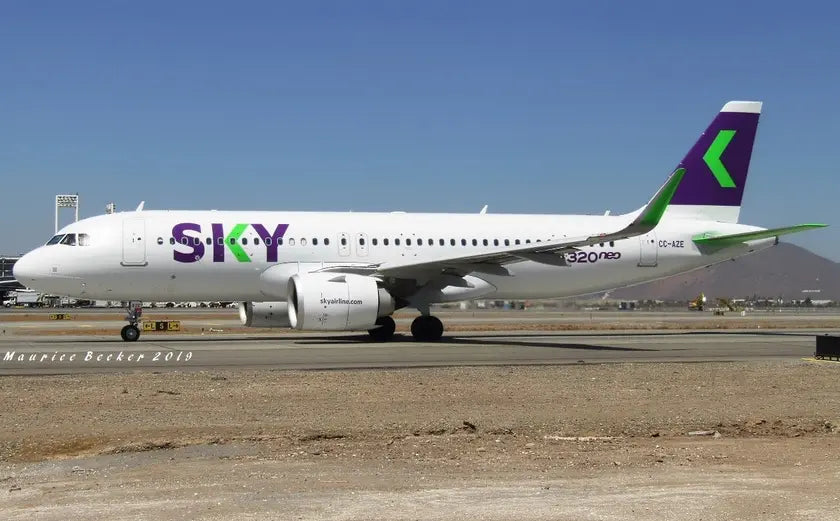
SKY Airline operates one of the most modern fleets of any carrier in the Americas. It is an all-Airbus, all-neo operator, flying exclusively the current-generation A320neo family. SKY was in fact the first airline in the Americas to run a fleet composed entirely of neo aircraft, having retired its last previous-generation jets and, before that, its original Boeing 737 fleet (phased out by 2013). Because every aircraft has been delivered since 2018, the fleet is among the youngest in commercial aviation worldwide, which has direct benefits for pilots in the form of consistent cockpits, modern avionics, and lower technical dispatch problems.
The fleet is built around the A320neo as the workhorse, complemented by the larger, higher-capacity A321neo on denser routes. The headline development is the order for the A321XLR, an extra-long-range single-aisle jet that will let SKY fly narrowbody metal on routes that historically required widebodies. SKY is the launch customer for the type in Latin America, with deliveries scheduled from 2026 onward. For a pilot, this matters: a single type rating on the A320 family covers the entire fleet, from a short domestic hop to a long transcontinental A321XLR sector.
| Aircraft Type | Role | In Service | Routes / Notes |
|---|---|---|---|
| Airbus A320neo | Narrowbody | ~29 | Core of the fleet. 186 seats. Domestic Chile, Peru, and regional international. |
| Airbus A321neo | Narrowbody | ~7 | 238 seats. High-demand and longer regional sectors. |
| Airbus A321XLR | Narrowbody (long-range) | 0 (10 on order) | Launch customer in Latin America. Deliveries from 2026. Range up to ~8,700 km. |
Fleet data compiled from public sources as of early 2026. Around a third of the group's aircraft are based in Lima under SKY Peru. Numbers are approximate and shift with deliveries.
Every SKY pilot flies the A320 family, so there is a single type rating to hold and maintain across the whole operation. New First Officers, including cadets, enter directly onto the A320neo. Because the airline does not operate widebodies or a second type, there is no fleet-transfer politics and no multi-type seniority juggling: the career is built vertically (First Officer to Captain) rather than by moving between aircraft. When the A321XLR arrives, it will sit under the same A320-family rating, with differences training rather than a full new rating.
SKY does not publish a live, audited fleet list for public use, and figures move as lessors deliver aircraft and as units rotate between the Chilean and Peruvian operations. The counts above are best estimates drawn from aviation databases and press releases. Pilots evaluating the airline should confirm current fleet and base allocation directly with SKY recruitment before making decisions.
Pilot Salary & Compensation Breakdown
Pilot pay at SKY Airline follows the Chilean commercial aviation market, where compensation combines a fixed monthly base with a variable component tied to hours actually flown. Within that market, SKY and its low-cost rival JetSmart sit at the value end, while flag carrier LATAM pays roughly 15% more at comparable ranks, particularly on widebody international flying that SKY does not operate. Chilean press reporting in 2025 placed working SKY pilot earnings broadly in the range of CLP 3.5 million to CLP 5.5 million per month, blending junior and mid-career crews.
The tables below present monthly gross estimates in Chilean pesos with approximate US dollar equivalents (using a rough rate of CLP 950 to the dollar in 2025) and an indicative annual gross. These are estimates built from Chilean salary reporting and industry benchmarks, not an official SKY pay scale. Actual take-home is lower after Chile's mandatory pension (AFP), health, and income tax deductions.
First Officer (Primer Oficial) Pay Scale
| Seniority | Monthly Gross (CLP) | Approx. USD / month | Annual Gross (est.) |
|---|---|---|---|
| Entry / Cadet (Year 1) | $2.0M – $2.8M | ~$2,100 – $2,950 | ~CLP 24M – 34M |
| Junior F/O (Yr 2–4) | $3.0M – $4.0M | ~$3,150 – $4,200 | ~CLP 36M – 48M |
| Senior F/O (Yr 5+) | $4.5M – $5.5M | ~$4,700 – $5,800 | ~CLP 54M – 66M |
Monthly gross figures blend fixed base and typical variable flight pay. First Officers who log more hours in a period earn more through the variable component.
Captain (Comandante) Pay Scale
| Seniority | Monthly Gross (CLP) | Approx. USD / month | Annual Gross (est.) |
|---|---|---|---|
| Entry Captain (domestic) | $6.0M – $7.5M | ~$6,300 – $7,900 | ~CLP 72M – 90M |
| Experienced Captain (regional) | $7.5M – $9.0M | ~$7,900 – $9,500 | ~CLP 90M – 108M |
| Senior Captain | $9.0M – $11.0M | ~$9,500 – $11,600 | ~CLP 108M – 132M |
Chilean captain pay is typically quoted at CLP 6M to 8M for domestic flying and higher for international sectors. SKY, as a short and medium-haul operator, concentrates around the domestic and regional bands.
These figures are estimates compiled from Chilean media salary reporting (including comparisons published during the 2025 LATAM and SKY labour disputes) and general market data. SKY does not publish an official pilot pay scale. A recurring theme in the 2025 pilot negotiations was that crews still had not fully recovered pre-pandemic earnings and conditions, and that a gap remained versus the wider industry. Variable pay means monthly income fluctuates with rostered hours. Always verify against the current collective agreement and a formal SKY offer before relying on any number here.
Roster Pattern & Quality of Life
SKY operates as a short and medium-haul low-cost carrier, which shapes the lifestyle more than any single pay figure. Rosters are governed by the Chilean Labour Code, the flight and duty time rules of the Chilean civil aviation authority (the DGAC), and the collective agreement negotiated with the pilot union. The operation is built on high aircraft utilisation typical of the low-cost model, which means productive flying days, tight turnarounds, and a mix of same-day returns and occasional overnights within the network.
Quality of life was the central issue in the 2025 collective bargaining round. The pilot union publicly criticised how duty and standby were distributed, arguing that some patterns could keep a pilot effectively available to the company for close to 24 continuous hours, and that crews were sometimes called for early-morning duty immediately after rest days, eroding genuine recovery time. The agreement reached in April 2025 was aimed squarely at improving rest distribution and closing the gap with pre-pandemic conditions. Prospective pilots should read current rostering rules as a work in progress that the union actively defends.
📅 Illustrative Month — A320neo First Officer (Santiago base)
The grid above is an illustration of a typical Chilean narrowbody low-cost pattern, not a published SKY roster. It shows the character of the job rather than exact figures: clusters of productive flying days broken by pairs of days off, periodic standby, and recurrent simulator or training days. Compared with a legacy long-haul roster, there are more flying days per month but no multi-day layovers in distant time zones. Longer stage lengths on A321neo and, from 2026, A321XLR routes will add some overnights away from base.
The main base is Santiago (SCL), with a second pilot base in Lima (LIM) under SKY Peru. There is no broad network of domestic bases as at a large US carrier, so living in or commuting to Santiago is effectively part of the deal for Chilean-based crews. Santiago offers a large aviation labour market, reasonable cost of living by regional standards, and quick access to a national network. Pilots who value being home most nights, rather than chasing long-haul layovers, tend to rate the SKY lifestyle well, subject to the rostering caveats above.
SKY does not publish its detailed rostering rules, block-hour targets, or days-off guarantees for public reference, and specifics are set inside the confidential collective agreement. The pattern shown here is illustrative and based on general Chilean short-haul practice plus the issues aired during the 2025 negotiation. Confirm current duty limits, standby rules, and monthly days off directly with SKY and the SPSKY union.
Benefits & Retirement in the Chilean System
Benefits at SKY are shaped less by airline-specific perks and more by the Chilean social framework that every formal employer operates within. Understanding that framework is essential, because it differs sharply from European or US legacy packages and there is no dedicated aviation pension fund of the kind found in France or some other markets.
Chile pioneered the individual-account pension model. Instead of a defined-benefit aviation fund, each pilot accumulates retirement savings in a personal AFP account fed by a mandatory percentage of taxable earnings, invested in regulated multifunds. The upside is portability: your balance follows you between airlines and is fully your own. The trade-off is that the eventual pension depends on contributions, career length, and investment returns rather than a guaranteed formula. Pilots on the higher variable-pay bands should pay attention to how much of their total income is pensionable, and many supplement the mandatory contribution with voluntary savings (APV).
SKY does not publish a detailed benefits brochure for pilots, and several items above (loss-of-licence cover, supplementary health, training bonds, exact staff-travel terms) are governed by the private collective agreement or individual contracts. Treat this section as a framework, not a guaranteed list. Ask for the specific benefits schedule in writing during recruitment.
Career Progression & Upgrade Path
Career progression at SKY is vertical and relatively simple by design. With a single fleet type, there is no lateral movement between aircraft and no widebody ladder to climb. The path runs from First Officer on the A320neo to Captain on the same family, with instructor and management roles (line training captain, TRI, TRE) available to experienced crews through separate selection.
The key structural advantage is growth. SKY is an expanding carrier with a young fleet and firm orders, including the ten A321XLRs due from 2026 that will open new long-range flying. A growing, expanding operator generates command opportunities faster than a mature carrier that only replaces retirements. For comparison, First Officers at flag carrier LATAM can wait roughly 9 to 11 years for command according to Chilean reporting, and ultra-low-cost rival JetSmart is known for fast upgrades precisely because it is scaling aggressively. SKY sits within that dynamic: an ambitious narrowbody operator where upgrade timing is driven by fleet and network expansion rather than a rigid published clock.
| Career Milestone | Typical Timeline | Notes |
|---|---|---|
| Cadet / low-hour entry | From ~200 hrs | Cadet-level First Officer entry has been advertised from 200 hours with CPL/IR. |
| Join as First Officer (A320neo) | Day 1 post-training | Single type. Line training on the A320 family in Chile or Peru. |
| Build experience as F/O | Several years | Hours accumulate toward command minimums; timing depends on expansion. |
| Upgrade to Captain | Growth-dependent | Command assessment plus simulator check. Faster in expansion phases. |
| Instructor / Examiner (TRI / TRE) | Variable | Separate selection and instructor qualification required. |
SKY does not publish an official First-Officer-to-Captain upgrade time, and it does not operate a transparent US-style seniority list open to outsiders. Any single figure would be speculation. What can be said with confidence is that command timing tracks fleet and network growth: in strong expansion years, upgrades come sooner; in flat years, they slow. Ask SKY recruitment for the current average command time and the criteria applied, and cross-check with the pilot union.
SKY is actively recruiting to crew its expanding all-neo fleet and to prepare for A321XLR long-range operations. The airline's growth, its Peruvian base, and the arrival of a longer-range single-aisle jet all point to continued demand for pilots and to command opportunities for those already inside. The main watch item is competition: JetSmart is scaling hard across the region and LATAM remains the dominant employer, so SKY's ability to retain crews depends heavily on keeping pay and rostering competitive, which is exactly what the 2025 negotiation addressed.
Recruitment Process & Requirements
SKY recruits pilots primarily for its A320neo family operation across its Chilean and Peruvian bases. Vacancies are posted through the airline's own careers channel on skyairline.com and via regional aviation job boards. The airline emphasises rigorous onboarding, since a single-type operation relies on standardised training to keep a young, high-utilisation fleet safe and reliable.
Two broad entry routes exist: a low-hour / cadet-level First Officer entry for candidates who have completed their basic professional licences, and experienced pilot hiring for those already holding an A320 rating or significant multi-crew turbine time. A cadet-level A320-family First Officer role has been advertised from as low as 200 flight hours, requiring a CPL and instrument rating, valid DGAC licensing (Chile or Peru), and no prior type rating.
Core Requirements
Typical Selection Stages
Application & Screening
Submit CV, licences, logbook, and medical through the SKY careers channel or a partner job board. Recruiters screen for licence validity, hours, and right-to-work at the target base (Santiago or Lima).
Aptitude & Technical Assessment
Expect aptitude testing, technical and ATPL-knowledge questions, and English evaluation, in line with standard airline selection. Cadet-level candidates face stronger emphasis on trainability and psychometrics.
Interview & HR / CRM Assessment
Competency-based interview covering motivation, crew resource management, safety attitude, and cultural fit within a lean low-cost operation. Conducted primarily in Spanish.
Simulator Assessment (experienced candidates)
Experienced applicants may complete a simulator check to demonstrate handling, procedures, and multi-crew coordination on the A320 or a representative platform.
Medical, Offer & Type Training
A valid Class 1 medical is confirmed before an offer. Successful candidates proceed to A320-family type rating (if not already held) and line training. Training may carry a service commitment.
Spanish is the working language of the operation, so genuine fluency is a practical must for the flight deck and for the selection process itself. Keep DGAC licences and your Class 1 medical current, and be clear about which base (Chile or Peru) you are eligible to work at, since the operating certificate and licensing authority differ. Because SKY does not publish a fixed annual cadet intake like some European carriers, monitor the careers page and reputable regional pilot job boards for openings, and apply promptly when they appear.
SKY does not maintain a single, always-open public pilot recruitment portal with fixed criteria. Requirements vary by campaign, base, and whether the role is cadet-level or experienced. The stages above are a representative airline selection flow informed by advertised SKY openings, not a guaranteed script. Always confirm the current requirements and process against the live job posting.
Route Network & the A321XLR Leap
Because SKY is a low-cost, point-to-point carrier rather than a long-haul legacy airline, the flying is defined by network shape rather than by exotic layovers. The current map centres on Chilean domestic trunk routes out of Santiago, complemented by regional international services to neighbouring markets. SKY connects roughly eight countries, including Argentina, Brazil, Colombia, Peru, Uruguay, and selected points in Mexico and the United States, with a Peruvian domestic and international network run from Lima by SKY Peru.
The most significant change on the horizon for pilots is the A321XLR. As the launch operator of the type in Latin America, SKY will be able to fly a single-aisle jet on routes that were previously out of narrowbody reach, with a stated range of up to around 8,700 kilometres. Public reporting has pointed to potential A321XLR missions from Santiago toward destinations such as Miami, Cancún, Mexico City, Punta Cana, and Easter Island (Rapa Nui), and from Lima toward North American points including New York and Orlando. For crews, this means the first genuine long-sector, multi-time-zone flying in SKY's history, layered on top of the existing short-haul core.
Today, most SKY flying keeps pilots within a few hours of base with same-day returns or short overnights, which suits crews who prioritise being home over collecting distant layovers. The A321XLR will introduce a smaller pool of longer, more demanding sectors with real time-zone changes and overnight stays at destination. If long-range narrowbody flying appeals to you, SKY is one of the few places in the region positioned to offer it. If you specifically want classic widebody long-haul layover culture, SKY is not that airline, and a flag carrier remains the better fit.
Specific A321XLR routes and timings are provisional and subject to aircraft delivery, regulatory approval, and commercial decisions. Destinations named here come from public reporting on SKY's stated intentions, not a confirmed published timetable. Treat the long-range network as a direction of travel rather than a fixed roster promise.
How SKY Airline Compares
The two most relevant benchmarks for a pilot weighing SKY are its direct Chilean rivals: JetSmart, the ultra-low-cost challenger scaling rapidly across the region, and LATAM, the dominant flag carrier with widebody long-haul flying and higher pay. The radar below scores all three across the same six-dimension framework used in the scorecard. Scores are editorial estimates based on public salary reporting, fleet data, and industry benchmarks, and they represent a general read for an experienced pilot planning a long-term career.
Key Takeaways from the Comparison
Fleet is SKY's standout strength. An all-neo, single-type fleet that is among the youngest in the world gives SKY a clean edge on modern cockpits and equipment. JetSmart is comparable, running a very young all-Airbus fleet, while LATAM operates a larger but more mixed and older fleet spanning narrowbodies and widebodies. For a pilot who values new aircraft and a simple type picture, the two Chilean low-cost carriers lead.
LATAM leads on pay and benefits. As the flag carrier with widebody international flying, LATAM sits roughly 15% above SKY and JetSmart on pay, with the broader benefits typical of a legacy operator. SKY and JetSmart cluster together at the value end of the Chilean market, where compensation leans on variable flight-hour pay and there is no aviation-specific pension backing anyone (all three operate under Chile's AFP system).
Career progression favours the growing low-cost carriers. LATAM's scale comes with long First Officer tenures (reported at roughly 9 to 11 years to command), whereas SKY and JetSmart generate faster upgrades in expansion phases because they are adding aircraft rather than merely replacing them. JetSmart in particular is known for quick command timelines driven by relentless growth; SKY benefits from a similar, if smaller, dynamic.
Work-life balance is the contested dimension. All three run demanding schedules, but SKY's own pilots pushed hard in 2025 over rostering and standby, which is reflected in a modest score here. JetSmart's ultra-low-cost model implies intense rostering as well. LATAM's larger, more structured operation and widebody patterns give it a relative edge, though not without its own disputes.
Scores are editorial estimates drawn from publicly available salary reporting, fleet databases, union communications, and industry benchmarks. They represent a general assessment for an experienced pilot planning a long-term career, not a precise measurement. Individual experience will vary with base, seniority, fleet phase, and personal priorities. Figures for JetSmart and LATAM are provided for comparison only and will be refined as dedicated guides are published.
Union & Industrial Relations
Any pilot considering SKY should understand the labour landscape, because it directly shaped current pay and rostering. Chilean flight crews are represented at the company level rather than by a single national pilots' union covering all airlines. At SKY, the relevant body is the Sindicato de Pilotos SKY Airline (SPSKY), whose stated mission is to safeguard the safety, wellbeing, and fair working conditions of the airline's pilots. As of the 2025 negotiation, the union represented 257 pilots at the Chilean operation. Its published leadership included Mauricio Coloma (President), Pablo Etchevers (Secretary), and Rodrigo Silva (Treasurer), operating from offices in Las Condes, Santiago. The union's site is spsky.cl.
How Bargaining Works
Working conditions at SKY are set through Chile's regulated collective bargaining process under the Labour Code, layered on top of DGAC flight and duty time rules. Pilots negotiate a collective instrument with the company covering pay, the fixed-plus-variable structure, rostering and standby, rest, and related conditions. Chilean law provides for a mediation stage and, if that fails, a legally regulated strike. The 2025 round was notable as the first fully regulated pilot negotiation at SKY in nearly a decade, which raised the stakes for both sides.
Recent Dispute & Outcome
SKY's pilot group is organised, engaged, and willing to use the legal tools available to it, as the near-unanimous 2025 strike vote showed. The practical takeaway is positive for incoming pilots: a functioning union means pay, rostering, and rest are actively defended rather than left to management discretion. It also means conditions can shift with each bargaining cycle, so the smart move is to read the current collective instrument, ask where the last negotiation landed on standby and rest, and follow SPSKY communications for the state of play before and after joining.
Verdict: Who Is SKY Airline For?
🎯 Our Take
SKY Airline is a strong regional low-cost employer for pilots who want a modern, single-type operation and a home-based lifestyle. The fleet is the headline: an all-neo, all-Airbus A320-family lineup among the youngest in the world, soon joined by the A321XLR that will bring genuine long-range narrowbody flying to the region. Growth, a Peruvian base, and Abra Group backing add up to a carrier with momentum and a clear expansion story that tends to accelerate command opportunities.
The trade-offs are the ones typical of a low-cost carrier in Chile. Pay sits at the value end of the market, roughly 15% below flag carrier LATAM, and it leans on variable flight-hour income. Rostering and standby were contentious enough to bring the pilot group to the brink of a strike in 2025, and while that negotiation delivered improvements, quality of life remains the dimension to scrutinise. Benefits follow Chile's AFP and Isapre framework rather than an aviation-specific package, and the airline does not publish transparent seniority, upgrade, or pay data, so due diligence at offer stage matters.
For a Spanish-speaking pilot with the right to work in Chile or Peru who values a new fleet, fast-moving growth, and being home more often than a long-haul roster allows, SKY is a compelling option. Pilots chasing top-of-market pay or classic widebody layover flying will find LATAM or a larger international carrier a better fit.
1What aircraft does SKY Airline fly, and how many type ratings do I need?
SKY is an all-Airbus, all-neo operator flying the A320neo and A321neo, with the A321XLR arriving from 2026. That means a single A320-family type rating covers the entire fleet. There is no widebody or second type, so pilots hold and maintain one rating throughout their SKY career, with differences training when the A321XLR enters service.
2How much do SKY Airline pilots earn?
Pay follows the Chilean market, combining a fixed base with variable flight-hour pay. Chilean reporting in 2025 placed working SKY pilots broadly around CLP 3.5 million to 5.5 million per month across junior and mid-career crews, with captains higher. LATAM pays roughly 15% more, while SKY and JetSmart sit at the value end. SKY does not publish an official pay scale, so treat all figures as estimates and confirm against a formal offer.
3Do I need to speak Spanish to fly for SKY?
In practice, yes. Spanish is the working language of the operation and the selection process, and both Chilean and Peruvian bases operate in Spanish. ICAO English proficiency (Level 4 minimum) is also required for radiotelephony. A pilot without functional Spanish would struggle through both recruitment and daily line operations.
4How long does it take to upgrade to Captain?
SKY does not publish an official upgrade timeline, and it does not run a transparent public seniority list. What can be said is that command timing tracks fleet and network growth, so upgrades come faster during expansion phases. For context, First Officers at LATAM can wait around 9 to 11 years, while growing low-cost carriers like SKY and JetSmart tend to move quicker. Ask recruitment for the current average and cross-check with the SPSKY union.
5Can low-hour pilots or cadets join SKY?
Yes. SKY has advertised cadet-level A320-family First Officer entry from as low as 200 flight hours, requiring a CPL and instrument rating, valid DGAC licensing, and no prior type rating (the type rating is provided). This makes it a realistic first airline for well-prepared low-hour pilots, though openings are campaign-based rather than a fixed annual intake, so timing and availability vary.
6What is the difference between SKY Airline and SKY Peru for pilots?
SKY Peru (IATA H8) is the Peruvian subsidiary, based at Lima's Jorge Chávez International Airport, operating under Peruvian DGAC oversight with its own aircraft and pilot base. The Chilean operation is based in Santiago under Chilean DGAC oversight. Both fly the same A320-family neo aircraft under the same low-cost philosophy, but licensing authority, base, and the applicable collective arrangements differ. Confirm which entity and base a given vacancy is for.
7What is the work-life balance really like?
It is a demanding short and medium-haul low-cost schedule with high aircraft utilisation, more flying days per month than a long-haul roster, and mostly same-day returns or short overnights. Rostering and standby were the flashpoint of the 2025 negotiation, with pilots citing near 24-hour availability windows and early call-outs after rest days. The April 2025 agreement targeted those issues, but quality of life remains the area to examine most closely before joining.
8Is SKY Airline financially stable?
SKY is the second largest airline in Chile, has grown passenger volumes, invested heavily in a new all-neo fleet, and since 2023 has had the Abra Group (parent of Avianca and GOL) as a minority investor, which adds backing. The main risks are competitive rather than existential: JetSmart is expanding aggressively and LATAM dominates the market, so retention depends on SKY keeping pay and conditions competitive. As with any airline, verify current financial and operational health before committing.
Official Links & Resources
Before applying or making career decisions, verify everything against primary sources. These are the key organisations and pages relevant to a SKY Airline pilot career in Chile and Peru:
Because SKY posts pilot vacancies on a campaign basis rather than through a permanent open portal, set alerts on the SKY careers page and reputable regional pilot job boards, and follow SPSKY channels for the latest on pay and rostering. Cross-referencing the JAC punctuality and market statistics with SKY's own announcements is also a fast way to gauge the airline's operational health before you apply.