

Maersk Air Cargo Overview & Company Profile
Maersk Air Cargo (IATA DJ, ICAO SRR, callsign WHITESTAR) is the in-house freight airline of A.P. Moller-Maersk, the Danish integrated logistics and container shipping group. For pilots, this is an important distinction from the outset: Maersk Air Cargo is not a standalone airline competing for cargo business on the open market. It is a controlled-capacity arm inside a much larger logistics company, and its size, fleet and route map are set by what the parent group's air freight product requires in any given year.
The operation is older than the brand. It began life as Star Air, founded in 1987 after Maersk acquired operational assets and three leased Fokker F27-600s from ALK-AIR. Star Air spent more than three decades as a quiet, technically respected contract freight operator, flying overnight feeder networks in Europe for integrators. In April 2022, Maersk relaunched the business under the Maersk Air Cargo name, stating in its official launch announcement that Billund Airport would serve as the air freight hub and that the carrier would be fully operational from the second half of that year.
Today the airline runs two structurally different operations under one brand. The first is the legacy European overnight feeder network, flown largely from Cologne/Bonn (CGN) and East Midlands (EMA) on behalf of UPS Airlines and Royal Mail, with UK sectors including Belfast International, Birmingham and Edinburgh. The second is the newer long-haul intercontinental operation out of Billund, built around two Boeing 777Fs and 767 freighters serving China and, until early 2026, North America. Maersk's careers material lists crew bases at Billund (BLL) and Cologne/Bonn (CGN).
A Maersk Air Cargo UK subsidiary received its own UK Air Operator Certificate in early 2025 and took delivery of two UK-registered 767 freighters (G-MACZ and G-MACY), with company records tying it to East Midlands Gateway. This gives the group post-Brexit traffic rights flexibility, and it means UK-registered aircraft now sit inside the wider Maersk Air Cargo fleet listing.
Scale matters when you are assessing a career here. This is a small airline by European standards. Industry directory listings put the workforce at roughly 441 employees, while Maersk's own air freight careers pages describe a 500-plus employee operation. That is one to two orders of magnitude smaller than a legacy flag carrier, and it has direct consequences for fleet choice, base choice, upgrade timing and exposure to a single customer's volumes.
Maersk does not publish a current pilot headcount for Maersk Air Cargo. Figures of around 119 pilots that circulate online trace back to a Star Air-era statistic from 2013 and should not be treated as current. What can be verified is the total workforce scale (roughly 441 to 500-plus employees across flight crew, engineering and administration), the 18-aircraft fleet as of February 2026, and the fact that 20 Billund-based pilots were made redundant in March 2026. Any pilot evaluating this airline should ask the recruiter directly for the current cockpit headcount by base and by fleet.
Fleet Composition & Type Ratings
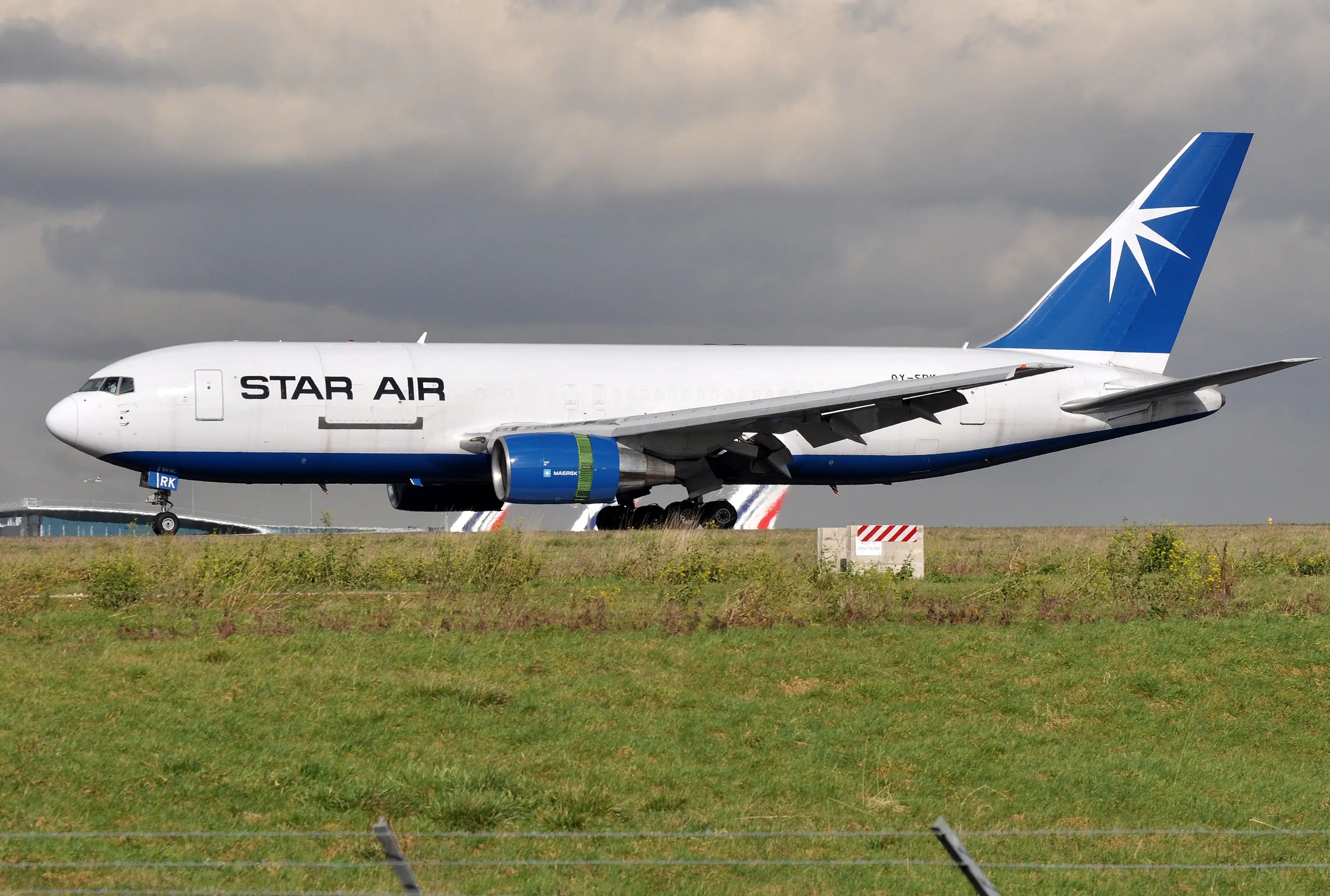
Maersk Air Cargo is an all-Boeing, all-freighter operator built around two families: the Boeing 767 (in both -200 and -300 freighter conversions and factory freighter form) and the Boeing 777F. As of February 2026, published fleet listings show 18 aircraft in service: nine Boeing 767-200SF, seven Boeing 767-300F, and two Boeing 777F. Two of the 767-200s operate under the Maersk Air Cargo UK AOC, and three 767-300Fs were sold in early 2026 as the airline exited its transpacific 767 operation.
The single most important fleet number for a pilot assessing this airline is average age: approximately 24.9 years. That headline figure conceals an enormous spread. The 767-200BDSF sub-fleet averages roughly 36.8 years, the 767-300(ER)F sub-fleet roughly 21.3 years, and the two 777Fs roughly 1.6 years. In practice this means a new First Officer is statistically far more likely to be assigned to a converted 767 built in the late 1980s or early 1990s than to a modern widebody. Anyone joining primarily to fly new metal should understand the odds before applying.
| Aircraft Type | Role | In Service | Approx. Avg. Age | Notes |
|---|---|---|---|---|
| Boeing 767-200SF / BDSF | Medium widebody freighter | 9 | ~36.8 yrs | Converted passenger airframes. Backbone of the European overnight feeder network. Two operate for Maersk Air Cargo UK (G-MACZ, G-MACY). |
| Boeing 767-300F / 767-300(ER)F | Medium widebody freighter | 7 | ~21.3 yrs | Mix of factory freighters and conversions. Three sold in early 2026 following the exit from Asia to US 767 flying. |
| Boeing 777F | Long-haul widebody freighter | 2 | ~1.6 yrs | Delivered 2024. Used on the Billund to China long-haul network. The declared future of the airline's own-controlled long-haul lift. |
| Total in service | 18 | ~24.9 yrs | Figures as published February 2026. | |
Fleet data as published in February 2026 fleet listings. Numbers move with sales, lease returns and AOC transfers, and the airline has been actively reshaping the 767 fleet through 2025 and 2026.
What the 2026 fleet strategy means for pilots
In January and February 2026 the airline made its direction explicit. It terminated the outsourced flying agreement with Amerijet International early, with operations ceasing on 28 February 2026, ended Asia to United States flying on Boeing 767-300 freighters, and put the three aircraft used on those lanes up for sale. Reporting on the decision framed it as a deliberate move away from mid-size 767 transpacific missions and toward larger, nonstop-capable Boeing 777 freighters. The South America flying launched in 2025 to Bogotá and Santiago had already been withdrawn on the same reasoning: the 767 could not do those missions efficiently compared with what a 777 can do nonstop.
The strategic read for a pilot is straightforward. The 767-200 fleet is old, tied to short European night sectors and to a small number of integrator contracts. The 777F is new, strategically favoured, and there are only two of them. Between those two poles sits the 767-300, which is being thinned. If the airline follows through on a 777-centric long-haul plan, the number of desirable long-haul seats depends entirely on how many 777Fs it actually buys, and as of mid-2026 no firm public order for additional 777Fs has been confirmed.
Maersk Air Crew & Training Company A/S (MACT) recruits both type-rated and non-type-rated First Officers for the Boeing 767 and Boeing 777. The collective agreement with Metal Luftfart makes the training commitment explicit: if employment ends within a period of up to 36 months after the company has paid for type rating or commander training, and the departure is the pilot's own resignation (or a dismissal the pilot gave just cause for), the pilot repays the actual training costs, reduced on a straight-line basis across the commitment period. The agreed maximum values are DKK 300,000 for a type rating and DKK 300,000 for commander training. In other words the training is company-funded up front, but it is bonded, and the bond is meaningful in size. Confirm the exact commitment period in your individual contract, since the agreement states the actual period is agreed with each crew member.
A ~37-year-old converted 767-200 is not inherently a worse aeroplane to fly, and freight operators keep old airframes flying safely and profitably for decades. But fleet age is a legitimate career signal. It usually means limited fleet growth, fewer new-hire seats, older avionics on your logbook, and eventual replacement decisions that can shrink an operation faster than they grow it. Weigh it against the 777F fleet, which is new but currently numbers only two aircraft.
Pilot Salary & Compensation Breakdown
Unusually for a European airline, Maersk Air Cargo's Danish pilot pay structure is a matter of public record. The collective bargaining agreement 2022 to 2026 between Maersk Air Crew & Training Company A/S (MACT) and Metal Luftfart is published in full by Dansk Metal, including the complete salary table. Everything in this section comes from that document unless stated otherwise.
The structure is simple and, by airline standards, unusually flat. There is a single nine-band salary scale that applies to all crew members regardless of rank. Captains are not on a separate scale. Instead, a commander receives a fixed monthly commander allowance of DKK 22,500 on top of whatever band they occupy. Each band consists of a base salary plus a variable component of DKK 9,013 per month. Crew members move up one band every two years.
The MACT Salary Bands (all crew, monthly DKK)
| Band | Base Salary (DKK/mo) | Variable (DKK/mo) | Total (DKK/mo) | Approx. EUR/mo | Approx. Annual Gross |
|---|---|---|---|---|---|
| Band 1 (entry) | 30,900 | 9,013 | 39,913 | ~€5,350 | ~DKK 479,000 / €64,200 |
| Band 2 | 36,050 | 9,013 | 45,063 | ~€6,040 | ~DKK 541,000 / €72,500 |
| Band 3 | 41,200 | 9,013 | 50,213 | ~€6,730 | ~DKK 603,000 / €80,800 |
| Band 4 | 45,423 | 9,013 | 54,436 | ~€7,300 | ~DKK 653,000 / €87,600 |
| Band 5 | 48,204 | 9,013 | 57,217 | ~€7,670 | ~DKK 687,000 / €92,000 |
| Band 6 | 50,470 | 9,013 | 59,483 | ~€7,970 | ~DKK 714,000 / €95,700 |
| Band 7 | 52,489 | 9,013 | 61,502 | ~€8,240 | ~DKK 738,000 / €98,900 |
| Band 8 | 54,508 | 9,013 | 63,521 | ~€8,510 | ~DKK 762,000 / €102,200 |
| Band 9 (top) | 57,680 | 9,013 | 66,693 | ~€8,940 | ~DKK 800,000 / €107,300 |
Rates as printed in the 2022 to 2026 agreement. Euro conversions use the Danish krone's ERM II central rate of 7.46038 DKK per EUR. From 1 January 2024 both base and variable salary in each band are subject to annual adjustment under the Maersk standard salary adjustment method, benchmarked against a third-party industry survey, so 2026 rates are higher than the printed figures.
Captain (Commander) Pay
A commander receives the band salary plus the DKK 22,500 monthly commander allowance, which is itself annually adjusted and, importantly, is included in pension-bearing salary. There is no separate captain scale and no captain-only progression, so a commander's total depends on how far up the nine-band ladder they have travelled.
| Commander at band | Band Total (DKK/mo) | + Commander Allowance | Total (DKK/mo) | Approx. Annual Gross |
|---|---|---|---|---|
| Band 3 | 50,213 | 22,500 | 72,713 | ~DKK 873,000 / €117,000 |
| Band 5 | 57,217 | 22,500 | 79,717 | ~DKK 957,000 / €128,200 |
| Band 7 | 61,502 | 22,500 | 84,002 | ~DKK 1,008,000 / €135,100 |
| Band 9 (top of scale) | 66,693 | 22,500 | 89,193 | ~DKK 1,070,000 / €143,500 |
Calculated from the published 2022 to 2026 salary table plus the DKK 22,500 commander allowance in clause 5.2.1. Instructors receive a further fixed allowance of DKK 2,000 per month.
What is not in the package
Two omissions deserve emphasis, because they cut against the pattern most European airline pilots expect.
There is no per diem. Clause 2.6.1 of the agreement states plainly that travel expenses including meals are paid by MACT in accordance with the Maersk Group travel policy, and that crew members are not entitled to any per diem. Pilots are issued a company credit card for out-of-pocket expenses and must comply with the group policy when using it. For a pilot moving from an operator where tax-advantaged subsistence allowances form a substantial slice of take-home pay, this is a material structural difference: your income here is essentially your salary, and expenses are reimbursed rather than allowanced. Preparing travel expense settlements must be done within normal working time and attracts no separate compensation.
Time off can be bought back. If MACT and a pilot agree in writing to buy a day off, the compensation is at least 8% of the monthly salary for that day. This is a useful earnings lever for pilots who want it, and a warning sign for those who do not.
The figures above are taken from the published 2022 to 2026 MACT and Metal Luftfart agreement and apply to pilots permanently based in Denmark. They do not necessarily apply to Cologne-based crew, who sit under a separate manning arrangement, nor to pilots hired through external suppliers (though the agreement does require that externally supplied crew receive combined total remuneration not lower than the agreement provides). Printed rates are pre-adjustment 2022 values and have been uplifted annually since 1 January 2024. A new four-year agreement took effect on 1 March 2026, and its detailed pay terms have not been published, so treat the tables above as a structural guide rather than a 2026 payslip. Danish taxation is heavy: the labour market contribution (AM-bidrag) is 8%, and the tax ceiling for top-bracket personal income is 52.07%, giving an effective marginal rate around 60% for a pilot earning roughly DKK 1,000,000 per year. Always ask for a written offer with current rates before making a decision.
Newly hired pilots are slotted into the table by defined criteria rather than negotiation. Band 1 is the default. Band 2 requires either a valid type rating for the relevant type or a minimum of 1,500 hours total time. Band 3 requires a valid type rating and 1,500 hours total time, or other relevant criteria determined by MACT. Bands 4 to 9 require a type rating plus 1,500 hours plus one of the following: TRI, TRE, NPFO or chief pilot status; a direct hire of a commander; or other relevant criteria determined by MACT. That last route is the clearest textual evidence in the agreement that direct entry commanders are contemplated, and it is worth raising explicitly in an interview if you hold command experience.
Roster Pattern & Quality of Life
The Danish agreement defines quality of life through a single arithmetic formula rather than through a fixed pattern. Clause 3.1.1 sets out the calculation of production days per calendar year for a full-time crew member:
That works out to roughly 15.4 production days and about 12.9 rostered days off per average month, before vacation. The contractual floor is 11 days off in any month. Holiday accrues at 2.08 days per month under the Danish Holiday Act, giving five weeks per year, with five combined holiday days counting as one week.
Working hours are governed by EASA Flight Time Limitations, administered in Denmark by Trafikstyrelsen, the Danish Civil Aviation and Railway Authority. The agreement adds one significant protection beyond FTL: on arrival at home base after a long-haul operation, a pilot is entitled to at least 72 hours of scheduled rest. Long-haul is defined in the agreement as any route extending beyond six hours of flight. For all other operations, rest follows FTL minima with no contractual uplift.
📅 Modelled 28-Day Cycle — Boeing 767 First Officer (Danish contract)
This grid is a model constructed from the agreement's own arithmetic (12 days off and 16 production days in 28 days, consistent with 155 days off per year and the 11-day monthly minimum). It is not a published Maersk Air Cargo roster. Actual patterns differ substantially between the European night feeder operation and the Billund long-haul operation, and the agreement itself does not prescribe a fixed line pattern.
Rostering mechanics you should understand before you sign
The agreement gives the company a broad set of scheduling levers, and a pilot evaluating this contract should read them as a package rather than individually.
Roster publication. The roster with assigned duty is released on the 15th of each month for the following full month. That is a shorter planning horizon than several European carriers offer, giving between 16 and 46 days of visibility depending on where in the month a duty falls.
Free reallocation. Between check-in and check-out at home base, a crew member may be freely reallocated. Once you sign in, the shape of the trip is the company's to change.
Check-in can move earlier. At home base, check-in may be advanced by up to three hours, notified 12 hours beforehand. On long-haul operations, with at least 12 hours' notice, a scheduled check-in may be advanced by up to seven hours.
Days off can be rescheduled. This is the clause that most divides opinion. Where rescheduling affects scheduled days off, or where a check-out lands on a scheduled day off, the compensation is either a replacement day off or money, at MACT's choice, not the pilot's. Where a long-haul call-out from standby affects subsequent days off, those days off can be cancelled and replaced with rescheduled or unscheduled days off. Your day-off count is contractually protected; the specific dates are considerably less so.
Standby. Depending on the operational pattern, pilots may be assigned on-call or standby duty, with a callout requiring check-in within 90 minutes under normal traffic and weather conditions. A standby relating to a long-haul operation covers the whole operation, which may run over several days.
Field duty. If a crew member is grounded or not assigned to flight duty, MACT may assign relevant ground duty instead.
There are two crew bases, Billund and Cologne/Bonn, and no base bidding system in the conventional sense. Billund is a small city in central Jutland with a low cost of living relative to Copenhagen, good road access and a compact airport; Cologne is a major European integrator hub with a large night-freight ecosystem. Under the agreement a Danish-based pilot can be required to be temporarily stationed at a base outside Denmark for up to six weeks, in two periods within any 12-month window, with at least two weeks' notice, and the Danish agreement continues to apply throughout. Longer stationing (up to 12 months) requires individual agreement. Part-time work is available by agreement and is calculated proportionally: a 67% part-time crew member has a maximum of about 10 production days per month. MACT also provides a parking space at home base while on duty, a uniform, and a company mobile phone or tablet.
Numbers on a page understate what freight flying does to a schedule. The European feeder network is fundamentally a night operation: integrator sortation windows dictate departures in the late evening and arrivals before dawn, week after week. The Billund long-haul network adds multi-timezone rotations to China with technical stops. A pilot comparing 155 days off per year against a passenger carrier's roster should weight the fact that a meaningful share of the flying days here are night duties, and that the 72-hour post-long-haul rest exists precisely because recovery from these patterns takes longer than FTL minima assume. If you value predictable daytime family time, examine the specific base and contract before committing.
Benefits, Pension & Loss of Licence
Benefits at Maersk Air Cargo follow the Danish model: relatively lean on airline-specific perks, relatively strong on statutory employment protection and pension. The employment relationship for Danish-based crew is governed by Danish employment law, including the Danish Salaried Employees Act (Funktionærloven) and the Danish Holiday Act (Ferieloven), which sets the floor for notice periods, sick pay and holiday entitlement independently of anything the airline negotiates.
The pension is the strongest single benefit
A combined 16% contribution rate (11% employer plus 5% employee) on a pension-bearing salary that explicitly includes the commander allowance and the variable salary component is competitive by European airline standards and well above the statutory minimum contributions in several neighbouring markets. Because the commander allowance is pensionable, a commander at Band 9 is accruing pension on roughly DKK 89,000 per month rather than on a stripped-down base figure. Over a full career this is a genuinely valuable feature of the package and one of the clearest reasons to take the Danish contract seriously despite the modest headline salaries.
Danish pilots also sit inside the general Danish social security system, which provides state pension, healthcare and unemployment insurance access on the same basis as other Danish employees. It is worth noting that the previous FPU-negotiated Star Air agreement had to resolve a long-running problem where pilots paid social security contributions in Germany despite being insured in Denmark. That specific issue was addressed in a 2021 agreement renewal, but it is a useful reminder to check which country's social security system your contract actually places you in before signing, particularly if you would be based in Cologne.
These two absences change the arithmetic of comparing offers. At many European carriers, tax-favoured subsistence allowances add a five-figure annual sum to take-home pay that never appears on the salary scale, and discounted staff travel on a global network is a real, if unquantified, benefit for pilots and families. Neither exists here in the conventional form. Maersk Air Cargo flies no passengers, and the collective agreement provides for reimbursement of actual travel costs rather than allowances. When you compare a Maersk Air Cargo offer against a passenger airline offer, compare gross salary plus pension against gross salary plus pension plus allowances plus staff travel, or you will overestimate the gap in the wrong direction.
Clause 5.5.2 of the agreement is short but important: crew members are covered by a loss of licence insurance, which is paid by MACT. For a pilot on a widebody freight contract in their thirties or forties, employer-funded loss of licence cover is a meaningful protection that is not universal across European operators, and it should be counted properly when benchmarking offers. Ask for the policy summary at offer stage so you can see the benefit level, the definition of incapacity used, and whether cover continues during unpaid leave.
Career Progression & Command Upgrade
This is the area where Maersk Air Cargo differs most sharply from the European legacy model, and where prospective joiners most often misread the airline. There is no strict seniority-based command system. The collective agreement is unambiguous on this point: MACT decides at its sole discretion if and when a crew member is promoted to captain, based on a non-exhaustive and explicitly non-prioritised list of criteria.
Read carefully, this cuts both ways. A high-performing pilot who joins with strong credentials can in principle be considered for command sooner than a pure seniority list would allow. Equally, there is no contractual date on which command becomes yours by right, no published upgrade queue, and no protection against the upgrade simply not happening in a shrinking operation. Pilots who want the predictability of a numbered seniority list will not find it here.
The pay ladder runs on time, not rank
Because the nine salary bands apply to all crew members and advance every two years, salary progression is decoupled from rank. Starting at Band 1, reaching Band 9 takes 16 years of service under the two-year step rule. Danish trade press reporting on the agreement has described the top of the scale as being reached after around 18 years, which may reflect placement rules or transitional arrangements rather than the pure step arithmetic; either way, the ladder is a long one by industry standards. A pilot entering at Band 2 or Band 3 on the strength of a type rating and 1,500 hours shortens that path by two to four years.
Command, when it comes, adds the fixed DKK 22,500 monthly allowance rather than moving you to a new scale. In practical terms, an experienced First Officer at Band 7 and a newly promoted commander at Band 3 are not far apart in gross pay, which is unusual and worth modelling before you assume that upgrade is the dominant financial event of your career here.
| Career Milestone | What the agreement actually says | Practical read |
|---|---|---|
| Join as First Officer | Band 1 to 3 depending on type rating and total time | Type rating plus 1,500 hours total time gets you to Band 3 on day one. |
| Salary band step | Every two years | Automatic and time-based, independent of rank or fleet. |
| Top of pay scale (Band 9) | 16 years from Band 1 | Reported in Danish trade press as roughly 18 years in practice. |
| Command upgrade | MACT sole discretion, five criteria, no timeline | No published queue. Ask in interview for recent actual upgrade times. |
| Direct entry commander | Contemplated in Band 4 to 9 placement criteria | Experienced captains should raise this explicitly at application. |
| Instructor (TRI / TRE / NPFO) | DKK 2,000 monthly allowance; also a Band 4 to 9 placement criterion | Instructor status is one of the few defined routes to higher bands early. |
| Commander training bond | Up to 36 months, max DKK 300,000, straight-line reduction | Upgrade ties you to the company for up to three further years. |
Derived from the published MACT and Metal Luftfart collective agreement 2022 to 2026. A new agreement took effect on 1 March 2026 and its detailed terms have not been published.
Career progression assumptions depend on fleet growth, and in 2026 this fleet contracted rather than grew. Three Boeing 767-300Fs were sold, the Amerijet outsourcing agreement was terminated early, Asia to United States 767 flying ended on 28 February 2026, and 20 Billund-based pilots were made redundant in March 2026 with two aircraft moved to another European base. In that environment, command opportunities are created by retirements and resignations rather than by expansion. If long-haul widebody command is your objective, note that the airline currently operates only two Boeing 777Fs, which caps the number of long-haul command seats regardless of your performance record.
Recruitment Process & Requirements
Pilot recruitment for the Danish operation is run by Maersk Air Crew & Training Company A/S (MACT), the manning entity that also holds the collective agreement, through its own dedicated candidate portal rather than through the general Maersk group careers system. Other Maersk Air Cargo roles, including engineering positions for the Cologne operation, appear on the main Maersk vacancies page. Both are worth monitoring, because the two channels do not always carry the same openings.
First Officer requirements (Billund, non-type-rated stream)
One nuance in the published advert is worth flagging for lower-time applicants: candidates with fewer than 250 PIC hours can still be accepted, but it becomes the individual candidate's responsibility to ensure the ATPL(A) minimum PIC or PICUS requirement is met before any later command upgrade. If you join short of PIC time, plan how you will build it, because it becomes a personal obligation rather than a company one.
Selection Stages
Application via the MACT candidate portal
Applications for the Billund flight crew pool are submitted directly to Maersk Air Crew & Training through its recruitment portal. Because pilot vacancies are pooled rather than continuously advertised, an open application into the flight crew pool is often the entry route rather than a numbered vacancy. Maersk advises candidates to prepare documentation early, particularly if they have lived abroad.
Screening against band placement criteria
Because the collective agreement fixes salary band placement by objective criteria (type rating held, 1,500 hours total time, instructor status, direct hire commander status), screening effectively determines your starting salary as well as your suitability. Make sure your application evidences these criteria clearly rather than burying them.
Aptitude and psychometric assessment
Historic published descriptions of the Star Air and Maersk Air Cargo process list an aviation aptitude test, an A.P. Moller group test with a minimum score threshold, and a Predictive Index behavioural assessment. These descriptions predate the current campaign and should be confirmed with the recruiter, but the presence of a group-wide corporate assessment alongside an aviation-specific one is consistent with how A.P. Moller-Maersk recruits across functions.
Interviews
Multiple personal interviews have historically formed part of the process, covering technical knowledge, CRM and motivation. Expect the operation's freight-specific realities (night flying, integrator contracts, long-haul technical stops, single-customer exposure) to feature, and be ready to explain why you want freight rather than passenger flying.
Simulator assessment
A simulator check ride on an available device has historically been part of the selection. For non-type-rated candidates this is an assessment of handling, instrument flying and multi-crew capability rather than a type-specific check.
Extended background check, contract and type rating
Maersk states explicitly that successful candidates must pass an extended background check. Contracts for Danish-based crew fall under the MACT collective agreement, with salary band placement per the published criteria. Company-funded type rating training follows, subject to the training repayment commitment of up to 36 months and a maximum agreed value of DKK 300,000.
Maersk Air Cargo runs a Billund operation and a Cologne operation with separate manning arrangements. Pilots report that these have historically involved different application routes, different assessments and different employment terms, and the published Danish collective agreement applies only to crew members employed by MACT and working permanently from a base in Denmark. If your target is a specific base, apply to the correct entity and ask, in writing, which legal entity would employ you, which country's social security system you would fall under, and which collective agreement (if any) covers the contract. Do not assume the published Danish terms transfer to a German-based role.
Maersk Air Cargo does not operate an ab initio cadet scheme. There is no sponsored zero-to-airline pathway, no partner flight academy programme and no self-funded cadet route published by the airline. The minimum realistic entry point is a frozen ATPL with 1,000 hours total time and 250 hours PIC, which in practice means instructing, general aviation, business aviation or a first airline job elsewhere before applying. If you are a low-hour graduate, this is not a first-job airline.
The published First Officer requirement is ICAO English Level 4 or better, with no Danish language requirement stated for the flight crew role. Maersk's engineering advert for the Cologne operation asks for fluent English with Danish as an advantage, and older recruitment summaries noted a preference for Scandinavian or German language skills. This is a genuinely English-language operating environment, which makes it accessible to EU pilots from outside Scandinavia in a way that several other national carriers are not. Right to work in the EU, however, is non-negotiable, and there is no published sponsorship route.
Route Network & Where You Night-Stop
Freight flying produces a very different destination list from passenger flying, and Maersk Air Cargo's is unusually split. On one side is the European overnight feeder network, where a typical duty is two short sectors at night with a hotel in between, and where the destination is a cargo apron rather than a city. On the other is the Billund long-haul operation to China, where rotations run through technical stops and produce genuine multi-day time away from base.
The long-haul network as publicly described centres on Billund to Hangzhou and Billund to Zhengzhou. Maersk stated that the Boeing 777F would operate Billund to Hangzhou at three weekly flights initially, rising to six weekly once the second 777F entered service, while the Billund to Zhengzhou service was reported at six flights per week using Boeing 767 freighters. Navoi International Airport in Uzbekistan has been used as a technical stop on Billund to Hangzhou rotations. A Hangzhou to Chicago Rockford service extended the network into North America, and a weekly Bournemouth to Hangzhou trial ran via Navoi to serve UK regional shippers. A Hangzhou to Billund to Liège 777F routing has also been referenced.
The European side is contract flying. Scheduled cargo services operate on behalf of UPS Airlines from Cologne/Bonn, and from East Midlands for UPS and Royal Mail, with UK sectors including Belfast International, Birmingham and Edinburgh. Maersk's own crew content has featured a Cologne to Bergamo Boeing 767 duty as a representative day in the life.
Three things separate this from passenger long-haul. First, there is no per diem: meals and incidentals are reimbursed through the Maersk Group travel policy on a company credit card, not paid as an allowance. Second, freight schedules are built around sortation windows and payload, not passenger convenience, so arrival and departure times cluster at night and rest periods often fall in daylight. Third, on long-haul operations MACT may advance a check-in by up to seven hours with 12 hours' notice, and may extend a duty by one or more days in the event of cancellation, delay or operational change. The offsetting protection is the contractual 72 hours of scheduled rest on arrival home from a long-haul operation, which is genuinely generous and should be weighed in the balance.
Between 2023 and 2026 this network launched Europe to China services, added Chicago Rockford, trialled Bournemouth to Hangzhou, expanded into South America with Bogotá and Santiago, then withdrew South America as inefficient for 767s, then exited Asia to United States 767 flying entirely and sold the aircraft. A pilot joining should expect the destination list to change materially inside a typical contract term. Judge the airline on its base structure and equipment strategy rather than on any given route.
How Maersk Air Cargo Compares: Airline Radar Chart
The right comparison set for Maersk Air Cargo is not a passenger flag carrier. It is the other European widebody freight employers a pilot would realistically apply to alongside it: Cargolux, the Luxembourg-based long-haul cargo specialist, and DHL Air UK, the East Midlands-based airline inside the DHL express network. Both operate widebody freighters, both are unionised, and both compete for the same candidate pool.
| Maersk Air Cargo | Cargolux | DHL Air UK | |
|---|---|---|---|
| First Officer pay | DKK 39,913 to 66,693/mo (~€5,350 to €8,940) | €6,527 to €7,690/mo gross (Junior to Senior F/O) | £57,000 to £93,000/yr |
| Captain pay | Band salary + DKK 22,500/mo (~€9,750 to €11,955/mo) | Reported €13,187 base to €20,518 top per month | £102,000 to £145,000/yr |
| Minimum days off per month | 11 | 12 | Various fixed roster options |
| Annual leave | 5 weeks (25 days) | 42 vacation days | 42 days |
| Per diem | None (expense reimbursement only) | Allowances and supplements paid | Standard allowances |
| Pension | 11% employer + 5% employee | Luxembourg state plus company supplementary scheme | 10% employer if you contribute 4.5% |
| Base | Billund and Cologne/Bonn | Luxembourg | East Midlands |
| Pilot representation | Metal Luftfart (Dansk Metal); MACTPU staff association | ALPL | UK collective arrangements |
| Command upgrade | Company sole discretion, no published timeline | Salary-step continuity retained on upgrade | Structured internal progression |
Maersk figures from the published MACT collective agreement. Cargolux First Officer figures from the airline's official working conditions page (index 992.24, effective 1 June 2026); Cargolux captain figures and DHL Air UK figures are third-party pilot pay databases and should be treated as indicative.
Key Takeaways from the Comparison
Cargolux is the stronger pay proposition at every rank. Cargolux publishes its First Officer scale openly on its working conditions page, showing Junior First Officer at €6,527.35, First Officer at €7,074.67 and Senior First Officer at €7,690.36 gross per month on index 992.24 effective 1 June 2026. A Maersk Air Cargo pilot does not reach the Senior First Officer equivalent until roughly Band 6, which under the two-year step rule is a decade into the career. At command level the gap widens further: third-party data puts Cargolux captain pay from around €13,187 to €20,518 per month, well above the roughly €9,750 to €11,955 range implied by the Maersk band table plus commander allowance.
Annual leave is the clearest single deficit. Five weeks (25 days) under the Danish Holiday Act compares with 42 vacation days at Cargolux and 42 days at DHL Air UK. That is a difference of more than three working weeks per year, and it is structural rather than negotiable at the individual level.
Pension is where Maersk Air Cargo holds its own. An 11% employer contribution on a pension-bearing salary that includes the commander allowance and the variable component is competitive with DHL Air UK's 10% conditional on a 4.5% employee contribution. Combined with company-paid loss of licence insurance, the deferred and protective side of the package is respectable.
Fleet modernity favours the comparators. A ~24.9-year average fleet age, dominated by 767-200 conversions approaching four decades, sits behind both comparators. The two new 777Fs are excellent aircraft, but two aircraft do not carry a fleet score.
Job security is the biggest differentiator, and not in Maersk's favour. Maersk Air Cargo lost DKK 173 million in 2025 and more than DKK 550 million across three years, made 20 Billund pilots redundant in March 2026, moved two aircraft to another European base, sold three 767-300Fs and terminated its Amerijet arrangement early. Neither comparator has had a comparable sequence of contractions in the same period.
Radar scores are editorial estimates derived from the sources cited throughout this article: the published MACT and Metal Luftfart collective agreement, Cargolux's official working conditions page, published fleet listings, company financial reporting, and third-party pilot pay databases where no official scale is published. Where an airline does not publish a figure, the comparison uses the best available secondary source and says so. Scores represent a general assessment for an experienced European pilot considering a long-term career and will vary with base, fleet, contract type and personal priorities. They are point-in-time estimates for mid-2026 and will be revised as new collective agreements and fleet decisions are published.
Union & Industrial Relations
The industrial relations history at this airline is unusually instructive, because it involves a genuine contested transition between two unions with materially different agreements. Understanding it explains why the current terms look the way they do.
Historically, Star Air pilots were represented by Flyvebranchens Personale Union (FPU) through the Star Air Cockpitforening, under a long-established collective agreement. FPU renewed that agreement in 2021, delivering a pay rise, improved travel expense coverage, and a fix for a long-running problem where Star Air pilots were paying social security in Germany despite being insured in Denmark.
When Maersk launched Maersk Air Cargo in 2022, FPU announced it was negotiating an agreement for the new carrier's pilots and expected a deal shortly. Instead, on 13 June 2022, Maersk Air Crew & Training Company A/S signed a collective agreement with Metal Luftfart, the aviation branch of Dansk Metal, effective retroactively from 1 April 2022 and running until no earlier than 1 March 2026. Reporting at the time indicated the agreement could support around 75 new pilot positions in 2022 with more to follow, and that the aircraft would be based in Billund.
FPU publicly criticised the outcome. Danish aviation trade press reported the union's position that the terms in the Dansk Metal agreement were below the FPU Star Air agreement on all fronts, and FPU pointed specifically to a starting salary 37% lower. FPU's leadership characterised the deal as a downward adjustment of terms in a growing segment. That criticism is the essential context for the Band 1 entry figure of DKK 39,913 per month in the published table.
Who represents pilots today
The 2026 agreement round
The 2022 agreement was written to expire no earlier than 1 March 2026, and a new four-year collective agreement took effect on that date. Metal Luftfart reported that preparations began before Christmas 2025, negotiations with Maersk started in January 2026, and the result was approved in a consultative ballot with 73% voting yes on a 95% turnout. Notably, the union described the priorities in this round as stability and security rather than pay and time off, which is a revealing signal given that 20 Billund pilots had been made redundant in the same window. Detailed terms of the new agreement have not been published, so the specific figures in this article remain those of the 2022 to 2026 text as annually adjusted.
Disputes and arbitration
Maersk Air Cargo has no meaningful recent history of pilot strikes, and that is a genuine positive: the Danish system channels disputes into arbitration under the Norm rather than into industrial action. But strike-free is not the same as strongly represented. The agreement you would join under was reached in competition with a rival union that argued it undercut the previous terms, it grants the company wide discretion over promotion and over the timing of days off, and the most recent round was explicitly not a pay round. Read the Metal Luftfart collective agreements page before applying, and join the union: shop steward representation exists at every Danish base with more than 10 covered crew, and the elected officials come from within the pilot group.
Job Security: The 2025–2026 Picture
No honest assessment of this airline can skip the last 18 months. A pilot deciding whether to join, or whether to leave a current employer for this one, needs the financial and structural picture in full, because it is the single factor most likely to determine whether the career you plan here actually happens.
Reading the numbers fairly
There are two defensible interpretations of this data, and a pilot should hold both.
The pessimistic read: a small airline losing money for three consecutive years, cutting cockpit headcount, selling aircraft, terminating contracts, withdrawing from two continents' worth of flying (South America in 2025, Asia to United States in 2026), and moving aircraft away from its declared hub is an airline in contraction. Twenty pilot redundancies at a carrier of this size is not a rounding error. The union's own framing of the 2026 negotiation round around stability and security rather than pay confirms that the pilot group itself read the situation the same way.
The optimistic read: revenue grew almost 37% in 2025, the parent group generated USD 54.0 billion of revenue and USD 9.5 billion of EBITDA in the same year, the loss was attributed to weak market rates combined with heavy investment (the 777Fs, the UK AOC, network build-out) rather than to structural failure, and the company expects a positive result in 2026. The 2026 actions read as a deliberate re-optimisation: exiting missions the 767 could not fly efficiently and concentrating on 777-capable nonstop lanes. A.P. Moller-Maersk has kept an in-house airline through multiple cycles since 1987, and its air freight product is now integrated into a broader logistics offering rather than being a standalone profit centre.
Danish labour law is flexible by European standards. Redundancy is comparatively straightforward for employers, with protection delivered mainly through notice periods under the Salaried Employees Act (which scale with length of service) rather than through onerous procedural barriers. There is no seniority-list redundancy protection in the published collective agreement equivalent to what exists at some US and legacy European carriers. Shop stewards have enhanced protection (six months' notice), and dismissal of a shop steward requires compelling reasons unless it is due to shortage of work. For an ordinary line pilot, the practical implication is that length of service does not contractually guarantee you a place ahead of a colleague in a downsizing.
Given the above, a candidate should treat the interview as a two-way assessment. Worth asking directly: (1) What is the current pilot headcount by base and by fleet? (2) How many pilots have been promoted to commander in each of the last three years? (3) Are further 777F acquisitions committed, and on what timeline? (4) Which legal entity would employ me, and under which collective agreement and social security system? (5) What is the length of my training repayment commitment, and what triggers it? (6) What proportion of current flying is under contract to a single customer, and when do those contracts run to? None of these are unreasonable questions, and the quality of the answers tells you a great deal.
Verdict: Who Is Maersk Air Cargo For?
🎯 Our Take
Maersk Air Cargo offers something genuinely valuable and increasingly rare in Europe: a route into widebody freight flying at a low experience threshold (1,000 hours total time, 250 PIC), with a company-funded type rating, on a permanent Danish contract with published terms you can read in full before you apply. The transparency alone is a mark in its favour. Very few European airlines let a candidate read the actual salary table, the days-off formula and the promotion criteria before submitting a CV.
The strengths are real. An 11% employer pension contribution on a pension-bearing salary that includes the commander allowance, company-paid loss of licence insurance, a contractual 72 hours of scheduled rest on return from long-haul, 155 days off per year, an English-language operating environment, and the backing of a parent group with USD 54 billion of revenue all count for something. The two Boeing 777Fs are excellent aircraft and represent genuine intercontinental widebody experience.
The weaknesses are equally real and should not be softened. Entry pay of DKK 39,913 per month is modest for a widebody operator and was publicly criticised by a rival union as 37% below the previous Star Air terms. There is no per diem at all, which removes a component that materially inflates take-home pay elsewhere. Annual leave is five weeks against 42 days at both comparator airlines. The salary ladder takes around 16 years to climb. Command is at the company's sole discretion with no published timeline and no seniority guarantee. The fleet averages almost 25 years old. And the airline lost DKK 173 million in 2025, more than DKK 550 million over three years, made 20 Billund pilots redundant in March 2026 and moved two aircraft away from its own declared hub.
The realistic view is that this is a solid stepping-stone or specialist airline rather than a lifetime seniority home. If you want widebody time, a Boeing type rating you did not pay for, and a properly regulated Northern European contract, it delivers. If you are optimising for lifetime earnings, leave entitlement, fleet modernity or the certainty of a numbered upgrade queue, the comparators do it better.
1What are the minimum requirements to join Maersk Air Cargo as a First Officer?
The published Billund First Officer requirements are a current EASA licence with valid IR/ME (frozen ATPL accepted), a minimum of 1,000 hours total time and 250 hours PIC, ICAO English Language Proficiency Level 4 or better, a valid EASA Class 1 medical, no criminal record, and full eligibility to work within the EU. Candidates with fewer than 250 PIC hours can be accepted, but it becomes their own responsibility to meet the ATPL(A) PIC or PICUS requirement before any later command upgrade. An extended background check is required, and Maersk advises candidates who have lived abroad to prepare documentation early.
2Does Maersk Air Cargo pay for the type rating, and is it bonded?
The company funds type rating training, but it is bonded. Under the collective agreement, if employment ends within a period of up to 36 months after MACT has paid for type rating or commander training, and the departure is the pilot's own resignation or a dismissal the pilot gave just cause for, the pilot repays the actual training costs, reduced on a straight-line basis over the commitment period. The agreed maximum values are DKK 300,000 for a type rating and DKK 300,000 for commander training. The exact commitment period is agreed individually, so confirm it in writing before accepting.
3How much does a Maersk Air Cargo captain earn?
There is no separate captain pay scale. A commander is paid their position on the nine-band all-crew salary table plus a fixed monthly commander allowance of DKK 22,500. Using the published 2022 to 2026 table, that produces roughly DKK 72,700 per month for a commander at Band 3 and roughly DKK 89,200 per month at Band 9, or approximately €117,000 to €143,500 gross per year. Both the band salaries and the commander allowance have been subject to annual adjustment since 1 January 2024 under a benchmarked adjustment method, so current figures are higher than the printed rates. A new agreement took effect on 1 March 2026 and its detailed pay terms are not public.
4Is there a per diem or subsistence allowance?
No. Clause 2.6.1 of the collective agreement states that travel expenses including meals are paid by MACT in accordance with the Maersk Group travel policy and that crew members are not entitled to any per diem. Pilots receive a company credit card for out-of-pocket expenses and must follow group policy when using it. Preparing travel expense settlements must be done within normal working time and attracts no separate compensation. This is a significant structural difference from most European operators and should be factored into any offer comparison.
5How long does it take to upgrade to captain?
There is no published timeline, and no seniority guarantee. The agreement states that MACT decides at its sole discretion if and when a crew member is promoted to captain, based on a non-exhaustive and non-prioritised list of five criteria: qualifications, performance, management skills, personnel engagement and seniority. Seniority is listed last and is explicitly not prioritised above the others. The agreement also contemplates direct hire of a commander within its Band 4 to 9 placement criteria, so experienced captains applying externally are not excluded. Ask the recruiter for actual upgrade counts over the last three years rather than relying on general expectations.
6Can non-EU citizens apply?
The published requirement is that candidates must be fully eligible to work within the EU. No sponsorship or work permit pathway is advertised. Note that the requirement is framed around work eligibility rather than nationality, so EU, EEA and other candidates who already hold unrestricted EU work rights meet it. Language is not the barrier it is at many national carriers: the published First Officer requirement is ICAO English Level 4 or better, with no Danish requirement stated, although Scandinavian or German language skills have historically been noted as preferable.
7What is the difference between the Billund base and the Cologne base?
They are structurally separate operations. Billund is the long-haul hub and the base covered by the published Danish collective agreement between MACT and Metal Luftfart, which applies only to crew members employed by MACT and working permanently from a base in Denmark. Cologne/Bonn hosts the European overnight feeder operation, historically the Star Air business, flying for UPS. Pilots report separate application routes and separate assessments for each. Before applying, confirm in writing which legal entity would employ you, which collective agreement covers the contract and which country's social security system applies, because the terms described in this article cannot be assumed to transfer to a German-based role.
8Is Maersk Air Cargo hiring, and is it a stable place to build a career right now?
Pilot recruitment is run through the Maersk Air Crew & Training candidate portal, and Maersk's air freight careers pages continue to reference active pilot recruitment. However, stability requires an honest caveat: the airline reported a DKK 173 million loss for 2025 on revenue of USD 386.8 million, has lost more than DKK 550 million over three years, made 20 Billund pilots redundant in March 2026, moved two aircraft to another European base, sold three Boeing 767-300Fs and terminated its Amerijet outsourcing agreement early with operations ceasing on 28 February 2026. The company expects a positive result in 2026 and the parent group remains highly profitable. Treat any current vacancy as real but verify the headcount and fleet plan before resigning from a secure position elsewhere.
9How many days off will I actually get?
The collective agreement's production day formula is explicit: 365 days per year, minus 155 days off, minus 25 vacation days, gives 185 production days. That is approximately 12.9 rostered days off per average month plus roughly two vacation days, with a hard contractual floor of 11 days off in any month. Five weeks of annual leave accrue at 2.08 days per month under the Danish Holiday Act. Rosters are published on the 15th of each month for the following full month. The important caveat is that where rescheduling affects scheduled days off, the compensation is either a replacement day off or money at MACT's choice, not the pilot's, so the number of days off is protected more firmly than the specific dates.
10Which union represents Maersk Air Cargo pilots?
Danish-based pilots are covered by a collective agreement between Maersk Air Crew & Training Company A/S and Metal Luftfart, the aviation branch of Dansk Metal. Pilots also organise through MACTPU, the Maersk Air Crew and Training Pilot Union, a pilot club operating under the Dansk Metal umbrella and chaired by line captains. Shop stewards are elected from among Dansk Metal members at any Danish base with more than 10 covered crew members. Flyvebranchens Personale Union (FPU) historically represented Star Air pilots and publicly criticised the Metal agreement in 2022 as falling below the previous Star Air terms. A new four-year agreement took effect on 1 March 2026, approved with 73% support on a 95% turnout.
Official Links & Resources
Verify every figure in this article against primary sources before making a career decision. Unusually for an airline profile, most of the important terms at Maersk Air Cargo can be read directly in the published collective agreement rather than inferred from second-hand reports.
Read the collective agreement PDF end to end before your interview. It is only 11 pages, it is in English, and it contains the answers to most of the questions candidates normally have to guess at: what you will be paid on day one, how often that increases, what happens to your days off when the operation changes, what triggers a training repayment, and exactly how command is decided. Turning up having read it signals seriousness, and it lets you ask about the things the document does not cover, which is where the real information is.
- 01Overview & Company Profile
- 02Fleet & Type Ratings
- 03Salary & Compensation
- 04Roster & Quality of Life
- 05Benefits, Pension & LOL
- 06Career & Command Upgrade
- 07Recruitment & Requirements
- 08Network & Night-Stops
- 09Airline Comparison
- 10Union & Industrial Relations
- 11Job Security 2025–2026
- 12Verdict & FAQ
- 13Links & Resources