KM Malta Airlines Overview & Company Profile
KM Malta Airlines is the flag carrier of Malta, established in 2024 as the successor to the financially troubled Air Malta, which ceased operations on March 31, 2024 after over fifty years of service. The new airline launched on the same day from Malta International Airport (MLA) in Luqa, inheriting the strategic role of connecting Malta to the European continent while operating under a fundamentally restructured business model designed to avoid the cost overruns that plagued its predecessor.
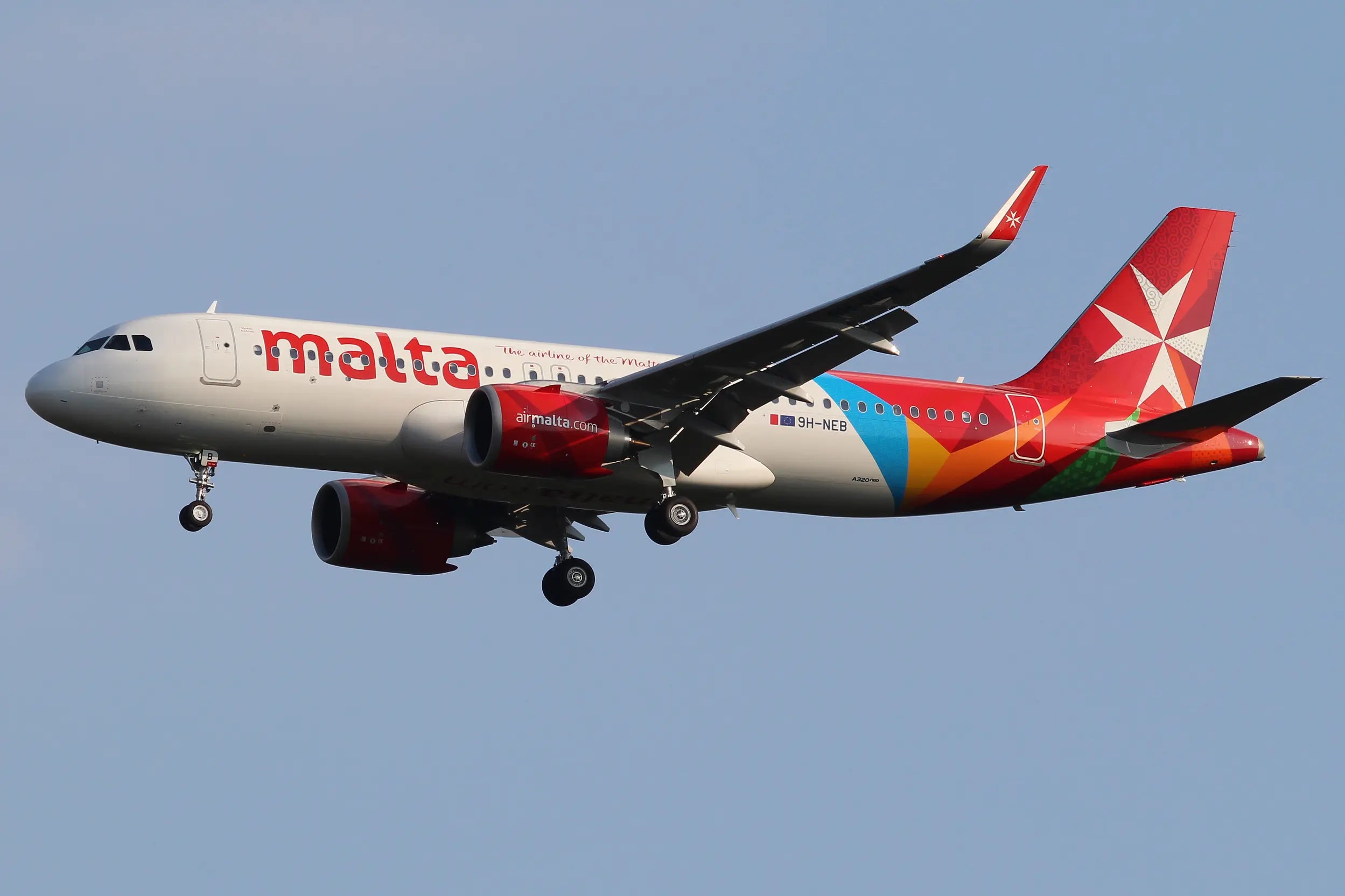
Wholly owned by the Government of Malta, KM Malta Airlines operates a fleet of eight Airbus A320neo aircraft across 19 European and Eastern Mediterranean destinations. The airline currently employs approximately 390 staff in total, a significant reduction from Air Malta's workforce, reflecting a deliberate shift toward a leaner, more cost-efficient operating model. During the summer 2026 season, the airline plans to operate 7,948 flights across 19 routes, averaging around 37 departures per day with an aircraft utilization rate of approximately 12 flight hours per day.
While KM Malta Airlines is not a member of any airline alliance, it has established codeshare agreements with several major carriers including Air France, KLM, Lufthansa, Austrian Airlines, Brussels Airlines, Swiss International Air Lines, ITA Airways, airBaltic, and Turkish Airlines. These partnerships allow passengers to connect from Malta to a wide range of global destinations, extending the airline's reach far beyond its own route network.
The airline's creation was driven by European Commission regulations that prevented additional state aid to Air Malta after a 2012 injection. When the Commission rejected a proposed €290 million aid package in April 2023, the Maltese government opted to wind down Air Malta and launch a new entity free from legacy obligations. This approach, while legally sound, has drawn criticism for the estimated €300 million in costs to taxpayers and for the significant reduction in employment terms for pilots and other staff who transitioned to the new airline.
Fleet Composition & Type Ratings
KM Malta Airlines operates one of the youngest and most homogeneous fleets in Europe. The entire fleet consists of eight Airbus A320neo aircraft, all powered by CFM International LEAP-1A engines. This single-type fleet strategy dramatically simplifies pilot training, maintenance logistics, and crew scheduling, as every pilot and engineer only needs to be qualified on one aircraft type. The A320neo delivers approximately 20% better fuel efficiency than the previous-generation A320ceo, along with reduced noise emissions and lower operating costs per seat.
The airline's fleet has received international recognition: in 2025, KM Malta Airlines was awarded Europe's Youngest Aircraft Fleet and the World's 2nd Youngest Aircraft Fleet by the independent aviation consultancy ch-aviation. With an average fleet age of approximately 3.4 years, pilots joining KM Malta Airlines will operate some of the newest commercial aircraft in European service.
| Aircraft Type | Role | In Service | Configuration & Notes |
|---|---|---|---|
| Airbus A320-200neo | Narrowbody | 8 | 36 Business + 132 Economy (168 total). CFM LEAP-1A engines. Maltese 9H- registrations. |
Fleet data as of early 2026. No additional aircraft are currently on order.
Each aircraft is configured in a two-class layout with 36 business class seats and 132 economy class seats, for a total of 168 passengers. All aircraft carry Maltese registrations (9H- prefix). As of early 2026, there are no announced orders for additional aircraft, and the fleet strategy focuses on maximizing utilization of the existing eight aircraft rather than expanding the fleet size. During peak summer operations, each aircraft targets 12 flight hours per day, which is a high utilization rate for European short-haul operations and reflects the airline's emphasis on cost efficiency.
All pilots at KM Malta Airlines fly the Airbus A320neo. The airline recruits both type-rated First Officers (who already hold an A320 qualification) and non-type-rated First Officers who will undergo A320 type-rating training after being hired. Since the fleet is entirely homogeneous, there is no fleet bidding or transition process. Pilots remain on the A320 for the duration of their career at KM Malta Airlines. For pilots seeking to build A320 experience on modern aircraft, this represents a strong platform for career portability, as the A320 family is the most widely operated narrowbody aircraft in European aviation.
Pilot Salary & Compensation Breakdown
Pilot compensation at KM Malta Airlines represents a significant departure from the pay structure that existed at the predecessor Air Malta. All pilots employed by the new airline operate under individual employment contracts negotiated during the 2024 transition. A defining feature of these contracts is a mandatory wage freeze lasting until April 2028 (four years from launch), during which basic salary adjustments are limited to cost-of-living increases only. Even if a collective agreement is eventually negotiated, employees cannot receive higher basic pay during this freeze period.
Specific salary figures for KM Malta Airlines pilots are not publicly disclosed. However, the transition from Air Malta involved a deliberate restructuring of compensation downward to align the airline's cost base with European low-cost carrier benchmarks rather than legacy flag carrier levels.
Estimated Pay Ranges (Based on Industry Data)
| Position | Estimated Annual Gross | Context |
|---|---|---|
| First Officer (entry) | €40,000 – €55,000 | European regional carrier benchmark for entry-level F/O on A320 |
| First Officer (mid-level, 3–5 yrs) | €55,000 – €75,000 | Based on comparable Mediterranean short-haul operators |
| First Officer (senior, 7+ yrs) | €70,000 – €90,000 | Upper range for experienced F/O on single-type narrowbody fleet |
| Captain (A320neo) | €85,000 – €130,000 | Estimated range for European short-haul captain positions |
These are editorial estimates based on European regional airline industry data. KM Malta Airlines does not publicly disclose pilot salaries. Actual figures may differ.
For context, pilots at the predecessor Air Malta earned significantly more: Captains averaged approximately €157,000 in basic annual salary (excluding bonuses and supplements), while First Officers averaged around €115,000. However, these compensation levels were part of the unsustainable cost structure that contributed to Air Malta's financial decline. The new KM Malta Airlines contracts deliberately restructure compensation downward, and the four-year wage freeze means that pilots hired today will see minimal salary progression until at least mid-2028.
KM Malta Airlines does not publish official pay scales. The estimated figures above are based on comparable European regional carrier data and should be treated as approximate industry benchmarks only. The airline currently has no collective agreement with any pilot union, and compensation terms are governed entirely by individual employment contracts. The four-year wage freeze (until April 2028) means that salary progression during the initial years of employment will be limited to cost-of-living adjustments. Removed benefits from the Air Malta era include retirement schemes beyond statutory minimums, long service bonuses, additional vacation increments, and employer-provided transportation. Always verify current compensation directly with the airline during the recruitment process.
Roster Pattern & Quality of Life
KM Malta Airlines operates exclusively short- and medium-haul routes within Europe and the Eastern Mediterranean, with all flights originating and terminating at Malta International Airport. The airline's operations fall under EASA Flight Time Limitation (FTL) regulations as implemented by Transport Malta's Civil Aviation Directorate. These rules govern maximum flight duty periods, minimum rest times, and cumulative flight hour limits to mitigate fatigue-related safety risks.
Under EASA FTL, the maximum flight duty period (FDP) is 14 hours as the basic daily limit. This maximum is reduced by 30 minutes for each sector from the third sector onwards, with a maximum total reduction of two hours. When an FDP starts or ends during the Window of Circadian Low (between 22:00 and 04:59), further reductions apply. Minimum rest before a new duty period is 9 to 12 hours depending on the preceding duty length, and pilots must have an eight-hour sleep opportunity.
📅 Sample Month — A320neo First Officer (MLA)
Typical short-haul airline pilots fly approximately 15 to 18 duty days per month, with each duty day involving 3 to 5 flight sectors depending on route length. A single duty day can range from 8 to 14 hours, including preflight briefings, turnarounds, and post-flight duties. Given KM Malta Airlines' target aircraft utilization of 12 flight hours per day during summer, crews will operate a relatively intensive schedule during peak season. Routes range from short hops to nearby Catania (approximately 30 minutes) to longer sectors such as London or Tel Aviv (around 3 hours).
All KM Malta Airlines pilots are based at Malta International Airport in Luqa, the island's only commercial airport. There is no option for secondary bases. Pilots must live in or commute to Malta, a small but well-connected Mediterranean island. Malta offers a favorable climate year-round, relatively low cost of living compared to Western Europe, and English as an official language, making it accessible for international pilots. The island is compact (just 316 km²), so commuting from anywhere on the island to the airport takes no more than 30 to 40 minutes. Note that KM Malta Airlines does not provide transport facilities for crew, offering only free parking at the airport.
Benefits, Travel Perks & Social Protections
The benefits package at KM Malta Airlines is significantly reduced compared to the predecessor Air Malta. The transition to the new airline involved the elimination of multiple legacy benefits, including supplementary retirement schemes, long service bonuses, additional vacation leave increments based on tenure, sick leave carryover provisions, and employer-provided transportation. The airline's benefits now align more closely with European low-cost carrier standards rather than legacy flag carrier norms.
That said, pilots benefit from Malta's statutory employee protections under Maltese employment law, which provides a reasonable baseline of rights including annual leave, sick leave, maternity and paternity leave, and social security coverage.
The transition from Air Malta to KM Malta Airlines involved the removal of several significant benefits that had been part of the legacy carrier's employment package. These included supplementary retirement schemes beyond statutory minimums, long service bonuses tied to years of employment, additional vacation leave increments based on tenure, sick leave carryover provisions, and all company-provided transportation. Crew sales commissions were also capped at just 10% of on-board sales. The number of salary scales has been reduced, making progression from one level to another more difficult and slower. These changes reflect the airline's deliberate restructuring toward a lower cost base.
Career Progression & Seniority
Career progression at KM Malta Airlines follows a seniority-based system standard to European airlines, but the specific pathway is currently clouded by an ongoing dispute between the airline and the Airline Pilots Association Malta (ALPA) over the recruitment of direct-entry Captains from outside the company. This dispute is arguably the most significant labor relations issue facing the airline in 2026 and has direct implications for the career prospects of every First Officer on the roster.
Under normal circumstances, pilots join as First Officers and advance to Captain based on accumulated seniority, completion of required training and assessments, and availability of command positions. At a small startup airline with only eight aircraft, the number of Captain seats is inherently limited, and upgrade timelines depend heavily on fleet growth, pilot retirements, and management decisions about crew recruitment.
| Career Milestone | Typical Timeline | Notes |
|---|---|---|
| Join as First Officer (A320neo) | Day 1 | Type-rated or non-type-rated entry. A320 type rating provided if needed. |
| Line check complete | 3–6 months | Initial line training under supervision, then released to line operations. |
| Captain upgrade | Uncertain | Disputed. ALPA argues internal F/Os should be prioritized. Airline plans direct-entry Captain recruitment. |
| Training Captain / TRE / TRI | Variable | Requires separate selection and instructor qualification. |
The Direct-Entry Captain Controversy
A generous early retirement scheme was negotiated during the Air Malta transition, offering departing senior Captains packages reportedly valued between €750,000 and €1 million each. The total cost of the scheme is estimated at approximately €74 million for 96 eligible pilots and First Officers. By early 2026, 23 pilots had already departed, with 10 leaving in March 2025 and a further 15 scheduled to exit in March 2026. An additional 44 Captains are expected to claim early retirement over the coming years through 2028.
To fill the command positions created by these departures, KM Malta Airlines has announced plans to recruit direct-entry Captains from outside the airline. ALPA argues that this approach effectively blocks the career progression of existing Maltese First Officers who should be given priority for upgrade to Captain as they accumulate flight experience. The union has proposed alternative solutions including modified retirement timelines and internal promotion pathways, but these have been rejected by airline management and Finance Minister Clyde Caruana, who insists that firm adherence to the negotiated 2028 deadline is essential to avoid repeating Air Malta's history of unsustainable renegotiations.
The ongoing dispute over direct-entry Captain recruitment creates genuine uncertainty about upgrade timelines for First Officers at KM Malta Airlines. Prospective applicants should be aware that joining as a First Officer does not currently come with a clear, predictable pathway to command. The outcome of this dispute, which may take months or years to resolve, will significantly shape the career prospects of pilots at this airline. At regional carriers experiencing rapid growth, Captain upgrade can occur in as little as 18 to 24 months. At slower-growing airlines, it can extend to 4 to 5 years or longer. KM Malta Airlines' situation is further complicated by the absence of a collective agreement and the airline's explicit plans for external recruitment.
Recruitment Process & Requirements
KM Malta Airlines recruits pilots through its official careers portal. The airline actively advertises positions for both type-rated A320 First Officers and non-type-rated First Officers who will receive A320 type-rating training after joining. The airline does not operate a cadet or ab-initio pilot training program, requiring all applicants to hold at least a Commercial Pilot License before applying.
Minimum Requirements
Selection Process
The detailed selection stages at KM Malta Airlines are not publicly documented in the same level of detail as larger European carriers. Based on standard European airline recruitment practices and available information, the process typically follows these stages:
Online Application
Submit CV, license details, medical certificate status, and flight experience through the KM Malta Airlines careers website. Both type-rated (A320) and non-type-rated First Officer positions may be advertised simultaneously.
Screening & Document Verification
The airline reviews applications against minimum requirements: valid EASA license, Class 1 medical, English language proficiency (Level 4+), and EU work authorization. Candidates who do not meet these criteria are filtered out.
Technical Assessment & Interview
Shortlisted candidates are invited to a technical evaluation covering aeronautical knowledge, aircraft systems, and operational scenarios. This is typically combined with a competency-based interview assessing CRM skills, decision-making, and professional demeanor.
Simulator Assessment (if applicable)
For type-rated candidates, a simulator session on the A320 may be conducted to evaluate handling skills, standard operating procedures, and crew coordination. Non-type-rated candidates may undergo a general aptitude simulator test.
Offer, Medical & Onboarding
Successful candidates receive an employment offer. A current Class 1 medical must be confirmed. Non-type-rated pilots then enter A320 type-rating training (approximately 2 to 3 months), followed by initial operating experience under supervision before being released to independent line flying.
KM Malta Airlines is a small airline with a limited number of pilot positions, so competition can be significant during active recruitment campaigns. Having an existing A320 type rating will improve your chances considerably and speed up the onboarding process. English fluency is essential, as all operations and communications are conducted in English. While the airline requires EU work authorization, Malta is an EU member state, making it straightforward for EU/EEA nationals. Non-EU pilots with valid work permits may also be considered. Monitor the careers page regularly, as positions are advertised on a rolling basis rather than through fixed annual campaigns.
How KM Malta Airlines Compares: Airline Radar Chart
How does KM Malta Airlines stack up against two comparable European carriers? We compare against Aegean Airlines (Greece's flag carrier, also a Mediterranean island-connected airline with an all-Airbus fleet) and Air Serbia (another small, government-linked European flag carrier). Scores are editorial estimates based on publicly available data and industry benchmarks.
Key Takeaways from the Comparison
Aegean Airlines leads in almost every category. As Europe's Skytrax-ranked #1 regional airline for 13 consecutive years, Aegean operates 83 aircraft across 250 routes with 16.3 million passengers in 2024. Its established collective bargaining agreements, profitable operations, and larger fleet offer pilots significantly better career stability, salary prospects, and progression opportunities. Aegean is a Star Alliance member, providing broader network benefits and staff travel options.
KM Malta Airlines' fleet advantage is clear. With an average fleet age of just 3.4 years and a homogeneous A320neo fleet, KM Malta scores highest on fleet modernity. Pilots benefit from operating some of the newest commercial aircraft in European service, which is valuable both for daily operations and for career portability, as A320 experience is the most transferable type rating in European aviation.
Job security and career progression are the weakest areas. The absence of a collective agreement, the ongoing dispute over direct-entry Captain recruitment, the four-year wage freeze, and the airline's relatively short operating history all contribute to uncertainty. Air Serbia, while offering lower salaries, provides more stable career progression within a longer-established operation.
Benefits are minimal by European flag carrier standards. The deliberate removal of legacy Air Malta benefits and the absence of union-negotiated supplementary packages place KM Malta Airlines closer to LCC territory than traditional flag carrier norms. Both Aegean and Air Serbia offer more established benefits frameworks.
Scores are editorial estimates based on publicly available salary data, pilot reports, airline press releases, regulatory filings, and industry benchmarks. They represent a general assessment for an experienced pilot considering a career move. Individual experiences will vary based on seniority, contract terms, and personal priorities. Scores for all airlines will be updated as new data becomes available.
Union & Industrial Relations
Industrial relations at KM Malta Airlines are among the most contentious aspects of the airline's short history. The relationship between the airline, its pilots, and the Airline Pilots Association Malta (ALPA) has been marked by disputes over union recognition, career progression, and the terms of employment inherited from the Air Malta transition. Understanding this landscape is essential for any pilot considering joining the airline.
ALPA Malta: Structure & Role
A critical point to understand is that KM Malta Airlines has not recognized any union and no collective agreement currently exists between the airline and pilot representatives. This absence of formal collective bargaining structures means pilots operate under individual contracts with limited scope for negotiated improvements through traditional labor relations channels. This stands in stark contrast to most European airlines, where pilot unions negotiate binding collective agreements covering salary, roster rules, career progression, and benefits.
Recent Disputes & Industrial Action
The absence of union recognition and a collective agreement at KM Malta Airlines is unusual for a European flag carrier. For pilots accustomed to unionized environments, this represents a significant change. Compensation, roster rules, and career progression terms are governed entirely by individual contracts and management discretion. ALPA Malta (alpamalta.org) continues to advocate for collective bargaining rights and internal promotion pathways. The outcome of the current dispute over direct-entry Captain recruitment will be a defining factor in the airline's industrial relations trajectory. New pilots should carefully review their individual contract terms before accepting an offer, as there is no collective agreement providing additional protections.
Verdict: Who Is KM Malta Airlines For?
🎯 Our Take
KM Malta Airlines is a brand-new flag carrier in a transitional phase, offering the appeal of modern A320neo aircraft, a Mediterranean island base, and the opportunity to join a national airline during its formative years. The fleet is among the youngest in Europe, the A320 type rating is the most transferable qualification in European aviation, and Malta itself offers a pleasant quality of life with year-round sunshine, English as an official language, and a low cost of living relative to Western Europe.
However, the trade-offs are substantial. The four-year wage freeze, the elimination of legacy benefits, the absence of union recognition and collective bargaining, and the unresolved dispute over direct-entry Captain recruitment all create significant uncertainty. Salary levels appear to have been restructured well below the legacy Air Malta benchmarks, placing compensation closer to European LCC territory. Career progression to Captain is currently unclear, with the airline's plans for external recruitment directly conflicting with internal promotion expectations.
For pilots building early-career A320 hours, seeking a stepping stone in European aviation, or attracted to the Mediterranean lifestyle, KM Malta Airlines can serve a purpose. For pilots seeking long-term career stability, competitive compensation, and a clear path to command, the current uncertainties may be difficult to accept.
1 Do I need to speak Maltese to fly for KM Malta Airlines?
No. English is the primary operational language at KM Malta Airlines and is one of Malta's two official languages. All flight operations, ATC communications, and company procedures are conducted in English. EASA English Language Proficiency Level 4 or higher is required. There is no publicly stated requirement for Maltese language proficiency for pilot positions.
2 Does KM Malta Airlines provide type-rating training?
Yes. The airline recruits both type-rated and non-type-rated First Officers. If you are hired without an A320 type rating, the airline will provide A320 type-rating training, which typically lasts 2 to 3 months. This is followed by initial operating experience under supervision by line check airmen before independent line flying. Details of any training bond or cost-sharing should be clarified directly with the airline during the recruitment process.
3 How long does it take to upgrade to Captain?
This is currently one of the most contentious issues at KM Malta Airlines. The airline plans to recruit direct-entry Captains from outside rather than exclusively promoting internal First Officers, which has sparked strong opposition from the pilots' union (ALPA Malta). The upgrade timeline is genuinely uncertain at this stage. At regional carriers experiencing rapid growth, upgrade can occur in 18 to 24 months. At slower-growing carriers, it can extend to 4 to 5 years or longer. The resolution of the current dispute will significantly shape upgrade prospects.
4 Can non-EU citizens apply?
KM Malta Airlines requires applicants to have the legal right to live and work in the European Union. EU/EEA and Swiss nationals automatically meet this requirement. Non-EU citizens would need to hold pre-existing EU residency or a valid work permit for Malta. The airline does not appear to sponsor work visas for pilot positions, though this may vary depending on operational needs and staffing requirements.
5 Is there a collective agreement for pilots at KM Malta Airlines?
No. As of early 2026, KM Malta Airlines has not recognized any trade union and no collective agreement exists between the airline and pilot representatives. All pilots operate under individual employment contracts. The Airline Pilots Association Malta (ALPA) continues to advocate for union recognition and collective bargaining rights, but the airline has not agreed to engage in formal negotiations on this basis.
6 What happened to Air Malta?
Air Malta, founded in 1973, was Malta's national carrier for over 50 years. It struggled financially for decades, reporting annual losses of approximately €30 million and requiring multiple government interventions. In 2023, the European Commission rejected a proposed €290 million state aid injection, as EU rules prohibit multiple state aid injections within ten years. The Maltese government announced Air Malta's closure in October 2023, and the airline ceased operations on March 31, 2024. KM Malta Airlines launched on the same day as a newly established entity, free from Air Malta's legacy obligations but with a fundamentally restructured employment model.
7 What is the wage freeze and when does it end?
All KM Malta Airlines employees, including pilots, are subject to a mandatory wage freeze lasting until April 2028, four years from the airline's launch. During this period, basic salary adjustments are limited to cost-of-living increases only. Even if a collective agreement is negotiated, employees cannot receive higher basic pay during the freeze period. This was a condition imposed during the transition from Air Malta to the new airline and affects all staff who transferred as well as new hires.
8 How does living in Malta compare to other European pilot bases?
Malta offers several lifestyle advantages for pilots: a warm Mediterranean climate with over 300 days of sunshine per year, English as an official language (eliminating language barriers), a relatively low cost of living compared to Western European capitals, no commuting stress (the entire island is less than 30 km across), and a vibrant expatriate community. The main drawbacks are the island's small size, limited domestic entertainment options compared to major cities, and the fact that you must live on the island or commute by air since Malta has only one airport. Property prices have risen significantly in recent years, though overall living costs remain below London, Paris, or Zurich levels.
Official Links & Resources
Before applying or making any career decisions, always verify information directly with official sources. These are the key websites and organisations relevant to KM Malta Airlines pilot careers:
Follow ALPA Malta on social media and check their website regularly for the latest updates on the direct-entry Captain dispute and industrial relations developments. The outcome of these negotiations will directly affect career prospects for new joiners. Also bookmark the Transport Malta licensing FAQ page for information on EASA license conversion and validation if you hold a third-country license.