

Olympic Air Overview & Company Profile
Olympic Air (IATA: OA, ICAO: OAL) is the regional turboprop arm of the Aegean Airlines group, Greece's largest carrier. It is a wholly owned subsidiary of Aegean and operates a fleet of De Havilland Canada and ATR turboprops on a network built almost entirely around the Greek mainland and islands. For a pilot, the most important thing to understand from the outset is that Olympic Air is not an independent employer in the conventional sense: recruitment, training, pay structure and career progression are managed at group level, and the airline shares a single pilot pipeline with Aegean mainline.
The Olympic name carries the heritage of Greece's former flag carrier, Olympic Airways (later Olympic Airlines), which dated back to 1957 under Aristotle Onassis before passing into state ownership. After years of losses and repeated EU state-aid cases, that carrier ceased most operations on 29 September 2009. A new, privately owned company, Olympic Air, was created to take over part of the domestic and regional flying, inheriting the OA/OAL codes. The European Commission initially blocked an Aegean-Olympic merger in 2010 on competition grounds, but reassessed the case during Greece's economic depression and approved Aegean's acquisition of Olympic Air in 2013, according to the Commission's published merger decision. Since then Olympic Air has functioned as Aegean's domestic feeder, keeping its own Air Operator's Certificate and brand while operating under group commercial and training structures.
Through its parent, Olympic Air sits inside the Star Alliance ecosystem (Aegean has been a member since 2010) and shares the Miles+Bonus frequent-flyer programme. Aegean is listed on the Athens Stock Exchange and is controlled by Greek shareholders, with Eftychios Vassilakis serving as Chairman. Aegean does not publicly break out Olympic Air's revenue or passenger numbers, which are consolidated into group results, so figures specific to Olympic alone are not disclosed. Further corporate detail is published on Aegean's own Olympic Air company page.
When evaluating Olympic Air as a pilot, think of it as one half of a single career system. Aegean operates Airbus A320-family jets on domestic, European and a handful of longer routes, while Olympic operates turboprops on thin and short-runway domestic routes that feed the Aegean network. New pilots may be placed on either side depending on operational need and type rating. This integration shapes nearly everything that follows in this guide, from pay to upgrade timelines.
Fleet Composition & Type Ratings
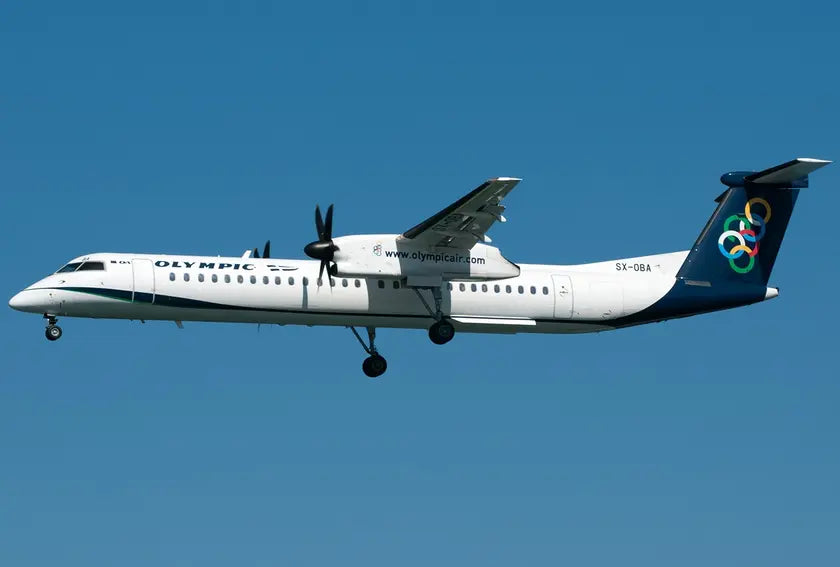
Olympic Air operates an all-turboprop fleet, and in the mid-2020s that fleet has consolidated firmly around the ATR family. According to Aegean's group fleet page and recent ATR and industry press, Olympic operated 15 ATR aircraft (12 ATR 72-600 and 3 ATR 42-600) alongside 2 De Havilland Canada Dash 8-100 in 2025, for roughly 17 operational aircraft. Independent airframe trackers list a slightly higher total when stored or transitioning aircraft are included, with an overall average fleet age of around 13 years. The Bombardier Q400 (Dash 8-400) that once formed the backbone of the fleet has been retired from scheduled service.
The fleet is actively being renewed in favour of new-build ATRs. On 7 October 2025, Aegean announced through Olympic Air the arrival of a new ATR 72-600 and a direct order for two more, due for delivery in December 2026. Aegean has framed this within a broader group renewal plan running from September 2025 to March 2027 that includes three ATR 72-600s and eleven Airbus A321neos. The ATR transition itself began back in 2016 with the airline's first two ATR 42-600s (registered SX-OAW and SX-OAX, ex-TAP Express). The two remaining Dash 8-100s are by far the oldest aircraft in the fleet and are used on thinner regional services. Live fleet detail can be cross-checked on Planespotters.
| Aircraft Type | Role | In Service | Notes |
|---|---|---|---|
| ATR 72-600 | Regional turboprop | 12 | ~70 seats. Backbone of the fleet. One delivered Oct 2025, two more on order for Dec 2026. |
| ATR 42-600 | Regional turboprop | 3 | ~48 seats. Thinner island and short-runway routes. First ATRs arrived 2016. |
| De Havilland Canada Dash 8-100 | Regional turboprop | 2 | ~37 seats. Oldest aircraft in fleet (legacy). Short-field regional services. |
| Bombardier Q400 (Dash 8-400) | Regional turboprop | 0 | Retired from scheduled operations. Historical type only. |
Fleet data compiled from Aegean's group fleet page, ATR press releases and airframe trackers (2025). Numbers are approximate and shift with ongoing deliveries and retirements.
Most new Olympic Air First Officers fly the ATR 42/72, which share a common type rating across the family, simplifying crew flexibility between the 42-600 and 72-600. The two Dash 8-100s require a separate type rating and a smaller pool of crews. Type rating and conversion training for group pilots is delivered through Aegean's Approved Training Organisation and the Aegean-CAE Flight Training Center. Pilots do not freely choose their type or base, assignment is driven by operational need and seniority, and a move from the ATR onto Aegean's Airbus A320 family later in a career is a recognised step rather than a guaranteed one.
Pilot Salary & Compensation Breakdown
Olympic Air does not publish official pay scales, so the figures below are drawn primarily from the crowdsourced PilotJobsNetwork entry for Olympic Air, cross-referenced against published Aegean group data. Pay is built on a monthly gross base salary differentiated by rank and seniority, supplemented by flight-hour and per-sector pay. The headline picture is honest and important to state plainly: salaries are modest by Western European standards but broadly in line with the Greek market, and they are competitive within Greece itself.
According to PilotJobsNetwork, Olympic Air First Officers earn a monthly gross base of roughly €1,950 at entry rising to about €2,450 at the top of the scale, while Captains start from around €3,800 gross per month, in each case plus flight-hour and sector pay that the public sources do not quantify in euros. For reference, Aegean's own A320 scale runs higher at the top end (Captains reaching roughly €5,350 gross per month), and Aegean pilots receive documented extras of about €0.02 per kilometre, €9.80 per sector and around €3,500 per year in duty pay. These add-ons illustrate the structure that variable pay takes across the group, though the exact Olympic rates are not published.
First Officer Pay (turboprop)
| Seniority | Monthly Gross Base | Annual Gross (est., incl. variable) | Notes |
|---|---|---|---|
| Year 1 (entry) | ~€1,950 | ~€28,000 – €32,000 | New F/O on ATR 42/72. Base from PilotJobsNetwork; total is an estimate. |
| Mid-seniority | ~€2,100 – €2,300 | ~€32,000 – €36,000 | Interpolated estimate between published entry and top base. |
| Senior / top of scale | ~€2,450 | ~€36,000 – €40,000 | Top F/O base per PilotJobsNetwork, plus flight-hour and sector pay. |
Base figures from PilotJobsNetwork; annual totals are informed estimates that add typical variable pay. Gross, before Greek income tax and social contributions.
Captain Pay (turboprop)
| Seniority | Monthly Gross Base | Annual Gross (est., incl. variable) | Notes |
|---|---|---|---|
| Entry Captain | ~€3,800 | ~€50,000 – €55,000 | New command on ATR/Dash 8. Base per PilotJobsNetwork. |
| Experienced Captain | €3,800+ (rising) | ~€55,000 – €62,000 | Progression with seniority plus flight-hour/sector pay. Top base not publicly itemised. |
For comparison, Aegean A320 Captains reach a documented ~€5,350 gross/month at the top of scale. Olympic turboprop command base sits lower, with totals depending heavily on hours and sectors flown.
These figures are compiled from crowdsourced pilot-pay databases and published Aegean group data, not from official Olympic Air contracts. Actual pay depends on the current agreement, individual seniority, type, and hours flown, and is strongly seasonal: variable pay swells during the intense summer schedule and shrinks in winter. Greek personal income tax is progressive (roughly 22% to 44% across these income bands) and social-security contributions to EFKA add around 15% of gross, so net take-home is materially lower than the gross figures shown. Treat all numbers here as indicative and verify directly during recruitment.
Roster Pattern & Quality of Life
Olympic Air pilots operate under the European Union Aviation Safety Agency (EASA) flight time limitation (FTL) rules, codified in ORO.FTL.205 and related material, combined with Greek labour law. Under the basic EASA framework a two-pilot crew's maximum daily flight duty period is generally capped at around 13 hours depending on report time and the number of sectors, with limited extensions and a hard ceiling, plus minimum rest requirements. The full FTL framework is published by EASA. Olympic does not publish its rosters, so the picture below uses Aegean group benchmarks, which share the same regulatory envelope and the same seasonal demand profile.
The defining feature of the job is seasonality. In the summer peak, pilots typically log around 70 to 90 block hours per month with three to four sectors per day on island routes, while winter schedules fall to roughly 40 to 60 hours per month. Days off run in the region of 8 to 11 per month, and statutory annual leave under Greek law is around 20 to 25 working days, increasing modestly with seniority. The trade-off for turboprop crews is workload density rather than long duty: short legs mean more takeoffs, approaches and landings per day, with quick 25 to 30 minute turnarounds leaving little slack between flights.
📅 Sample Summer Month — ATR First Officer (Athens base)
Illustrative summer roster based on Aegean group benchmarks (multi-sector island flying). Winter months are lighter, with fewer sectors and more days off.
Most Olympic Air pilots are based in Athens (ATH), with a smaller number in Thessaloniki and seasonal needs at Rhodes. A major lifestyle advantage over many European carriers is that crews are home-based and sleep at home most nights, rather than commuting internationally to a foreign base. The flip side is the early-start culture: a first-wave island departure can mean signing on before dawn, and EASA FTL does not count the commute to the airport, so pilots living far from ATH effectively lengthen their own day. Living costs in Athens have risen but remain below most Western European capitals, and the city offers strong public transport and a high quality of life.
Benefits, Travel Perks & Retirement
The benefits package for Olympic Air pilots blends statutory Greek employee rights with group-level perks, the most valuable of which is staff travel across the Star Alliance network. Several elements below are documented at Aegean group level rather than specifically for Olympic, and a few important items (notably supplementary health cover and loss-of-licence insurance) are not confirmed in public sources. Those gaps are flagged honestly, because they materially affect a pilot's financial planning.
Independent analysis of Aegean group pilot conditions reports no confirmed employer-funded loss-of-licence (LoL) insurance, and the same appears to apply to Olympic Air. Because a pilot's income depends entirely on holding a valid EASA Class 1 medical, the absence of group cover is significant. Prospective and current pilots should budget for a private LoL policy and confirm during recruitment exactly what medical, disability and income-protection benefits the group actually provides. Do not assume cover exists.
For pilots weighing modest Greek salaries against the cost of living, staff travel is the benefit that repeatedly tips the scales. Through Aegean's Star Alliance membership, Olympic crews and their families gain access to reduced-fare and standby travel on dozens of global carriers, which would otherwise be financially out of reach on regional turboprop pay. Exact eligibility, family terms and standby priority are governed by internal policy, so check the specifics, but the value of the benefit is well established and should be weighed seriously in any offer.
Career Progression & The Aegean Pathway
Career progression at Olympic Air is seniority-based, like most established airlines, with date of hire largely governing bidding, base preference and upgrade to command. The single most attractive structural feature is the pathway into the wider Aegean group: the same scholarship and recruitment system feeds both companies, and a turboprop First Officer can, over time, transition onto Aegean's Airbus A320 family. That said, group seniority-integration rules between Olympic and Aegean are not fully public, so any candidate should ask precisely how a move between the two affects their seniority and pay.
Independent accounts of Aegean group careers put historical time-to-command in the region of six to ten years, accelerating during fleet growth and stalling in downturns such as the pandemic. On the turboprop side specifically, command opportunities can be more constrained because the fleet is smaller and more static, but turnover (pilots leaving for higher-paying carriers abroad) periodically opens upgrade slots. These timelines are estimates that move with hiring waves, so treat them as a guide rather than a promise.
| Career Milestone | Typical Timeline | Notes |
|---|---|---|
| Cadet training (scholarship path) | 18–20 months | Integrated CPL/ATPL with MCC via Aegean group academies, then type rating. |
| Join as F/O (ATR 42/72) | Day 1 post-training | Most common entry. Some pilots placed on Aegean A320 instead, by group need. |
| Captain upgrade (turboprop) | ~6–10 years (estimate) | Seniority-driven, with command assessment. Varies with fleet growth and turnover. |
| Transition to Aegean A320 | Variable | Recognised group pathway, not guaranteed. Subject to seniority and vacancies. |
| Training Captain / TRI / TRE | Variable | Requires separate selection and instructor qualification. |
The Aegean group is in a clear hiring and growth phase. Aegean has stated that since its pilot scholarship launched in 2018, more than 240 people have entered the programme, of whom around 130 have completed training and begun flying for Aegean and Olympic Air, with roughly 110 still in training as of late 2025. Combined with active fleet renewal (new ATR 72-600s for Olympic and eleven A321neos for Aegean through to 2027), this points to continued demand for First Officers and a healthy, if seniority-gated, progression environment. Direct-entry roles are also advertised on the group's careers portal for type-rated ATR and A320 crews.
Recruitment & The Cadet Scholarship
There are two main routes into an Olympic Air flight deck, and both are managed through the Aegean group's careers portal. The first is the Aegean Pilot Scholarship Programme, an ab-initio cadet path for candidates with little or no flying experience. The second is direct entry for experienced, type-rated pilots. The careers portal explicitly recruits 'A320 and ATR 42/72 type-rated captains and first officers,' as well as experienced pilots willing to enter the group's structured type-rating training.
Aegean Pilot Scholarship (Cadet Path)
Aegean has announced a new three-year scholarship cycle covering up to 120 cadets in total across 2026 to 2028, with up to 40 candidates starting on 2 March 2026. Training runs full-time for roughly 18 to 20 months at the Global Aviation Academy (Athens) and Egnatia Aviation Academy (Kavala), leading to an Integrated CPL/ATPL with MCC, after which cadets continue to type rating and a First Officer role at Aegean or Olympic Air. Full terms are published on Aegean's scholarship page.
Direct Entry (Experienced Pilots)
Selection Stages
Application & Screening
Candidates apply through the Aegean group careers portal (cadets via the scholarship campaign, experienced pilots against advertised vacancies). CVs, licences and eligibility are screened against the relevant requirements.
Aptitude & Psychometric Testing
Computer-based assessment of cognitive ability, coordination, spatial reasoning and multitasking, the standard backbone of European pilot selection. English proficiency is verified during the process.
Interviews (HR & Technical)
Personal and competency-based interview alongside a technical discussion. Assessors look for trainable, communicative team players with sound airmanship and cultural fit, rather than a flawless résumé. A prepared 'story bank' of crew, conflict and workload examples helps.
Simulator Assessment
For experienced applicants in particular, a simulator session evaluates basic flying skills, instrument procedures, CRM and adherence to standard operating procedures. Cadets are assessed on raw aptitude rather than type knowledge.
Class 1 Medical, Training & Type Rating
A valid EASA Class 1 Medical (issued via an HCAA-approved aeromedical centre) is required. Cadets then begin academy training; experienced and post-academy pilots proceed to type rating at the Aegean group training organisation and line training.
Greek language ability is a genuine differentiator. The scholarship is restricted to Greek and Cypriot citizens, and even where wider EU applicants are considered for line roles, fluent Greek smooths communication with Greek ATC, cabin crew and company culture. English is non-negotiable as the language of aviation. For the cadet path, watch the application window around the announced 2 March 2026 start, and male Greek candidates must have settled military obligations with no deferment. Apply early and treat every stage, including the medical, as a hard gate.
Network & Island Flying Environment
Olympic Air is a short-haul, domestically focused carrier, so this is not a job with long-haul layovers in five-star city hotels. Instead, the defining experience is intensive island and regional flying out of Athens, with secondary activity from Thessaloniki and Rhodes. Published destinations include Chania, Heraklion, Kos, Mykonos, Santorini, Rhodes, Chios, Samos, Lesbos, Paros, Naxos, Karpathos, Leros, Kastellorizo, Milos, Skiathos, Syros, Astypalaia, Kythira, Ikaria, Sitia, Kalamata, Ioannina, Kavala and Alexandroupoli, among others. For a pilot, the appeal is hands-on flying into demanding airfields, the kind of environment that builds genuine stick-and-rudder skill.
Many Greek island airports combine short runways, surrounding terrain, strong and gusty winds and high summer temperatures, often with non-precision or visual approaches and minimal infrastructure. Add three to four sectors a day and quick turnarounds, and the result is operationally dense flying that rewards precision and currency. The five destinations below are illustrative of the network's character rather than an exhaustive list, and exact runway and approach details should always be checked against current charts.
Olympic Air offers some of the most rewarding hands-on flying in European regional aviation, but it is demanding rather than relaxing. Expect early starts, several short sectors per day, and frequent operations into terrain-affected, wind-exposed island airfields under EASA performance and FTL rules. Most duties are out-and-back from base with relatively few night-stops, so the per diem and overnight element is smaller than at long-haul carriers. Pilots who love frequent takeoffs and landings, varied scenery and genuine airmanship tend to thrive here; those seeking long cruise legs and exotic layovers will not find them in this network.
How Olympic Air Compares: Airline Radar Chart
How does Olympic Air stack up against its parent, Aegean Airlines, and its main domestic rival, Sky Express? These three carriers dominate Greek domestic flying. Below is a comparative view across the same six themes used in the scorecard. Scores are editorial estimates based on the research in this guide (pay databases, fleet data, pilot reports and industry benchmarks), not precise measurements.
Key Takeaways from the Comparison
Aegean leads on pay and job security. As the group's mainline jet operator, Aegean offers the highest Captain pay (a documented top base around €5,350 gross per month versus roughly €3,800 at Olympic), a modern and growing A320neo/A321neo fleet, and the strongest job security as Greece's largest carrier and a Star Alliance member. Olympic and Sky Express First Officers cluster at a similar entry level (roughly €1,800 to €2,450 gross base).
Olympic Air's edge is the group safety net. Being owned by a profitable, Star-Alliance-backed parent gives Olympic crews more stability than a standalone regional carrier, plus a built-in pathway toward Aegean jets and the same scholarship pipeline. Sky Express, an independent operator that has expanded aggressively with ATR 72-600s and some Airbus jets, offers genuine competition and opportunity but without the backing of a larger group.
Fleet modernity is close, but Aegean wins. All three operate new-generation ATRs on island routes, and Olympic is actively renewing toward the ATR 72-600. Aegean scores highest on fleet because its narrowbody jets are among the youngest in Europe, while Olympic carries two ageing Dash 8-100s that pull its average down.
Work-life and benefits are broadly similar across the three, shaped by common EASA FTL rules and Greek labour law. The differentiator for the Aegean group (Olympic included) is Star Alliance staff travel, which independent Greek carriers cannot match in global reach.
Scores are editorial estimates based on publicly available salary databases (PilotJobsNetwork, AircrewNetwork), fleet trackers, airline press releases and industry benchmarks. They represent a general assessment for a pilot considering a medium-term career and are not precise metrics. Individual experiences vary with seniority, type and personal priorities. Olympic Air and Sky Express figures in particular rely on limited public data and should be verified directly.
Union, Labour Relations & Regulation
The union picture for Aegean group pilots is less publicly documented than at some Western European flag carriers, and it is worth being upfront about that. Greek airline pilots are represented within the national pilots' union framework, principally the Hellenic Airline Pilots Association (HALPA), rather than by a publicly identified company-only union. A separate, broader body, the Hellenic Pilots Association (Panhellenic Union of Pilots), founded in 2014, represents pilots across military, general and commercial aviation. Detailed collective-bargaining agreements specific to Aegean and Olympic are not published in open sources, so the structure below maps the wider representation and regulatory framework that governs an Olympic Air pilot's working life.
Representation & Regulatory Framework
The Real Industrial-Relations Story: ATC, Not Pilots
The crucial point for anyone joining Olympic Air is that recent disruption to Greek aviation has come from national general strikes and air traffic control (ATC) walkouts, not from Aegean or Olympic pilots. There is no publicly reported Aegean or Olympic pilot strike in 2024 or 2025. Instead, Aegean and Olympic repeatedly cancelled or adjusted flights because air traffic controllers joined wider strikes called by the national confederations ADEDY and GSEE. This distinction matters: as a pilot you are far more likely to have a duty disrupted by a controller strike than to be on strike yourself.
For a prospective Olympic Air pilot, the labour environment looks relatively calm on the cockpit side, with disruption driven by external national strikes rather than internal pilot disputes. The flip side of the limited public information is that you should ask direct questions during recruitment: which union or staff body represents pilots, whether a collective agreement governs your pay scale and roster rules, and how seniority is protected when moving between Olympic and Aegean. Greek pilots, like most in Europe, have access to union representation, but verify the specifics that apply to your contract rather than assuming.
Verdict: Who Is Olympic Air For?
🎯 Our Take
Olympic Air is best understood not as a destination airline but as the regional, turboprop entry point into the Aegean group, one of the most stable and well-run airline businesses in southeastern Europe. For the right pilot, that is a genuinely attractive proposition: hands-on island flying that builds real airmanship, a home base in Greece with nights at home, Star Alliance staff travel that punches well above the salary, and a structured pathway (via the Aegean scholarship and a shared pipeline) toward Airbus A320 flying at the mainline.
The trade-offs are real and should not be glossed over. Base pay is modest by Western European standards, the work is seasonally intense with early starts and dense multi-sector days, two ageing Dash 8-100s sit alongside the modern ATRs, and several benefit details (supplementary health cover, loss-of-licence insurance, exact seniority-integration rules with Aegean) are not transparent in public sources and must be confirmed directly. This is a career that rewards pilots who want to live and fly in Greece for the medium to long term, rather than those chasing maximum gross income or long-haul layovers.
For Greek and Cypriot nationals especially, and for EU pilots with strong Greek, Olympic Air offers a credible, professionally rewarding way into airline flying with a clear route toward bigger jets inside a profitable, alliance-backed group.
1Do I need to speak Greek to fly for Olympic Air?
For the Aegean Pilot Scholarship (the main cadet route into the group), yes: it is open only to Greek and Cypriot citizens and requires excellent Greek and English. For experienced direct-entry roles, English is mandatory as the language of aviation, and Greek is a strong asset because it smooths communication with Greek ATC, cabin crew and company culture. In practice, fluent Greek is close to essential for a long-term career here.
2How do I get in with little or no flying experience?
Through the Aegean Pilot Scholarship Programme, an ab-initio path that takes candidates with no flight experience. The new cycle covers up to 120 cadets across 2026 to 2028, with up to 40 starting on 2 March 2026. Training runs around 18 to 20 months at the Global Aviation (Athens) and Egnatia Aviation (Kavala) academies, leading to an Integrated CPL/ATPL with MCC, then type rating and a First Officer role at Aegean or Olympic Air.
3What aircraft will I fly at Olympic Air?
Almost certainly the ATR 42-600 or ATR 72-600, which make up the great majority of the fleet (roughly 3 and 12 aircraft respectively) and share a common type rating. Two older De Havilland Canada Dash 8-100s remain in service on thinner regional routes and use a separate rating. The Bombardier Q400 has been retired from scheduled service.
4How much do Olympic Air pilots earn?
Crowdsourced data (PilotJobsNetwork) put First Officer monthly gross base at roughly €1,950 at entry rising to about €2,450, and Captain base from around €3,800, in each case plus flight-hour and per-sector pay. That points to estimated annual gross of roughly €28,000 to €40,000 for First Officers and around €50,000 to €62,000 for Captains, before Greek income tax and EFKA contributions, which significantly reduce take-home pay. Figures are modest by Western European standards but competitive within Greece. These are estimates, not official scales.
5Can I move from Olympic Air to Aegean's Airbus jets?
Yes, this is a recognised pathway. Olympic and Aegean share a single recruitment and training pipeline, and a turboprop First Officer can transition onto the Airbus A320 family at the mainline over time. It is not automatic or guaranteed, however: it depends on seniority and vacancies, and the exact rules for how seniority carries across the two companies are not fully public. Ask about this directly during recruitment.
6How long does it take to upgrade to Captain?
Independent accounts of the Aegean group put historical time-to-command at roughly six to ten years, accelerating during fleet growth and slowing in downturns. On the turboprop side the smaller fleet can make command slots scarcer, though pilot turnover periodically opens upgrades. Treat this as an estimate that moves with hiring waves rather than a fixed timeline.
7Can non-EU citizens apply?
The cadet scholarship is restricted to Greek and Cypriot citizens. Direct-entry roles require the legal right to work in the EU/EEA, which is straightforward for EU nationals but generally not available to non-EU candidates without existing work rights. There is no advertised sponsorship pathway for non-EU pilots, and Greek language ability remains a practical requirement for most positions.
8Is Olympic Air a good first airline?
For Greek and Cypriot pilots in particular, it is one of the strongest options in the country: fully structured cadet training, a guaranteed route to a First Officer seat, and demanding island flying that builds excellent core skills, all inside a stable, Star-Alliance-backed group with a pathway to jets. The main caveats are modest pay and intense summer rosters. If you want to fly and live in Greece long term, it is a compelling first and potentially only airline.
Official Links & Resources
Before applying or making any career decision, verify information directly with official sources. These are the key websites and organisations relevant to an Olympic Air pilot career:
Because Olympic Air and Aegean share a single recruitment system, monitor the Aegean group careers portal and the official scholarship page rather than waiting for an 'Olympic Air' vacancy to appear separately. Cadet scholarship windows open around the announced spring start date, so set a reminder well ahead of the 2 March intake, and confirm pay, benefits and seniority terms in writing before accepting any offer.