Aérospatiale N 262: History, Development and Evolution of a French Turboprop Pioneer
The Aérospatiale N 262, originally designated the Nord 262, is a French twin-turboprop high-wing regional airliner that emerged in the early 1960s as part of an ambitious effort to replace aging Douglas DC-3s on short-haul routes across Europe and beyond. Its development traces a path from a modest single-engine utility aircraft through a series of progressively larger turboprop designs, culminating in a pressurized commuter transport that served airlines and military operators for decades.
The story begins with French aircraft designer Max Holste, whose company produced the single-engine MH.1521 Broussard for the French military. In 1957, Holste turned attention to a twin-engine DC-3 replacement concept, the MH.250 Super Broussard, which first flew on 20 May 1959 powered by two Pratt & Whitney R-1340 Wasp piston engines. The design seated 17 to 23 passengers, but the real ambition was a turboprop-powered successor. This led to the MH.260, a larger turboprop variant fitted with Turbomeca Bastan engines, which flew on 29 July 1960. However, financial difficulties at Max Holste's company forced a change of direction.
In late 1960, state-owned Nord Aviation signed an agreement with Max Holste to take over production and marketing rights for the MH.260. Nord Aviation soon decided to go further than a simple production takeover: the manufacturer launched a thorough redesign in early 1961, replacing the MH.260's square-section fuselage with a new circular, pressurized fuselage while retaining the proven high-wing layout and twin-turboprop configuration. The result was designated the Nord 262, and it was engineered to meet both French civil airworthiness specification AIR 2051 and American requirements under CAR 4B / SR 422B, opening the door to export markets.
The Nord 262 prototype completed its maiden flight on 24 December 1962, powered by two Turbomeca Bastan turboprops. The aircraft was presented at the 1963 Paris Air Show, generating interest from both civil and military customers. Three pre-series aircraft followed, the first of which flew on 8 April 1964. The first standard production Nord 262, which introduced a dorsal fin for improved directional stability, flew on 8 July 1964. Just eight days later, on 16 July 1964, the aircraft received its French type certificate. The launch customer, domestic carrier Air Inter, took delivery shortly after and placed the type into commercial service in September 1964.
The initial production version, the Nord 262A, was powered by two Turbomeca Bastan VIC turboprops producing approximately 1,080 hp each. It accommodated up to 29 passengers in a pressurized cabin with a three-abreast seating layout. Around 70 N 262A airframes were built, making it the most numerous variant. Civil customers in the United States included Lake Central Airlines, which became the first American operator in May 1965, and Allegheny Airlines, which absorbed Lake Central's fleet. Several other US commuter carriers also flew the type, helping to shape the American regional airline landscape in a manner similar to how operators like Mokulele Airlines connect smaller communities through turboprop service today.
In 1970, the merger of Sud Aviation and Nord Aviation created Aérospatiale, which continued production of the aircraft under the designation Aérospatiale N 262 Frégate. Production continued at Bourges until the mid-1970s, with the final airframes completed by late 1976 and last deliveries in early 1977. In total, approximately 110 aircraft of all variants were built, according to established aviation history references.
Variant Differences: From the N 262A to the N 262D Frégate
The N 262C Frégate, which first flew on 9 July 1968, represented the most significant evolution of the design. It introduced more powerful Turbomeca Bastan VII turboprops rated at approximately 1,145 hp, driving four-bladed propellers in place of the earlier three-bladed units. According to the World Airline Historical Society, the Frégate also featured a fuselage stretch of approximately 2 feet 3.75 inches and an increased wingspan, resulting in improved payload-range performance. Nine N 262C airframes were completed for civil operators.
The N 262D was the dedicated military transport variant for the French Air Force (Armée de l'Air), sharing the Bastan VII engines and enlarged airframe of the N 262C but fitted with mission-specific equipment. The French Air Force ordered 24 N 262D aircraft for transport, liaison, and training duties. The French Navy (Aéronautique Navale) also operated the type extensively, acquiring around 15 N 262A airframes plus additional second-hand examples, using them for transport, crew training, and maritime patrol until the last examples were retired in 2009.
A notable derivative was the Mohawk 298, developed in 1975 by Frakes Aviation in Texas for the US market. This conversion replaced the Bastan turboprops with Pratt & Whitney Canada PT6A-45 engines and five-bladed propellers, creating a variant better suited to American operational preferences and maintenance networks. Nine airframes were converted, primarily for Allegheny Airlines and its commuter affiliates.
The following list summarises the key variant identifiers across the Aérospatiale N 262 family:
- N 262A: Turbomeca Bastan VIC engines (approximately 1,080 hp each), three-bladed propellers, standard-length pressurized fuselage, up to 29 passengers, approximately 70 built
- N 262C Frégate: Turbomeca Bastan VII engines (approximately 1,145 hp each), four-bladed propellers, stretched fuselage, increased wingspan, 9 built
- N 262D Frégate: Military variant of the N 262C for the French Air Force, Bastan VIIA engines, 24 ordered
- Mohawk 298: Re-engined with Pratt & Whitney Canada PT6A-45 turboprops, five-bladed propellers, 9 conversions for US commuter operators

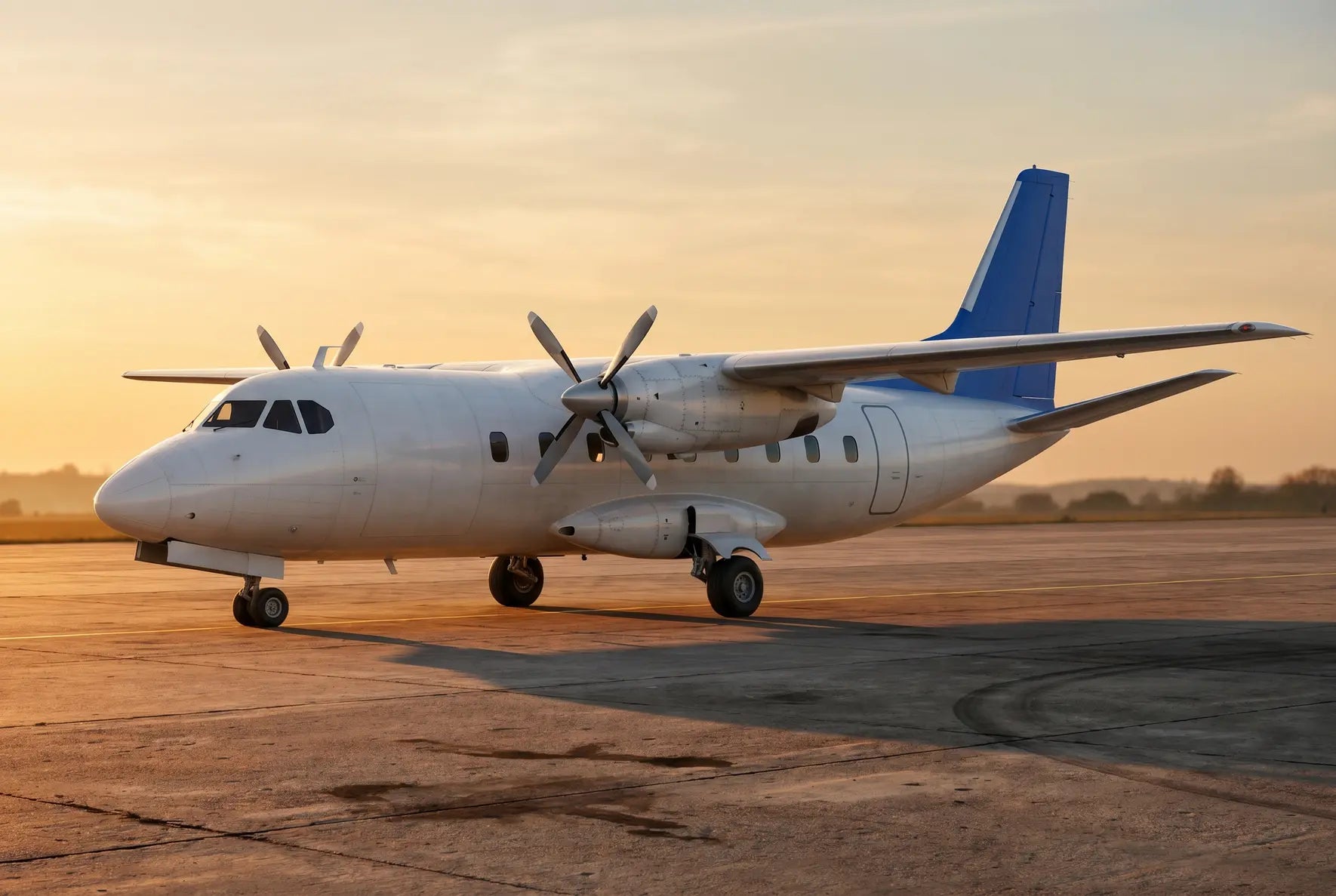
The image shows an Aerospatiale N-262, also known as the Fregate, a twin-engine turboprop aircraft. It is flying against a clear blue sky, displaying its distinctive design and markings.
Aerospatiale N 262 Technical Specifications, Performance Data and Engine Options
The Aerospatiale N 262 was designed as a pressurised, high-wing, twin-turboprop regional transport built to replace ageing piston-engine airliners such as the Douglas DC-3 on short-haul European and overseas routes. Its core design trade-offs centred on short-field performance, rugged simplicity for secondary airports, and a pressurised cabin offering improved passenger comfort over its predecessor, the unpressurised Max Holste MH.260. Nord Aviation (later merged into Aerospatiale in 1970) prioritised ease of maintenance, a high wing for propeller clearance on unimproved surfaces, and compliance with US airworthiness standards to boost export potential.
The family evolved through several variants. The initial N 262A used two Turbomeca Bastan VIC turboprops rated at approximately 1,065 shp each, while the later N 262C Fregate introduced more powerful Bastan VII engines (about 1,145 shp per engine), four-bladed propellers, and a modest fuselage stretch. A US-market derivative, the Mohawk 298, replaced the French engines entirely with Pratt & Whitney Canada PT6A-45 turboprops. Competing in the same commuter niche as types such as the Beechcraft Model 99 Airliner, the N 262 found its largest customer base among military operators, particularly the French Air Force and Navy, with a total of 110 airframes produced across all versions.
- Crew: 2 (pilot and co-pilot)
- Typical passenger capacity: 26 to 29, depending on cabin configuration
- Overall length: 19.28 m (63 ft 3 in)
- Wingspan: 21.90 m (71 ft 10 in) on the N 262A
- Height: 6.21 m (20 ft 4 in)
- Wing area: 55.0 m² (592 sq ft), NACA 23016 root / NACA 23012 tip airfoils
- MTOW (N 262A): 10,300 kg (22,708 lb); approximately 10,800 kg (23,810 lb) for the N 262C Fregate
- Empty weight (N 262A): 6,654 kg (14,670 lb)
- Fuel capacity (N 262A): 2,000 litres (530 US gal)
- Engines (N 262A): 2 x Turbomeca Bastan VIC turboprops, each rated at approximately 794 kW (1,065 shp)
- Engines (N 262C Fregate): 2 x Turbomeca Bastan VII turboprops, each rated at approximately 854 kW (1,145 shp), driving four-bladed propellers
- Propellers (N 262A): 3-bladed Ratier-Figeac FH.146, 3.20 m (10 ft 6 in) diameter
- Economic cruise speed (N 262A): 360 km/h (194 kt / 220 mph)
- Maximum speed: 385 km/h (208 kt / 239 mph)
- Range (N 262A, max fuel): 1,110 km (600 NM / 690 mi)
- Service ceiling: 7,300 m (24,000 ft)
- Rate of climb: 6.4 m/s (1,250 ft/min)
- Take-off distance to 10.5 m (35 ft): 1,200 m (3,937 ft)
- Landing distance from 15 m (50 ft): 1,100 m (3,609 ft)
Systems, Flight Controls and Handling
The N 262 featured conventional mechanical primary flight controls (ailerons, elevators, rudder) actuated through cables and bellcranks, with aerodynamic balancing and trim tabs. This approach was consistent with other regional turboprops of the early 1960s in its weight class and kept the control system straightforward for operators at smaller airfields with limited maintenance infrastructure. Hydraulic power was employed for the retractable tricycle landing gear, wheel brakes, and likely the flap system. The main gear retracted into distinctive streamlined fairings along the lower fuselage sides, a visual hallmark of the type.
Pressurisation was achieved through an engine bleed-air environmental control system, making the N 262 a marked comfort improvement over the unpressurised MH.260 from which it was derived. Baseline avionics comprised a standard analogue IFR suite for the era, including dual VHF communications, VOR/ILS, ADF, and transponder. The Mohawk 298 conversion for the US market incorporated updated avionics and an auxiliary power unit (APU) to meet American commuter airline standards. On the ground, deceleration relied on hydraulic wheel brakes combined with propeller beta-range drag, which was a standard technique for turboprops of this size and period.
Published performance figures for the N 262 can vary depending on the variant (A, C, or Mohawk 298), operator-specific cabin density, actual operating weight versus certified MTOW, atmospheric conditions (ISA versus hot-and-high scenarios), and runway surface state. The take-off and landing distances quoted above assume sea-level ISA conditions and a clean, dry runway. Cruise speed and range are also affected by altitude selection, power setting (economic cruise versus high-speed cruise), and reserve fuel policy. When comparing figures across sources, it is important to verify which variant and weight assumptions apply.
Engines: Turbomeca Bastan and the PT6A Alternative
The primary powerplant for most N 262 variants was the Turbomeca Bastan, a French free-turbine turboprop developed in the 1950s by Turbomeca (now Safran Helicopter Engines). Positioned in the 800 to 1,150 shp class, the Bastan filled a medium-power niche between Turbomeca's smaller helicopter turboshafts (such as the Artouste) and larger Western European turboprops like the Rolls-Royce Dart. The free-turbine architecture, in which the gas generator and power turbine rotate independently, provided smooth propeller control and favourable low-speed torque characteristics, qualities especially valued in short-field operations.
The N 262A used the Bastan VIC, rated at approximately 1,065 shp, while the improved N 262C Fregate adopted the Bastan VII (VIIC) at around 1,145 shp, paired with four-bladed propellers for better thrust and lower noise. Beyond the N 262, the Bastan also powered the Breguet 941 experimental STOL transport (which used four Bastan engines to drive its blown-wing high-lift system) and the Max Holste MH.260 prototype from which the N 262 was derived. Despite its technical merits, the Bastan saw limited adoption compared to competitors like the PT6A, partly because Turbomeca's commercial turboprop market presence was overshadowed by its dominance in helicopter engines.
For the US commuter market, the N 262 airframe was re-engined as the Mohawk 298, replacing the Bastan turboprops with two Pratt & Whitney Canada PT6A-45 engines. The PT6A-45, part of the medium PT6A family, features a two-stage reduction gearbox, a free power turbine, and a certified take-off rating of approximately 875 kW (1,173 shp) according to EASA type-certificate data, though it could be de-rated for specific installations. With a dry weight of around 423 kg (933 lb), the PT6A-45 offered improved parts availability, globally standardised maintenance procedures, and the outstanding reliability record of the broader PT6A family. Beyond the Mohawk 298, the PT6A-45 also powered certain variants of the Shorts SD3-30 commuter aircraft. The re-engining gave the Mohawk 298 better dispatch reliability and lower operating costs, which were key requirements for competitive commuter airline operations in North America during the 1970s.
Aérospatiale N 262 vs HS 748 vs F27 Friendship vs Dart Herald: Specifications Comparison
Scroll horizontally to see more →
| Parameter | Aérospatiale N 262 | Hawker Siddeley HS 748 | Fokker F27 Friendship | Handley Page Dart Herald |
|---|---|---|---|---|
| Entry into service | 1964 | 1961 | 1958 | 1962 |
| Engines | 2 × Turbomeca Bastan VII turboprops | 2 × Rolls-Royce Dart turboprops | 2 × Rolls-Royce Dart turboprops | 2 × Rolls-Royce Dart turboprops |
| Length | 19.3 m | 20.4 m | 23.4 m | 21.4 m |
| Wingspan | 22.6 m | 30.2 m | 29.0 m | 29.3 m |
| Height | 6.2 m | 7.6 m | 8.5 m | 8.4 m |
| Typical seating and layout (short description + approximate passengers) | Single-class regional: 26–29 passengers | Single-class regional: 40–58 passengers | Single-class regional: 44–56 passengers | Single-class regional: 40–56 passengers |
| MTOW | 10.8 t | 21.3 t | 20.0 t | 21.0 t |
| Range | 600 nm | 1,400 nm | 1,250 nm | 1,050 nm |
| Cruise speed | 0.29 Mach | 0.37 Mach | 0.36 Mach | 0.35 Mach |
| Service ceiling | 24,000 ft | 25,000 ft | 25,000 ft | 25,000 ft |
| Program note | French high-wing pressurized turboprop regional airliner positioned for short-haul commuter routes with around 30 seats. | British twin-turboprop regional airliner offering higher capacity and STOL performance for short to medium-haul services. | Dutch-built early-generation turboprop regional airliner widely adopted as a backbone of short-haul networks in the 1960s–1970s. | British high-wing turboprop designed as a rugged short-haul feeder airliner competing with early F27- and HS 748-class aircraft. |
Scroll horizontally to see more →
The table compares four 1960s turboprop regional airliners by key specs and typical seating. The Aérospatiale N 262 is the smallest and lightest (10.8 t MTOW) with 26–29 seats and the shortest range (600 nm) and lowest cruise (0.29 Mach). The HS 748, F27 and Dart Herald carry roughly 40–58 passengers, cruise faster (~0.35–0.37 Mach) and offer much longer range, led by the HS 748 at 1,400 nm.
Aérospatiale N 262: Typical Routes, Missions and Airlines Around the World
The Aérospatiale N 262, also known as the Nord 262, was purpose-built for short-haul regional operations. With a maximum range of approximately 1,110 km (690 miles) and a cruising speed around 360 km/h (220 mph), the aircraft was optimised for sectors typically between 200 and 600 km. Its high-wing configuration and robust landing gear allowed it to operate from short, sometimes unpaved, runways at secondary and regional airports where larger aircraft could not go. In daily service, this 26-to-29-seat turboprop completed multiple short rotations per day, connecting smaller communities with larger transport hubs.
The Aérospatiale N 262 served primarily in hub-and-spoke feeder roles and point-to-point regional networks. In the United States, airlines such as Allegheny Airlines and its commuter partners used the type, including the re-engined Mohawk 298 variant, to feed passengers from small towns into major hubs like Pittsburgh and Philadelphia. In Europe, carriers deployed the Nord 262 on thin domestic routes linking secondary cities with national capitals or regional hubs. The aircraft's pressurised cabin and short-field performance made it well suited to operations in mountainous terrain, island services, and coastal routes where runway length was limited.
Operators faced several challenges. The original Turbomeca Bastan engines did not achieve the global support network of competitors such as the Pratt & Whitney Canada PT6, which limited sales outside France. With only about 110 aircraft built across all variants, spare parts availability was constrained, increasing maintenance costs for airlines far from the French supply chain. The Mohawk 298 conversion, which replaced the Bastan engines with PT6A-45 turboprops, was specifically developed to address these reliability and support issues for the American market.
Where the Aérospatiale N 262 Operates and Operated
The Aérospatiale N 262 saw service across four broad regions. In Europe, it was a pioneer of regional turboprop flying, connecting domestic routes in France, Scandinavia, Italy, and the United Kingdom. In North America, the type became a workhorse of the 1960s and 1970s commuter boom, particularly in the northeastern and southeastern United States. In Asia, a small number served on domestic and inter-island routes in countries such as Japan, Sri Lanka, and the Philippines. In Africa, operators valued the Nord 262 for its ability to reach remote airfields in Madagascar, Tunisia, and Central Africa.
While the Aérospatiale N 262 is no longer in widespread airline service, its operational legacy spans decades and multiple continents. The list below highlights the principal airlines and missions by region, based on documented operator records.
- Europe - Air Inter was the launch customer, introducing the type on routes such as Paris-Quimper from 1964. Cimber Air in Denmark and Widerøe in Norway used it on short Scandinavian regional services. Dan-Air in the United Kingdom operated it on low-density scheduled and charter routes, while Alisarda connected Sardinia with mainland Italy. Linjeflyg in Sweden, Delta Air Transport in Belgium, and Tempelhof Airways in West Berlin also operated the type on regional feeders. The French Air Force and French Navy were significant military users, flying the Nord 262D variant for transport, liaison, and crew training.
- North & South America - Lake Central Airlines was the first US operator from 1965, later absorbed by Allegheny Airlines, which became the largest American user. Ransome Airlines, Altair Airlines, and Pocono Airlines operated the type under the Allegheny Commuter banner in the northeastern United States. On the West Coast, Swift Aire Lines and Golden Gate Airlines flew California intrastate commuter routes. National Commuter Airlines operated Nord 262s under the Air Florida Commuter brand on Florida regional services. In Canada, B.C. Air Lines and subsequently Pacific Western Airlines used the aircraft in British Columbia. Understanding how airlines structure their regional feeder networks helps explain the role this aircraft played in connecting smaller communities.
- Asia - Japan Domestic Airlines operated the Nord 262 on short domestic sectors within Japan. Air Ceylon used the type on domestic and short regional routes in Sri Lanka. Filipinas Orient Airways deployed it on inter-island services across the Philippines, while an Indonesian operator used it on domestic archipelago routes.
- Africa - Air Madagascar flew the Nord 262 on domestic routes across Madagascar, often serving basic airstrips. Tunis Air operated it on short-haul sectors in North Africa. Trans Service Airlift and Malu Aviation used the aircraft for charter, cargo, and regional passenger services in Central Africa, capitalising on its ability to operate from remote and rough-field locations.
Typical Seating Configurations on the Aérospatiale N 262
The Aérospatiale N 262 featured a pressurised, circular-section fuselage arranged in a three-abreast layout (1+2) with an offset aisle. The standard configuration seated 26 passengers, while high-density commuter layouts accommodated up to 29 seats. On the two-seat side, pairs were often a single bench unit, and pitch was minimal, reflecting the aircraft's commuter-oriented design philosophy. There was no meaningful distinction between business and economy class on this type; virtually all operators configured the cabin in a single all-economy arrangement.
Network carriers operating the Nord 262 as a hub feeder, such as Allegheny Airlines, typically used the standard 26-seat layout to balance passenger comfort with operational efficiency. Charter and regional point-to-point operators sometimes opted for the denser 29-seat configuration to maximise revenue per flight. Cabin windows were elliptical, and baggage was stowed in a rear or ventral compartment depending on the operator. Detailed specifications for the type are available via SKYbrary's N 262 page.
In this short video, discover why the Nord 262 is considered legendary, with a concise look at its origins and historical context. Learn the key moments that shaped its reputation over time.
Aérospatiale N 262 Safety Record: How Safe Is This Turboprop?
The Aérospatiale N 262 entered commercial service in 1964 and remained in active military use until early 2009, spanning roughly 45 years of operations. With approximately 110 airframes built across all variants, including the Nord 262A, Nord 262C, Nord 262E Frégate and the Mohawk 298, the fleet was modest compared with mass-produced regional turboprops. The type served a wide range of operators, from small regional airlines in France and the United States to the French Navy (Aéronautique Navale) and several African air forces. Over its long service life, the Aviation Safety Network records multiple hull-loss accidents for the N 262 family. While these events are notable, they must be read in context: many occurred during an era when commuter aviation safety standards, cockpit resource management training and terrain awareness systems were still maturing. The aircraft itself was designed with a pressurised circular-section fuselage, twin-turboprop redundancy and a high-wing layout that offered stable low-speed handling, all features that reflected sound engineering practice for a 1960s regional transport.
Major Accidents and Incidents Involving the N 262
Several serious events shaped the operational history of the Nord 262 and prompted improvements in procedures, training and regulations across the commuter aviation sector.
- Rousseau Aviation, 31 December 1970, Mediterranean Sea. A Nord 262E (registration F-BNGB) operating a charter flight from Algiers to Menorca disappeared over the Mediterranean after the crew transmitted a distress call. All 30 occupants were lost. The aircraft was never recovered, and no definitive technical cause was publicly established. The tragedy underscored the risks of overwater operations without modern tracking and emergency locator technology, which would gradually improve in subsequent decades.
- French Air Force (Armée de l'Air), 21 January 1971, Mézilhac, France. A Nord 262A-34 (registration F-RBOA) carrying 21 military personnel struck the slopes of the Suc de Pradou in the Ardèche mountains during poor visibility. The accident was classified as controlled flight into terrain (CFIT), attributed to a premature descent likely caused by confusion over altitude clearances from Marseille ATC. All 21 occupants died. This event, documented by the Bureau of Aircraft Accidents Archives, reinforced the need for clearer altitude management procedures and eventually contributed to the development of standardised approach protocols and ground-proximity warning systems across the industry.
- Swift Aire Lines Flight 235, 10 March 1979, Santa Monica Bay, United States. A Nord 262A-33 (registration N418SA) ditched in the Pacific Ocean shortly after take-off from Los Angeles International Airport. The right propeller autofeathered and the right engine shut down. The crew then inadvertently shut down the remaining left engine, leaving the aircraft without power. Three of the seven occupants did not survive the water impact. The NTSB investigation (Report AAR-79-13) determined that the probable cause was the crew's mismanagement of the engine-out emergency procedure, with inadequate restart information in the aircraft flight manual as a contributing factor. The findings led to industry-wide emphasis on engine-failure identification drills, improved checklists and clearer emergency documentation for twin-engine turboprops.
- Trans Service Airlift, 26 December 1991, Kinshasa, Zaire. A Nord 262A-44 (registration 9Q-CJK) crashed shortly after take-off when it failed to gain adequate altitude. The aircraft was reportedly overloaded, and the resulting performance shortfall proved fatal. Three occupants and six people on the ground were killed. The accident highlighted the critical importance of weight-and-balance management and regulatory enforcement in regions where oversight resources were limited.
How Safe Is the Aérospatiale N 262 Today?
Evaluating the safety of the N 262 requires perspective. The type accumulated the vast majority of its hull-loss events during the 1960s, 1970s and early 1980s, a period when commuter aviation worldwide experienced higher accident rates than the standards seen today. Many of the causal factors, such as CFIT, engine-failure mismanagement and overloading, were systemic issues that affected numerous aircraft types, not design flaws unique to the Nord 262. The aircraft's twin-turboprop configuration, pressurised fuselage and robust high-wing airframe were considered reliable by the standards of their era, and the type served the French Navy without a major publicised accident for decades. Operators that followed rigorous standard operating procedures (SOPs) and invested in crew training maintained strong safety records throughout the aircraft's career. On the regulatory side, the N 262 was certified by French civil aviation authorities and later overseen under EASA rules until the type certificate was surrendered in December 2008, reflecting continuous regulatory scrutiny for as long as the fleet was active. For readers interested in how modern regional aircraft have evolved in terms of safety, design and certification, the Airbus A220-100 overview offers a useful comparison point. As the Flight Safety Foundation and global aviation bodies consistently confirm, commercial aviation remains statistically one of the safest forms of transport, and the lessons drawn from earlier-generation aircraft like the Aérospatiale N 262 have directly contributed to the exceptional safety levels the industry achieves today.
01 What kind of routes and missions was the Aérospatiale N 262 mainly used for?
The Aérospatiale N 262 was designed as a short-haul regional airliner, typically flying routes of 300 to 800 km, with a maximum range of roughly 1,400 to 1,600 km depending on the version and load. It was commonly used on low-density domestic routes, island services, and feeder flights connecting smaller cities to major hubs. Many operators in Europe, Africa and Asia used it for public-service or regional contracts where runway length and basic airport infrastructure were limiting factors. The aircraft’s rugged gear and good short-field performance made it suitable for secondary and sometimes unimproved airfields.
02 How many passengers did the Aérospatiale N 262 carry and what was the cabin like?
The Aérospatiale N 262 typically seated around 24 to 29 passengers in a single-aisle, 2–1 or 2–2 seating layout depending on the operator’s configuration. The cabin was pressurized and relatively spacious for a small turboprop, but noise levels from the twin turboprop engines were noticeably higher than on modern regional jets. Overhead storage was limited, so most larger bags were carried in the baggage hold rather than in the cabin. Passengers generally experienced a simple, functional interior focused on short flights rather than long-haul comfort features.
03 Which airlines flew the Aérospatiale N 262 and on what types of routes?
The Aérospatiale N 262 was operated by various regional and national carriers, including French operators such as Air Inter and military or governmental users like the French Air Force, as well as airlines in Germany, Scandinavia, Africa, and Southeast Asia. It was often used on thin regional routes where demand did not justify larger aircraft, including cross-country services, island connections, and subsidized public-service routes. Some operators also used it for corporate shuttle, training, and light cargo missions. As newer regional turboprops arrived, the N 262 gradually moved to niche roles and was eventually retired from mainstream airline service.
04 How does the performance of the Aérospatiale N 262 compare with similar turboprops?
The Aérospatiale N 262 offered competitive short-field performance and climb for its era, powered by twin Turbomeca Bastan turboprop engines giving it a cruise speed in the 450–480 km/h range. Its capacity and performance placed it in a similar category to early Fairchild F-27 or small versions of the Nord 2501, but below later turboprops like the ATR 42 in both payload and efficiency. Fuel burn and noise were higher than those of modern regional turboprops, reflecting older engine technology and aerodynamics. As a result, it became less economical over time compared with newer aircraft, especially on routes with higher passenger demand.
05 What is known about the safety record and design features of the Aérospatiale N 262?
The Aérospatiale N 262 had a safety record typical of many 1960s regional turboprops, with a number of accidents over its operational life, most of them linked to weather, approach and landing issues, or operational factors rather than a single systemic design flaw. The aircraft featured a high wing, robust landing gear and twin turboprop engines, giving good low-speed handling and relatively forgiving short-field characteristics. Its systems and avionics reflected its era, with less automation and situational awareness support than modern airliners, which placed more emphasis on crew training and procedures. Today, it is considered an aging type and is no longer in mainstream commercial service, with remaining airframes mostly retired, preserved, or used in limited special roles.
06 What should a passenger know if they ever fly on an Aérospatiale N 262 today?
Encounters with the Aérospatiale N 262 in passenger service today are extremely rare, but if operated on a special or heritage flight, travellers can expect a small, intimate cabin with relatively high engine noise compared with modern aircraft. Seats are usually close to the wing and propellers, so views may be partially obstructed, but the high wing can offer good downward visibility from some rows. The aircraft is likely to be flown by crews experienced with classic turboprops and maintained under strict regulatory oversight if carrying passengers. For comfort, using good ear protection and keeping hand luggage compact is advisable, as storage and amenities are minimal by modern standards.