

Calm Air Overview & Company Profile
Calm Air International LP is a Canadian regional airline that flies passengers, freight, and charters across northern Manitoba and the Kivalliq region of Nunavut. Founded in 1962 by bush pilot Carl Arnold Lawrence Morberg and his wife Gail, the airline grew out of a small charter operation and steadily took over the northern routes once flown by carriers such as Transair and Lamb Air. Today it is headquartered in Winnipeg, Manitoba, and operates as one of the essential air links for remote Arctic and sub-Arctic communities that have no road access for much of the year.
Since April 2009, Calm Air has been a wholly owned subsidiary of Exchange Income Corporation (EIC), a diversified, publicly traded company listed on the Toronto Stock Exchange under the ticker EIF. EIC owns a family of aviation companies, which means Calm Air pilots sit inside a larger, financially stable group rather than at a standalone operator dependent on a single season. The airline employs roughly 620 people in total, of whom about 108 are professional pilots represented by the Air Line Pilots Association (ALPA).
For an aspiring pilot, the most important thing to understand about Calm Air is its character. This is not a glamorous widebody operation with intercontinental layovers. It is a hard-working turboprop airline serving 14 communities, where reliability in extreme weather, gravel and ice runway operations, and a genuine sense of community service define the job. Calm Air has been named one of Manitoba's Top Employers for several consecutive years (2024 through 2026), and it holds aviation safety credentials including a BARS Gold rating. For many Canadian pilots, it functions as a respected stepping stone into multi-crew turbine flying, and for others it becomes a long-term career close to home.
Calm Air is not simply a commercial carrier; in much of the Kivalliq it is core infrastructure. The airline moves people, mail, perishable food, medical patients, and bulk cargo to communities such as Rankin Inlet, Arviat, and Baker Lake that are otherwise reachable only by seasonal sealift or winter ice road. In July 2025, Exchange Income Corporation signed a long-term air service agreement with the Government of Nunavut covering the entire territory, a deal that underpins demand for years to come. For pilots, that translates into unusually durable job security compared with airlines exposed purely to discretionary leisure travel.
Fleet Composition & Type Ratings
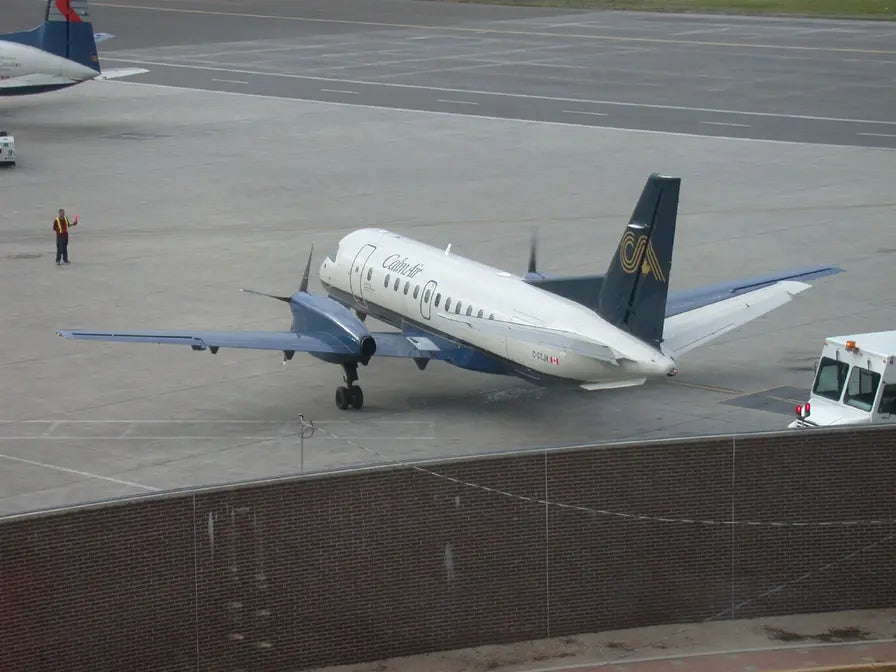
Calm Air operates a focused, purpose-built fleet centred on the ATR family of regional turboprops, supplemented by a single regional jet. As of mid to late 2025, public fleet records indicate roughly 15 aircraft: a group of ATR 42s, a larger group of ATR 72s (a portion of which are dedicated freighters), and one Dornier 328JET. These are not the newest variants on the market, but they are exactly the right tools for the job: rugged, short-field capable, and certified to operate from the gravel and ice strips that serve the North. The ATR's high wing, robust landing gear, and turboprop efficiency make it one of the few western airliners practical for this environment.
Because Calm Air flies a small number of closely related types, pilots benefit from straightforward type-rating and fleet management. A First Officer hired onto the ATR will fly both the 42 and 72 variants under a common type rating, which keeps qualifications simple and broadens the pilot's exposure across the network. The freighter ATR 72s, fitted with full roller floors, carry the bulk cargo and fuel loads that scheduled passenger aircraft cannot, and crews may operate combi and all-cargo configurations depending on the day's tasking.
| Aircraft Type | Role | In Service (approx.) | Notes |
|---|---|---|---|
| ATR 42-300 / 320 | Regional turboprop (passenger / combi) | ~5 | 22 to 42 seats. Gravel and unprepared surface capable. Short sectors to smaller strips. |
| ATR 72-202 / 500 | Regional turboprop (passenger) | ~7 | Up to ~62 seats. Backbone of scheduled passenger service to Nunavut and northern Manitoba. |
| ATR 72-500F | Freighter | ~2 | Full roller floor, up to ~16,000 lb payload. Bulk cargo, materials, and fuel to remote communities. |
| Dornier 328JET | Regional jet | 1 | Used on select charter and time-sensitive services where jet speed adds value. |
| Boeing 737 (codeshare) | Jet (operated by Canadian North) | n/a | Winnipeg to Rankin Inlet jet service flown on Calm Air's behalf by codeshare partner Canadian North, not on Calm Air metal. |
Fleet figures are approximate, compiled from public records as of late 2025, and shift with conversions, additions, and retirements. The Boeing 737 line is shown for clarity because it appears on Calm Air schedules but is operated by codeshare partner Canadian North.
According to Calm Air's published pilot postings, type-rating training is provided by the company for successful candidates, which is a meaningful advantage for pilots who do not arrive already rated on the ATR. The ATR 42/72 common type rating is the entry point for almost all new First Officers. Because the ATR 42 and ATR 72 share a type rating, a pilot can be rostered across both variants and across passenger, combi, and freight missions. The single Dornier 328JET is a specialist asset rather than a mainline fleet, so the vast majority of flying, and therefore of career time, is on the ATR.
Calm Air does not publish a continuously updated tail-by-tail fleet list, and third-party trackers differ on exact counts because aircraft move between passenger and freighter roles and because the parent group reallocates assets. Treat the numbers above as a reliable approximation rather than an official census, and confirm current types directly on the Calm Air website before making career decisions based on a specific aircraft.
Pilot Salary & Compensation
Pilot pay at Calm Air is set by the collective agreement negotiated by ALPA on behalf of the pilot group. In April 2023, Calm Air pilots ratified a five-year contract that delivered pay increases, stronger job-security language, and quality-of-life improvements; that agreement runs until April 30, 2028. The exact dollar-per-credit-hour pay scales inside that contract are not published publicly, which is normal for Canadian regional airlines, so the figures below are industry-informed estimates in Canadian dollars rather than official Calm Air rates. They are intended to give a realistic sense of scale for a Canadian regional ATR operator, not to quote a contract.
Compensation in this segment is typically built from a base or guaranteed monthly figure, credit-hour or flight pay, per diems for time away from base, and northern or duty premiums. As part of Exchange Income Corporation, Calm Air employees also have access to an employee share purchase plan and an employer-matched pension, both of which add to total reward beyond the headline salary. The North also tends to generate strong charter and overtime demand, which can lift annual earnings above the base scale in busy years.
First Officer (estimated annual gross, CAD)
| Seniority | Estimated Annual Gross (CAD) | Notes |
|---|---|---|
| Year 1 (entry F/O) | ~$48,000 to $62,000 | First-year rates at Canadian regionals are typically the lowest point; premiums and charters can add to this. |
| Year 2 to 3 | ~$60,000 to $76,000 | Rate escalation per the ALPA pay scale as longevity builds. |
| Senior F/O (4+ yrs) | ~$72,000 to $92,000 | Top-of-scale F/O before command upgrade. |
Estimated ranges only. Not official Calm Air pay scales. Actual pay depends on the current ALPA agreement, longevity step, credit hours flown, and premiums.
Captain (estimated annual gross, CAD)
| Seniority | Estimated Annual Gross (CAD) | Notes |
|---|---|---|
| New ATR Captain | ~$95,000 to $120,000 | Upon command upgrade, subject to seniority and a successful command check. |
| Captain, 5+ yrs | ~$115,000 to $140,000 | Mid-seniority command with full longevity steps. |
| Senior Captain | ~$135,000 to $165,000 | Top-of-scale command, boosted by premiums, charter flying, and overtime in busy years. |
Estimated ranges only. Northern premiums, per diems, and high charter demand (for example, the 2025 wildfire season) can push annual totals higher than base scale.
Calm Air's ALPA pay scales are not published publicly, and self-reported figures on salary aggregator sites for a company this size are sparse and inconsistent (one aggregator listed broad pilot figures that almost certainly reflect senior captains or total compensation outliers rather than typical pay). The ranges above are constructed from general Canadian regional turboprop norms and clearly labelled as estimates. They should not be treated as a contract quotation. For accurate, current figures, speak directly with the Calm Air ALPA Master Executive Council or the company's recruitment team, and remember that the 2023 to 2028 agreement raised rates from earlier levels.
Roster Pattern & Quality of Life
Calm Air pilots are based at Thompson and Winnipeg, the airline's two operational hubs. Thompson sits in northern Manitoba and acts as a forward base close to the network's centre of gravity, while Winnipeg is the corporate and maintenance home as well as the southern gateway. Flying is governed by Canada's flight and duty time rules under the Canadian Aviation Regulations (CAR Part VII), including the modernised fatigue-management framework that now applies to scheduled operators, and by the scheduling protections written into the ALPA collective agreement. The 2023 contract specifically highlighted quality-of-life improvements as one of its achievements.
The day-to-day rhythm is regional and turboprop in nature: multiple sectors per duty day, early starts to serve communities on a fixed schedule, and a mix of same-day returns and northern night stops depending on the routing. Unlike a long-haul carrier, the trip lengths are short but the operating environment is demanding, with cold-weather procedures, contaminated runways, and weather diversions all part of normal life. Pilots who enjoy frequent takeoffs and landings, real stick-and-rudder flying, and a tangible connection to the communities they serve tend to thrive here.
📅 Representative Rotation Pattern — Regional ATR First Officer
The grid above is an illustrative example of a typical Canadian regional turboprop rotation, not an official Calm Air roster. Calm Air does not publish its line-construction rules, and real patterns vary by base, season, seniority, and whether a pilot is flying scheduled service, charters, or freight. What is reliably true is that the work is concentrated into rotations with blocks of consecutive days off, that reserve or standby duty is part of junior life, and that summer (wildfire season, sealift support, and peak charter demand) is far busier than the deep winter.
Living in or commuting to Thompson or Winnipeg is central to the Calm Air lifestyle decision. Winnipeg is a full-sized prairie city with reasonable cost of living, a major airport, and family amenities, which makes it a comfortable base for pilots settling down. Thompson is a smaller northern mining and service town that puts crews closer to the operation and the flying, with a strong sense of community but fewer big-city options. Many pilots weigh the trade-off between the convenience of being close to the action in the North and the broader lifestyle and connectivity of the Winnipeg base. Whichever you choose, the absence of long-haul jet lag is a genuine quality-of-life advantage compared with international flying.
Benefits, Travel & Retirement
Calm Air's benefits package reflects both its status as a unionized Canadian employer and its membership in the larger Exchange Income Corporation group. The company explicitly frames its package around helping employees "lead healthy lives and succeed in their careers," and it backs that up with a set of benefits that are competitive for the regional segment. The standout structural advantage over many independent regionals is the financial stability and scale that come with a publicly traded parent, including a share purchase plan that lets employees build equity in the group.
On the retirement side, the employer-matched pension plan is the core long-term benefit, and it is meaningfully strengthened by the Employee Share Purchase Plan. Because Exchange Income Corporation is a dividend-paying public company, employees who participate in the share plan accumulate ownership in the broader group rather than relying on a single airline's fortunes. This combination of a matched pension and equity participation is a stronger retirement structure than many small regionals can offer, and it is one of the practical reasons pilots describe Calm Air as a place you can build a stable life rather than just log hours.
Being part of Exchange Income Corporation is not just a corporate footnote; it directly shapes the benefits picture. EIC's scale supports the matched pension and the share purchase plan, and its diversified, essential-service business model has historically supported steady dividends and reinvestment. For a pilot comparing a standalone regional against Calm Air, the parent-company backing is a tangible part of the value proposition: it underwrites both the benefits and the long-term security of the operation.
Career Progression & Seniority
Career progression at Calm Air follows the classic Canadian regional model: pilots are hired as First Officers on the ATR, build experience and seniority, and upgrade to Captain when their seniority and a successful command assessment allow. Movement through the ranks is governed by the seniority list under the ALPA collective agreement, which provides transparency and protection against arbitrary decisions. Because the pilot group is relatively small (around 108 pilots), individual progression is closely tied to the airline's hiring waves, retirements, and the rate at which experienced pilots leave for the major airlines.
That last point is the key dynamic for upgrade speed. At small regionals like Calm Air, command can come comparatively quickly relative to a major airline precisely because senior captains and first officers are regularly recruited away by larger jet operators. When the majors are hiring aggressively, the seniority list churns and upgrade opportunities open up; when hiring slows, progression slows with it. The ceiling at Calm Air is an ATR Captain or a training and management role rather than a widebody command, so many pilots view it as either a strong long-term home or a high-quality launchpad toward a jet career elsewhere.
| Career Milestone | Typical Path | Notes |
|---|---|---|
| Join as ATR First Officer | Entry point | CPL with multi-engine IFR rating required; type-rating training provided by the company. |
| Build experience & seniority | First years | Line flying across the network, reserve/standby duty as a junior pilot. |
| Upgrade to ATR Captain | Seniority-based | Requires meeting hour thresholds, a command course, and a check ride. Pace depends on attrition and growth. |
| Senior Captain | Long-term | Top-of-scale command, line-check and mentoring opportunities. |
| Training / Check Pilot / Management | Selection-based | Instructor (line indoctrination), check airman, or flight-ops leadership roles. |
Calm Air actively recruits ATR First Officers and Captains, and 2025 was an exceptionally busy operational year: pilots flew a high volume of evacuation and repatriation charters during the second-worst wildfire season in Canadian history, on top of regular scheduled and freight service. Combined with the long-term Nunavut air service agreement signed in July 2025, this points to a healthy, sustained demand picture. For career planning, the practical takeaway is that upgrade timing at a small regional is driven less by a fixed number and more by the wider Canadian pilot market, so prospective pilots should ask the recruitment team and the ALPA pilot group about the current upgrade outlook before joining.
Recruitment, Requirements & Cadet Pathways
Calm Air recruits pilots directly through its own careers portal rather than through a third-party cadet academy, and it hires across flight operations roles including First Officers, Captains, dispatchers, and flight attendants. Applications are submitted through the company's Dayforce candidate portal, accessible from the official Calm Air careers page. The two main entry points are the First Officer role for pilots building their airline careers and the direct-entry Captain role for experienced command-qualified pilots, with type-rating training provided in both cases.
First Officer — Core Requirements
Direct-Entry Captain — Core Requirements
How the Process Works
Online Application
Submit your resume and credentials through the Calm Air Dayforce candidate portal for the specific posting (First Officer or Captain). Make sure your licence, ratings, medical, and total times are clearly documented.
Screening & Interview
Qualified candidates are screened against the published requirements and invited to interview. Expect a focus on airmanship, judgement, teamwork, and genuine interest in Northern operations, which are central to the job.
Conditional Offer & Clearances
Successful candidates receive an offer conditional on a valid Category 1 medical, the ability to obtain a Transport Canada security clearance, and an airport restricted area identity card through the relevant airport authority.
Ground School & Type Rating
New pilots complete company ground school and ATR type-rating training. Because the ATR 42 and ATR 72 share a type rating, this single course qualifies you across the core fleet.
Line Indoctrination
Final preparation is line training with a training captain, flying real sectors across the network until you are released to the line and added to the seniority list.
One genuinely distinctive feature of Calm Air's recruitment ecosystem is its commitment to growing Northern and Indigenous aviation talent. The Carl Morberg Memorial Bursary Program, named after the airline's founder, awards up to five bursaries of $5,000 each to aspiring Canadian Inuit and Indigenous aviators who reside in Nunavut or Manitoba. Applicants must be at least 18, demonstrate Inuit or Indigenous ancestry, hold a Transport Canada Category 1 medical and a completed Private Pilot Licence, and be enrolled in a recognised Canadian aviation institution. Funds are paid directly to the training institution. The 2025 cycle closed applications on September 15, 2025. For young people in the communities Calm Air serves, this is a real, structured first rung on the ladder toward an airline career.
Some Calm Air pilot postings referenced here come from earlier hiring cycles, and exact First Officer hour minimums are not always stated publicly because the company assesses candidates against current operational needs. Hour expectations at Canadian regionals commonly fall anywhere from a few hundred hours up to well over a thousand depending on the market. Always confirm the live requirements, base, and closing dates on the official Calm Air careers portal and via Transport Canada for licensing standards (tc.canada.ca/en/aviation) before applying.
Flying the North: Network & Operating Environment
Because Calm Air is a short-haul regional carrier, it has no traditional international layover program of the kind associated with widebody airlines. What it offers instead is something many pilots find more interesting: real Arctic and sub-Arctic flying into communities that depend on the airline. The network spans 14 destinations, with six in Manitoba (Winnipeg, Thompson, Churchill, Flin Flon, Gillam, and The Pas) and eight in Nunavut's Kivalliq region (Rankin Inlet, Arviat, Baker Lake, Chesterfield Inlet, Coral Harbour, Naujaat, Sanikiluaq, and Whale Cove). You can explore the full network on the official Calm Air route map.
This is genuine challenge-and-reward flying. Many strips are gravel or, in winter, ice and snow, with limited approach aids, rapidly changing weather, extreme cold, and long periods of darkness in winter or near-constant daylight in summer. The ATR's short-field and rough-surface capability is what makes the operation possible. Pilots build deep experience in contaminated-runway operations, cold-weather procedures, weather decision-making, and the discipline of serving a fixed schedule that communities rely on for food, mail, medical travel, and connection to the south. Below are five representative stations that capture the variety of the network.
For a pilot's logbook and skill set, Calm Air is a serious school. You leave with deep competence in gravel and ice runway operations, cold-weather and contaminated-surface procedures, single-pilot-style decision making within a multi-crew cockpit, and the judgement that comes from operating to remote strips with limited infrastructure and unforgiving weather. These are exactly the qualities major airlines value, which is part of why Northern Canadian flying has long been regarded as one of the best foundations a professional pilot can build.
How Calm Air Compares: Airline Radar Chart
How does Calm Air stack up against its closest Canadian peers? The two most relevant comparisons are Perimeter Aviation, a sister company within the Exchange Income Corporation group that also flies northern Manitoba and Ontario routes, and Canadian North, the larger Arctic carrier that serves Nunavut, the Northwest Territories, and Nunavik and is also Calm Air's codeshare partner. All three are ALPA-represented Canadian operators. The scores below are editorial estimates based on publicly available data, fleet and route profiles, and union information.
Key Takeaways from the Comparison
Calm Air and Perimeter are close cousins. Both are Exchange Income Corporation companies, both are ALPA-represented, and both ratified five-year agreements in 2023. Perimeter is larger by headcount (around 160 pilots and roughly 41 aircraft, including Dash 8-100/300s, Metroliners, and Merlins) and offers more base options (Winnipeg and Thompson in Manitoba, plus Thunder Bay, Sioux Lookout, Timmins, and Toronto in Ontario). Calm Air's edge is its cleaner, ATR-focused fleet and its strong, government-backed Nunavut franchise. Benefits are broadly similar because both draw on the same EIC group structure.
Canadian North sits a tier up in equipment and pay ceiling. With around 240 to 243 pilots and a fleet that includes Boeing 737 jets alongside ATR and Dash 8 turboprops, Canadian North offers a jet-flying ceiling that neither Calm Air nor Perimeter can match, which lifts its fleet and salary scores. Its pilots ratified a new three-year agreement (87 percent in favour) running to December 31, 2028. However, Canadian North has also seen pilot layoffs reported in recent years, which is why its job-security score sits slightly below Calm Air's, where the long-term Nunavut service agreement and essential-route profile are especially stable.
Job security is Calm Air's standout strength. Across all three, Calm Air arguably has the most defensible long-term demand picture: it provides essential, non-discretionary air service to communities with no road alternative, it is backed by a financially robust public parent, and the 2025 territory-wide Nunavut air service agreement locks in a long runway of work. For pilots who prioritise stability and a predictable career over chasing the highest possible pay, that matters a great deal.
Fleet and career ceiling are the trade-offs. None of these carriers will put you in a widebody; the realistic ceiling at Calm Air is an ATR command or a training and management role. If your goal is a jet career, Canadian North offers an in-house path to the 737, while Calm Air and Perimeter are best understood as either excellent long-term homes for those who love northern turboprop flying or as high-quality launchpads toward the majors.
Scores are editorial estimates based on our research into publicly available data: fleet and route profiles, ALPA pilot-group information, company benefit pages, and news reporting. They represent a general assessment for a pilot weighing a long-term career, not a precise measurement, and exact pay scales for all three carriers are set by confidential collective agreements. Individual experiences vary with base, seniority, and personal priorities. We will refine these scores as we publish dedicated guides for Perimeter Aviation and Canadian North.
Union & Industrial Relations
Calm Air pilots are represented by the Air Line Pilots Association, International (ALPA), the largest airline pilot union in the world, with tens of thousands of members across the United States and Canada. Calm Air's pilots joined ALPA in 1997, and the group has been a stable, well-organised part of the union ever since. Membership in ALPA gives a roughly 108-pilot group at a remote regional access to a national legal, safety, and bargaining infrastructure that a standalone in-house association could never match, which is a meaningful advantage when negotiating with a large corporate parent.
How the Pilot Group Is Organised
How Negotiations Work
Working conditions at Calm Air are governed by a layered framework: Canadian labour law, Transport Canada flight and duty time regulations under the Canadian Aviation Regulations, and the ALPA collective agreement that the pilot group negotiates directly with the company. The MEC, supported by ALPA's national resources, bargains the contract; once a tentative agreement is reached, it is put to a ratification vote of the pilots. This structure gives even a small group real leverage and transparency, and it is why pay scales, upgrade rules, and scheduling protections are codified rather than left to management discretion.
In spring 2024, the Calm Air MEC developed and has continued to update a strategic plan for the pilot group, a sign of an engaged, forward-looking union presence rather than a body that only activates at contract time. Day-to-day relations between the pilot group and management have generally been constructive, and unlike some carriers, Calm Air does not have a recent history of pilot strikes.
Recent Union Milestones
Calm Air offers what many pilots want from a union environment: meaningful protection without a culture of conflict. The pilot group is fully ALPA-represented, recently negotiated a contract with real gains, and has a stable, engaged Master Executive Council, yet relations with management have remained constructive and strike-free in recent memory. For a new recruit, that combination, strong representation plus operational stability, is close to ideal. You can read more about the pilot group through ALPA's own resources, which we link in the final section.
Verdict: Who Is Calm Air For?
🎯 Our Take
Calm Air is one of the most respected regional turboprop operators in Canada, and for the right pilot it is an outstanding place to build, or sustain, a career. The combination of a purpose-built ATR fleet, genuine Arctic flying, full ALPA representation with a fresh contract running to 2028, the financial backing of Exchange Income Corporation, a matched pension plus share-ownership benefits, and exceptional job security tied to essential community service is hard to beat in the regional segment.
The trade-offs are honest ones. Pay is regional-scale rather than major-airline money, the realistic career ceiling is an ATR command or a training and management role rather than a jet or widebody, the bases are limited to Thompson and Winnipeg, and the operating environment, extreme cold, gravel and ice strips, long northern winters, demands resilience. Exact ALPA pay scales are not published, so prospective pilots should verify current rates and upgrade timing directly with the company and the pilot group.
For pilots who value stability, meaningful flying, and a real connection to the communities they serve, Calm Air offers something many larger airlines cannot: a job that genuinely matters, at an airline with a durable future and a culture that long-tenured employees consistently praise.
1 Do I need an ATPL to fly for Calm Air?
Not to start as a First Officer. Calm Air's First Officer postings call for a Canadian Commercial Pilot Licence (CPL) with a multi-engine IFR rating and a Category 1 medical, with ATR type-rating training provided by the company. A full or frozen ATPL becomes important for command: direct-entry Captain postings have specified an ATPL alongside high total time and pilot-in-command experience. You build toward the ATPL as you accumulate hours as a First Officer.
2 How many flight hours do I need to get hired as a First Officer?
Calm Air does not always publish a fixed hour minimum for First Officers, because it assesses candidates against current operational needs. The firm requirements are a CPL with multi-engine IFR rating, a Category 1 medical, and the ability to obtain security clearances. In practice, hour expectations at Canadian regionals commonly range from a few hundred hours up to well over a thousand, depending on how active the pilot market is. Always confirm the live minimum on the official Calm Air careers portal.
3 Does Calm Air pay for the type rating?
Yes. According to Calm Air's published pilot postings, type-rating training is provided by the company for successful candidates, for both First Officers and direct-entry Captains. Because the ATR 42 and ATR 72 share a common type rating, a single training course qualifies you across the airline's core fleet.
4 Where are Calm Air pilots based?
Calm Air pilots are based in Thompson and Winnipeg, Manitoba. Winnipeg is the corporate and maintenance hub and a full-sized city, while Thompson is a smaller northern town that serves as a forward base closer to the flying. There is no large network of base options, so living in or commuting to one of these two locations is part of the job.
5 How long does it take to upgrade to Captain?
Upgrade is seniority-based and depends heavily on attrition and growth. At a small regional like Calm Air (around 108 pilots), command can come comparatively quickly when senior pilots are being recruited away by the major airlines, and more slowly when the wider market cools. There is no fixed published timeline, so ask the recruitment team and the ALPA pilot group about the current upgrade outlook before joining. Upgrade requires meeting hour thresholds, completing a command course, and passing a check ride.
6 Are Calm Air pilots unionized?
Yes. Calm Air pilots have been represented by the Air Line Pilots Association (ALPA) since 1997. The group ratified a five-year collective agreement in April 2023 that runs to April 30, 2028, delivering pay increases, stronger job security, and quality-of-life improvements. The pilot group is governed by a Master Executive Council and benefits from ALPA's national legal, safety, and bargaining resources.
7 Is Calm Air a good first airline job?
For many Canadian pilots, yes. It offers entry into multi-crew turbine operations on the ATR, company-provided type-rating training, full union protection, and the kind of demanding Northern flying that builds skills major airlines respect. It also offers unusually strong job security for a regional. The main caveats are regional-scale pay and a career ceiling at ATR command, which is why some pilots treat it as a long-term home and others as a launchpad toward the majors.
8 What is it like flying in the Arctic and northern Manitoba?
It is challenging and rewarding. Expect gravel and ice runways, limited approach aids at some strips, extreme cold, rapidly changing weather, and long winter darkness offset by near-constant summer daylight. The ATR's short-field and rough-surface capability makes the operation possible, and pilots develop deep expertise in cold-weather and contaminated-runway operations and weather decision making. Crucially, the airline is a lifeline for the communities it serves, which gives the flying a genuine sense of purpose.
Official Links & Resources
Before applying or making any career decisions, always verify information directly with official sources. These are the key websites and organisations relevant to a Calm Air pilot career:
Set a job alert on the Calm Air Dayforce candidate portal and check the ALPA Calm Air pilot-group page regularly. Regional hiring at Northern carriers moves in waves tied to the wider pilot market and to seasonal demand (the summer charter season is especially active), so the pilots who get in are usually the ones watching closely and ready to apply the moment a posting goes live. If you are an Indigenous or Northern aviator, mark the bursary's annual deadline in your calendar well in advance.