

JetSMART Overview & Company Profile
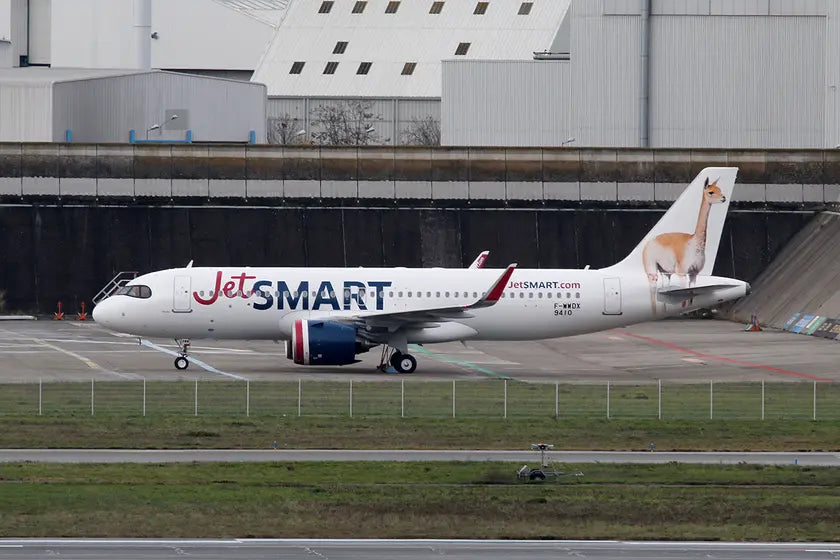
JetSMART is an ultra-low-cost carrier (ULCC) that launched commercial flights from Santiago, Chile, in July 2017. It is controlled by the American private equity firm Indigo Partners, the same investor behind Frontier Airlines in the United States, Volaris in Mexico, and Wizz Air in Europe. That parentage matters for a pilot: JetSMART runs the classic Indigo playbook of a single-family Airbus fleet, very high aircraft utilization, ultra-low fares, and aggressive expansion into price-sensitive markets. In under a decade the airline has grown from a purely Chilean start-up into a multinational group with affiliates and operating certificates in Argentina, Peru, Colombia, and a broadening South American footprint.
The Chilean company (IATA code JA) is the founding carrier and remains the core of the group. Its headquarters sits in the Ciudad Empresarial business district at Avenida del Valle 515, Huechuraba, in northern Santiago, and its primary hub is Santiago's Arturo Merino Benítez International Airport (SCL). Unusually for a Chilean operator, JetSMART also runs operating and crew bases in Concepción (CCP) and Antofagasta (ANF), a detail that shapes rostering and commuting for line pilots (more on that in the roster section).
By late 2025 the JetSMART group operated 50 Airbus A320-family aircraft, having taken delivery of its 50th jet in December 2025. According to aviation analytics firm Cirium, the fleet carried a weighted average age of roughly 3.1 years in 2025, one of the youngest fleets of any airline of its size anywhere in the world. The network spans about 50 destinations across 8 countries on more than 80 routes, and cumulative traffic reached about 42.5 million passengers by June 2025, up sharply year on year. For pilots, the headline is simple: this is a young, fast-growing, all-new narrowbody operation with a long delivery pipeline still ahead of it.
JetSMART is privately held through Indigo Partners and does not publish the detailed pay scales, pilot headcounts, or duty statistics that listed carriers sometimes disclose. Where hard numbers exist (fleet, orders, passengers, regulatory limits), this guide states them plainly with their source. Where the airline keeps figures private (exact salaries, roster averages, pilot headcount), the guide flags the estimate clearly and explains the basis for it. Nothing here is invented: uncertain points are labelled as uncertain.
Fleet Composition & Type Ratings
JetSMART flies an all-Airbus A320-family fleet and nothing else. There are no widebodies, no regional jets, and no second manufacturer. For a pilot, that single-family commonality is one of the most important structural facts about the airline: training, recurrent checks, and standard operating procedures all revolve around one flight deck philosophy, and moving between the A320 and A321 within the family requires only differences training rather than a fresh type rating.
As of October to December 2025, the group fleet of 50 aircraft broke down into 11 first-generation A320-200 (ceo), 28 A320neo, and 11 A321neo. The direction of travel is firmly toward the new-generation NEO aircraft: the classic ceo jets are the legacy tail of the fleet, while every aircraft on order is a NEO variant. JetSMART also holds a launch position on the long-range A321XLR, a narrowbody the group intends to use for thinner long-haul city pairs toward North America and the Caribbean, which would eventually add genuinely long sectors to a roster that is otherwise short and medium haul.
| Aircraft Type | Role | In Service | On Order | Notes |
|---|---|---|---|---|
| Airbus A320-200 (ceo) | Narrowbody | 11 | 0 | Legacy tail of the fleet. Domestic and short regional flying. |
| Airbus A320neo | Narrowbody | 28 | 14 | Current backbone of the operation across all countries. |
| Airbus A321neo | Narrowbody | 11 | 35 | Higher-capacity and longer sectors. Large delivery pipeline. |
| Airbus A321XLR | Narrowbody (long range) | 0 | 14 | Ordered for future long, thin routes. Not yet in service. |
Group fleet as reported for late 2025. Country-by-country allocation is not published in a single authoritative table; Chile operates a mix of all three in-service types. Figures shift with ongoing deliveries.
The order book is what makes this fleet section so relevant to a career decision. The roots trace to the landmark December 2017 agreement in which Indigo Partners committed to 430 A320neo-family aircraft across its airlines, with JetSMART's share described at the time as a "historic" order for 70 aircraft (56 A320neo plus 14 A321neo). Subsequent orders in 2019 and 2021 added A321neos and A321XLRs. As of late 2025 the group still had roughly 63 Airbus jets on firm order (14 A320neo, 35 A321neo, 14 A321XLR). Management has repeatedly stated a target of around 100 aircraft by the late 2020s (2028 to 2029) and a long-term ambition of roughly 120 to 125 aircraft by the early 2030s. A pilot reading those numbers should read one word: hiring.
JetSMART's low-hour First Officer campaigns (documented in detail for the Argentina affiliate) explicitly accept non-type-rated candidates and provide the A320-family type rating and line training after selection. In other words, you are not required to arrive with an A320 rating already in your logbook, and you should not need to self-fund one to be selected into a formal intake. All pilots operate the common A320-family type rating, with A320-to-A321 handled as differences training. Because the fleet is 100% Airbus narrowbody, there is no widebody or second-fleet path inside JetSMART itself, an important limitation for pilots who eventually want long-haul heavy-metal command.
Pilot Salary & Compensation Breakdown
Pilot pay is the single area where JetSMART is least transparent, so this section needs an honest disclaimer up front: the airline does not publish rank-by-rank scales, and Chile as a whole has no公open collective pay tables of the kind seen at European legacy carriers. The figures below are compiled from Chilean salary aggregators (Glassdoor, ArielJobCenter, RecreoExplora), press coverage of the November 2025 LATAM dispute, and career guidance from Chilean training providers. They are ranges and estimates, expressed in Chilean pesos (CLP) with rough US dollar equivalents at approximately CLP 950 to USD 1. Treat them as orientation, not a contract.
Structurally, Chilean airline pay combines a monthly base tied to rank and seniority with variable components: per-block-hour or productivity pay, per diems (viáticos) for duties away from base, and any bonuses. At a ULCC like JetSMART, the base tends to be leaner and a larger share of total earnings comes from flying more sectors, which fits the high-utilization model. Multiple Chilean sources place JetSMART First Officers at roughly CLP 2.0 to 3.5 million per month and Captains at a published base band of roughly CLP 3.5 to 6.0 million per month. Those same sources caution that the captain figure is a conservative base and that senior commanders flying high block hours can realistically reach CLP 8 to 10 million per month once overtime and variable pay are included.
First Officer (Copiloto) Pay Estimate
| Seniority | Monthly (CLP, est.) | Monthly (USD, est.) | Annual Gross (USD, est.) |
|---|---|---|---|
| Entry First Officer | CLP 2.0M – 2.5M | $2,100 – $2,600 | ~$25,000 – $32,000 |
| Established F/O (a few years) | CLP 3.0M – 3.5M | $3,200 – $3,700 | ~$38,000 – $44,000 |
JetSMART First Officer ranges per Chilean salary sources (ArielJobCenter, RecreoExplora). Figures are gross before AFP pension and health deductions. USD converted at ~CLP 950.
Captain (Comandante) Pay Estimate
| Seniority | Monthly (CLP, est.) | Monthly (USD, est.) | Annual Gross (USD, est.) |
|---|---|---|---|
| Junior Captain (base scale) | CLP 3.5M – 5.0M | $3,700 – $5,300 | ~$44,000 – $63,000 |
| Established Captain | CLP 5.0M – 6.0M | $5,300 – $6,300 | ~$63,000 – $76,000 |
| Senior Captain (high hours + variable) | CLP 8.0M – 10.0M | $8,400 – $10,500 | ~$100,000 – $126,000 |
Published JetSMART captain scales top out near CLP 6M, but Chilean sources note this is a base figure; senior commanders with overtime and high block hours realistically reach CLP 8M – 10M/month. Estimates only.
For market context, the November 2025 LATAM offer disclosed during the pilots' strike put LATAM captain base pay at roughly CLP 8.9 to 10 million and First Officers at CLP 5.3 to 5.9 million per month, while Chilean sources place Sky Airline pilots broadly between LATAM and JetSMART. The pattern is consistent across the market: LATAM sits at the top, Sky in the middle, and JetSMART generally at the value end, which is exactly what you would expect from an ultra-low-cost operator competing on productivity rather than headline base salary.
These numbers are estimates drawn from public salary aggregators, press reports, and industry guidance, not from an official JetSMART pay scale, which the airline does not release. Actual pay depends on the current SPJS collective agreement, individual seniority, aircraft type, and hours flown. Chilean gross pay is further reduced by mandatory deductions, roughly 10% to the AFP pension system and about 7% for health, plus income tax. Peso-to-dollar conversions move with the exchange rate. Always verify against the current contract and a live job posting before making a career decision.
Roster Pattern & Quality of Life
Roster life at JetSMART is governed by Chilean flight-time rules set out in the civil aviation authority's regulation DAN 121, layered on top of Chilean labor law and the SPJS collective agreement. The DGAC (Dirección General de Aeronáutica Civil) caps flight time (tiempo de vuelo, measured chocks to chocks) at 100 hours per calendar month, 270 hours per quarter, and 1,000 hours per year, with additional short-cycle limits of 34 hours in any 5 consecutive days and 68 hours in 6 to 10 consecutive days. Within a 24-hour window, a crew member may perform up to 12 hours of flight service and no more than 8 hours of flight time on a standard crew, with a normal duty day of roughly 12 to 14 hours and an absolute minimum rest of 10 continuous hours (structured to allow at least 8 hours of sleep). Extended duties up to about 18 hours are possible only with augmented crews and additional rest.
Those are the legal ceilings. In practice, the ULCC model pushes toward the productive end of them: high aircraft utilization, four to six short sectors on a busy day, and tight turnarounds. Because most of the Chilean network is domestic point-to-point flying, many duties are out-and-back to base, so pilots frequently sleep at home rather than in hotels, but the trade-off is a denser, more fatiguing pattern of early starts and late finishes than a long-haul operation would produce. The sample month below is illustrative of a Santiago-based A320-family First Officer, not a published JetSMART roster.
📅 Sample Month — Narrowbody First Officer (Santiago / SCL)
The pattern above shows roughly 15 flying days, a couple of standby days, one training day, and about 10 days off, which is a fair reflection of a demanding domestic ULCC month and deliberately more intense than the 15-days-off rosters common at European legacy carriers. Note that Chile's statutory paid vacation is comparatively modest: general labor law grants a minimum of 15 working days of paid annual leave (about three weeks), with additional days possible through seniority accrual or the collective agreement. A meaningful pilot protection worth knowing is that DGAC policy allows a crew member to declare fatigue and decline a flight without sanction, with the event logged as an internal safety report.
Santiago (SCL) is the primary base, but JetSMART has publicly announced operating bases in Concepción and Antofagasta as well, with crew resident in the Antofagasta region so that flights begin and end there without repositioning through Santiago. That multi-base structure is genuinely useful: it means a pilot may not be forced to live in the capital, which softens commuting and cost-of-living pressure. The sources confirm operating and crew bases in these cities; whether a formal separate pilot base list exists beyond Santiago is not spelled out in public documents, so confirm your assigned base directly during recruitment.
Benefits, Staff Travel & Retirement
Benefits are the second area (after salary) where JetSMART publishes little, so this section separates what is structural under Chilean law from what is anecdotal. As a Chilean employer, JetSMART operates within the country's private, individual-account systems rather than offering a bespoke aviation pension or the kind of dedicated aircrew fund found in some European countries. That is not a JetSMART choice so much as a feature of the Chilean model, and it is worth understanding clearly before comparing the airline to carriers in other jurisdictions.
On staff travel, the honest position is that JetSMART markets fare discounts to customers through its Tarjeta SMART programme, but a formal employee travel-benefit page is not public. Anecdotal employee accounts describe generous internal flight discounts (for example a block of heavily discounted legs per year plus additional reduced-fare travel), yet these come from forums rather than the company, so they should be verified during hiring rather than assumed. Given the airline's expanding eight-country network, whatever the exact terms, staff travel is most valuable for regional South American trips rather than global positioning.
The single most tangible benefit for a joining First Officer is the company-funded A320-family type rating. A type rating on the open market costs tens of thousands of dollars, so having JetSMART deliver it as part of a formal intake is a real economic transfer that partly offsets the modest starting salary. For a low-hour pilot in South America, that funded pathway into a modern Airbus flight deck is arguably the strongest single reason to look at JetSMART early in a career.
Unlike carriers in countries with dedicated aircrew pension funds, JetSMART pilots retire on Chile's AFP system, a defined-contribution model based on individual accounts managed by private pension administrators. There is no employer-guaranteed defined-benefit pension and no aviation-specific fund. In practice this means a pilot's retirement outcome depends heavily on consistent contributions, fund performance, and personal voluntary savings on top of the mandatory minimum. Pilots weighing JetSMART against European or Gulf offers should factor this in: the headline pay gap is only part of the picture, and the long-term retirement structure is genuinely different.
Career Progression & Seniority
Career progression is where JetSMART's growth story becomes a concrete advantage. The mechanics of the seniority list are not published in detail, so the specifics below combine standard industry practice with what the airline's expansion makes likely. What is documented is the direction: a group heading from 50 aircraft today toward a stated target of around 100 by 2028 to 2029 and potentially 120 to 125 by the early 2030s needs a steady inflow of First Officers and a steady stream of command upgrades to crew those jets.
Two features distinguish JetSMART from a slow-growing legacy carrier. First, the airline hires direct-entry Captains externally when it needs experienced commanders quickly, as seen in A320 captain campaigns across the group's affiliates, including "quick upgrade" captain postings. Second, that same rapid growth tends to compress internal upgrade times for First Officers who perform well, because command vacancies open faster than at an airline with a static fleet. Exact upgrade timing is not published and depends on hiring waves, attrition, and the individual's hours and performance, so any single number would be a guess, but a growth environment structurally favors faster progression than a flat one.
| Career Milestone | Typical Path | Notes |
|---|---|---|
| Join as First Officer | Day 1 post-selection | A320-family type rating and line training provided by the airline. |
| Consolidation on type | First few years | Building hours across a dense domestic and regional network. |
| Command upgrade (from within) | Growth-dependent | Command assessment plus simulator check. Accelerated by fleet expansion. |
| Direct-entry Captain (external) | Experienced hires | Used during rapid ramp-ups; A320 command experience required. |
| Instructor / Examiner (TRI / TRE) | Variable | Demand rises as the fleet and training footprint grow. |
| Cross-affiliate move | Case by case | Chile, Argentina, Peru, Colombia share the A320 type but need local licensing and work rights. |
One structural ceiling deserves emphasis: because JetSMART operates only narrowbody Airbus aircraft, there is no widebody or long-haul heavy command inside the airline. The eventual arrival of the A321XLR would add long, thin routes, but it remains a single-aisle aircraft on the same type rating. A pilot whose long-term ambition is a widebody left seat will, at some point, need to move to a carrier such as LATAM to reach it. For pilots who are happy building a career on modern narrowbody Airbus metal, though, JetSMART offers a rare combination in the region: new aircraft, a long delivery pipeline, and a realistic path to early command.
With 50 aircraft in service, roughly 63 more Airbus jets on firm order, and a publicly stated goal of about 100 aircraft before the end of the decade, JetSMART is one of the clearest growth stories for pilots in South America. That growth is the engine behind faster upgrades and instructor opportunities. The main caveats are the ones common to any ULCC: the model is exposed to fuel, currency, and demand cycles, and rapid expansion can be uneven. Pilots should track the airline's delivery pace and the SPJS collective bargaining outcomes to judge how the growth is translating into actual command and pay progression.
Recruitment Process & Requirements
JetSMART recruits pilots through its group portal at recruitment.jetsmart.net, with country-specific requirements because each affiliate flies under its own regulator. The clearest published requirements come from the Argentina affiliate's non-type-rated First Officer campaigns; Chile-specific numbers are less public and are drawn from Chilean airline-recruitment guidance. A key point for aspiring pilots: JetSMART has no documented ab-initio or fully sponsored cadet scheme that takes you from zero hours to a licence. Entry is at post-CPL level, after which the airline provides the A320 type rating.
Chile — Indicative First Officer Requirements
Argentina — Documented Low-Hour F/O Intake
The contrast between the two countries is instructive. In Argentina, JetSMART has openly run 200-hour, non-type-rated First Officer campaigns, an unusually low bar that reflects both rapid expansion and the airline's willingness to train from a low base. In Chile, market guidance suggests the competitive band is higher, around 500 to 800 hours, so a 200-hour Chilean applicant is generally below the typical range for a Chile-based seat. Real IFR and multi-engine experience, plus instructing or structured commercial flying, materially strengthen an application in either country.
Typical Selection Stages
Application & Document Screening
Submission through the JetSMART recruitment portal, followed by verification of licence, ratings, medical, total hours, English level, MCC, radiotelephony certificate, and background checks. Logbooks must be current and properly foliated.
Theoretical & Aptitude Testing
Written or online assessment covering IFR procedures, aircraft performance, regulations, and human factors, alongside general aptitude items. This filters for technical foundation before any simulator time.
Psychometric & Psychological Evaluation
Aptitude, personality, and stress-tolerance testing assessing traits relevant to multi-crew cockpit teamwork, safety culture, and decision-making under load.
Technical & HR Interviews
A technical interview with training captains or instructors, plus a behavioral interview focused on communication, attitude, and cultural fit within a lean ULCC operation.
Simulator Assessment & Final Checks
A simulator evaluation (typically A320) assessing instrument flying, SOP discipline, CRM, workload management, and situational awareness, followed by final medical and background verification before a training date is issued.
Spanish fluency is essential: daily operations, local ATC, and company culture run in Spanish, and each affiliate requires that country's licence (a DGAC licence for Chile, an ANAC licence for Argentina), so there is no single pan-group shortcut. Because JetSMART funds the type rating, selectors weigh raw airmanship, IFR competence, and CRM heavily rather than expecting an A320 rating on arrival. If you are low-hour and flexible on location, the Argentina 200-hour intakes are the most accessible documented entry point into the group; for a Chile seat, plan to build toward 500 hours or more and complete an MCC course. Always confirm the exact requirements against the live posting, since they vary campaign to campaign.
How JetSMART Compares: Airline Radar Chart
The natural comparison for a Chile-based pilot is against the country's two other major operators: Sky Airline, JetSMART's fellow low-cost Airbus rival, and LATAM Airlines Group, the full-service giant that is the largest airline group in Latin America. The radar below scores all three across the six scorecard dimensions. Scores are editorial estimates based on public fleet data, salary sources, and market positioning, not precise metrics.
| Airline | Model | Fleet (2025) | Aircraft | Long-haul? |
|---|---|---|---|---|
| JetSMART | Ultra-low-cost | ~50 | A320ceo/neo, A321neo, A321XLR (order) | No (narrowbody only) |
| Sky Airline | Low-cost | ~36 | A320neo, A321neo, A321XLR (order) | No (narrowbody only) |
| LATAM Group | Full-service | ~350–360 | A319/320/321 + B767/777/787 | Yes (widebody) |
Fleet figures for 2025. Sky is majority Chilean-owned (Paulmann family) with a minority stake held by Abra Group; LATAM is the largest airline group in Latin America.
Key Takeaways from the Comparison
LATAM leads on pay, benefits, and job security. As the region's largest group with around 350 to 360 aircraft and a genuine widebody long-haul network (Boeing 767, 777, and 787, plus A321XLRs arriving from late 2025), LATAM offers the highest ceilings on salary, the broadest benefits, and the deepest stability. Its November 2025 strike also showed strong, established union leverage. The trade-off is a deeper seniority list and generally slower progression.
JetSMART wins on fleet modernity and growth-driven progression. Its roughly 3.1-year average fleet age is among the youngest in the world, every ordered aircraft is a NEO, and the path to early command is realistically faster than at LATAM thanks to relentless expansion. Where it lags is pay and benefits, which sit at the value end of the Chilean market, and work-life balance, which reflects intense ULCC rostering.
Sky Airline is the closest peer. Sky flies an all-NEO Airbus fleet of about 36 aircraft (29 A320neo and 7 A321neo, with 10 A321XLRs on order) and, since Abra Group took a minority stake, is integrating into a larger multi-airline group alongside Avianca and GOL. On pay it generally sits between LATAM and JetSMART. For a Chilean narrowbody pilot, the JetSMART-versus-Sky decision often comes down to which airline is hiring, which base suits you, and which growth trajectory you find more convincing.
These scores are editorial estimates built from public fleet trackers, Chilean salary aggregators, press coverage, and market analysis. They represent a general read for a pilot weighing a long-term narrowbody career in Chile, not a precise measurement. JetSMART's private status means several inputs (exact pay, roster averages, headcount) are estimated rather than disclosed. Individual experience will vary by seniority, base, and personal priorities. Figures will be revised as dedicated Sky Airline and LATAM guides are published.
Union & Industrial Relations
Chilean pilot representation works differently from the single-national-union model seen in some countries. Rather than one dominant line-pilot union, Chile has company-level pilot unions that sometimes coordinate through federations and joint action. JetSMART's Chilean pilots are represented by the Sindicato de Pilotos de JetSMART (SPJS), which negotiates directly with company management on pay, rosters, safety, and working conditions. Public documentation on SPJS is thin: the union has a president (whose name is not reliably published in accessible sources) and a membership best described as in the dozens-to-low-hundreds range given the fleet size, but no official membership figure is published.
The Chilean Union Landscape
Negotiating framework aside, the practical record for JetSMART Chile pilots has been relatively calm. There is no documented legal pilots' strike at JetSMART Chile through mid-2025; the main friction points have been ordinary collective bargaining and cross-group solidarity rather than open industrial conflict on the pilot side. That said, the group is not conflict-free elsewhere: in Argentina, the JetSMART workers' union (ASTJ) announced a strike for 1 August 2025 over pay and unequal treatment versus Chilean and Peruvian staff, then suspended it after signing an agreement that raised fixed pay by up to 10% for First Officers and 10% to 17% for cabin crew.
Recent Industrial Context
For a joining pilot, the union picture is a mixed but net-positive signal. JetSMART Chile has avoided the open pilot strikes seen at LATAM, which points to functional (if pressured) labor relations, while SPJS provides a real bargaining channel on pay, rosters, and quality of life, exactly the areas where a lean ULCC needs a counterweight. The LATAM and ASTJ actions in 2025 show that Chilean and regional pilots will organize and act when pushed. Union membership is a personal choice, but engaging with SPJS is the most reliable way to understand the current collective agreement and where negotiations stand before you sign.
Verdict: Who Is JetSMART For?
🎯 Our Take
JetSMART is one of the most compelling growth stories for a narrowbody pilot in South America. The fleet is genuinely exceptional for its size: an all-Airbus, all-modern lineup with a roughly 3.1-year average age, a long delivery pipeline of A320neo, A321neo, and A321XLR aircraft, and a stated march toward 100-plus jets. That growth translates into steady hiring, funded type ratings for selected First Officers, and a realistic path to early command that slower-growing legacy carriers cannot match.
The trade-offs are equally real and should not be glossed over. Pay sits at the value end of the Chilean market, clearly below LATAM and generally below Sky, and take-home is further reduced by Chilean deductions. Benefits are modest, retirement runs on Chile's individual-account AFP system rather than any aviation-specific fund, staff-travel terms are not officially published, and the ULCC roster is intense, with high sector counts and only around 10 to 12 days off in a demanding month. There is also no widebody path inside the airline: this is a narrowbody career by design.
For a Spanish-speaking pilot early in their career, willing to trade top-end pay for a modern flight deck, fast progression, and a foot in one of the region's fastest-growing operators, JetSMART is a strong choice. For pilots who prioritize maximum salary, comprehensive benefits, or an eventual widebody command, LATAM remains the more complete destination.
1Do I need a Chilean licence to fly for JetSMART in Chile?
Yes. A JetSMART Chile First Officer role expects a current DGAC Chile commercial licence (PCA or PTLA) with IFR and multi-engine ratings, a Class 1 medical, and ICAO English Level 4 or higher. Each affiliate flies under its own regulator, so the Argentina operation requires an ANAC licence instead. There is no single group-wide licence that covers every country, and Spanish fluency is essential throughout.
2Does JetSMART pay for the A320 type rating?
Yes, for pilots selected through a formal intake. JetSMART's documented non-type-rated First Officer campaigns (clearest in Argentina) explicitly provide the A320-family type rating and line training after selection, so you do not need to arrive with the rating or self-fund it. This funded rating is one of the most valuable in-kind benefits the airline offers, partly offsetting the modest starting salary.
3Does JetSMART hire low-hour pilots?
In Argentina, yes: JetSMART has run First Officer campaigns with a minimum of just 200 logged hours, targeting new commercial licence holders. In Chile, the competitive range is higher, around 500 to 800 hours per Chilean recruitment guidance, so a 200-hour applicant is usually below the typical bar for a Chile-based seat. If you are low-hour and geographically flexible, the Argentine intakes are the most accessible documented entry point into the group.
4How long does it take to upgrade to Captain?
JetSMART does not publish upgrade timelines, so any single figure would be a guess. What is clear is that rapid fleet growth (toward roughly 100 aircraft by 2028 to 2029) structurally favors faster upgrades than at a flat, slow-growing carrier, and the airline also hires direct-entry Captains during ramp-ups. Actual timing depends on hiring waves, attrition, your hours, and performance in the command assessment and simulator check.
5How much do JetSMART pilots earn?
The airline does not release pay scales. Chilean salary sources place JetSMART First Officers at roughly CLP 2.0 to 3.5 million per month and Captains at a published base of about CLP 3.5 to 6.0 million, though senior commanders with overtime and high block hours can realistically reach CLP 8 to 10 million. That positions JetSMART at the value end of the market, below LATAM and generally below Sky. All figures are gross estimates before AFP pension, health, and tax deductions.
6Is there a widebody or long-haul path at JetSMART?
No. JetSMART is an all-narrowbody Airbus operator, so there is no widebody fleet and no heavy long-haul command inside the airline. The A321XLR on order will add longer, thinner routes, but it is still a single-aisle aircraft on the same A320-family type rating. Pilots who want an eventual widebody left seat would need to move to a carrier such as LATAM to reach it.
7Where are JetSMART pilots based in Chile?
Santiago (SCL) is the primary base, but JetSMART has publicly announced operating bases in Concepción and Antofagasta as well, with crew resident in the Antofagasta region. That multi-base structure means living in the capital is not necessarily required, which helps with commuting and cost of living. Confirm your specific assigned base during recruitment, since the formal pilot base list beyond Santiago is not fully detailed in public documents.
8Does JetSMART have a pilots union?
Yes. JetSMART Chile pilots are represented by the Sindicato de Pilotos de JetSMART (SPJS), which handles collective bargaining on pay, rosters, and conditions. A major negotiation round was scheduled for May 2025. JetSMART Chile has avoided open pilot strikes, and Chilean pilot unions across LATAM, Sky, and JetSMART have at times coordinated on shared concerns. Membership is optional but is the best way to understand the current collective agreement before you join.
Official Links & Resources
Because JetSMART publishes limited pilot-specific detail, verifying information against primary sources matters more than usual. These are the key official and authoritative resources for a pilot researching a JetSMART career in Chile:
Because JetSMART's requirements vary by campaign and country, treat the live posting on recruitment.jetsmart.net as the single source of truth for hours, licence, and type-rating conditions, and cross-check any salary or fleet figure you read (including in this guide) against a primary source before deciding. For labor terms, ask SPJS directly about the current collective agreement rather than relying on second-hand numbers.