

Georgian Airways Overview & Company Profile
Georgian Airways (IATA A9, ICAO TGZ, callsign TAMAZI) is the flag carrier of Georgia, operating from Shota Rustaveli Tbilisi International Airport. The airline was founded in 1993 under the name Airzena, became Georgia's designated flag carrier in 1999, and adopted the Georgian Airways name in August 2004. Unlike most European flag carriers, it has never been state owned: it is a privately held company, reported in Georgian business media as majority owned by general director Davit Gaiashvili with a minority stake held through Georgian Air Service LLC.
Two points matter before you read any further. First, this is a genuinely small operator. The Georgian civil aircraft register maintained by the Georgian Civil Aviation Agency lists roughly eleven aircraft associated with the airline and its Airzena entity, and that total includes two VIP business jets and a regional jet. Second, Georgian Airways publishes almost nothing about pilot terms and conditions. There is no public pay scale, no collective agreement, no seniority list, no published roster pattern and no advertised cadet scheme. Everything in this guide that concerns pay, rosters, bonds and benefits is therefore framed as market context and due diligence, not as verified company policy.
Commercially, the airline holds a solid second place in its home market. Georgian government and industry data for January to September 2025 recorded 509,238 passengers carried by Georgian Airways across Georgian airports, representing roughly an 8% market share and placing it behind Wizz Air (17%) and ahead of Turkish Airlines, Pegasus and Azerbaijan Airlines. Half-year 2025 figures showed year-on-year growth of about 17%, driven substantially by the restoration of Russian routes. Georgia's airports handled close to 8 million passengers in 2025 overall, so the airline operates in a growing market while carrying a modest slice of it.
The route map is concentrated on short and medium-haul services from Tbilisi. The airline's own booking site lists direct Tbilisi services to Paris, Nice, Vienna, Amsterdam, Berlin, Munich, Milan Bergamo, Larnaca, Tel Aviv, Saint Petersburg, Moscow and Yerevan, with Rome, Forlì, Novosibirsk and Batumi also appearing on its route pages. In late June 2026 it added Batumi to Moscow Vnukovo and Batumi to Tbilisi, both four times weekly on the Boeing 737-500, which gives the airline a small second operating point on the Black Sea coast.
Georgian Airways joined IATA in 2010 following IOSA auditing. It is not a member of any of the three global alliances, and instead relies on codeshare and interline arrangements with carriers including Air France, KLM, Austrian Airlines, Aegean, Air Astana, Azerbaijan Airlines, Emirates, El Al and Delta. For a pilot, the absence of an alliance matters mainly because it limits the staff travel ecosystem that legacy carrier crews normally take for granted.
Searching for "Georgian Airways pilot pay" returns a large volume of results for Air Georgian, a former Canadian regional operator based in Ontario, and for Georgian Bay Airways. Those companies have published ALPA and Unifor collective agreements, US-style pay tables and Canadian roster rules, none of which have any connection to Georgian Airways of Tbilisi. There is also a separate Georgian cargo operator called Georgian Airlines, which operates 737 and 767 freighters. Its aircraft orders and fleet are not those of Georgian Airways. Check the operator's IATA code (A9) and country before treating any figure you find as relevant.
Fleet Composition & Type Ratings
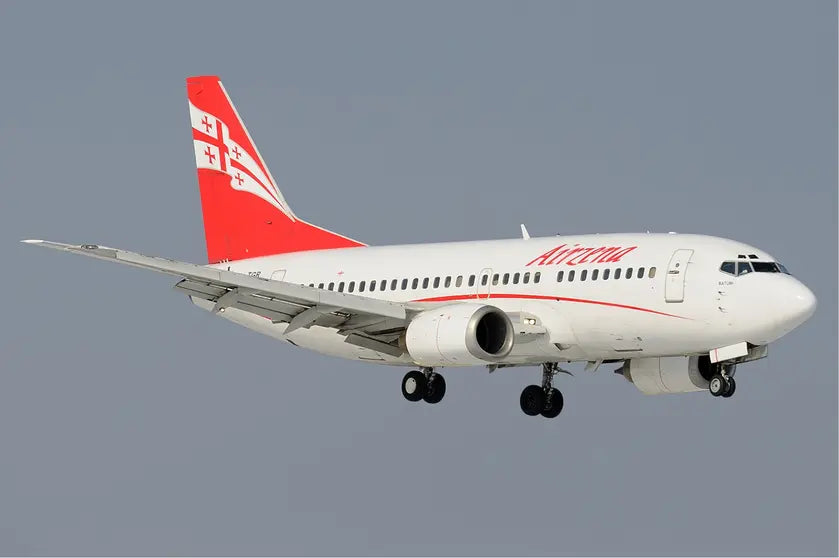
Georgian Airways operates an all-Boeing narrowbody line fleet built around the 737 family, plus one Boeing 767-300 widebody, one Bombardier CRJ200 regional jet and two Bombardier business jets used for government and VIP charter. Cross-checking the airline's own fleet page against the GCAA civil aircraft register produces the list below. The register is the more authoritative source because it records legal registration rather than marketing content, but it does not confirm which aircraft are actually flying on any given day.
| Aircraft Type | Registration | Built | Role & Pilot Relevance |
|---|---|---|---|
| Boeing 737-500 | 4L-TGI | 1996 | 737 Classic. Used on the new Batumi to Moscow and Batumi to Tbilisi services. Analogue-era flight deck, distinct from the NG. |
| Boeing 737-700 | 4L-GTI | 2008 | 737NG. European and regional short-haul. |
| Boeing 737-700 | 4L-NIK | 2009 | 737NG. Advertised at 133 seats (12 business, 121 economy). |
| Boeing 737-800 | 4L-GTD | 2008 | 737NG workhorse. Core European medium-haul aircraft. |
| Boeing 737-800 | 4L-GTN | 2009 | 737NG. Advertised at 168 seats in two classes. |
| Boeing 737-800 | 4L-GTO | 2012 | 737NG, added to the register in late 2024. |
| Boeing 737-900ER | 4L-GTL | 2013 | Largest 737 variant in the fleet, registered April 2025. Around 189 seats. |
| Boeing 767-300 | 4L-GTR | 2002 | Only widebody. Advertised at 245 seats (2 first, 16 business, 227 economy). Very small crew establishment. |
| Bombardier CRJ200LR | 4L-TGB | circa 2000s | 46 seats. Registered to the associated Airzena entity rather than directly to Georgian Airways. |
| Bombardier Challenger 850 | 4L-GAA | 2005 | VIP and government charter, not scheduled service. |
| Bombardier Global 6000 | 4L-GTG | 2016 | 14-seat VIP jet, registered February 2024. Advertised as capable of Tbilisi to Washington and Tbilisi to Tokyo non-stop. |
Compiled from the GCAA civil aircraft register and the airline's official fleet page, cross-checked August 2026. Registration does not guarantee daily serviceability. The CRJ200 build year is inconsistent between public sources and is shown as approximate.
Two structural features of this fleet are worth understanding before you apply.
It is old. Calculated from the build years above, the eight Boeing passenger aircraft average roughly 19 years of age in 2026, and the 737-500 is around 30 years old. There are no publicly recorded firm orders. A 2018 letter of intent covering Embraer E195-E2s and an expressed intent for 737 MAX aircraft never materialised and should not be treated as an outstanding order. If your career plan depends on flying a next-generation type within a few years, this is not the operator for that.
It is unusually mixed for its size. A fleet of this scale containing 737 Classic, 737NG in three variants, a 767 widebody, a CRJ and two business jets is atypical. That mix can be an advantage for a pilot who wants varied exposure, including a realistic path towards widebody or corporate flying inside one company. It also creates practical questions about how crews are allocated, whether pilots are dedicated to a single fleet, and how currency is maintained across variants.
The airline's crew page states that its pilots hold CAT II and CAT III ratings for low-visibility operations, and that recurrent training is conducted every six months at established third-party centres including CAE (Amsterdam, Brussels and Dubai), SIM Aero in Paris, Baltic Aviation Academy in Vilnius and the Lufthansa training centre, covering the Boeing 737, Boeing 767, CRJ and Global 6000. That is a genuinely positive data point: recurrent training at recognised European providers on a six-month cycle is a mainstream standard, and it means simulator detachments abroad are a normal part of the job. What the airline does not publish is whether it funds initial type ratings, whether it recruits only type-rated pilots, or whether a training bond applies. Treat all three as open questions to be settled in writing.
Because the fleet mixes generations and entities, ask specifically: Am I assigned to one fleet or expected to fly Classic and NG? Is the 767 crewed from the same pilot pool or does it have a separate list? Is the CRJ flown under the Airzena entity on a different contract? Which aircraft are currently airworthy and flying, as opposed to registered? How many hours per month can I realistically expect on my assigned type? A small operator with an ageing fleet can see utilisation swing sharply with a single unscheduled maintenance event, and that swing lands directly on pilot hours and pay if any part of your package is hourly.
Pilot Salary & Compensation Reality Check
Georgian Airways publishes no pilot pay scale, no collective agreement and no guaranteed monthly credit system. There is no union-negotiated table to consult, no seniority-step chart, and no public evidence of a standard per diem schedule. Any specific "Georgian Airways captain earns X" figure circulating online is not sourced from the company. What can be established reliably is the Georgian pilot labour market that the airline recruits into, and the tax and social framework that determines take-home pay.
The table below therefore presents Georgian market benchmarks, not company payroll. Conversions use an approximate rate of USD 1 = GEL 2.62. For context, the National Statistics Office of Georgia (Geostat) reported an average monthly nominal salary across all employees of GEL 2,282.7 in 2025 and GEL 2,363.8 in Q1 2026, so airline pilots sit well above the national mean even at the lower end of the ranges below.
Georgian Pilot Pay Benchmarks (Market Data, Not Company Data)
| Role / Measure | Monthly (GEL) | Monthly (USD approx.) | Basis & Confidence |
|---|---|---|---|
| Georgian Airways First Officer | Not disclosed | Not disclosed | No published scale. Must be obtained in writing from the employer. |
| Georgian Airways Captain | Not disclosed | Not disclosed | No published scale. Likely varies by 737 / 767 / CRJ and contract type. |
| First Officer, Tbilisi market benchmark | ~4,870 | ~1,860 | Derived from a published annual benchmark of GEL 58,440. Aggregator data, medium confidence. |
| Aircraft Captain, Tbilisi market benchmark | ~10,370 | ~3,960 | Derived from a published annual benchmark of GEL 124,400. Aggregator data, medium confidence. |
| Airline pilot average, Tbilisi | ~12,670 | ~4,840 | From GEL 152,000 per year; reported spread GEL 80,060 to 232,900 per year. |
| Broad Georgian pilot survey range | 1,920 to 7,260 | 735 to 2,775 | Paylab survey. Low confidence for airline captains; likely mixes general aviation and junior roles. |
| National all-employee average, Q1 2026 | 2,364 | ~905 | Geostat. Context only. |
Salary aggregator benchmarks for a country with only a handful of jet operators carry a wide margin of error. Use them to establish an order of magnitude, not to negotiate a specific number.
Regional Employer Comparison
| Employer | First Officer (annual, gross) | Captain (annual, gross) | Notes |
|---|---|---|---|
| Georgian Airways (Tbilisi) | Not published | Not published | Georgian market benchmarks suggest roughly USD 22,000 to 48,000 for an F/O and USD 47,000 to 60,000 for a captain, unverified. |
| Wizz Air, Kutaisi base (Georgia) | from ~EUR 45,600 | up to ~EUR 120,000 | Recruitment material for the Kutaisi base has advertised F/O pay from around EUR 3,800 per month and captain pay up to around EUR 10,000 per month. |
| Turkish Airlines (Istanbul) | ~USD 65,000 to 100,000 | ~USD 145,000 to 220,000 | Published 2026 estimates by seniority year. Foreign-pilot hiring is irregular and generally aimed at experienced widebody crews. |
| Azerbaijan Airlines (Baku) | Low confidence | Low confidence | Aggregator data suggests roughly AZN 66,000 per year for pilots in Baku. Contract terms are not transparent. |
Comparison figures are compiled from public recruitment material and salary databases as of 2026. They are indicative and should be verified against a current, named contract offer.
The practical conclusion is straightforward: on gross pay alone, Georgian Airways is unlikely to compete with the Wizz Air base sitting 220 kilometres away in Kutaisi, and it certainly does not compete with Turkish Airlines. What it may offer instead is jet command exposure, Georgian-language working environment, a home base for Georgian nationals, and a route into 737 or 767 time that is harder to obtain elsewhere in the region. That trade is legitimate, but it needs to be a conscious one.
No figure in this section comes from Georgian Airways. The benchmarks are drawn from Georgian salary aggregators and national statistics, and the comparison figures come from published recruitment material and public salary databases. Because Georgia has only a small number of commercial jet operators, aggregator samples are thin and the ranges are wide. Before accepting any offer, get the following in writing: gross and net monthly pay; whether pay is fixed salary, block-hour pay or a mix; the guaranteed minimum credit if any; the currency of payment and whether there is exchange-rate protection; sector, positioning and simulator pay; per diem rates and currency; and what happens to pay during grounding, extended maintenance downtime or route suspension.
Georgia applies a flat 20% personal income tax on employment income, with no progressive bands. Georgian citizens and foreign nationals holding permanent residence also contribute 2% of gross salary to the mandatory funded pension scheme, matched by 2% from the employer plus a state contribution of up to 2% on lower income bands. As a rough guide, a Georgian-resident pilot keeps roughly 78% of gross. That is a materially better ratio than France, Germany or the Nordics, and it partially offsets the lower gross figures. Living costs in Tbilisi are also well below Western European levels. When comparing an offer here against a Western European one, always compare net, not gross.
Roster, Duty Limits & Quality of Life
Georgian Airways does not publish a roster pattern, a bidding system, a monthly block-hour guarantee or any fixed on/off cycle. There is no evidence of preferential bidding, seniority-based line bidding, protected weekends or commuting contracts. This guide therefore does not include a sample roster grid, because inventing one would be misleading. What can be described accurately is the regulatory framework that bounds the roster, and the shape of the actual flying programme, which tells you a great deal about what your days will look like.
The Regulatory Framework
Georgia signed the EU-Georgia Common Aviation Area Agreement, which commits the country to progressively transposing EU aviation legislation, including the air operations rules that contain flight and duty time limitations. The Georgian Civil Aviation Agency operates a dedicated rulemaking and EU regulation transposition department and works within the ICAO, EUROCONTROL and EASA framework. In practice this means Georgian operators work to an FTL regime aligned with the European model, with the familiar structural limits of 100 flight hours in any 28 consecutive days and 900 to 1,000 flight hours over a rolling twelve-month period, together with prescribed minimum rest and recurrent extended recovery rest.
The specific Georgian implementing order that governs flight and duty time limitations for Georgian AOC holders is not readily available in English, and public sources do not allow the exact national text and its variations to be confirmed. Numerical limits quoted here reflect the European framework Georgia is aligning with, not a verified Georgian legal citation. Two further cautions: a very large share of online search results for "GCAA flight time limitations" refer to the United Arab Emirates General Civil Aviation Authority, which is a completely different regulator with different rules. And an operator's approved FTL scheme, including any approved variations and its fatigue risk management provisions, is what actually governs your roster. Ask for the operations manual Part A section on flight time limitations, plus three anonymised recent rosters covering a normal month, a reserve month and a disrupted month.
Leave and Statutory Protections
Whatever the airline offers contractually, the Labour Code of Georgia sets a floor. It provides a minimum of 24 working days of paid annual leave plus at least 15 working days of unpaid leave per year, a 40-hour standard working week, and maternity leave of 126 calendar days, extended to 143 days in cases of complications or multiple births. Twenty-four working days is roughly five working weeks, which is competitive by global standards though below the 30 to 45 days seen at Western European legacy carriers. There is no public evidence that Georgian Airways enhances any of these statutory minimums for pilots, so treat the legal floor as your working assumption until a contract says otherwise.
There is effectively one base: Tbilisi. The June 2026 Batumi additions do not appear to constitute a separate crew base, and no commuting contract or positioning entitlement is publicly documented. For a pilot living in Tbilisi, the operating model has a real quality-of-life upside, which is that you sleep at home far more often than a comparable European medium-haul pilot. The offsetting cost is duty length: several European rotations are long single-duty days, and the Paris rotation in particular ends in the small hours of the morning. Tbilisi itself is a low-cost, well-connected capital with good onward air links, which makes it a reasonable place to be based if you are not commuting internationally.
Network Structure & What the Flying Is Like
This section replaces the layover guide that would normally appear here. Georgian Airways is not a long-haul carrier and, on the evidence of its own published timetable, it largely does not do European night stops. Its European rotations are flown as same-day out-and-back turns from Tbilisi. That is an unusual model for sectors of this length, and it is the single most important thing to understand about the day-to-day job.
Published Rotation Patterns
Using the airline's own published schedule, three of the longest European rotations look like this:
| Rotation | Outbound | Inbound | Approx. Block (round trip) | Duty Shape |
|---|---|---|---|---|
| Tbilisi to Amsterdam | 06:35 dep, 09:40 arr | 10:40 dep, 17:00 arr TBS | ~9h 25m | Early report around 05:35, roughly 12-hour duty, home the same evening. |
| Tbilisi to Paris CDG | 16:30 dep, 19:30 arr | 20:40 dep, 03:10 arr TBS | ~9h 30m | Afternoon report, duty finishing around 03:10 local. Effectively a night duty. |
| Tbilisi to Vienna | 16:30 dep, 18:00 arr | 19:00 dep, 00:20 arr TBS | ~6h 50m | Roughly a 9-hour duty ending just after midnight. |
Times are local, taken from the airline's published summer schedule and cross-checked in August 2026. Schedules change seasonally. Duty estimates are calculated from published departure and arrival times using standard report and debrief allowances, not taken from an operator roster.
Sector Lengths Across the Network
The network spans everything from 30-minute regional hops to five-hour-plus European sectors, which produces a wide spread in duty profiles.
| Route from Tbilisi | Approx. Flight Time | Frequency Pattern | Character |
|---|---|---|---|
| Yerevan (EVN) | ~0h 30m | Regional | Shortest sector in the network. |
| Batumi (BUS) | ~0h 45m | 4x weekly (from June 2026) | Domestic, operated by the 737-500. |
| Larnaca (LCA) | ~2h 30m | Daily | High-frequency leisure and diaspora route. |
| Tel Aviv (TLV) | ~2h 50m | Up to daily | Multiple departure waves including early morning and evening. |
| Moscow Vnukovo (VKO) | ~3h 00m | Multiple daily waves | Includes late-night departures. See the sanctions section. |
| Vienna (VIE) | ~3h 40m | 3x weekly | Same-day turn. |
| Saint Petersburg (LED) | ~3h 45m | Year-round | Russian network. |
| Berlin (BER) | ~4h 00m | 2x weekly | Lowest-frequency European route. |
| Rome (FCO) / Milan Bergamo (BGY) | ~4h 10m to 4h 15m | Up to 3x weekly | Italian network, also serves Forlì. |
| Munich (MUC) | ~4h 15m | 3x weekly | Same-day turn. |
| Nice (NCE) | ~4h 20m | 3x weekly | Seasonal leisure demand. |
| Amsterdam (AMS) | ~5h 05m | 3x weekly | Longest scheduled European sector. |
| Paris CDG (CDG) | ~5h 20m | 3x weekly | Latest-finishing duty in the network. |
Flight times are typical scheduled block times published by the airport and schedule databases. Actual times vary by aircraft type, routing and season.
The upside of a turn-based network is that you go home most nights. There are no long stretches away, no living out of a suitcase, no five-day pairings, and no hotel-room routine. For a pilot with a family in Tbilisi, that is a substantial and underrated benefit. The downside is that a five-hour sector flown as an out-and-back becomes a ten-hour block day plus report and debrief, so long duty days and back-of-the-clock finishes are structural rather than occasional. Circadian disruption at this airline comes from late finishes and early reports rather than from time-zone crossing, which is a different kind of fatigue challenge and one that some pilots handle better than others. Ask directly how many of these long turns you can be scheduled in a row and what the minimum rest is between an 03:10 arrival and the next report.
This article does not include a layover destinations section because Georgian Airways does not publish crew hotel arrangements, layover durations, per diem rates or night-stop policy, and its schedule structure indicates that European night stops are the exception rather than the norm. Where night stops do occur, whether through disruption, positioning or seasonal scheduling, no reliable public information exists on hotel standards or allowances. Rather than fill this space with unverifiable content, we have set it out as an open question for candidates to raise with the company directly.
Benefits, Insurance & Retirement
Benefits are the least transparent area of the entire package at Georgian Airways. There is no published employee handbook, no staff travel policy, no confirmed medical scheme and no stated loss-of-licence provision. What follows separates what is legally guaranteed in Georgia, which applies regardless of the employer, from what is entirely undocumented and must be negotiated.
At a Western European legacy carrier, loss-of-licence cover is normally embedded in the collective agreement or the national aircrew pension fund, and pilots rarely think about it. At Georgian Airways, nothing public confirms that any such cover exists. If you lose your Class 1 medical mid-career, the Georgian funded pension scheme will not replace your income. Before signing, establish in writing whether the employer provides loss-of-licence insurance, what the sum insured is, what the exclusions are, and whether it is a lump sum or an income stream. If it is not provided, price an individual policy through a specialist aviation insurer and factor that premium into your salary comparison. Also confirm who pays for the annual Class 1 medical, licence renewals, recurrent checks and travel to simulator sessions abroad, since six-monthly recurrent training at overseas centres carries real cost.
Because so little is provided by default, a realistic approach is to treat this as a gross-pay negotiation and buy your own protection. Price out private international medical cover for yourself and family, a loss-of-licence policy, and a private pension or investment plan, then require a gross salary that funds all three and still leaves your target net. Georgia's 20% flat tax and low cost of living make that arithmetic more workable than it would be in Western Europe, but it only works if you do the calculation before you accept, not after.
Career Progression & Seniority
Georgian Airways publishes no seniority list, no command pathway, no minimum service requirement for upgrade and no direct-entry captain policy. In the absence of a collective agreement, promotion at an airline of this size is normally driven by operational need and management selection rather than by a strict seniority number. That cuts both ways.
The upside: in a small operator, a strong performer can move faster than a seniority list would ever allow. There is no queue of two thousand pilots ahead of you. If the airline adds an aircraft or a route and needs a command, the pool of candidates is small. The unusual fleet mix also creates internal moves that most airlines of this size cannot offer, including a 767 widebody and two corporate jets. Publicly visible professional profiles of Georgian Airways pilots show real movement between the 737 and the Global 6000, which suggests the corporate side is genuinely reachable from the line fleet rather than being a closed shop.
The downside: with no fleet growth, no aircraft on order and a total establishment of around eight passenger jets, the number of command slots is inherently small and depends almost entirely on retirements and attrition. There is also no published protection if a command course is failed, no published bidding rules for fleet transfer, and no transparency about how assignments are decided. In an environment without a union or a published list, career outcomes depend more on relationships and management judgement than they would at a larger carrier.
| Career Milestone | Published Position | What to Establish in Writing |
|---|---|---|
| Seniority system | None published | Is there a list at all? Is it used for leave, bidding, fleet moves and upgrade, or only for one of these? |
| Entry as First Officer | Fleet not specified | Which type will you be assigned, and can you be moved between Classic and NG? |
| Upgrade to Captain | No published timeline | Minimum hours, minimum service, ATPL requirement, selection criteria, and how many commands have been awarded in the last three years. |
| Direct-entry Captain | No public policy | Treat any agency advertisement as unconfirmed until it links to a named Georgian Airways contract. |
| Transfer to Boeing 767 | No published route | Is the widebody crewed from the same pool? Does a transfer reset anything or trigger a new bond? |
| Transfer to Global 6000 / Challenger | No published route | VIP flying is a genuinely different job. Ask about roster impact and standby obligations. |
| Instructor roles (TRI / TRE) | Not published | Recurrent training runs through third-party centres, which may limit internal instructor opportunities. |
| Training bond | Not published | Amount, term, amortisation, triggers, treatment of medical loss or redundancy, and governing law. |
Where an airline funds a type rating, a bond is normal and reasonable. What matters is the detail. Ask for the exact amount, the amortisation schedule (straight-line monthly reduction is the fair standard), and precisely which events trigger repayment. Critically, establish what happens if you lose your medical, if you fail a check through no fault of your own, if the company makes you redundant, or if the company itself suspends operations. A bond that survives an employer-side termination or a medical loss transfers the entire risk of the airline's own volatility onto you, and given the company's restructuring history that is not a theoretical concern. Also confirm the governing law and jurisdiction, since enforcing or contesting a Georgian-law bond from abroad is a materially different proposition than an EU-law one.
Recruitment Process & Requirements
Georgian Airways runs no public, structured recruitment campaign. Its careers page carries a general invitation to apply and a single contact address, career@georgian-airways.com, together with a short statement that it looks for candidates who value long-term career plans and stability and who are ready both to receive and to share knowledge. It does not list live vacancies, minimum hours, licence requirements, salary or roster information. There is no online application portal, no assessment-day description and no published selection stages.
This is not unusual for an airline of this size in this region. Hiring tends to be need-driven, informal and often filled through professional networks and local training pipelines rather than open campaigns. It does mean that a speculative, well-prepared application carries more weight here than it would at a carrier running an automated recruitment funnel.
Requirements: Confirmed vs Reasonable Expectation
How Georgian Pilots Actually Reach the Flight Deck
With no cadet scheme, the domestic pipeline runs through self-funded training. Georgian Aviation University in Tbilisi is the principal local provider, offering academic aviation degrees alongside flight training, with a flight base at Telavi. Published programme pricing varies substantially by track and intake format, with bachelor pilot routes advertised in the region of EUR 11,000 to 19,000 per year and vocational CPL programmes quoted anywhere from roughly EUR 26,000 per year up to EUR 57,000 in total for full packages. Broad market guides put a full CPL plus ATPL theory path in Georgia at roughly EUR 30,000 to 50,000, which is materially cheaper than Western Europe but still a significant personal investment in a country with a GEL 2,364 average monthly wage.
The type rating is normally the second hurdle. No Georgian school bundles a Boeing 737 rating into initial training, so pilots typically obtain the rating separately, often at one of the European training providers the airline already uses for recurrent work, or through an airline-sponsored arrangement after selection. Whether Georgian Airways sponsors, part-sponsors or requires a self-funded rating is not published and varies with the individual case.
Applying Effectively
Confirm Your Licensing Route First
Before applying, contact the Georgian Civil Aviation Agency to establish exactly what is required to have your licence recognised, validated or converted for use on a Georgian AOC. Doing this first means your application arrives with a credible answer to the airline's most obvious objection.
Send a Complete Speculative Application
Apply to career@georgian-airways.com with a full document set: CV, licence, Class 1 medical, type rating certificate with validity status, ICAO English proficiency certificate, last logbook pages showing totals and recency, and last LPC or OPC record. In an unstructured process, completeness is what separates a file that gets read from one that does not.
Expect an Informal, Direct Process
No formal assessment structure is published. Prepare for a technical interview, an HR conversation and, if the airline follows normal practice, a simulator assessment. Because the process is not standardised, you should ask early what stages exist and who makes the final decision.
Complete Background and Security Clearance
Expect passport verification, criminal record checks, employment history verification, licence authentication with the issuing authority and airport security clearance. Build time for this into any resignation timeline from a current employer.
Resolve Immigration Before Signing
If you are not a Georgian citizen or permanent resident, work authorisation is now a prerequisite rather than a formality. See the next section. Do not resign from an existing job until the right-to-work application and the visa or residence route are confirmed in writing.
Small operators with tight balance sheets recruit the candidate who reduces cost and risk. In practical terms that means: a current and valid 737 rating, recent time on type, no licence validation problem, no visa problem, and immediate availability. If you can present all five, you are a fundamentally different proposition from a candidate who needs a sponsored rating and an immigration process. If you cannot, be honest about which of these gaps you are asking the airline to close, and be prepared for that to shape the offer.
Licences, Work Permits & Tax for Foreign Pilots
If you are not a Georgian citizen, this section is the one that will determine whether an offer is workable at all. Georgia was for many years one of the easiest countries in the world for foreigners to live and work in, with long visa-free stays and minimal bureaucracy. That changed in 2026.
The March 2026 Work Authorisation Change
From 1 March 2026, amendments to Georgia's Law on Labour Migration introduced a new work authorisation, or right to work, requirement for most foreign nationals who are employed or self-employed in Georgia. This is separate from, and additional to, any visa or residence permit. Relying on a temporary residence permit alone is no longer sufficient. In practice a foreign pilot will generally need both a work authorisation and an appropriate immigration status document, normally a D1 labour migration visa or a work residence permit if already in the country.
For employees, the local employer submits the work authorisation application. Working without the required authorisation attracts a fine of GEL 2,000, which can fall on the employer, the foreign employee or a self-employed foreigner depending on circumstances, with escalating penalties for repeat violations. The US Embassy in Tbilisi and several Georgian law firms have published practical summaries of the change.
Georgian Airways does not publicly promise work permit or residence sponsorship. Because the employer is the party that applies for the work authorisation, you are structurally dependent on the company completing the process correctly and on time. Put the following in the contract: who applies, who pays the fees, what happens if the authorisation is refused or delayed, what your status is during the waiting period, and what happens to your right to remain in Georgia if employment ends. Also clarify whether the airline will support a residence route for your spouse and children. These are the clauses that determine whether a problem eighteen months from now is an inconvenience or a crisis.
Licence Recognition
Holding an EASA ATPL does not make you licensed to fly for a Georgian AOC holder. Georgian law permits recognition of foreign aviation licences where the applicable recognition arrangements are satisfied, but the process, timescale and documentary requirements are administered by the Georgian Civil Aviation Agency and are not clearly set out in English on its public site. Before treating an offer as real, obtain written confirmation from the GCAA, or from the airline acting on your behalf, covering: whether your licence will be validated or converted; whether theoretical examinations, an air law examination or a skill test are required; whether your Class 1 medical will be accepted or must be re-issued in Georgia; how your ICAO English proficiency endorsement transfers; and how long the process takes end to end.
The Tax Position
Georgia's flat 20% personal income tax applies to employment income for tax residents, with no progressive bands and no additional local income taxes. Foreign nationals who do not hold Georgian permanent residence are generally outside the mandatory funded pension scheme, so the 2% employee contribution does not apply to them, though it also means no employer or state matching contribution accrues. Tax residency is generally established by physical presence, and if you retain ties to another country you may face dual-residency questions. Take professional advice on your own situation rather than assuming the flat rate resolves everything.
Financial Health, Sanctions & Job Security
No responsible assessment of Georgian Airways as an employer can skip its recent financial history. This is not a criticism of the company, which survived a period that closed many carriers permanently, but it is directly relevant to anyone deciding where to spend the next decade of their career.
The 2021 Insolvency and 2022 Restructuring
Tbilisi City Court accepted Georgian Airways' insolvency filing at the end of December 2021. Reported obligations at the time were approximately GEL 175.9 million, owed to more than 70 organisations and over 16,000 passengers, against roughly GEL 21 million in assets. Two causes dominated: the Russian ban on flights to and from Georgia imposed in July 2019, which the airline estimated cost it around USD 25 million, and the COVID-19 pandemic, which included an eleven-month suspension of international air traffic.
Crucially, the airline was rehabilitated rather than liquidated. In October 2022 creditors approved and the court confirmed a five-year plan under which roughly 90% of recognised debt was written off and approximately GEL 17 million was to be repaid. The formal rehabilitation regime was subsequently terminated and the company continued trading under the plan. Public evidence confirming that all plan payments have been completed is not available, and no audited revenue or profit figures for 2024 to 2026 are in the public domain. A 2025 Georgian business media report referred to a USD 150 million valuation in the context of a process to find a partner for a 49% stake, but that reads as a proposed transaction rather than a completed sale.
The operating trend since then has been positive. Passenger numbers grew about 17% year on year in the first half of 2025, the airline held second place in the Georgian market through September 2025, and it has added aircraft to the register (a 737-800 in late 2024, a 737-900ER in April 2025, a 767-300 in June 2024) and launched new Batumi routes in June 2026. That is the behaviour of a recovering airline, not a failing one.
Sanctions and Geopolitical Exposure
Russia lifted its flight ban on 10 May 2023 and Georgian Airways resumed Moscow services from 20 May 2023. In response, Ukraine imposed ten-year sanctions on Georgian Airways and its founder from 1 July 2023, including asset blocking, suspension of trade and financial operations, and prohibition of flight or transit through Ukrainian airspace. The Russian network (Moscow Vnukovo, Saint Petersburg, Novosibirsk, and from June 2026 Batumi to Moscow) is commercially important to the airline and was a significant driver of its 2025 recovery.
For a pilot, Russia flying raises questions that go beyond company risk. Consider: whether logged time on sanctioned routes affects future employability with EU, UK or US carriers; whether your personal banking, insurance or visa position could be affected; whether the airline's insurers, lessors and maintenance providers face constraints; and whether the route network could be curtailed again by a policy change entirely outside the company's control, as happened in 2019. None of this makes flying these routes improper, and many carriers in the region operate them. But you should decide your own position in advance and ask whether your contract permits you to decline a specific route, and what the consequences of doing so would be. Do not assume there is a conscientious-objection clause: ask.
The balanced view is this. Georgian Airways has been in business for over thirty years, holds the flag carrier designation, is an IATA member, is not on the EU Air Safety List, and is growing again after a genuine near-death experience. Equally, it is a small privately held company with no published audited accounts, an ageing fleet, no order book, a heavy dependence on a politically exposed route group, and a debt restructuring whose completion is not publicly verifiable. That combination justifies a job security score below the halfway mark, and it justifies asking for evidence of timely payroll over the last twenty-four months as part of your due diligence. Asking that question is normal and any well-run employer will answer it.
Union & Industrial Relations
There is no publicly identifiable Georgian Airways pilot union, no ALPA or IFALPA member association representing its pilots, and no publicly available pilot collective bargaining agreement. This is one of the clearest structural differences between Georgian Airways and the European legacy carriers most pilots use as a mental benchmark. At Air France or Lufthansa, pay scales, roster protections and upgrade rules exist because a union negotiated them and published them. Here, employment terms appear to be governed by individual contracts.
That has a direct practical consequence: everything is negotiable and nothing is guaranteed. There is no standard offer to point to, no scale you can check your salary against, no grievance machinery beyond the statutory framework, and no collective body to escalate a rostering or fatigue dispute to. Your individual contract is the entire extent of your protection.
The Legal Framework That Does Exist
Georgian law recognises the right of employees to form associations and trade unions. Collective disputes involving at least twenty workers, or an employee association, follow prescribed conciliation and mediation procedures, with notice requirements before industrial action. The Georgian Trade Union Confederation (GTUC) is the national cross-sector confederation and organises through sector unions; it is the logical starting point for labour law or organising enquiries in Georgian aviation, though it is not an aviation-specific body.
No strike history, industrial action or formal pilot dispute at Georgian Airways is documented in public sources, which is consistent with the absence of an organised bargaining unit rather than evidence of exceptional labour harmony. The 2021 insolvency involved substantial passenger and supplier debts, and public reporting focused on creditors rather than on employee claims.
Searching for "Georgian Airways union agreement" returns a large volume of Canadian material relating to Air Georgian, including ALPA and Unifor collective agreements filed with Canadian labour authorities. Those documents contain detailed pay grids, per diem rates and roster rules. None of them apply to Georgian Airways of Tbilisi. Do not use them as a reference point in a salary negotiation.
Without collective representation, protect yourself contractually. Insist on written terms covering: notice periods on both sides; the exact grounds for termination; payment terms and what happens if salary is late; the bond and its release conditions; roster publication timelines and minimum notice of changes; fatigue reporting and the right to declare unfit without penalty; and dispute resolution and governing law. Consider maintaining membership of a professional pilot association in your home country if eligible, and take independent legal advice on the contract before signing. A Georgian employment lawyer will review a contract for a modest fee, which is trivial against the value of the decision.
How Georgian Airways Compares: Airline Radar Chart
The two most decision-relevant comparators for a pilot considering Georgian Airways are not other flag carriers but the two operators that a Tbilisi-based pilot could realistically target instead. Wizz Air maintains a crew base at Kutaisi, roughly 220 kilometres from Tbilisi, making it a direct alternative without leaving the country. Turkish Airlines is the largest network competitor in the Georgian market and the aspirational regional employer for experienced pilots. Both are compared below across the same axes used in the scorecard.
Key Takeaways from the Comparison
Georgian Airways is behind on pay, and the gap is not marginal. Wizz Air recruitment material for the Kutaisi base has advertised first officer pay from around EUR 3,800 per month and captain pay up to around EUR 10,000 per month, with retention bonuses reported in the EUR 30,000 to 50,000 range across the group. Turkish Airlines captain pay is published in 2026 estimates at roughly USD 145,000 to 220,000 depending on seniority. Georgian market benchmarks for Tbilisi captains sit around GEL 124,400 per year, roughly USD 48,000. Even allowing for Georgia's 20% flat tax and low living costs, the net comparison does not close that gap.
Georgian Airways wins on being home. This is the one axis where the small carrier genuinely outperforms. The turn-based European network means most duties end back in Tbilisi the same day or shortly after midnight, with very few night stops. A Wizz Air base involves a low-cost roster with early starts and multi-sector days, and Turkish Airlines involves long-haul time-zone disruption on the widebody fleets. If you live in Tbilisi and value sleeping at home, that is a real and quantifiable advantage. The caveat is duty length: ten-hour block days and 03:10 arrivals are not restful, and there is no published protection above the regulatory minimum.
Fleet is the clearest structural weakness. Wizz Air operates one of the youngest fleets in Europe, built around the A320neo family, and Turkish Airlines runs a large modern mixed fleet with genuine widebody career paths. Georgian Airways operates 737 Classic and NG aircraft averaging roughly 19 years, with no orders on the books. The counterargument is variety: a single small operator giving access to 737 Classic, 737NG, a 767 widebody and two corporate jets offers breadth that a single-type LCC never will.
Transparency itself is part of the score. Wizz Air and Turkish Airlines publish structured recruitment requirements, defined bases, indicative pay and formal selection processes. Georgian Airways publishes an email address. That difference is scored here under Benefits and Job Security, because from a candidate's perspective an undocumented package is a package you cannot evaluate, and an unevaluable package carries risk regardless of what it turns out to contain.
Where Georgian Airways genuinely wins: for a Georgian national or permanent resident who wants to fly jets, live at home, avoid international relocation and build 737 or 767 time, it is the natural and in some cases the only realistic domestic option. Its value is highest for the pilot for whom the alternative is not Wizz Air or Turkish Airlines but no airline job at all.
Scores are editorial estimates, not measured values. They are based on published recruitment material, national statistics, salary aggregators, the Georgian civil aircraft register, published schedules, court and business media reporting on the airline's restructuring, and Georgian labour and migration law. Because Georgian Airways publishes no pay scale, roster pattern or benefits policy, its scores incorporate an explicit penalty for non-disclosure: an undocumented benefit is treated as absent for scoring purposes. If the airline publishes verifiable terms, these scores should be revised upward. Comparator scores for Wizz Air and Turkish Airlines are drawn from public recruitment and salary sources and are indicative only. Individual outcomes vary substantially with contract type, nationality and negotiation.
Verdict: Who Is Georgian Airways For?
🎯 Our Take
Georgian Airways is a legitimate, long-established flag carrier that has been flying for over thirty years, holds IATA membership, trains its crews to CAT II and CAT III standards at recognised European providers on a six-month recurrent cycle, and has grown its way out of a genuine insolvency. It is also a small, privately held, financially opaque employer with an ageing fleet, no order book, no union, no published pay scale and no published roster.
The strongest case for joining is geographic and practical. If you are Georgian, or already have the right to live and work in Georgia, this is realistically the primary route to flying commercial jets from your home city, on an international network, without relocating. The turn-based schedule means you sleep in your own bed far more often than most medium-haul pilots in Europe. The mixed fleet offers routes into widebody and corporate flying that a single-type operator cannot match. Georgia's 20% flat income tax and low cost of living mean a modest gross goes further than the headline number suggests.
The case against is equally clear. Pay is well below the Wizz Air base 220 kilometres away at Kutaisi and far below Turkish Airlines. Duty days are long, with 03:10 arrivals built into the schedule. Loss-of-licence cover, health insurance, staff travel and per diems are all undocumented. There is no collective body to escalate a dispute to. The route network depends materially on Russian services that have already been suspended once by political decision and have attracted Ukrainian sanctions against the company. And for foreign pilots, the March 2026 work authorisation changes mean immigration is now a genuine gate rather than a formality.
This is not an airline to join on faith. It is an airline to join on a contract you have read carefully, negotiated properly and had reviewed independently.
1 How much do Georgian Airways pilots earn?
Georgian Airways does not publish a pilot pay scale, and no verified company payroll data is publicly available. Georgian market benchmarks for Tbilisi put first officer pay at roughly GEL 4,870 per month (about USD 1,860) and aircraft captain pay at roughly GEL 10,370 per month (about USD 3,960), with broader airline pilot averages in Tbilisi around GEL 12,670 per month. These are aggregator estimates for the Georgian market, not company figures. Georgia applies a flat 20% income tax plus a 2% employee pension contribution for citizens and permanent residents, so net retention is around 78% of gross. Always obtain a written breakdown of base pay, hourly or sector pay, per diems and currency before accepting an offer.
2 Can a foreign pilot work for Georgian Airways?
There is no published Georgian-citizens-only policy, so foreign recruitment is legally possible. However, two conditions must be met. First, your licence must be recognised, validated or converted by the Georgian Civil Aviation Agency; an EASA licence is not automatically valid for a Georgian AOC holder. Second, since 1 March 2026 most foreigners without permanent residence need a Georgian work authorisation (right to work), applied for by the employer, plus a D1 labour migration visa or a work residence permit. Working without authorisation carries a GEL 2,000 fine. The airline does not publicly commit to sponsoring either process, so get it in the contract.
3 Does Georgian Airways pay for the Boeing 737 type rating?
This is not published. The airline confirms that recurrent training is conducted every six months at third-party centres including CAE, SIM Aero Paris, Baltic Aviation Academy Vilnius and the Lufthansa training centre, but it does not state whether it funds initial type ratings, requires candidates to arrive already rated, or applies a training bond. No Georgian flight school bundles a 737 rating into initial training, so Georgian pilots typically obtain the rating separately or through an arrangement made after selection. If a rating is offered, insist on written bond terms including the amount, amortisation schedule, repayment triggers, and treatment of medical loss, employer-side termination and company insolvency.
4 How long does it take to upgrade to Captain?
No upgrade timeline is published, and there is no public seniority list or collective agreement setting command criteria. At an operator with roughly eight passenger jets and no aircraft on order, the number of command slots is small and depends primarily on retirements and attrition rather than on growth. In practice, promotion at a company of this size is normally driven by operational need, ATPL eligibility, hours, check record and management selection. Ask directly how many commands have been awarded in the last three years and what the current minimum hours and minimum service requirements are.
5 Does Georgian Airways have a cadet programme?
No cadet programme, ab initio scheme or airline-funded MPL pathway is publicly advertised by Georgian Airways or by any other Georgian carrier. Domestic pilots typically self-fund training, most commonly through Georgian Aviation University in Tbilisi, which operates a flight base at Telavi. Published programme pricing varies widely by track, with bachelor pilot routes advertised in the region of EUR 11,000 to 19,000 per year and vocational CPL programmes quoted from roughly EUR 26,000 per year. Broad market guides place a full CPL plus ATPL theory path in Georgia at roughly EUR 30,000 to 50,000. Graduating does not carry any placement guarantee with the airline.
6 Do Georgian Airways pilots get layovers?
Mostly no. The airline's published schedule shows its European rotations operating as same-day out-and-back turns from Tbilisi. Amsterdam departs around 06:35 and the aircraft is back in Tbilisi by roughly 17:00. Paris departs at 16:30 and returns at approximately 03:10 the following morning. Vienna departs at 16:30 and returns around 00:20. That means very few night stops, but it also means long single duty days, some finishing in the middle of the night. The airline does not publish crew hotel arrangements, layover durations or per diem rates for the occasions when a night stop does occur.
7 Is Georgian Airways financially stable after its 2021 insolvency?
It is trading and growing, but its financial position is not publicly verifiable. The airline filed for insolvency in December 2021 with reported obligations of about GEL 175.9 million against roughly GEL 21 million in assets. It was rehabilitated rather than liquidated: in October 2022 a five-year plan was approved writing off roughly 90% of recognised debt, with about GEL 17 million to be repaid. Public confirmation that the plan has been completed is not available, and no audited revenue or profit figures for 2024 to 2026 are in the public domain. Operationally the picture is better, with about 17% passenger growth in the first half of 2025, second place in the Georgian market, and three aircraft added to the register between mid-2024 and April 2025. Ask for evidence of timely payroll over the last twenty-four months as part of your due diligence.
8 Should I be concerned about the Russia routes and Ukrainian sanctions?
You should at least be informed about them. Georgian Airways resumed Moscow flights in May 2023 after Russia lifted its 2019 ban, and Ukraine responded by imposing ten-year sanctions on the airline and its founder from 1 July 2023, including asset blocking and a prohibition on flying through or transiting Ukraine. The Russian network (Moscow Vnukovo, Saint Petersburg, Novosibirsk, and Batumi to Moscow from June 2026) is commercially significant to the airline. The practical questions for a pilot are whether logged time on sanctioned routes could affect future employability with EU, UK or US carriers, whether your personal banking or visa position could be affected, and whether the network could be suspended again by political decision as it was in 2019. Decide your position in advance and ask whether your contract allows you to decline a specific route.
Official Links & Resources
Because so little about Georgian Airways pilot employment is published by the company, verifying information at source matters more here than at a typical legacy carrier. These are the primary references used in this guide and the ones worth consulting before you apply or accept an offer:
The recurring theme of this guide is that Georgian Airways publishes very little, which means the burden of establishing your terms falls entirely on you. Before accepting an offer, request in writing: gross and net monthly pay with the guaranteed minimum credit; three representative anonymised rosters covering a normal, reserve and disrupted month; the operations manual section on flight time limitations and the approved FTL scheme; the current IOSA certificate and AOC operations specifications; confirmation of loss-of-licence and health insurance; the training bond terms in full; the work permit and licence validation responsibility split; and the notice, termination and late-payment provisions. A well-run employer will supply these without difficulty. Reluctance to supply them is itself the answer.
- 01Overview & Company Profile
- 02Fleet & Type Ratings
- 03Salary & Compensation
- 04Roster & Duty Limits
- 05Network & The Flying
- 06Benefits & Retirement
- 07Career Progression
- 08Recruitment & Requirements
- 09Licences & Work Permits
- 10Financials & Job Security
- 11Union & Industrial Relations
- 12Airline Comparison
- 13Verdict & FAQ
- 14Links & Resources