

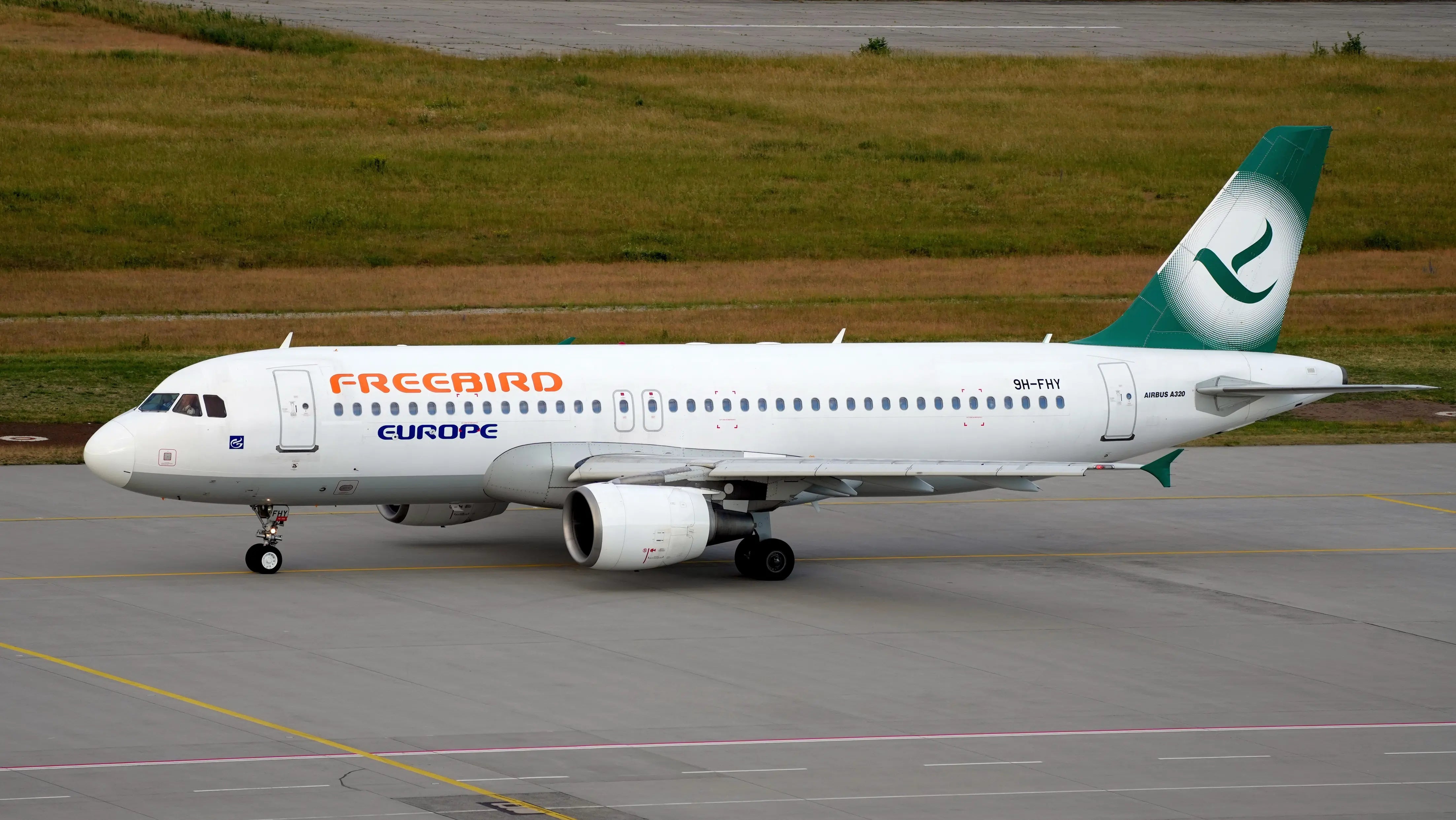
Freebird Airlines Europe Overview & Company Profile
Freebird Airlines Europe Limited is a small Maltese leisure charter and ACMI operator, and the European Union arm of the Turkish charter airline Freebird Airlines. It was incorporated in Malta in 2018 (company registration C 85462), received its Air Operator Certificate from the Malta Civil Aviation Directorate in late January 2019, and flew its first commercial European service on 20 February 2019 with the Airbus A320 registered 9H-FHB. Malta's published AOC-holder list identifies the company as AOC MT-50. The registered office is at 233 Triq il-Kbira, Mosta, and Malta International Airport (MLA) is the regulatory and administrative home of the certificate.
One point causes constant confusion among applicants, and it matters when you search job boards or check a fleet database. Freebird Airlines Europe uses IATA code MI, ICAO code FHM and the callsign EUROBIRD. The codes FH / FHY belong to the Turkish parent, Freebird Airlines (legal entity Hürkuş Hava Yolu Taşımacılık ve Ticaret A.Ş.), which is a separate airline on a separate Turkish AOC. The two carriers share a brand, a livery, a management structure and an aircraft type, but they are distinct employers with distinct contracts, distinct bases and distinct regulatory regimes. If you are an EU-based pilot, the entity that will employ you is almost certainly the Maltese one, and in practice that means a German-based flying job.
Ultimate ownership sits with Gözen Holding, a privately held Turkish aviation and tourism group whose origins date to 1979. Gözen's businesses span ground and airline services, representation and supervision, fuel, brokerage, aviation security, training and aviation technology, and the group reports more than 3,000 staff across all activities. The Turkish airline itself was established in June 2000 and flew its first commercial service on 5 April 2001, from Istanbul to Lyon, with three MD-83s. It moved to the Airbus A320 in 2003 and marked its 25th anniversary in 2026.
Group-level figures published by Freebird in 2026 describe a combined operation of 14 Airbus A320 aircraft, more than 850 airline employees, more than 120 destinations, more than one million passengers a year and departures from 16 German airports. Freebird also joined the German airline association BARIG on 3 June 2026, a signal of how central the German market has become to the group. Aspiring pilots should read those numbers carefully: they cover both AOCs together. Freebird Airlines Europe on its own operates three A320s. Its company profile indicates an employee band of 51 to 200 people, and no audited pilot headcount for the Maltese entity has been published. For a three-aircraft operation, the flight crew establishment is necessarily small, likely in the low tens rather than the hundreds.
Commercially, Freebird Europe is a leisure charter operator first, supplemented by seasonal own-brand leisure services and short- or longer-term ACMI (aircraft, crew, maintenance and insurance) capacity. In an ACMI arrangement, the airline supplies the metal and the crew while a tour operator or contracting airline controls the commercial programme, pricing and seat inventory. The clearest recurring customer is TUI Germany, whose booking conditions expressly name TUI fly as the contractual carrier and Freebird Europe as the operating carrier on affected flights. A second named customer is RSD Reisen, which contracted Freebird Europe for a large Skopje charter programme from Germany, France and the United Kingdom across February to June and October to December 2025, a programme reported as designed to move roughly 35,000 tourists.
The company also holds a second regulatory approval that matters for a pilot's career: it is listed by Transport Malta as Approved Training Organisation MLT.ATO.06, with approvals covering A320, A330/A350, Boeing 737-300 to 900 and Boeing 777/787 type rating training, plus Type Rating Instructor, Synthetic Flight Instructor, refresher training, Multi-Crew Cooperation and TRE(MPA) examiner standardisation. Regulatory status can be checked directly on the Malta Civil Aviation Directorate pages.
Freebird Europe was created for a regulatory reason rather than a marketing one. A Turkish AOC holder cannot freely operate intra-EU flights or EU-origin charter series under European traffic rights. By establishing an EU-licensed carrier in Malta, the group gained the ability to base aircraft at German airports and sell capacity to German tour operators as an EU operating carrier. For a pilot, the practical consequence is that the Maltese AOC is the vehicle, but the flying, the base and, on current contracts, the employment law are German.
Fleet Composition & Type Ratings
Freebird Airlines Europe operates one of the simplest fleets in European commercial aviation: three Airbus A320-214s, all powered by CFM International CFM56-5B4/P engines, all configured in a single-class 180-seat economy layout. There is no second type, no sub-fleet, no widebody and no regional operation. Everything you will fly on the Maltese AOC is the same aircraft with the same engines and the same cockpit.
That simplicity has genuine operational advantages. Recurrent training, standardisation, SOP discipline and crew pairing are all easier on a single-type fleet, and a new First Officer will reach a stable, predictable level of competence quickly. The trade-off is equally clear. These are classic-generation A320s, not neos. Based on published build and first-flight dates, the average fleet age is approximately 17.7 years as of mid-2026, and the oldest airframe is closing on 20 years. There is no publicly disclosed A320neo order, no announced neo lease and no published delivery plan for the Maltese AOC.
| Registration | Type | MSN | Approx. age (mid-2026) | Notes |
|---|---|---|---|---|
| 9H-FHB | Airbus A320-214 | 3025 | ~19.5 years | First flight January 2007. Transferred to the Malta AOC in January 2019 and launched Freebird Europe operations on 20 February 2019. Has previously been held available for short-notice charter and ACMI work. |
| 9H-FHA | Airbus A320-214 | 4207 | ~16.5 years | Built February 2010. Documented at Leipzig/Halle from May 2020 and formally announced as the airline's second aircraft in 2022. |
| 9H-FHY | Airbus A320-214 | 3891 | ~17.2 years | Built 2009. Transferred from the Turkish operation, where it flew as TC-FHY, becoming the third Malta-registered aircraft in 2022. |
| Airbus A321 | Narrowbody | — | — | None on the Malta AOC. The Turkish airline historically operated one A321 (TC-FBG), phased out in November 2015. |
| Airbus A320neo | Narrowbody | — | — | No aircraft in service and no publicly announced firm order or lease for either AOC. |
Fleet as published by the airline and cross-checked against airframe build records, position mid-2026. Ages are calculated from build and first-flight dates rather than copied from secondary database fields, several of which are stale. Verify against the airline's own fleet page before applying.
Fleet growth in 2026 has come from utilisation rather than aircraft count. The most visible expansion is the seasonal stationing of one A320 at Cologne/Bonn for an enlarged summer programme running from 26 June to mid-September 2026, with an extension option. That is a redeployment of existing capacity, not a fourth airframe. The group's stated strategy references European and wider expansion with a growing fleet, but no quantified delivery plan for the Maltese entity has been published, and any claim you read of an imminent neo order should be treated as speculation until Freebird or a lessor confirms it. One frequently misread item: Gözen Holding's 2022 commitment covering up to 100 Vertical Aerospace VX4 eVTOL aircraft is a separate group project and has nothing to do with A320 fleet renewal at Freebird Europe.
The only type rating that matters here is the A320 family. Freebird Europe recruits both type-rated and non-type-rated First Officers, and the group states that non-rated candidates are not required to fund the type rating upfront. Instead, they join on the standard First Officer salary scheme from the employment date, and a portion of the training cost is recovered through salary deductions over a period of two years. The airline's own Maltese ATO approval (MLT.ATO.06) covers A320 type rating and instructor training, so much of this is delivered in-house. The exact total cost, the monthly deduction and any early-departure liability are not published, so treat them as contract negotiation points and get them in writing before you sign.
Three airframes averaging close to 18 years is a genuine consideration for a long career decision. A single-type, single-variant fleet gives you deep A320 classic experience but no exposure to newer-generation flight decks, no widebody path inside the Maltese AOC and no internal fleet transfer to bid for. Older CFM56-powered aircraft also carry higher maintenance exposure, which for a small operator can translate into cancelled or reallocated flying when one aircraft goes technical. With only three aircraft, a single unplanned grounding removes roughly a third of the operation's capacity, and that pressure lands on rosters.
Pilot Salary & Compensation Breakdown
Freebird's pay structure follows the standard European charter model: a monthly base salary that reflects proven experience, plus a progressive block hour component that increases the marginal rate as monthly flying rises, plus a set of fixed allowances. The most detailed published figures come from the group's own recruitment salary information sheets for First Officer and Captain, distributed through aviation job portals. Those documents are branded "Freebird Airlines" at group level and do not name a specific base or governing law, so they are the best available published benchmark rather than a guaranteed offer for every Maltese-AOC contract. The current Freebird Europe vacancy text is deliberately vaguer, promising "a competitive, experience based basic salary" and "flight hour pay starting from the first flight hour on duty" without numbers.
First Officer Pay Structure
| Component | Published figure | Notes |
|---|---|---|
| Base salary, entry (zero experience) | from €3,750 / month | Gross. Stated as reflecting proven experience on commercial aircraft. |
| Base salary, top of published range | up to €6,000 / month | Gross. Reached with accumulated experience, not by a fixed year-by-year ladder. |
| Block hour pay, 30 BH in a month | €600 | Progressive model: the marginal rate rises with monthly block hours. |
| Block hour pay, 60 BH in a month | €1,890 | Roughly triple the 30-hour figure for double the flying. |
| Block hour pay, 90 BH in a month | €3,630 | The steepest band, designed to reward peak summer months. |
| Worked example (company's own) | ~€8,000 gross / month | First Officer with 2,500 block hours, flying 70 block hours per month, inclusive of salary and fringe benefits. That annualises to roughly €96,000 gross. |
Figures as published in the Freebird Airlines First Officer salary information sheet circulated with 2025 recruitment campaigns. Gross, before tax and social contributions.
Captain / Commander Pay Structure
| Component | Published figure | Notes |
|---|---|---|
| Base salary, entry band | €7,500 – €8,500 / month | Gross. Entry point for a direct-entry commander depends on demonstrated command experience. |
| Base salary, top of published range | up to €10,500 / month | Gross. Described as a progressive salary scheme. |
| Block hour pay, 30 BH in a month | €740 | Command premium applies to the block hour component as well as base pay. |
| Block hour pay, 60 BH in a month | €2,240 | |
| Block hour pay, 90 BH in a month | €4,490 | |
| Worked example (company's own) | ~€12,000 gross / month | Commander with nine years of starting experience, flying 70 block hours per month, inclusive of salary and fringe benefits. That annualises to roughly €144,000 gross. |
Figures as published in the Freebird Airlines Captain salary information sheet circulated with 2025 recruitment campaigns. Gross, before tax and social contributions.
Fixed Allowances and Cash Extras
The published sheets list a consistent set of add-ons for both ranks. These are not trivial: for a pilot flying a moderate month, the allowance stack can add several hundred euros of largely tax-advantaged income.
Two features of this structure deserve close attention if you are comparing offers. First, the progressive block hour model amplifies seasonality. A pilot who flies 90 block hours in July earns disproportionately more per hour than one flying 30 hours in February, which is rational for the employer but means your monthly income in a leisure charter operation is genuinely variable. Second, the €100 OFF-day payment is a voluntary-acceptance mechanism, not an involuntary-callout penalty. In a three-aircraft operation with thin crew cover, expect to be asked. Whether you say yes is your lever on both earnings and lifestyle.
Every figure above traces to Freebird's own published recruitment material or to the current vacancy text on the Gözen Group career portal. Three caveats matter. One: the detailed salary sheets are group-branded and do not state a Maltese or German base or governing law, so they should not be read as a contractual guarantee for every Freebird Europe contract. Two: current Freebird Europe advertisements offer an indefinite contract under German law and quote no numbers, so your actual offer will be individually negotiated against experience. Three: all figures are gross. On a German-law contract with a German home base, German payroll and social insurance treatment will normally apply, and net pay will be materially lower. No Freebird Europe collective agreement or published pay scale exists to appeal to, so the offer letter is the document that binds. Get the base figure, the block hour table and the type rating deduction schedule in writing.
Roster, Seasonality & Quality of Life
This is the section where honest reporting has to replace a tidy diagram. Freebird Airlines Europe does not publish a fixed roster pattern. There is no advertised 20-on/10-off, no 5/4, no 6/3. What the current vacancy text does establish is more revealing than a pattern label: applicants must live near Leipzig/Halle or Paderborn or be willing to relocate, and must be able to reach the assigned base within 60 minutes when on standby. Those two requirements describe a resident-base airline, not a commuting-rotation ACMI operator. If you were hoping for the block-on/block-off model that SmartLynx or Avion Express advertise, with paid travel to and from a distant base, that is not what is on offer here.
The Regulatory Floor
In the absence of a company agreement, the binding limits come from EASA Flight Time Limitations and from national working-time law. Every pilot evaluating a small charter operator should know these cold, because they are the actual protection.
| Limit | Value | Source |
|---|---|---|
| Maximum flight hours, any 28 consecutive days | 100 hours | EASA ORO.FTL cumulative limits |
| Maximum flight hours, calendar year | 900 hours | EASA ORO.FTL cumulative limits |
| Maximum flight hours, any 12 consecutive months | 1,000 hours | EASA ORO.FTL cumulative limits |
| Maximum duty hours, 7 / 14 / 28 consecutive days | 60 / 110 / 190 hours | EASA ORO.FTL cumulative limits |
| Minimum rest at home base | Preceding duty or 12 hours, whichever is greater | EASA ORO.FTL.235 |
| Minimum rest away from base | Preceding duty or 10 hours, whichever is greater, including an 8-hour sleep opportunity | EASA ORO.FTL.235 |
| Days free of duty and standby | At least 7 per calendar month and 96 per calendar year | EASA ORO.FTL.235 and Maltese working-time law for aircrew |
| Maximum annual working time (Malta-employed crew) | 2,000 hours, within which block time is capped at 900 hours | Malta Subsidiary Legislation 452.90 |
Consolidated EASA Air Operations and FTL provisions are published in the EASA Easy Access Rules. Malta's aircrew working-time regulations under the Employment and Industrial Relations Act sit in SL 452.90 and apply to crew employed by an undertaking established in Malta. Maximum daily flight duty period varies with report time and sector count, typically starting around 13 hours for one or two sectors in a favourable report window and reducing during circadian-low operations and with additional sectors.
Note the interaction that catches people out. The Maltese aircrew working-time rules bite where the employing undertaking is established in Malta. Pilots on German-law contracts with a German home base are subject to German working-time and employment law at their actual place of work, alongside the EASA FTL rules that follow the operator's AOC. In practice you get the EASA floor either way, but the national layer above it depends on your contract, and that is worth clarifying at offer stage rather than assuming.
Seasonality Is the Defining Feature
Freebird Europe's flying is strongly seasonal, and this shapes quality of life more than any roster pattern would. The clearest documented example is the Cologne/Bonn summer 2026 programme: one A320 stationed at CGN from 26 June to mid-September, adding twelve weekly rotations and taking the airline's peak presence at that airport to nineteen weekly connections including the Turkish sister company's daily Antalya service. Summer weeks are dense, with high utilisation and long duty days built around tour operator departure and arrival windows, including early morning starts and late finishes.
Winter is genuinely different but not empty. Freebird Europe has flown shoulder and winter season work including Egypt and Türkiye leisure services and the RSD Reisen Skopje programme, which ran February to June and October to December 2025. Critically, there is no reliable public evidence of a systematic policy of winter layoffs or compulsory unpaid leave at Freebird Europe, and the current indefinite German contracts argue against describing that as standard practice. What does change in winter is aircraft utilisation, and therefore your block hours and your progressive block hour pay. Reduced flying is not the same as reduced employment, but it is reduced income under this pay model.
Most airline guides publish a four-week roster illustration. We have deliberately not done so for Freebird Airlines Europe, because no verifiable published roster pattern exists for this operator and inventing a plausible-looking grid would mislead you on the single most important lifestyle variable. If you reach assessment or offer stage, ask three specific questions: how many days off are contractually rostered per month, how many standby days a typical month contains, and how block hours are distributed between the summer peak and the winter trough. Ask to see a real published roster from the previous January and the previous July. Those two documents will tell you more than any brochure.
All current Freebird Europe pilot recruitment points to German regional bases. Leipzig/Halle has hosted the operation since May 2020 and is the base named in the direct-entry captain vacancy. Paderborn/Lippstadt appears alongside Leipzig in current First Officer recruitment. Cologne/Bonn has been used repeatedly on a seasonal or project basis since May 2021 and received a stationed aircraft for summer 2026. All three are mid-sized German cities with living costs well below Frankfurt, Munich or Paris, which materially improves what a €3,750 to €6,000 base salary actually buys. The counterpoint is that the airline provides no published permanent housing allowance or company apartment for resident contracts, so relocation is at your own cost and risk, and a small operator can and does move its aircraft between bases between seasons.
Benefits, Insurance, Tax & Social Security
Freebird Europe's benefits package is best described as solid and well specified for an operator of its size, but narrow compared with a legacy carrier. There is no pension top-up scheme, no aviation-specific supplementary pension fund of the kind French or Dutch pilots enjoy, and no broad interline or ZED travel network. What there is, is documented and useful.
Which Social Security System Applies to You
This is where a Maltese AOC with German bases becomes genuinely technical, and where a lot of online commentary is simply wrong. For flight crew, Article 11(5) of EU Regulation 883/2004 establishes that the applicable social security legislation is that of the Member State where the crew member's home base is located. Your A1 certificate is issued there. So a Freebird Europe pilot with a home base at Leipzig, Paderborn or Cologne is normally insured in Germany, not Malta, regardless of the fact that the aircraft carry 9H registrations and the AOC is Maltese.
Where a pilot genuinely is insured in Malta, the Maltese Class 1 contribution for 2026 is 10% of the weekly basic wage for the employee, matched by 10% from the employer, with a maximum employee contribution of €55.93 per week for persons born on or after 1 January 1962 once annual salary passes the relevant threshold. That capped structure is one of the more attractive features of Maltese employment for a high earner, because contributions stop rising well below a pilot's income level.
Tax: The Malta 15% Regime and Its Limits
Malta has long marketed a reduced flat tax rate to attract aviation professionals, and this is one of the first things applicants hear. The position changed in 2026 and the detail matters.
| Regime | Rate & threshold | Duration | Status |
|---|---|---|---|
| Highly Skilled Individuals Rules | 15% flat, minimum qualifying income €65,000/year, capped at €7,000,000. Entry threshold rises by €10,000 every five years. | Initial 5 years, with two possible 5-year extensions. No benefit after 31 December 2040. | In force from 1 January 2026, applying from Year of Assessment 2027. Requires non-domiciled status, an approved eligible office, relevant qualifications or comparable experience, stable resources, suitable accommodation, private medical insurance and a valid travel document. |
| Qualifying Employment in Aviation (Personal Tax) Rules | 15% flat, minimum €45,000/year | 5 consecutive years, with two possible 5-year extensions | In force from 24 May 2016, applying from Year of Assessment 2017. Replaced by the 2026 regime, with a transition path for individuals who qualified as at 31 December 2025. |
| Standard Malta rates (single, basis year 2026) | 0% to €12,000; 15% to €16,000; 25% to €60,000; 35% above €60,000 | Ongoing | Married and parent computations use wider bands. 35% is the top marginal rate, not an effective rate on total income. |
The Tax Treatment of Highly Skilled Individuals Rules are published on the Malta legislation portal. Personal tax positions are individual and require formal determination.
This is the single most commonly misunderstood point about Malta-AOC airlines. The 15% flat rate is not an automatic pilot tax rate. It requires non-domiciled status, an eligible office approved by the competent authority, and a formal determination. Critically, a Freebird Europe pilot on an indefinite German-law contract with a German home base would ordinarily fall within German payroll and social insurance treatment, and would not automatically access Malta's reduced regime or Maltese social security, notwithstanding the Maltese AOC. Income tax is not decided by the Regulation 883/2004 home base rule at all; that rule governs social security only, and tax follows separate residency and treaty analysis. If your financial case for taking a job depends on a 15% rate, get written cross-border tax advice before you accept, not after.
A published loss of licence ceiling of €150,000 is a real benefit and better than nothing, which is what some small charter operators offer. It is not, however, comparable to the multi-year income replacement schemes attached to legacy carrier collective agreements or to the statutory aircrew funds in France and the Netherlands. €150,000 is a lump sum, not an income for life. Most professional pilots at this level of cover carry additional personal loss of licence insurance, typically arranged through a national pilot association or a specialist broker. Budget for that premium when you compare a Freebird offer against a legacy carrier package.
Career Progression & Command Upgrade
Career progression is the weakest part of the Freebird Europe proposition, and the arithmetic explains why. Three aircraft means roughly six command seats. There is no published seniority list, no published minimum company service for command, no published upgrade timeline and no collective agreement establishing an order of progression. The vacancy text promises a "clear career path with upgrade to Captain possibilities", which is a genuine statement of intent rather than a contractual entitlement.
Compounding this, Freebird Europe recruits direct-entry commanders from outside the company. The published Leipzig direct-entry captain requirements are 1,000 hours pilot-in-command on the A320 family, 2,500 total hours on aircraft of at least 27,000 kg maximum take-off weight, and five years as an airline pilot. No public agreement establishes whether an external direct-entry captain is placed above or below an internal First Officer awaiting upgrade. In a company this size, command opportunities arise from attrition and from fleet or base growth, not from a queue that moves predictably. If your primary objective is a defined path to the left seat within a known number of years, a larger operator with a published seniority system will serve you better.
| Career Milestone | Published position | Notes |
|---|---|---|
| Entry as non-type-rated First Officer | Available | Type rating delivered without upfront payment, cost recovered via salary deduction over two years. Entry on the standard First Officer salary scheme from day one. Example intake: entry January 2026. |
| Entry as type-rated First Officer | Available | Requires 2,000 hours on A320 type in the cited 2026 vacancy. Example intake: entry February 2026. |
| Ground Instructor while serving as First Officer | Explicitly offered | A rare and genuinely useful early-career differentiator. Builds a training record before command. |
| Upgrade to Captain from within | Not published | No timeline, no minimum company service, no seniority list and no command course standard has been made public. In practice an unrestricted ATPL, satisfactory record, operational need and a company command assessment and training course would be required. |
| Direct-entry Captain from outside | Actively recruited | 1,000 PIC on A320 family, 2,500 hours on aircraft ≥27 tonnes, 5 years airline experience, maximum age 62. |
| Instructor / trainer (TRI, SFI, TRE) | Offered to Captains | Delivered through the company's own Maltese ATO (MLT.ATO.06), which holds TRI, SFI, refresher and TRE(MPA) standardisation approvals. |
| Widebody or second type inside the AOC | Not available | Single-type A320 operation. The ATO holds A330/A350 and B777/787 training approvals, but the airline operates no such aircraft. |
Compiled from Freebird Europe's published vacancies and Transport Malta's approved training organisation listings. Entries marked "not published" are genuinely undisclosed, not omitted.
Where the Real Career Upside Sits
Three things partially offset the thin internal ladder, and they are worth weighing properly.
The instructor pathway is unusually accessible. Because Freebird Europe holds its own ATO approval with a broad scope, and because the company is small, a motivated pilot can reach ground instructor duties as a First Officer and TRI or SFI work as a Captain far faster than at a large carrier with hundreds of applicants per instructor slot. A training qualification is portable, valuable and durable in a way that seniority at a three-aircraft airline is not.
The group offers geographic mobility. Freebird Airlines in Türkiye recruits A320 pilots for Antalya and Istanbul, accepts ICAO as well as EASA licences on some campaigns, and states that visa sponsorship is provided. Group ACMI work also opens unusual routes: reports in late 2025 and early 2026 described five Freebird A320s approved for wet-lease to IndiGo in India, with inductions expected across December 2025 and January 2026 and Indian permissions subject to a sunset clause ending 31 March 2026. This kind of deployment can offer variety, though it is not a Maltese-AOC entitlement and is not something you can bid for.
It builds A320 command-track hours quickly. For a pilot with a fresh licence or with hours on a smaller type, a permanent German-law contract on an A320 with block hour pay from the first hour is a legitimate route to the 1,000 PIC and 2,500-hour marks that unlock direct-entry command at larger carriers. Many pilots use operators like this as a deliberate three to five year step rather than a destination, and there is nothing wrong with entering with that plan, provided you are clear-eyed about it.
Freebird Europe's recruitment has been steady rather than large: a documented First Officer campaign with assessments in December 2025 and entry in January and February 2026, and a direct-entry captain vacancy for Leipzig. Growth in 2026 has been driven by utilisation, notably the seasonal A320 stationing at Cologne/Bonn from 26 June, rather than by additional Malta-registered aircraft. That distinction matters for career planning: more flying on the same three aircraft raises your block hours and your block hour pay, but it does not create new command seats.
Recruitment Process & Requirements
Freebird Europe recruits through the Gözen Group career portal, which carries vacancies for Antalya, Istanbul, Leipzig, Cologne and Paderborn under a single interface. The airline also signposts applicants from its own pilot applications page. There is no rolling open pool with a published cadence: campaigns appear when the operation needs crew, typically ahead of the summer season, and close quickly. Set up alerts on the portal and on the major European pilot job aggregators rather than checking sporadically.
First Officer Requirements (A320, type-rated and non-type-rated)
Direct-Entry Captain Requirements (A320, Leipzig)
Selection Stages
Online Application via the Gözen Career Portal
All Freebird pilot applications route through the group's Peoplise-hosted career portal. Have your CV, licence and Class 1 medical, A320 type rating evidence and hours summary, logbook extracts, ICAO English proficiency verification and proof of EU work rights ready as documents before you start. Applications close on a fixed expiry date rather than remaining open indefinitely.
Document Screening and Shortlisting
The published minimums are hard filters, particularly the 2,000 hours on type for rated First Officers, the 12-month recency requirement and ICAO English Level 5. The airline states that only shortlisted candidates who meet the minimum requirements are contacted. Freebird does not publish a scoring matrix or a stage-by-stage pass rate.
Assessment
Assessments are scheduled per campaign and communicated to shortlisted candidates. The documented 2026 First Officer intake held assessments in December 2025, before Christmas. Freebird does not publish a complete assessment syllabus. Expect competency-based and technical interviewing, and expect the interview to probe safety mindset, teamwork in a multinational crew and willingness to work a seasonal charter pattern, because all three are emphasised in the vacancy text.
Simulator Assessment (experienced and rated candidates)
A simulator evaluation is the normal industry practice for rated applicants and direct-entry commanders, but no authoritative public Freebird Europe simulator profile exists. Prepare to a standard European A320 assessment level: raw data handling, standard instrument departure and arrival, non-precision approach, single-engine work, go-around, plus clear standard callouts and disciplined crew resource management. Do not pay for a third-party course that claims to teach "the Freebird profile"; nobody publishes one.
Offer, Type Rating and Line Training
Successful non-type-rated candidates proceed to A320 type rating, delivered without upfront payment and recovered by salary deduction over two years, followed by line training. Rated candidates move to differences and operator conversion training. The 2026 intake example shows entry dates of January 2026 for non-type-rated and February 2026 for type-rated candidates, roughly one to two months after assessment.
Address the base requirement head-on. The 60-minute standby rule is not negotiable and the airline knows most applicants underestimate it. State plainly in your application that you will live within the required radius of Leipzig or Paderborn, and mean it. Emphasise seasonal charter suitability. Prior tour operator, ACMI or leisure charter experience is directly relevant and worth a line in your CV. Flag any instructor background. The company explicitly offers ground instructor duties to First Officers, so a teaching or FI history is a genuine differentiator here in a way it would not be at a large carrier. Track both AOCs. If you hold an ICAO rather than EASA licence, or lack EU work rights, the Turkish entity's Antalya campaigns have accepted ICAO ATPLs, stated ICAO English Level 4 as a floor on some vacancies and offered visa sponsorship. Those Turkish roles carry different conditions, including a stated preference for a four-year bachelor's degree and military service requirements for Turkish nationals, so read each advertisement on its own terms.
Freebird Airlines Europe is an approved training organisation and accepts non-type-rated, newly graduated First Officers, but it operates no separately branded ab-initio cadet scheme with published tuition costs, financing terms or guaranteed employment. If you hold a fresh CPL/IR with ATPL theory and MCC, the non-rated First Officer route is the door. If you have no licence at all, this is not an entry point, and any third party marketing a "Freebird cadet programme" to you should be asked to produce the airline's own published terms.
Bases & Network: Where You Actually Fly
Freebird Europe flies short and medium-haul leisure sectors from German regional airports to Mediterranean, Aegean, Canary Island and Balkan destinations. This is not a long-haul airline and there are no multi-day intercontinental layovers. Most duties are either same-day returns or single night stops, and the airline pays for at least four-star hotel accommodation with breakfast when a night stop occurs. That is a better published standard than several competitors offer, and it is worth confirming for your specific base at offer stage.
The best-documented single expansion is the summer 2026 Cologne/Bonn programme, announced by the airport and by the airline. One A320 is stationed at CGN from 26 June to mid-September with an extension option, adding twelve weekly rotations across five destinations and taking Freebird's peak presence at the airport to nineteen weekly connections when the Turkish sister company's daily Antalya service is included. The five destinations below are the clearest published picture of what a Freebird Europe roster block looks like in high season.
Summer 2026 Cologne/Bonn programme as published by Cologne Bonn Airport and confirmed by the airline. Charter and ACMI programmes change season by season; treat any route list as a snapshot rather than a permanent network.
The Wider German Footprint
Beyond Cologne, Freebird Europe appears in published route data from a spread of German regional airports: Paderborn/Lippstadt, Bremen, Saarbrücken, Memmingen, Friedrichshafen, Düsseldorf and Leipzig/Halle, with Heraklion as the dominant counterpart airport and a Bremen to Heraklion launch among the more recent additions. Winter and shoulder-season work has included Egypt and Türkiye leisure services and the RSD Reisen Skopje programme operated from Germany, France and the United Kingdom. The group as a whole reports departures from sixteen German airports and more than 120 destinations across both AOCs.
For a pilot, the pattern to take away is this: a small number of aircraft, a wide and shifting set of departure points, and a concentrated set of leisure destinations. You will fly a limited menu of airports very frequently, which builds deep familiarity but limited variety, and the departure airports can change between seasons as tour operator contracts move.
Freebird Europe's published commitment is accommodation in at least four-star hotels with bed and breakfast at layover destinations, at no additional cost, plus a per diem of €55 gross per overnight away from home base in the group salary sheet, described in current recruitment as well above German statutory rates. Hotels are contracted by the company; you do not choose or book them. Under EASA Flight Time Limitations, rest away from base must be at least the length of the preceding duty or 10 hours, whichever is greater, including an eight-hour sleep opportunity plus travel and physiological needs. In practice, on a short-haul leisure charter operation, most duties return to base the same day, so night stops are the exception rather than the routine, and per diem income is correspondingly modest. Do not model your earnings around allowances.
How Freebird Airlines Europe Compares
The fair comparison set for Freebird Europe is not Lufthansa or KM Malta Airlines. It is the cluster of Malta-AOC leisure charter and ACMI operators that compete for the same crews and, often, the same tour operator contracts. We have benchmarked against Corendon Airlines Europe, a Malta-based Boeing 737 leisure operator within the Corendon group, and SmartLynx Airlines Malta, the Maltese arm of a large charter, ACMI and cargo group. Both hire A320 or 737 pilots in the same European market and both publish more about their terms than Freebird does.
| Metric | Freebird Airlines Europe | Corendon Airlines Europe | SmartLynx Airlines Malta |
|---|---|---|---|
| First Officer base salary | €3,750 to €6,000/month (group sheet) | €3,590 entry to about €6,160 senior on the Maltese scale | Published bands of about €4,270 to €5,185/month May to October, €3,300 to €4,050 November to April |
| Captain base salary | €7,500 to €10,500/month (group sheet) | €6,500 entry to about €10,400 senior on the Maltese scale | Published bands of about €8,235 to €9,455/month May to October, €6,600 to €7,800 November to April |
| Block hour pay model | Progressive: €600 / €1,890 / €3,630 at 30 / 60 / 90 BH for F/O; €740 / €2,240 / €4,490 for Captain | Flat per block hour: about €38/BH F/O and €50/BH Captain on the Maltese contract, higher on the German contract | Block hours included within seasonal monthly figures, plus published day-rate bands |
| Contract type | Indefinite duration under German law on current vacancies | Fixed-term Maltese contracts documented, with German contract options | Varies by campaign; commuting contracts with paid travel and base accommodation |
| Roster model | Resident base, 60-minute standby callout. No pattern published. | Block pattern documented, with about 40 block hours in winter and 80 or more in summer | Commuting rotations, including a documented 23 days on / 7 days off pattern |
| Fleet | 3 × A320-200, average about 17.7 years | Boeing 737 leisure fleet within a larger group network | Malta-attributed 2025 listing of A320, A321, A321P2F freighters, one A330 and Boeing 737 MAX 8 |
| Type rating financing | No upfront payment; cost recovered by salary deduction over 2 years | Not comparably published | Not comparably published |
Comparative figures compiled from each airline's published recruitment material and public salary documentation, 2025 to 2026. Individual offers vary by contract, base and governing law.
Key Takeaways from the Comparison
Freebird's published pay scale is the strongest of the three on paper. A First Officer base reaching €6,000 and a Captain base reaching €10,500, layered with a steeply progressive block hour model, produces the company's own worked examples of roughly €8,000 and €12,000 gross per month at 70 block hours. Corendon's Maltese scale starts and finishes lower at both ranks, and SmartLynx's advertised monthly figures include block hours rather than adding them on top. The important asterisk is that Freebird's numbers come from a group-branded sheet, while its actual Freebird Europe vacancies quote no figures at all. Corendon and SmartLynx both publish more contract-specific detail, and in a negotiation, published detail is leverage.
Freebird wins clearly on contract security and loses on roster transparency. An indefinite German-law contract is a materially better legal position than a fixed-term Maltese contract with a stated end date, which is what Corendon has documented. German employment law offers real dismissal protection and, following a Federal Labour Court ruling in the Malta Air case, employees at German locations can establish works councils even where the AOC and corporate structure are foreign. Against that, Corendon and SmartLynx both publish roster patterns and seasonal block hour expectations. Freebird publishes neither, which transfers the planning risk to you.
SmartLynx offers the most fleet variety and the most diversified employer. A Malta operation spanning A320, A321, A321 freighters, a widebody and Boeing 737 MAX 8 gives internal transfer options that a three-aircraft single-type operator structurally cannot. Its cargo and ACMI exposure also softens the seasonal demand cycle that hits pure leisure charter hardest. The price is a commuting rotation model with long consecutive duty blocks away from home.
Corendon is the closest like-for-like on seasonality, and it illustrates the risk. Publicly discussed expectations of around 40 block hours in winter against 80 or more in summer show exactly what a Malta-AOC leisure charter income curve looks like across a year. Freebird's progressive block hour model would amplify that swing further, because the marginal rate falls as monthly hours fall. If you need stable monthly income, this whole category deserves careful thought, and Freebird's structure is the most variable of the three.
Radar and scorecard values are editorial estimates, derived from published recruitment material, official airline and airport announcements, regulatory filings, aviation trade reporting and union publications. They are weighted for a pilot evaluating a multi-year career decision, not for maximising one season's earnings. Freebird Europe scores lowest on Fleet because of three classic-generation airframes averaging close to 18 years with no announced renewal, and lowest on Career Progression because roughly six command seats with no published seniority system and active external direct-entry captain recruitment offer no predictable ladder. It scores highest on Salary because its published scales lead this peer group. Where an airline does not publish data, we have scored the absence of transparency as a negative rather than assuming a favourable value. Individual experience will vary by base, contract, governing law and seniority.
Union, Employment Law & Industrial Relations
Here is the plain finding, and it is important: no publicly available pilot collective agreement, union recognition agreement, strike record or industrial dispute exists for Freebird Airlines Europe. Pilot conditions at this airline appear to be governed by individual employment contracts, sitting on top of German or Maltese employment law and EASA Flight Time Limitations. There is no negotiated pay scale to appeal to, no agreed seniority system, no bidding rules and no agreed roster protections beyond the regulatory floor.
That is not unusual for a small Malta-AOC charter operator. The same absence of published cockpit collective agreements applies to SmartLynx Malta, Avion Express Malta and Corendon Airlines Europe. It is, however, a genuine difference from a legacy carrier, and it means your individual contract carries all the weight. Read it as though nothing above it will protect you, because in bargaining terms very little will.
The Representation Landscape
Two general unions, the General Workers' Union and UHM Voice of the Workers, are also active in Maltese aviation and have historically represented employee groups across the former Air Malta. Neither has a publicly documented pilot agreement at Freebird Europe. On the Turkish side of the group, Hava-İş is the civil aviation labour union with collective bargaining functions, though its published agreements concern Turkish Airlines, and TALPA is Türkiye's professional pilot association, which provides safety advocacy and IFALPA representation rather than employer-specific bargaining. No Freebird collective agreement was identified on either side.
Sector Industrial Relations Context
Because Freebird Europe itself has no dispute history to report, the events below are the wider Maltese and German context that shapes the environment a Freebird pilot works in. None of these involve Freebird Airlines Europe directly. They are included because they establish what pilot representation can and cannot achieve in this jurisdiction.
Two practical conclusions. First, your contract is your only real bargaining document. With no collective agreement, everything that matters (base salary, block hour table, days off, type rating deduction schedule, base change provisions) must be explicit in writing. Ask specifically what happens to your contract if the airline moves its aircraft to a different base between seasons. Second, your strongest structural protection is German employment law, not Maltese aviation regulation. The Federal Labour Court's Malta Air ruling confirms that pilots at German locations can pursue works council co-determination regardless of a foreign AOC, and German dismissal protection applies to an indefinite German-law contract. Joining ALPA Malta or Vereinigung Cockpit gives you individual legal support, professional representation and access to IFALPA and ECA safety advocacy, even where no company-level recognition exists. At an operator with no collective agreement, that individual backing is worth more, not less.
Verdict: Who Is Freebird Airlines Europe For?
🎯 Our Take
Freebird Airlines Europe is a credible stepping-stone employer, not a destination airline. Its genuine strengths are specific and worth naming: an indefinite German-law employment contract at a time when much of the ACMI sector still offers fixed-term and seasonal terms, published group salary scales that lead its Malta-AOC peer group, an A320 type rating with no upfront payment and cost recovery spread over two years, a documented four-star layover accommodation standard, loss of licence cover to €150,000, and unusually early access to instructor work through the company's own Maltese ATO. For a pilot with a fresh licence or with hours on a smaller type, that combination is a legitimate route into a jet flight deck on a permanent contract.
The weaknesses are equally specific. Three A320-200s averaging close to eighteen years, with no announced renewal and no neo, mean limited equipment progression and real exposure when one airframe goes technical. Roughly six command seats, no published seniority list, no published upgrade timeline and active external direct-entry captain recruitment mean there is no predictable ladder to the left seat. No roster pattern is published at all, and the 60-minute standby callout confirms a resident-base model rather than a commuting rotation, so you must live near Leipzig or Paderborn at your own cost. The progressive block hour pay model, combined with a strongly seasonal leisure charter operation, will make your monthly income genuinely variable across a year. And with no collective agreement anywhere in the company, your individual contract carries all the weight.
Two things deserve emphasis before you apply. The detailed salary figures circulating for Freebird are from group-branded recruitment sheets that do not name a base or governing law, while the actual Freebird Europe vacancies quote no numbers. And the widely repeated Maltese 15% flat tax rate will very likely not apply to you on a German-law contract with a German home base, because social security follows the home base and income tax follows separate residency rules. Do not build a financial case on either assumption without written confirmation.
1Is Freebird Airlines Europe the same as Freebird Airlines, and which one is IATA FH?
They are two separate airlines in the same group. Freebird Airlines Europe Limited is the Maltese company, holding Malta AOC MT-50, using IATA MI, ICAO FHM and the callsign EUROBIRD, with Malta-registered 9H- aircraft and German operating bases. Freebird Airlines is the Turkish carrier (Hürkuş Hava Yolu Taşımacılık ve Ticaret A.Ş.), using IATA FH, ICAO FHY, with TC- registered aircraft and Turkish bases. Both sit under Gözen Holding. If you hold EU work rights and want a European base, the Maltese entity is your employer. If you hold an ICAO licence and need visa sponsorship, the Turkish entity's Antalya and Istanbul campaigns are the relevant ones, on different terms.
2Do I need to pay for my A320 type rating?
No upfront payment is required. Freebird accepts non-type-rated First Officers and states that they are not required to fund the type rating in advance. Instead, you join on the standard First Officer salary scheme from your employment date and a portion of the training cost is recovered through salary deductions over a two-year period. The airline holds its own Maltese ATO approval (MLT.ATO.06) covering A320 type rating training, so much of it is delivered in-house. The exact total cost, the monthly deduction amount and any liability if you leave early are not published, so request the full schedule in writing before signing.
3Will I be based in Malta?
Almost certainly not. Despite the Maltese AOC and Malta International Airport being the airline's regulatory home, all current pilot recruitment points to German bases: Leipzig/Halle and Paderborn/Lippstadt for First Officers, Leipzig for the direct-entry captain position, and Cologne/Bonn on a seasonal or project basis. The vacancies require you to live near the assigned base or relocate, and to reach it within 60 minutes when on standby. The current contracts are indefinite-duration contracts under German law, not Maltese law.
4Do I get the Maltese 15% flat tax rate for pilots?
Probably not, and you should not assume it. Malta's Highly Skilled Individuals Rules, in force from 1 January 2026, offer a 15% flat rate on qualifying employment income of at least €65,000 a year, but only to non-domiciled individuals in an approved eligible office, subject to a formal determination, and applying from Year of Assessment 2027. It replaced the earlier Qualifying Employment in Aviation Rules, which used a €45,000 threshold. Crucially, a pilot on a German-law contract with a German home base would ordinarily fall under German payroll and social insurance treatment. Under Article 11(5) of EU Regulation 883/2004, social security follows the home base, so a German home base means German social security. Income tax is not decided by that rule and requires separate residency and treaty analysis. Get written cross-border tax advice before you accept an offer.
5What roster pattern does Freebird Airlines Europe operate?
None is published, and we will not invent one. There is no advertised 20-on/10-off, 5/4 or any other fixed pattern. What is documented is a resident-base model: you must live near the base and reach it within 60 minutes when on standby, which rules out the commuting rotation model used by SmartLynx and Avion Express. The regulatory floor is at least seven days free of duty and standby per calendar month and at least 96 per calendar year, plus 30 calendar days of annual leave with one additional day for every two years of Freebird seniority. Ask at interview for the contractual monthly days off, the typical number of standby days, and a real published roster from the previous January and July.
6Will I be laid off or put on unpaid leave in winter?
There is no reliable public evidence of a systematic winter layoff or compulsory unpaid leave policy at Freebird Airlines Europe, and the current indefinite German-law contracts argue against describing that as standard practice. The airline flies shoulder and winter season work including Egypt and Türkiye leisure services and the RSD Reisen Skopje charter programme, which ran February to June and October to December 2025. What does change in winter is aircraft utilisation, and therefore your block hours. Under the progressive block hour model, fewer hours means both less hourly pay and a lower marginal rate, so expect income variability rather than employment insecurity. A useful comparison point: pilots at the similar Malta-AOC operator Corendon Airlines Europe have publicly discussed expectations of around 40 block hours in winter against 80 or more in summer.
7How long does upgrade to Captain take?
Nobody outside the company can tell you, because Freebird Europe publishes no upgrade timeline, no seniority list and no minimum company service for command. The vacancy text promises a clear career path with upgrade possibilities, which is a statement of intent rather than an entitlement. The structural reality is that three aircraft support roughly six command seats, so vacancies arise from attrition or growth rather than from a moving queue. The airline also recruits direct-entry commanders externally, with published minimums of 1,000 PIC hours on the A320 family, 2,500 hours on aircraft above 27 tonnes and five years of airline experience, and no public rule establishes whether external commanders are placed above internal First Officers. If a defined command timeline is your priority, look at a larger operator with a published seniority system.
8Can non-EU pilots apply?
For the Maltese entity, effectively no. The direct-entry captain vacancy explicitly requires eligibility to work within the EU, and the First Officer position is a German employment contract, which requires lawful German or EU work rights. No sponsorship pathway for the European operation has been published. The Turkish sister airline is a different matter: its Antalya-based A320 campaigns have accepted EASA or ICAO ATPLs, stated ICAO English Level 4 or higher as a floor, and expressly offered visa sponsorship, alongside additional requirements such as a preference for a four-year bachelor's degree and military service completion or deferral for Turkish nationals. Those are Turkish-law positions with Turkish conditions, not the Malta-AOC package described in this guide.
9Is there a union or collective agreement for Freebird Europe pilots?
No publicly available pilot collective agreement, recognition agreement or industrial dispute record exists for Freebird Airlines Europe. Conditions appear to rest on individual contracts above German or Maltese employment law and EASA Flight Time Limitations. That is common across the Malta-AOC charter and ACMI sector, and the same absence applies to SmartLynx Malta, Avion Express Malta and Corendon Airlines Europe. Two routes remain open to you individually: ALPA Malta is Malta's specialist pilot union and IFALPA member association, and Vereinigung Cockpit is the relevant German union. Germany's Federal Labour Court has also confirmed that employees at German locations may establish works councils under German law even where the AOC and corporate structure are foreign, which is a real co-determination route at a German base.
Official Links & Resources
Freebird Airlines Europe publishes less about pilot terms than most European operators, which makes primary sources unusually important. Verify every figure in this guide against the sources below before making a career decision, and treat any third-party claim about salaries, rosters or simulator profiles that cannot be traced to one of them as unverified.
When an airline publishes no roster pattern, no seniority system and no collective agreement, the information gap is itself data. Build your own picture from three primary sources: the career portal vacancy text (which states the contract type, governing law, base and standby requirement), the regulator's approval lists (which confirm AOC and ATO status and scope), and airport press releases (which reveal where aircraft are actually being stationed and for how long, often before the airline says anything). Cross-reference the salary sheets circulating on job portals against the vacancy text, and treat any discrepancy as a question for your interview rather than a rounding error.