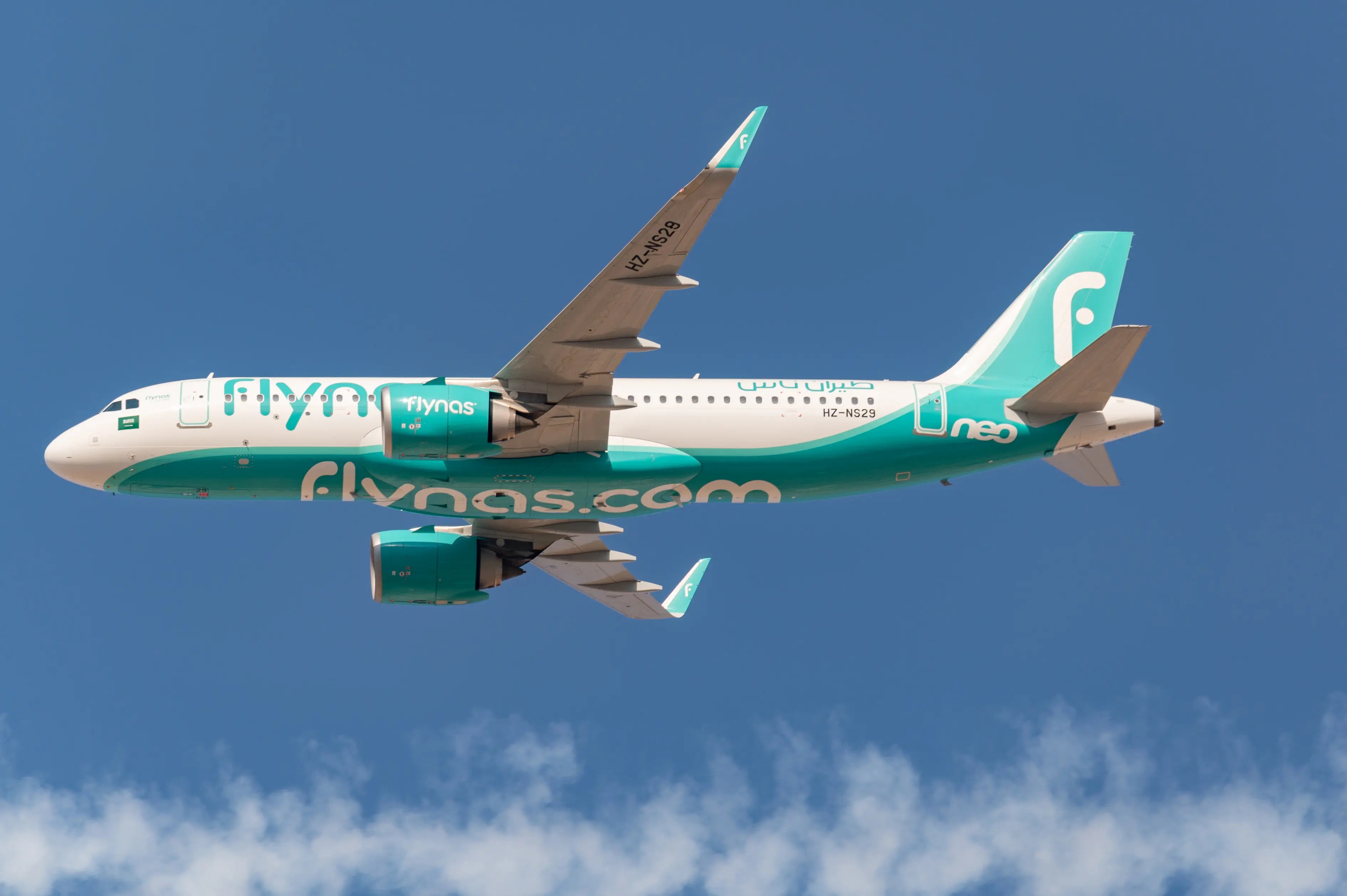
flynas Overview & Company Profile
flynas is Saudi Arabia's first and largest independent low-cost carrier, founded in 2007 as Nas Air and rebranded to flynas in November 2013. Headquartered in Riyadh, the airline operates from four strategic hubs across the Kingdom: Riyadh (RUH), Jeddah (JED), Dammam (DMM), and Madinah (MED). With more than 70 domestic and international destinations across 30 countries served via 139 routes, flynas has grown into a major force in Middle Eastern aviation.
The airline is a key player in Saudi Arabia's Vision 2030 strategy, which aims to triple the Kingdom's annual passenger throughput to 330 million by 2030. In 2024, flynas carried 14.7 million passengers (up from 11.2 million in 2023) with an 86% seat occupancy rate and 88% on-time performance. Revenue reached SAR 7.56 billion ($2 billion), a 17% increase year-on-year, with net profit of SAR 434 million ($115.7 million). The airline operates over 1,500 weekly flights, or roughly 215 flights per day.
In June 2025, flynas made history by becoming the first airline to list on the Saudi Exchange (Tadawul) and the first Gulf airline IPO in nearly two decades. The offering raised SAR 4.1 billion ($1.1 billion), with the institutional tranche oversubscribed approximately 100 times. Backed by Prince Alwaleed bin Talal through NAS Holding, flynas has firm orders for 280 Airbus aircraft worth over SAR 161 billion, positioning it for a fleet of 160+ aircraft by 2030.
Fleet Composition & Type Ratings
flynas operates an all-Airbus fleet that is one of the youngest and most modern in the Middle East. The backbone of the operation is the Airbus A320neo, which makes up the vast majority of the fleet. The airline received its 60th A320neo in October 2025 and its 61st shortly after, bringing the total fleet to approximately 67 aircraft by early 2026. This modern, fuel-efficient fleet gives flynas a significant operating cost advantage and means pilots fly some of the newest narrowbody aircraft available in the region.
The most significant development is the arrival of widebody operations. flynas took delivery of its first two Airbus A330neo aircraft in late 2025, marking its entry into longer-range, higher-capacity flying. This opens new career opportunities for pilots who can transition from narrowbody to widebody operations as the fleet grows.
| Aircraft Type | Role | In Service | Routes / Notes |
|---|---|---|---|
| Airbus A320neo | Narrowbody | ~61 | Primary workhorse. Domestic and regional international. CFM LEAP-1A engines. Custom cabin with enhanced comfort seats. |
| Airbus A320ceo | Narrowbody | ~4 | Legacy fleet. Being phased out as neo deliveries continue. |
| Airbus A330neo | Widebody | 2 | New long-haul capability. 30 on order. Full deliveries from 2027 onwards. |
Fleet data as of early 2026. Numbers are approximate and subject to ongoing deliveries.
With 280 firm Airbus orders outstanding (the largest single-aisle order book in the Middle East), flynas is on track to more than double its fleet by 2030. The order includes 130 A320 family narrowbodies and 30 A330neo widebodies, with over 100 deliveries expected in the next five years. The airline anticipates receiving approximately 8 additional A320neo aircraft in 2026 alone, bringing the fleet toward 74 aircraft.
flynas covers the cost of type rating for pilots recruited through its official selection process. The Airbus A320neo is the standard entry fleet for both new First Officers and experienced Captains. As the A330neo fleet expands from 2027, transition opportunities to widebody operations will emerge, likely governed by seniority and operational need. Pilots currently on the A320ceo will transition to neo variants as older aircraft are retired, with minimal additional training required given the commonality between the two types.
Pilot Salary & Compensation Breakdown
Pilot compensation at flynas follows a structured package comprising a monthly base salary, flight hour pay on a tiered scale, a housing allowance, a transportation allowance, and per diem payments for overnight stays. One of the most significant advantages of flying for a Saudi airline is that all earnings are tax-free for expatriate pilots. Saudi Arabia does not impose personal income tax on employment income, which means the gross salary figure is effectively the take-home amount. This dramatically increases real purchasing power compared to European or North American carriers where tax rates can absorb 30-50% of gross pay.
Captain (A320) Pay Structure
| Component | Monthly Amount (SAR) | Monthly Amount (USD) | Notes |
|---|---|---|---|
| Base Salary (training) | 25,000 | ~6,667 | During type rating & line training (3-4 months) |
| Base Salary (line) | 30,000 | ~8,000 | Once released to line operations |
| Captain Allowance | 5,000 | ~1,333 | Fixed monthly supplement for command holders |
| Housing Allowance | 8,333 - 9,133 | ~2,222 - 2,435 | Or company-provided accommodation |
| Transportation Allowance | 800 | ~213 | Or company-provided transport |
| Flight Pay (0-50 hrs) | 150/hr | ~40/hr | First 50 block hours per month |
| Flight Pay (51-75 hrs) | 300/hr | ~80/hr | Hours 51 through 75 |
| Flight Pay (76+ hrs) | 500/hr | ~133/hr | Hours above 75 (premium rate) |
| Annual Increase | 3% on base salary | Compounding annually | |
Captain salary structure based on pilot reports and recruitment postings (2024-2025). Figures are for A320 Captains. Verify directly with flynas recruitment for the latest terms.
Based on these figures, a Captain flying a typical 65-hour month would earn approximately SAR 61,800 ($16,500) per month, inclusive of all allowances and flight pay. At higher monthly hours (75-85 hours), monthly earnings can reach SAR 70,000-80,000+ ($18,700-21,300+). Annualized, this translates to approximately $198,000 - $255,000 per year, entirely tax-free.
First Officer (A320) Estimated Pay
| Component | Monthly Amount (SAR) | Monthly Amount (USD) | Notes |
|---|---|---|---|
| Base Salary | 20,000 - 25,000 | ~5,333 - 6,667 | Varies by experience and contract date |
| Housing Allowance | 5,000 - 8,333 | ~1,333 - 2,222 | Or company-provided accommodation |
| Transportation Allowance | 800 | ~213 | Standard rate |
| Flight Pay | Tiered | Tiered | Similar tiered structure, rates may differ |
First Officer salary estimates based on industry data and job postings. F/O packages are less frequently disclosed. Total monthly earnings for an experienced F/O are estimated at SAR 35,000-50,000 ($9,300-13,300).
Pilots receive overnight stay allowances of SAR 200 ($53) per night within Saudi Arabia and SAR 400 ($107) per night outside the Kingdom. These are paid in addition to all other compensation components. While modest compared to some Gulf carriers, the tax-free nature of all earnings means these allowances contribute directly to disposable income.
These figures are compiled from pilot reports on aviation forums, recruitment advertisements, and industry data sources. Individual compensation depends on the specific contract negotiated at the time of hiring, seniority, and the airline's current pay scales. flynas has historically updated its compensation packages to remain competitive within the Saudi market. Saudi nationals may receive an additional National Allowance (reported at SAR 3,000/month). Always verify current terms directly with flynas HR during the recruitment process.
Roster Pattern & Quality of Life
flynas operates under the regulatory oversight of the General Authority of Civil Aviation (GACA), which sets flight time limitations aligned with ICAO standards. As a low-cost carrier with high fleet utilization, flynas runs a structured roster pattern that balances operational demands with crew rest requirements. The airline has moved between different roster configurations over time, with the most commonly reported patterns being 20 days on / 10 days off and 23 days on / 7 days off.
The 20/10 pattern is the more commonly reported current arrangement for expatriate pilots. Under this roster, pilots are based in the Kingdom for 20 consecutive working days, followed by 10 days off. The days off can be spent at base or used for travel home, with staff travel benefits available on the flynas network and via MyIDTravel with partner airlines. Some contract variants offer 28 days of annual leave in lieu of the 10-day off period, though the roster with built-in days off appears to be the standard for most expat contracts.
📅 Sample Month: A320neo Captain (20/10 Pattern, RUH Base)
During the 20 working days, pilots typically fly multiple short-haul sectors per day on domestic and regional routes. The high-utilization LCC model means duty days can be long (9-13 hours including turnaround times), though GACA regulations cap maximum duty time at 14 hours with a minimum 10-hour rest period between duties. Typical monthly block hours fall in the 65-85 hour range, with the tiered flight pay structure incentivizing higher-hour months.
flynas operates from four bases: Riyadh, Jeddah, Dammam, and Madinah. Riyadh is the largest hub with the most flight activity and the best connectivity. Jeddah is popular for its proximity to the Red Sea coast and the holy cities. Expatriate pilots are typically assigned to a base on joining, though preferences can be expressed. Staff travel on the flynas network is available for commuting during days off. The airline also provides access to MyIDTravel tickets with partner carriers, which can be used for commuting to home countries during the 10-day off period. Company-provided accommodation or housing allowance helps offset living costs, which are significantly lower than in the Gulf's more expensive cities like Dubai or Doha.
Benefits, Perks & End-of-Service
As a Saudi-based airline, flynas offers a benefits package shaped by Saudi labor law and the Kingdom's tax-free employment environment. While the package is more streamlined than what legacy carriers or Gulf mega-carriers offer, the combination of zero income tax, housing support, and end-of-service benefits creates a financially attractive total package.
Under Saudi labor law, all employees (including expatriates) are entitled to an end-of-service gratuity when their contract concludes. For a Captain earning a SAR 30,000 base salary who completes a 5-year contract, this translates to approximately SAR 75,000 ($20,000) as a lump-sum payment. For longer tenures, the amount grows significantly as the rate doubles after the fifth year. Combined with the tax-free salary, this benefit adds substantial long-term financial value.
flynas offers two contract types depending on the candidate's situation. Family contracts include higher housing allowances, education allowances for children, and medical coverage for spouse and dependents. Single contracts provide the core package without family-related benefits. The contract type is typically determined during the hiring process based on the candidate's marital and family status. The standard contract length is 5 years (renewable), with a 3-month notice period and 3-month probationary period.
Career Progression & Seniority
Career progression at flynas is driven by two powerful forces: a standard seniority-based system and the airline's aggressive growth trajectory. With 280 aircraft on order and plans to more than double the fleet by 2030, the pace of career advancement at flynas is significantly faster than at mature legacy carriers. This makes flynas particularly attractive for pilots seeking quicker upgrades and fleet transition opportunities.
The airline operates a seniority list that determines bid priority for base assignments, roster preferences, and upgrade eligibility. Unlike some legacy carriers that have 15-20 year upgrade timelines, the rapid fleet expansion at flynas means the estimated upgrade from First Officer to Captain is approximately 5-8 years. This timeline is likely to compress further as fleet growth accelerates, particularly with the A330neo program creating new command positions.
| Career Milestone | Typical Timeline | Notes |
|---|---|---|
| Join as F/O (A320neo) | Day 1 post-training | Standard entry fleet for all new pilots |
| Line check / consolidation | 3-6 months | Supervised line flying, route familiarization |
| Captain upgrade (A320) | ~5-8 years | Seniority-based. Faster during high growth periods. |
| A330neo transition (F/O or Capt) | From 2027+ | New opportunity as widebody fleet expands. Seniority-dependent. |
| Training Captain / TRI / TRE | Variable | Requires senior status + instructor qualification |
flynas accepts direct-entry Captains with significant experience on the A320 family. Experienced Captains with 5,000+ total hours and 2,000+ PIC hours on A320 can join directly as Captains, bypassing the First Officer stage entirely. This is a notable difference from some European carriers that require all Captains to upgrade internally. For pilots already holding command, this offers an immediate step into a growing airline with strong career prospects.
Saudi Arabia's aviation sector is undergoing a historic transformation. The Kingdom aims to have 250 million passengers transiting through Saudi airports by 2030, up from approximately 100 million today. flynas, as one of the Kingdom's three major carriers alongside Saudia and Riyadh Air, is positioned to capture a significant share of this growth. The airline's firm orders for 280 aircraft will require hundreds of new pilots over the coming years, creating sustained demand for both First Officers and Captains. The introduction of A330neo widebody operations from 2027 will add a further layer of career progression that currently does not exist at flynas.
Recruitment Process & Requirements
flynas recruits pilots through two primary pathways: the Future Pilots cadet programme (exclusively for Saudi nationals) and direct-entry hiring for experienced Captains and First Officers. The airline's rapid growth means recruitment campaigns are frequent, though openings can vary depending on fleet delivery schedules and operational needs.
Experienced Captain: Requirements
Future Pilots (Cadet Programme): Requirements
Selection Stages (Experienced Pilots)
Online Application & CV Screening
Submit application through the flynas careers portal or via recruitment@flynas.com. Include updated CV, license copies, logbook summary, and medical certificate. HR screens for minimum requirements.
Technical Assessment
Aviation knowledge assessment covering aircraft systems, flight theory, meteorology, and operational procedures. Conducted remotely or at a designated assessment centre.
Simulator Assessment
Up to 1 hour in an A320 simulator. Evaluates handling skills, CRM, decision-making under normal and abnormal scenarios. Both type-rated and non-type-rated candidates may be assessed, with expectations adjusted accordingly.
Interview
Panel interview with the Chief Pilot or senior management. Covers technical competency, CRM scenarios, motivation, and cultural fit. Professional presentation and knowledge of flynas operations expected.
Background Check, Medical & Contract
International background check and security clearance. GACA-approved medical examination if not already holding valid Class 1. Successful candidates receive contract offer. Sim training conducted in Bahrain (approximately 2 weeks), followed by GACA line check in Kingdom. Allow 2 weeks to 2 months between sim completion and first line flight.
flynas recruitment campaigns are published on the official careers portal and on aviation job sites like PilotsGlobal and PILOT CAREER CENTER. For experienced A320 Captains, campaigns run periodically as fleet growth creates demand. First Officer positions for non-Saudi pilots are less frequently advertised, so monitoring the careers portal regularly is recommended. Arabic language skills are beneficial but not mandatory for expatriate pilots. English is the operational language in the cockpit.
How flynas Compares: Airline Radar Chart
How does flynas stack up against the two other major Saudi carriers: Saudia (the flag carrier) and flyadeal (Saudia Group's low-cost subsidiary)? Below is a comparative analysis across five key metrics. Scores are editorial estimates based on publicly available data, pilot reports, and industry benchmarks.
Key Takeaways from the Comparison
Saudia dominates on salary and benefits. As Saudi Arabia's flag carrier with 149 aircraft and extensive long-haul operations, Saudia offers the highest pilot compensation in the Kingdom. Senior Captains on widebody types (777, 787, A330) earn significantly more than their narrowbody counterparts at flynas or flyadeal. Saudia also provides more comprehensive benefits, backed by the stability of government ownership and a decades-long operational history.
flynas wins on fleet modernity and career progression. With 61 A320neo aircraft and the newest average fleet age among Saudi carriers, flynas pilots fly the most modern equipment. The airline's rapid growth trajectory (280 aircraft on order) creates upgrade opportunities that simply do not exist at more mature carriers. The estimated 5-8 year upgrade to Captain at flynas compares favorably to potentially longer waits at Saudia.
flyadeal offers a similar LCC proposition with less independence. As a subsidiary of the Saudia Group, flyadeal operates approximately 30 A320neo aircraft with comparable pay and roster patterns (also 20/10). However, flyadeal's fleet is smaller and its growth trajectory is less aggressive than flynas. The advantage of flyadeal is potential future integration or transfer opportunities within the broader Saudia Group.
All three airlines benefit from tax-free salaries. The Saudi tax-free environment is a universal advantage across all three carriers. When comparing net take-home pay, even flynas's lower gross salary can be competitive with higher-paying airlines in Europe or Asia where 30-45% of gross pay is lost to taxation.
Scores are editorial estimates based on research into publicly available salary data, pilot forum reports, airline press releases, fleet data, and industry benchmarks. They represent a general assessment for an experienced pilot considering a career at each airline. Individual experiences will vary based on seniority, fleet assignment, base location, and personal priorities. Scores will be updated as dedicated guides for Saudia and flyadeal are published.
Verdict: Who Is flynas For?
🎯 Our Take
flynas is one of the most exciting growth stories in Middle Eastern aviation. The combination of a modern all-neo Airbus fleet, firm orders for 280 aircraft, a successful Tadawul IPO, and alignment with Saudi Arabia's Vision 2030 creates a unique opportunity for pilots seeking rapid career progression in a growing market. The tax-free salary, while lower than Gulf mega-carriers or Saudia, delivers strong real purchasing power once you account for zero income tax and modest living costs in Saudi Arabia.
The trade-offs are real: the LCC operating model means higher utilization, longer duty days, and less variety than long-haul carriers. The 20/10 roster is workable but not as generous as some European or Gulf alternatives. Benefits are functional rather than lavish, and the Saudi lifestyle may not suit everyone. Pilots used to the per diems and layover culture of long-haul flying will need to adjust expectations.
For A320-rated pilots with solid experience looking for a stable, growth-oriented employer with genuine career advancement, flynas offers something increasingly rare in aviation: the chance to join a rapidly expanding airline at a pivotal moment in its history, with the A330neo widebody program opening an entirely new chapter from 2027.
1 Is the flynas salary really tax-free?
Yes. Saudi Arabia does not impose personal income tax on employment income for expatriate workers. All salary components (base pay, flight pay, allowances, per diems) are received gross. However, pilots who are tax residents of countries with worldwide taxation (such as the US, UK, or France) may still have reporting obligations or tax liabilities in their home country. US citizens, for example, can use the Foreign Earned Income Exclusion (up to $132,900 in 2026) to offset much of their Saudi earnings. Consult a tax professional familiar with expatriate aviation taxation for your specific situation.
2 Does flynas pay for the type rating?
Yes. For pilots recruited through the official selection process, flynas covers the cost of type rating training on the A320. Simulator training is conducted in Bahrain (approximately 2 weeks), followed by line training and a GACA line check in the Kingdom. However, the type rating funding is typically tied to a minimum service period (usually aligned with the 5-year contract). Early termination may trigger a requirement to reimburse a portion of the training cost.
3 How long does it take to upgrade to Captain at flynas?
The estimated upgrade timeline from First Officer to Captain at flynas is approximately 5-8 years. This is significantly faster than at most legacy carriers, driven by the airline's rapid fleet expansion (280 aircraft on order). The timeline depends on seniority position, fleet growth rate, and successful completion of the command assessment. With the A330neo program creating new Captain positions from 2027, upgrade opportunities may accelerate further.
4 Can non-Saudi pilots apply to flynas?
Yes, for experienced pilot positions. flynas actively recruits expatriate Captains with A320 experience. Non-Saudi First Officer positions are less frequently available, as the airline's Future Pilots cadet programme (which is exclusive to Saudi nationals) produces a significant number of co-pilots. However, experienced expat F/Os with strong A320 hours have been hired in the past. All expatriate pilots require an Iqama (Saudi work permit), which flynas sponsors as part of the employment process.
5 What is the roster pattern at flynas?
The most commonly reported roster pattern for expatriate pilots is 20 days on / 10 days off. Some contracts have been reported as 23/7. During the working period, pilots typically fly multiple short-haul sectors per day on domestic and regional routes. The 10 days off can be spent in the Kingdom or used for travel home via staff travel benefits. Annual leave of 28-30 days is also provided, depending on the contract.
6 How does flynas compare to Emirates or Qatar Airways for pilot pay?
Gulf mega-carriers like Emirates and Qatar Airways typically offer higher gross salaries, more generous benefits, and long-haul flying opportunities. However, flynas offers advantages that these carriers do not: faster career progression, a newer narrowbody fleet, Saudi-specific benefits like end-of-service gratuity, and lower living costs than Dubai or Doha. For pilots prioritizing rapid upgrade to Captain or seeking to build A320 command hours quickly, flynas may actually be a better strategic career move than waiting years for a widebody command at a larger carrier.
7 What is life like for expatriate pilots in Saudi Arabia?
Saudi Arabia has undergone significant social reforms under Vision 2030. Entertainment venues, cinemas, concerts, and restaurants have expanded dramatically. Riyadh and Jeddah offer modern amenities, international dining, and recreational facilities. Living costs are considerably lower than in the UAE, particularly for housing. However, alcohol is prohibited, and some cultural norms differ from Western countries. The 20/10 roster allows pilots to spend their days off outside the Kingdom if preferred. Many expat pilots report that the combination of tax-free salary, low living costs, and the ability to travel during days off creates a highly favorable financial and lifestyle balance.
8 Will flynas fly widebody aircraft?
Yes. flynas has ordered 30 Airbus A330neo widebody aircraft, with the first two delivered in late 2025. Full-scale widebody operations are expected to ramp up from 2027 onwards. This will open new longer-range routes and create transition opportunities for pilots currently on the A320 fleet. The A330neo program represents a major evolution for flynas, moving it from a purely short/medium-haul LCC into a carrier capable of serving destinations across the Middle East, Africa, Europe, and South/Southeast Asia.
Official Links & Resources
Before applying or making any career decisions, always verify information directly with official sources. These are the key websites and organisations relevant to flynas pilot careers:
Follow flynas on LinkedIn for recruitment announcements, fleet milestones, and company news. The official careers portal at career.flynas.com is the most reliable source for current vacancies. For informal pilot feedback and real-world experience reports, the PPRuNe Middle East forum contains active discussion threads on flynas conditions, roster patterns, and salary updates.