

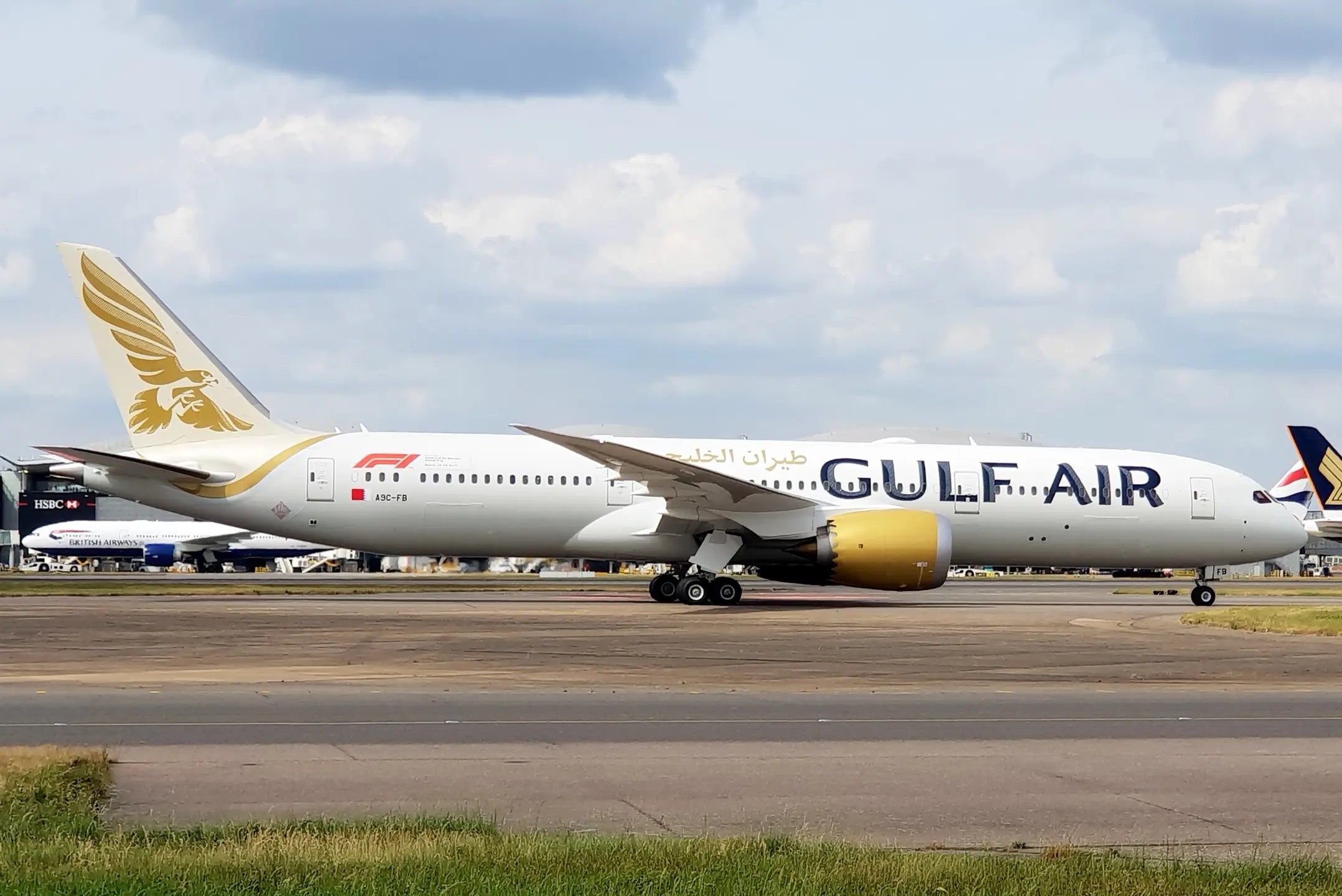
Gulf Air Overview & Company Profile
Gulf Air is the national flag carrier of the Kingdom of Bahrain and one of the oldest airlines in the Gulf region. It traces its roots to 1950, when it was founded as Gulf Aviation Company. For decades it served as the shared flag carrier for several Gulf states before Qatar and Abu Dhabi withdrew to build Qatar Airways and Etihad Airways. Today Gulf Air is owned exclusively by Bahrain, operating as a focused, mid-sized full-service carrier rather than a mega-connector. For a pilot, that distinction matters: this is a single-base, single-hub airline with a modern fleet and a tax-free salary environment, positioned as a boutique alternative to its much larger neighbours in Doha and Abu Dhabi.
The airline is a subsidiary of Gulf Air Group Holding Company, which is in turn wholly owned by Mumtalakat, Bahrain's sovereign wealth fund. Gulf Air Group is the sole shareholder of three linked entities: Gulf Air itself, Bahrain Airport Company (the operator of Bahrain International Airport), and the Gulf Aviation Academy training arm. According to Gulf Air Group's own 2024 performance report published on gulfairgroup.bh, the group carried roughly 6.2 million passengers in 2024, up about 5.4% year on year, and added six new destinations including Munich, Shanghai, Guangzhou, Geneva, Mykonos and Rhodes. Current group CEO Jeffrey Goh, a former Star Alliance chief executive, has publicly signalled openness to future alliance membership, though Gulf Air remains unaligned for now and relies on bilateral codeshare and interline partnerships.
Gulf Air operates from its sole hub at Bahrain International Airport (BAH), in Muharraq, where the corporate headquarters are also located. The network spans the Middle East, South Asia, Africa, Europe and East Asia. Published destination counts vary by season and source: Gulf Air's encyclopaedic profile cites scheduled flights to 65 destinations in 38 countries, while winter 2024/25 schedule data shows around 48 destinations flown from Bahrain. A defensible planning figure is roughly 50 destinations across 30 or more countries. Public sources do not disclose an authoritative total pilot headcount or exact daily flight figure, so this guide does not assign precise numbers to either; given the fleet and network, the pilot body is best described as several hundred crew.
Gulf Air sits in a different category from Europe's legacy carriers. It is an expatriate-friendly Gulf airline offering tax-free pay, a single base in a relatively liberal and lower-cost Gulf state, and a young fleet that pairs Airbus A320-family narrowbodies with Boeing 787-9 widebodies. It accepts direct-entry Captains, which is a significant differentiator for experienced pilots, and unusually for the region it has a recognised pilots' union. The trade-off is a smaller internal job market than Qatar or Etihad, and pay scales that the airline does not publish.
Fleet Composition & Type Ratings
Gulf Air runs a deliberately simple, modern, two-family fleet: Airbus A320-family narrowbodies for regional and medium-haul flying, and Boeing 787-9 Dreamliners for long-haul. There is no Boeing 777 or older widebody in active service, and no Airbus A380. Independent fleet trackers converge on roughly 43 aircraft, with an average age of about 7.6 years, one of the younger fleets among full-service carriers. The narrowbody side blends current-engine A320ceo and A321 jets with new-generation A320neo, A321neo and long-range A321LR aircraft. The widebody side is built entirely around the 787-9, which Gulf Air positions as the backbone of its long-haul operation.
The big fleet story is the Dreamliner. Gulf Air already operates ten 787-9s, and at the Dubai Airshow in November 2025 it finalised a firm order for 15 more 787-9s plus options for three additional aircraft, taking its 787 order book to 17 and pointing toward a widebody fleet of up to 27 aircraft once all deliveries complete. This followed Boeing's July 2025 announcement of an agreement for "up to 18" Dreamliners. The order, confirmed on Boeing's investor newsroom, signals a clear long-term commitment to expanding the long-haul network, which in turn supports sustained demand for widebody First Officers and Captains over the coming decade.
| Aircraft Type | Role | In Service | Routes / Notes |
|---|---|---|---|
| Airbus A320-200 | Narrowbody | ~8 | GCC and Middle East short/medium-haul. Oldest narrowbodies (avg ~10.6 yrs). |
| Airbus A320neo | Narrowbody | 7 (+5 on order) | Fuel-efficient regional and medium-haul. Gradually replacing A320ceo. |
| Airbus A321-200 | Narrowbody | ~4 | Higher-capacity regional sectors. |
| Airbus A321neo | Narrowbody | 6 (+3 on order) | Higher-density, medium-haul routes. |
| Airbus A321LR | Narrowbody (long-range) | 8 | Long, thin routes. Blurs the line between short-haul and long-haul flying. |
| Boeing 787-9 | Widebody | 10 (+17 in order book) | Long-haul flagship to Europe and Asia. Fleet heading toward ~27 aircraft. |
Fleet data compiled from Airfleets, Planespotters and 2025 industry reporting. Totals are approximate (~43 aircraft) and shift with ongoing deliveries and retirements.
From a career standpoint, this structure offers two clear tracks. The A320-family track delivers steady regional flying within the Gulf Cooperation Council, the wider Middle East, South Asia and shorter European or Mediterranean sectors, often with same-day returns or short layovers. The A321LR adds variety, reaching longer routes where a widebody would be uneconomic. The 787-9 track is the long-haul path, with augmented crews on the longest sectors, multi-day layovers and modern wide-body systems. A single widebody type keeps type-rating and recurrent training streamlined, which is attractive once a pilot is established on the Dreamliner.
Most pilots join Gulf Air on the A320 family. Direct-entry First Officers and Captains are generally expected to already hold a valid A320 type rating, since Gulf Air's published recruitment criteria require it. Transition to the Boeing 787-9 widebody is governed by internal bidding, seniority and training capacity. Gulf Air also sits inside a training ecosystem: the group-owned Gulf Aviation Academy in Bahrain provides simulator and ground training that supports type ratings and recurrent checks. Specific 787 hour minima are not published in the same detail as the A320 roles, so prospective widebody applicants should confirm current thresholds directly with the airline.
Pilot Salary & Compensation
Salary is the area where Gulf Air is least transparent, and honesty requires stating that clearly up front. Gulf Air does not publish its pilot pay scales, and its current recruitment adverts describe only a "competitive remuneration package" without figures. The most concrete hard data in the public record is a 2007 pay snapshot, which is now too dated to use as a current benchmark, supplemented by recent crowd-sourced estimates. Every number in this section should therefore be treated as an estimate or historical reference, not a contractual figure. What can be stated with confidence is the structure and the tax environment.
Like other Gulf carriers, Gulf Air pay is understood to combine a monthly basic salary (denominated in Bahraini dinar, BHD) with block-hour or sector pay, time-away-from-base allowances, and a housing element either as cash or company accommodation. The decisive advantage is the tax regime: Bahrain levies no personal income tax on salaries, capital gains or inheritance. For expatriate pilots, gross is effectively net at source, subject only to any obligations in their home country. Bahrain's social insurance burden on expatriates is also light, with the employer contributing around 3% on a salary base capped at 4,000 BHD per month, so deductions from a pilot's pay are minimal.
Estimated Total Package (Tax-Free)
| Rank / Seniority | Est. Monthly Total (BHD) | Est. Annual (USD) | Notes |
|---|---|---|---|
| First Officer (junior, A320) | ~3,000 – 4,500 | ~$95,000 – $145,000 | First years on the line. Tax-free. |
| First Officer (senior, A320 / 787) | ~4,500 – 6,000 | ~$145,000 – $190,000 | Experienced F/O, widebody premium. |
| Captain (junior, A320) | ~6,000 – 8,000 | ~$190,000 – $255,000 | On command upgrade or direct entry. |
| Captain (senior, 787 widebody) | ~8,000 – 11,000+ | ~$255,000 – $340,000 | Top of the crowd-sourced range. |
Estimates only. Built from regional package norms and crowd-sourced data, converted at the pegged rate of roughly 1 BHD = 2.65 USD. Gulf Air does not publish official scales.
Where do these estimates come from? Two reference points anchor them. First, the last hard figures, captured by Pilot Jobs Network in 2007, showed Captains on a basic salary of roughly 3,000 to 4,200 BHD per month (with annual increments of around 60 BHD per year of service) and First Officers topping out near 2,600 BHD per month in basic pay, before block-hour pay and allowances. Those are basic-salary figures only and are nearly two decades old. Second, more recent crowd-sourced estimates on Glassdoor place the average Gulf Air "airline pilot" total compensation at roughly 181,000 USD per year (about 87 USD per hour), with a seniority band running from around 108,000 USD at entry level to about 343,000 USD at the most senior end. Those Glassdoor figures aggregate Captains and First Officers and do not separate fleet, rank or allowances, so they indicate orders of magnitude rather than precise scales.
There is no official, public Gulf Air pilot pay scale for 2024 to 2025. The ranges above are informed estimates derived from a 2007 historical scale (Pilot Jobs Network), crowd-sourced totals (Glassdoor), and prevailing Gulf-carrier package structures. They are not guaranteed, may not reflect your fleet, seniority step or contract type, and should never be used in place of a formal offer letter. Pilots evaluating Gulf Air should request a full written breakdown of basic salary, block-hour pay, housing, allowances, education support and end-of-service contributions, then assess it against Bahrain's tax-free status and cost of living. Treat any single figure online, including ours, as a starting point for that conversation, not a fact.
Roster Pattern & Quality of Life
Rostering at Gulf Air is shaped by three forces: Bahrain's Civil Aviation Affairs flight and duty time limitations, the airline's own scheduling practice, and, since July 2024, the collective labour agreement negotiated with the pilots' union. Gulf Air does not publish its detailed roster rules, days off or block-hour targets, so this section sets realistic expectations using the regional regulatory framework and Gulf-carrier norms, and flags clearly where Gulf Air-specific data is unavailable.
The regulatory ceiling in the Gulf is broadly consistent across operators. Frameworks of the type used by neighbouring authorities cap flight time at around 900 hours in any 12 consecutive months and roughly 100 hours in any 28 days, with layered limits on duty hours and mandatory rest. Airlines plan well below those maxima to preserve buffer for disruption. As a reference, comparable Gulf carriers target around 75 block hours per month and provide on the order of eight to nine days off per month plus generous annual leave. Gulf Air operates within the same regulated envelope under its national regulator, though its exact targets should be confirmed with current crew.
📅 Illustrative Month — Narrowbody First Officer (Bahrain base)
The pattern above is illustrative only. It reflects a typical Gulf single-base narrowbody rhythm: clusters of regional duty days, periodic standby, a recurrent training day, and days off grouped to allow genuine rest. A 787-9 long-haul month looks different, with fewer total duty days but longer individual trips: a sector to Europe or Asia, a 24 to 48 hour layover at the destination, then the return, followed by recovery days at home. Narrowbody pilots fly more sectors with more takeoffs and landings; widebody pilots fly fewer, longer duties. Each carries a distinct fatigue profile that the airline's fatigue risk management must address.
The roster grid and metrics above are illustrative, based on Gulf-region flight time limitations and the published practice of comparable carriers. Gulf Air does not publicly release its days off per month, annual leave entitlement, or block-hour targets, and the July 2024 collective agreement may set terms that differ from regional norms. Verify all rostering details directly with Gulf Air or with current pilots before drawing conclusions for your own planning.
Gulf Air is a strict single-base operation: all line pilots are based in Bahrain, with no domicile bidding. Relocation to Bahrain is effectively required for medium to long-term employment. The upside is that Bahrain is widely regarded as one of the more liberal and cosmopolitan Gulf states, with a large expatriate community, international schools, modern healthcare, and a cost of living generally lower than Dubai or Doha. The island is compact, so commuting times to the airport are short. Combined with tax-free income, this can make for a stable family lifestyle, provided you are comfortable with a single fixed base.
Benefits, Travel Perks & Expat Package
The headline benefit at Gulf Air is the one that applies to every component: there is no personal income tax in Bahrain, so the value of the whole package is preserved net of tax. Beyond that, Gulf Air does not publish a detailed benefits table for pilots, so the items below combine what is confirmed for Gulf Air with the standard Gulf expatriate model that the airline must broadly match to remain competitive with Qatar Airways and Etihad. Where a benefit is the regional norm rather than a documented Gulf Air figure, that is stated plainly.
One concrete, recent change is Bahrain's shift, effective March 2024, from employer-paid lump-sum end-of-service gratuity to a contribution-based system run by the Social Insurance Organisation. Employers now contribute 4.2% of basic salary during an employee's first three years of service, rising to 8.4% beyond three years, into the centralised SIO fund. For pilots this is a meaningful structural improvement: your accrued end-of-service benefit is tied to contributions paid over time into a national fund, rather than depending on the employer's financial position at the moment you leave. It is a different model from the traditional lump-sum formulas still used in the UAE, Saudi Arabia, Qatar and Oman, and worth understanding before signing.
Because Gulf Air publishes neither pay scales nor benefit tables, the nominal monthly salary is only part of the story. Housing, medical cover, schooling support, staff travel, loss-of-licence insurance and end-of-service contributions can add very substantial value, particularly for pilots with families and long service horizons. When evaluating an offer, insist on written confirmation of each element. Only by aggregating the full package and adjusting for Bahrain's tax-free status can you make a fair comparison with Qatar Airways, Etihad, or an airline back home.
Career Progression & Seniority
Gulf Air follows a recognisably standard Gulf-carrier progression model, driven by a mix of seniority, fleet need, performance and regulatory experience requirements. The single most important feature for experienced pilots is that, unlike many European legacy carriers, Gulf Air accepts direct-entry Captains. You do not have to spend years in the right seat waiting for an internal upgrade if you already meet the command thresholds. That makes Gulf Air an option for command-ready Airbus pilots looking to move into a tax-free Gulf role at the left seat from day one.
For First Officers, progression to command depends on accumulating hours and time in rank, demonstrating performance, and the pace at which command vacancies open. As a mid-sized carrier, Gulf Air sits between the slow, decades-long upgrades of some legacy airlines and the very rapid promotions seen during hyper-growth phases elsewhere. The expanding 787-9 fleet and continued narrowbody renewal point to measured growth rather than contraction, which should sustain a healthy but not explosive upgrade pipeline. Movement between the A320 family and the Boeing 787 is governed by internal bidding and training capacity; some pilots prioritise a quicker narrowbody command, while others move to the widebody right seat first to build long-haul experience before pursuing 787 command.
| Career Milestone | Typical Path | Notes |
|---|---|---|
| Second Officer (Bahraini cadet path) | Entry, nationals only | Ab-initio style pipeline for Bahraini nationals, progressing to First Officer then Captain. |
| Direct-entry First Officer (A320) | Day 1 (rated) | Open to expatriates. Requires A320 type rating and minimum hours. |
| Widebody First Officer (787-9) | Seniority / bid | Transition from A320 family, governed by internal bidding and training slots. |
| Direct-entry Captain (A320) | Day 1 (rated, qualified) | Major differentiator. 5,000 hrs total, 1,000 hrs A320 PIC. Open to expatriates. |
| First Officer to Captain upgrade | Experience-based | Driven by hours, performance, fleet need and vacancies, not a fixed clock. |
| Widebody Captain (787-9) | Top of progression | Competitive; values prior command and widebody time. Growing with the 787 fleet. |
The 787 order finalised at the November 2025 Dubai Airshow (15 firm aircraft plus three options, taking the order book to 17) is the single biggest driver of future career opportunity at Gulf Air. As new Dreamliners arrive, widebody First Officer and, eventually, Captain positions should open, while narrowbody renewal sustains A320-family demand. The flip side of a boutique carrier is that absolute opening numbers are smaller than at Qatar Airways or Emirates, and progression speed can fluctuate with fleet timing and attrition. Treat Gulf Air as a stable, modernising mid-sized employer rather than a fast-upgrade machine.
Recruitment Process & Requirements
Gulf Air recruits pilots through three main routes: direct-entry Captains and direct-entry First Officers on the A320 family (both open to expatriate ICAO licence holders), and a Bahraini-national Second Officer pathway that functions as the airline's early-career pipeline. The requirements below are drawn from Gulf Air's own careers portal and from recruitment postings that reproduce its criteria. Applications are handled through the Gulf Air Group careers portal. As with any airline, exact hour minima can tighten or loosen between intakes, so confirm the live vacancy before applying.
Direct-Entry Captain — A320 Family
Direct-Entry First Officer — A320 Family
Second Officer — A320 (Bahraini Nationals)
Selection Stages
Application & Document Screening
Apply via the Gulf Air Group careers portal against a specific vacancy code. Initial screening verifies licence, ATPL, type rating, total and in-type hours, Class 1 medical and ICAO English Level 4. Candidates not meeting the hard minima are filtered at this stage.
Technical & HR Interview
Shortlisted candidates face a technical interview covering aircraft systems, procedures and regulations, alongside an assessment of background, motivation and fit. Logbook and licence documents are checked in detail.
Simulator Assessment
For rated A320 Captains and First Officers, a simulator evaluation assesses handling, adherence to standard operating procedures and crew resource management. This is the core skills gate, particularly for direct-entry command candidates.
Medical, Licence Validation & Visa
Successful candidates complete or confirm a Class 1 medical to Bahrain Civil Aviation Affairs standards, validate their licence for use in Bahrain, and arrange work permits. Expatriate hires complete relocation formalities.
Type Rating / Line Training & Entry
Rated direct-entry pilots proceed to differences, operator conversion and line training. Bahraini Second Officers and any pilots requiring it complete type rating training, supported by the group's Gulf Aviation Academy, before line operations.
Three points matter most. First, the direct-entry A320 roles are genuinely open to expatriate ICAO ATPL holders, so non-Bahraini pilots should target those, not the Bahraini-only Second Officer scheme. Second, a current A320 type rating materially strengthens an application and is effectively expected for the direct-entry roles. Third, command applicants must clear the simulator assessment, so currency and sharp standard-operating-procedure discipline are decisive. Always cross-check the exact hour minima against the live vacancy code on the Gulf Air Group careers portal just before you apply.
Top 5 Layover Destinations
Long-haul flying on the Boeing 787-9 is where Gulf Air offers genuine layover variety. From Bahrain, the Dreamliner reaches flagship European hubs and major Asian cities, with layovers typically in the 24 to 48 hour range depending on stage length, time zones and rest requirements. The five routes below are confirmed 787-9 sectors that represent the most attractive crew destinations on the network. Note that Gulf Air occasionally substitutes A321neo or A321LR equipment on some longer sectors, and the airline does not publish its crew hotel arrangements, so the layover details here describe typical patterns rather than contractual specifics.
Layover destinations are determined by fleet assignment and bidding, with seniority influencing who gets first pick of the most popular routes. Under Gulf-region flight time limitations, pilots must receive adequate rest before the next duty, and the longest sectors use augmented crews so pilots can take in-flight rest. Gulf Air is also expanding its long-haul reach: industry reporting points to the resumption of New York JFK service with the 787-9, and recently launched China routes to Shanghai and Guangzhou add further variety. Crew hotel specifics are not published by the airline, so confirm current arrangements with line pilots.
How Gulf Air Compares: Airline Radar Chart
How does Gulf Air stack up against its two larger Gulf neighbours, Qatar Airways and Etihad Airways? All three are state-owned, tax-free, single-hub carriers, but they differ sharply in scale. The chart below compares them across the same six dimensions used in the scorecard. Scores are editorial estimates based on publicly available data, pilot feedback and industry benchmarks, and they reflect the reality that Gulf Air is a focused mid-sized carrier rather than a global mega-connector.
Key Takeaways from the Comparison
Qatar and Etihad lead on top-end pay and scale. Etihad publishes or has well-documented ranges: A320 First Officers can reach total annual packages around 513,700 AED, widebody First Officers around 600,000 AED, and widebody Captains roughly 680,000 to 760,000 AED, with top commands exceeding 800,000 AED tax-free. Qatar Airways is broadly comparable and arguably ahead at the very top. Gulf Air does not publish scales, so it is rated as likely Gulf-competitive but not market-leading, which is why its salary axis trails the other two.
Gulf Air competes on lifestyle and stability, not size. Its modern, young fleet (average around 7.6 years) holds up well against both rivals, and the single base in Bahrain offers a lower cost of living than Dubai or Doha. The standout differentiator is industrial relations: Gulf Air recognises a pilots' union and signed a collective labour agreement in 2024, something neither Qatar nor Etihad offers in a Western-style form. For pilots who value collective representation and a more intimate operation, that is a real plus.
Career mechanics differ. All three are single-hub carriers, but Gulf Air's smaller scale means fewer absolute openings and a narrower internal market. The upside is that Gulf Air, like its neighbours, accepts direct-entry Captains, so command-ready Airbus pilots can join at the left seat. Qatar and Etihad offer more aircraft types, more destinations and ultra-long-haul flying, at the cost of larger, more competitive seniority lists.
Job security is strong across the board. State ownership through sovereign wealth funds backs all three. Gulf Air's union and collective agreement add a layer of formal protection that is unusual in the region, though its smaller scale leaves it somewhat more exposed to regional shocks, including the airspace disruptions that affected Gulf carriers during periods of regional tension.
Scores are editorial estimates based on our research into publicly available salary data, pilot testimonials, union and regulatory publications, airline and Boeing press releases, and industry benchmarks. Gulf Air does not publish pilot pay or roster data, so its scores carry more uncertainty than those of better-documented carriers. The figures represent a general assessment for an experienced pilot considering a long-term career, and individual experiences will vary by seniority, fleet and personal priorities. Scores will be updated as we publish dedicated guides for Qatar Airways and Etihad Airways.
Union & Industrial Relations
This is where Gulf Air stands apart from almost every other Gulf carrier. While airlines such as Qatar Airways and Etihad operate without Western-style pilot unions, Gulf Air pilots are represented by the Gulf Air Pilots Trade Union (GAPTU). In a region where private-sector unionisation is often limited or tightly regulated, the existence of a recognised pilot union, and a negotiated collective agreement with the airline, gives Gulf Air pilots a structured channel for collective bargaining that is rare in the Gulf and more familiar to pilots from Europe or North America.
The 2024 Collective Labour Agreement
In a milestone for pilot relations at the airline, Gulf Air and GAPTU signed a Collective Labour Agreement (CLA) in July 2024, reported by Arab News in late July 2024 and by Aviation Week. The agreement resolved what both outlets described as a longstanding dispute over pilot employment terms and allowances. According to Aviation Week's coverage, the CLA sets the terms and conditions for current pilots' allowances and establishes a foundation for future pilot employment in line with Bahraini Labour Law. For pilots, a CLA matters because it creates clarity around pay and allowances, formalises grievance and dispute-resolution mechanisms, and reduces the risk of abrupt, unilateral changes to key terms.
Industrial Action History
Public reporting does not document any recent pilot strike or organised industrial action (work stoppages, walkouts or formal strike notices) at Gulf Air. The framing of the 2024 CLA as resolving a longstanding dispute confirms that real tension over allowances existed beforehand, but both sides reached an amicable, negotiated settlement rather than escalating to a strike. The operational disruptions Gulf Air faced in 2024 and 2025 were tied to regional security and airspace closures, not union action.
For a pilot weighing Gulf Air against other Gulf carriers, union representation is a genuine point of difference. A recognised union and a signed collective agreement mean pilot allowances and terms are negotiated rather than simply imposed, and there is a formal mechanism to raise and resolve disputes. Combined with state ownership through Mumtalakat, this supports a relatively stable employment environment. As always in aviation, that stability is not absolute: a smaller carrier remains exposed to industry cycles and regional events, so collective protection should be seen as a meaningful advantage, not a guarantee.
Verdict: Who Is Gulf Air For?
🎯 Our Take
Gulf Air is a credible, modernising option for pilots who want a tax-free Gulf career without the scale and intensity of a mega-connector. The combination of a young two-family fleet (A320 family plus Boeing 787-9), an expanding Dreamliner operation, a single base in a relatively liberal and lower-cost Gulf state, acceptance of direct-entry Captains, and a recognised pilots' union with a 2024 collective agreement makes for a distinctive package. For a command-ready Airbus pilot, the ability to join at the left seat in a tax-free environment is a real draw.
The trade-offs are equally clear. Gulf Air does not publish its pay scales or roster details, so candidates must do more homework and rely on offer letters rather than transparent benchmarks. The internal job market is smaller than at Qatar Airways or Etihad, top-end pay is likely below the regional leaders, and the single Bahrain base offers no domicile choice. As a focused carrier in a sometimes volatile region, it carries more exposure to external shocks than its giant neighbours.
For the right pilot, those trade-offs are acceptable. Gulf Air offers modern equipment, a growing long-haul network, structured collective representation, and the lifestyle of a compact, family-friendly base, all within a state-backed national carrier.
1 Does Gulf Air hire expatriate (non-Bahraini) pilots?
Yes. Gulf Air's direct-entry A320 Captain and First Officer vacancies are open to ICAO ATPL holders from any state, so experienced expatriate pilots are eligible. Nationality is only a constraint on the Second Officer cadet-style pathway, which is reserved for Bahraini nationals. Gulf Air has long operated with mixed-nationality cockpit crews.
2 How much do Gulf Air pilots earn?
Gulf Air does not publish pilot pay scales, and its adverts cite only a "competitive remuneration package." Crowd-sourced estimates suggest total compensation averaging around 181,000 USD per year, with a band from roughly 108,000 USD at entry level to about 343,000 USD at the most senior end. These are tax-free, since Bahrain has no personal income tax, but they are estimates only. Always rely on a written offer for exact figures.
3 What are the requirements for a direct-entry A320 Captain?
Gulf Air's direct-entry A320 Captain postings require a minimum of 5,000 hours total time, 1,500 hours pilot-in-command across all types, and 1,000 hours PIC on the A320 family, together with a current A320 type rating, an unrestricted ICAO ATPL, a valid Class 1 medical and ICAO English Level 4 or higher. Selection includes a simulator assessment.
4 What hours does a Gulf Air First Officer need?
The direct-entry A320 First Officer route offers two options: either 1,500 hours total time including 250 hours on the A320 fly-by-wire family and 500 hours on multi-crew jets, or a minimum of 700 hours total time including 500 hours on the A320 family. An A320 type rating, an ICAO-compliant ATPL, a Class 1 medical and ICAO English Level 4 are required in both cases.
5 Does Gulf Air fly widebodies, and is there a long-haul path?
Yes. Gulf Air operates ten Boeing 787-9 Dreamliners and, at the November 2025 Dubai Airshow, finalised a firm order for 15 more plus three options, taking its 787 order book to 17 and pointing toward a widebody fleet of up to 27 aircraft. That expansion should steadily create widebody First Officer and Captain opportunities for pilots transitioning from the A320 family by internal bid.
6 Does Gulf Air accept direct-entry Captains?
Yes, and this is a key advantage over many legacy carriers. Command-ready A320 pilots who meet the experience thresholds (5,000 total hours and 1,000 A320 PIC hours, among others) can join directly as Captains rather than waiting for an internal upgrade. This makes Gulf Air a practical option for experienced Airbus Captains seeking a tax-free Gulf role.
7 Is Bahrain a good place to live for an expat pilot?
Bahrain is widely regarded as one of the more liberal and cosmopolitan Gulf states, with a large expatriate community, international schools and modern healthcare. There is no personal income tax, the cost of living is generally lower than Dubai or Doha, and the island is compact, so commutes are short. The main consideration is that Gulf Air has a single base, so you must be willing to live in or near Bahrain.
8 Does Gulf Air have a pilots' union?
Yes. Gulf Air pilots are represented by the Gulf Air Pilots Trade Union (GAPTU), which signed a Collective Labour Agreement with the airline in July 2024 covering pilot allowances and a framework for future employment under Bahraini Labour Law. Formal union representation is unusual among Gulf carriers and is one of Gulf Air's distinguishing features.
Official Links & Resources
Before applying or making any career decisions, verify information directly with official sources. Because Gulf Air does not publish pay or roster data, the recruitment portal and the airline's own communications are the most reliable references. These are the key websites and organisations relevant to a Gulf Air pilot career:
Because Gulf Air does not publish salary or roster figures, the single most valuable thing you can do is speak directly with current Gulf Air pilots and request a complete written breakdown of any offer: basic salary, block-hour pay, housing, allowances, medical cover, education support and end-of-service contributions. Cross-check the exact hour minima on the live vacancy code before you apply, since requirements can change between intakes. Treat every online figure, including the estimates in this guide, as a conversation starter rather than a contractual fact.