

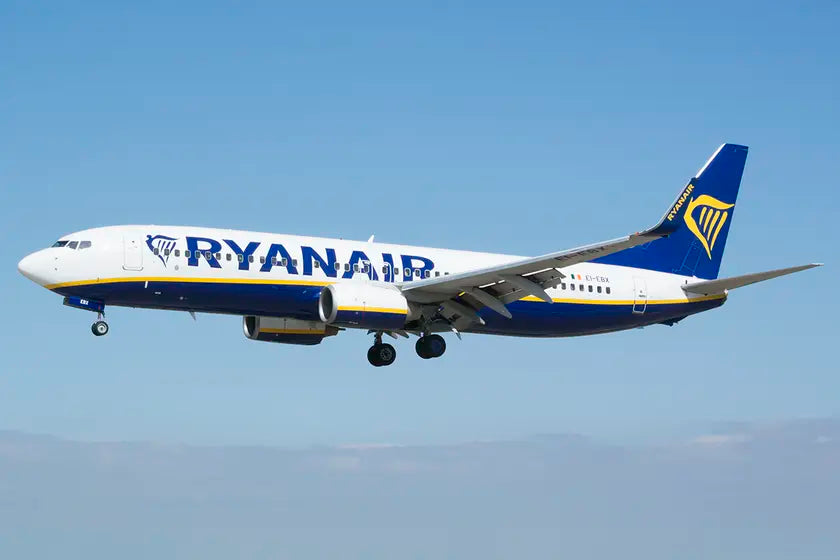
Ryanair Overview & Group Structure
Ryanair is Europe's largest airline by passengers carried, and it sits at the centre of a story that matters to every pilot weighing a job there: enormous scale, relentless cost control, and a fast-moving career ladder. Founded in Ireland in 1984, the business is run today through Ryanair Holdings plc, a publicly listed company headquartered in Swords, County Dublin. From a single turboprop route in the mid-1980s, the group has grown into a network of over 3,500 short-haul flights per day serving roughly 230 airports across 36 countries, all on a point-to-point, ultra-low-cost model with no long-haul flying.
Unlike a traditional flag carrier, Ryanair is not a single airline but a multi-AOC group. The original Irish operator, Ryanair DAC, now flies alongside Malta Air (Maltese AOC), Buzz (Polish AOC), Lauda Europe (Maltese AOC, the group's only Airbus operation), and Ryanair UK (UK AOC). This structure, partly shaped by Brexit and by the desire to base aircraft and crews under different national labour regimes, directly affects which company name appears on a pilot's contract, even though day-to-day flying feels uniform across the network. The group is not a member of any global alliance such as SkyTeam, oneworld, or Star Alliance; it operates entirely independently.
The numbers behind the operation are striking. According to Ryanair's 2025 Annual Report (fiscal year ended March 2025), group revenue reached approximately €9.23 billion, of which around €4.72 billion came from ancillary products such as bags, seat selection, and priority boarding. The group carried close to 200 million passengers and remains one of the most profitable airlines in the world by net income. For pilots, that profitability underwrites a steady stream of aircraft deliveries, new base openings, and rapid command opportunities, even if it also explains the company's famously hard-nosed approach to pay negotiations.
The airline you fly for in practice (Ryanair DAC, Malta Air, Buzz, Lauda Europe, or Ryanair UK) determines your employing entity, the labour law that applies, your social security and tax base, and which collective agreement covers you. Operating procedures, training standards, and corporate culture are heavily standardised at group level around the Ryanair DAC model, but pay scales and protections can differ by AOC and country. Always confirm which company name is on the contract before signing.
Fleet Composition & Type Ratings
Ryanair operates one of the most homogeneous large fleets in world aviation. The overwhelming majority of aircraft are variants of the Boeing 737, supplemented only by a small Airbus A320 subfleet at Lauda Europe and a handful of corporate jets. For a pilot, this single-type strategy is the defining feature of the operation: it simplifies training, recurrent checks, and cross-base flying, but it also means there is no in-house path to wide-body or long-haul flying. If your long-term ambition is intercontinental operations on a wide-body, Ryanair is not the airline for that; if you want high utilisation and rapid command on a modern narrow-body, it is one of the best-placed employers in Europe.
A Flightradar24 fleet analysis from February 2026 counted 611 aircraft in the mainline operation: 410 Boeing 737-800s, 196 Boeing 737 MAX 8200 "Gamechangers", and a single 737-700 used mainly for training. Ryanair's own 2025 Annual Report cited 613 aircraft at the March 2025 year-end, with the difference reflecting ongoing deliveries. Add Lauda Europe's Airbus A320s (roughly 26 to 29 airframes) and the group total sits at around 640 aircraft. The fleet is also relatively young: a Simple Flying fleet-age comparison put the 737-800 subfleet at about 12.8 years on average and the newer MAX 8200s at just 2.6 years, giving the core Ryanair fleet an average age near 10.7 years.
| Aircraft Type | Role | In Service | Notes |
|---|---|---|---|
| Boeing 737-800 | Narrowbody | ~410 | The long-standing workhorse, ~189 seats. Avg. age ~12.8 yrs. Being supplemented by MAX. |
| Boeing 737 MAX 8200 ("Gamechanger") | Narrowbody | ~196 | High-density MAX 8 with extra over-wing exit, ~197 to 200 seats. Avg. age ~2.6 yrs. |
| Boeing 737-700 | Narrowbody | 1 | Single airframe, used for training and occasional charter. |
| Airbus A320-200 | Narrowbody | ~26 to 29 | Operated by Lauda Europe (Maltese AOC), ~180 seats. Separate Airbus pilot pool. |
| Boeing 737 MAX 10 | Narrowbody (on order) | 0 (300 ordered) | 150 firm + 150 options, announced May 2023. Deliveries 2027 to 2033. |
| Corporate jets | Utility | ~4 | Bombardier Challenger / Learjet for parts, personnel, and VIP transport. |
Fleet data compiled from Flightradar24 (Feb 2026), the Ryanair 2025 Annual Report, and Simple Flying. Numbers are approximate and shift with ongoing deliveries.
The most important fleet development is the Boeing 737 MAX 10 order. In May 2023, Ryanair agreed to buy up to 300 of the stretched variant (150 firm and 150 options), a deal with a headline list value above 40 billion US dollars before the substantial discounts typical of large orders. Deliveries are scheduled between 2027 and 2033. Each additional aircraft requires multiple crews to support Ryanair's high-utilisation model, so the order book translates directly into sustained demand for first officers, command upgrades, and training captains well into the 2030s.
New joiners on the mainline operation fly the Boeing 737-800 or 737 MAX 8200; the two share a common type rating with a short differences course between variants. Cadets and most non-type-rated direct-entry pilots receive their 737 type rating through Ryanair's training pipeline (the company's training centre at East Midlands is widely used), though funding arrangements vary and are covered in the Benefits section below. Pilots joining Lauda Europe are rated on the Airbus A320 instead. Cross-fleeting between Boeing and Airbus within the group is limited, so the manufacturer you start on is generally the one you stay on while employed.
Pilot Salary & Compensation Breakdown
Ryanair pay is built around a mixed structure: a fixed basic salary that is typically lower than at legacy carriers, topped up by significant sector pay (payment per flight or block hour). For productive pilots, and especially captains who fly close to the annual limit, total earnings can be very competitive by low-cost-carrier standards. The trade-off is income variability: earnings rise in the busy summer and soften in winter, and the picture differs markedly by base, AOC, contract type, and national tax regime. Ryanair does not publish a public seniority-by-seniority pay table, so the figures below are ranges compiled from the company's own recruitment material, union and press releases, and third-party salary summaries.
First Officer Pay (total annual gross, estimated)
| Experience Level | Annual Gross (est.) | Source / Notes |
|---|---|---|
| New / junior First Officer | ~€53,000 – €65,000 | Includes basic plus sector pay. Lower in some Central/Eastern European bases. |
| First Officer, 3 to 5 years | ~€65,000 – €80,000 | Rises with seniority step and higher sector rates as hours accumulate. |
| Senior First Officer | ~€80,000 – €93,000 | High utilisation and higher-cost bases sit at the top of this band. |
First Officer ranges drawn from 2024 to 2025 industry salary summaries. Figures are total gross including variable sector pay, before national income tax and social charges.
Captain Pay (total annual gross, estimated)
| Stage | Annual Gross (est.) | Source / Notes |
|---|---|---|
| Direct Entry Captain, year 1 | up to €165,000 / £155,500 | Ryanair careers site headline figure. Total earnings including sector pay, not basic alone. |
| Established Captain (Western Europe) | ~€130,000 – €180,000 | Directly employed, mid-cost to high-cost base, full-time line flying. |
| Ryanair UK Captain (estimate) | ~£114,000 – £145,000 | Third-party estimate for UK-based commanders. |
Captain figures combine Ryanair's published "up to €165,000 in year 1" recruitment claim with third-party estimates. Highly productive captains in expensive bases can sit at or above the top of these ranges.
The recovery of pay since the pandemic is a central part of the current picture. In December 2023, Ryanair concluded a four-year agreement with the Fórsa union covering Irish-based pilots, running to March 2027. According to the airline's own corporate news release, the deal delivered accelerated restoration of the 20% Covid-era pay cuts, with full restoration appearing in the December 2023 payroll, and then incorporated three years of pay increases spread across the four-year term. Ryanair stated that the Irish agreement brought those pilots into line with similar restoration deals concluded with its other pilot unions across Europe during 2023. The exact percentage steps by year have not been published, so pilots should ask base representatives for the detail.
Ryanair publishes no full, base-by-base pilot pay scale. The figures above are estimates assembled from the company's recruitment pages, union and press releases, and independent salary surveys, and they should be treated as indicative rather than contractual. Actual income depends heavily on your AOC, base, contract model (directly employed versus contractor with guaranteed minimum hours), the number of sectors flown, and the local tax and social security regime, which differs sharply between Ireland, the UK, Poland, Italy, Spain, and other markets. Always verify with the relevant collective agreement and current pilots at your intended base before making a decision.
Roster Pattern & Quality of Life
Quality of life is where Ryanair markets itself most aggressively, and with some justification. The company's pilot recruitment material describes a stable 5-on / 4-off roster with rosters published four weeks in advance and, crucially, no planned overnights. Because the network is exclusively short-haul and out-and-back from a fixed home base, line pilots generally sleep in their own bed after every duty, provided they live within commuting distance of the base. For pilots with families, the predictability of regular four-day blocks off and the absence of multi-day trips away can be a genuine advantage over both legacy long-haul rotations and the more variable patterns at some competitors.
The flip side is intensity. Within the five working days, duties are packed with high-frequency, multi-sector flying and quick turnarounds, and the most workload-intensive phases (takeoff and landing) recur several times a day. A day can involve early reports or late finishes, and standby duties are mixed into the working block. The pattern delivers excellent rest cycles but demands disciplined fatigue management on the duty days themselves.
📅 Sample Month — Boeing 737 First Officer (5-on / 4-off pattern)
The 5-on / 4-off cycle is a nine-day rhythm that does not align neatly with calendar weeks, so the grid above shifts from month to month. Over a typical four-week period it works out to roughly 13 to 15 days off, on top of annual leave. Note that roster terminology varies: Ryanair's current recruitment pages advertise the 5/4 pattern, while a 5-on / 3-off arrangement has been used historically and in some contexts, and Wizz Air explicitly modelled its own fixed roster on the Ryanair approach. Confirm the exact pattern for your base and contract during recruitment.
Ryanair operates under EASA Flight Time Limitations (and the closely aligned UK CAA rules for Ryanair UK). As explained in the EASA regulatory framework, the maximum flight duty period without in-flight rest is typically up to 13 hours, reducing with the number of sectors flown (a four-sector duty starting at 06:00 is generally capped at 12 hours), extendable by up to three hours at the commander's discretion in exceptional circumstances. Cumulative limits cap duty at 60 hours in any 7 days, 110 hours in any 14 days, and 190 hours in any 28 days, while flight time is capped at 100 hours in any 28 days, 900 hours per calendar year, and 1,000 hours in any 12 months. In practice, Ryanair line pilots commonly log somewhere in the region of 700 to 850 block hours per year.
Ryanair operates from more than 85 bases, so pilots are recruited to a specific home base (or given a shortlist). The "home every night" model only works if you live within reasonable commuting distance, and the company has historically been less accommodating of long-distance commuting than legacy carriers. New joiners are often offered less popular or lower-cost bases first, with transfers to preferred locations subject to vacancy and seniority. Base allocation is therefore one of the most important practical questions to settle before accepting an offer, and is covered further in the Base Network section.
Benefits, Pension & Type Rating Funding
Benefits are where the ultra-low-cost model shows most clearly. Ryanair's emphasis is on cash earnings tied to productivity rather than a deep bundle of fringe benefits, and a prospective pilot should treat type rating funding, pension, and social protections as central parts of the package to investigate rather than assume. The picture has improved substantially since union recognition and the shift toward direct employment, but it still varies by AOC and base far more than at a single-entity flag carrier.
On type rating, the historical Ryanair model often required new and low-time pilots to self-fund the 737 rating, either upfront or recovered through salary deductions that function as a retention bond. Competitive pressure to fill an expanding fleet has pushed the company toward more airline-funded or co-funded ratings, particularly for experienced pilots and mentored cadets, but self-funded and bonded schemes have not disappeared. An integrated cadet course plus type rating frequently exceeds €100,000 in total when training and living costs are included, so the financial structure (and any bond length) is one of the most important things to clarify in writing before committing.
Because conditions differ by AOC, base, and contract type, do not assume a benefit is included. Confirm in writing: the exact type rating funding and bond terms; whether you are directly employed or contracting; pension contribution levels and vesting; sick pay duration; and whether loss-of-licence cover is provided or must be self-insured. National pilot associations such as IALPA and BALPA are the best independent source for what is actually standard at a given base.
Career Progression & Time to Command
Speed to command is Ryanair's headline career attraction. The company markets the "fastest time to command in the aviation sector", and the underlying logic is sound: continuous fleet growth, a large MAX 10 order book, and frequent new base openings create steady captain vacancies. In strong growth phases, first officers have upgraded to captain in as little as three to five years, far quicker than the decade-plus that is common at many legacy carriers. The pace varies with fleet growth, captain attrition, and, importantly, your willingness to relocate to a base where commanders are needed.
Progression at Ryanair is driven more by base demand and performance than by a classical airline-wide seniority bid for routes and aircraft. Because the fleet and network are uniform, captains and first officers at a given base fly broadly the same routes and aircraft, so seniority shows up mainly in base transfers, leave bidding, and roster preferences rather than in equipment. Pilots flexible on location can use that flexibility strategically: accepting an expanding or newly opened base can bring command years earlier than waiting at a saturated one.
| Career Milestone | Typical Timeline | Notes |
|---|---|---|
| Cadet training (ab-initio path) | ~18 to 24 months | Integrated ATPL plus APS MCC at a Ryanair-partner ATO, then 737 type rating. |
| Join as First Officer (B737) | Day 1 post-rating | Most join on the 737-800 / MAX 8200; Lauda joiners fly the A320. |
| Senior First Officer | ~3 to 5 years | Higher sector pay band; building hours toward command minimums. |
| Command upgrade (Captain) | ~3 to 5 years (growth phases) | Requires ATPL, command minimums on type, selection, and a command course. |
| Training roles (TRI / TRE / base trainer) | Variable | Separate selection and instructor training; additional allowances. |
To upgrade, a first officer must meet regulatory and internal experience thresholds, hold an ATPL, and pass an internal command selection (simulator assessment, interviews, and ground school) followed by a command course covering leadership, decision-making, and crew resource management in Ryanair's quick-turnaround environment. Ryanair also recruits Direct Entry Captains externally to fill command vacancies, particularly at new and expanding bases, which means experienced commanders from other 737 (or comparable jet) operations can join straight into the left seat without waiting for an internal upgrade.
With roughly 7,000 pilots on the books, a fleet heading toward and beyond 600 aircraft, and 300 MAX 10s on order for delivery from 2027, Ryanair's structural demand for both first officers and captains is strong. That demand, combined with a tight European market for experienced commanders, is what sustains the fast upgrade timelines and the competitive Direct Entry Captain packages. The main variables to watch are the pace of MAX deliveries from Boeing and the company's base-opening decisions, both of which directly shape how quickly individual pilots reach command.
Recruitment Process & Requirements
Ryanair recruits through three broad pathways: the Cadet (Mentored) Programme for those building toward their first airline job, the experienced Direct Entry First Officer stream, and the Direct Entry Captain stream. All applications run through the official portal at careers.ryanair.com, and a key feature across every stream is that the company will provide the Boeing 737 type rating for cadets and most non-type-rated joiners rather than requiring it on entry. Across all routes, applicants need the unrestricted right to live and work in the EU and/or UK, a valid EASA (or UK) Class 1 medical, and at least ICAO English Level 4 (Level 5 or 6 preferred).
Cadet (Mentored) Programme — Requirements
Direct Entry First Officer — Requirements
Direct Entry Captain — Requirements
Selection Stages
Online Application
Create a candidate profile on careers.ryanair.com, upload your licence, medical, logbook summary, CV, and proof of right to work, and apply for a specific First Officer or Captain vacancy. Recruitment screens applications against the minimum criteria for that campaign.
Online Assessment
Candidates who meet the criteria are invited to complete an online assessment, typically aptitude and cognitive tests and, for some roles, ATPL-style technical knowledge questions. This must be completed before progressing to the simulator stage.
Simulator Assessment
A simulator check, commonly run in Dublin or London Stansted for the mainline operation, evaluates handling, instrument procedures, SOP adherence, crew resource management, and capacity to manage abnormal situations. The bar is correspondingly higher for Direct Entry Captain candidates.
Technical & HR Interview
Interviews probe aircraft systems and operational knowledge alongside motivation, teamwork, resilience, and cultural fit. Ryanair looks for pilots who can balance efficiency and on-time performance with uncompromising adherence to safety and regulations.
Offer, OCC / Type Rating & Line Training
Successful candidates receive an offer subject to background checks and medical. Non-type-rated joiners complete an Operator Conversion Course and 737 type rating; type-rated Direct Entry Captains complete an OCC. Line training follows before full line release.
For those still in training, Ryanair runs Mentored cadet programmes with selected Approved Training Organisations, including Aviomar Flight Academy in Rome and the Ryanair Future Flyer Academy at Skyborne Airline Academy in the UK. These integrated courses (around 18 to 24 months to an EASA CPL/IR with multi-engine rating and APS MCC) are built around a Ryanair-designed syllabus and lead to a Ryanair 737 type rating assessment on successful completion. They offer a relatively clear route into the right-hand seat, but the financial commitment is large (often above €100,000 all-in), so weigh the strong likelihood of a Ryanair job against the airline-specific nature of the training. Current cadet details are published at careers.ryanair.com/cadets.
Base Network & Group Airlines
Ryanair has no long-haul layovers to write about, so the equivalent lifestyle question for its pilots is the base network: where you are based, under which group airline, and how easily you can move. Ryanair recruitment material cites more than 85 bases across Europe, ranging from major hubs like Dublin, London Stansted, Milan Bergamo, and Madrid to secondary regional airports. This wide footprint gives pilots more potential home bases than almost any other European carrier, but the most desirable city bases are also the most competitive, and new joiners are frequently placed at less popular or lower-cost locations first.
Layered on top of the base map is the multi-AOC group structure. The airline you are contracted to determines your governing labour law, social security, tax base, and collective agreement, so it is worth understanding the operating companies before applying.
| Group Airline | AOC / Country | Fleet | Role & Notes |
|---|---|---|---|
| Ryanair DAC | Ireland | Boeing 737 | The original and largest operating airline; the template for group-wide procedures. |
| Malta Air | Malta | Boeing 737 | Covers a large share of Italian, Maltese, French, and other bases under a Maltese AOC. |
| Buzz | Poland | Boeing 737 | Polish AOC; Central/Eastern European operations and group wet-lease capacity. |
| Lauda Europe | Malta | Airbus A320 | The group's only Airbus operation; a separate type-rated pilot pool. |
| Ryanair UK | United Kingdom | Boeing 737 | UK AOC created to preserve UK traffic rights post-Brexit; UK CAA rules apply. |
Group airline structure as of 2025. Day-to-day flying is standardised across the network, but contracts and labour protections are tied to the specific AOC.
Base choice is the single biggest lever a Ryanair pilot controls over both lifestyle and career speed. A base near where you already want to live maximises the "home every night" advantage, while accepting an expanding or newly opened base can accelerate command by years. Before signing, ask recruiters about current demand and waiting times at your preferred bases, and ask incumbent pilots how long recent transfers have actually taken.
How Ryanair Compares: Airline Radar Chart
The natural comparison for Ryanair is with Europe's other two giant low-cost carriers, easyJet and Wizz Air. All three fly single-type narrow-body fleets (Ryanair on Boeing 737s, easyJet and Wizz Air on the Airbus A320 family) and all three offer faster command than legacy carriers. The differences are in pay levels, benefits, roster stability, and base geography. Scores below are editorial estimates across the same six metrics used in the scorecard, based on publicly available data and pilot-focused salary reporting.
Key Takeaways from the Comparison
easyJet tends to lead on First Officer pay and benefits. A 2024 BALPA-negotiated deal reported easyJet UK First Officer pay rising toward £75,446 and Senior First Officer pay to £112,879, with captain pay moving from around £163,589 toward £190,000. easyJet's basic salaries and pension provision are generally stronger than Ryanair's, and its bases sit at major primary airports and city hubs, which suits pilots who prioritise city living over the widest possible choice of locations.
Ryanair leads on captain earnings potential and base choice. Ryanair's advertised "up to €165,000 in year 1" for Direct Entry Captains is at the top of the low-cost field, its 85-plus base network is the largest of the three, and its 5-on / 4-off roster with no planned overnights is a genuinely distinctive lifestyle proposition. Wizz Air sits lower on pay overall, with First Officers roughly €38,000 to €65,000 and captains from around €75,000 plus retention bonuses (reported up to €40,000 after three years), reflecting its Central and Eastern European base weighting.
All three offer fast command, with nuances. Wizz Air and Ryanair are typically the quickest, with upgrades often achievable in around three to five years during growth phases; easyJet is faster than legacy carriers but generally a touch slower than the other two. Wizz Air has introduced fixed roster patterns (including 5/4 and a 14-on / 7-off commuting option) explicitly modelled on the Ryanair approach, though it has historically carried a reputation for more intense scheduling.
Fleet and job security are strong across the board. Wizz Air operates one of the youngest fleets in Europe, easyJet's A320 family fleet (around 350 aircraft) is modern, and Ryanair's near-600-strong 737 fleet plus 300 MAX 10s on order make it the largest and, by net income, among the most financially resilient. Ryanair's scale is its biggest job-security argument; Wizz Air's rapid growth comes with somewhat greater exposure to regional and geopolitical risk.
Scores are editorial estimates derived from research into published recruitment pay ranges, union announcements, pilot salary surveys, and fleet data (Flightradar24, Simple Flying, and airline disclosures). They reflect a general assessment for an experienced pilot weighing a long-term career and are not a precise measurement. Individual outcomes vary by base, contract type, tax regime, and personal priorities, and figures will be revisited as dedicated easyJet and Wizz Air guides are published.
Union & Industrial Relations
Ryanair's labour history is impossible to ignore, because it has shaped the conditions on offer today. For most of its existence the company refused to recognise trade unions, dealing with pilots directly and base by base. That stance ended in December 2017, when, facing the threat of coordinated Christmas strike action across several countries, Ryanair made a strategic U-turn and agreed to recognise pilot unions. The shift transformed the industrial landscape and is the reason much of the older, contractor-heavy reputation no longer reflects conditions at many Western European bases.
Who Represents Ryanair Pilots
How Negotiations and Disputes Have Played Out
The pandemic prompted temporary pay cuts agreed with pilot groups across the network in exchange for job protection, with pathways to restoration built in. As traffic recovered, unions pressed for those cuts to be reversed. The cooperative endpoint of that process is the December 2023 Fórsa agreement for Irish pilots, which restored the 20% Covid cut and added three years of increases to March 2027.
Industrial conflict has not disappeared, but it now sits within a structured union framework rather than the unilateral environment of the pre-2017 era. Between 2022 and 2025, episodic disputes continued in markets with strong labour traditions such as Belgium, Spain, France, and Portugal, often centred on local labour-law compliance, national contracts, and social security rather than headline pay, and frequently involving cabin crew more than pilots. Ryanair's negotiating style remains assertive, but recognised unions, collective agreements, and formal grievance procedures now give pilots considerably more transparency and protection than existed a decade ago.
Industrial relations at Ryanair are more stable and more structured than the airline's historical reputation suggests, but they remain dynamic, and labour conditions still vary by AOC and country. The practical advice is consistent: engage early with the recognised union at your intended base (IALPA via ialpa.net in Ireland, BALPA in the UK), use it to understand local pay, rostering, and base-closure protections, and make sure you have representation in place before any dispute arises rather than after.
Verdict: Who Is Ryanair For?
🎯 Our Take
Ryanair is the clearest expression of the modern European low-cost career: a single, modern Boeing 737 fleet flown hard from a fixed home base, with the fastest realistic route to command in the industry and the largest base network on the continent. For a pilot who wants to be a captain on a good salary sooner rather than later, and who values sleeping at home every night on a predictable 5-on / 4-off roster, few employers compete with it.
The trade-offs are equally clear. Pay leans heavily on variable sector earnings, so income fluctuates and first-officer salaries trail easyJet in several markets. Benefits are leaner than at a legacy carrier: type ratings are often self-funded or bonded, staff travel is modest, and loss-of-licence cover and pension provision vary by base and contract, so they must be checked rather than assumed. The single-type, short-haul model offers no path to wide-body or long-haul flying, and base allocation can place new joiners far from where they would like to live. Conditions also differ meaningfully across the five group airlines.
For pilots who go in with their eyes open, choose their base strategically, and read the contract detail carefully, Ryanair offers something rare: rapid command, strong job security backed by enormous scale and a 300-aircraft order book, and a genuinely home-based short-haul lifestyle.
1 Do I need a Boeing 737 type rating to join Ryanair?
Not in most cases. Cadets and the majority of non-type-rated direct-entry pilots receive their 737 type rating through Ryanair's training pipeline after selection, completing an Operator Conversion Course on entry. There are also separate campaigns aimed specifically at pilots who already hold a current B737-300/900 rating, particularly for Direct Entry Captains. Pilots joining Lauda Europe are rated on the Airbus A320 instead. Funding terms for the rating vary and may involve a bond, so confirm the financial arrangement in writing.
2 How fast can I become a Captain at Ryanair?
Ryanair markets the fastest time to command in the sector, and in strong growth phases first officers have upgraded in roughly three to five years. The pace depends on fleet growth, captain attrition, your performance, and above all your willingness to relocate to a base where commanders are needed. Upgrade requires an ATPL, the relevant command minimums on type, an internal selection process, and a command course. Ryanair also recruits Direct Entry Captains externally to fill vacancies at expanding bases.
3 How much do Ryanair pilots actually earn?
Based on 2024 to 2025 industry summaries, First Officers earn roughly €53,000 to €93,000 total gross depending on experience and base, while captains earn roughly €84,000 to €165,000, with Ryanair advertising up to €165,000 (£155,500) in year one for Direct Entry Captains. These totals include significant variable sector pay, so they fluctuate with hours flown and the season. Ryanair publishes no full seniority pay table, and net income depends heavily on national tax and social charges, so treat all figures as indicative.
4 What is the Ryanair roster pattern, and will I be home every night?
Ryanair's recruitment material advertises a stable 5-on / 4-off roster published four weeks in advance, with no planned overnights. Because the operation is entirely short-haul and out-and-back, line pilots normally sleep at home after every duty, provided they live within commuting distance of their base. That works out to roughly 13 to 15 days off per month plus annual leave. The duty days themselves are intense, with multiple sectors and quick turnarounds. A 5-on / 3-off pattern has been used historically, so confirm the exact arrangement for your base.
5 Can I choose my base?
Not freely. Ryanair operates more than 85 bases and assigns new joiners to a specific base, sometimes from a shortlist, with the most popular city bases being the hardest to secure. New pilots are often placed at less popular or lower-cost locations first, and transfers to preferred bases depend on vacancies and seniority and can take time. Because base allocation drives both lifestyle and command speed, ask recruiters about current demand and realistic transfer waiting times before accepting an offer.
6 Does Ryanair still use contractor (self-employed) pilots?
Less than it used to. The historical model relied heavily on agency contractors paid almost entirely per sector, but since union recognition in 2017 and the move toward direct employment, a large majority of pilots in core Western European bases are now directly employed under local labour law, with basic salary, paid leave, and social insurance. Some agency or contractor arrangements remain, often with guaranteed minimum hours, particularly in certain bases. Always clarify whether a given role is directly employed or contracted and what social protections apply.
7 What are the requirements for a Direct Entry Captain?
Published Ryanair Direct Entry Captain requirements include a minimum of 3,500 total hours, 2,000 hours on multi-crew, multi-engine jets above 30 tonnes with an established airline, and 800 hours as pilot-in-command on such jets (turboprop command time does not count). The B737-type-rated stream additionally requires 500 hours PIC on the B737-300/900 plus a current rating and recency, while a non-type-rated stream provides the conversion. A full ATPL, a valid Class 1 medical, and ICAO English Level 4 are required, and applicants must generally be under 65 with the right to work in the EU/UK.
8 How does Ryanair compare to easyJet and Wizz Air?
easyJet generally offers higher First Officer basic pay and better benefits and pension, with bases at major city airports. Wizz Air sits lower on pay (First Officers roughly €38,000 to €65,000, captains from around €75,000 plus retention bonuses) but offers very fast command and a young Airbus fleet. Ryanair leads on captain earnings potential (up to €165,000 in year one for Direct Entry Captains), the largest base network, and the distinctive 5-on / 4-off, no-overnights roster. All three offer faster command than legacy carriers, with Ryanair and Wizz Air typically the quickest at around three to five years in growth phases.
Official Links & Resources
Before applying or making any career decision, verify the details directly with official sources, because pay, contracts, and requirements change and vary by base and AOC. These are the key websites and organisations relevant to a Ryanair pilot career:
Pay structures and base availability are the two things most likely to differ from any online summary, so cross-check them against two sources before you commit: the recognised union at your intended base (for the real collective-agreement pay scales and rostering rules) and current line pilots at that base (for realistic earnings, standby levels, and transfer waiting times). Ryanair's recruitment "up to" figures describe the top of the range, not the typical outcome.
- 01Overview & Group Structure
- 02Fleet & Type Ratings
- 03Salary & Compensation
- 04Roster & Quality of Life
- 05Benefits, Pension & Type Rating
- 06Career Progression
- 07Recruitment & Requirements
- 08Base Network & Group Airlines
- 09Airline Comparison
- 10Union & Industrial Relations
- 11Verdict & FAQ
- 12Links & Resources