

Vickers Vanguard: History, Development, and Evolution of the Turboprop Airliner
The Vickers Vanguard was a British short- and medium-haul turboprop airliner developed by Vickers-Armstrongs (Aircraft) Ltd as a larger, faster successor to the hugely successful Vickers Viscount. While the Viscount had established itself as the world's first turboprop airliner to enter scheduled service, airlines such as British European Airways (BEA) needed a higher-capacity aircraft for their busiest European trunk routes. In 1953, Vickers-Armstrongs initiated design studies for what would become the Vanguard, envisioning a 100-seat-class turboprop that could deliver near-jet speeds while retaining the fuel economy and short-field performance inherent to propeller-driven aircraft.
The programme took shape around a new, wider "double-bubble" fuselage cross-section, offering substantially more cabin volume and underfloor cargo space than the Viscount. Power came from four Rolls-Royce Tyne turboprop engines, each producing roughly twice the shaft horsepower of the Dart engines fitted to the Viscount. This combination promised a cruise speed of approximately 425 mph (684 km/h) and a range of around 1,830 miles (2,945 km) with maximum payload, figures competitive with early short-haul jets of the era. For aviation enthusiasts interested in how modern turboprops continue this lineage, the Xian MA700 represents a contemporary regional turboprop programme with similarly ambitious goals.
Programme Launch and Key Milestones
The Vanguard programme was formally launched when BEA placed an order for 20 aircraft in July 1956, making it the type's first customer. Trans-Canada Air Lines (TCA) followed in January 1957 with an order for 20 aircraft, later increased to 23. Despite the commercial promise, no other airlines placed production orders, ultimately limiting total production to just 44 airframes.
The prototype, registered G-AOYW, was built at Vickers' factory at Weybridge, Surrey. On 20 January 1959, the Vanguard completed its maiden flight from Brooklands to the company's test airfield at Wisley. The flight test programme that followed revealed teething problems with the Rolls-Royce Tyne engines, which delayed the originally planned entry into service. BEA had hoped to introduce the type for the summer 1960 peak season, but engine reliability issues pushed the timetable back by several months.
BEA eventually began limited ad hoc revenue services during the December 1960 Christmas travel period, with the official introduction date recorded as 17 December 1960. Full scheduled service with BEA commenced in March 1961. TCA introduced its Vanguards to scheduled service slightly earlier, in February 1961. TCA found the aircraft so economical that it was able to reduce fares on some routes by up to 35%, stimulating significant passenger demand.
Unfortunately, the Vanguard entered service at precisely the moment when second-generation jet airliners were becoming commercially available for short- and medium-haul routes. The arrival of pure jets rapidly overshadowed the turboprop, and despite its strong operating economics, the Vanguard attracted no further airline customers. This situation is often summarised as the aircraft being "the right plane at the wrong time."
Variants: What Distinguishes the Type 951, 952, and 953
Vickers produced the Vanguard in three main production variants, each tailored to the requirements of its launch customers. The Type 950 was the single prototype used for development and certification testing. The Type 951 was the initial BEA production variant, powered by four Rolls-Royce Tyne 506 engines and built to a standard maximum take-off weight. BEA received six Type 951 aircraft (registrations G-APEA to G-APEF).
The Type 952 was developed specifically for TCA. It featured the more powerful Rolls-Royce Tyne 512 (RTy.11 Mk 512) engines rated at approximately 5,545 shp each, along with a structurally strengthened airframe permitting a higher maximum take-off weight of 146,500 lb (66,450 kg). The Type 952 could seat up to 139 passengers in an all-economy configuration. All 23 TCA aircraft were delivered as Type 952s.
After evaluating the improvements incorporated into TCA's Type 952, BEA requested a hybrid variant. The resulting Type 953 combined the Tyne 506 engines of the Type 951 with the strengthened, higher-weight airframe structure of the Type 952, enabling a maximum weight of approximately 141,000 lb and seating for up to 135 passengers. BEA amended its original order, ultimately receiving 6 Type 951s and 14 Type 953s.
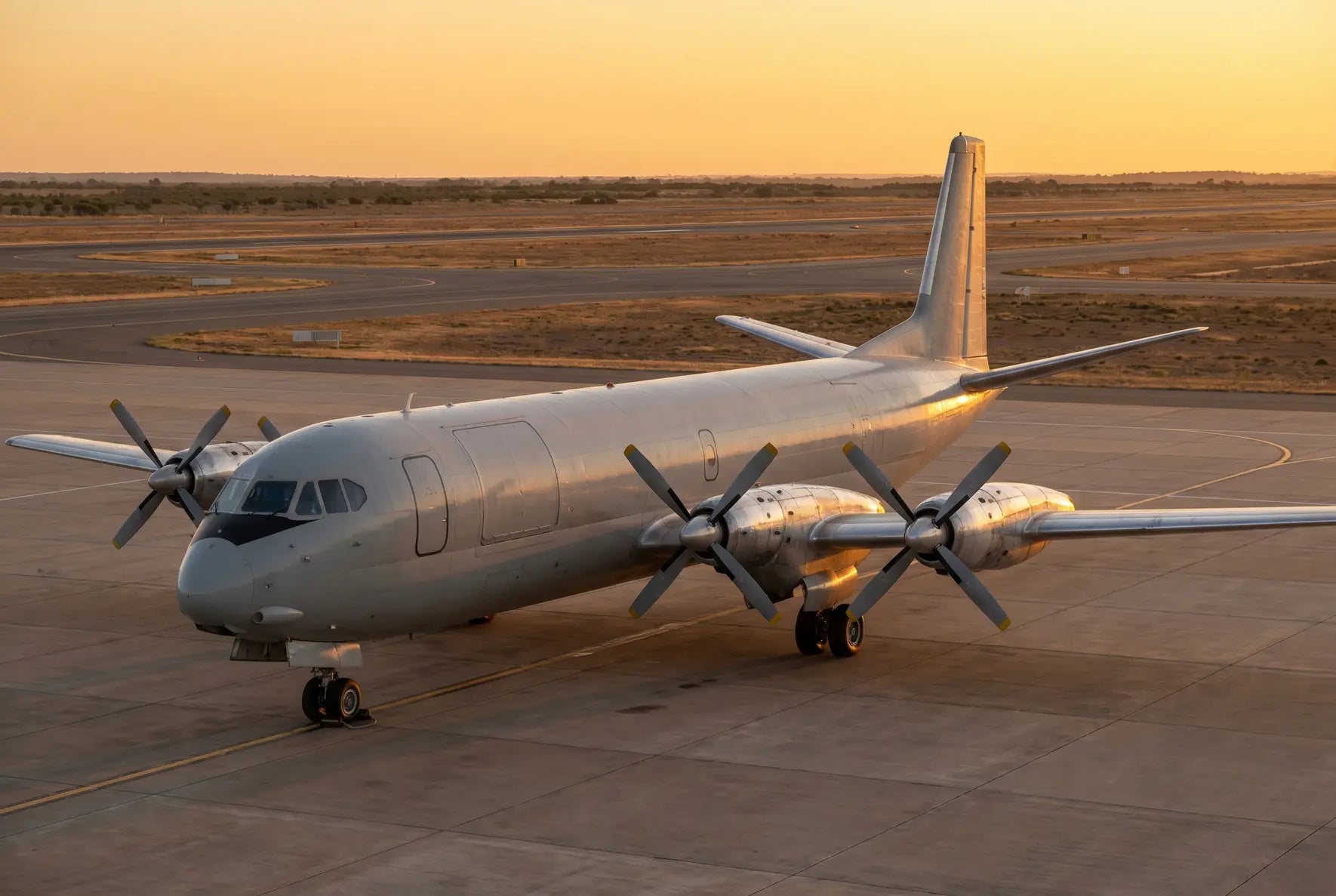
In the early 1970s, with passenger operations winding down, many surviving Vanguards were converted to all-cargo configuration. BEA designated its freighter conversions as the Type 953C Merchantman, featuring a large forward cargo door and removal of all passenger furnishings. BEA and later British Airways (formed by the 1972 merger of BEA and BOAC) operated Merchantman freighters until 1979, when remaining aircraft were sold to operators such as Air Bridge Carriers and later Hunting Cargo Airlines. The last commercial flight of any Vickers Vanguard variant was operated by Hunting Cargo Airlines in October 1996.
The key identifiers distinguishing each Vanguard variant are summarised below:
- Type 951 - Four Rolls-Royce Tyne 506 engines; standard production weight; BEA operator; 6 built.
- Type 952 - Four Rolls-Royce Tyne 512 engines (5,545 shp each); structurally strengthened airframe; higher MTOW of 146,500 lb; up to 139 passengers; TCA operator; 23 built.
- Type 953 - Four Rolls-Royce Tyne 506 engines with Type 952 higher-weight airframe; MTOW approximately 141,000 lb; up to 135 passengers; BEA operator; 14 built.
- Type 953C Merchantman - Cargo conversion of Type 953; large forward freight door; zero passenger capacity; operated by BEA/British Airways and later Hunting Cargo Airlines.

The image shows a Vickers 952 Vanguard aircraft operated by Invicta International Airlines. The plane is captured in mid-air during a flight, with a clear sky backdrop and green landscape below.
Vickers Vanguard Technical Specifications, Systems and Engine Overview
The Vickers Vanguard was designed as a higher-capacity, longer-range successor to the highly successful Vickers Viscount, tailored for dense short- and medium-haul routes in Europe and across Canada. Its design reflected a careful trade-off between speed, payload and runway performance: the distinctive double-bubble fuselage cross-section expanded cabin volume in the upper lobe while keeping a compact lower section for baggage, and a large, efficient wing paired with four powerful turboprops delivered cruise speeds that rivalled early pure jets. The Type 951, ordered by British European Airways (BEA), used a baseline structure optimised for European sectors, while the Type 952, built for Trans-Canada Air Lines (TCA), featured a strengthened wing and fuselage for higher operating weights and longer-range capability. BEA later adopted this stronger airframe for its own Type 953 variant.
The Vanguard's cockpit was crewed by three (captain, first officer and flight engineer) and was noted for its spacious layout and excellent external visibility. The aircraft earned a strong reputation among pilots for its handling qualities, powerful climb performance and refined systems integration, which made it one of the most capable turboprop airliners of its generation.
- Length: 37.45 m (122 ft 10.5 in)
- Wingspan: 35.97 m (118 ft 0 in)
- Height: 10.64 m (34 ft 11 in)
- Wing area: 141.9 m² (1,527 sq ft)
- Typical seating: 127 passengers (Type 951, mixed class) or up to 139 passengers (Type 952, higher density)
- Crew: 3 (two pilots plus flight engineer)
- Empty weight: approximately 37,421 kg (82,500 lb)
- Maximum take-off weight (MTOW): approximately 63,960 kg (141,000 lb) for the Type 952
- Cruise speed: approximately 680 km/h (367 kt / 422 mph) at 20,000 ft
- Range: approximately 2,945 km (1,590 nm) with maximum payload (Type 952)
- Service ceiling: 30,000 ft (9,144 m)
- Engines: 4 x Rolls-Royce Tyne turboprops (Mk 506 on the Type 951; RTy.11 Mk 512 on the Type 952)
- Total production: 44 aircraft
Systems, Flight Controls and Automation
The Vanguard used conventional primary flight controls (ailerons, elevators and rudder) operated mechanically through cables and pulleys with hydraulic boost on the heavier surfaces, consistent with large turboprop design practice of the period. Large trailing-edge flaps provided the low-speed performance necessary for operations from shorter runways. Engine and propeller management followed a "Single Lever Control" philosophy: although twelve levers were present for the four engines, throttle, propeller and condition inputs were consolidated so that each engine could be managed much like a jet thrust lever, significantly reducing pilot workload on high-frequency sectors. Deceleration after landing relied on propeller beta and reverse pitch combined with hydraulic multi-disc wheel brakes rather than engine-mounted thrust reversers.
One of the Vanguard's most notable features was its quadruplicated automatic flight control system, described by contemporaries as a "super autopilot." This four-channel redundant system provided full lateral and vertical coupling to radio navigation aids, including ILS localiser and glideslope, and was designed for reliable operation in the demanding weather conditions of Northern Europe and Canada. The flight engineer's station managed fuel, electrics and pressurisation, while bleed air from the Tyne engines provided cabin pressurisation and de-icing for wing and tail leading edges. Pilots who operated the Vanguard on routes similar to those still flown by regional airlines today consistently praised its speed, comfort and responsive handling.
Published performance figures for the Vanguard can vary between sources depending on the variant (Type 951 vs 952 vs 953), cabin configuration, assumed payload, atmospheric conditions and reserve fuel policy. For example, range values are typically quoted at maximum payload, and cruise speed depends on altitude and temperature. MTOW differs between the original 951 airframe and the structurally strengthened 952/953. When comparing data, it is important to verify which variant and set of assumptions apply.
Rolls-Royce Tyne: The Engine Behind the Vanguard
The Rolls-Royce Tyne was a twin-shaft turboprop engine developed by Rolls-Royce in the mid-to-late 1950s specifically to meet the power requirements of the Vickers Vanguard programme. The Tyne featured a six-stage low-pressure axial compressor driven by a three-stage low-pressure turbine, plus a nine-stage high-pressure axial compressor driven by a single-stage high-pressure turbine, with ten cannular combustion chambers. It measured approximately 2,762 mm (108.7 in) in length and 1,400 mm (55.1 in) in diameter, with a dry weight of around 1,085 kg (2,391 lb) and an overall pressure ratio of 13.5:1.
On the Vanguard Type 951, the Tyne Mk 506 delivered approximately 4,985 equivalent shaft horsepower (eshp) per engine, while the more powerful RTy.11 Mk 512 variant fitted to the Type 952 was rated at around 5,545 shp. This substantial power output made the Tyne one of the most capable turboprop engines of its era. Beyond the Vanguard, the Tyne went on to power a diverse family of military and civil aircraft, including the Canadair CL-44 cargo aircraft, the Short Belfast heavy-lift transport, the Breguet Atlantic and ATL2 Atlantique maritime patrol aircraft, and the Transall C-160 tactical transport. This wide adoption across European military programmes ensured a long production life and extensive operational service record for the Tyne family, well beyond its original Vanguard application.
Vickers Vanguard vs Viscount 800 vs Lockheed L-188 Electra vs Hawker Siddeley HS 748 Specifications
Scroll horizontally to see more →
| Parameter | Vickers Vanguard | Vickers Viscount 800 | Lockheed L-188 Electra | Hawker Siddeley HS 748 |
|---|---|---|---|---|
| Entry into service | 1961 | 1959 | 1959 | 1964 |
| Engines | 4 × Rolls-Royce Tyne RTy.11 Mk 515 turboprops | 4 × Rolls-Royce Dart RDa.7 turboprops | 4 × Allison 501-D13 turboprops | 2 × Rolls-Royce Dart RDa.7/2 turboprops |
| Length | 37.45 m | 26.11 m | 31.84 m | 20.42 m |
| Wingspan | 35.97 m | 28.55 m | 30.18 m | 30.78 m |
| Height | 10.64 m | 8.15 m | 10.27 m | 7.57 m |
| Typical seating and layout (short description + approximate passengers) | 2-class: 120–139 passengers | 2-class: 70–75 passengers | 2-class: 85–99 passengers | Single-class: 40–58 passengers |
| MTOW | 64 t | 31 t | 52 t | 21 t |
| Range | 1,590 nm | 1,400 nm | 2,200 nm | 1,200 nm |
| Cruise speed | 0.63 Mach | 0.52 Mach | 0.64 Mach | 0.43 Mach |
| Service ceiling | 30,000 ft | 25,000 ft | 28,400 ft | 25,000 ft |
| Program note | High-capacity short/medium-haul turboprop developed as a larger, faster successor to the Viscount for trunk routes. | Earlier-generation turboprop airliner that pioneered successful short/medium-haul turboprop operations and set the baseline for the Vanguard. | Contemporary American four‑engine turboprop competing on similar medium-haul routes, later adapted into the P-3 Orion family. | Smaller regional turboprop aimed at short-haul feeder services, complementing larger types like the Vanguard on thinner routes. |
Scroll horizontally to see more →
The table compares four classic turboprop airliners by dimensions, performance, and role. The Vickers Vanguard is the largest and highest-MTOW type (64 t) with the most seats (120–139) and a higher cruise than the Viscount and HS 748. The Electra offers the longest range (2,200 nm) and similar cruise to the Vanguard. The HS 748 is a smaller, two‑engine regional feeder with lower speed and capacity.
Vickers Vanguard Operations: Airlines, Routes and Missions Worldwide
The Vickers Vanguard was conceived as a high-capacity, short- to medium-range turboprop airliner, intended to replace the smaller propeller-driven types of the 1950s on busy trunk routes. With a practical payload range of roughly 1,800 to 2,000 miles (2,900 to 3,200 km) and a cruise speed of approximately 420 mph (680 km/h), the aircraft was optimised for stage lengths between 300 and 1,000 miles. On sectors of about 485 km (300 miles) or less, the Vickers Vanguard could deliver block times comparable to early jet airliners, making it particularly effective on dense, high-frequency services.
Only 44 airframes were built, and the type saw service primarily in hub-and-spoke networks. British European Airways (BEA) operated from London to key domestic and European destinations, while Trans-Canada Air Lines (TCA, later Air Canada) used the aircraft on transcontinental Canadian routes anchored on Montreal and Toronto. Typical daily utilisation centred on multiple short rotations per day, exploiting the aircraft's relatively quick turnaround and strong short-field performance, with approach speeds of around 95 to 105 knots and landing distances under 4,500 feet. This allowed operations into airports with runway limitations across Europe and North America.
A significant challenge for operators was timing. The Vickers Vanguard entered service in 1961, just as jet aircraft like the de Havilland Trident and Douglas DC-9 began dominating the same short-haul markets. Higher cabin noise and vibration compared to jets reduced passenger appeal, and early teething problems with the Rolls-Royce Tyne engines delayed BEA's full scheduled service. The small production run also limited the operator base, making long-term spares support and fleet standardisation difficult. These factors hastened the type's retirement from passenger service and its conversion to the Merchantman freighter variant, which extended the airframe's operational life into the early 1990s on overnight mail, parcel and general cargo routes across Europe.
Where the Vickers Vanguard Operated
The Vickers Vanguard was operated almost exclusively in Europe and North America, with limited secondary use in Asia. No documented operators flew the type in Africa or South America. In Europe, the aircraft served high-density trunk routes from London to cities such as Paris, Brussels, Glasgow, Edinburgh and Belfast. After passenger retirement, a succession of British-based cargo airlines used Merchantman freighters on scheduled and ad-hoc freight services. In North America, TCA and later Air Canada deployed the Vickers Vanguard on routes linking Montreal, Toronto, Ottawa, Winnipeg, Calgary and Vancouver, as well as cross-border services to New York, Detroit and Chicago, and seasonal flights to Florida, the Caribbean and Bermuda. In Asia, a small number of ex-European airframes reached Indonesia, where regional carriers used them on domestic services.
- Europe: British European Airways (BEA) was the launch customer with 20 aircraft (Type 951/953), operating domestic UK and short-haul European passenger services from 1961. Nine airframes were later converted to V953C Merchantman freighters. British Airways inherited 3 passenger and 9 Merchantman aircraft in 1974 and operated the freighters on European cargo and mail routes until 1979. Air Bridge Carriers then acquired several Merchantmen for regional European freight from East Midlands Airport through the 1980s. Hunting Cargo Airlines continued these operations into the early 1990s. Invicta International Airlines used Vanguard freighters for European charter and cargo work in the 1970s, and Elan Air Cargo operated at least one freighter in the 1980s.
- North America: Trans-Canada Air Lines ordered 23 aircraft (Type 952), using them on transcontinental and regional Canadian routes as well as services to the United States and the Caribbean from 1961. After rebranding as Air Canada in 1964, the airline continued operations until 1972, including a single Cargoliner freighter conversion (C-FTKK) that became the last Canadian Vickers Vanguard in service.
- Asia: In Indonesia, Air Fast (via Air Tenggara) operated one aircraft, and Merpati Nusantara Airlines used at least one ex-European Vanguard on regional domestic services during the 1970s and 1980s.
- Africa and South America: No documented commercial operators of the Vickers Vanguard have been identified in these regions.
Typical Seating and Cabin Configurations
The Vickers Vanguard featured a distinctive double-bubble fuselage that provided a wide upper passenger cabin above a spacious lower cargo hold. Standard cabin layouts used six-abreast seating in a 3+3 arrangement. BEA configured its aircraft for approximately 100 passengers in a predominantly single-class layout suited to European trunk services. TCA adopted a two-class configuration with around 96 seats in mixed first and tourist class, trading capacity for greater comfort on longer North American sectors. The maximum certified seating capacity reached 139 passengers in a high-density, all-economy arrangement, though no operator is known to have used this configuration in regular service. According to technical references, passenger capacity typically ranged from 130 to 140 depending on configuration, but actual airline layouts consistently sat well below this figure in favour of passenger comfort and adequate cargo volume in the lower hold.
In this video, discover why pilots still miss the Vickers Vanguard, exploring its standout handling, engineering, and legacy. Learn what made this turboprop airliner memorable and how it compares to modern aircraft.
Vickers Vanguard Safety Record: Accidents, Incidents and Overall Assessment
With only 44 airframes built, the Vickers Vanguard served a relatively small operator base dominated by British European Airways (BEA) and Trans-Canada Air Lines (TCA, later Air Canada). Passenger operations ran from 1960-61 through the early-to-mid 1970s, while freighter-converted Merchantman variants continued flying until 1996. According to the Aviation Safety Network Vanguard type page, the fleet was involved in 10 recorded accidents and incidents, of which five resulted in hull losses and approximately 210 fatalities in total. Given that BEA Vanguards were designed for intensive short-haul duty, often flying 8 to 10 cycles per day across European trunk routes, the cumulative number of flights and flight hours was substantial for such a small fleet. In that context, the majority of Vanguard operations were completed without serious incident, though three major accidents in the 1960s and 1970s left a significant mark on both the type's reputation and aviation safety regulation.
Major Accidents Involving the Vickers Vanguard
BEA Vanguard G-APEE, London Heathrow, 27 October 1965. A Vickers 951 Vanguard operating a scheduled Edinburgh-to-London service crashed during a go-around attempt in extremely low visibility (less than 50 metres) at Heathrow Airport. All 36 occupants (30 passengers and 6 crew) were killed. The official investigation attributed the accident to pilot error compounded by a combination of factors: fog, crew fatigue, disorientation, an incorrect flap selection (5 degrees instead of 20 degrees), misleading pressure-instrument readings during rapid pitch changes, and deficiencies in overshoot training. Recommendations from this investigation included positive regulatory approval of operator weather minima, mandatory use of vision-limiting devices during instrument training, fitment of improved attitude indicators and servo-altimeters, research into static-pressure position errors, and the addition of elevator angle as a flight data recorder parameter. The accident also helped accelerate development of automatic landing systems for UK airliners.
BEA Flight 706, G-APEC, Aarsele, Belgium, 2 October 1971. A Vickers 951 Vanguard operating a Heathrow-to-Salzburg service broke up in flight over Belgium, killing all 63 people on board. The UK Civil Aircraft Accident Report 15/72 determined that the initiating event was a catastrophic rupture of the rear pressure bulkhead, caused by fatigue cracking and corrosion that had gone undetected during maintenance inspections. This accident led to mandatory structural inspections and modifications of Vanguard pressure bulkheads, strengthened requirements for fatigue-life tracking and corrosion control on pressurised transports, and improved maintenance documentation standards. The lessons learned fed directly into the broader development of damage-tolerance design philosophy and supplementary structural inspection programmes for ageing aircraft.
Invicta International Airways G-AXOP, Basel-Mulhouse, 10 April 1973. A Vickers 952 Vanguard on a charter flight from Bristol struck a wooded hillside during a non-precision approach to Basel-Mulhouse Airport in poor weather, resulting in 108 fatalities. The investigation identified controlled flight into terrain (CFIT) as the accident mechanism, with contributing factors including descent below minimum descent altitude without adequate visual references, navigational errors and insufficient crew cross-checking. This disaster reinforced strict approach-discipline standards, contributed to the case for wider adoption of Ground Proximity Warning Systems (GPWS), and prompted closer regulatory oversight of charter operators in both the United Kingdom and Switzerland.
How Safe Was the Vickers Vanguard?
Assessing the safety of the Vickers Vanguard requires careful context. A fleet of just 44 aircraft suffering five hull losses appears statistically unfavourable, yet each major accident was traced to specific, addressable causes rather than to a fundamental design flaw. The 1965 Heathrow crash was rooted in human factors and procedural gaps during low-visibility operations. The 1971 in-flight breakup exposed shortcomings in structural inspection practices rather than an inherent weakness in the airframe design. The 1973 Basel CFIT accident reflected approach-procedure failures common across many aircraft types during that era. Two further hull losses in the late 1980s, both involving freighter operations in France, resulted in three fatalities combined.
From a design standpoint, the Vanguard was a robust pressurised turboprop built to withstand the demanding cycle counts of high-frequency European short-haul flying. Its four Rolls-Royce Tyne engines offered ample power redundancy, and the airframe was certificated to contemporary British airworthiness standards under what is now the UK Civil Aviation Authority (CAA). Many of the safety improvements triggered by Vanguard accidents, including enhanced low-visibility procedures, GPWS mandates, fatigue-management programmes and expanded flight data recorder parameters, became cornerstones of modern aviation safety that benefit today's aircraft types and their operators worldwide. As with any historical type, it is important to note that the regulatory and training environment of the 1960s and 1970s was markedly different from today's framework. Aviation remains, by any statistical measure, among the safest modes of transport, and many of the standards that underpin that record owe a debt to the hard lessons of earlier generations of aircraft such as the Vickers Vanguard.
01 What was the Vickers Vanguard designed to do?
The Vickers Vanguard was a British turboprop airliner designed for short- to medium-haul high-density passenger service, especially on busy domestic and regional routes. It entered service in 1960 and was built by Vickers-Armstrongs as a faster successor to earlier turboprops, with a focus on carrying large numbers of passengers efficiently rather than on long-range flying.[1][2]
02 How far could the Vickers Vanguard fly?
The Vickers Vanguard typically had a practical range of about 2,000 miles, depending on payload and variant, which made it well suited to intra-European and other regional sectors. Its mission profile favored sectors where speed, payload, and runway performance mattered more than intercontinental range.[2][3]
03 What was the cabin like on the Vickers Vanguard?
The Vickers Vanguard was known for a relatively spacious turboprop cabin and a high-density layout, with many airlines using it for around 100 to 130 passengers depending on configuration. Compared with piston aircraft of the previous generation, it offered a smoother ride and a more modern passenger experience, though turboprop noise was still noticeable in flight.[2][4]
04 Which airlines used the Vickers Vanguard?
The Vickers Vanguard was operated mainly by airlines that needed strong short-haul capacity, including British European Airways, Trans-Canada Air Lines, and several other carriers in passenger and cargo service. It was commonly used on trunk domestic routes, regional city pairs, and later as a freighter when passenger demand declined.[1][2]
05 How did the Vickers Vanguard compare with similar aircraft?
The Vickers Vanguard was larger and faster than many earlier turboprops, and it was designed to compete with high-capacity short-haul aircraft such as the Bristol Britannia. Its four Rolls-Royce Tyne turboprop engines gave it good payload performance and relatively strong hot-and-high capability, which made it useful on busy routes with shorter stages.[1][2]
06 Is the Vickers Vanguard a safe aircraft to fly on?
The Vickers Vanguard had a service life that included routine airline operations, and its design featured a conventional low-wing layout with four engines, which added redundancy compared with twin-engine types of its era. As with many aircraft from the early jet age, it is now a historic type rather than a current passenger aircraft, so any travel questions are mainly relevant to preserved examples, cargo history, or specialist operations information.[2][3]