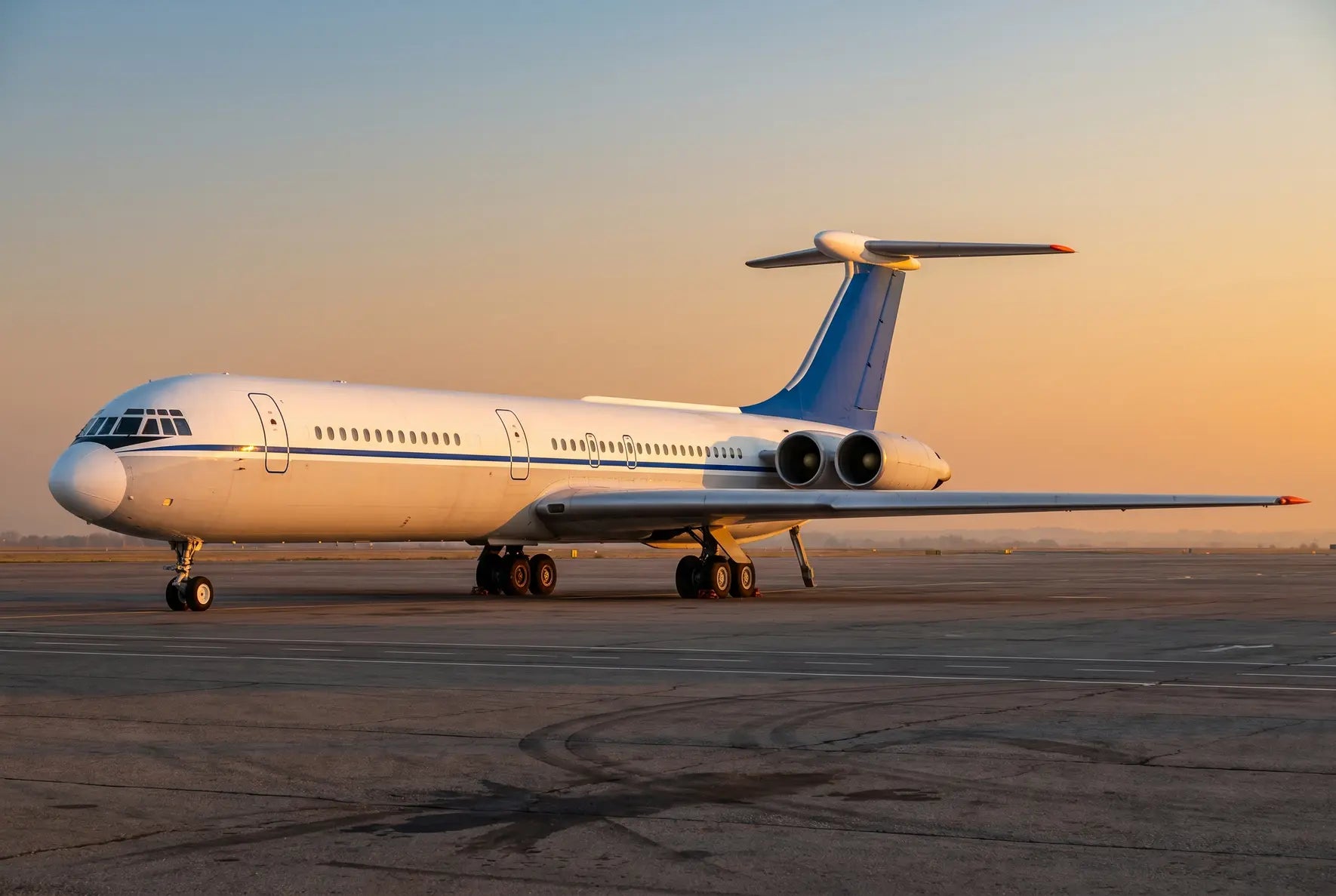
Ilyushin Il-62: History, Development, and Evolution of the Soviet Long-Range Jetliner
The Ilyushin Il-62 was the Soviet Union's first true long-range jet airliner, conceived as a successor to the turboprop Ilyushin Il-18 and designed to give Aeroflot intercontinental capability comparable to Western types such as the BAC One-Eleven-era British aerospace programmes and the Boeing 707. The aircraft was developed by the Ilyushin Design Bureau (OKB Ilyushin), a major Soviet state aircraft enterprise founded in 1933 by Sergey Vladimirovich Ilyushin and based in Moscow. The Il-62 programme was formally approved by the Soviet Council of Ministers on 18 June 1960, with instructions issued simultaneously to the Kuznetsov bureau to develop the NK-8 turbofan engine for the new airframe.
Like the British Vickers VC-10, the Il-62 adopted a distinctive rear-mounted four-engine layout with a T-tail, keeping the wings aerodynamically clean and reducing cabin noise. This configuration also included a retractable tail bumper gear to prevent the aircraft from tipping backward when parked without passengers or cargo. At the time of its maiden flight, the Il-62 was briefly the largest jet airliner in the world by passenger capacity.
Key Milestones in the Il-62 Programme
Development of the Il-62 progressed through several important phases. The first prototype taxied under its own power at Khodynka airfield in Moscow on 19 September 1962. However, the intended Kuznetsov NK-8 engines were not yet ready, forcing Ilyushin to fit temporary Lyulka AL-7 turbojets, which left the prototype significantly underpowered. The aircraft completed its first flight on 3 January 1963, piloted from the Zhukovsky flight test centre near Moscow.
The flight test programme suffered a serious setback on 25 February 1965, when a prototype was lost in an accident during testing, causing significant delays. After an extended certification and testing campaign, the Il-62 entered Aeroflot commercial service on 15 September 1967 with an inaugural passenger flight from Moscow to Montreal. This made it the backbone of Soviet long-haul operations, serving intercontinental routes to North America, Western Europe, Africa, and Asia. Several Eastern Bloc and allied carriers, including LOT Polish Airlines, CSA Czechoslovak Airlines, Interflug, Cubana, and TAROM, also operated the type.
Production was carried out at the Kazan Aviation Plant, with approximately 94 baseline Il-62 airframes completed before the production line transitioned to the improved Il-62M. In total, around 292 Il-62-family aircraft were built between 1963 and 1995, according to available production records.
What Differentiates the Il-62 from the Il-62M
The most significant evolution of the programme came with the Il-62M (where "M" stands for modifitseerovannyy, meaning modified), which entered commercial service on 9 March 1974. The Il-62M addressed several performance, efficiency, and reliability shortcomings of the original variant. Early Il-62s had experienced notable engine bearing problems on the NK-8-4 powerplants, and limited avionics contributed to operational challenges. The re-engined and upgraded Il-62M became the dominant production version, with approximately 193 series aircraft built.
The following list summarises the principal variant identifiers that distinguish the baseline Il-62 from the Il-62M:
- Engines: The original Il-62 was powered by four Kuznetsov NK-8-4 low-bypass turbofans (approximately 103 kN / 23,150 lbf thrust each), while the Il-62M uses four Soloviev D-30KU turbofans offering higher thrust, improved fuel efficiency, and lower noise.
- Exhaust and nacelle configuration: NK-8-4 engines feature dual exhausts (separate fan and core flows); D-30KU engines have a single exhaust per nacelle and bucket-type thrust reversers on the outer pair, serving as the quickest visual recognition cue.
- Fuel system: The Il-62M introduced the vertical tail (fin) as an additional fuel tank, increasing total fuel capacity and extending range by over 1,000 km compared with the baseline Il-62.
- Range: The baseline Il-62 offered approximately 9,200 km with maximum fuel and standard reserves; the Il-62M extended this to roughly 10,000 km in typical configuration.
- Maximum takeoff weight: The Il-62M features a strengthened airframe to accommodate a higher MTOW of approximately 165,000 kg. The further-reinforced Il-62MK sub-variant pushed MTOW even higher.
- Avionics: Il-62M fleets received progressively modernised navigation and communication suites, including GPS and automatic transponders on post-1991 retrofits.
A sub-variant designated Il-62MK incorporated additional structural reinforcement to support an even higher maximum takeoff weight, allowing greater payload or range on demanding routes. Several Il-62M airframes were also converted to VIP/government transport and freighter configurations, reflecting the type's operational flexibility. Detailed technical specifications for the Il-62M are documented by sources such as Air Charter Service.
Despite its age, a small number of Il-62M aircraft remained in active service well into the 21st century with operators including the Russian military, Rada Airlines of Belarus, and Air Koryo of North Korea, a testament to the durability and long service life engineered into the Il-62M airframe.

An air-to-air photograph of a Russian Air Force Ilyushin Il-62M aircraft flying through clear skies. The aircraft is painted in grey with a Russian flag on its tail fin.
Ilyushin Il-62 Technical Specifications, Systems and Engine Overview
The Ilyushin Il-62 was designed in the early 1960s by the Ilyushin Design Bureau as the Soviet Union's first long-range intercontinental jet airliner. Its primary mission was to cover distances such as Moscow to New York (approximately 7,700 km) with more than 150 passengers and reserve fuel. The aircraft's most distinctive design trade-off was the placement of all four engines in paired pods on either side of the rear fuselage, combined with a T-tail. This configuration delivered a completely clean wing, optimised for efficient long-range cruise, reduced cabin noise, and minimised asymmetric yaw in case of engine failure. It also lowered the risk of foreign object damage on unpaved or contaminated runways, a practical concern for Soviet-era operations. The Il-62 family came in two main production variants: the original Il-62 with Kuznetsov NK-8-4 engines, and the improved Il-62M with Soloviev D-30KU turbofans, which offered better fuel economy and increased range.
Structurally, the Il-62 is an all-metal, low-wing monoplane with a fail-safe semi-monocoque fuselage. The wing features a prominent saw-tooth (dog-tooth) leading edge that acts as a vortex generator and fixed droop, engineered to ensure vice-free stall behaviour and eliminate the need for automatic stall-protection devices such as stick pushers or shakers. Unlike many regional turboprops such as the ATR 72-200 that rely on simpler aerodynamic solutions for short-haul roles, the Il-62's wing was specifically tailored for high-altitude, long-range cruise while maintaining safe handling at low speeds.
- Length: 53.12 m (174 ft 3 in)
- Wingspan: 43.20 m (141 ft 9 in)
- Height: 12.35 - 12.40 m (40 ft 6 in)
- Wing area: approximately 279.6 m² (3,009 sq ft)
- MTOW: approximately 162,000 - 165,000 kg (357,000 - 363,760 lb), depending on variant
- Typical seating: 138 - 186 passengers depending on class layout
- Range (Il-62): approximately 9,200 km (4,970 nm) with full fuel
- Range (Il-62M): approximately 10,000 km (5,400 nm) with full fuel
- Cruise speed: approximately 850 - 870 km/h (Mach 0.82) at cruise altitude
- Service ceiling: approximately 12,000 - 13,000 m (39,400 - 42,650 ft)
- Engines (Il-62): 4x Kuznetsov NK-8-4 turbofans, 103 kN (23,150 lbf) each
- Engines (Il-62M): 4x Soloviev D-30KU turbofans, approximately 107.9 kN (24,250 lbf) each
- Fuel capacity: approximately 105,000 litres (Il-62M included vertical tail fuel tank)
- Takeoff field length: approximately 3,300 m (10,830 ft) at MTOW
- Landing distance: approximately 2,300 m (7,550 ft)
- Crew: five (two pilots, flight engineer, navigator, radio operator) on early variants; later reduced
Systems, Flight Controls and Onboard Technology
The Il-62 stands out among long-range airliners of its era for using fully mechanical, unboosted primary flight controls. Elevators, ailerons and rudder are operated through steel cables, rods and pulleys with aerodynamic and weight balancing. No hydraulic power-assist is used for primary surfaces. Hydraulic systems are reserved for landing gear actuation, nosewheel steering, wheel brakes, and on the Il-62M, spoiler and lift-dumper deployment. The variable-incidence tailplane is adjusted by twin electric motors. The wing features triple-section ailerons on each side, with outer sections for low-speed authority and inner sections for high-speed cruise, interlinked by a torsion bar to coordinate movement and reduce control forces.
The Il-62M introduced spoilerons (differentially deployed spoilers for roll assist at cruise) and automatic lift-dumpers that deploy on touchdown to destroy residual lift and improve braking effectiveness. Thrust reversers are fitted to the two outboard engines and, on the Il-62M, are rated for in-flight use at idle reverse during final approach to steepen the descent path.
Automation centred on the Polyot-1 automatic flight control system, described at the time as a programmable route-following autopilot capable of hands-off en-route flight under crew supervision. Standard ILS Category I approach capability was included, with Category II as an option. Early aircraft used Doppler navigation radar for ground-speed and drift correction; from 1978, the Il-62M received triplex inertial navigation system sets, and after 1991 many airframes were retrofitted with GPS/GLONASS satellite navigation receivers. Communications comprised triple VHF and HF radios suitable for oceanic routes, with ICAO-standard SSR transponders.
Published performance figures for the Il-62 vary depending on operator configuration, cabin density, actual operating weight, atmospheric conditions and runway state. Range values, for example, assume specific payload and fuel loads, and takeoff distances are strongly influenced by altitude, temperature and runway surface. Any comparison of quoted figures should account for these variables, as absolute values are rarely applicable across all operating scenarios.
Engines: Kuznetsov NK-8-4 and Soloviev D-30KU
The original Il-62 was powered by four Kuznetsov NK-8-4 low-bypass turbofan engines, each producing 103 kN (23,150 lbf) of takeoff thrust. Designed by OKB-276 (the Kuznetsov Design Bureau) in Samara, the NK-8 family was the Soviet Union's first widely used civil low-bypass turbofan in the 90 - 100 kN thrust class. The NK-8-4 features a two-shaft axial-flow layout with a bypass ratio of approximately 1.02:1, an overall pressure ratio of 10.8:1 and a dry weight of around 2,400 kg. The broader NK-8 engine family also powered other Soviet airliners: the NK-8-2 and NK-8-2U variants were fitted to the Tupolev Tu-154A/B and some Tu-134 variants. The NK-8 lineage later evolved into the NK-86 engine used on the Ilyushin Il-86 widebody.
The improved Il-62M, entering Aeroflot service in the mid-1970s, switched to four Soloviev D-30KU medium-bypass turbofans, each rated at approximately 107.9 kN (24,250 lbf). Designed by OKB-19 (the Soloviev Design Bureau, now UEC-Perm Engines) in Perm, the D-30KU offered a significantly higher bypass ratio of around 2.4:1 compared to the NK-8-4's 1.02:1. This translated into meaningfully better specific fuel consumption at cruise, which was the primary driver behind the re-engining programme and a key reason the Il-62M achieved longer range. The D-30 engine family has been one of the most widely produced Soviet/Russian turbofans, with variants powering the Ilyushin Il-76 military transport (D-30KP), the Tupolev Tu-154M (D-30KU-154) and the A-50 airborne early warning aircraft. The Il-62M also introduced the use of the vertical tail as an additional fuel tank, a modification enabled by structural confidence in the T-tail design and made practical by the D-30KU's improved fuel efficiency.
Ilyushin Il-62 vs VC10 vs Boeing 707-320B vs Douglas DC-8-62 Specifications Comparison
Scroll horizontally to see more →
| Parameter | Ilyushin Il-62 | Vickers VC10 | Boeing 707-320B | Douglas DC-8-62 |
|---|---|---|---|---|
| Entry into service | 1967 | 1964 | 1962 | 1967 |
| Engines | 4 × Kuznetsov NK-8-4 turbofans | 4 × Rolls-Royce Conway 550 turbofans | 4 × Pratt & Whitney JT3D-3B turbofans | 4 × Pratt & Whitney JT3D-3B turbofans |
| Length | 53.1 m | 48.5 m | 46.6 m | 48.4 m |
| Wingspan | 43.2 m | 44.6 m | 44.4 m | 45.2 m |
| Height | 12.4 m | 12.0 m | 12.9 m | 12.9 m |
| Typical seating and layout (short description + approximate passengers) | 2-class: 168–186 passengers | 2-class: 135–151 passengers | 2-class: 147–189 passengers | 2-class: 150–189 passengers |
| MTOW | 162 t | 151 t | 151 t | 158 t |
| Range | 4,970 nm | 5,200 nm | 5,750 nm | 5,200 nm |
| Cruise speed | 0.80 Mach | 0.86 Mach | 0.84 Mach | 0.82 Mach |
| Service ceiling | 42,700 ft | 43,000 ft | 42,000 ft | 41,000 ft |
| Program note | Soviet long-range narrow-body flagship, designed for intercontinental routes comparable to Western quadjets of the 1960s–1970s. | British rear-engined long-haul airliner optimised for hot-and-high and short-runway operations on former Empire routes. | Early U.S. intercontinental jetliner that became a benchmark long-haul aircraft for major airlines worldwide in the 1960s. | Stretched-range development of the DC-8 aimed at very long sectors, directly competing with contemporary 707 and Il-62 services. |
Scroll horizontally to see more →
The table compares four 1960s long-range quadjet airliners across size, capacity, performance and roles. The Il-62 is longest and among the heaviest (162 t MTOW) with mid-pack range (4,970 nm). The 707-320B leads range (5,750 nm) and is faster than the Il-62, while the VC10 is fastest (Mach 0.86) but carries fewer passengers. The DC-8-62 matches VC10 range (5,200 nm) with similar seating to the 707.
Ilyushin Il-62 Operations: Typical Routes, Missions and Airlines Worldwide
The Ilyushin Il-62 was designed as a long-range intercontinental airliner, purpose-built to connect distant capitals on sectors typically spanning 5,000 to 10,000 km. With a normal cruise speed of approximately 850 to 870 km/h (Mach 0.80 to 0.82) at around 10,500 m altitude, the aircraft was suited for flights lasting 8 to 12 hours. On its flagship Moscow to New York route (roughly 7,700 km), block times averaged around 9 to 9.5 hours westbound. The longest regular scheduled missions, such as Moscow to Havana (approximately 9,500 km), could exceed 12 hours of flight time, often requiring intermediate fuel stops depending on the variant and payload.
Operationally, the Ilyushin Il-62 functioned primarily in a hub-and-spoke model centred on major national gateways. Aeroflot based most long-haul operations at Moscow-Sheremetyevo, radiating routes to Europe, North America, Asia, and Africa. Other Eastern Bloc national carriers similarly used their capital airports as the sole intercontinental hub. The aircraft required long runways, with an Il-62M takeoff distance of approximately 2,380 m (7,810 ft), limiting operations to major international airports rather than secondary or regional fields. Daily utilisation on long-haul schedules typically involved one or two sectors per day, estimated at roughly 6 to 10 block hours per aircraft per day, reflecting the lengthy turnaround and maintenance cycles common to long-range operations of that era. A comparable concept in long-range four-engined operations, though from an earlier generation, was the Douglas DC-7, which served a similar intercontinental role for Western airlines before the jet age.
Operators faced several well-documented challenges. The four rear-mounted engines required reinforced fuselage and wing structures, adding weight and reducing fuel efficiency. Early Il-62 variants powered by Kuznetsov NK-8-4 engines suffered from reliability issues including bearing failures and false fire warnings. The T-tail configuration created a risk of deep stall, requiring automatic stall-prevention systems that were not always dependable by 1960s standards. By the 1990s, high fuel consumption relative to newer twin-engine widebodies made the type increasingly uneconomical, accelerating its withdrawal from service with most operators. According to Wikipedia, the type experienced 23 hull losses during its operational life.
Where the Ilyushin Il-62 Operated: Airlines and Regions
The Ilyushin Il-62 served over 30 nations and was exported to more than 80 operators across four continents. In Europe, it was the backbone of Soviet and Eastern Bloc intercontinental air travel, connecting state capitals to destinations worldwide. In Asia, it served routes between Moscow and the Far East, as well as government and state airline operations. Across Africa, the type appeared with flag carriers closely aligned with the Soviet Union, operating trunk routes between African capitals and Moscow or Eastern European cities. In the Americas, Cuba was the primary operator, using the aircraft on transatlantic routes to the Soviet Union and Europe.
The aircraft saw its most intensive use during the 1970s and 1980s, when COMECON-aligned states relied on Soviet-built equipment for long-haul connectivity. As political alliances shifted and more efficient Western-built aircraft became available, most operators retired their Il-62 fleets during the 1990s and 2000s. By the 2020s, only a handful remained active, mainly in cargo, government transport, and very limited passenger roles.
- Europe: Aeroflot was the launch and principal operator, inaugurating service on the Moscow to Montreal route in September 1967 and eventually deploying the type across intercontinental networks to New York, Havana, Tokyo, Delhi, and numerous African capitals. Interflug (East Germany) used the Il-62 as its primary long-haul jet from Berlin-Schoenefeld to Havana, Luanda, and Maputo. LOT Polish Airlines operated the type on its Warsaw to New York and Warsaw to Chicago routes throughout the 1970s and 1980s. CSA Czechoslovak Airlines flew Il-62s from Prague to Havana and Montreal. TAROM (Romania) connected Bucharest with New York, Beijing, and several African capitals. Rada Airlines (Belarus) operated Il-62MGr freighter variants on cargo charters into the 2020s, making it one of the last commercial operators of the type.
- North and South America: Cubana was the sole major operator in the Americas, using the Il-62 on its Havana to Moscow flagship route and services to Eastern European cities. Guyana Airways was the only South American airline to operate the type, linking Georgetown with Havana and onward Eastern Bloc destinations.
- Asia: Air Koryo (North Korea) is among the last known passenger operators, with two Il-62Ms reportedly still in its fleet as of recent years, used on routes from Pyongyang to Vladivostok and historically to Moscow and Beijing. CAAC (China) operated the type in the 1970s on long-haul routes from Beijing to Moscow and Eastern Europe before transitioning to Western aircraft. Air India briefly leased Il-62s for capacity on India to USSR and European routes.
- Africa: TAAG Angola Airlines used the Il-62 on the Luanda to Moscow route, often with intermediate stops, and on services to Cuba and Eastern Europe. LAM Mozambique Airlines connected Maputo with Moscow, a sector of approximately 8,600 km. EgyptAir and Libyan Arab Airlines both operated the type in the 1970s on routes to Moscow and Eastern European capitals.
Typical Seating Configurations on the Ilyushin Il-62
The Ilyushin Il-62 featured a narrow-body fuselage with a cabin width of approximately 3.49 m and a single aisle. The standard economy layout used a six-abreast (3+3) arrangement, a configuration it shared with Western contemporaries of similar dimensions. Seat pitch in economy typically measured around 84 to 86 cm (33 to 34 inches).
In a standard two-class configuration, the aircraft seated approximately 150 passengers, with around 12 business-class seats and 138 in economy, spread across two cabin sections separated by a central galley vestibule. A typical single-class high-density layout accommodated 168 passengers in 28 rows, as documented for Interflug, while the structural exit limit allowed up to 186 seats. According to Air Charter Service, the theoretical maximum in a single-class configuration reached 198 passengers, though most scheduled airlines stayed within the 150 to 186 range. VIP and government variants used low-density salon layouts with as few as 86 seats, featuring private compartments and conference areas. The Il-62M variant, while introducing improved engines and enclosed overhead bins, did not fundamentally change the cabin cross-section or seating geometry. Detailed performance and cabin specifications can be reviewed on SKYbrary.
In this video, discover the story of the Ilyushin Il-62, once the world’s largest plane. Learn how it was designed, what made it stand out in its era, and why it remains a notable aircraft in aviation history.
Ilyushin Il-62 Safety Record: Accidents, Incidents and How Safe Is It?
The Ilyushin Il-62 entered airline service with Aeroflot in September 1967 and remained in commercial operation for over five decades. A total of 292 airframes were built between 1963 and 1995, including 94 original Il-62s, 193 improved Il-62M variants and five prototypes. Throughout its service life, the type accumulated approximately 23 hull losses and 12 fatal accidents in civilian operations, resulting in roughly 1,100 fatalities according to data compiled by the Aviation Safety Network. While those figures appear high in isolation, they must be weighed against the aircraft's decades of continuous use across dozens of operators, many of which flew in regions with less developed aviation infrastructure and lower regulatory oversight than Western Europe or North America.
Notable Accidents and Their Impact on Safety
Several major accidents shaped the operational history and design evolution of the Il-62 family. The following events illustrate the most significant safety lessons learned.
- Interflug Flight 450, 14 August 1972 (Konigs Wusterhausen, East Germany): An Interflug Il-62 (registration DM-SEA) crashed shortly after departure from Berlin-Schonefeld, killing all 156 people on board. The investigation determined that an in-flight fire broke out in the rear fuselage, caused by overheating components in the tail equipment bay. The fire burned through flight-control cables, leading to loss of controllability and in-flight structural failure. This accident prompted significant redesigns to the Il-62 tail compartment, including improved routing and protection of control cables, better fire-detection sensors in the rear fuselage, and use of more fire-resistant insulation materials. Many of these improvements were incorporated into the Il-62M variant.
- Aeroflot Flight 217, 13 October 1972 (Moscow-Sheremetyevo, USSR): An Il-62 (registration CCCP-86671) descended below the correct glide path during a night approach in poor visibility and struck terrain approximately 11 km from the airport, killing all 174 occupants. Classified as a controlled flight into terrain (CFIT) event, the accident was attributed primarily to crew error during instrument approach. No conclusive evidence of a major mechanical failure was found. Soviet aviation authorities responded by tightening instrument-approach procedures and minimum descent altitude requirements, and by enhancing crew training for low-visibility operations at major airports.
- LOT Polish Airlines Flight 5055, 9 May 1987 (near Warsaw, Poland): This remains the deadliest accident involving the Ilyushin Il-62. An Il-62M (registration SP-LBG) suffered an uncontained failure of engine number 2 shortly after take-off from Warsaw for New York. The Soloviev D-30KU engine's shaft disintegrated due to defective roller bearings, sending debris into the rear fuselage. The resulting fire burned through flight-control cables, and the crew lost control while attempting an emergency return. All 183 people on board perished. In response, Soviet authorities imposed stricter quality-control standards for engine bearing manufacture, improved fire-detection and suppression systems in the aft fuselage, and enhanced the protection and routing of control cables. LOT subsequently equipped its remaining Il-62M fleet with engine vibration monitoring gauges and eventually transitioned to Western-built widebodies.
Each of these events led to tangible improvements in aircraft design, operational procedures, or manufacturing quality control. The progression from the original Il-62 to the improved Il-62M variant reflected many of these hard-won lessons, particularly in fire protection, structural reinforcement and engine reliability.
How Safe Is the Ilyushin Il-62?
Evaluating the safety of the Il-62 requires context. According to comparative analyses based on Bureau of Aircraft Accidents Archives (BAAA) and Aviation Safety Network data, the Il-62 had a hull-loss rate of approximately 0.12 per airframe built, compared with roughly 0.17 for the Boeing 707. Within the peer group of comparable long-range airliners of the same era, including the Boeing 707, Douglas DC-8 and Vickers VC10, the Il-62M variant recorded the lowest hull-loss rate when normalised for fleet exposure. That said, Il-62 hull-loss events tended to be more lethal on average, with fewer survivable outcomes, partly because many operators flew in environments with limited emergency response infrastructure.
The Il-62's rear-mounted, four-engine layout concentrated critical systems in the tail section, a design philosophy shared with the VC10. While this configuration offered aerodynamic advantages, it also meant that an uncontained engine failure or a fire in the aft fuselage could compromise multiple control systems simultaneously. This vulnerability was progressively addressed through structural modifications, improved fire protection and more robust control-cable routing in later production aircraft.
Modern commercial aviation is governed by rigorous safety frameworks, including standardised operating procedures (SOPs), crew resource management (CRM) training and continuous airworthiness oversight. Pilots preparing for careers in the industry can explore how these principles are assessed during the hiring process through resources such as common pilot interview questions and preparation tips. The SKYbrary Il-62 reference page also provides a useful technical overview of the type's operational characteristics.
Ultimately, the Ilyushin Il-62's safety record is a product of its era. It operated for decades under vastly different regulatory environments and maintenance standards compared with today's global aviation system. While its accident history carries important lessons, it is worth noting that commercial aviation remains statistically one of the safest modes of transport, a status achieved through the continuous cycle of investigation, design improvement and procedural reform that aircraft like the Il-62 helped drive.
01 What kinds of routes and missions was the Ilyushin Il-62 mainly used for?
The Ilyushin Il-62 was designed as a long‑range jet airliner and was widely used on intercontinental routes linking the Soviet Union and Eastern Europe with destinations in North America, Asia, and Africa. It typically flew sectors of 6–9 hours, with a maximum range of around 9,000–10,000 km depending on version and payload. Flag carriers such as Aeroflot and LOT Polish Airlines used the Il‑62 on prestige routes like Moscow–Havana, Moscow–Tokyo, and Warsaw–New York. Later in its life, many aircraft moved to charter work, governmental and VIP transport, and niche long‑haul services from the CIS and North Korea.
02 What is the cabin layout and passenger experience like on the Ilyushin Il-62?
The Ilyushin Il-62 typically features a single‑aisle cabin in a 2‑3 or 3‑3 seating configuration, depending on airline and class layout. The cabin cross‑section is comparable to early Western wide single‑aisle jets, offering reasonable shoulder room but less overhead storage than modern aircraft. Because the four engines are mounted at the rear, the front and mid‑cabin areas are relatively quiet in cruise, while seats closer to the tail experience more engine noise and vibration. Interior comfort, lighting, and materials vary significantly between original Soviet‑era interiors and later refurbished VIP or charter configurations.
03 How does the Ilyushin Il-62 compare to similar long-range airliners like the Boeing 707 or Douglas DC-8?
The Ilyushin Il-62 is broadly comparable in size, range, and era to the Boeing 707 and Douglas DC‑8, but uses a rear‑engine, T‑tail layout rather than under‑wing engines. This configuration can provide a quieter cabin forward of the wing and a clean wing for aerodynamic efficiency, but adds structural weight in the rear fuselage and tail. Early Il‑62s with NK‑8 engines were generally less fuel‑efficient and noisier than later Western jets, though the upgraded Il‑62M with Soloviev D‑30KU engines improved range, performance, and reliability. In service, Western types tended to dominate global commercial fleets, while the Il‑62 filled a similar long‑haul role primarily within the Soviet sphere and select export markets.
04 Which airlines and operators still use the Ilyushin Il-62 today, and on what types of flights?
The Ilyushin Il-62 has almost completely disappeared from mainstream commercial service, but a small number remain active with state, military, and niche operators. Air Koryo of North Korea has been one of the most visible commercial users in recent years, typically employing the type on regional and occasional longer‑range routes, although schedules and utilization are irregular. Several Il‑62s are operated by Russian government and military organizations, often in VIP, transport, or special‑mission roles rather than scheduled passenger service. Aviation enthusiasts interested in flying on an Il‑62 generally need to look for rare charter flights, enthusiast tours, or special events, as regular ticketed routes are increasingly uncommon.
05 What is the safety record of the Ilyushin Il-62 and are there any notable design features related to safety?
The Ilyushin Il-62 has experienced a number of hull‑loss accidents over its long service life, reflecting both the era of its design and operational practices in the environments where it flew. The improved Il‑62M, introduced with more powerful and reliable engines and system upgrades, is generally regarded as having a better safety and reliability record than the original Il‑62. Notable design features include a distinctive rear fuselage tail‑support strut (or “tail stand”) to prevent tipping during loading, powerful wheel brakes and thrust reversers for operation from relatively long but sometimes less‑developed runways, and structural reinforcement of the tail to handle the four‑engine installation. As with many classic jets, remaining aircraft today are typically maintained to specialized standards and used by experienced operators, but they lack modern safety systems like the latest flight‑deck automation and avionics found on new‑generation airliners.
06 What should a passenger know when choosing a seat on an Ilyushin Il-62 flight?
On the Ilyushin Il-62, seats in the forward cabin tend to offer a quieter ride with less engine noise because the four engines are mounted at the rear. Passengers sensitive to noise or fumes usually prefer seats ahead of the wing, while enthusiasts often favor seats near the rear to better hear and feel the classic jet engines. The Il‑62’s relatively high wing loading and sturdy structure can give a slightly firmer feel in turbulence compared with some modern widebodies, but overall ride comfort is comparable to other classic long‑haul jets. Window alignment varies by cabin layout and airline, so checking seat maps or online trip reports for a specific operator can help travelers choose a seat with a good view or away from galley and lavatory areas.