

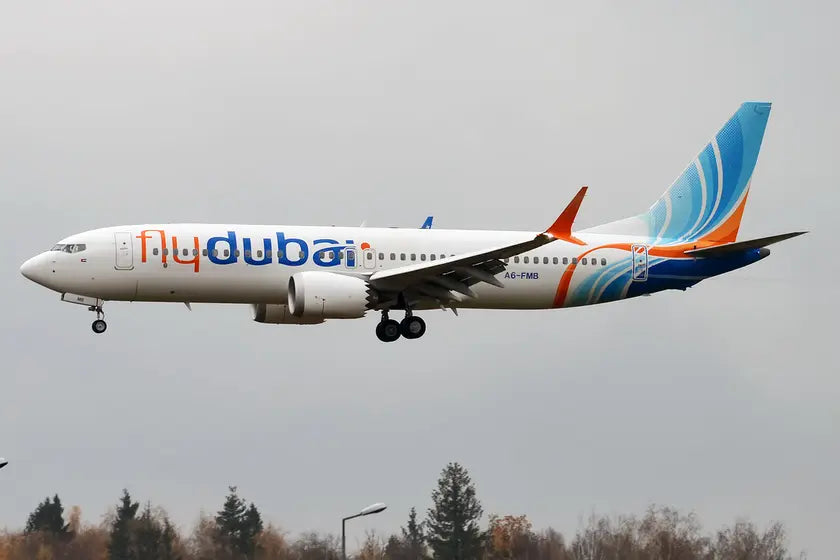
flydubai Overview & Company Profile
flydubai is a Dubai-based hybrid carrier established by the Government of Dubai in 2008, with commercial operations beginning in June 2009. It is wholly owned by the emirate through the Investment Corporation of Dubai (ICD), the same sovereign investment vehicle that holds Emirates. The airline operates an all-Boeing 737 narrowbody fleet from its home base at Dubai International Airport (DXB), historically out of Terminal 2 with a growing presence at Terminal 3 for connections feeding the Emirates network. For pilots, the key point is that flydubai is a fully independent company with its own Air Operator Certificate, its own seniority and its own contracts, entirely separate from Emirates even though the two cooperate closely on the commercial side.
The business model sits between a pure low-cost carrier and a full-service airline: lean operations and high aircraft utilisation, but with a business class cabin on most aircraft and an extensive codeshare with Emirates that turns flydubai into a regional feeder for long-haul traffic at DXB. flydubai is not a member of any of the three global alliances. According to the airline's 2025 full-year results published on news.flydubai.com, flydubai carried 15.7 million passengers in 2025 and generated revenue of AED 13.6 billion (about USD 3.7 billion), with a profit before tax of AED 2.2 billion. By the end of 2025 the network had grown to around 140 destinations across more than 55 countries, spanning the GCC, the wider Middle East, the Indian subcontinent, Africa, Central Asia, the Caucasus, and Central and Eastern Europe.
The flydubai and Emirates relationship is central to understanding the airline's role. Through a wide-ranging codeshare, Emirates places its EK code on a large number of flydubai-operated 737 sectors, allowing passengers to combine an Emirates widebody flight with a flydubai connection on a single ticket. For pilots, this means many flydubai schedules are timed to feed the Emirates long-haul banks at DXB, producing peaks of early-morning arrivals and late-evening departures. It also explains the airline's resilience: as a government-owned, consistently profitable carrier with a structural feed role, flydubai has expanded steadily where many global airlines retrenched. Pilots should note that flydubai's official disclosures report total staff (6,763 at the end of 2025) rather than a precise pilot headcount, so the figure of roughly 1,000 or more flight crew is an industry estimate based on a fleet of 97 aircraft and standard narrowbody crewing ratios.
Fleet Composition & Type Ratings
flydubai operates one of the most homogeneous fleets of any sizeable carrier in the region: every aircraft in service is a member of the Boeing 737 family. At the end of 2025 the airline reported a fleet of 97 aircraft with an average age of just 5.5 years, making it one of the youngest narrowbody fleets in the Middle East. The fleet blends the older Boeing 737-800 (Next Generation) with the newer 737 MAX 8 and a small number of 737 MAX 9. The MAX now forms the clear majority of the fleet, with older 737-800s being progressively returned to lessors as new MAX frames arrive (three 737-800s were returned during 2025 while twelve MAX 8s were delivered).
| Aircraft Type | Role | In Service (approx.) | Notes |
|---|---|---|---|
| Boeing 737-800 (NG) | Narrowbody | ~26 | The original backbone of the fleet. Being phased out and returned to lessors as MAX deliveries continue. |
| Boeing 737 MAX 8 | Narrowbody | ~64 | Now the dominant type. More fuel efficient and longer range than the 737-800. Twelve delivered in 2025. |
| Boeing 737 MAX 9 | Narrowbody | ~3 | Longer fuselage, higher seat count. Deployed on selected higher-demand sectors. |
| Boeing 787-9 Dreamliner | Widebody (on order) | 0 in service | 30 ordered (announced Nov 2023). First widebodies in flydubai history, due from 2026. |
Fleet total of 97 is the official end-of-2025 figure. The subtype split is approximate (flydubai does not publish a current breakdown); the last official breakdown was 30 x 737-800, 47 x MAX 8 and 3 x MAX 9 in November 2023.
The order book is substantial. According to Boeing's investor disclosures and flydubai's own announcements, the airline holds a backlog of more than 130 Boeing 737 MAX aircraft scheduled for delivery through 2035, the legacy of a landmark order placed at the 2017 Dubai Airshow. In November 2023, flydubai broke from its single-aisle history by ordering 30 Boeing 787-9 Dreamliners, its first widebodies, in a deal valued at roughly USD 11 billion (details on investors.boeing.com). Those Dreamliners are due to begin arriving from 2026 and will open longer-range markets that a 737 cannot economically serve.
Because the operating fleet is entirely Boeing 737, pilots hold a single 737 type rating that covers both the 737-800 and the MAX, with a short differences course bridging the two. flydubai funds the type rating for recruited pilots but applies a training bond (see the Recruitment section). The all-737 structure simplifies training and rostering, but it also means narrowbody flying is the day-to-day reality for years. The arriving 787-9 will eventually create a separate widebody pathway, though initial Dreamliner crewing is likely to rely on a mix of external widebody recruits and internal upgrades, with the scale of internal opportunity depending on how quickly that fleet grows.
Pilot Salary & Compensation Breakdown
flydubai is unusually transparent about pay for a Gulf carrier: its careers portal (careers.flydubai.com) publishes headline monthly package figures for each pilot rank. Compensation has two parts: a fixed monthly package that bundles basic salary, housing allowance and transportation allowance, plus a variable flying pay component that rises and falls with block hours flown. The published flying-pay figures assume an average month of 70 block hours. Critically, all of this is paid in UAE dirhams and is tax-free under the UAE's personal taxation regime, which materially raises the net value compared with equivalent European gross salaries.
First Officer & Second Officer Pay
| Rank / Phase | Fixed Package (AED/mo) | Variable Flying Pay (~70 hrs) | Est. Total (AED/mo) | Est. Annual (tax-free) |
|---|---|---|---|---|
| Second Officer, Phase 0 (type rating, ~3 mo) | Unpaid | n/a | n/a | n/a |
| Second Officer, Phase 1 (assessment) | 14,300 | included | ~14,300 | ~AED 172,000 |
| Second Officer, Phase 2 (until 1,500 hrs) | 23,015 | included | ~23,015 | ~AED 276,000 |
| First Officer | 35,250 | ~11,410 | ~46,660 (USD ~12,700) | ~AED 560,000 (USD ~152,000) |
Fixed package = basic salary + housing + transportation. Figures from flydubai's careers pages for First and Second Officers. Flying pay scales with actual block hours, so totals vary month to month.
Captain Pay
| Rank | Fixed Package (AED/mo) | Variable Flying Pay (~70 hrs) | Est. Total (AED/mo) | Est. Annual (tax-free) |
|---|---|---|---|---|
| Captain (B737-800 / MAX) | 48,485 | ~16,310 | ~64,795 (USD ~17,640) | ~AED 778,000 (USD ~212,000) |
Captain figures combine the published fixed package with estimated flying pay at 70 block hours. High-utilisation months push total pay higher; quieter months sit closer to the fixed package. A non-type-rated captain typically draws a reduced stipend (reported around AED 22,465/month) during the conversion and training period before moving onto the full command scale.
To put these numbers in context: a flydubai First Officer earns an estimated tax-free total of roughly AED 46,660 per month (around USD 12,700), while a 737 Captain earns roughly AED 64,795 per month (around USD 17,640). Because there is no income tax in the UAE, the headline figure is close to the take-home figure for many expatriate pilots, subject to any home-country tax obligations. That makes flydubai's narrowbody pay competitive within the region and often stronger in net terms than a comparable European short-haul job, even if it sits below an Emirates or Qatar Airways widebody command.
The fixed-package figures are drawn directly from flydubai's published careers pages, but the flying-pay and total figures are estimates built on a 70-hour average and current exchange rates (the AED is pegged to the US dollar at about 3.67). flydubai does not publish seniority-stepped pay scales the way some unionised carriers do, so there are no guaranteed annual increments shown here. Actual earnings depend on block hours flown, rank, the prevailing recruitment campaign, and any contract-specific terms. Always confirm the current package directly with flydubai recruitment before making a career decision.
Roster Pattern & Quality of Life
Pilot duty and rest at flydubai are governed by the UAE General Civil Aviation Authority (GCAA) flight and duty time limitations, broadly comparable to the EASA framework. The headline regulatory caps are 100 flight hours in any 28 consecutive days and 900 flight hours in any 12 consecutive months. These are absolute ceilings; company planning normally sits below them. flydubai advertises 42 days of paid annual leave per year for pilots on its First Officer careers page, and pilot reports describe a legal minimum of roughly 8 days off per month, typically rostered in blocks of two to three days, with many months delivering closer to 10 to 12 days off.
📅 Illustrative Month — Boeing 737 First Officer (Dubai base)
This grid is illustrative rather than an official published roster: it reflects the reported pattern of roughly 11 days off, blocks of duty interspersed with rest, standby coverage and recurrent training. The lived reality of flying short and medium haul out of Dubai is intensive. Many sectors are same-day returns of two to four hours (for example Dubai to Kuwait and back, or multi-sector days), so pilots often sleep at home, but the trade-off is multiple takeoffs and landings, fast turnarounds of 30 to 45 minutes, and a mix of very early reports and late-night finishes built around the Emirates connection banks. Fatigue management is therefore a genuine consideration, and flydubai operates a GCAA-mandated Fatigue Risk Management System through which pilots are expected to report and decline duty when unfit.
flydubai operates a single pilot base in Dubai. There is no base-bidding system and no widely advertised commuting contract that lets pilots live abroad and travel in for duty blocks, as some European low-cost carriers offer. The expectation is that pilots relocate to Dubai, where the housing element of the package helps offset rent. Dubai offers a modern, cosmopolitan lifestyle, tax-free income, excellent global connectivity and year-round sunshine, but it also brings high summer temperatures, a high cost of living for family accommodation and international schooling, and residency tied to employment. Pilots whose families remain in their home country must weigh the cost and fatigue of self-funded commuting against relocating.
Benefits, Travel Perks & End of Service
flydubai's benefits follow the standard Gulf expatriate template, structured around tax-free cash and a set of allowances rather than the defined-benefit pension common at European legacy carriers. The benefits listed on the airline's official First Officer vacancy give a clear picture of what is on offer, although the precise monetary value of several items (such as the education allowance) is not published and must be confirmed with HR during recruitment.
A point that genuinely matters for long-term planning is the absence of a traditional pilot pension. Unlike a French CRPN or a legacy defined-benefit scheme, flydubai pilots rely on the statutory end-of-service gratuity plus their own private savings and investments, funded out of tax-free income. The gratuity is a meaningful lump sum after a long tenure, but because it is calculated on basic salary rather than total package, it is smaller than a pilot might expect when anchoring on headline monthly pay. Disciplined pilots treat the tax-free margin as the real retirement vehicle, channelling it into private pensions or investments at home.
The headline appeal of a flydubai package is simple: zero UAE income tax. For a single pilot or a couple without children, the maths can be strongly favourable, especially with careful spending. For a pilot with a family, however, Dubai's cost of living can erode the advantage quickly, with international school fees frequently running into tens of thousands of dirhams per child per year and family rents well above what the bundled housing element covers. The right comparison is never the gross headline against a European gross salary, but net disposable income and savings potential after Dubai living costs are factored in. flydubai sits comfortably above pure low-cost regional operators on benefits, but its package is leaner than full-service Emirates, particularly on schooling and housing support.
Career Progression & Seniority
Career progression at flydubai is shaped by fleet growth, pilot turnover, individual performance and an internal seniority structure. Unlike strictly seniority-only legacy carriers, flydubai does recruit Direct Entry Captains from the external market to meet command needs, which means an experienced 737 commander can join straight into the left seat rather than waiting years for an internal upgrade. For First Officers already inside the airline, command upgrade depends on accruing the required 737 hours and command experience, passing a command assessment, and the availability of vacancies driven by the delivery of new aircraft and the departure of retiring captains.
flydubai does not publish a guaranteed upgrade timeline. Drawing on the airline's own command requirements and typical Gulf-carrier practice, a realistic expectation for an internal First Officer to reach command is somewhere in the region of five to eight years, though this is an industry-informed estimate rather than a published figure and will move with the pace of fleet expansion. With a backlog of more than 130 MAX aircraft to 2035 and the first 787 widebodies arriving from 2026, the structural direction of travel favours upgrade opportunities over the medium term.
| Career Milestone | Typical Timeline | Notes |
|---|---|---|
| Ab-initio cadet (UAE nationals, MPL) | ~18-24 months | Zero-to-737 MPL pathway. First intake reported for late 2025. |
| Second Officer to First Officer | At 1,500 hrs | Low-hour licensed entry. Transition to F/O once 1,500 hours are logged. |
| Join as First Officer (direct) | Day 1 | Type-rated or non-type-rated, subject to hours minima and GCAA conversion. |
| Command upgrade (internal F/O to Captain) | ~5-8 years (est.) | Performance plus command assessment. Not officially published; varies with growth. |
| Direct Entry Captain | Day 1 (external) | For experienced 737 commanders meeting the hours requirements. |
| Future widebody (Boeing 787) | From 2026 | New pathway as the Dreamliner fleet builds. Internal opportunity scale still to be defined. |
flydubai is in a sustained growth phase. The fleet expanded from 88 aircraft at the end of 2024 to 97 at the end of 2025, the network reached around 140 destinations, and the airline announced plans to recruit more than 130 pilots during 2024 alone. That growth, combined with the MAX backlog and the incoming Dreamliners, is the single biggest driver of career velocity here: command timelines and widebody openings will track how fast aircraft arrive. The flip side is that Direct Entry Captain hiring, while it stabilises operations, can slow internal upgrade prospects if used heavily, a tension worth raising directly with recruitment when you evaluate an offer.
Recruitment Process & Requirements
flydubai runs several distinct entry routes, published on careers.flydubai.com: an Ab-initio (MPL) cadet programme for UAE nationals, a Second Officer bridge for low-hour licensed pilots, First Officer recruitment for experienced pilots, and Direct Entry Captain hiring. Across every pilot role the airline requires a valid ICAO Class 1 medical and ICAO English Language Proficiency Level 4 or above, and non-GCAA licence holders convert to a UAE GCAA licence after selection.
First Officer — Requirements
Direct Entry Captain — Requirements
Second Officer & Ab-Initio Cadet — Requirements
Selection Stages
Online Application & Screening
Apply through the flydubai careers portal, submitting CV, licence details, logbook summary and medical status. Applications are screened against the hours, licence, age and recency criteria for the relevant role.
Aptitude & Psychometric Testing
Shortlisted candidates complete online or in-person testing covering cognitive ability, multitasking, psychomotor coordination and personality profiling. Cadet and Second Officer routes also include an English assessment.
Group Exercise & Interview
Group tasks and a panel interview assess communication, teamwork, crew resource management, cultural fit and decision-making under pressure, key competencies for multi-crew short-haul operations.
Simulator Assessment
A full-flight 737 simulator evaluation of manual handling, instrument scan, briefings, checklist discipline and CRM. This is a decisive stage for experienced-pilot recruitment.
Medical, GCAA Conversion & Training
A conditional offer leads to a GCAA Class 1 medical, licence conversion or validation, and (where needed) type rating training in Dubai under a training bond, followed by line training.
flydubai funds type rating training but applies a training bond: USD 24,000 for type-rated joiners and USD 36,000 for non-type-rated joiners, over a three-year term, repaid via salary deduction. The Second Officer route is the structured low-hour entry for CPL holders with a frozen ATPL: it begins with roughly three months of unpaid type rating (Phase 0), then a paid assessment phase at AED 14,300 per month (Phase 1), then AED 23,015 per month (Phase 2) until 1,500 hours, at which point the pilot transitions to First Officer. The Ab-initio MPL programme, by contrast, is open only to UAE nationals; flydubai has indicated it expects to reopen applications for a 2026 intake.
Top Layover Destinations
flydubai is short and medium haul at its core, so a large share of flying consists of same-day returns where the crew sleeps at home. That said, the network does include genuine longer routes (and seasonal leisure markets) that generate overnight layovers, because schedule design and flight time limitations make them impossible to fly out-and-back in a single duty. The airline's longest route is Dubai to Penang in Malaysia at roughly 6.5 hours, and other long sectors reach Thailand, Tanzania, the Maldives and Central Europe. On these pairings the crew rests at a flydubai-contracted hotel before operating the return. The five destinations below are a representative cross-section of where layovers actually occur, not a ranked seniority list.
Most of the flydubai network is flown as same-day returns, so overnight layovers are the exception rather than the rule and concentrate on the longest and most leisure-oriented routes. Where layovers do occur, hotels are contracted by the airline and transport between hotel and airport is provided. Under GCAA flight time limitations, the crew must receive an adequate rest opportunity before the next duty, and longer sectors closer to the limit are deliberately built with an overnight. Which layovers a pilot sees is driven by fleet scheduling and the route mix rather than a US-style bidding system.
How flydubai Compares: Airline Radar Chart
The most useful benchmarks for flydubai are its two closest UAE peers: Emirates, the long-haul widebody giant sharing the same owner and hub, and Air Arabia, the Sharjah-based low-cost carrier flying a comparable short and medium haul model on Airbus narrowbodies. The radar below scores all three across the same six metrics used in the scorecard. Scores are editorial estimates based on publicly available data, official figures and pilot community feedback.
Key Takeaways from the Comparison
Emirates leads on top-end pay and benefits. An Emirates widebody command on the A380 or 777 outearns a flydubai 737 captain, and Emirates has historically offered more generous housing and schooling support. Both airlines share the same tax-free environment and the same Dubai cost base, so the gap is real but narrower in net terms than the gross headline suggests. flydubai's advantage is the speed of entry: it recruits Direct Entry Captains and runs structured low-hour pathways, whereas Emirates is a widebody-only operation with its own competitive selection.
flydubai sits above Air Arabia on pay and benefits. Air Arabia runs a leaner, cost-focused model from Sharjah on Airbus A320-family aircraft, and pilot packages are generally somewhat below flydubai's, partly offset by lower living costs in Sharjah. For a pilot choosing between the two UAE narrowbody operators, flydubai typically offers the stronger package and the Boeing 737 (with a future 787 pathway), while Air Arabia offers Airbus experience and a different base.
Fleet modernity is a flydubai strength. With an average fleet age of just 5.5 years and a rapidly growing MAX fleet, flydubai flies one of the youngest narrowbody fleets in the region. Emirates scores higher on fleet for sheer widebody scale and variety, while Air Arabia's all-Airbus fleet is modern but smaller and less varied.
Work-life balance is the shared regional weak spot. Both flydubai and Air Arabia run intensive short-haul rosters with early starts, late finishes and multiple sectors, so neither scores highly on lifestyle. Emirates edges ahead on days off and time structure thanks to long-haul rotations, though at the cost of more nights away from home.
Scores are editorial estimates derived from official airline disclosures, published careers-page salary data, GCAA regulations, and pilot community sources. They reflect a general assessment for an experienced pilot weighing a long-term career, not a guarantee for any individual. Emirates and Air Arabia scores in particular are directional benchmarks and will be refined as dedicated guides are published for each carrier. Individual experience varies with rank, fleet, seniority and personal priorities.
Pilot Representation & Industrial Relations
The industrial-relations picture at flydubai is fundamentally different from that of a European or North American carrier, and any pilot considering the move needs to understand it clearly. The United Arab Emirates does not permit independent trade unions, and collective bargaining as practised in Europe or the US is not part of the legal framework. There is therefore no recognised flydubai pilot union, no collective agreement negotiated on the pilots' behalf, and no legal right to strike. This applies equally to Emirates, Air Arabia and every other UAE-based airline; it is a feature of the jurisdiction, not of any one company.
In place of unions, employment terms are set by individual contracts under UAE Labour Law, which establishes minimum standards for leave, end-of-service gratuity, notice periods and termination. Pilot concerns are raised through internal channels: company communication forums, surveys, and informal or semi-formal pilot representation that liaises with management but holds no legal bargaining status. Disputes that cannot be resolved internally fall under the UAE Ministry of Human Resources and Emiratisation (MOHRE) and the formal labour-dispute mechanism, rather than industrial action. Pilots remain free to resign and change employer, subject to contractual notice and any outstanding training bond.
In a tight global pilot market, that freedom to leave is the main form of leverage available to crews, and it makes retention a live commercial concern for the airline. Experienced 737 pilots have options in Europe, North America and across Asia, so flydubai has an incentive to keep its package competitive. This dynamic helps explain the transparent, regularly refreshed pay figures on its careers portal and the structured benefits on offer. Prospective pilots should still calibrate expectations: without a union backstop, pay scales, roster rules and policy changes are ultimately management decisions, and the lived experience of rostering and fatigue depends heavily on company culture.
Fatigue and rostering have been recurring themes in discussions about intensive Gulf short-haul flying generally, and flydubai is part of that conversation. The 2016 loss of flydubai Flight 981, a Boeing 737-800 that crashed during a go-around in poor weather at Rostov-on-Don, prompted wide industry discussion of crew fatigue and night-operation rostering; the official investigation pointed primarily to spatial disorientation during the manual go-around, while fatigue and rostering featured in the broader debate that followed. As a GCAA-regulated operator, flydubai runs a Safety Management System and a Fatigue Risk Management System, and pilots are both empowered and obligated to report fatigue and decline duty when unfit. The point for a prospective pilot is not alarm but awareness: short-haul intensity is the defining quality-of-life factor here, and a healthy reporting culture matters more than any single statistic.
Verdict: Who Is flydubai For?
🎯 Our Take
flydubai is one of the most accessible and fastest-growing pilot employers in the Middle East. The combination of tax-free pay, a young all-Boeing 737 fleet, transparent published salary figures, multiple entry routes from cadet to Direct Entry Captain, and a base in one of the world's best-connected cities makes it a genuinely attractive option, particularly for experienced 737 pilots who can step straight into a command, and for ambitious younger pilots who fit the Second Officer pathway.
The trade-offs are equally clear. The flying is intensive short and medium haul with early starts, late finishes and multiple sectors, so work-life balance is the weakest part of the package. There are no unions and no collective bargaining, so terms rest on management decisions and individual contracts. Training bonds tie pilots in, the cost of living and schooling in Dubai can erode the tax-free advantage for families, and top-end earnings trail an Emirates or Qatar Airways widebody command. The incoming Boeing 787 hints at future widebody flying, but the scale and timing of that internal opportunity are still unfolding.
For pilots who want a modern narrowbody operation, real tax-free savings potential, fast structural growth and life in Dubai, and who are comfortable with high-tempo short-haul flying and the UAE labour framework, flydubai is a strong and pragmatic choice.
1 Does flydubai accept Direct Entry Captains?
Yes. Unlike strictly seniority-only legacy carriers, flydubai recruits Direct Entry Captains from the external market. The commonly cited minimums are around 5,000 hours total time with 1,500 hours of multi-crew jet command and 1,000 hours of Boeing 737 PIC endorsed within the last 24 months (with alternative non-type-rated paths). This lets an experienced 737 commander join straight into the left seat rather than waiting years for an internal upgrade.
2 How much do flydubai pilots earn, and is the salary tax-free?
Per flydubai's careers pages, a First Officer's fixed package (basic, housing and transport) is AED 35,250 per month, plus variable flying pay averaging around AED 11,410 at 70 block hours, for an estimated total near AED 46,660 per month (about USD 12,700). A Captain's fixed package is AED 48,485 per month plus roughly AED 16,310 flying pay, for an estimated total near AED 64,795 (about USD 17,640). All of it is paid in dirhams and is free of UAE personal income tax, though some pilots may owe tax in their home country.
3 What are the minimum hours for a flydubai First Officer?
For a type-rated First Officer, flydubai requires a valid ICAO ATPL, 1,500 hours of multi-pilot aeroplane time and 500 hours on the Boeing 737-300 to 900 (NG/MAX) endorsed within the last 24 months. The non-type-rated path requires around 2,500 hours total, including 1,000 hours on a modern EFIS multi-crew, multi-engine aircraft over 10 tonnes, plus 1,500 hours of multi-pilot time. ICAO English Level 4 or above and a Class 1 medical are mandatory.
4 Does flydubai have a cadet programme, and who can apply?
flydubai runs an Ab-initio (MPL) cadet programme that is open only to UAE nationals aged 17 to 30 with a UAE passport and Emirates ID, strong high-school results and the ability to obtain a GCAA Class 1 medical. Separately, the Second Officer programme is a low-hour route open to licensed pilots who already hold a CPL with a GCAA frozen ATPL, plus MCC and Advanced UPRT; it provides a flydubai-funded 737 type rating (bonded) and transitions to First Officer at 1,500 hours.
5 How long does it take to upgrade to Captain at flydubai?
flydubai does not publish a guaranteed timeline. Based on the airline's command requirements and typical Gulf-carrier practice, an internal First Officer might reasonably expect to reach command in roughly five to eight years, though this is an industry-informed estimate that moves with fleet growth and retirements. Because flydubai also hires Direct Entry Captains, internal upgrade pace can be influenced by how heavily that route is used. Current pilots and the fleet management are the best source for live upgrade expectations.
6 What is the training bond at flydubai?
flydubai funds type rating training but applies a training bond, repaid by salary deduction. For direct First Officer and Captain joiners it is USD 24,000 if you arrive type-rated and USD 36,000 if not, over a three-year term. The Second Officer programme carries a USD 36,000 bond over 24 months, beginning with roughly three months of unpaid type rating before paid phases start. Confirm the exact current terms and deduction schedule with recruitment, as bond figures can change between campaigns.
7 Are there pilot unions at flydubai?
No. UAE law does not permit independent trade unions or collective bargaining, so there is no flydubai pilot union and no legal right to strike. This is the same for Emirates, Air Arabia and all UAE carriers. Pilot concerns are raised through internal and informal channels, and unresolved disputes fall under UAE Labour Law and the Ministry of Human Resources and Emiratisation. In practice, a pilot's main leverage is the freedom to resign and move to another airline, subject to notice and any training bond.
8 What aircraft does flydubai fly, and will it get widebodies?
flydubai operates an all-Boeing 737 fleet (the 737-800, 737 MAX 8 and a few 737 MAX 9), totalling 97 aircraft at the end of 2025 with an average age of 5.5 years. It holds a backlog of more than 130 additional 737 MAX aircraft through 2035. In November 2023 it ordered 30 Boeing 787-9 Dreamliners, its first widebodies, due to begin arriving from 2026. Those Dreamliners will eventually create a separate widebody pathway, though the scale of internal opportunity will depend on how quickly that fleet grows.
Official Links & Resources
Before applying or making any career decision, verify the current details directly with official sources. Recruitment criteria, pay figures and bond terms change between campaigns, so treat the airline's own pages as the authoritative reference. These are the key resources relevant to a flydubai pilot career:
Bookmark the flydubai careers portal (careers.flydubai.com) and check it regularly, because flydubai posts role-specific vacancies (type-rated and non-type-rated First Officer, Second Officer, Captain) on a rolling basis with the current pay package, hours minima and bond terms attached. Pair it with the GCAA site to understand licence conversion before you apply, and read flydubai's latest results on news.flydubai.com to gauge the airline's growth trajectory and hiring appetite.