
GoJet Airlines Overview & Company Profile
GoJet Airlines (IATA code G7, ICAO code GJS, radio callsign "Lindbergh") is a United States regional airline founded in 2005 and headquartered in Bridgeton, Missouri, in the St. Louis metropolitan area. It is a wholly owned subsidiary of Trans States Holdings, the privately held airline group that historically also controlled Trans States Airlines and Compass Airlines. Today GoJet operates exclusively as a United Express carrier, flying more than 250 daily departures to over 50 destinations and carrying upwards of three million passengers per year on behalf of United Airlines.
What sets GoJet apart from most other US regionals is its tight focus. The airline flies a single aircraft family for a single mainline partner. Over the past several years it has narrowed from a mixed CRJ700 and CRJ900 operation, which once included Delta Connection flying, into the flagship operator of United's premium 50-seat Bombardier CRJ550 product. That specialization shapes nearly every aspect of a pilot's experience here, from the training pipeline to the route map to the career pathway. Pilots interested in the company can review current openings directly on the GoJet pilot careers page.
GoJet's crew bases sit at three United hubs plus its St. Louis home. The hub bases are Chicago O'Hare (ORD), Newark Liberty (EWR) and Washington Dulles (IAD), with an additional domicile at St. Louis Lambert (STL), which functions primarily as a crew base, training site and corporate headquarters rather than a United hub. The airline employs roughly 600 pilots within a total workforce that public sources place between approximately 1,100 and 1,670 employees, depending on the counting basis and reporting year.
For an aspiring or transitioning pilot, the practical meaning of this profile is straightforward. GoJet is a mid-sized regional whose entire value proposition is built around a fast climb to Captain and a structured route toward a United Airlines mainline seat through the United Aviate program. It is smaller than SkyWest, Republic or Mesa, but large enough to sustain its own training organization, multiple domiciles and a dedicated headquarters. That scale, combined with active fleet growth, is precisely what drives the rapid upgrade environment the airline markets so heavily.
Fleet: The All-CRJ550 Operation
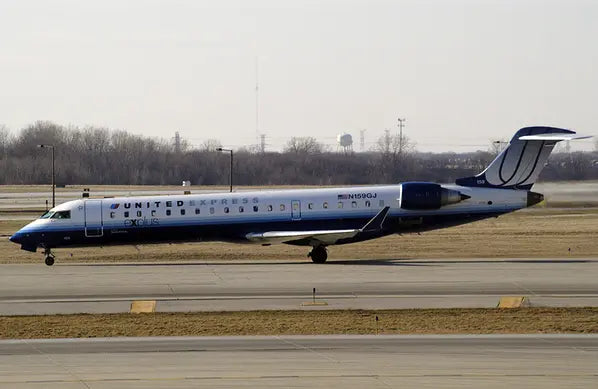
GoJet flies one aircraft type, and only one: the Bombardier CRJ550. The CRJ550 is not a new airframe but a re-certified and re-configured CRJ700 that seats just 50 passengers in a premium-heavy, three-class layout. United and Bombardier launched the type in 2019 specifically so United could offer a high-end regional product, complete with first class and extra-legroom seating, while still complying with the scope clauses in its mainline pilot contract that cap the number and size of regional jets. GoJet became the launch and primary operator of the concept.
From a pilot's standpoint, the practical takeaway is simple: joining GoJet today means flying the CRJ550 under United Express livery. The aircraft is configured with 10 United First seats, 20 Economy Plus seats and 20 standard Economy seats, plus in-flight Wi-Fi and full-size bin space for every carry-on. Because the CRJ550 shares the CRJ700 airframe, performance, weight and systems, the type rating and recurrent training are built around the well-established Bombardier CRJ (CL-65) platform that has trained regional pilots for decades.
| Aircraft Type | Role | In Service | Notes |
|---|---|---|---|
| Bombardier CRJ550 | Regional jet (50 seats) | ~57 frames (~47 active) | Sole operating type. 3-class United Express cabin, Wi-Fi. Program target up to 74 aircraft. |
| Bombardier CRJ700 | Legacy / donor airframe | 0 in passenger service | Former CRJ700s converted into CRJ550 configuration for United. No longer flown as 70-seaters. |
| Bombardier CRJ900 | Legacy (Delta era) | 0 | Operated historically under Delta Connection. Exited with the end of GoJet's Delta flying. |
Fleet data as of 2025, drawn from public fleet trackers and GoJet corporate communications. Active counts fluctuate as aircraft move between service, storage and conversion.
As of mid-2025, public fleet data shows roughly 57 CRJ550 frames assigned to GoJet, of which about 47 are active and around 10 parked. The originally announced agreement envisioned 54 aircraft over ten years, and GoJet's own "Summer of Success" messaging describes a path toward as many as 74 CRJ550s in the United program. One important development for prospective pilots to understand: United has expanded CRJ550 flying beyond GoJet, with SkyWest Airlines now also taking on a CRJ550 sub-fleet. That broadens the product across United's network but means GoJet is no longer the only operator of the type.
New First Officers are trained on the CRJ550 and earn the Bombardier CRJ (CL-65) type rating, which historically covers the CRJ200, CRJ550, CRJ700 and CRJ900 family. GoJet provides the type rating and initial training as part of the new-hire program, so candidates are not asked to self-fund a CRJ type rating before starting. Because the airline operates a single type, there is no fleet bidding and no wide-body progression internally. Every pilot flies the CRJ550, and "moving up" means upgrading to Captain or, ultimately, transitioning to United mainline.
A one-type, one-customer model brings efficiency and a focused culture, but it also concentrates risk. GoJet's flying depends entirely on United's continued demand for the 50-seat premium product, and the airframe itself is a 50-seat derivative of an older platform rather than a next-generation jet. Pilots who value fleet diversity, larger regional jets (such as the 76-seat Embraer E175), or a hedge across multiple mainline partners will find GoJet narrower than carriers like SkyWest. This is a deliberate trade-off rather than a flaw, but it is worth weighing for a long-term plan.
Pilot Salary & Compensation Breakdown
Like nearly all US airlines, GoJet pays pilots an hourly flight-pay rate against a monthly minimum guarantee, layered with per diem, bonuses and a 401(k) match. The hourly rates below are published by the independent aggregator Airline Pilot Central and corroborated by Epic Flight Academy's GoJet profile. They reflect the current Teamsters Local 618 contract as amended, including the substantial pay increases ratified in December 2022. They should be treated as well-sourced estimates rather than the literal contractual document.
GoJet's monthly minimum guarantee is 75 flight hours, meaning a line holder is paid for at least 75 hours even in a light month. Annual estimates in the tables use that 75-hour floor and a more typical line of roughly 85 credited hours per month, so a pilot's real earnings usually land between the two columns. Federal rules cap any pilot at 1,000 flight hours per calendar year.
First Officer Pay Scale
| Seniority | Hourly Rate | Annual @ 75-hr guarantee | Annual @ ~85 hrs/mo |
|---|---|---|---|
| Year 1 (entry) | $91/hr | ~$81,900 | ~$92,800 |
| Year 2 | $96/hr | ~$86,400 | ~$97,900 |
| Year 3 | $97/hr | ~$87,300 | ~$98,900 |
| Year 4 | $99/hr | ~$89,100 | ~$101,000 |
| Year 5 | $101/hr | ~$90,900 | ~$103,000 |
| Year 6 (top F/O) | $104/hr | ~$93,600 | ~$106,100 |
First Officer rates per Airline Pilot Central. The scale tops out at year 6 because most First Officers upgrade to Captain well before reaching it.
Captain Pay Scale
| Seniority | Hourly Rate | Annual @ 75-hr guarantee | Annual @ ~85 hrs/mo |
|---|---|---|---|
| Year 1 (entry Captain) | $146/hr | ~$131,400 | ~$148,900 |
| Year 3 | $156/hr | ~$140,400 | ~$159,100 |
| Year 5 | $165/hr | ~$148,500 | ~$168,300 |
| Year 10 | $190/hr | ~$171,000 | ~$193,800 |
| Year 15 | $209/hr | ~$188,100 | ~$213,200 |
| Year 18 (top Captain) | $216/hr | ~$194,400 | ~$220,300 |
Captain rates per Airline Pilot Central, rising in roughly $4 to $6 annual steps from $146/hr to $216/hr at the top of the scale.
Where GoJet gets aggressive is on bonuses, which it uses to attract experienced pilots and accelerate staffing. Recruiting campaigns have advertised a Direct Entry Captain (DEC) package reaching $200,000, structured as a $175,000 sign-on bonus plus a $25,000 Part 121 experience bonus, alongside a separate $100,000 "no-strings" bonus aimed at experienced pilots who want cash up front without long lock-in terms. For First Officers, a $40,000 upgrade bonus has been promoted for reaching Captain. Commuting Captains based at Newark have been offered a $1,000 monthly travel stipend and up to six commuter hotels per month. Bonus campaigns change frequently, so any specific figure should be confirmed against the current offer.
On the recurring side, GoJet's domestic per diem is listed at about $2.00 per hour (with some recent postings showing $2.05), and the 401(k) carries a 50% company match on a tiered, longevity-based schedule explained in the benefits section below. Unlike major carriers such as United or Delta, GoJet does not publicly advertise a pilot profit-sharing plan, so GoJet pilots primarily rely on hourly pay, bonuses, per diem and the 401(k) while at the regional.
These figures are compiled from independent pilot-pay aggregators (Airline Pilot Central and Epic Flight Academy) and public recruiting materials, not from the full collective bargaining agreement text. Actual pay depends on the latest Teamsters Local 618 contract, individual longevity, credited hours and any active bonus campaign. Regional pay has risen sharply since 2022, and bonus offers in particular can appear and disappear quickly. Always verify current numbers against an official offer or union documentation before making a career decision.
Roster, Reserve & Quality of Life
Quality of life at GoJet is governed by FAA flight and duty time rules (FAR 117) layered on top of the Teamsters Local 618 pilot contract. The headline number is the 75-hour monthly minimum guarantee for line holders, which stabilizes income even when flying is light. In a normal month, a line-holding pilot can expect credited block time in the mid-70s to mid-80s of hours, with the option to pick up additional flying for extra pay during busy periods.
As at any regional, new hires should plan to spend their first months, and possibly longer, on reserve rather than holding a fixed line. Pilot reports describe GoJet's reserve as a mix of long-call and short-call: long-call reserve carries a 12-hour call-out window, while short-call reserve carries a 2-hour window. The company typically builds reserve as two blocks of roughly six days each per month and may convert those blocks from long-call to short-call. How quickly a pilot escapes reserve and holds a line depends heavily on base, hiring pace and attrition, all of which the airline's growth tends to push in the pilot's favor.
📅 Sample Month — Junior CRJ550 First Officer (Reserve + Line Mix)
The grid above is illustrative, blending reserve blocks with line trips to show a realistic early-career month. It is built from GoJet's reserve structure and guarantee, not from a published roster, so treat it as a representative example rather than a fixed template. Line holders generally see roughly 12 to 14 days off in a month, while pilots in a heavy reserve block can have fewer fully free days because availability days still count as duty.
GoJet domiciles pilots at Chicago O'Hare (ORD), Newark (EWR), Washington Dulles (IAD) and St. Louis (STL). The airline markets itself as commuter-friendly, and recruiting material has stated that more than 80% of GoJet pilots commute to base rather than living in domicile. Commuter support has included a $1,000 monthly travel stipend and up to six commuter hotels per month for some Captain positions, plus United non-revenue travel benefits that make positioning to base easier. Commuting still carries real hidden costs in unpaid time and fatigue, so living in base, where O'Hare and the New York area are expensive but central, remains the lowest-stress option for those who can manage it. Because GoJet covers four domiciles spanning the Midwest and East Coast, most pilots can find a base within reasonable reach.
Benefits, Travel Perks & Retirement
GoJet's benefits package is solid for a regional carrier, though more modest than the comprehensive programs at major airlines or at Delta-owned Endeavor Air. The standout perk for many pilots is travel: as a United Express carrier, GoJet pilots receive United flight benefits for non-revenue standby travel, plus ZED (Zonal Employee Discount) options for reduced-fare travel on other carriers. These privileges are central to commuting and to personal travel, and they offer an early taste of the network a pilot may eventually serve as a United mainline crew member.
On retirement, GoJet offers a 401(k) with a 50% employer match structured in three longevity tiers. Per Airline Pilot Central, the company matches 50% up to 4% of eligible pay (an effective 2% employer contribution) from roughly nine months through two years of service, then 50% up to 6% (an effective 3%) from year three through six, and finally 50% up to 8% (an effective 4%) from year seven onward. Vesting occurs after one year. This is reasonable within the regional tier but well below the automatic 9% to 16%-plus contributions seen at large carriers, reinforcing the view of GoJet as an early-career stage rather than a retirement destination.
A pilot's income depends entirely on holding a valid FAA medical certificate, and even minor medical issues can ground a career. GoJet provides employer long-term disability insurance, but there is no clear evidence of a company-paid loss-of-medical-license policy specific to pilots. Pilots who want robust protection typically purchase supplemental loss-of-license coverage individually through specialist providers such as Harvey Watt & Co. Building this into a financial plan early is prudent, especially for pilots commuting and carrying training debt.
Career Progression & Captain Upgrade
Rapid upgrade to Captain is GoJet's single most heavily marketed feature, and it is the main reason many pilots choose the airline. Recruiting materials advertise a Captain upgrade within the first year for qualified First Officers, driven by fleet growth on the CRJ550 and steady attrition as Captains move on to United and other majors. Captain seats pay dramatically more than First Officer seats (roughly $146 per hour versus $91 per hour at entry), so reaching the left seat quickly has an outsized effect on both annual income and on lifetime earnings.
Career progression follows a strict seniority system, as at every US airline. A pilot's seniority number, set on their start date, governs base assignment, schedule bidding, upgrade timing and vacation. GoJet does not have internal fleet diversity, so within the company "advancement" means moving from First Officer to Captain, then potentially into a check airman, line instructor or training role, and ultimately out to United mainline. The airline also runs an Early Seniority Program for Direct Entry Captains, allowing a new hire to lock in a seniority date after completing the first day of indoctrination, then take leave for up to six months before returning for full training, which helps experienced pilots exit a current employer cleanly without losing their place in line.
| Career Milestone | Typical Timeline | Notes |
|---|---|---|
| Join as First Officer (CRJ550) | Day 1 post-training | Company-provided CRJ type rating and line training. Initial period usually on reserve. |
| Hold a line (off reserve) | Months, base-dependent | Driven by base, hiring pace and attrition. Faster during active growth. |
| Upgrade to Captain | ~1 to 2 years | Advertised as fast as ~1 year. Requires meeting hour and company requirements plus a command check. |
| Direct Entry Captain | Immediate (if qualified) | Requires ~975 hrs qualifying Part 121/135/91K experience. Large sign-on bonuses. |
| Build Captain PIC for Aviate | ~1,000 to 1,200 PIC hrs | Captain time is the key currency for the United Aviate transition. |
| Transition to United mainline | ~2 to 5 years total | Via Aviate, conditional on performance and United hiring (see next section). |
The speed comes from the math of a growing fleet and constant outflow to United. Each new CRJ550 needs Captains, and every GoJet Captain who flows to United opens a left seat behind them. As long as United keeps expanding the 50-seat premium program and hiring at the mainline, the upgrade engine keeps running. The corresponding risk is the mirror image: if United slows CRJ550 growth or pauses mainline hiring, both upgrade speed and the onward path can stretch out. Pilots should track United's regional fleet plans, not just GoJet's, when judging how fast the climb will really be.
The United Aviate Pathway to Mainline
For most pilots evaluating GoJet, the decisive question is not the regional paycheck but the route to a major airline. GoJet's answer is the United Aviate program, United's structured pilot development pipeline. GoJet is promoted as a United Aviate partner, and its marketing frames the airline as a fast on-ramp to a United mainline cockpit. Pilots can read United's own description of the program on the United Aviate site before committing to any single regional.
It is important to be precise about what Aviate is and is not. Aviate is a conditional pathway, not a contractual flow-through guarantee. Pilots in the program who meet defined milestones secure a route to apply and transition to United, but movement still depends on satisfying performance criteria and on United's actual hiring needs at the time. United simplified the program in 2023 to emphasize Pilot-in-Command (PIC) hours as a Captain in qualifying operations rather than complex total-time formulas. In practice, a GoJet pilot's job is to upgrade to Captain quickly and then accumulate the required Captain PIC time, commonly cited around 1,000 to 1,200 hours, to position for the United transition.
GoJet has advertised a path to United "in as little as 2 years." That figure represents a best-case scenario for a highly motivated pilot under favorable conditions: hire on, upgrade to Captain fast, build PIC time quickly, and meet Aviate criteria while United is hiring. A more realistic planning range for many pilots is roughly three to five years from initial regional hire to a United class date. The two-year number is achievable but should be read as a ceiling on speed, not an average. Treat it as marketing math and plan conservatively.
This Aviate focus is the heart of GoJet's appeal and also its main limitation. Compared with a diversified regional like SkyWest, which partners with United, Delta, American and Alaska, GoJet points almost exclusively at United. For a pilot whose firm goal is United, that single-minded alignment is an advantage: the operation, procedures, customer product and culture all mirror United, which can smooth the eventual transition. For a pilot who wants to keep options open across several majors, the narrow focus is a drawback. The decision largely comes down to how committed the individual is to United specifically.
Unlike Endeavor Air's contractual Career Advancement Program to Delta (which commits to a defined number of pilots per month), GoJet's Aviate route does not obligate United to hire any specific number of GoJet pilots. It is a recognized, branded pathway supported by United's hiring demand, but it carries more conditionality than a true flow agreement. In a strong hiring market this distinction matters little; in a downturn it matters a great deal. Verify the current Aviate terms directly with United and GoJet before relying on any timeline.
Recruitment Process & Requirements
GoJet hires through two main channels: First Officer recruitment for pilots reaching airline minimums, and Direct Entry Captain hiring for experienced pilots. The airline also feeds its pipeline upstream through the Wingman program for student pilots. All First Officer requirements are anchored to FAA Airline Transport Pilot rules, which a candidate can verify against the FAA certification standards directly.
First Officer Requirements
Direct Entry Captain Requirements
Selection & Pipeline Stages
Application
Apply through the GoJet pilot careers portal or via industry platforms such as AirlineApps and PilotsGlobal. Classes are scheduled frequently, and GoJet attends recruiting events, university visits and airshows to source candidates.
Screening & Interview
Qualifications are screened for licenses, ratings, total and recent time. Selected candidates complete an interview that typically combines technical knowledge with behavioral and crew-resource-management questions, assessing professionalism, trainability and fit.
Conditional Offer & Class Date
Successful candidates receive an offer and a class date. Wingman and pipeline participants who have reached ATP or R-ATP minimums are given priority in recruitment and class selection.
Training & Type Rating
New hires complete ground school, the CRJ type rating in a full-motion simulator, and line training. GoJet provides the type rating as part of the program rather than requiring self-funding.
Line Operations
After line checks, pilots enter scheduled operations, usually starting on reserve. The seniority clock that governs the rest of the career begins on the official start date.
GoJet's Wingman program engages student pilots before they reach airline minimums. Participants visit GoJet's St. Louis headquarters for an all-expenses-paid tour that includes a new-hire class, full-motion CRJ simulator sessions and time with line and training pilots, plus United standby travel. Epic Flight Academy's profile notes that the Wingman pipeline includes up to $10,000 in tuition reimbursement (paid over one year after completing First Officer training) and a $2,500 referral bonus, alongside priority hiring. For students at partner schools, it functions as a near-cadet route that aligns training with GoJet and the United Aviate pipeline. Always confirm current program terms on GoJet's site, since incentives change.
How GoJet Compares: Airline Radar Chart
To put GoJet in context, the radar below compares it against two well-known US regionals that represent different strategic models: SkyWest Airlines, the large independent that flies for four majors, and Endeavor Air, the wholly Delta-owned regional with a contractual flow to Delta. Scores are editorial estimates across the same six metrics used in the scorecard, based on publicly available pay data, fleet information, union materials and industry benchmarks.
Key Takeaways from the Comparison
Pay is broadly comparable, with Endeavor slightly ahead at entry. GoJet First Officers earn about $91 to $104 per hour and Captains $146 to $216 per hour. SkyWest lists First Officers near $92.73 per hour rising to roughly $98 after a year, and Captains starting around $144.24 per hour. Endeavor sits a touch higher, with first-year First Officers around $105 per hour and Captains running from about $157 up to $226 per hour at the top. GoJet narrows or closes that gap through aggressive Direct Entry Captain and upgrade bonuses, which can be worth more than the hourly difference in the early years.
Career pathway is where the three diverge most. Endeavor offers a contractual, guaranteed flow to Delta through its Career Advancement Program (committing to a defined number of pilots per month). SkyWest offers preferential-interview pathways across four majors but no guaranteed flow at any one. GoJet offers the United Aviate route, a fast but conditional path to a single major. For a United-focused pilot prioritizing speed, GoJet is compelling; for guaranteed movement, Endeavor's contractual flow is stronger; for optionality, SkyWest is broadest.
Fleet and job security favor the larger players. SkyWest operates close to 500 aircraft across multiple types (including the larger Embraer E175) and four partners, giving it the strongest diversification and stability. Endeavor, as a Delta-owned operator of CRJ700 and CRJ900 jets, also rates highly on security. GoJet's single-type, single-partner CRJ550 model is leaner and more exposed to United's decisions, which is reflected in its lower fleet and job-security scores.
GoJet's edge is speed and focus. The reason a pilot picks GoJet over these peers is usually the combination of very fast Captain upgrade, large bonuses and a direct line of sight to United. It is a sharp tool for a specific goal rather than the most diversified or most secure option in the field.
Radar scores are editorial estimates derived from public salary aggregators (Airline Pilot Central, Epic Flight Academy), airline and union publications, fleet trackers and industry commentary. They represent a general assessment for a pilot weighing a multi-year career stage, not a precise index. Individual experiences vary by base, seniority and timing, and regional pay and bonus structures change quickly. Figures should be reverified against current sources before any decision.
Union & Labor Relations
One detail that surprises many pilots: GoJet pilots are not represented by ALPA. Their bargaining agent is the International Brotherhood of Teamsters (IBT), Airline Division, organized locally as Teamsters Local 618 and known as the GoJet Airlines Pilot Group. This matters because union culture, governance and resources differ from the pilot-specific ALPA that represents United, Delta and most other large North American pilot groups. GoJet pilots can find union information, contract resources and committee contacts at the local's site, gojetibt618.org.
Representation Structure
The pilot collective bargaining agreement governs pay scales, the 75-hour minimum guarantee, scheduling and reserve rules, vacation, sick leave, training pay and grievance procedures. Crucially for a regional, the contract operates inside the constraints of GoJet's capacity purchase agreement with United, which controls schedules and aircraft. GoJet's flight attendants are separately represented by the Association of Flight Attendants (AFA-CWA), so the airline has a strongly unionized workforce across both work groups.
Recent Contract Milestones
GoJet has not been marked by notable pilot strike activity; its recent labor history centers on negotiated pay improvements rather than industrial action. The Teamsters representation is fully functional and delivered meaningful raises in 2022, but pilots accustomed to ALPA should expect a different union ecosystem and fewer cross-carrier pilot coordination structures than ALPA provides. Union membership is the norm here, and engaging early with Local 618 is the best way to understand current contract details, reserve rules and how bonus campaigns interact with the CBA.
Verdict: Who Is GoJet For?
🎯 Our Take
GoJet Airlines is a sharply focused tool for one job: getting a pilot to a United Airlines mainline cockpit as quickly as possible. Its strengths are real and specific. Captain upgrade is among the fastest in the industry (advertised within the first year), bonuses for Direct Entry Captains and upgrades are large, the United Aviate pathway gives a clear line of sight to a major, and a growing CRJ550 fleet keeps the seniority list moving. For a pilot reaching airline minimums or a Captain at a stagnant regional, that velocity is the headline appeal.
The trade-offs are equally clear. GoJet flies a single 50-seat type for a single partner, so there is no fleet diversity, no wide-body progression and meaningful exposure to United's network decisions. The Aviate route is conditional rather than a contractual flow, which is fine in a strong hiring market but less protective than Endeavor's guaranteed pathway to Delta. Benefits and retirement are solid but modest for the regional tier, and representation is by the Teamsters rather than ALPA. There are also no glamorous international layovers here; this is domestic regional flying built around hub turns.
Viewed correctly, GoJet is a stepping stone, and a good one for the right pilot. Lifetime earnings in this industry are driven mostly by how soon a pilot reaches a major airline, and GoJet is explicitly engineered to shorten that timeline for United-bound aviators.
1What aircraft do GoJet pilots fly?
GoJet operates a single type, the Bombardier CRJ550, exclusively for United Express. The CRJ550 is a 50-seat, three-class reconfiguration of the CRJ700 airframe (10 United First, 20 Economy Plus, 20 Economy, with Wi-Fi). New hires earn the Bombardier CRJ (CL-65) type rating, which GoJet provides. There is no internal fleet bidding and no wide-body flying.
2How fast is the upgrade to Captain at GoJet?
GoJet advertises Captain upgrade within the first year for qualified First Officers, making it one of the fastest upgrade environments among US regionals. Actual timing depends on base, hiring pace, attrition and meeting hour and command-check requirements, so a one-to-two-year window is a realistic plan. The speed is driven by fleet growth and constant attrition to United.
3Does GoJet have a guaranteed flow to United Airlines?
No. GoJet is a United Aviate partner, which is a recognized and relatively fast pathway to United, but it is conditional rather than a contractual flow. Movement depends on meeting Aviate criteria (notably Captain PIC hours) and on United's hiring needs. This differs from Endeavor Air's contractual Career Advancement Program to Delta, which commits to a defined number of pilots per month.
4What are the minimum flight-hour requirements?
First Officers need an ATP-CTP and must meet ATP (1,500 hours) or Restricted ATP minimums: 1,000 hours for graduates of qualifying four-year aviation degree programs, or 1,250 hours for qualifying two-year programs. Standard experience requirements include 100 hours night, 75 hours instrument and 200 hours cross-country, plus a valid First Class Medical. Direct Entry Captains need roughly 975 hours of qualifying Part 121, 135 or 91K experience.
5Which union represents GoJet pilots?
GoJet pilots are represented by the International Brotherhood of Teamsters (Airline Division), organized as Teamsters Local 618, not by ALPA. The Teamsters negotiated a contract amendment in December 2022 that delivered significant pay increases. Flight attendants are separately represented by AFA-CWA. United mainline pilots, the destination for many GoJet pilots, are represented by ALPA.
6Where are GoJet's pilot bases?
GoJet domiciles pilots at Chicago O'Hare (ORD), Newark Liberty (EWR), Washington Dulles (IAD) and St. Louis (STL). The three hub bases sit on United's network, while St. Louis serves as the corporate headquarters, training site and a crew base. Most of the flying starts or ends at the United hubs.
7Is GoJet commuter friendly?
Yes, GoJet markets a commuter-friendly culture, and recruiting material has cited that more than 80% of pilots commute. Support has included a $1,000 monthly travel stipend and up to six commuter hotels per month for certain Captain positions, plus United non-revenue travel benefits. Commuting still carries unpaid time and fatigue costs, so living in base remains the lower-stress choice where feasible.
8How does GoJet pay compare to other regionals?
GoJet's First Officer rates (about $91 to $104 per hour) and Captain rates (about $146 to $216 per hour) are competitive within the regional tier. SkyWest sits at a similar level, while Endeavor Air pays slightly more at entry (around $105 per hour for first-year First Officers, up to $226 per hour for senior Captains). GoJet closes much of the gap with large Direct Entry Captain and upgrade bonuses, and its main differentiator is upgrade speed plus the United Aviate path rather than top-of-market base pay.
Official Links & Resources
Before applying or making a career decision, verify the latest details directly with official sources. Pay scales, bonus campaigns and program terms at regionals change frequently. These are the key resources relevant to a GoJet pilot career:
Because GoJet's appeal hinges on the onward move to United, monitor both GoJet's careers pages and United's Aviate and hiring updates together. The fastest way to gauge real-world upgrade and flow timelines is to combine official sources with current pilot reporting, then confirm any bonus or program figure against a live offer. Treat marketed timelines (such as "Captain in a year" or "United in two years") as best-case ceilings and plan conservatively around them.