

ETF Airways Overview & Company Profile
ETF Airways is a Croatian ACMI (Aircraft, Crew, Maintenance, Insurance) and passenger charter operator headquartered in Zagreb. The name stands for "Enjoy The Flight". According to the company's own history page, the concept dates back to 2016, when three airline captains drafted a plan for what they described as a people-oriented airline. The company was formally founded in November 2020, received its Air Operator Certificate (AOC HR-105) on 28 May 2021, and flew its first commercial service on 4 June 2021 from Pristina to Helsinki.
This is not a scheduled airline. ETF Airways sells its aircraft, crews and operational capability to other carriers. It has no route network of its own, no frequent flyer programme, no interline agreements and no ticket sales under its own brand. For a pilot, that single structural fact drives almost everything else in this article: where you are based, how long you stay there, what your roster looks like, and how predictable your year is.
The airline is run by people who fly. CEO Stjepan Bedić is an aeronautical engineer and a serving Boeing 737 captain, instructor and examiner, with earlier experience at Croatia Airlines flight operations, Eurocontrol consultancy work and aviation security auditing. Marko Banković and Kristijan Starčević sit on the board. In July 2025, SeeNews reported that ETF Airways' management bought out the shares of the initial external investors, leaving the company pilot-owned and pilot-managed. That ownership structure is unusual in the ACMI segment and is worth weighing when you assess how the company is likely to treat crew.
Financially, the company is small but has been profitable. Filings published through the Croatian financial agency FINA report revenue of €34.23 million and net profit of €4.51 million in 2024 with 61 employees, and €31.29 million revenue with €1.72 million net profit in 2025 with 71 employees. The company passed the one million passengers carried milestone in 2024. For context, those figures place ETF Airways well below the European ACMI majors in scale, and closer to a boutique operator than to a SmartLynx or an Avion Express.
In December 2025 the airline announced a second Croatian base at Zadar Airport, alongside two new subsidiaries: ETF Technics (aircraft maintenance and safety standards, headquartered in Zadar) and ETF Travel (a travel agency supporting aviation professionals and charter organisation). At the presentation, Bedić said the ambition was for "Croatia to become an aviation powerhouse that provides high-quality and recognisable services to clients from all over the world."
You will find ETF Airways listed with different two-letter IATA designators depending on the database you consult: CAPA and PilotsGlobal show 2F, while Wikipedia and several code directories show 2E. This inconsistency is common for pure ACMI operators, which fly under the marketing code of their lease customer rather than their own. The reliable identifiers to use on any application, licence endorsement or flight plan are the ICAO code EZZ and the callsign ENTERPRISE. Do not rely on any two-letter code you see quoted for this carrier without checking the current IATA code register directly.
Fleet Composition & Type Ratings
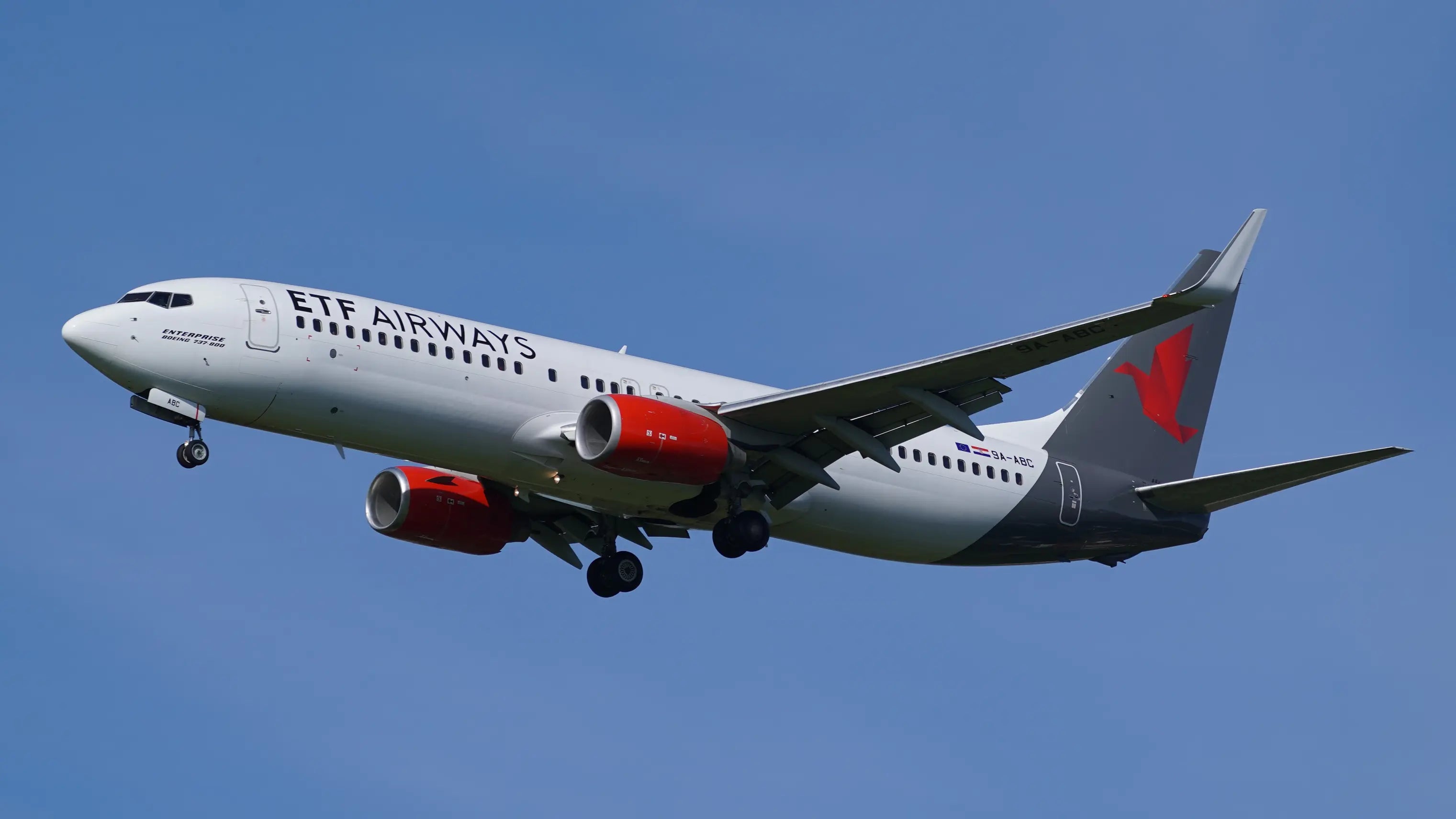
ETF Airways runs a two-type fleet: mid-life Boeing 737-800s for jet ACMI and charter work, and, since March 2026, a single ATR 72-600 for regional turboprop wet-lease. Every aircraft carries a name in an exploration theme (Voyager, Enterprise, Discovery, Explorer), which fits the ENTERPRISE callsign.
The jets are second-hand and interior-refurbished rather than new. That is standard for the ACMI segment, where lease customers are buying capacity at short notice, not cabin product. Ex-Yu Aviation reported in June 2026 that the airline took delivery of its fifth aircraft and fourth Boeing 737-800, registered 9A-ICF, a 16-year-old airframe previously operated by Shandong Airlines and Norwegian Air Shuttle.
| Registration | Type | Name | Year Built | Status & Notes |
|---|---|---|---|---|
| 9A-LAB | Boeing 737-8K5 | Voyager | 2001 | First aircraft delivered (May 2021). Sustained significant hail damage at Córdoba, Argentina on 1 January 2026 and has been reported as facing possible write-off. |
| 9A-ABC | Boeing 737-8Q8 | Enterprise | 2004 | Delivered June 2021. Deployed to Dresden (Sundair) and Réunion (Corsair) in early operations. |
| 9A-KOR | Boeing 737-8GJ | Discovery | Not published | Joined ETF Airways in 2022. MSN 34899. |
| 9A-ICF | Boeing 737-8FZ | Explorer | 2010 | Delivered June 2026. Ex-Shandong Airlines and Norwegian Air Shuttle. |
| 9A-ATR | ATR 72-600 | Not published | Not published | Delivered March 2026, 70 seats. Wet-leased to Croatia Airlines on a reported six-year agreement. |
Fleet as reported by ch-aviation, Ex-Yu Aviation and public registry data through July 2026. ETF Airways does not publish a fleet page with build dates, so some fields are marked as not published rather than estimated.
Fleet Direction and What It Means for Hiring
Two growth tracks are publicly stated. On the jet side, the airline's older ambition (voiced by Bedić in a 2022 interview) was a fleet of seven Boeing 737-800s. Progress toward that has been deliberate rather than aggressive, and ch-aviation reported in December 2025 that management described growth in both the ATR and 737 fleets as cautious. On the turboprop side, CAPA reported in March 2026 that ETF Airways may add a second ATR 72-600 in 2027, describing strong demand for turboprop ACMI capacity.
No source in the public record indicates any 737 MAX or new-build jet order. If you are joining for the equipment, be clear-eyed: this is classic-generation Next Generation 737 flying with a mid-life fleet, not a new-technology cockpit progression.
Operationally, the fleet is better equipped than its age suggests. ETF Airways states the entire fleet holds ICAO Chapter 4 noise certification, is approved for CAT III low visibility operations (RVR 200 m, take-off minima 125 m), and is MNPS approved between FL285 and FL420 for North Atlantic operations. Combined with FAA FAR 129 and Transport Canada FAOC approvals, that means the 737s can and do work transatlantic and long-range ferry sectors, which is why an ETF aircraft can end up in Réunion or Argentina.
Both the Boeing 737 and ATR 72-600 vacancies published on the official ETF Airways careers page require a valid type rating on type before you apply. That applies to First Officer positions as well as Captain positions. There is no published ab-initio, cadet or self-sponsored line training scheme, and there is no published type rating funding programme. Wikipedia's entry on the airline records that ETF Airways refuses "pay to fly" schemes, which is a meaningful positive on ethics, but it also means the airline is not a route into a first jet type rating. You need to arrive already rated.
Pilot Pay: What Is Actually Published
This section has to start with a statement rather than a number. ETF Airways does not publish a pilot pay scale. Its own vacancy pages list requirements, roster and non-cash benefits but no salary. PilotJobsNetwork's ETF Airways entry explicitly records "no detailed payscale available". Recruitment agency listings and LinkedIn campaigns for the airline's 737 and ATR roles reviewed for this article likewise carry no euro figure. Compensation appears to be negotiated individually during the recruitment process.
Rather than invent a scale, what follows is the verifiable material a candidate can actually use: the published pay scales of two comparable European ACMI operators, the verified Croatian allowance rules that ETF explicitly says it applies, and the Croatian payroll mechanics that convert any gross offer into take-home pay.
No figure in this section is an ETF Airways figure. The benchmark tables below are the published pay scales of other European ACMI operators and are included only so you can judge whether an offer from ETF Airways is competitive for the segment. Both benchmark scales are dated: the SmartLynx scale reproduced by AircrewNetwork is marked effective November 2023, and the Avion Express figures come from a company recruitment post rather than a current contract. Treat them as an order-of-magnitude reference, not as current market rates, and confirm any number directly with the employer before making a decision.
European ACMI Benchmark: Published Monthly Basic Pay
| Operator / Role | Summer (May to Oct) | Winter (Nov to Apr) | Notes |
|---|---|---|---|
| SmartLynx Captain, over 3,000 block hours | €9,455/month | €7,800/month | Summer basic includes 80 block hours; winter basic includes 30. |
| SmartLynx Captain, over 1,500 block hours | €8,235/month | €6,600/month | Same block hour inclusion structure. |
| SmartLynx First Officer, over 1,500 block hours | €5,185/month | €4,050/month | A320 and B737 fleets. |
| SmartLynx First Officer, over 500 block hours | €4,270/month | €3,300/month | Entry band. |
| Avion Express A320 Captain | €10,000/month | Not published | Company recruitment post; annual estimate quoted at €110,000+. |
| Avion Express A320 Senior First Officer | €6,000/month | Not published | Company recruitment post. |
| Avion Express A320 First Officer | €5,500/month | Not published | Annual estimate quoted at €64,000+. |
Benchmark data from published SmartLynx and Avion Express recruitment material. These are not ETF Airways rates. The seasonal split is the defining feature of ACMI pay: winter basic can be 15 to 25 percent below summer basic at the same rank.
The One Pay Component ETF Airways Does Specify
The ETF Airways 737 Captain and First Officer adverts state that per diems are paid "as per Croatian regulations". That is a precise and checkable commitment, because Croatian per diem levels are set by statute rather than by the employer. Under the current Croatian non-taxable receipt rules, the domestic daily allowance is €30 for a trip exceeding 12 hours and €15 for 8 to 12 hours. Foreign per diems are set country by country in the Ministry of Finance ordinance published in Narodne novine, and are materially higher: France is listed at €90 per day and Italy at €80 per day, for example.
| Allowance Type | Rate | Basis |
|---|---|---|
| Croatian domestic, over 12 hours | €30/day | Croatian non-taxable receipt limits, current for 2025 and 2026 |
| Croatian domestic, 8 to 12 hours | €15/day | Same |
| Foreign duty, France | €90/day | Ministry of Finance ordinance (NN 16/2024) |
| Foreign duty, Italy | €80/day | Ministry of Finance ordinance (NN 16/2024) |
Because ETF Airways crews spend most of the season on foreign deployment, the foreign rate is the one that matters. Ten to twenty days per month at a foreign rate is a substantial, and in Croatia non-taxable, addition to basic pay. Confirm which country rate applies to your specific deployment before signing.
Gross to Net in Croatia
If your contract is a Croatian employment contract, and the reference to Croatian per diem regulations strongly suggests it is, then Croatian payroll applies. The mechanics are straightforward and, by Western European standards, relatively light on the employee side.
The practical effect is that an ACMI-level gross salary goes a long way in Croatia relative to the local cost base, provided you actually live in Croatia. If you are commuting from Germany, the Netherlands or the UK, that arbitrage largely disappears and you are comparing a Croatian gross figure against a Western European cost of living.
Because there is no published scale, the burden of due diligence sits entirely with you. Ask, in writing: What is the monthly basic and does it differ between summer and winter? How many block hours are included in basic and what is the rate above that? Is the contract a permanent Croatian employment contract or a fixed-term seasonal one? Which country's per diem rate applies at my deployed base? Is there a bond or training cost recovery clause? Is pay guaranteed if the ACMI contract that justifies my position ends mid-season? None of these are answered in public material, and every one of them changes the value of the offer.
Roster Pattern & Quality of Life
This is where ETF Airways is unusually transparent, and where prospective pilots should pay closest attention. The airline's own Boeing 737 Captain and First Officer vacancy pages publish the rotation directly: 20 days on and 10 days off in summer, and 15 days on and 15 days off in winter. Cabin crew vacancies on the same site show a harder summer pattern of 21 on and 7 off, and 20 on and 10 off in winter, which gives a useful sense of the operation's tempo.
A "day on" at an ACMI operator is not the same as a day on at a scheduled carrier. It means you are at the deployed operational base, living in a company-provided hotel, available for duty. Within that block you will have flying days, standby days, and the rest days required by EASA flight time limitations, but you are not at home. The 10 days off in summer are your only real home time in a 30-day cycle.
📅 Illustrative Summer Cycle: Boeing 737 First Officer on ACMI Deployment
Illustrative only. Built from the published 20 on / 10 off summer rotation on the ETF Airways careers page. ETF Airways does not publish sample rosters, and the day-by-day mix of flying, standby and base rest varies by ACMI contract and client schedule.
The Rules That Actually Bound Your Duty
As an EASA operator, ETF Airways works to EASA Subpart FTL. The protections that matter most on a 20-day block are the requirement for local days free of duty (seven per calendar month, or two consecutive days per 14, with an annual floor of 96 local days), the 100 flight hours in 28 consecutive days limit, and the 900 flight hours per calendar year and 1,000 duty hours per 12 months ceilings. On a heavy summer ACMI contract you will feel all of these. There is no company-level agreement in the public record that improves on the EASA baseline, so EASA FTL is effectively both the floor and the ceiling of your fatigue protection.
One credit worth recording: Wikipedia's entry on the airline notes that ETF Airways mandates one additional simulator training session per year beyond the legal requirement. In an ACMI operation where crews move between clients, procedures and airport environments, additional recurrent simulator exposure is a genuine safety and confidence benefit rather than a marketing line.
At a scheduled airline your base is a place you live. At ETF Airways your base is a place the aircraft is contracted to sit for a season. The company provides a hotel at the designated operational base and positioning tickets to and from your nearest international airport, which removes the cost of commuting but does not remove the disruption of it. Over a summer you may work from one base for the whole season, or you may be moved when a contract changes. Pilots with young children, a partner in a fixed job, or a strong preference for sleeping in their own bed should weigh this pattern very carefully before applying. Pilots who want concentrated blocks of home time and are indifferent to hotel living will find 15 on and 15 off in winter genuinely attractive.
Benefits, Allowances & Social Cover
ETF Airways publishes its non-cash benefits explicitly on each pilot vacancy, which is more than many operators of its size do. The package is built around removing the cost of being away from home rather than around long-tail benefits like staff travel or supplementary pensions, neither of which a pure ACMI operator can realistically offer.
The Croatian Social Package
If your contract is Croatian, you enter the Croatian social security system automatically on registration of employment. That gives you compulsory health insurance, statutory sick pay, statutory maternity and paternity rights, and pension accrual across two pillars. The 5 percent Pillar II contribution goes into a mandatory private pension fund in your own name, which is portable and does not depend on your staying at the airline. Minimum paid annual leave under the Croatian Labour Act is four weeks per calendar year, rising to five weeks for employees in demanding conditions and for minors, with the right generally acquired after six months of continuous employment.
What Croatia does not have is an aviation-specific supplementary pension fund of the kind French pilots get through the CRPN or the industry schemes some Northern European carriers run. For an ETF Airways pilot, retirement provision beyond the statutory pillars is a personal responsibility. So, in the absence of any published scheme, is loss of licence cover. Both are worth pricing into your assessment of an offer, because at a legacy carrier they would be part of the package and here they are a line item on your own budget.
Do the arithmetic before you dismiss the package. On a summer deployment to a Western European base, the Croatian foreign per diem framework can pay well into three figures per day, non-taxable within the statutory ceiling, on top of basic salary, while accommodation is already paid for. Over a 20-day on-block that is a material sum which never appears in a headline salary comparison. It also means the effective value of the job varies significantly depending on which country you are deployed to, something no published pay scale would capture. Ask for the specific country rate that will apply to you, not the generic wording.
Career Progression & Command Upgrade
Honesty is required here: ETF Airways is not a career airline in the conventional sense, and it does not present itself as one. With five aircraft and 71 employees, there is no published seniority list, no published bidding system, no fleet transition ladder, and no published internal command upgrade programme. The airline's own careers copy promises "a growing airline with long-term career opportunities" and "the opportunity to grow together with a young and ambitious company", which is a fair description of a startup trajectory but not a structured progression path.
What the recruitment material does show is that command at ETF Airways is currently filled externally. Both the Boeing 737 Captain and the ATR Captain vacancies require 3,000 hours total time and 500 hours pilot-in-command on type before you apply. A First Officer joining with low hours has no published route from that position to the left seat inside the company, and with a fleet this size there are simply very few command slots to open up. On PilotsGlobal, the single pilot review of ETF Airways on file scores upgrade opportunities at 1 out of 5, the lowest of any category. One review is not evidence, but it is consistent with what the fleet arithmetic implies.
| Career Milestone | Position at ETF Airways | Notes |
|---|---|---|
| Entry as First Officer | Type rating required | No minimum hours published for either 737 or ATR First Officer, but you must already hold the rating. |
| Seniority system | None published | No public seniority list or bidding structure. |
| Fleet transition (737 to ATR or reverse) | Not published | Two unrelated types with one ATR airframe; cross-fleet movement is unlikely to be a routine option. |
| Internal command upgrade | No published programme | Captain vacancies are advertised externally with 3,000 TT / 500 PIC on type. |
| Direct entry Captain | Yes, this is the route | Valid type rating, 3,000 TT, 500 PIC on type, EASA licence, Class 1, ICAO English 4+. |
| Instructor / examiner roles | Exist but not advertised | The CEO is himself a 737 instructor and examiner. In an airline of this size these roles are filled informally. |
ETF Airways makes most sense as a hours-building and experience-broadening posting rather than a destination. A First Officer who arrives 737 rated will accumulate varied line experience quickly, across multiple clients, procedures and airport environments, on an IOSA-certified operation that explicitly refuses pay-to-fly and funds extra simulator time. That is a genuinely strong CV entry when you later apply to a scheduled carrier. A Captain arriving with 3,000 hours and command experience gets an operationally interesting job with published rotation and covered living costs. What neither gets is a 20-year ladder. Plan accordingly, and do not join expecting an internal upgrade timeline, because no such timeline has been published.
Where the Growth Could Come From
The airline is expanding, if cautiously. Additional Boeing 737-800 capacity has been the stated near-term jet plan, with an earlier target of seven jets. CAPA reported a possible second ATR 72-600 in 2027. The Zadar base and the ETF Technics maintenance subsidiary broaden the company beyond pure flying. Each new airframe on an ACMI contract requires several full crews, so fleet additions are the most direct signal of hiring. The counterweight is the loss of 9A-LAB's availability after the January 2026 hail damage in Córdoba, which effectively absorbed one delivery's worth of growth.
Recruitment Process & Requirements
ETF Airways recruits directly through its own careers page and through periodic LinkedIn campaigns, with applications going to a single HR mailbox rather than through an applicant tracking system. As of August 2026, the ATR 72-600 Captain and First Officer positions are open, while the Boeing 737 Captain and First Officer positions are marked applications closed. That status changes with fleet and contract movements, so the careers page is worth checking regularly rather than once.
Boeing 737 Requirements
ATR 72-600 Requirements
Selection Stages
Application by Email
Applications go to etf.hr@etfairways.com with a CV containing detailed flight time information and supporting documentation. There is no online portal or standardised form, so the CV does the entire first-filter job. Break down your hours by type, by role and by PIC, because the published minima are expressed exactly that way and a recruiter with 71 colleagues to support will not chase you for clarification.
Screening
The airline states that shortlisted candidates are invited for interview, screening and simulator assessment. Screening at an EASA operator of this size typically covers licence and medical validity, logbook verification, the five-year background check required for airside and security clearance, and confirmation of your right to work in the EU.
Interview
Expect a technical and human factors interview conducted in English. Given that senior management are serving line pilots, interviews at this airline are likely to be conducted by people who will later fly with you. Prepare for practical ACMI-specific questions: operating into unfamiliar airfields at short notice, handling different client procedures, managing fatigue on long deployment blocks, and decision making without home-base support.
Simulator Assessment
A simulator assessment is explicitly part of the process. Since a valid type rating is a prerequisite, this is a competency check on type rather than an aptitude screen. Standard raw-data handling, instrument flying, non-normal management and crew resource management under observation should be your preparation focus.
Clearance, Contract and Line Training
Croatian security clearance must be obtained before you can operate. Contract terms, including the salary that is absent from every public advert, are agreed at this stage. Line training then follows on the operation you are assigned to, which may be at a foreign deployed base rather than in Croatia.
Three practical points. First, the type rating requirement is absolute across all four published pilot roles, so do not apply untyped hoping the airline will fund it. Second, the "no minimum flight hour requirement" on both First Officer positions is genuinely unusual and makes ETF Airways one of the few EASA operators where a freshly typed low-hour pilot can be considered for a jet or turboprop line seat, provided you fund and hold the rating yourself. Third, timing matters: ACMI hiring tracks contract signature and aircraft delivery, so applications tend to open in bursts. Follow the airline on LinkedIn and monitor the ETF Airways careers page rather than waiting for a scheduled annual campaign, because there is not one.
Deployment Bases: Where Crews Actually Live
A scheduled long-haul carrier offers layovers. An ACMI operator offers deployments, which are a fundamentally different proposition: instead of 24 to 48 hours in a city, you spend weeks or a whole season working from one place. Understanding ETF Airways' deployment history is therefore more useful to a candidate than any layover list would be, because it shows the actual geography of the job.
The airline's published history and subsequent press coverage give a clear record of where its aircraft and crews have been sent since 2021. The pattern is consistent: one aircraft, one client, one base, one season. Locations have ranged from a German regional airport to an Indian Ocean island to central Argentina.
ETF Airways' published history and subsequent reporting record ACMI or wet-lease work for My Wings Aviation (Pristina, 2021), Sundair (Dresden, 2021), Corsair (Réunion, from December 2021), Transavia (Eindhoven and Rotterdam, from March 2022, with Transavia Holland and Transavia France from 2023), Neos (2023), Jet2.com and SunExpress (2024), Flybondi (Córdoba, 2025 to 2026) and Croatia Airlines (ATR 72-600, from April 2026 on a reported six-year agreement covering domestic Croatian routes plus Zagreb to Munich and Sarajevo, Osijek and Rijeka to Munich, and Dubrovnik to Rome). The airline's own website lists 18 or more partners in total. That client list is the single best indicator of where you might be sent, and of how quickly the answer can change.
How ETF Airways Compares: Airline Radar Chart
Two comparators make sense for ETF Airways. Croatia Airlines is the obvious domestic alternative: the same country, the same labour law, the same regulator, but a completely different employment proposition as a state-owned Star Alliance flag carrier with a collective agreement. SmartLynx Airlines is the obvious segment alternative: a much larger European ACMI specialist with a comparable business model and, crucially, a publicly available pay scale that lets a candidate benchmark an offer.
Key Takeaways from the Comparison
SmartLynx wins on pay transparency, and probably on pay. Its published scale reaches €9,455 monthly basic for a Captain with over 3,000 block hours in the summer period, with €100 per day base per diems for Captains and €70 for First Officers. Whether ETF Airways matches that is unknown, because no ETF figure exists in the public record. Transparency itself has value to a candidate, and here ETF Airways scores poorly through absence rather than through any demonstrated shortfall. Note also that the SmartLynx material explicitly states no pension scheme, whereas an ETF Airways pilot on a Croatian contract accrues statutory Pillar I and Pillar II pension.
Croatia Airlines wins decisively on fleet and structure. The flag carrier took delivery of five Airbus A220s in 2025 and ended the year with a 16-aircraft operational fleet, giving pilots new-generation equipment, a defined base in Zagreb, a workforce of around 145 pilots and co-pilots (2024 annual report), and a five-year collective agreement signed with ORCA and SHSZUZ in July 2024 that included salary indexation to inflation and contractual holiday bonuses. Nothing comparable exists at ETF Airways.
Job security is more complicated than the ownership label suggests. Croatia Airlines posted an operating loss of €36.3 million and a net loss of €38.8 million in 2025, driven by €21.2 million of fleet transition costs, though EBITDA stayed positive at €9 million. ETF Airways, by contrast, was profitable in both 2024 and 2025. The flag carrier has state backing and a collective agreement behind it; the ACMI operator has profitability but a five-aircraft fleet, seasonal contract exposure and one hull potentially written off. Neither is unambiguously safer.
Work-life balance is where the segment loses. ETF Airways publishes 20 on and 10 off in summer, 15 on and 15 off in winter. SmartLynx publishes a commuting roster described as 20 to 21 days on duty followed by 10 days off, and elsewhere as 23 on including travel days with 7 days off paid at home. Both mean hotel living for most of the year. A Croatia Airlines pilot goes home after the day's flying. If home life is your priority, that difference outweighs almost every other line in this comparison.
Radar scores are editorial estimates, not measured values. They are derived from published company recruitment material, filed financial results, published union agreements, EASA and Croatian regulatory frameworks, and public fleet data. The ETF Airways salary score is deliberately mid-range rather than high or low: with no published pay scale, it reflects typical European ACMI market positioning plus a deduction for the lack of transparency, not any verified figure. Individual experience will vary substantially by contract, rank, deployment country and season. Any candidate should treat this chart as a framing device and verify every number that matters to them directly with the employer.
Unions, Labour Law & Regulation
There is no public record of a pilot union, works council or collective agreement at ETF Airways. That is not unusual for a 71-employee airline founded in 2020, but it is a material difference from every legacy carrier and from the larger unionised ACMI operators, and it should be understood clearly rather than glossed over. Your terms at ETF Airways are set by your individual contract, by the Croatian Labour Act, and by EASA regulation. There is no negotiated layer in between.
The Framework That Actually Governs Your Conditions
The practical consequence: if you want organised representation, the pathway in Croatia runs through HSPP, listed by IFALPA as the Croatian member association under the CRO-ALPA designation. Its industrial activity in the public record has been concentrated at Croatia Airlines. Nothing in the public record shows HSPP representation, recognition or bargaining at ETF Airways.
Croatian Aviation Labour Milestones
The pilot-owned structure is a genuine mitigating factor. When the CEO is a serving Boeing 737 captain, instructor and examiner, and management bought out the external investors in July 2025, the alignment between the people setting terms and the people flying the line is unusually close. The airline's refusal of pay-to-fly schemes and its self-imposed extra annual simulator session are consistent with that. But alignment is a matter of goodwill, and goodwill is not a contract. Read your individual contract with unusual care, particularly the clauses on termination, seasonal variation of pay, base assignment and any training cost recovery. Where a unionised carrier's collective agreement would protect you, at ETF Airways only your own signature does. The European-level context is worth knowing too: the European Cockpit Association and the European Transport Workers' Federation have both flagged atypical and precarious aircrew employment in the wet-lease sector as a live safety and social issue, and their published material is useful background reading before you negotiate.
Verdict: Who Is ETF Airways For?
🎯 Our Take
ETF Airways is a well-run, profitable, IOSA-certified ACMI specialist with an unusually credible ownership structure. It is pilot-founded, pilot-owned since the July 2025 management buyout, and led by a serving line captain and examiner. It refuses pay-to-fly schemes, funds an extra simulator session every year beyond the legal minimum, and publishes its roster pattern openly on its vacancy pages, which is more honesty than many competitors offer. Its 737s carry CAT III and North Atlantic approvals and its client list runs from Transavia and Jet2 to Corsair in Réunion and Flybondi in Argentina. For varied, genuinely interesting flying, few airlines of five aircraft can match it.
The trade-offs are equally clear and should not be minimised. There is no published pay scale anywhere in the public record, so you cannot evaluate an offer before you receive one. The summer rotation of 20 days on and 10 days off means you live in a hotel at a base chosen by a contract, not by you. There is no published seniority system, no internal command upgrade path, and Captain vacancies are filled externally at 3,000 hours total time and 500 hours PIC on type. There is no union, no collective agreement, no staff travel, no supplementary pension and no published loss of licence cover. A valid type rating is mandatory for every published pilot role, including First Officer.
Read correctly, this is an excellent two to four year posting rather than a career destination. A recently typed First Officer who cannot find a first jet or turboprop seat elsewhere will find one of the very few EASA operators with no published minimum hour requirement, at an airline that will not charge them for the privilege. An experienced Captain who values operational variety and covered living costs over home life will find the rotation workable and the flying genuinely diverse. A pilot with young children, a fixed home life, or a need for structured long-term progression should look at Croatia Airlines or a scheduled carrier instead.
1 How much do ETF Airways pilots earn?
ETF Airways does not publish a pilot pay scale, and none appears in any recruitment listing, agency advert or pilot salary database reviewed for this article. PilotJobsNetwork's entry for the airline explicitly records that no detailed pay scale is available. What the airline does specify is that per diems are paid according to Croatian regulations, which are set by statute at €30 per day for domestic duty over 12 hours and at country-specific foreign rates (France €90 per day, Italy €80 per day, for example). For benchmarking, published European ACMI scales at comparable operators run from roughly €3,300 to €5,185 monthly basic for First Officers and €6,600 to €10,000 for Captains, varying by block hours and season. Those are other airlines' numbers, not ETF's. Request the specific figure in writing during recruitment.
2 Does ETF Airways pay for the type rating?
No published scheme exists, and every current pilot vacancy on the airline's careers page requires a valid type rating on type before you apply. This applies to the Boeing 737 and ATR 72-600 First Officer positions as well as the Captain positions. The airline is on record as refusing pay-to-fly arrangements, which means it will not sell you line training, but equally it is not a route into your first type rating. You need to arrive already rated and current.
3 What is the roster really like?
The airline publishes it directly: Boeing 737 Captains and First Officers work 20 days on and 10 days off in summer, and 15 days on and 15 days off in winter. Cabin crew work 21 on and 7 off in summer, 20 on and 10 off in winter. Critically, "days on" means days at the deployed operational base living in a company hotel, not days flying. Within a 20-day block you will have flying days, standby days and the rest days required by EASA FTL, but you are away from home throughout. Positioning tickets to and from your nearest international airport are provided at the start and end of each block.
4 Do I need to speak Croatian?
No. None of the published pilot vacancies requires Croatian. The stated language requirement is ICAO English Level 4 or above. For the ATR positions the airline notes that French, Italian or German are advantageous, which reflects the markets its turboprop and jet clients serve. You do, however, need to be able to obtain Croatian security clearance, which is an administrative and background-check requirement rather than a language one.
5 Can non-EU pilots apply?
The published requirement is the right to live and work in the EU, or the ability to obtain a work permit. That wording is looser than a hard EU-nationality bar, but it places the burden of securing work authorisation on the candidate. Combined with the Croatian security clearance requirement and the need for an EASA licence and Class 1 medical, the practical bar for a non-EU applicant is high. Non-EU pilots should establish their work-permit position before investing time in an application.
6 Where will I actually be based?
Wherever the contract is. Zagreb is the headquarters and Zadar became a second Croatian base in December 2025, but flight crew are deployed to whichever base the current ACMI customer requires. The historical record includes Pristina, Dresden, Réunion, Eindhoven, Rotterdam and Córdoba in Argentina, alongside Croatian domestic flying for Croatia Airlines since April 2026. The airline provides hotel accommodation at the designated base, covers travel expenses and provides positioning tickets, but you do not choose the location and it can change between seasons.
7 Is ETF Airways financially stable?
On the filed numbers, yes, with the caveat of small scale. Croatian financial agency filings report revenue of €34.23 million and net profit of €4.51 million in 2024, and €31.29 million revenue with €1.72 million net profit in 2025. The company has been profitable in both years, took delivery of two additional aircraft in 2026, opened a second base, and launched maintenance and travel subsidiaries. Against that, it operates five aircraft, depends entirely on third-party ACMI contracts for revenue, and lost the availability of 9A-LAB to hail damage in Argentina in January 2026, with reports that the airframe faces possible write-off. It is a profitable small business, not a balance sheet that can absorb a major shock.
8 Are ETF Airways pilots unionised, and how do I upgrade to Captain?
On unionisation: no pilot union, works council or collective agreement at ETF Airways appears in the public record. Croatia's IFALPA member association is HSPP (CRO-ALPA), whose documented industrial activity has centred on Croatia Airlines. Your terms are set by your individual contract, the Croatian Labour Act and EASA regulation. On upgrade: there is no published internal command programme. Both the Boeing 737 and ATR Captain vacancies are advertised externally requiring 3,000 hours total time and 500 hours pilot-in-command on type. With a five-aircraft fleet, command opportunities are structurally scarce. Treat a First Officer position here as experience building rather than as step one of an upgrade timeline, because no such timeline has been published.
Official Links & Resources
Because ETF Airways publishes relatively little, verifying information directly at source matters more here than at a large carrier. These are the primary references for anyone evaluating this airline:
Before you accept any ACMI offer, cross-check three things independently of the recruiter. First, the operator's filed financial results, since ACMI carriers live or die on contract renewals and a filed profit figure tells you more than a press release. Second, the current fleet and its deployment, because that is what determines whether your job exists in six months. Third, the specific country per diem rate that will apply to your deployment, since at a Croatian employer the difference between a domestic rate and a Western European rate is substantial and non-taxable. None of these appear in a job advert, and all three change the value of the offer materially.