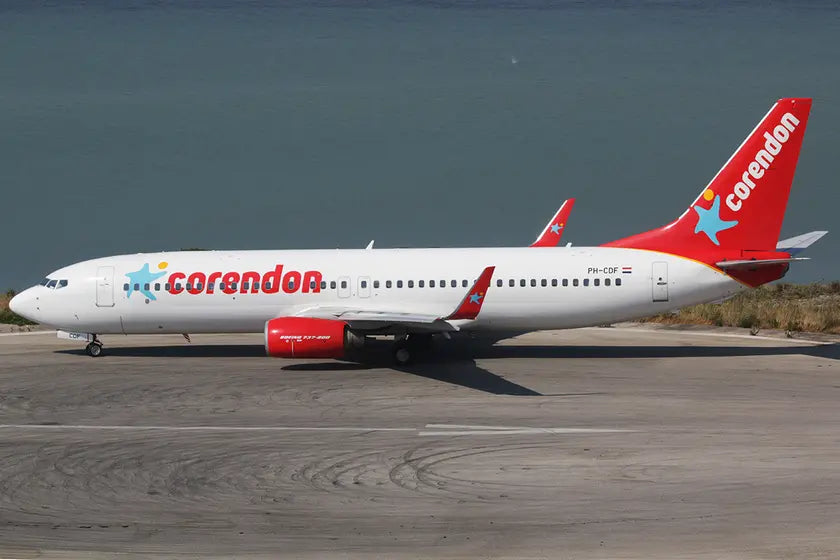
Corendon Dutch Airlines Overview & Company Profile
Corendon Dutch Airlines (IATA CD, ICAO CND, callsign "Dutch Corendon") is the Netherlands-registered leisure carrier of the Corendon Tourism Group. It was founded in 2010, received Dutch AOC number NL-AOC-68, and began commercial operations in April 2011 with a single Boeing 737-800 flying holiday routes from Amsterdam. Its registered office is in Badhoevedorp, in the municipality of Haarlemmermeer, a short drive from Amsterdam Airport Schiphol.
The most important thing an applicant needs to understand about Corendon is that it is not one airline. It is three separate airlines under one brand, each with its own AOC, its own employment law, and radically different pilot conditions:
- Corendon Dutch Airlines (CD / CND), the Dutch operator, based at Schiphol, employing pilots on Dutch contracts.
- Corendon Airlines (XC / CAI), the original Turkish operator founded in 2004 and based in Antalya, employing pilots on Turkish contracts.
- Corendon Airlines Europe (XR / CXI), the Maltese operator founded in 2017, which staffs German, Belgian, Greek, Egyptian and Turkish bases on Maltese contracts.
Pilot job boards and salary aggregators routinely blend these three entities into a single "Corendon" listing. They should not be blended. A German-based Maltese contract with hotel accommodation and a 20-days-on commuting roster is a fundamentally different proposition from a Dutch contract at Schiphol with a pension scheme, 25 statutory-plus holiday days, and a requirement to live within an hour of the airport. This article covers the Dutch operator only, and flags clearly wherever a figure comes from a sister AOC.
Corendon Dutch Airlines is small by design. It operates three Boeing 737 MAX 9 aircraft, all delivered new between September 2023 and April 2024, and it charters a wet-leased Airbus A350-900 from Spanish operator World2Fly for its Caribbean services. It is the only Dutch airline that offers holiday flights from all five Dutch commercial airports, and the only Dutch carrier serving both Groningen Eelde and Maastricht Aachen in the summer season, according to reporting by Luchtvaartnieuws. The group as a whole carries in the region of ten million passengers a year across roughly 33 to 35 aircraft, and Corendon's own corporate responsibility report put group turnover at approximately €800 million for 2024.
Ownership sits with the Corendon Tourism Group, founded by Turkish-Dutch entrepreneur Atilay Uslu. Gunay Uslu was appointed group CEO in early 2024. The airline is not part of an alliance, does not codeshare in the traditional sense, and sells almost entirely through the Corendon tour operator and its own direct channels.
Corendon Dutch Airlines is a Dutch-speaking, Schiphol-based, single-type leisure operator with three aircraft. That profile creates a very specific candidate fit: a Dutch-speaking EU passport holder who already lives in the Randstad, wants to stay home-based rather than commute to a foreign base, and is comfortable joining an operation where the establishment is small and command upgrades depend on attrition rather than growth. Pilots looking for rapid command, a large seniority list, or long-haul progression on their own AOC will find better options elsewhere in the Dutch market.
Fleet Composition & Type Ratings
Corendon Dutch Airlines operates one of the youngest and simplest fleets of any European airline: three Boeing 737 MAX 9 aircraft, all leased new from Air Lease Corporation, all configured in a single-class 213-seat layout. There is no mixed fleet, no sub-fleet, and no second type on the Dutch AOC. From a pilot's perspective that means one type rating, one set of procedures, one recurrent training profile, and no fleet bidding of any kind.
The transition away from the Boeing 737-800 was completed quickly. PH-CDH left the fleet in October 2023, PH-CDF in December 2023, and PH-CDE, the aircraft that flew the airline's first revenue service in April 2011, in April 2024. The replacement MAX 9s arrived in the reverse order: PH-CDP was ferried non-stop from Boeing Field to Schiphol at the end of September 2023 and entered service the following weekend on a flight to the Greek island of Lefkas, PH-CDQ followed in November 2023, and PH-CDR was delivered in late April 2024 and entered service on 1 May 2024 on a rotation to Corfu. Corendon Dutch Airlines was the first operator in the Corendon group to take the MAX, and the PH-CDP was the first 737 MAX 9 to appear on the Dutch civil register.
| Aircraft Type | Role | In Service | Notes for Pilots |
|---|---|---|---|
| Boeing 737 MAX 9 | Narrowbody | 3 | PH-CDP, PH-CDQ, PH-CDR. 213 seats, single class, 7 cabin crew. Leased from Air Lease Corporation. The only type flown by Corendon Dutch Airlines pilots. |
| Airbus A350-900 | Widebody (wet-lease) | 1 | Operated by World2Fly of Spain under a wet-lease, 432 seats. Flies Amsterdam to Curaçao and Bonaire. Crewed by World2Fly pilots, not by Corendon Dutch Airlines pilots. |
| Airbus A330 | Widebody (wet-lease) | Planned | Announced for Düsseldorf to Curaçao three times weekly from 14 December 2026, also with World2Fly. Again an ACMI arrangement, not a Corendon Dutch Airlines AOC aircraft. |
| Boeing 737-800 | Narrowbody | 0 | Fully retired. PH-CDH (Oct 2023), PH-CDF (Dec 2023), PH-CDE (Apr 2024). The 737-800 remains in service with the Turkish and Maltese sister AOCs. |
Fleet data compiled from Corendon corporate sources, ch-aviation, Luchtvaartnieuws and Dutch registry records, current to mid-2026. Aircraft counts on the Dutch AOC have been stable at three since May 2024.
What the wet-lease means for your logbook
This is the single most misunderstood point about Corendon Dutch Airlines. The airline sells and markets long-haul flights to Curaçao and Bonaire under its own CD flight numbers, five times a week to Curaçao and with a Bonaire routing on selected days. Prospective pilots reasonably assume this creates a widebody career path. It does not. The A350-900 is a wet-lease, meaning World2Fly supplies the aircraft, crew, maintenance and insurance. Corendon Dutch Airlines pilots do not fly it, do not hold an A350 rating, and are not in line for one. The same applies to the A330 announced for the Düsseldorf to Curaçao route from December 2026.
The one exception on record is charter work. In June 2026 Corendon positioned a 737 MAX 9 to Curaçao with its own cockpit and cabin crews, routing via Terceira in the Azores for fuel, to operate a charter programme between Curaçao and United States World Cup host cities including Fort Lauderdale, Houston, Kansas City and Philadelphia. That was a one-off special operation rather than a scheduled pattern, but it does illustrate that the MAX 9 and its Dutch crews occasionally operate well outside the Mediterranean.
Corendon Dutch Airlines recruits experienced pilots who already hold a valid B737-300/900 type rating. The published First Officer vacancy on the company's Dutch careers site requires the rating, a completed line check on the 737, and at least 300 hours of recent multi-engine experience. There is no company-funded ab-initio type rating on the Dutch entity for experienced hires. The only route into a Corendon-funded type rating is the cadet pathway described in Section 8, where E-Flight Academy states that the type rating is "provided by Corendon upon hire". By contrast, the Maltese sister airline's Trainee First Officer scheme is explicitly self-sponsored, with the type rating delivered exclusively by Global Aviation Training in Madrid at the candidate's own cost.
Corendon Dutch Airlines has no aircraft on order. At group level the message has been explicitly cautious: Aviation Week reported in May 2026 that Corendon Airlines "sees no need to expand its fleet in the current environment" and is instead investing in long-haul activity through ACMI arrangements, meaning leased aircraft and leased crews rather than its own. Where the group is growing, it is growing in Germany, not the Netherlands. Corendon plans roughly 20 percent more German capacity for summer 2026, stationing ten aircraft across four German bases, with Düsseldorf overtaking Schiphol as its largest departure airport. For a pilot, this matters: fleet growth drives command upgrades, and the growth is happening on a different AOC in a different country.
Pilot Salary & Compensation Breakdown
Corendon Dutch Airlines does not publish a pilot pay scale. There is no collective labour agreement (CAO) covering its pilots, which means there is no publicly registered salary table of the kind that exists for KLM, Transavia, TUI fly Netherlands and easyJet Netherlands. The company's own First Officer vacancy describes the offer only as "een marktconform salaris", a market-conforming salary. That is the honest starting point, and any article claiming precise Corendon Dutch pay steps is extrapolating.
What can be established is threefold: what Corendon itself publishes, what third-party aggregators report for the Corendon group, and what the surrounding Dutch market pays. Taken together these give a usable range, and the Dutch benchmarks are the more reliable guide because a Schiphol-based Dutch operator competing for Dutch-speaking, type-rated 737 pilots has to price against Transavia and TUI fly or it will not fill seats.
What Corendon publishes directly
Third-party reported ranges (Corendon group, treat with caution)
| Rank | Reported gross monthly range | Source and caveat |
|---|---|---|
| First Officer | €4,154 to €8,698 | Pilotcareer.org aggregator entry for Corendon Dutch Airlines. The same entry lists bases in Hanover, Nuremberg, Düsseldorf, Cologne, Brussels, Heraklion and Antalya, which are Corendon Airlines Europe bases, not Dutch ones. Treat as a Corendon group range, not a Dutch scale. |
| Captain | €7,337 to €15,385 | Same aggregator, same caveat. The upper figure almost certainly reflects a base salary plus block-hour pay total on a foreign contract rather than a Dutch monthly base. |
These are the only publicly circulating numbers attached to the Corendon Dutch Airlines name. They come from a third-party jobs wiki, not from the company, and the base list attached to them shows they describe the group rather than the Dutch entity.
The Dutch market benchmarks that actually matter
A more defensible way to size a Corendon Dutch offer is to look at what its direct Dutch competitors publish, because these are CAO-registered figures rather than estimates.
| Airline | Rank / step | Published gross monthly | Notes |
|---|---|---|---|
| Transavia Netherlands | First Officer, 500 to 2,800 relevant hours | €6,461.46 | Published starting salary in Transavia's own First Officer campaign. Rises roughly €300 per month annually. Training allowance of €2,605.35 gross in the first two months. |
| Transavia Netherlands | First Officer, 2,800+ relevant hours | €7,552.37 | Same campaign, higher entry step. Plus 10 percent monthly allowance, 8.33 percent year-end bonus, 8 percent holiday allowance, profit sharing, €104.17 travel allowance and €84.38 route cost allowance. |
| TUI fly Netherlands | (Senior) First Officer, scale maximum | €7,771 | Pilot CAO 2024 to 2026, excluding holiday allowance. |
| TUI fly Netherlands | Captain, scale maximum | €11,561 | Pilot CAO 2024 to 2026, excluding holiday allowance. |
| Transavia Netherlands | B737 Captain, advertised start | ~€11,000 | Figure from a current external recruitment listing for a Transavia B737NG Captain, plus annual increments and block-hour pay. |
Transavia figures from Transavia's own recruitment materials; TUI fly Netherlands figures from the registered pilot CAO for 2024 to 2026. All are gross monthly amounts before Dutch income tax and social contributions.
The December 2024 pay settlement
One concrete and well-documented compensation event does exist. Dutch union AVV spent around eighteen months trying to open collective bargaining with Corendon Dutch Airlines and was preparing to ask a court to compel the company to negotiate. In December 2024 Corendon short-circuited that process by putting a high wage offer directly to its pilots, conditional on those pilots agreeing to discuss terms directly with the company for the following two years without AVV involvement. A majority of Corendon pilots accepted, and the union and the company jointly withdrew the court case. AVV's own published account describes the offer as "een hoog loonbod", a high wage offer.
The practical read for a candidate is that Corendon Dutch pay was repriced upward at the end of 2024 under competitive and union pressure, and that the resulting terms are individually negotiated rather than published. That two-year direct-negotiation window ran to around the end of 2026, so the next round of terms is a live question for anyone joining now.
Corendon Dutch Airlines publishes no pilot salary scale, and no CAO exists to make one public. The figures in this section are drawn from the company's own vacancy text, a third-party pilot jobs aggregator whose Corendon entry demonstrably mixes group AOCs, published Dutch competitor CAOs, and AVV's account of the December 2024 settlement. Do not treat any of them as a Corendon Dutch Airlines offer. Because pay here is negotiated individually rather than set by scale, the only reliable number is the one in your own offer letter, and candidates should ask specifically about the base salary, whether block-hour or sector pay applies on top, the pension contribution split, and the holiday allowance treatment. Dutch gross-to-net is also substantially different from Maltese or Turkish gross-to-net, so never compare a Corendon Dutch offer with a Corendon Airlines Europe offer on the gross figure alone.
Roster Pattern & Quality of Life
Corendon Dutch Airlines does not publish its roster construction rules, and with no CAO there is no negotiated work and rest agreement (Werk- en Rusttijdenregeling) of the type VNV has secured at KLM, Transavia and TUI fly. What governs the roster is therefore the regulatory floor plus company practice: EASA Subpart FTL under Regulation (EU) 965/2012, the Dutch Arbeidstijdenbesluit vervoer, and EU Directive 2000/79/EC on mobile aviation workers.
The regulatory ceilings you are actually flying to
What the operation looks like day to day
The Dutch operation is overwhelmingly out-and-back short and medium-haul from Schiphol, with additional departures from Rotterdam The Hague, Eindhoven, Groningen Eelde and Maastricht Aachen. Summer flying is the Mediterranean core: Turkey, Greece, Spain including the Balearics and Canaries, Bulgaria, Portugal and Italy. The airline announced an expanded summer 2026 programme adding Costa Blanca, Costa Brava via Barcelona and Girona, Menorca, La Palma and Málaga, plus Agadir, Marrakech, Cairo and the Algarve.
Unlike some leisure carriers, Corendon Dutch Airlines does not shut down in winter. Its winter programme from Schiphol includes Hurghada in Egypt at around five hours, Banjul in The Gambia at around six hours fifteen minutes, the Canary Islands at around four and a half hours, and from winter 2025/2026 a new three-times-weekly service to Sal in Cape Verde. Those are long sectors for a 737, and they materially change the shape of a duty day compared to a two-sector Antalya rotation. Corendon does not publish which of these routes involve crew night stops, but the company does confirm that per diems are paid for overnights away from base, which indicates night stops occur on at least part of the network.
We have not been able to source a published or company-confirmed roster pattern for Corendon Dutch Airlines: no days-on/days-off cycle, no fixed roster publication window, no verified average block hours per month. We are deliberately not showing an invented sample month for the Dutch operator. What follows instead is the roster pattern the group publishes for its Maltese AOC, shown because candidates frequently receive it during a group application and mistake it for the Dutch offer. It is not the Dutch pattern.
📅 Sample Month — Corendon Airlines Europe (Malta AOC) commuting roster, for contrast
Illustration of the pattern described in Corendon Airlines Europe's own cockpit recruitment FAQ: 20 days on at the base, then 10 consecutive block-off days, with "snipped" rest days interspersed during the on-base block. Applies to the Maltese AOC, not to Corendon Dutch Airlines.
Why the Dutch and Maltese models are not comparable
The Corendon Airlines Europe cockpit FAQ sets out the Maltese model plainly. Crew are expected to average 75 block hours per month against a 100-hour 28-day ceiling, with a peak in high season. Accommodation at base is provided in an aparthotel with airport shuttles, or a housing allowance is paid if the pilot rents privately. The roster is 20 days on at base followed by 10 consecutive block-off days, and critically those block-off days are set off against the annual leave entitlement. Flights home during block-off days are paid for by the crew member. Contracts are fixed-term with an annual evaluation each October determining renewal.
None of that describes the Dutch operation. Corendon Dutch Airlines pilots live at home in the Netherlands and commute daily to Schiphol. The company's First Officer vacancy states that applicants must hold a category B driving licence and must be able to reach Schiphol within one hour, which tells you two things: the operation uses home standby with a short callout, and it effectively requires living in or around the Randstad. Annual leave is stated separately as 25 days full-time and is not consumed by a block-off cycle. A commuting allowance is paid rather than accommodation being provided.
There is one base, Schiphol, and no base bidding. The one-hour reachability requirement is the practical constraint that shapes the job. Amsterdam, Haarlem, Hoofddorp, Leiden, Almere, Utrecht and Amersfoort are all comfortably inside it; Groningen, Maastricht and most of Zeeland are not, despite the airline flying from those regional airports. Housing in the Schiphol catchment is expensive by Dutch standards, and unlike the Maltese contract there is no company accommodation to offset it. On the positive side, a three-aircraft Schiphol operation with predominantly out-and-back flying means a high proportion of nights in your own bed, which is a genuine quality-of-life advantage over a commuting contract at a foreign base.
A three-aircraft airline running a year-round programme with sectors from two hours to six and a quarter has very little slack. With no negotiated work and rest agreement above the EASA and Dutch legal minimum, roster stability, standby callout frequency and the ability to protect requested days off depend on company practice and on crewing levels rather than on an enforceable collective agreement. This is the single most important question to press in interview, and candidates should ask for specifics: how far ahead the roster is published, how many days off per month are typical in July and August as opposed to the legal minimum of seven, how often standby converts to a duty, and what the annual block-hour average actually is.
Benefits, Travel Perks & Retirement
The benefits package at Corendon Dutch Airlines is a conventional Dutch employer package rather than a specialised airline-pilot package. That distinction matters. Dutch employment law provides a strong baseline that applies automatically: statutory holiday accrual, the standard 8 percent holiday allowance convention, mandatory participation in the national health insurance system, sickness pay obligations on the employer, and full access to Dutch social security. On top of that Corendon adds a company pension scheme and a set of travel-sector perks. What it does not add, because there is no CAO, is the specialised layer that VNV has negotiated at KLM, Transavia and TUI fly: a dedicated pilot pension fund, a collectively-funded loss of licence scheme, and career-protection provisions.
Staff travel: a different model to a network carrier
Do not expect a legacy-style ID90 network. Corendon is not in an alliance and has no interline staff-travel agreements of the kind KLM pilots enjoy across SkyTeam. What Corendon offers instead is a tour-operator benefit: discounted package holidays and hotel nights on the Corendon product, extended beyond the employee to family and friends. For a pilot whose family takes Mediterranean or Caribbean package holidays, that can be worth more in cash terms than a standby ticket scheme. For a pilot who wants to fly standby to Tokyo, it is worth nothing. The group's Turkish and Maltese entities separately offer standby staff tickets on Corendon flights for crew and first-degree family members.
Pension and loss of licence: the two gaps to interrogate
Corendon confirms a pension scheme exists but publishes no detail. There is no Dutch industry-wide pension fund for airline pilots that would automatically cover Corendon; the well-known dedicated pilot fund, Stichting Pensioenfonds Vliegend Personeel KLM, is specific to KLM. Corendon's arrangement is therefore almost certainly an insured company scheme, and the terms that matter, namely the contribution percentage, the employer share, whether it is defined contribution, and the retirement age assumption, are all things a candidate must ask about directly.
Loss of licence is the more serious gap. Pilots at CAO-covered Dutch airlines benefit from collectively-arranged schemes: at KLM, for example, cover runs through the Stichting Loss of License Fonds under the collective agreement rather than through a commercial insurance policy. No equivalent collective scheme is documented for Corendon Dutch Airlines. Dutch statutory sickness and disability provisions (loondoorbetaling bij ziekte and the WIA regime) apply to any employee, but they are not designed around the specific risk of permanently losing a Class 1 medical while retaining full general working capacity. Commercial loss of licence products are available in the Netherlands through specialist providers, and any pilot joining a non-CAO Dutch operator should establish in writing what the employer provides before deciding whether to buy private cover.
Because there is no collective agreement to fall back on, the offer letter is the whole deal. Ask for written answers on: the pension provider, scheme type and contribution split; whether any loss of licence cover is provided by the employer and at what benefit level; whether the 8 percent holiday allowance is paid on top of the quoted salary or included in it; whether there is a year-end bonus or profit share; whether the contract is fixed-term or indefinite and what the renewal criteria are; and whether any training bond applies to type rating or recurrent costs. At Corendon's Maltese entity, contracts are explicitly fixed-term with an annual October evaluation, and candidates should confirm whether the Dutch entity works the same way.
Career Progression & Seniority
This is where Corendon Dutch Airlines is weakest, and candidates should go in with clear eyes. Three aircraft, one type, no orders, and a parent group that has publicly said it does not need more aircraft is not a growth environment. Corendon does not publish a seniority list, does not publish a pilot headcount, and does not publish upgrade timelines. What can be assessed is the structural arithmetic, and the arithmetic is unforgiving.
The establishment problem
A three-aircraft narrowbody operation flying a year-round schedule needs a modest number of crews. Corendon has not published how many pilots that translates to, and we are not going to estimate a headcount and present it as fact. What is not in doubt is the direction of travel: the fleet has been stable at three aircraft since May 2024, there are no orders, and Aviation Week reported in May 2026 that Corendon Airlines sees no need to expand its fleet in the current environment. In a stable-fleet airline, left-seat vacancies arise only when an incumbent captain retires, resigns, moves to management or loses a medical. There is no fleet-growth engine creating new commands.
The corollary is that Corendon Dutch Airlines does hire direct-entry captains. A published B737NG Captain vacancy for Corendon Dutch Airlines (since filled) specified an EASA ATPL, EASA Class 1 medical, 5,000 hours total time, 1,000 command hours, current PBN, ICAO English Level 4 or higher, an unrestricted right to live and work in the EU, and both English and Dutch. Direct-entry command is good news if you are already a captain and want to come home to the Netherlands. It is bad news if you are a First Officer waiting for an upgrade, because every direct-entry captain hired is a command that does not go to an internal candidate.
| Career Stage | What is documented | What it means in practice |
|---|---|---|
| Cadet entry | 16-month ATPL via E-Flight Academy, self-funded at €119,000 | Letter of intent signed with Corendon on selection. Type rating provided by Corendon on hire. No guaranteed job: E-Flight states the chance of being hired is "very high" but explicitly not a guarantee. |
| Direct-entry First Officer | B737-300/900 type rating, 737 line check completed, 300 hours recent multi-engine, EASA ATPL or CPL, fluent Dutch | Type rating must already be held. The bar is experience-light by European standards but language-heavy. |
| Upgrade to Captain | No published timeline. No published seniority system. | Command depends on attrition in a static three-aircraft fleet and competes with direct-entry hiring. Treat any specific upgrade figure you see quoted online as unsourced. |
| Direct-entry Captain | 5,000 hours total, 1,000 command hours, ATPL, Dutch and English | Actively recruited when vacancies arise. The realistic route into the left seat at this airline for most candidates. |
| Widebody progression | None on the Dutch AOC | The A350 and the planned A330 are World2Fly wet-leases. Corendon Dutch Airlines pilots do not fly them and there is no internal widebody path. |
| Training roles | Not published | A three-aircraft operator needs TRI/TRE capacity, so instructor roles exist, but selection criteria are not public. |
Movement between the three Corendon AOCs
There is no published single seniority list across Corendon Dutch Airlines, Corendon Airlines and Corendon Airlines Europe, and no published transfer or bidding mechanism between them. This is the opposite of a group like Air France and Transavia France, where a single seniority list protects a pilot assigned to the low-cost subsidiary. At Corendon, the three carriers are separate employers under separate jurisdictions: Dutch, Maltese and Turkish. Moving from the Maltese entity to the Dutch entity, or the reverse, should be assumed to be a new job application on new terms rather than an internal transfer, unless the company states otherwise in writing.
This matters more than usual right now because the group's growth is concentrated in Germany, flown by the Maltese AOC. Corendon is stationing ten aircraft across Düsseldorf, Hanover, Cologne/Bonn and Nuremberg for summer 2026, with Düsseldorf becoming its largest departure airport. A pilot who joins Corendon hoping to ride group expansion into a command needs to understand that the expansion is happening on a Maltese contract at a German base, not at Schiphol.
There are two genuine positives. First, single-type stability: 737 MAX 9 time on a modern aircraft is portable currency across Europe, and Corendon is one of very few Dutch operators offering MAX time on a Dutch contract. Second, the airline demonstrably produces experienced First Officers quickly, because a small operation gives high sector counts and varied flying, with sectors ranging from two hours to Banjul at over six. One Corendon Dutch First Officer profiled in the Dutch aviation press in July 2026 had accumulated approximately 1,300 hours on the 737 MAX 9 in a little over two years in the right seat. For a pilot treating Corendon as a first or second airline and a route to a competitive 737 logbook, that is a reasonable proposition. As a thirty-year career with a predictable path to command, it is a much harder case.
Recruitment Process & Requirements
Corendon Dutch Airlines recruits through its own Dutch careers portal at werkenbijcorendon.nl, separately from the group's international portal at corendonairlines.com. This is an important practical point: the group careers page carries First Officer and Trainee First Officer campaigns for the Turkish and Maltese entities with German, Belgian, Greek and Turkish bases, while Dutch cockpit vacancies appear on the Dutch site. Applying through the wrong portal means applying to the wrong airline.
Cockpit hiring at Corendon is also seasonal in rhythm. The group has stated that, as a leisure airline whose operation peaks in summer, its main recruitment drive typically starts in September or October, with most cockpit and cabin positions closed by the time the summer season begins.
Experienced First Officer requirements (Corendon Dutch Airlines)
Direct-entry Captain requirements (Corendon Dutch Airlines)
Captain requirements from a published Corendon Dutch Airlines B737NG Captain vacancy, since filled. Requirements on future campaigns may differ.
Selection stages
Online application via the Dutch careers portal
Applications go through werkenbijcorendon.nl. Corendon confirms receipt of every application and screens it against the vacancy. Candidates are told either that there is no match, with feedback, or invited to a first conversation.
Kennismakingsgesprek (introductory interview)
Usually conducted by the Corporate Recruiter together with someone from the relevant department, in Corendon's case Flight Operations or Crew Training. Can be held virtually or in person. Corendon describes this as a mutual fit conversation rather than a technical grilling.
Second, technical interview
The company's published process describes a second conversation going deeper into the role and its technical content. For cockpit roles this is where operational, technical and CRM competence is assessed.
Offer
Corendon makes an offer when both sides are positive. Because there is no CAO scale, the financial terms at this point are individually negotiated, which makes preparation on market benchmarks worthwhile.
Screening: VOG and VVGB
Corendon states that for some roles it carries out further screening and requires a Verklaring Omtrent het Gedrag (Dutch certificate of conduct) or a Verklaring van Geen Bedenkingen. For airside cockpit roles at Schiphol the VVGB is standard and the pilot vacancy explicitly requires cooperation in obtaining one.
Onboarding and line training
Since experienced hires arrive already type-rated and line-checked on the 737, onboarding centres on company conversion and line training on the MAX 9 rather than on a full type course.
Fluent spoken and written Dutch is stated as a hard requirement on both the Corendon Dutch Airlines First Officer and Captain vacancies. This is a genuine differentiator in the Dutch market and one that works in favour of Dutch nationals. For comparison, Transavia states plainly in its own First Officer campaign that "if you do not speak Dutch, no problem." A non-Dutch-speaking EU pilot with a 737 rating can realistically target Transavia or the Corendon group's German bases, but not Corendon Dutch Airlines. Conversely, a Dutch-speaking pilot faces a much smaller field of competition here than at Transavia or KLM.
The Corendon Airlines Europe process, documented in the group's cockpit recruitment FAQ, is quite different: an online psychological assessment, an online competency-based interview, then a simulator assessment in Madrid, followed by Company Conversion Training in Antalya with a €100 one-way travel allowance and full-board accommodation, then transfer to a base for line training. It also requires 500 hours on the B737 CL and NG for First Officers and 5,000 hours total with 2,500 hours in command for Captains. Those thresholds and that process apply to the Maltese entity. Corendon Dutch Airlines publishes a different, lighter set of experience requirements and its own Dutch hiring process. Verify which entity any recruiter is representing before you invest time.
The E-Flight Academy Cadet Pathway
In October 2025 Corendon Dutch Airlines announced a cadet pilot programme with E-Flight Academy, a flight school founded in 2021 and based at Teuge Airport near Apeldoorn. The first cohort started in January 2026. The programme is genuinely unusual and deserves its own section, because it is marketed as the world's first airline cadet pathway in which a substantial share of the flying training is done in electric aircraft, and because it is the only route into a Corendon-funded type rating on the Dutch AOC.
How the programme works
The course is a modular route to a frozen ATPL, run to a 16-month schedule, with students trained to Corendon's own procedures from the first day so that they can move directly into the airline's operation on completion. The main training base is Teuge Airport, with night flying and instrument approaches flown at Lelystad, and additional hours flown in Alicante in Spain during the winter months for better weather. A significant portion of early flying is done on the Pipistrel Velis, the certified electric two-seat trainer, which is what produces the claimed emissions reduction of roughly half compared with a conventional programme.
| Item | Detail |
|---|---|
| Course fee | €119,000 |
| Duration | 16 months (E-Flight also quotes 15 to 18 months for the complete training) |
| Licences covered | PPL, Night Rating, UPRT, IR, MEP, ME-IR and all flight hours, to frozen ATPL |
| Also included | All instruction, landing fees, fuel and electricity, theory materials and training, exams and proficiency checks, excursions and workshops |
| Not included | Accommodation, re-tests (€200 to €600 each), additional training beyond syllabus, flights to Alicante (€150 to €300 return), medical examinations (€375 to €500), personal living costs |
| Type rating | Provided by Corendon on hire, per E-Flight Academy |
| Financing | No airline funding or bursary. Self-funded. E-Flight can introduce candidates to a training finance specialist and contributes to part of the advisory fee once selection is passed and training has started |
| Physical constraint | The Pipistrel Velis has a 180 kg payload limit. E-Flight advises that above 95 kg scheduling becomes difficult and the 16-month timeline may not be achievable. A trial lesson is recommended for taller candidates |
| Accommodation | Not provided. E-Flight cites Deventer as nearby and affordable at €400 to €800 per month and assists via its network |
Details as published by E-Flight Academy on its Corendon programme page. Full admission requirements are held in Corendon's own cadet vacancy rather than on the school's site.
The commitment question
Candidates who pass selection sign an intentieovereenkomst, a letter of intent, with Corendon. E-Flight Academy is careful and commendably direct about what this is worth: the school states that the chance of being hired after training is "very high" but that this is explicitly not a guarantee, and refers candidates to Corendon for the conditions. Corendon's own announcement describes graduates as being able to start at the airline directly, which is a statement of design intent rather than a contractual commitment.
That is a €119,000 personal investment plus living costs, against a letter of intent rather than a conditional job offer, at an airline with three aircraft. It is a materially different risk profile from a KLM Flight Academy place or an Air France cadetship, where the airline funds the training. It is, however, a better proposition than the group's Maltese Trainee First Officer scheme, where the cadet self-funds both the flight training and a B737 type rating delivered by Global Aviation Training in Madrid, and where the resulting contract is fixed-term.
When applications for the first cohort opened in October 2025, with a closing date of 31 October 2025, Corendon explicitly encouraged female candidates to apply, framing the campaign around increasing the number of women progressing towards command. Applications for subsequent cohorts run through the E-Flight Academy Corendon page, with the full admission criteria published in Corendon's own vacancy.
Before signing, establish in writing: whether the letter of intent creates any obligation on Corendon at all; what happens if the airline has no vacancy at the point you graduate; whether the type rating carries a training bond and over how many years; what the starting First Officer salary would be, given that Corendon publishes no scale; and whether the type rating would be funded outright or advanced as a loan. Given a static three-aircraft fleet with no orders, the number of First Officer seats opening in any given year is small, and cohort timing relative to those vacancies is the dominant risk.
How Corendon Dutch Airlines Compares: Airline Radar Chart
The realistic alternatives for a Dutch-speaking, 737-rated pilot who wants to be based in the Netherlands are Transavia Netherlands and TUI fly Netherlands. Both are leisure operators, both are Schiphol-centred, and both compete directly with Corendon for the same candidates. The comparison below scores all three on the same six dimensions used in the scorecard. Scores are editorial estimates based on the published CAOs, company recruitment material and the research set out in this article.
| Dimension | Corendon Dutch Airlines | Transavia Netherlands | TUI fly Netherlands |
|---|---|---|---|
| Own fleet | 3 x B737 MAX 9 | ~52 aircraft: 34 B737-800, 18 A321neo | B737 narrowbody plus B787 widebody within the TUI group |
| Pilot CAO | None. Direct negotiation since Dec 2024 | CAO with VNV, 2024 to Feb 2026 term, renegotiation ongoing in 2026 | Pilot CAO 2024 to 2026 with VNV |
| Published FO pay | Not published ("marktconform") | €6,461.46/month entry (500 to 2,800 hrs); €7,552.37 (2,800+ hrs) | Scale maximum €7,771/month excl. holiday allowance |
| Published Captain pay | Not published | ~€11,000/month advertised start plus increments and block pay | Scale maximum €11,561/month excl. holiday allowance |
| Dutch language | Mandatory, spoken and written | Not required | Not stated as mandatory in current campaigns |
| Bases | Schiphol only | Amsterdam, Rotterdam, Eindhoven, Brussels | Amsterdam-centred |
| Widebody path | None on own AOC | None (narrowbody operator) | Yes, B787 First Officer roles advertised at Amsterdam |
| Upgrade to Captain | Not published; structurally slow | Estimated around 7 to 8 years | Not published |
Transavia fleet data from Transavia's own newsroom. CAO figures from the registered Dutch collective agreements. Corendon rows reflect the absence of published data rather than an assessment that the terms are poor.
Key takeaways from the comparison
Transavia is the benchmark, and it is a high one. A CAO negotiated with VNV, a 52-aircraft fleet across two types, four bases, published salary scales, an 8.33 percent year-end bonus, 8 percent holiday allowance, profit sharing and an estimated seven to eight year path to command. Transavia also does not require Dutch. On paper it beats Corendon on every measure except one, and it is the airline any Corendon candidate should apply to in parallel.
TUI fly Netherlands offers something neither of the others can: a widebody. Its pilot CAO for 2024 to 2026 gives published maxima of €7,771 for a Senior First Officer and €11,561 for a Captain, and the group has been advertising Boeing 787 First Officer roles based in Amsterdam alongside 737 positions. For a pilot who wants long-haul without leaving the Netherlands and without joining KLM, TUI fly is the realistic option.
Where Corendon genuinely wins is aircraft and accessibility. The three MAX 9s are the newest narrowbodies flown by any Dutch operator, delivered between September 2023 and April 2024, in a clean single-type operation with no sub-fleets. And the entry bar is meaningfully lower: 300 hours of recent multi-engine time with a 737 rating and a line check, against Transavia's requirement of 500 hours on type or 1,000 hours total with 500 on a CS-25 multi-pilot type. For a low-hours Dutch-speaking pilot who already has a 737 rating, Corendon is often a realistic first airline where Transavia is not.
Where Corendon loses is structure. No CAO means no published pay scale, no negotiated work and rest agreement, no collective loss of licence scheme, and no seniority-based bidding. Three aircraft with no orders means commands are scarce and direct-entry captains compete with internal upgrades. That is not a criticism of Corendon's intentions; it is arithmetic.
Radar scores are editorial estimates, not measured values. They are based on the published Transavia and TUI fly Netherlands pilot CAOs, Transavia's own recruitment campaigns, Corendon's published vacancies and corporate communications, Corendon Airlines Europe's cockpit FAQ, AVV's published account of the 2024 to 2025 Corendon negotiations, and fleet data from ch-aviation, Luchtvaartnieuws and Dutch registry records. Corendon scores lower on Salary and Benefits partly because it publishes nothing, and an absence of public data is not proof of poor terms. Individual outcomes will vary considerably at an airline where pay is individually negotiated. Scores will be revised as we publish dedicated guides to Transavia Netherlands and TUI fly Netherlands.
Union & Industrial Relations
The industrial relations picture at Corendon Dutch Airlines is the most distinctive thing about the airline as an employer, and it is the part most prospective pilots know nothing about. In short: Corendon Dutch Airlines pilots have no collective labour agreement, and in December 2024 a majority of them voted to keep it that way for two years in exchange for a pay rise.
The Dutch union landscape
The dominant pilot union in the Netherlands is the Vereniging Nederlandse Verkeersvliegers (VNV), the Dutch member association of IFALPA and the European Cockpit Association. VNV has close to 6,000 members and negotiates collective agreements for around 4,500 of them. Those agreements cover pilots at the KLM group including KLM, Transavia and the KLM Flight Academy, plus TUI fly, easyJet and CHC helicopters. The union's board carries dedicated seats for KLM, Transavia, TUI fly and easyJet. Since its first KLM agreement in 1969 it has embedded structures that Dutch pilots take for granted: the Regeling Vlieger Loopbaan career regulation, pension arrangements, the Werk- en Rusttijdenregeling work and rest agreement, legal assistance in professional cases, and protection in disciplinary proceedings.
Corendon does not appear on that list. No VNV collective agreement covers Corendon Dutch Airlines pilots, and none of the structural protections listed above applies to them.
The AVV campaign and how it ended
AVV, a smaller Dutch union that runs on a democratic members-vote model, opened a Corendon Dutch Airlines B.V. sector in April 2024 with a first member meeting, and spent around eighteen months with its workplace representatives preparing to reach collective bargaining. Corendon, by AVV's account, did not want to participate. By November 2024 the union announced it was heading to court, intending to have a judge rule on whether Corendon was obliged to sit down with AVV and attempt to reach a CAO.
That process collapsed in early December 2024. Corendon put a high wage offer directly to its pilots, conditional on the pilots agreeing to discuss terms and conditions directly with the company for the following two years, without AVV involved. The majority of Corendon pilots accepted. AVV and Corendon then jointly withdrew the lawsuit. AVV's published statement is measured: it wishes the pilots success, says it is standing on the sidelines for now, and remains ready to help. From 1 September 2025 the sector moved to AVV's standard membership contribution, indicating the sector remains formally open.
What this means if you are considering joining
There are two honest readings, and a candidate should weigh both.
The favourable reading is that the December 2024 outcome delivered a real pay rise, that a majority of the pilot body actively chose direct negotiation over union representation, and that a small airline with short communication lines can move faster and more flexibly for individuals than a rigid collective scale allows. Corendon's own careers material emphasises an informal culture with short lines to management, and a three-aircraft operation genuinely is a place where the Chief Pilot knows every pilot by name.
The cautious reading is that direct negotiation without a union works well when the labour market is tight and much less well when it is not. A pay rise won under the threat of litigation in a pilot shortage is not the same thing as a durable structure. Without a CAO there is no negotiated work and rest agreement above the legal minimum, no collective loss of licence fund, no seniority-protection framework, no agreed redundancy provisions, and no mechanism forcing the employer back to the table. Everything rests on individual contracts and on the employer's continued goodwill. The two-year direct-negotiation commitment made in December 2024 has now run its course, which makes the current bargaining position at the airline a live and legitimate question to raise in an interview.
Joining a union is a personal decision, but pilots at non-CAO operators should at minimum understand what they are not covered by. VNV membership is open to Dutch pilots and to foreign pilots working for a Dutch airline, and brings professional support, legal assistance in licensing and disciplinary matters, and safety advocacy even where the union holds no collective agreement at your employer. AVV's Corendon sector page remains live, with membership from €32 a year. Where there is no collective loss of licence scheme, checking whether a private policy is needed should be part of the same review.
Verdict: Who Is Corendon Dutch Airlines For?
🎯 Our Take
Corendon Dutch Airlines is a good first or second airline and a difficult career airline. The equipment is excellent: three Boeing 737 MAX 9s delivered new between September 2023 and April 2024, the newest narrowbodies operated by any Dutch carrier, in a clean single-type operation with no sub-fleets. The base is Schiphol, the flying is home-based and predominantly out-and-back, the contract is Dutch, and the entry bar of a 737 rating with a completed line check and 300 hours of recent multi-engine time is genuinely accessible to pilots who cannot yet reach Transavia's thresholds.
The structural weaknesses are real and should not be talked around. There is no collective labour agreement, which means no published pay scale, no negotiated work and rest agreement above the EASA and Dutch legal minimum, and no collective loss of licence scheme. A majority of the pilot body traded union representation for a pay rise in December 2024, and that trade is now due for review. Three aircraft with no orders and a parent group that has publicly said it does not need more aircraft means commands are scarce and direct-entry captains compete with internal upgrades. The A350 and the announced A330 to Curaçao are World2Fly wet-leases, so the widebody career path visible in Corendon's marketing does not exist for its own pilots. And the group's actual growth is happening in Germany on a Maltese AOC.
Fluent Dutch is mandatory here where it is not at Transavia, which cuts both ways. It closes the door to most non-Dutch EU pilots, and it substantially reduces the field of competition for those who do speak it. If you are a Dutch-speaking pilot in the Randstad with a 737 rating, this is one of a very small number of home-based Dutch employers, and the MAX time you build is portable across Europe.
1 Do I need to speak Dutch to fly for Corendon Dutch Airlines?
Yes. Fluent spoken and written Dutch is listed as a hard requirement on the Corendon Dutch Airlines First Officer vacancy, and Dutch is also listed alongside English on its published B737NG Captain vacancy. This is a genuine differentiator: Transavia states explicitly in its own First Officer campaign that not speaking Dutch is not a problem. If you do not speak Dutch but hold a 737 rating and an EU passport, your realistic Corendon route is the group's Maltese entity, Corendon Airlines Europe, which operates from German, Belgian, Greek and Turkish bases with ICAO Level 4 English as the language requirement.
2 What is the difference between Corendon Dutch Airlines, Corendon Airlines and Corendon Airlines Europe?
They are three separate airlines with three separate AOCs and three different employment jurisdictions, all under the Corendon Tourism Group. Corendon Dutch Airlines (CD/CND) holds a Netherlands AOC, is based at Schiphol, flies three Boeing 737 MAX 9s and employs pilots on Dutch contracts with a pension scheme and 25 leave days. Corendon Airlines (XC/CAI) is the original Turkish carrier founded in 2004, based in Antalya, on Turkish contracts. Corendon Airlines Europe (XR/CXI) is the Maltese carrier founded in 2017, staffing German, Belgian, Greek, Egyptian and Turkish bases on Maltese contracts with company-provided accommodation and a 20-days-on, 10-days-off commuting roster. There is no published single seniority list across the three, and moving between them should be treated as a new job application rather than an internal transfer.
3 Does Corendon Dutch Airlines pay for the type rating?
Not for experienced hires. The published First Officer vacancy requires candidates to already hold a valid B737-300/900 type rating and to have completed a line check on the 737. The only documented route to a Corendon-funded rating is the cadet pathway, where E-Flight Academy states that the type rating is "provided by Corendon upon hire" following the €119,000 self-funded ATPL programme. By contrast, the group's Maltese Trainee First Officer scheme is explicitly self-sponsored, with the B737 type rating delivered exclusively by Global Aviation Training in Madrid at the cadet's own expense.
4 Will I get to fly the Airbus A350 to Curaçao?
No. The A350-900 that operates Corendon's Amsterdam to Curaçao and Bonaire services is wet-leased from Spanish operator World2Fly, meaning World2Fly supplies the aircraft, crew, maintenance and insurance. Corendon Dutch Airlines pilots do not fly it. The same applies to the Airbus A330 announced for the Düsseldorf to Curaçao route from 14 December 2026, also a World2Fly arrangement. Corendon Dutch Airlines pilots fly the 737 MAX 9 only. The one exception on record is charter work: in June 2026 Corendon positioned a MAX 9 to Curaçao with its own cockpit and cabin crews, routing via Terceira in the Azores for fuel, to operate World Cup charters between Curaçao and United States host cities.
5 How long does it take to upgrade to Captain?
Corendon Dutch Airlines does not publish an upgrade timeline or a seniority system, and we found no reliable third-party figure. Any specific number you see quoted online should be treated as unsourced. What can be said structurally is that the fleet has been stable at three aircraft since May 2024 with no orders, and that Aviation Week reported in May 2026 that Corendon Airlines sees no need to expand its fleet. In a static fleet, commands open only through attrition, and Corendon has separately advertised direct-entry B737NG Captain positions requiring 5,000 hours total and 1,000 command hours, which compete with internal upgrades. Realistically, command here is slow and not something to plan a career around.
6 Is there a collective labour agreement (CAO) for Corendon pilots?
No. VNV, which holds pilot CAOs at KLM, Transavia, the KLM Flight Academy, TUI fly, easyJet and CHC, has no agreement at Corendon. Union AVV opened a Corendon Dutch Airlines section in April 2024 and by November 2024 was preparing to ask a court to compel the company to negotiate. In December 2024 Corendon offered its pilots a high wage increase conditional on two years of direct negotiation without AVV involvement; a majority accepted, and the lawsuit was jointly withdrawn. Pilots therefore negotiate individually, and there is no negotiated work and rest agreement, no collective loss of licence fund, and no published pay scale. AVV keeps its Corendon sector open and states it remains available if the pilots want representation again.
7 What does Corendon Dutch Airlines pay its pilots?
The company publishes no pay scale and describes the offer only as "marktconform", or market-conforming. The package it does confirm includes a pension scheme, 25 full-time vacation days, a commuting allowance, an expense allowance, per diems for overnights away from base and free worldwide travel insurance. A third-party jobs aggregator lists €4,154 to €8,698 gross per month for First Officers and €7,337 to €15,385 for Captains under the Corendon Dutch Airlines heading, but the same entry lists German, Belgian, Greek and Turkish bases, showing it describes the group rather than the Dutch entity. The most useful reference points are the published Dutch competitor scales: Transavia advertises €6,461.46 gross per month for a First Officer with 500 to 2,800 relevant hours and €7,552.37 with 2,800 or more, while the TUI fly Netherlands pilot CAO for 2024 to 2026 gives maxima of €7,771 for a Senior First Officer and €11,561 for a Captain, both excluding holiday allowance.
8 Is the €119,000 E-Flight Academy cadet programme worth it?
It depends entirely on your risk tolerance and your alternatives. The programme is real and well documented: 16 months to a frozen ATPL, main base Teuge with night flying and instrument work at Lelystad and winter hours in Alicante, a substantial share flown on the electric Pipistrel Velis, Corendon procedures taught from day one, and the type rating provided by Corendon on hire. The €119,000 covers all licences, hours, instruction, landing fees, theory, exams and checks, but excludes accommodation, re-tests, medicals and flights to Alicante. Selected candidates sign a letter of intent with Corendon. E-Flight Academy is explicit that the chance of being hired is "very high" but not a guarantee. Against a static three-aircraft fleet, the number of First Officer seats opening in any year is small, so cohort timing is the dominant risk. Compare it directly against airline-funded routes such as KLM Flight Academy before committing.
9 Does Corendon Dutch Airlines fly in winter, or is it a summer-only job?
It flies year-round. Unlike some leisure operators that hibernate, Corendon runs a full winter sun programme from Schiphol including Hurghada in Egypt at around five hours, Banjul in The Gambia at around six hours fifteen minutes, the Canary Islands at around four and a half hours, and a three-times-weekly service to Sal in Cape Verde launched for winter 2025/2026. Those are long sectors for a 737 and they change the shape of the duty day compared with a summer Mediterranean rotation. Note that Corendon's group-level hiring rhythm is still seasonal: the company has said its main recruitment drive typically begins in September or October ahead of the summer season.
10 Where do I actually apply?
Corendon Dutch Airlines cockpit vacancies are posted on the Dutch careers portal at werkenbijcorendon.nl, which is separate from the group's international portal at corendonairlines.com. The international portal carries First Officer, Trainee First Officer and Captain campaigns for the Turkish and Maltese entities, with bases in Hanover, Cologne, Düsseldorf, Nuremberg, Brussels, Heraklion and Antalya. Applying through the wrong portal means applying to a different airline on a different contract in a different country. Cadet applications for the E-Flight Academy pathway run through eflight.nl/corendon, with the full admission criteria published in Corendon's own cadet vacancy.
Official Links & Resources
Because Corendon Dutch Airlines publishes very little about pilot terms, verifying information at source matters more here than at a CAO-covered airline. These are the primary references used in this article and the places to check before applying or accepting an offer.
Cross-check every "Corendon" figure you find against the AOC it belongs to. The fastest way to do this is the base list: if a listing mentions Hanover, Cologne, Düsseldorf, Nuremberg, Brussels, Heraklion or Antalya, it is describing Corendon Airlines Europe or Corendon Airlines, not the Dutch operator. Only Schiphol-based, Dutch-language listings on werkenbijcorendon.nl describe Corendon Dutch Airlines. This single check will save you from most of the salary and roster misinformation circulating about this airline.
Corendon Dutch Airlines does not publish a pilot pay scale, a roster pattern, a pilot headcount, a seniority system or an upgrade timeline, and no collective agreement exists to make any of these public. Where that is the case, this article says so rather than filling the gap with estimates. Verified material in this guide is drawn from Corendon's own vacancies and newsroom, E-Flight Academy's published programme page, Corendon Airlines Europe's cockpit recruitment FAQ (revision 38, dated 17 December 2024), AVV's published Corendon updates, the registered Dutch pilot CAOs for TUI fly Netherlands and Transavia, Transavia's own recruitment campaigns and newsroom, EASA and ILT regulatory sources, and fleet reporting from ch-aviation, Luchtvaartnieuws, Reisbizz and Aviation Week. Conditions at a non-CAO employer can change without public notice, so verify everything directly with the airline before making a career decision.