

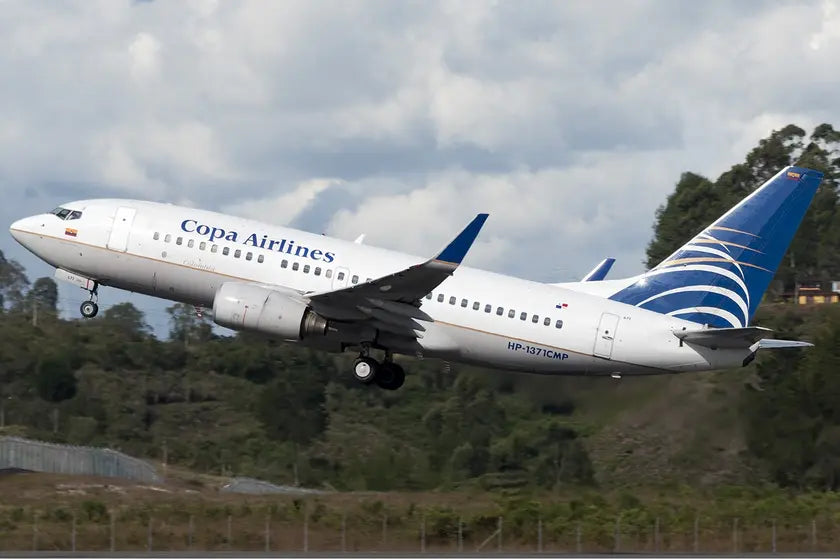
Copa Airlines Overview & Company Profile
Copa Airlines (legally Compañía Panameña de Aviación, S.A., IATA code CM) is the flag carrier of Panama. It was founded in 1947 by a group of Panamanian investors together with Pan American World Airways, and today operates from a single hub: Tocumen International Airport (PTY) in Panama City, which the airline markets as the Hub of the Americas. Corporate headquarters sit at the Business Park complex in Costa del Este, roughly ten minutes from the airport. Copa has been a member of Star Alliance since June 2012 and maintains a deep commercial and codeshare relationship with United Airlines.
The airline is 99.9% owned by Copa Holdings, S.A., which is listed on the New York Stock Exchange under the ticker CPA. The same holding company owns AeroRepública, S.A., the Colombian entity that today operates the group's low-cost brand Wingo. For pilots evaluating Copa, this distinction matters: Copa Airlines mainline in Panama and Wingo in Colombia are separate operations with separate crew bases, separate labour frameworks, and separate seniority. Applying to one does not give you access to the other.
Copa's defining characteristic as an employer is financial strength. According to Copa Holdings investor relations, the group reported 2025 operating revenue of US$3.62 billion, operating profit of US$819.0 million and an operating margin of 22.6%, with net profit of US$671.6 million. Those are among the highest sustained margins in the global airline industry, not just in Latin America. Copa has never filed for Chapter 11 protection, which separates it sharply from LATAM and Avianca, both of which restructured through US bankruptcy courts in the early 2020s.
Operationally, Copa is also the punctuality leader of the region. Cirium named it the most punctual airline in Latin America for 2025, the eleventh time it has held that title, with 90.75% on-time performance, ranking first in the Americas and second worldwide. That reliability is not an abstraction for crews: a network that runs on time produces fewer disrupted duty days, fewer unplanned night stops, and fewer reserve call-outs.
At the end of 2025 the group employed 1,552 pilots, up from 1,456 a year earlier, out of a total workforce of 8,565. The company's 2026 plan calls for roughly 420 daily flights from Panama to around 88 destinations in 32 countries, and Copa publicly committed to creating more than 400 new positions in 2026 with over 1,000 total hires including replacement of turnover. In July 2026 it became the first airline in Latin America to roll out Starlink high-speed connectivity across its fleet.
Copa is a pure connecting carrier. Passengers arrive in Panama, change aircraft, and continue. That structure is currently built around six daily connection banks at Tocumen, and the airline has announced it will expand to eight banks from March 2027 in order to spread departures more evenly across the day. For pilots, the bank structure drives everything: a large share of pairings are same-day out-and-backs from Panama, layovers concentrate on the longest sectors, and duty periods cluster around bank departure and arrival windows. More banks generally means more schedule variety, but also more early and late duty edges.
Fleet Composition & Type Rating
Copa operates a single-family, all-Boeing 737 fleet. There is no widebody, no regional jet, and no Airbus. Every pilot in the company flies the same basic aircraft, which has significant consequences for how a career at Copa works. Copa Holdings closed the second quarter of 2026 with 131 aircraft across the group after taking four 737 MAX 8 deliveries during the quarter. Of that total, roughly 113 aircraft wear Copa Airlines mainline colours, with the balance made up of Wingo-assigned 737-800s and two freighters. Copa expects the mainline fleet to reach approximately 121 aircraft by the end of 2026.
| Aircraft Type | Role | Group Fleet | Notes |
|---|---|---|---|
| Boeing 737-700 | Narrowbody | 9 | Oldest type in the fleet, average age 22.2 years at end-2025. Being progressively retired. |
| Boeing 737-800 | Narrowbody | 67 | The current workhorse. Includes 10 aircraft assigned to Wingo. Average age 13.3 years. |
| Boeing 737 MAX 8 | Narrowbody | 21 | Six delivered in the first half of 2026 alone. Backbone of near-term growth. |
| Boeing 737 MAX 9 | Narrowbody | 32 | Long-sector flagship. Carries the lie-flat Dreams business cabin on selected aircraft. |
| Boeing 737-800BCF | Freighter | 2 | Converted freighters, approximately 21.7 tonnes payload each. Copa Airlines Cargo. |
Group fleet as of 30 June 2026, per Copa Holdings quarterly reporting. Average fleet age was 10.2 years at 31 December 2025, with the MAX sub-fleet averaging just 2.9 years.
The Order Book: Growth Through 2034
Copa's fleet plan is one of the most aggressive in the Americas, and it is the single strongest argument for joining the airline as a young pilot. The pre-existing order book alone was projected to grow the MAX fleet from 47 aircraft at the end of 2025 to 55 in 2026, 68 in 2027, 85 in 2028 and 92 in 2029, with total group fleet reaching approximately 161 aircraft by the end of 2029 after retirements.
On 28 April 2026, Copa went considerably further. Per the official Boeing announcement, the airline placed an order for 40 firm 737 MAX aircraft with options for 20 more, a deal valued at roughly US$13.5 billion at list prices. Crucially, these are incremental to the existing book and are scheduled for delivery between 2030 and 2034. Combined with prior commitments, Copa has signalled a path toward more than 200 aircraft in service by 2034, close to double the current mainline fleet.
For a First Officer joining now, that arithmetic is the entire career case. Fleet growth of that magnitude, sustained over a decade, is what compresses upgrade times and keeps seniority moving.
Every Copa pilot flies the Boeing 737. New First Officers are trained onto the 737NG and MAX, and recent published vacancies have been advertised specifically as B737 MAX positions. Copa's recent captain recruitment has been advertised as non-type-rated, meaning an existing MAX rating is not a prerequisite to apply. Copa does not publish its type rating funding policy, training bond terms, or repayment clauses, so applicants should obtain those terms in writing before accepting an offer. Do not assume either a fully funded rating or a bond-free contract.
An all-737 fleet is a genuine double-edged sword. On the positive side: no fleet bidding politics, no downgrade risk when a type is retired, no time lost to transition courses, and a seniority list that moves purely on retirements and growth rather than on fleet assignment. On the negative side: there is no widebody career path at Copa. A pilot who wants to fly a 777, 787 or A350 will eventually have to leave. Pilots who value long-haul widebody flying should treat Copa as a strong stepping stone or a deliberate narrowbody career, not as a route to a widebody command.
Pilot Salary & Compensation Breakdown
Copa pilot pay is set by the convención colectiva negotiated between the company and UNPAC, the Panamanian commercial pilots' union. That agreement is not published openly: UNPAC keeps the full text behind a members-only password on its website, and Copa does not disclose pay scales in its regulatory filings. Everything below is therefore compiled from pilot-contributed salary databases and press reporting on past negotiations, and should be treated as an informed estimate rather than an official company quotation.
The single most important structural fact is that Copa pays against a 66-hour monthly guarantee. Pilots are paid for at least 66 block hours whether they fly them or not, and hours flown above 66 attract premium rates established in the 2017 collective agreement, alongside a separate night-flying premium table. Because typical line values run well above the guarantee, actual take-home consistently exceeds the guaranteed scale.
First Officer Pay Scale
| Pay Element | Monthly (USD) | Annual Guarantee (USD) | Equivalent Hourly at 66 hrs |
|---|---|---|---|
| Year 1 (entry step) | $5,208 | ~$62,500 | ~$78.90 |
| Intermediate steps | Graduated CBA seniority steps | Not published | Not published |
| Top of published scale | $6,744.80 | ~$80,940 | ~$102.20 |
| Hours flown above 66/month | Paid at premium rate under the 2017 agreement, plus a separate night-flight premium table. | ||
| Décimo tercer mes | Statutory Panamanian 13th-month payment, paid in three instalments around 15 April, 15 August and 15 December. | ||
Guarantee scale reported by pilot-contributed database PilotJobsNetwork for 2026. Hourly equivalents are calculated by dividing the guarantee by 66 hours and are not necessarily the contract's actual flight-hour formula.
Captain Pay Scale
| Pay Element | Monthly (USD) | Annual Guarantee (USD) | Equivalent Hourly at 66 hrs |
|---|---|---|---|
| Year 1 (entry step) | $9,461 | ~$113,530 | ~$143.35 |
| Intermediate steps | Graduated CBA seniority steps | Not published | Not published |
| Top of published scale | $12,973.54 | ~$155,680 | ~$196.57 |
| Hours flown above 66/month | Premium rate. Pilots reporting on public forums describe flying 90+ hours to maximise earnings. | ||
| Seniority premium (prima de antigüedad) | Introduced in the 2017 settlement following strike action. Current values not published. | ||
A Captain at the top of the published guarantee scale earns roughly 2.5 times the pay of a Year 1 First Officer before overtime. Upgrade is by far the largest single income event in a Copa career.
Independent Total-Compensation Estimates
Because the guarantee scale excludes overtime, night premiums and the 13th month, several independent databases publish higher all-in estimates. The Rotate Pilot 2026 salary database places Copa First Officers in a total-earnings range of roughly US$52,000 to US$90,000 and Captains at roughly US$125,000 to US$200,000. Note that its First Officer entry figure sits below the guarantee scale reported elsewhere, which illustrates how much variation exists between third-party sources. The honest reading is a range, not a point estimate: an entry First Officer should budget somewhere in the region of US$52,000 to US$65,000, and a senior Captain flying an active line can realistically clear US$180,000 or more.
Copa and UNPAC do not publish current wage appendices. The figures above are compiled from pilot-contributed databases (PilotJobsNetwork, Rotate Pilot), Panamanian press coverage of past negotiations, and Panama's published 2026 tax and social security schedules. They exclude per diem (viáticos), whose current destination-by-destination schedule is not publicly verifiable, and any profit-sharing or productivity payments, for which no official 2026 figure exists. A widely circulated claim that Copa pilot salaries are tax-free is incorrect: Panama-source income is taxable at the rates shown. Verify all figures directly with Copa recruitment and, where possible, with UNPAC before making a career decision.
Roster Pattern & Quality of Life
Copa rosters are published around the 20th of the preceding month and are built through a seniority-driven preferential bidding system (PBS). Pilots reporting publicly describe the system as workable but heavily seniority-weighted: requested days off are generally respected for mid-seniority and senior crews, while new hires face materially worse outcomes in their first years. This is a conventional seniority environment, and expectations should be set accordingly.
The collective agreement's exact day-off minimum is not public. Pilot reports consistently indicate a floor of at least 9 days off per month, with 10 to 11 days being typical. That is meaningfully below European legacy norms (Air France and Lufthansa pilots average closer to 15) and below the better US majors, and it is the clearest quality-of-life weakness at Copa. Separately, Panama's Autoridad Aeronáutica Civil (AAC) regulations require a minimum of 24 consecutive hours free of all duty in every seven consecutive days.
📅 Illustrative Month, Boeing 737 First Officer (PTY)
Illustrative reconstruction based on publicly reported day-off counts, reserve volume and Copa's connection-bank duty structure. It is not an actual published Copa roster, and individual months vary widely by seniority.
Block Hours and Reserve
The 66-hour guarantee sets the floor, not the norm. Pilots describe typical lines running 80 to 83 block hours per month and around 900 hours per year, with those chasing maximum variable pay pushing past 90 hours where the schedule and legalities allow. Because pairings are described as relatively rigid with limited swap flexibility, building a high-hour month is not always straightforward even for pilots who want the income.
Reserve is the most consistently criticised element of the Copa roster in public pilot commentary. Forum reports describe reserve blocks as heavy and restrictive, with one recurring description of a two-hour callout obligation across a fourteen-hour window. Reserve assignment follows seniority through PBS, so junior pilots carry a disproportionate share.
Panamanian Flight Time Limitations
Copa flight crews are governed by the AAC's RACP regulations, not by EASA FTL or FAA Part 117, even when operating into the United States. For scheduled operations in aircraft above 5,700 kg, the principal limits are:
| Limitation | AAC Panama (RACP) | FAA Part 117 (for reference) |
|---|---|---|
| Flight hours / 7 days | 32 hours | Not directly limited |
| Flight hours / 30 days | 100 hours | 100 hours per 672 hours (28 days) |
| Flight hours / 12 months | 1,000 hours | 1,000 hours per 365 days |
| Max flight time, 2-pilot crew | 8 hours | Varies by report time and segments |
| Max duty period, 2-pilot crew | 16 hours | 9 to 14 hours FDP depending on start time |
| Minimum rest | 9 consecutive hours | 10 hours with 8 hours sleep opportunity |
AAC limits are broadly comparable to FAA Part 117 on cumulative hours but permit a longer maximum duty period for a two-pilot crew. Augmented crew provisions extend these limits on the longest sectors.
Copa Airlines has one pilot base: Panama City. There is no base bidding, no domicile transfer, and no commuter contract. Public pilot reporting does not identify any formal commuting policy, and none of the reviewed sources confirm a housing allowance or relocation package for line pilots. A historical arrangement providing shared accommodation to new hires during training was last reported around 2017 and should not be assumed to still apply. Panama City living costs, particularly housing and food, are described by expatriate pilots as high relative to regional salaries. Anyone considering Copa should plan on permanently relocating their family to Panama and should verify immigration and work-permit terms carefully, as Panamanian labour law applies nationality quotas to foreign employees.
Benefits, Travel Perks & Retirement
Copa's benefits package combines Panama's statutory employee entitlements with additional provisions negotiated through the UNPAC collective agreement. Several of the most important elements, including current insurance limits and employer pension contribution rates, are not published. What follows is what can be verified, with explicit gaps marked as such.
Copa's Star Alliance membership gives crews discounted standby access across one of the world's two largest alliance networks, including Lufthansa Group, United, Singapore Airlines, ANA, Turkish Airlines and Air Canada. For a pilot based in Panama, which sits at a genuine crossroads of the Americas, this is materially more useful than it would be from a peripheral base. It is worth weighing against the fact that Copa itself operates no widebody long-haul, so intercontinental leisure travel depends almost entirely on partner metal and on standby availability.
Copa is notably less transparent about pilot benefits than European or North American carriers of comparable size. UNPAC holds the collective agreement behind a members-only login, and Copa's public filings do not itemise crew benefits. The practical consequence for an applicant: do not accept verbal assurances on pension contribution rates, loss-of-licence limits, life cover, per diem values or type-rating bonds. Ask for the relevant CBA articles and insurance certificates in writing during the offer stage.
Career Progression & Seniority
Career progression at Copa is seniority-based but not seniority-only. Position on the list governs bidding, vacation priority and access to upgrade opportunities, but the upgrade itself requires meeting operational qualification thresholds and passing a selection process that includes interviews, theoretical assessment, simulator evaluation and satisfactory training performance. Seniority gets you the opportunity; it does not hand you the fourth stripe.
Because Copa operates a single aircraft type from a single base, the seniority list is unusually simple. There is no fleet bidding, no base bidding, and no equipment-driven stagnation. Movement comes from two sources only: retirements and fleet growth. Given the order book described above, growth is currently doing most of the work.
| Career Milestone | Typical Timeline | Notes |
|---|---|---|
| ALAS cadet training (cadet path) | 18 to 20 months | Panamanian nationals only. Approximately 250+ flight and simulator hours plus 600+ theory hours. |
| Join as First Officer, Boeing 737 | Day 1 after type training | Single fleet, single base. No fleet choice to make. |
| Off reserve onto a held line | Seniority dependent | Reserve is described as heavy for junior pilots. No published timeline. |
| Captain upgrade | ~4 to 5 years (historical, growth periods) | Requires hours, special-airport qualification, interview, theory and simulator assessment. |
| Line Training Captain / Instructor / Examiner | Variable | Separate internal selection and instructor qualification. |
Copa does not publish a guaranteed upgrade timeline. The 4 to 5 year figure comes from historical pilot reporting during expansion phases and will lengthen if growth slows.
Upgrade Velocity in 2026
The most concrete evidence available on current upgrade pace comes from Copa's own 2026 announcements: the airline publicised the promotion of 43 First Officers to Captain in February 2026, followed by a further 29 in May 2026. That is 72 new commands in a single half-year at a carrier employing roughly 1,550 pilots, or approximately 4.6% of the entire pilot body upgraded in six months. Copa specifically noted that the May group had all joined the company as First Officers, which underlines that internal promotion remains the primary route to command.
Compare that against European legacy carriers where upgrade to Captain routinely takes 12 to 15 years, or against Avianca and LATAM where post-restructuring growth has been slower. On career velocity alone, Copa is currently one of the strongest narrowbody employers in the Western Hemisphere.
Direct-Entry Captains
Unlike closed-shop European legacy carriers, Copa does hire direct-entry Captains when operational need requires it. External captain vacancies were advertised during 2025 and 2026, non-type-rated, with the published standard being an ATP licence, 5,000 total hours and 1,000 hours PIC on transport-category aircraft. This is a meaningful option for an experienced narrowbody Captain seeking a Latin American base, but it comes with a caveat: direct-entry hiring runs alongside, not instead of, internal upgrades, and its volume fluctuates with fleet delivery timing.
Copa committed to creating more than 400 new positions in 2026, with over 1,000 total hires including turnover replacement, and reported an estimated US$1.4 billion economic contribution to Panama for the year. Fleet capacity is guided to grow 14% to 15% in 2026. With deliveries running through 2029 on the existing book and a fresh 2030 to 2034 order announced in April 2026, the hiring and upgrade pipeline is visible further into the future than at most airlines. The principal risk to that outlook is macroeconomic rather than structural: Copa's Q2 2026 operating margin fell to 8.7% from a much higher prior-year level on a sharp jet fuel price increase, even as full-year guidance was held at 17% to 19%.
Recruitment Process & Requirements
Copa recruits through three channels: the ALAS cadet academy for Panamanian nationals with no flying experience, direct-entry First Officer hiring for licensed pilots, and direct-entry Captain hiring when fleet growth outpaces internal upgrades. All roles are advertised through Copa's corporate careers portal, and the company states publicly that it never charges candidates for participation in its selection process.
First Officer Requirements
Direct-Entry Captain Requirements
Selection Stages
Online Application & Document Pack
Profile creation on the Copa careers portal with CV in PDF. Copa-related screening lists have requested: application form, CV, copy of CPL or ATP, medical certificate, logbook pages, passport, valid US visa, a no-accident/no-incident record, and two letters of recommendation. Applications close on published deadlines rather than rolling indefinitely.
Screening & Online Testing
Document review and filtering, followed by online English assessment and psychometric testing. Candidates who clear the paper screen proceed to structured evaluation.
Recruiter & Panel Interview
Competency and CRM-focused interviewing. Spanish is the operational working language of the company on the ground in Panama, and candidates should expect at least part of the process to test practical Spanish comprehension even where English is the published requirement.
Technical & Simulator Evaluation
Technical knowledge assessment and a simulator session evaluating raw handling, instrument flying, procedural discipline and crew coordination. Copa does not publish the profile or aircraft used.
Medical, Background & AAC Licence Validation
Class 1 medical and security/background checks. Foreign candidates must then complete AAC Panama licence validation or conversion, plus immigration and work authorisation, before they can exercise privileges on the Panamanian AOC. This step routinely adds weeks to the timeline and is the most common source of delay for expatriate hires.
Offer, Type Training & Line Training
Contract issuance followed by ground school, 737 type rating (or differences training for rated pilots), simulator, and supervised line flying to release. Copa's training reputation among pilots posting publicly is consistently positive, and the airline's operational reliability metrics support that.
Three practical points. First, the hours threshold is genuinely different for Panamanians (350) and foreigners (1,000), so foreign applicants below 1,000 hours should not expect an exception. Second, Panama applies nationality quotas to foreign employees under its labour code, which caps how many expatriate pilots Copa can carry regardless of demand; a strong CV does not override a quota. Third, Spanish matters more than the job advert implies. Company communication, ground operations, dispatch interaction in Panama and union life all run in Spanish. Arriving with only ICAO English will make the first year harder than it needs to be.
The ALAS Academy: Copa's Cadet Pathway
Copa runs its own ab-initio flight school, the Academia Latinoamericana de Aviación Superior (ALAS), established in 2013 to build a domestic pilot pipeline. It is the closest thing in Central America to a European-style airline cadet programme, and for a Panamanian with no flying background it is realistically the fastest route into a jet flight deck.
The programme runs approximately 18 to 20 months and is structured across theory, flight and simulator phases leading to licence issuance. Published descriptions cite more than 600 hours of ground theory and more than 250 hours of flight and simulator training. All instruction is delivered in English, which is a deliberate design choice given ICAO language requirements. The academy set a stated target of training roughly 100 pilots per year; it graduated 64 in 2022, and Copa's 2026 corporate roadmap reported 65 pilot graduates from ALAS alongside 50 aeronautical technicians and 415 cabin crew from its sister academies.
| Element | Detail | Notes |
|---|---|---|
| Duration | 18 to 20 months | Theory, flight, simulator and licensing phases |
| Programme cost | ~US$52,000 to US$57,110 | Figures vary by source and intake year. Additional flight hours increase cost. |
| Training content | 600+ theory hrs, 250+ flight/sim hrs | Delivered in English |
| Nationality | Panamanian or naturalised citizen | Not open to foreign applicants |
| Age (2026 scholarship) | 19 to 25 | General admission minimum is 19 |
| Academic minimum (2026 scholarship) | 4.5/5.0 secondary or 2.5/4.0 university | Secondary school completion required |
| English | ICAO Level 4 or higher | Assessed at admission |
| Medical | AAC Class 1 plus psychological clearance | Required before entry |
Admission criteria as published for the 2026 scholarship competition and general ALAS admission material. Note that the ALAS website was undergoing reconstruction at the time of writing, so applicants should confirm current terms directly with the academy or Copa.
The Scholarship Route
ALAS runs an annual scholarship competition (concurso de becas) for Panamanian nationals. The 2026 intake offered four scholarships: two full and two partial. The full scholarships cover the entire programme cost of approximately US$52,000, and the partial awards cover US$26,000 each. Given the total programme cost relative to Panamanian median incomes, these awards are highly competitive and represent the primary means by which candidates without family capital access the profession domestically.
Copa material describes a job slot being reserved on the payroll for graduates who complete the programme and obtain their licence, and ALAS is explicitly designed to meet the licensing standard needed to enter Copa's First Officer selection. However, no reviewed source establishes an unconditional employment guarantee. Graduates still enter the company's selection and training process. Anyone financing this course privately, whether at US$52,000 or US$57,110, should treat it as a strongly favoured pathway rather than a purchased job, and should ask ALAS directly and in writing what happens if a graduate is not selected.
Longest Routes & Layover Network
Copa's layover profile is fundamentally different from that of a widebody legacy carrier, and applicants should understand this before setting expectations. Copa's average stage length was 1,255 miles in Q2 2026, and the connection-bank structure at Tocumen means a large proportion of pairings are same-day out-and-back rotations from Panama. Layovers concentrate on the longest sectors at the edges of the network, principally the Southern Cone of South America and the North American West Coast.
The airline's flagship long sectors are flown by the Boeing 737 MAX 9, which carries Copa's Dreams lie-flat business cabin. Copa publishes Dreams service on routes including Los Angeles, San Francisco, San Diego, Montevideo, Rio de Janeiro, São Paulo, Buenos Aires, Washington Dulles, New York JFK, Miami and Santiago de Chile, noting that aircraft assignment may change with operational need. Several of these sectors run around seven hours in a narrowbody, which is demanding flying by any standard.
Copa does not publish crew hotel contracts, hotel standards, layover durations by destination, or route-by-route pernocta assignments, and no reliable public source documents them. This article therefore ranks these destinations by verified route distance and block time, which correlate strongly with layover likelihood, rather than by asserted hotel quality. Pilots reporting publicly rate Copa's network variety and international exposure positively, but specific hotel and per diem details should be confirmed with UNPAC or with serving Copa crews before joining. Note also that a substantial share of Copa flying involves no layover at all: the bank structure at Tocumen is built to return aircraft and crews to Panama the same day wherever the sector length permits.
How Copa Compares: Airline Radar Chart
The two most relevant benchmarks for a pilot weighing Copa are Avianca (Colombia, now part of Abra Group) and LATAM Airlines Group (Chile, Brazil, Peru, Colombia and Ecuador). Both are large Latin American network carriers, both compete directly with Copa on South American traffic flows, and both restructured through US Chapter 11 proceedings in the early 2020s. Scores below are editorial estimates across the same six dimensions used in the scorecard, based on publicly available salary databases, union reporting, financial filings and pilot commentary.
Key Takeaways from the Comparison
Copa wins decisively on job security. This is the clearest differentiator of the three. Copa posted a 22.6% operating margin in 2025 and has never entered bankruptcy protection. Both Avianca and LATAM emerged from Chapter 11 restructurings that involved fleet reductions, contract renegotiation and pilot furloughs. For a pilot placing a long career bet, the balance sheet difference is not a rounding error.
Pay is close, with Copa at or near the top of the regional band. Independent 2026 database estimates place Copa First Officers at roughly US$52,000 to US$90,000 and Captains at US$125,000 to US$200,000, against LATAM at approximately US$40,000 to US$45,000 entry for First Officers with Captains around US$180,000 to US$220,000, and Avianca generally trailing both. LATAM arguably holds the higher captain ceiling; Copa holds the better floor and the more predictable path to reaching it. All three are far below US major or Gulf carrier gross compensation.
LATAM wins on fleet and route diversity. LATAM operates widebodies including the 787 and 777 across genuine intercontinental routes to Europe, Oceania and beyond, and offers multiple fleet families. Copa's all-737 operation is modern, efficient and simple, but it has a hard ceiling: no widebody, no intercontinental long-haul, no fleet progression. Avianca sits between the two with a mixed Airbus narrowbody fleet plus a small widebody operation.
Career progression favours Copa substantially. Seventy-two Captain upgrades in the first five months of 2026 at a carrier of roughly 1,550 pilots, against a fleet plan targeting more than 200 aircraft by 2034, is a velocity neither LATAM nor Avianca currently matches. Historical upgrade reporting of four to five years at Copa compares favourably against most of the region.
Work-life balance is a weakness across all three, and Copa is not the exception. Nine to eleven days off per month, 80 to 90 block hours, heavy junior reserve and a single base is a demanding pattern. LATAM's multi-country structure offers more base options in principle, though transfers between national subsidiaries are not straightforward. None of the three approaches European legacy carrier standards on time off.
These scores are editorial estimates derived from research into published salary databases (PilotJobsNetwork, Rotate Pilot), airline financial filings and investor materials, union publications and press reporting, and pilot commentary on public forums. They describe a general assessment for an experienced pilot considering a long-term career, not a precise measurement. Individual outcomes vary substantially with seniority, nationality, family situation and personal priorities. Latin American pilot compensation is significantly less transparent than in North America or Europe, and readers should treat all comparative figures as indicative.
Union & Industrial Relations
Copa pilots are represented by UNPAC, the Unión Panameña de Aviadores Comerciales, founded on 30 January 1967. It is a professional union of commercial aviators under Panamanian labour law and holds collective bargaining agreements with both Copa Airlines and DHL in Panama. UNPAC reported representing approximately 1,200 Copa pilots at the time of the 2023 dispute. Across the group, Copa Holdings reports that roughly 66% of its 8,565 employees are unionised across five separate Panama-based unions covering pilots, flight attendants, mechanics, airport personnel and other ground staff.
The union's leadership for the 2026 to 2028 term is headed by Secretary General Capt. Ilma Velásquez. The incoming board stated its priorities as transparency, member participation, professional development and, notably, strengthening and updating the Copa collective agreement, which is a strong signal that contract renewal work was live rather than completed as of mid-2026.
UNPAC Structure & Reach
The Collective Agreement Cycle
Copa Holdings states that collective bargaining agreements in Panama typically carry four-year terms. The current pilot agreement was signed in February 2023, which places its natural expiry around February 2027. Copa's other agreements were signed with the flight attendants' union in March 2023, the mechanics' union in May 2022, and the airport personnel union in December 2025. As of August 2026, no publicly reported replacement pilot agreement had been executed, and UNPAC's stated 2026 to 2028 objectives indicate renewal work was still in progress. Any pilot joining in the current window should expect a negotiation cycle during their first two years.
Dispute History
Panamanian law materially constrains pilot industrial action. The Labour Code permits strike restrictions in designated public services, and public air passenger transport falls within that category. A 2025 executive decree further updated and expanded the list of essential services to explicitly include air passenger transport. In practice this means strikes require advance notice, mandate emergency staffing of roughly 20% to 30% of normal operations, and can be suspended by MITRADEL ordering compulsory arbitration. This legal framework helps explain the consistent pattern in Copa's history: strikes are announced, used as leverage, and settled hours before the deadline. Pilots evaluating Copa should understand that UNPAC's practical bargaining power is real but legally capped.
The track record is encouraging on balance: no completed system-wide Copa pilot strike across four documented disputes, and each settlement produced tangible gains, most notably the 2017 package that created overtime pay and the private retirement plan. Union representation is meaningful and negotiations are genuinely adversarial rather than ceremonial. Two caveats for foreign pilots specifically. First, at least one forum account states that expatriate pilots pay union dues but do not hold voting rights, so verify your representation status before joining. Second, the collective agreement is not public, which means you cannot independently verify your own terms before signing. Making contact with UNPAC directly during the application process is worth the effort.
Verdict: Who Is Copa Airlines For?
🎯 The Bottom Line
Copa Airlines is the most financially secure and fastest-progressing major airline job in Latin America. A 22.6% operating margin in 2025, no bankruptcy history, eleven regional punctuality titles, a fleet plan pointing toward more than 200 aircraft by 2034, and 72 Captain upgrades in the first five months of 2026 alone: these are not marketing claims but reported figures, and together they describe an airline where a career actually moves.
The trade-offs are equally concrete. There is one base and it is Panama City, with no commuter arrangement and no confirmed housing support. Days off run 9 to 11 per month against 80 to 90 block hours, which is a hard schedule by any developed-market standard, and junior reserve is described as heavy and restrictive. The all-737 fleet means no widebody career path whatsoever. Pay is upper-tier for the region but well below US, European or Gulf carriers in gross terms, and Panamanian income tax reaches 25% above US$50,000 despite persistent myths to the contrary. Compensation transparency is poor: the collective agreement sits behind a union password and Copa publishes no scales.
Foreign pilots face an additional hurdle set that should not be underestimated: a 1,000-hour minimum versus 350 for Panamanians, AAC licence validation, work-permit quotas under Panamanian labour law, functional Spanish for daily company life, and potentially limited union voting rights. None of these is insurmountable, but collectively they make Copa a considered relocation rather than an opportunistic application.
1 Does Copa Airlines hire foreign pilots?
Yes. Copa employs both Panamanian and foreign pilots, and has run external captain recruitment campaigns in 2025 and 2026. However, the flight-time threshold differs sharply by nationality: recent First Officer campaigns required 350 hours for Panamanians and 1,000 hours for foreign nationals. Foreign hires must also obtain AAC Panama licence validation or conversion, secure immigration and work authorisation, and fit within Panama's statutory nationality quotas for foreign employees. Those quotas cap the total number of expatriate pilots the company can carry regardless of hiring demand.
2 How much do Copa Airlines pilots actually earn?
Copa pays against a 66-hour monthly guarantee. Pilot-contributed database figures for 2026 put a Year 1 First Officer at approximately US$5,208 per month (around US$62,500 annually guaranteed) rising to roughly US$6,745 per month at the top of the published scale. A Year 1 Captain is reported at approximately US$9,461 per month (around US$113,500 guaranteed), reaching roughly US$12,974 per month at the top step. Hours above 66 attract premium pay, and Panama's statutory 13th month adds roughly one extra month of income. Independent total-compensation estimates place First Officers at US$52,000 to US$90,000 and Captains at US$125,000 to US$200,000 all-in. None of these figures is officially confirmed by Copa, which does not publish pay scales.
3 Are Copa pilot salaries tax-free in Panama?
No. This is a persistent and incorrect claim. Panama-source employment income is taxable: 0% on the first US$11,000, 15% from US$11,001 to US$50,000, and US$5,850 plus 25% on income above US$50,000. Social security (CSS) contributions of 9.75% for the employee in 2026 plus an educational insurance levy also apply. Panama's territorial tax system means foreign-source income is generally not taxed, which is a genuine advantage for pilots with overseas investments, but salary paid by Copa for work performed in Panama is fully taxable.
4 How long does upgrade to Captain take at Copa?
Copa does not publish a guaranteed timeline. Historical pilot reporting during growth phases suggests approximately 4 to 5 years. The 2026 evidence supports continued fast movement: Copa announced 43 Captain promotions in February 2026 and 29 more in May 2026, roughly 4.6% of its entire pilot workforce upgraded in six months. Upgrade requires meeting hour and qualification thresholds, special-airport experience, an interview, theoretical and simulator assessment, and successful training. It is not automatic on seniority alone, and the timeline will lengthen if fleet growth slows.
5 Does Copa accept direct-entry Captains?
Yes, when operational need requires it. Copa advertised external non-type-rated Boeing 737 and MAX Captain positions during 2025 and 2026. The published standard is an ATP licence, 5,000 total flight hours and 1,000 hours PIC on transport-category aircraft seating more than 100 passengers, with ICAO English Level 5 commonly specified and at least basic Spanish required or preferred. An existing 737 MAX type rating has not been required at application in recent campaigns. Direct-entry hiring runs in parallel with, not instead of, internal upgrades, and its volume varies with delivery timing.
6 Can I commute to Panama, or do I have to live there?
Plan on living in Panama City. Copa Airlines operates a single pilot base at Tocumen (PTY), and no reviewed source identifies a formal commuter policy, a commuter clause, or a housing or relocation allowance for line pilots. External captain vacancies explicitly state that willingness to relocate to Panama is required. A historical arrangement providing shared accommodation to new hires during training was last reported around 2017 and should not be assumed to still exist. Expatriate pilots posting publicly describe Panama City housing and food costs as high relative to regional salaries, so budget accordingly.
7 Is there a widebody or long-haul path at Copa?
No. Copa operates an all-Boeing 737 fleet consisting of the 737-700, 737-800, MAX 8 and MAX 9, plus two 737-800BCF freighters. There is no widebody aircraft in the fleet and none on order: the April 2026 order for up to 60 aircraft was entirely for additional 737 MAX. The longest routes, including Montevideo at 3,384 miles and San Francisco at around 7 hours 30 minutes block time, are flown by MAX 9s carrying the Dreams lie-flat cabin, but these remain narrowbody operations. A pilot whose goal is widebody intercontinental command will eventually need to leave Copa.
8 How secure is a job at Copa compared with other Latin American airlines?
Copa is the strongest of the major Latin American carriers on this measure. It reported 2025 operating revenue of US$3.62 billion with a 22.6% operating margin and US$671.6 million net profit, and it has never filed for bankruptcy protection. By contrast both LATAM and Avianca restructured through US Chapter 11 proceedings in the early 2020s. Copa's 2026 full-year guidance calls for 14% to 15% capacity growth and a 17% to 19% operating margin. The main caveat is fuel exposure: Q2 2026 operating margin fell to 8.7% on a sharp jet fuel price increase, a reminder that even the region's strongest balance sheet is not immune to input cost shocks.
Official Links & Resources
Because Copa publishes no pilot pay scales and UNPAC keeps its collective agreement behind a members-only login, independent verification matters more here than at most carriers. These are the primary sources worth consulting before applying or accepting an offer:
Read the Copa Holdings Form 20-F on the investor relations site before your interview. It states pilot headcount, total employees, unionisation rate, collective agreement signing dates and terms, and the fleet plan year by year through 2029. It is the only place where Copa itself commits to figures in writing, and referencing it accurately in an interview signals that you have done genuine research rather than skimmed a jobs board. Pair it with the UNPAC news page for the current state of contract negotiations, which matters given the February 2023 agreement's expected expiry around February 2027.
- 01Overview & Company Profile
- 02Fleet & Type Rating
- 03Salary & Compensation
- 04Roster & Quality of Life
- 05Benefits & Retirement
- 06Career Progression
- 07Recruitment & Requirements
- 08ALAS Cadet Academy
- 09Longest Routes & Layovers
- 10Airline Comparison
- 11Union & Industrial Relations
- 12Verdict & FAQ
- 13Links & Resources