

Binter Canarias Overview & Company Profile
Binter Canarias is the principal regional airline of Spain's Canary Islands, founded on March 26, 1989, as a regional subsidiary of Iberia. Headquartered at Gran Canaria Airport (LPA) in Telde, the airline has evolved from a small inter-island shuttle service into one of Europe's most recognised regional carriers, connecting all eight Canary Island airports while steadily expanding to mainland Spain, North Africa, Portugal, and West Africa. In 2024, Binter transported 5.6 million passengers across 63 routes, representing a 13% year-on-year increase, and has set a target of six million passengers for 2025.
Following privatisation in 2002, when a consortium of Canarian investors acquired the airline through Hesperia Inversiones Aéreas, Binter embarked on a major modernisation programme. The current ownership structure includes Ilsamar Tenerife (49.8%), Ferma Canarias Electrica (10.4%), Agencia Maritima Afroamericana (10.1%), and Flapa (10%), among others. Since a further ownership transition in 2022, the airline has invested over €1.1 billion in fleet renewal and expansion. Binter is not a member of any global airline alliance but maintains membership in the European Regions Airline Association (ERA), where it has won seven awards for regional airline excellence.
The airline currently operates approximately 210 daily flights with a workforce of around 1,200 employees. In 2024, Binter opened its first base outside the Canary Islands in Madrid, launching 16 daily flights between Madrid and the Canaries, which achieved a remarkable 25% market growth rate. For 2025, the route network is expanding to 65 destinations, with new services from Gran Canaria to Cordoba, Badajoz, Valencia, and Almeria, plus routes from Tenerife to San Sebastian, Granada, Murcia, Pamplona, and Ponta Delgada (Azores).
Fleet Composition & Type Ratings
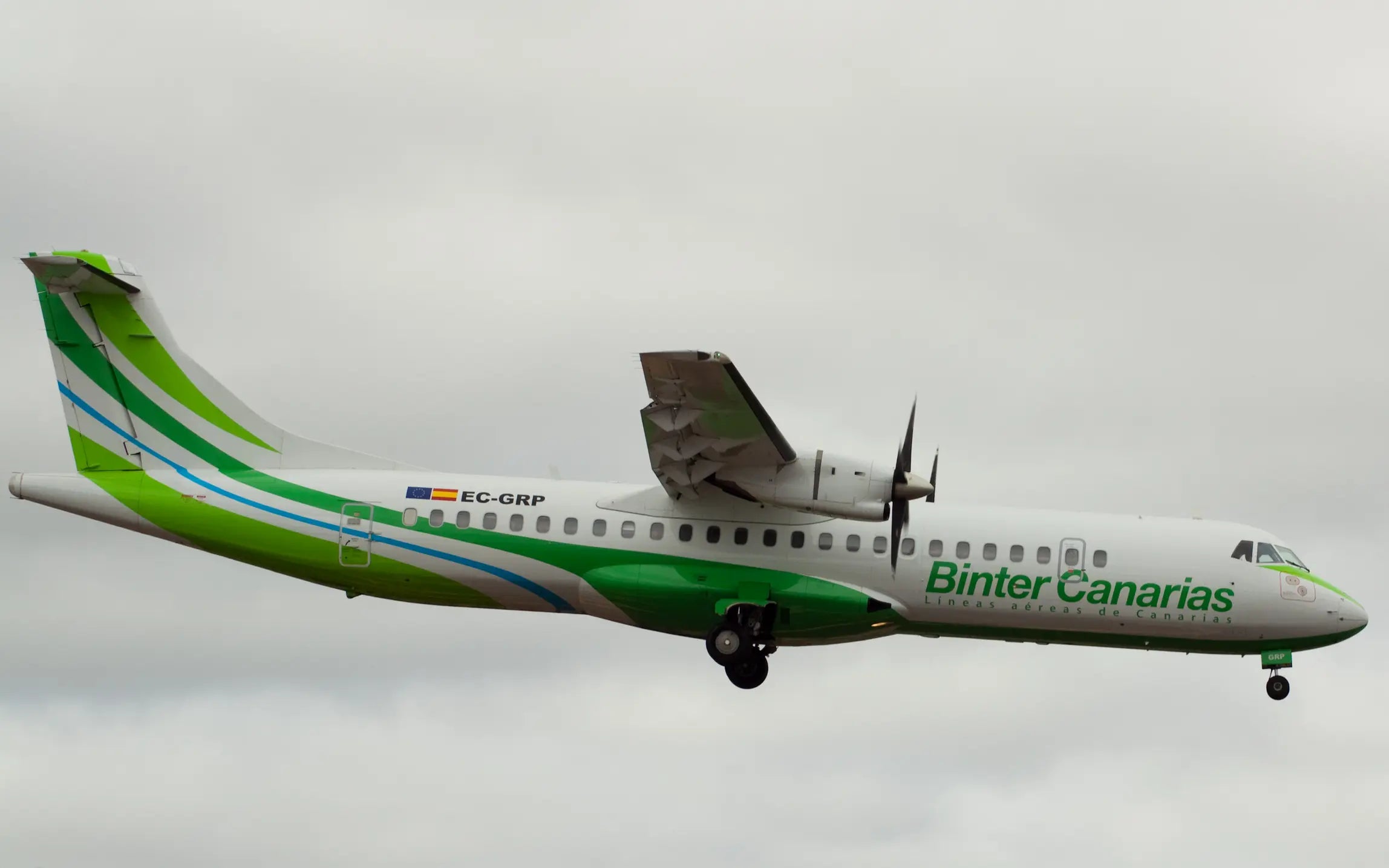
Binter Canarias operates a modern dual-fleet configuration built around two aircraft families: the ATR 72-600 turboprop and the Embraer E195-E2 regional jet. This combination is purpose-built for the airline's operational profile, with ATRs handling the short inter-island hops (where STOL capabilities and fuel efficiency are paramount) and Embraer jets covering the longer routes to mainland Spain, Portugal, North Africa, and beyond. Binter was the European launch customer for the E195-E2 in November 2019, underlining the airline's commitment to operating cutting-edge regional equipment.
The airline has been recognised by ch-aviation (a Swiss aviation intelligence provider) for maintaining one of the youngest fleets in Europe. This is a direct result of the massive fleet renewal programme initiated after the 2022 ownership transition, with over €1.1 billion invested in new aircraft. In February 2025, Binter placed a firm order for four additional ATR 72-600s equipped with the new PW127XT engines, with five further options, in a deal financed by Santander, CaixaBank, and BBVA and valued at €215 million.
| Aircraft Type | Role | In Service | Configuration / Notes |
|---|---|---|---|
| ATR 72-600 | Turboprop | 26 | 72 seats. Inter-island & short regional. 14 operated by Canarias Airlines, 12 via Naysa wet-lease arrangement. |
| Embraer E195-E2 | Regional Jet | 16 | 132 seats ("Canary Mode"). PW1900G engines. Mainland Spain, North Africa, Portugal, West Africa routes. WiFi-equipped. |
Fleet data as of early 2025 per aviation databases. Numbers may vary slightly with ongoing deliveries and operational rotations.
Fleet Orders & Future Plans
| Order | Type | Quantity | Status / Notes |
|---|---|---|---|
| ATR 72-600 (PW127XT) | Turboprop | 4 firm + 5 options | Ordered February 2025. PW127XT engines deliver 3% better fuel efficiency, 40% longer time on wing, 20% lower maintenance costs. |
| Embraer E195-E2 | Regional Jet | 6 | Ordered at Paris Air Show, June 2023. Deliveries through 2024, bringing total to 16. |
Binter covers the cost of type rating training for pilots recruited through its official selection process who do not already hold the relevant type. Most new First Officers begin on the ATR 72-600, given it makes up the majority of the fleet. Progression to the Embraer E195-E2 typically occurs after gaining experience and seniority on the ATR, though direct entry to the E195-E2 is possible for candidates with existing Embraer E-Jet type experience. Holding an ATR 42/72-600 type rating is considered highly desirable and gives applicants a significant advantage during selection.
Pilot Salary & Compensation
Pilot compensation at Binter Canarias is governed by the airline's III Convenio Colectivo (third collective agreement), which was extended in August 2022 with validity from September 2022 through December 31, 2025, as published in the Boletin Oficial de Canarias. The agreement covers all ground staff, flight crew, and cabin crew at Binter Canarias S.A. and includes provisions for annual salary revisions linked to Spain's Consumer Price Index (IPC) with a cap of 2.5% per year for 2024 and 2025.
Binter does not publicly disclose detailed pilot pay scales. The limited publicly available data, combined with Spanish aviation industry benchmarks and the airline's regional carrier profile, provides the following estimated compensation ranges. These figures should be treated as approximations derived from industry sources, pilot forums, and Spanish salary databases.
Estimated Pilot Compensation
| Position | Estimated Annual Gross | Notes |
|---|---|---|
| First Officer (entry, ATR 72) | €35,000 - €50,000 | Base salary + flight hour pay. Comparable to Spanish regional carrier entry levels. |
| First Officer (experienced, 3-5 yrs) | €50,000 - €65,000 | Seniority increments + additional allowances. ATR or E195-E2. |
| Captain (ATR 72) | €75,000 - €100,000 | Command pay + seniority supplements. Historical reports suggest senior ATR Captains reached ~€100,000+. |
| Captain (E195-E2, senior) | €90,000 - €120,000 | Jet type premium. Limited public data for this newer fleet type. |
Estimates compiled from industry databases, pilot job network reports, Spanish aviation salary surveys, and forum discussions. Actual compensation depends on seniority step, aircraft type, flight hours, and the current collective agreement terms.
Compensation at Binter includes several components beyond the base salary: flight hour pay (calculated per block hour flown), night flying premiums for operations conducted during nighttime hours, per diem allowances during layovers, and potentially an annual bonus tied to the IPC-linked salary review mechanism. Spanish social security contributions reduce gross pay by approximately 6-7% on the employee side, while income tax rates range from 19% to 47% depending on total earnings, with the Canary Islands benefiting from a slightly more favourable tax regime than mainland Spain through the Canarian Regional Government's fiscal incentives.
These figures are estimates only. Binter Canarias does not publicly release pilot pay scales, and the airline's III Convenio Colectivo is the only authoritative source for exact compensation terms. The most recent publicly available payscale data (from Pilot Jobs Network, dated 2018) is significantly outdated and likely does not reflect current conditions following the 2022 collective agreement extension and subsequent salary revisions. Prospective applicants should request current compensation details directly from Binter during the recruitment process. The Canary Islands' lower cost of living compared to mainland Spanish cities partially offsets the regional carrier salary levels.
Roster Pattern & Quality of Life
Binter Canarias operates under EASA Flight Time Limitation (FTL) regulations combined with Spanish labour law and the provisions of the III Convenio Colectivo. The airline's operational profile is predominantly short-haul, with typical inter-island flights lasting 30 to 50 minutes and longer routes to mainland Spain or North Africa ranging from 2 to 3.5 hours. This short-sector focus means pilots typically complete multiple sectors per duty day but usually return to base the same day, resulting in fewer overnight layovers than at long-haul carriers.
While Binter does not publish detailed roster patterns, the airline's operational structure and comparable European regional carriers suggest pilots fly approximately 15 to 18 days per month, with the remaining 12 to 15 days off. The high-frequency, short-sector model means a typical duty day may involve 3 to 5 sectors, with turnarounds of 25 to 40 minutes between flights. Block hours typically fall in the 65 to 80 range per month, well within EASA FTL limits of approximately 900 hours per calendar year and 100 hours per 28 consecutive days.
📅 Illustrative Month: ATR 72 First Officer (Gran Canaria Base)
The roster shown above is an illustrative example based on typical European regional turboprop operations and should not be taken as Binter's actual published roster pattern. Actual schedules vary based on season, base assignment, seniority, fleet type, and the specific terms of the collective agreement. E195-E2 pilots flying longer mainland or international routes may have different duty patterns with more overnight layovers.
Binter pilots are based at Gran Canaria Airport (LPA) and Tenerife North Airport (TFN), with a possible emerging base in Madrid (MAD) following the 2024 mainland expansion. Living in the Canary Islands offers a significantly lower cost of living compared to Madrid, Barcelona, or other major European cities. Year-round mild temperatures (averaging 20-25°C), no commuting stress to a distant hub, and a strong outdoor lifestyle culture make the Canaries an attractive base location for pilots prioritising quality of life. The islands also benefit from a favourable tax regime through the Canarian Economic and Fiscal Regime (REF), with lower indirect taxes and various fiscal incentives compared to mainland Spain.
Benefits, Travel Perks & Insurance
As a Spanish employer, Binter Canarias provides benefits that combine statutory Spanish labour law entitlements with company-specific provisions outlined in the III Convenio Colectivo. While the airline does not publish a detailed benefits breakdown for pilots, the following overview is compiled from available recruitment documentation, industry standards, and Spanish employment law.
Pilots based in the Canary Islands benefit from the archipelago's special fiscal regime (Regimen Economico y Fiscal, or REF). The Canaries operate outside Spain's standard VAT system, instead applying a much lower indirect tax (IGIC, currently 7% general rate vs. mainland Spain's 21% IVA). Additionally, residents may qualify for the Reserva para Inversiones en Canarias (RIC) and other fiscal incentives. Combined with a lower cost of living (housing, food, and services are generally 15-25% cheaper than Madrid or Barcelona), the effective purchasing power of a Binter pilot salary stretches further than the gross numbers might initially suggest.
Career Progression & Seniority
Career progression at Binter Canarias follows a traditional seniority-based model consistent with European regional aviation standards. First Officers advance to Captain through accumulated flight time, consistent operational performance, and successful completion of the Captain upgrade process including type rating training and line evaluation by company check pilots. The specific upgrade timeline is not formally published, but comparable European regional carriers typically offer Captain upgrade opportunities within 2 to 5 years for well-performing First Officers, depending on fleet growth and pilot attrition rates.
Binter's current expansion phase, marked by the 2024 entry into the Madrid market, the growth to 65 routes, and the target of six million passengers in 2025, is creating significant demand for qualified pilots. This growth environment should accelerate upgrade timelines compared to periods of operational stability, making the current window an attractive entry point for ambitious First Officers seeking a relatively fast path to command.
| Career Milestone | Estimated Timeline | Notes |
|---|---|---|
| Join as F/O (ATR 72-600) | Day 1 | Most common entry fleet. Type rating provided if not already held. |
| Transition to E195-E2 F/O | 1-3 years | Seniority-dependent. Cross-fleet type rating funded by Binter. |
| Captain upgrade (ATR 72) | 2-5 years | Requires 1,000 hrs PIC on multi-crew >23t MTOW, or 1,500 hrs copilot on ATR 72. Command assessment. |
| Captain on E195-E2 | 4-8 years | Progression from ATR Captain or direct if meeting experience thresholds. Jet command is the top progression step. |
| Training Captain / TRE / TRI | Variable | Requires separate instructor selection and training qualification. |
Binter's investment of over €1.1 billion since 2022, combined with fleet orders for additional ATR 72-600s and Embraer E195-E2s, points to sustained recruitment and promotion needs over the coming years. The airline's expansion from a purely inter-island operator to one serving 65+ routes across Spain, Portugal, North Africa, France, and the Azores means more aircraft, more routes, and more command positions becoming available. For pilots joining now, this growth phase could translate into faster-than-average upgrade opportunities compared to more mature carriers.
Binter does not appear to operate a formal cadet programme. Recruitment focuses on experienced pilots with existing ATPL or CPL/IR qualifications. The airline does, however, accept non-type-rated First Officers and provides full type rating training, lowering the barrier to entry for qualified pilots who lack ATR or Embraer experience specifically. For Captain positions, Binter accepts experienced external candidates meeting the minimum PIC hour requirements, effectively allowing direct entry Captains from other operators.
Recruitment Process & Requirements
Binter Canarias recruits pilots through its dedicated careers portal at trabajaconnosotros.bintercanarias.com. The airline actively hires both First Officers and Captains for the ATR 72 and Embraer E195-E2 fleets, with positions based in the Canary Islands. Type-rated pilots receive preferential consideration, but non-type-rated candidates are accepted with company-funded type rating training provided upon successful selection.
First Officer Requirements
Captain Requirements
Selection Process
Online Application
Submit CV, license copies, medical certificate, language proficiency documentation, and any type rating evidence through the Binter careers portal. Applications are reviewed on a rolling basis.
Document Screening & Shortlisting
HR and flight operations review applications against minimum requirements. Type-rated and experienced candidates are prioritised. Shortlisted candidates are invited to the next phase.
Technical Interview & Assessment
An interview covering technical knowledge, operational scenarios, CRM competencies, and motivation. Conducted in both Spanish and English to verify language proficiency claims.
Simulator Evaluation
A simulator session on the relevant aircraft type (ATR or Embraer) assessing handling skills, standard operating procedures, and crew resource management under normal and non-normal scenarios.
Medical Verification & Contract
Final confirmation of Class 1 Medical validity, criminal record clearance, and contract offer. Successful candidates proceed to type rating training (if non-type-rated) or directly to line training.
Spanish language proficiency is essential. All internal communications, flight briefings, and company culture at Binter are conducted in Spanish. Captains require ICAO Level 5 (Advanced), and even for First Officers, stronger Spanish skills will significantly improve your competitiveness. If you are not a native Spanish speaker, invest in achieving at least ICAO Level 5 before applying. The Canary Islands' relaxed lifestyle and island-based operations attract candidates from across Europe, so competition can be meaningful despite Binter's regional profile. Holding an existing ATR 42/72-600 type rating is the single strongest differentiator for First Officer candidates.
How Binter Canarias Compares: Airline Radar Chart
How does Binter stack up against the two most comparable Spanish regional carriers: Air Nostrum (operating as Iberia Regional) and Volotea? Below is a comparative analysis across five key dimensions that matter most to pilots evaluating career options. Scores are editorial estimates based on publicly available data, pilot feedback, and industry benchmarks.
Key Takeaways from the Comparison
Binter leads on fleet modernity and work-life balance. With one of Europe's youngest fleets (all ATR 72-600s and brand-new E195-E2s), plus island-based operations offering year-round sunshine and a low cost of living, Binter scores highest in these two dimensions. Air Nostrum still operates older CRJ variants alongside its ATR fleet, while Volotea's A319/A320 fleet, though jet-powered, is an older generation without neo engines.
Salaries are modest across all three. Spanish regional carriers generally pay less than legacy carriers like Iberia or international low-cost giants like Ryanair. Volotea edges slightly higher on gross pay due to its larger Airbus narrowbody operation and higher-utilisation LCC model. Air Nostrum's integration with the Iberia group provides comparable base pay but with a pathway to Iberia mainline for ambitious pilots.
Air Nostrum offers the strongest career pathway. As an Iberia subsidiary, Air Nostrum pilots have a potential (though not guaranteed) transition route to Iberia mainline operations, flying A320neo, A330, and A350 equipment. Neither Binter nor Volotea offers comparable progression to a large legacy carrier.
Binter's growth trajectory is the strongest. With 13% passenger growth in 2024, €1.1 billion in fleet investment, and rapid route expansion, Binter is in its most dynamic phase ever. This translates into faster upgrade timelines and more opportunities for pilots joining now compared to the more mature operations at Air Nostrum or Volotea.
Scores are editorial estimates based on publicly available salary data, pilot forums, airline financial disclosures, fleet analysis, and industry benchmarks from sources including ERA, ECA, and pilot career platforms. They represent a general assessment for an experienced pilot considering a medium-term career at each airline. Individual experiences will vary based on seniority, fleet assignment, base, and personal priorities.
Union & Industrial Relations
Pilot representation at Binter Canarias is handled by SEPLA (Sindicato Espanol de Pilotos de Linea Aerea), Spain's dedicated airline pilots' union. SEPLA is an independent professional union focused exclusively on commercial airline pilot interests, maintaining formal affiliations with European and international pilot representative bodies. SEPLA represents pilots across multiple Spanish airlines and provides collective bargaining, legal support, safety advocacy, and career guidance.
Binter's labour relations history has been complex and at times contentious. The airline's corporate structure evolved significantly from the mid-2000s onward, when the Binter Group created multiple subsidiary entities (Naysa, Canair, Canarias Airlines) that effectively received production previously handled by Binter Canarias mainline. SEPLA has publicly criticised this structure as a strategy to reduce pilot conditions by shifting operations to subsidiaries with different (and typically less favourable) employment terms.
Key Labour Relations Events
The corporate restructuring that dominated the 2007-2012 period has largely stabilised. In 2018, Binter merged Naysa back into its own operations and surrendered Naysa's separate Air Operator Certificate, consolidating most flying under the Binter banner. The 2022 collective agreement extension through end-2025 provides a period of contractual stability. However, prospective pilots should be aware that Binter's complex subsidiary history means employment terms can vary depending on which entity within the group you are formally employed by. SEPLA membership is recommended, as the union provides legal support, salary benchmarking, and collective representation that individual pilots would struggle to obtain independently. Binter has not experienced a pilot strike since 2011, suggesting improved management-union relations in recent years.
Verdict: Who Is Binter Canarias For?
🎯 Our Take
Binter Canarias is a compelling option for pilots seeking a career with one of Europe's most dynamic regional airlines. The combination of a brand-new dual fleet (ATR 72-600 and Embraer E195-E2), rapid route expansion, island-based operations with exceptional quality of life, and company-funded type rating training creates a package that is particularly attractive for early-career pilots building hours and experience.
The trade-offs are real: salaries are below those offered by legacy carriers or large LCCs, public data on compensation is scarce, and the airline's complex corporate history (including past subsidiary restructuring and labour disputes) requires careful evaluation. The absence of a global alliance or clear pathway to a larger carrier means Binter is best suited for pilots who value the lifestyle, the fleet, and the growth trajectory over maximum pay or a stepping-stone to a major airline.
For Spanish-speaking EU pilots who want to fly modern equipment from a sunny, affordable base while enjoying a rapidly growing route network, Binter Canarias offers something genuinely distinctive in the European regional aviation landscape.
1 Do I need to speak Spanish to fly for Binter Canarias?
Yes. ICAO Spanish Level 4 is the minimum for First Officers, and Level 5 (Advanced) is required for Captains. All internal communications, briefings, and company culture are conducted in Spanish. Non-native speakers should invest in achieving strong Spanish proficiency before applying.
2 Does Binter pay for the type rating?
Yes. Binter provides company-funded type rating training for pilots who do not already hold the ATR 42/72-600 or Embraer E195-E2 type rating. However, candidates who already possess the relevant type rating receive preferential consideration during selection.
3 Can non-EU citizens apply?
No. Binter requires a valid EU passport with at least six months' validity. The airline does not provide visa sponsorship. This applies to both First Officer and Captain positions.
4 How long does it take to upgrade to Captain at Binter?
Binter does not publish a fixed upgrade timeline. Based on comparable European regional carriers and the airline's current growth phase, an estimated 2 to 5 years is realistic for well-performing First Officers. The Captain position requires either 1,000 hours PIC on multi-crew aircraft over 23,000 kg MTOW or 1,500 hours as copilot on the ATR 72. Binter's rapid expansion is likely creating faster-than-average upgrade opportunities.
5 What is the cost of living like in the Canary Islands?
The Canary Islands offer a significantly lower cost of living than mainland Spanish cities like Madrid or Barcelona (generally 15-25% cheaper for housing, food, and services). The islands also benefit from a special tax regime (IGIC at 7% vs. mainland IVA at 21%), further increasing purchasing power. Year-round warm weather eliminates heating costs and supports an outdoor lifestyle. Many pilots find the quality of life in Gran Canaria or Tenerife to be one of the strongest reasons for choosing Binter.
6 Does Binter have a cadet programme?
No. Binter does not operate a structured cadet or ab-initio training programme. The airline recruits pilots who already hold an ATPL or CPL/IR-ME (EASA). However, the willingness to accept non-type-rated First Officers and provide company-funded type rating training lowers the barrier for qualified pilots lacking specific ATR or Embraer experience.
7 What aircraft will I fly at Binter?
Binter operates two aircraft types: the ATR 72-600 (72-seat turboprop, 26 in fleet) for inter-island and short regional routes, and the Embraer E195-E2 (132-seat regional jet, 16 in fleet) for longer routes to mainland Spain, North Africa, and beyond. Most new First Officers start on the ATR 72 before potentially transitioning to the E195-E2 based on seniority and operational need.
8 How does Binter compare to Air Nostrum for pilots?
Air Nostrum (Iberia Regional) is the most comparable Spanish carrier. It operates a larger fleet (~46 aircraft) with ATR 72s and CRJ jets, serving ~350 daily flights. The key advantage of Air Nostrum is the potential career pathway to Iberia mainline (A320neo, A330, A350). Binter's advantages include a newer fleet (especially the E195-E2), island-based lifestyle, and stronger recent growth trajectory. Salary levels are broadly comparable between the two. The choice often comes down to whether you prioritise career progression to a legacy carrier (Air Nostrum/Iberia) or quality of life and fleet modernity (Binter).
Official Links & Resources
Before applying or making any career decisions, always verify information directly with official sources. These are the key websites and organisations relevant to Binter Canarias pilot careers:
Check the SEPLA Binter Canarias section on the SEPLA website for the most current information about labour conditions, ongoing negotiations, and pilot-specific developments at Binter. The official text of the III Convenio Colectivo extension (published December 2024) is publicly available and provides the definitive reference for employment terms through end-2025.