

Aurigny Overview & Company Profile
Aurigny Air Services is the flag carrier of the Bailiwick of Guernsey, headquartered next to Guernsey Airport in the Channel Islands. The airline traces its roots to 1968 (with predecessor operations from 1964) and takes its name from the French word for Alderney, the northernmost of the inhabited Channel Islands. Since 15 May 2003 it has been wholly owned by the States of Guernsey, which makes Aurigny one of the few genuinely state-owned airlines a European pilot can join today. That ownership shapes almost everything about the job: the airline exists first to protect the island's air links, and commercial performance is judged through a political as well as a financial lens.
Aurigny is a small, short-haul regional operator. It flies a network of roughly 29 destinations across the United Kingdom, France, Ireland and the Channel Islands, with core "lifeline" services from Guernsey to London Gatwick, Southampton, Manchester, Birmingham and Bristol, plus the vital inter-island Guernsey to Alderney shuttle. Seasonal routes reach Edinburgh, Dublin, Exeter, Grenoble and Paris. The airline carried around 571,000 passengers in 2023 and reported record passenger numbers in 2024, generating a turnover of roughly £57 million. It employs about 321 people (full-time equivalent), of whom the flight-crew community is small: press reporting in 2025 put the pilot group at around 50 captains and first officers. Aurigny does not belong to a global alliance, but it maintains codeshare and interline relationships with British Airways, Emirates and Loganair.
For an aspiring pilot, the headline is this: Aurigny is a boutique, community-focused airline where you will fly demanding sectors into some of Europe's more challenging small airfields, live in a low-tax island jurisdiction, and (since 2025) have a formal onward pathway to wide-body jets. It is not a high-volume, high-pay major, and it has real financial and structural pressures, but it offers a genuine first-airline experience with an unusually clear next step.
Aurigny reported an operating loss of about £6.5 million for 2024, which its shareholder body, the States' Trading Supervisory Board (STSB), publicly described as "not satisfactory." Management attributed the loss largely to extraordinary wet-lease (ACMI) costs during a period of aircraft-availability problems. In 2025 the airline flagged further losses and did not rule out needing additional public money, and it has projected a loss of around £5 million for 2026 as British Airways' new Guernsey to Heathrow service pressures its Gatwick traffic. Any pilot joining should understand they are entering a subsidised, politically scrutinised business, not a growth-stage commercial airline.
Fleet Composition & Type Ratings
Aurigny has spent 2024 and 2025 executing a deliberate "fleet simplification" toward an all-turboprop operation, and understanding that story matters because it directly affects which type ratings you will hold and how your flying life looks day to day. The backbone is now the modern ATR 72-600, a 68 to 72 seat twin turboprop with a Thales glass cockpit. Aurigny has grown this fleet from three aircraft toward six, and notably several of its ATRs are fitted with the ClearVision enhanced flight vision system (an infrared/synthetic-vision "fog camera"), which is a meaningful operational tool at a place like Guernsey where sea fog regularly reduces visibility.
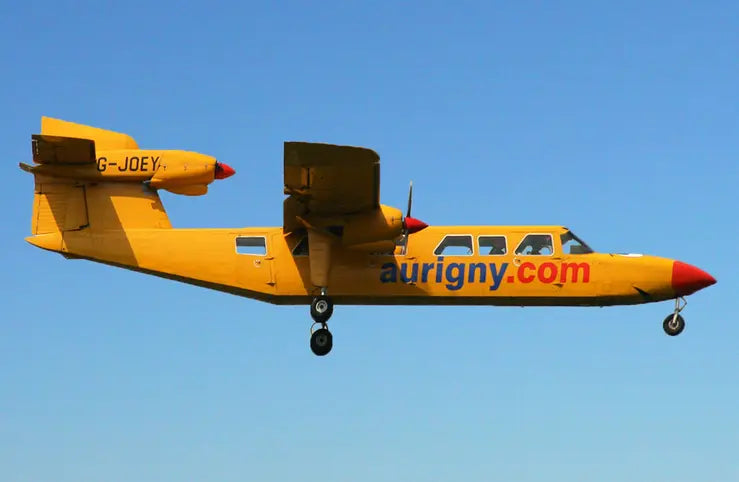
The single biggest change was the retirement of the airline's lone Embraer E195 jet, whose final commercial flight was a Guernsey to Gatwick service on 31 May 2024. CEO Nico Bezuidenhout was candid that the 116-seat jet had been "used in a manner it should not have been," running too many short rotations in a corrosive maritime environment, with punishing maintenance economics (he cited thrust reversers costing roughly $4 million that fail prematurely on very short sectors). The jet was sold to lessor Azorra. On the Alderney lifeline routes, the ageing Dornier 228 turboprops were withdrawn through late 2025 and early 2026, with the final Dornier duties completed in February 2026. In their place, Aurigny introduced DHC-6 Twin Otter aircraft on a damp/wet-lease from Isles of Scilly Skybus, the first Twin Otter service flying on 1 November 2025. Early results were encouraging, with cancellations down and passenger numbers up versus the Dornier, helped by the Twin Otter's higher wet-runway crosswind limit.
| Aircraft Type | Role | In Service | Notes |
|---|---|---|---|
| ATR 72-600 | Regional turboprop | ~6 | Core fleet, 68–72 seats. Several fitted with ClearVision EFVS for low-visibility ops. |
| DHC-6 Twin Otter (-300) | Inter-island (Alderney) | ~2 | Damp/wet-leased from Skybus. Replaced the Dornier 228 on lifeline Alderney routes from Nov 2025. |
| Embraer E195 | Jet (retired) | 0 | Single aircraft retired 31 May 2024, sold to Azorra. Ended Aurigny's jet operation. |
| Dornier 228-212 NG | Inter-island (retired) | 0 | Final duties completed Feb 2026. Replaced by Twin Otter. |
| ACMI wet-lease (2024) | Capacity cover | Ad hoc | ATR 72-500 (Jump Air) and Saab 340A (RAF-Avia) used to cover shortfalls; a major cost driver of the 2024 loss. |
Fleet snapshot compiled from Aurigny statements and 2024–2026 press reporting. Numbers are approximate and continue to change as leases and deliveries evolve.
The overwhelming majority of Aurigny line pilots fly the ATR 72-600, and this is the type rating you should expect to hold. Aurigny's own First Officer advertisements state that holding a Dornier 228 or ATR-600 type rating is "advantageous but not mandatory," which confirms the airline trains new joiners onto type rather than demanding a rating up front. The Twin Otter operation on the Alderney routes is smaller and specialised. Because Aurigny is a single-hub, near single-type operation, you will not spend a career switching frames within the company. The variety in this job comes from the demanding airfields and weather, not from a broad fleet, and the natural "next aircraft" is now a Boeing 787 with partner Norse Atlantic (see Section 6).
Pilot Salary & Compensation
Aurigny does not publish a detailed, seniority-by-seniority pay scale, and as a Guernsey employer it is not bound by any published UK collective agreement. The figures below are therefore indicative ranges drawn from third-party pilot-jobs databases, salary aggregators and community reporting, not from an official Aurigny pay table. Treat them as a realistic order of magnitude rather than a contract. What is not in dispute is the shape of the deal: Aurigny pays regional-turboprop money, which is modest by industry standards, but that gross figure lands in a low-tax jurisdiction, so the take-home comparison is more favourable than the headline suggests.
Indicative Pay by Rank
| Rank / Stage | Aircraft | Indicative Annual Gross | Notes |
|---|---|---|---|
| First Officer (entry) | ATR 72-600 | ~£30,000 – £38,000 | Low-hour and newly type-rated joiners at the bottom of the range. |
| First Officer (experienced) | ATR 72-600 | ~£40,000 – £50,000 | Senior F/O approaching command readiness. |
| Captain (entry command) | ATR 72-600 | ~£60,000 – £72,000 | Newly upgraded or direct-entry command. |
| Captain (senior) | ATR 72-600 | ~£72,000 – £85,000 | Top of the regional band; may include training or management duties. |
Ranges synthesised from public salary aggregators and pilot-jobs listings (First Officer roughly £30,000–£50,000; Captain roughly £60,000–£85,000). Aurigny has not confirmed an official scale, and actual offers vary with experience, type rating and role.
The most important compensation factor at Aurigny is not the gross salary, it is where you pay tax on it. Guernsey applies a flat 20% income tax rate, with no separate capital gains tax, no inheritance tax and no VAT, and an overall cap on the tax a high earner can pay. In practice a £70,000 Guernsey captain keeps a noticeably larger share of their pay than a UK-mainland pilot on a similar gross, where higher-rate income tax reaches 40% or more. Social insurance contributions apply on top and living costs are high, so this is not a loophole, but for career planning the flat 20% rate materially closes the gap between Aurigny's regional pay and a busier mainland job. Always confirm your personal position with the Guernsey Revenue Service before you rely on any tax figure.
No official Aurigny pilot pay scale is in the public domain. The bands above are estimates aggregated from pilot-jobs networks, Glassdoor-style salary sites and pilot forums, cross-referenced with the general UK regional-turboprop market. They exclude sector pay, allowances, standby and any type-rating bond arrangements, none of which Aurigny discloses publicly. Verify all numbers directly with Aurigny during recruitment, and remember that a Guernsey salary must be assessed net of Guernsey tax and the island's cost of living, not on gross alone.
Roster Pattern & Quality of Life
Aurigny's flying is overwhelmingly short-haul, out-and-back day flying, which is one of the strongest quality-of-life arguments for the job. A typical ATR duty is multiple sectors between Guernsey and the UK or near-Europe, returning to base the same day, so pilots are generally home most nights rather than living out of hotels. Long-haul-style overnight layovers are rare in the mainline ATR operation. Pilot-community reports describe the roster as relatively stable, built around predictable patterns such as five days on and two off, or four on and two off, with occasional changes rather than constant churn. First Officers can expect to log somewhere in the region of 400 to 500 flying hours per year, which is healthy hands-on experience for a career-building role.
📅 Illustrative Month — ATR 72 First Officer (Guernsey)
The honest counterweight to that stability is resilience. Because the pilot group is small (around 50 crew) and the aircraft count is tight, the operation has limited slack. During 2024 in particular, crew availability and sickness resilience were cited as contributors to cancellations and delays, and the airline has openly acknowledged crewing pressure as a driver of disruption. When a small roster is stretched, standby days get used and days off can come under pressure at short notice. The 2025 recruitment drive (seven pilots hired, described as roughly a 30% increase in officer numbers) was explicitly aimed at improving that resilience, which should benefit rostering stability going forward.
Aurigny does not publish its rostering agreement, so the pattern shown above is illustrative and built from pilot-community descriptions, not an official document. Real rosters vary by season, by crew shortages and by the balance between ATR and Twin Otter needs. Summer is materially busier than winter given the island's tourism-driven demand. Confirm current roster rules, standby structure and days-off guarantees directly with Aurigny before making any decision.
Benefits, Relocation & Retirement
As a small, government-owned employer, Aurigny's package is built around stability, training investment and the practicalities of relocating to an island, rather than the lavish travel benefits of a global major. Aurigny does not publish a detailed benefits brochure for pilots, so the picture below combines what the airline states in recruitment, what applies under Guernsey law, and reasonable inference clearly flagged as such. Verify the specifics of any offer in writing.
For most joiners, the single most valuable "benefit" at Aurigny is not a discount or an allowance, it is access to funded, structured training and a documented route to the flight deck of a wide-body jet. New First Officers are trained onto the ATR, and the airline's cadet stream (run with Leading Edge Aviation) plus the Norse Atlantic partnership turn a small regional job into a costed, multi-year career ladder. In a sector where self-funded type ratings and "pay-to-fly" schemes remain common, an airline that trains you and then hands you a bonded onward pathway is offering real financial value.
Because Aurigny publishes little pilot-specific benefits detail, several items above (pension terms, loss-of-licence cover, exact staff-travel rules and any type-rating bond) are indicative and must be confirmed in your contract. Do not assume UK-mainland norms transfer automatically; Guernsey has its own tax, social-insurance and healthcare systems.
Career Progression & the Norse 787 Pathway
Career progression is where Aurigny has reinvented its pitch to pilots. As a small airline, its internal ceiling is an ATR captaincy, and historically the airline struggled to retain crews who used it as a stepping stone before leaving for larger jet operators. In July 2025 Aurigny turned that weakness into a selling point by formalising a career pathway with Norse Atlantic UK, the London Gatwick based long-haul carrier. Under this arrangement, pilots begin as First Officers on the ATR 72, build around two years of demanding short-haul experience, and then have a route onto Norse Atlantic's Boeing 787 Dreamliner flying long-haul to destinations including North America, South Africa and Thailand.
Alongside the experienced-hire route, Aurigny launched a cadet programme delivered with Leading Edge Aviation at London Oxford Airport. The first six cadets began training in December 2025, several with clear Guernsey connections, reflecting the airline's aim to grow local talent. Cadets complete an integrated ATPL course, join Aurigny as ATR First Officers, and sit on the same Norse-linked progression ladder. COO Philip Smallwood framed the scheme as a way to make Aurigny "a more appealing long-term career choice for aspiring aviators" while protecting a vital island service.
| Career Milestone | Typical Timeline | Notes |
|---|---|---|
| Cadet training (cadet path) | ~18–24 months | Integrated ATPL with Leading Edge Aviation (Oxford). Conditional job offer possible during training. |
| Join as ATR First Officer | Day 1 post-training | Type-rated onto the ATR 72-600 by the airline. Based Guernsey. |
| Build regional experience | ~2 years | Demanding short-haul sectors and weather. The core of the value proposition. |
| Onward to Norse 787 (optional) | ~2 years+ | Boeing 787 First Officer with Norse Atlantic UK at Gatwick, via the partnership. |
| ATR Captain upgrade (internal) | Variable | Command on the ATR for those who stay. Aurigny also recruits direct-entry captains, which can affect internal timelines. |
Timelines are indicative. Aurigny does not publish a guaranteed upgrade schedule; progression depends on experience, performance, vacancies and fleet needs.
Unlike large legacy carriers that only promote from within, Aurigny recruits direct-entry ATR captains as well as non-type-rated First Officers. That flexibility helps the airline crew up quickly, but it also means internal upgrade timing is not a fixed, seniority-locked ladder; command can come relatively quickly at a small growing operator, or it can be slowed when experienced captains are hired externally. Aurigny does not publish an average time-to-command, so treat any specific figure with caution and ask directly. For many joiners the more compelling ladder is not the internal captaincy at all, it is the two-year ATR-to-787 pathway.
Recruitment Process & Requirements
Aurigny recruits through three broad channels: the cadet programme for those starting from zero, non-type-rated First Officers holding a frozen ATPL, and direct-entry captains. Vacancies are advertised on the airline's own careers portal and through partner and industry job boards, typically in defined application windows rather than continuously. The requirements below reflect Aurigny's own 2025 First Officer advertisement; note that earlier campaigns have used different thresholds (for example a 400-hour minimum, or a separate rated-Dornier stream), so always read the live posting for the exact criteria.
First Officer — Core Requirements (2025 campaign)
Selection Stages
Online Application
Apply through Aurigny's careers portal within the advertised window (the 2025 First Officer window ran late February to late March). You will submit licences, medical status, hours and a clear five-year employment and education history.
Screening & Assessment
Shortlisted candidates progress to competency and aptitude assessment. Expect the standard regional-airline mix of technical knowledge, situational judgement and a structured interview focused on airmanship, CRM and suitability for island operations.
Simulator Assessment
A simulator check is standard for experienced-pilot streams to evaluate handling, procedures and capacity under load. This is where multi-crew discipline and raw flying ability are tested.
Medical, Background & Right to Work
A valid UK CAA Class 1 medical is required, along with criminal-record clearance and confirmation you can relocate to and work in Guernsey. The island's housing and right-to-work rules are part of onboarding, not an afterthought.
Type Rating & Line Training
Successful non-rated joiners are trained onto the ATR 72-600, followed by line training into the Guernsey operation. Cadets instead begin the integrated ATPL course with Leading Edge before reaching this stage.
Aurigny values people who genuinely want to live in Guernsey and commit to the community operation, not just tick a box on the way to a jet. Emphasise reliability and resilience: this is a small airline where every crew member matters and where weather (fog and strong crosswinds) is a routine challenge. Make sure your UK CAA licence, Class 1 medical, APS MCC and A-UPRT are current, and check the live vacancy on the Aurigny careers page for the exact hour and documentation requirements, which vary by campaign.
Living & Flying in Guernsey
Because Aurigny is a single-base airline with no meaningful overnight layover culture, the "lifestyle" question is really a "living in Guernsey" question, and it deserves as much of your attention as the salary. Guernsey is a self-governing British Crown Dependency of roughly 63,000 people, safe, scenic and community-minded, with short commutes and a strong outdoor culture. For a pilot who wants to be home each night and raise a family somewhere calm, it is a genuinely attractive base. The trade-offs are equally real: the cost of living is high, and the island controls who may live there.
Guernsey operates a housing-market system that splits property into "Local Market" and "Open Market" categories, and newcomers cannot simply buy or rent anywhere. New arrivals typically need either an employment-linked housing licence or access to the more expensive Open Market. Pilot-community reports note that a housing licence can effectively set the minimum value of property you may occupy, which pushes up housing costs for relocating crews. An established island employer like Aurigny can help navigate the right-to-work and housing-licence process, but you should research this carefully and budget for it before accepting an offer. This is the single most important practical difference between Aurigny and a UK-mainland regional job.
The flying itself is a genuine training ground. Guernsey and Alderney sit in an exposed maritime environment where sea fog can roll in quickly and strong crosswinds are common; pilot accounts describe approaches into Guernsey with visibility down toward the airport's limits and crosswinds in the region of 30 knots. That is exactly why several of Aurigny's ATRs carry the ClearVision enhanced-vision system, and why the airline moved the Alderney routes to the Twin Otter, which offers a higher wet-runway crosswind limit than the outgoing Dornier. For a low-hour First Officer, building 400 to 500 hours a year in that environment produces sharp, weather-tested handling skills that stand out later in a career.
Do not underestimate the move. Between the housing-licence system, high property costs and the fact that you are committing to an island rather than a commutable city base, relocating to Guernsey is a lifestyle decision as much as a job decision. It suits pilots who actively want island life and stability; it suits mobile commuters far less well than a mainland base with multiple airport options. Research housing, schooling and the right-to-reside rules through the States of Guernsey before signing.
How Aurigny Compares: Airline Radar Chart
Aurigny is a very small operator, so the fairest comparison is against the airlines a low-hour or regional pilot in the British Isles would realistically weigh alongside it. We have chosen two live ATR-focused regionals: Loganair, the UK's largest regional airline, and Emerald Airlines, which operates Aer Lingus Regional out of Dublin and Belfast. (A third natural peer, Channel Islands rival Blue Islands, ceased trading in November 2025, a point we return to under job security.) Scores below are editorial estimates on a like-for-like six-metric basis, grounded in public data and pilot reporting rather than any single official source.
Key Takeaways from the Comparison
Pay is broadly similar across all three, and modest. These are regional turboprop operators, so First Officers start in the low-to-mid £30,000s and captains top out in the £70,000s to mid-£80,000s. Loganair's published salary data shows a comparable band, and Emerald sits in a similar Irish-regional range. Aurigny's differentiator is not gross pay but the Guernsey flat 20% tax, which lifts net income relative to UK or Irish tax on the same gross.
Work-life balance favours Aurigny for home life. Aurigny's day-return, single-base flying keeps pilots home most nights with a relatively predictable pattern, which many crews prefer to the multi-base, sometimes overnighting patterns at larger regionals. The offset is thin crewing resilience at Aurigny; Loganair's ten UK bases and Emerald's larger roster give more slack and more base choice.
Fleet and career breadth tilt to the peers. Loganair operates a more varied fleet (ATR 42/72 plus Embraer regional jets) and Emerald runs a large, modern, single-type ATR 72-600 fleet with a documented onward route to Aer Lingus mainline. Aurigny's in-house fleet is the smallest of the three, but its Norse Atlantic 787 pathway is arguably the most striking onward step of any, taking a turboprop First Officer to a wide-body jet.
Job security is a nuanced draw. Aurigny's state ownership and protected lifeline routes give it a structural safety net that a privately financed regional lacks, but its persistent losses and political scrutiny cut the other way. The November 2025 collapse of Channel Islands rival Blue Islands is a sobering reminder that regional airlines fail; Aurigny's government backing is precisely what makes it less likely to.
Scores are editorial estimates based on public salary aggregators, airline and union statements, press reporting and industry benchmarks. They reflect a general assessment for a career-building pilot, not a precise index, and individual experience will vary with seniority, base and personal priorities. Peer scores for Loganair and Emerald Airlines are directional and will be refined as we publish dedicated guides for those carriers.
Ownership, Job Security & Industrial Relations
Aurigny's industrial-relations story is different from a large unionised major, and it starts with ownership. The airline is 100% owned by the States of Guernsey and overseen by the States' Trading Supervisory Board (STSB) as shareholder. That gives pilots an unusual employer: one whose core mandate is to keep the island connected, and which can be supported with public money, but which is also answerable to politicians and taxpayers and subject to formal inquiries when it loses money. In 2024 the airline's roughly £6.5 million loss prompted an official States inquiry (which found no misjudgement by management), and the STSB warned Aurigny must not become a "recurring burden" on the taxpayer.
On formal union representation, the picture is less clear-cut than at a UK-mainland airline. BALPA (the British Airline Pilots' Association) is the dominant pilot union across the UK and is recognised at around 20 companies, but there is no clear public record confirming a formal BALPA collective-bargaining agreement specifically at Aurigny, and Guernsey sits under its own employment legislation rather than UK law. Prospective joiners should ask directly during recruitment what union recognition, if any, applies, and whether membership brings loss-of-licence and legal support. Many British Isles pilots carry BALPA membership individually for those protections regardless of formal recognition.
Recent Ownership & Operational Milestones
| Date | Development | Relevance to Pilots |
|---|---|---|
| May 2024 | Embraer E195 retired; ACMI wet-leases used to cover capacity | Marked the move to an all-turboprop, ATR-centric operation. Wet-lease costs drove the year's loss. |
| Nov 2024 | States of Guernsey cut PSO funding by 25% | Tighter public support raises pressure on efficiency and route economics. |
| Apr 2025 | Seven pilots recruited to improve resilience | Roughly a 30% boost to officer numbers, aimed at reducing crewing-driven disruption. |
| Jul 2025 | Norse Atlantic career pathway announced | Turned pilot retention from a weakness into a recruiting advantage (ATR to 787). |
| Nov 2025 | First Twin Otter service; Blue Islands ceases trading | Alderney fleet renewed; a direct Channel Islands rival collapses, reshaping the market. |
| Dec 2025 | First six Leading Edge cadets begin training | Launch of a home-grown pilot pipeline for the island. |
Compiled from Guernsey Press, BBC, ITV and airline statements, 2024–2026.
The security calculus at Aurigny is genuinely two-sided. On one hand, state ownership and legally protected lifeline routes (Gatwick, Southampton and Alderney) provide a floor that privately funded regionals simply do not have, and the recent failure of Blue Islands shows how brutal the unprotected end of this market can be. On the other hand, Aurigny loses money, is under real political and competitive pressure (notably British Airways' new Guernsey to Heathrow service eroding Gatwick demand), and future restructuring or route changes are possible. The likeliest outcome for pilots is continued employment underpinned by the island's need for air links, but with ongoing change around fleet, network and finances that you should expect rather than be surprised by.
Verdict: Who Is Aurigny For?
🎯 Our Take
Aurigny is a distinctive first-airline job that has become substantially more compelling since 2025. You get demanding, weather-rich flying on a modern ATR 72-600, a stable day-return roster that keeps you home most nights, a low 20% tax environment, and, crucially, a formal, funded pathway onto a Boeing 787 with Norse Atlantic after around two years. For a low-hour pilot who wants real hand-flying experience and a clear escalator toward long-haul, that combination is rare among regionals.
The trade-offs are equally clear and should not be glossed over. The pay is regional-modest in gross terms, the airline is loss-making and politically scrutinised under States of Guernsey ownership, the fleet is small and turboprop-only, and relocating to Guernsey means navigating a housing-licence system and a high cost of living. Crewing resilience has been thin, though recent recruitment is addressing it. This is a community airline with pressures, not a high-growth commercial carrier.
If you actively want island life and a documented route to wide-body jets, Aurigny is one of the more interesting regional entry points in the British Isles. If your priority is maximum gross pay, fleet variety or a large, deeply unionised employer, it is not the right fit.
1 What are the minimum requirements to become an Aurigny First Officer?
Aurigny's 2025 First Officer campaign asked for a UK CAA frozen ATPL (85%+ theory pass), a UK CAA Class 1 medical, ICAO English Level 5, and minimums of 250 hours total time, 100 hours pilot-in-command and 50 hours multi-engine piston, plus APS MCC and A-UPRT certificates. You must also be able to swim 25m unaided and be willing to relocate to Guernsey. An ATR-600 or Dornier 228 type rating is advantageous but not required. Note that earlier campaigns used different thresholds (for example 400 hours), so always check the live vacancy.
2 Does Aurigny pay for the ATR type rating?
Aurigny trains new joiners onto the ATR rather than requiring you to arrive type-rated, and its recruitment explicitly treats an existing rating as a bonus, not a prerequisite. In the regional sector, employer-provided type ratings are frequently accompanied by a training bond (a repayable amount that reduces over time if you leave early). Aurigny does not publish its bond terms, so confirm whether a bond applies, its value and its duration in writing before accepting an offer.
3 How does the Norse Atlantic 787 pathway work?
Announced in July 2025, the partnership lets Aurigny First Officers build roughly two years of experience on the ATR 72 and then progress to Norse Atlantic UK's Boeing 787 fleet at London Gatwick, flying long-haul routes to destinations such as North America, South Africa and Thailand. It applies both to experienced First Officers and to cadets trained through Leading Edge Aviation. It is a structured career route rather than an automatic transfer, so progression still depends on performance and vacancies, but it is a genuine, promoted turboprop-to-widebody ladder.
4 Do I have to live in Guernsey, and what about the housing licence?
Yes. Aurigny is a single-base airline and its roles require relocation to Guernsey. The island runs a housing-market system splitting properties into "Local Market" and "Open Market," and newcomers generally need an employment-linked housing licence or access to the pricier Open Market. Pilot reports indicate a housing licence can set the minimum value of property you may occupy. An established employer like Aurigny can help with the right-to-work and housing process, but you should research housing costs and eligibility thoroughly, as this is the biggest practical difference from a mainland regional job.
5 How much do Aurigny pilots actually earn after tax?
Aurigny does not publish an official pay scale. Third-party data points to First Officers in roughly the £30,000 to £50,000 range and captains around £60,000 to £85,000, in line with the regional turboprop market. The key nuance is Guernsey's flat 20% income tax with no capital gains, inheritance tax or VAT, and an overall tax cap, which means take-home pay is higher than an equivalent UK gross taxed at 40%+. Set that against Guernsey's high living and housing costs, and confirm your personal position with the Guernsey Revenue Service.
6 Does Aurigny take low-hour pilots and cadets?
Yes. Aurigny recruits non-type-rated First Officers with a frozen ATPL and modest hours, and in December 2025 it welcomed its first six cadets through an integrated ATPL programme with Leading Edge Aviation at London Oxford, several of them with Guernsey connections. Both routes feed the same ATR First Officer role and the Norse Atlantic progression pathway, so it is a viable option for pilots at or near the start of their careers.
7 Is Aurigny financially stable given it is government-owned?
It is stable in the sense that the States of Guernsey own it and legally protect its lifeline routes, so outright failure is far less likely than for a privately funded regional (as illustrated by rival Blue Islands ceasing trading in November 2025). However, Aurigny has been loss-making, drew an official States inquiry over its 2024 loss of about £6.5 million, saw its public funding trimmed, and faces new competition from British Airways' Guernsey to Heathrow service. Expect a secure but change-heavy environment rather than a financially serene one.
8 Can non-UK pilots apply?
Aurigny's advertisements are built around UK CAA licences and a UK CAA Class 1 medical, and the job requires the right to work and reside in Guernsey. Guernsey operates its own immigration and population-management rules, separate from the UK. There is no simple sponsorship promise, so any applicant who does not already hold the necessary licences and right-to-reside status should clarify eligibility directly with Aurigny before applying.
Official Links & Resources
Before applying or making any career decision, verify everything directly with primary sources. These are the key organisations and websites relevant to an Aurigny pilot career:
Aurigny recruits in defined windows rather than continuously, so set an alert on the Aurigny careers page and follow the airline on LinkedIn to catch First Officer and cadet campaigns as they open. When a vacancy appears, read it line by line: the hour minimums, English level and required certificates (APS MCC, A-UPRT) have varied between campaigns, and getting your documentation in order early is the difference between applying and missing the window.