

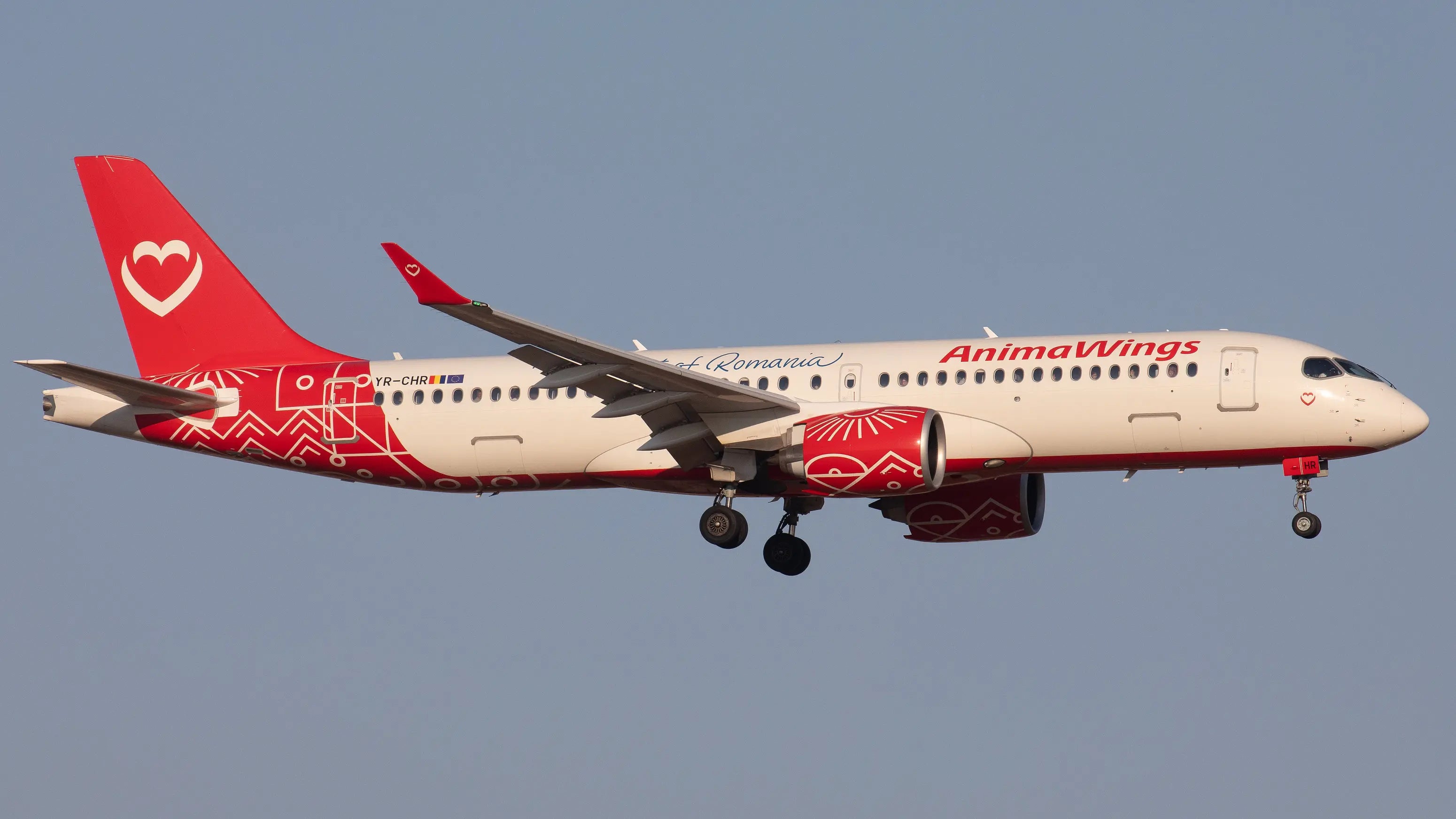
AnimaWings Overview & Company Profile
AnimaWings (legal entity Anima Wings Aviation S.A.) is a Romanian airline operating under IATA code A2, ICAO code AWG and the radio callsign ANIMA WINGS. The company was incorporated in 2019, received its Romanian air operator certificate (AOC RO-067) in July 2020 and flew its first commercial service the same month. It is one of the very few genuinely new European carriers to have been launched, survived the pandemic period, and then scaled up rather than folded.
The airline began life as a leisure charter operator closely tied to Christian Tour, Romania's largest tour operator, and its parent Memento Group. That charter DNA still shapes a large part of the summer flying programme. Since January 2025, however, AnimaWings has repositioned itself as a hybrid full-service scheduled and charter carrier, and the scheduled network is now the growth engine. The airline itself dates the present scheduled phase from 15 January 2025, when it launched Bucharest to Cluj-Napoca with eight weekly frequencies.
The ownership story matters for anyone assessing job security. Greece's AEGEAN Airlines took a 25% stake in 2020 and raised it to 51% in October 2021, for a total reported investment of around €1.3 million. AEGEAN then transferred its entire holding back to the Memento side in February 2024, leaving the founding Pandel family in full control. In April 2026 a new chapter opened: BT Asset Management, Winners Holding Investments and EVERGENT Investments signed to acquire a combined 50% interest, with the founders retaining the other half. Both the airline and EVERGENT stated the transaction would complete only after regulatory approvals and conditions precedent, and the invested amount was not disclosed. For a pilot reading this in August 2026, the accurate description is founder-controlled with a signed but not publicly confirmed 50% institutional investment.
Operationally, the airline is anchored at Bucharest Henri Coandă (OTP), which is both the registered home base and the base named in every current pilot vacancy. A second operational base opened at Timișoara (TSR), where two Airbus A220-300s in the 148-seat configuration are allocated and crews have been recruited locally. Cluj-Napoca is an important focus city and a repeatedly announced future base, but it should not yet be treated as an established crew base. Iași and Craiova are route stations rather than confirmed bases.
Network scale grew quickly. Cirium schedule data for January to October 2026 showed 51 scheduled routes (five domestic and 46 international) serving 34 airports, offering roughly 1.3 million two-way seats. By mid-2026 the airline was publicising approximately 60 routes across 30 destinations after further additions to Rotterdam, Copenhagen, Vienna and Frankfurt. AnimaWings is a member of the Romanian Airline Companies Association (ACAR) but is not part of a global alliance. AEGEAN continues to list AnimaWings among its airline partners, so the commercial relationship outlived the equity relationship.
AnimaWings does not publish an audited passenger traffic series, a pilot headcount, or a pay scale. The most recent clearly filed Romanian statutory result is for 2024: turnover of RON 124,678,640, net profit of RON 1,984,754 and an average of 68 employees. Management publicly forecast that 2025 turnover would roughly double, but that was guidance rather than a filed result, and no 2025 statement was located. Do not use the 68-employee figure to estimate current staffing, because the airline doubled its fleet during 2025 and 2026. Secondary profiles quoting "300,000" or "over 500,000" passengers give no reporting year and should not be treated as audited.
Fleet Composition & Type Ratings
AnimaWings runs a two-type all-Airbus fleet. The Airbus A220-300 is the strategic aircraft and carries the scheduled network. Two older Airbus A320-200s handle the higher-density tour operator charter programme. According to the airline's own official fleet page, the operating fleet in August 2026 stood at six A220-300s and two A320-200s, a total of eight aircraft.
The pace of growth is the headline. The fleet was four aircraft at the start of 2025, five by September 2025, seven by spring 2026 and eight by August 2026 following the delivery of the sixth A220. Management has stated an objective of 18 aircraft by the end of 2027, describing the programme as worth more than US$1 billion. That is a growth plan supported by ongoing Airbus negotiations rather than a confirmed backlog of 18 firm purchase orders, and pilots should read it accordingly.
Current Aircraft, Registrations & Configurations
| Type | Registration | Configuration | Entered Service | Primary Role |
|---|---|---|---|---|
| Airbus A220-300 | YR-CHR | 137 seats (12 Business + 125 Economy) | December 2024 | Scheduled network |
| Airbus A220-300 | YR-FUN | 137 seats (12 Business + 125 Economy) | December 2024 | Scheduled network |
| Airbus A220-300 | YR-GUN | 137 seats (12 Business + 125 Economy) | September 2025 | Scheduled network |
| Airbus A220-300 | YR-RUN | 148 seats, all Economy | March 2026 (ex-factory) | Scheduled + charter |
| Airbus A220-300 | YR-BUN | 148 seats, all Economy | Spring 2026 | Timișoara base |
| Airbus A220-300 | YR-DUN | 148 seats, all Economy | August 2026 | Timișoara base / network |
| Airbus A320-200 | YR-AGC | 180 seats, all Economy | MSN 3621 | Charter, Abu Dhabi |
| Airbus A320-200 | YR-AGD | 180 seats, all Economy | MSN 6350 | Charter |
Fleet data compiled from the AnimaWings fleet page and delivery announcements, current as of August 2026. Registrations and configurations change with lease returns and reconfiguration.
Ownership, Age and What It Means on the Line
Every A220 is on lease rather than owned outright. The original A220 package comprised two aircraft from Air Lease Corporation and four from Azorra. That structure is normal for a fast-scaling operator and has one practical consequence for pilots: fleet composition can shift with lease terms, and delivery slippage directly affects the flying programme. This is not hypothetical. In May 2025, A220 delivery delays forced AnimaWings to cut and postpone announced routes, which is exactly the kind of event that moves a new joiner's base allocation or utilisation.
Fleet age is a genuine strength. The reported average was 6.2 years in January 2026, when three near-new A220s were paired with two A320s averaging 14.2 years. With three further factory-fresh A220s added, the airline reported an average of approximately five years by spring 2026. For a First Officer, that means Pratt & Whitney PW1500G-powered, fly-by-wire, modern-flight-deck equipment on a type with strong long-term demand across Europe and North America.
The official AnimaWings careers page recruits exclusively for the Airbus A220 at present. It does not state whether the type rating is company funded, salary deducted, or subject to a training bond, and no public bond amount or service period has been published. Third-party recruitment listings have described the First Officer role as non-type-rated with training provided, and have at times advertised non-A220-rated direct-entry commanders, but the airline's own page is silent on this. Get the type rating funding model, any pro-rata repayment schedule, and whether travel and accommodation during training are covered, in writing before you sign. The A320 is not currently being recruited for, so do not assume an A320 rating gives you a direct route in.
Several secondary fleet databases list six Airbus A320neos as planned or on order for AnimaWings, and the airline's 2024 strategy documents referred to a future mix of A220-300s and A320neos. However, the current official fleet page gives no type-by-type order backlog, and no 2026 announcement confirms an A320neo order. Treat A320neo capacity as contracted or intended future growth, not as a type you can plan a career transition onto. Similarly, AnimaWings operates no A319s and no ATR 72s; ATR references in Romanian pilot recruitment almost always relate to TAROM.
Pilot Salary & Compensation Breakdown
This is the section where honesty matters more than volume. AnimaWings does not publish a pilot pay scale. Its careers page offers "competitive salary, daily per diem in local, or as applicable in hard currency" and nothing more specific. There is no public collective labour agreement, no published seniority-linked increments, and no disclosed sector or block-hour pay formula. Any article presenting a detailed AnimaWings salary table is extrapolating, and you should treat such figures with suspicion.
What follows is therefore structured as: the one crowd-sourced AnimaWings data point that exists, the Romanian statistical context, and the verified pay of the airlines you will realistically be choosing between. Use it to calibrate expectations and to build your negotiation questions, not as a contract preview.
What Is Actually Known About AnimaWings Pay
| Element | Published Position | Confidence |
|---|---|---|
| Base salary structure | Not published | Careers page states "competitive salary" only |
| First Officer fixed pay | ~€1,800 – €2,200 net/month | Single crowd-sourced report, June 2025. Indicative only |
| Captain pay | No credible public figure | Not disclosed by any source located |
| Per diem | Confirmed, rate not published | "Daily per diem in local or hard currency" |
| Sector / block-hour pay | Not published | Existence not confirmed either way |
| Contract type | Permanent Romanian labour contract | Explicitly stated on careers page |
| Loss-of-licence / insurance | Not published | Must be asked at offer stage |
The single First Officer figure comes from a crowd-sourced pilot submission and is ambiguous about whether the accompanying per diem is domestic or international. It is not an official scale.
Romanian Market Context
To judge whether a Romanian offer is good, you need the local baseline. Romania's National Institute of Statistics reported an average gross monthly wage of RON 9,272 and an average net monthly wage of RON 5,557 in early 2026. Against that, salary databases place a Romanian airline pilot at roughly RON 16,000 net per month on average, with one 2026 estimate putting the average at about €32,300 gross per year. Occupational surveys give a First Officer band of roughly RON 38,620 to RON 120,880 per year (average RON 79,280) and a broader airline-pilot band of roughly RON 85,700 to RON 282,500 per year (average RON 181,600). These generic surveys systematically undercount variable flight pay and per diem, so they mark the floor of the conversation rather than the ceiling.
Romanian Airline Pay Comparison
| Operator | First Officer | Captain | Notes |
|---|---|---|---|
| AnimaWings | ~€1,800 – €2,200 net/mo (unverified) | Not disclosed | Permanent contract + daily per diem. No published scale. |
| Wizz Air (group scales) | ~€32,000 yr 1 to ~€62,000 yr 10 | ~€105,000 yr 1 to ~€160,000 yr 10 | 2026 salary-guide figures, group-wide. Bucharest-specific table not public. |
| Wizz Air (Romanian press reporting) | ~€3,500 – €8,000/mo | ~€10,000 – €12,000 net/mo | Highly variable with base, sectors, utilisation and employment vehicle. |
| TAROM | ~€2,500 – €3,500/mo total | ~€5,000 rising toward €6,500/mo | After the staged ~€1,500 increase agreed in 2024. Low base plus mission pay and per diem. |
| HiSky Europe | No dependable public scale | No dependable public scale | Ask whether the offer is Romanian employment or a contractor arrangement. |
Compiled from 2026 salary guides, Romanian press reporting and post-dispute settlement reporting. Wizz Air and TAROM figures are the best-documented Romanian comparators; AnimaWings remains the least transparent of the three.
Tax and Take-Home in Romania
Romanian payroll deductions are straightforward but material. Employees pay 25% CAS (pension), 10% CASS (health) and 10% income tax. That means a headline gross figure converts to roughly 55 to 58 percent net before any per diem is added. Per diem is where Romanian aviation pay gets interesting: under the Fiscal Code, delegation allowances are exempt from income tax and social contributions up to 2.5 times the legal public-sector rate for the destination, subject to an overall monthly cap. For international duties, the exempt ceiling is 2.5 times the destination-specific rate set under HG 518/1995, so a destination with a €35 base rate carries a non-taxable ceiling of €87.50 per day. A per diem heavy package can therefore deliver a meaningfully better net outcome than the same headline gross paid as salary. This is why the split between fixed salary and per diem is the single most important question to ask at offer stage.
No official AnimaWings pay scale exists in the public domain as of August 2026. The figures above are drawn from Romanian statistical databases, 2026 industry salary guides, Romanian press reporting on Wizz Air and TAROM, and a single crowd-sourced AnimaWings submission. They are presented for calibration, not as a representation of what AnimaWings will offer you. Before accepting any position, request in writing: guaranteed monthly gross and net, whether sector or block-hour pay exists, domestic versus international per diem rates and the unit of payment (per duty, per calendar day, or per night away), training pay, simulator and line-check pay, holiday pay basis, overtime treatment, sick pay basis, and whether the type rating carries a bond.
Roster Rules & Quality of Life
AnimaWings does not publish a fixed roster pattern. Its recruitment material commits to a "working roster published in advance" and a Bucharest home base, but names no cycle such as 5 on / 4 off or 6 on / 3 off. What is fully determined, and what you can rely on, is the regulatory floor: EASA ORO.FTL and CS-FTL.1, EU Directive 2000/79/EC on working time in civil aviation, and the Romanian Labour Code. Understanding those limits tells you the worst legally permissible month, which for a small growing operator in peak season is a more useful planning tool than an advertised average.
The Regulatory Framework That Governs Your Month
| Limit | Value | Source |
|---|---|---|
| Days free of duty and standby | 7 local days per calendar month, 96 per calendar year | EU Directive 2000/79/EC |
| Definition of a day off | 1 day plus 2 local nights, notified in advance | EASA FTL guidance |
| Maximum duty hours | 60 h / 7 days, 110 h / 14 days, 190 h / 28 days | ORO.FTL.210 |
| Annual working time cap | 2,000 hours total work | EU working time rules |
| Maximum block hours | 100 h / 28 days, 900 h / calendar year, 1,000 h / any 12 consecutive months | ORO.FTL.210 |
| Rest at home base | At least the preceding duty length or 12 hours, whichever is greater | ORO.FTL.235 |
| Rest away from home base | At least the preceding duty length or 10 hours, whichever is greater | ORO.FTL.235 |
| Extended recovery rest | 36 hours including 2 local nights, max 168 h between periods | ORO.FTL.235 |
| Minimum paid annual leave | 20 working days per year, excluding public holidays | Romanian Labour Code |
These are legal minimums and maximums, not AnimaWings policy. Individual contracts and any future collective agreement may improve on them, but nothing published confirms that they do.
Other airline guides on this site include a four-week roster grid. That grid is deliberately omitted here because AnimaWings publishes no roster pattern, has no public collective labour agreement, and no verifiable multi-pilot roster sample was found. Constructing one would mean inventing it. The honest planning assumption is the statutory floor of seven days free of duty per calendar month and 20 working days of annual leave, with anything above that being a matter for your individual contract. Ask directly during interview: what is the published roster cycle, how many days in advance is the roster issued, how many days off per month does a line pilot actually receive in July and August, and how much of the month is standby?
What the Flying Programme Implies
The operation itself tells you a lot. AnimaWings flies a short and medium-haul programme where the A220-300 is optimised for sectors of roughly four to five hours. The longest scheduled service, Bucharest to Abu Dhabi, is about five hours outbound and five and a half hours inbound, and the published rotation is same-day rather than a night stop. The domestic programme runs around 90 weekly flights across five city pairs. That mix produces a predominantly turnaround, home-every-night operation with multi-sector days, early starts and late finishes, rather than the layover-driven pattern of a long-haul carrier.
Seasonality is the defining quality-of-life variable. Summer brings the Christian Tour charter programme to Greece, Italy and Spain layered on top of a year-round scheduled network, flown out of Bucharest, Cluj-Napoca, Timișoara, Iași and Craiova. Expect a materially heavier summer than winter, with more weekend and night flying. A realistic short-haul planning band is roughly 60 to 85 block hours per month during active season, but this is an industry planning estimate rather than an AnimaWings disclosure, and only the statutory ceilings are guaranteed.
Bucharest is the primary base and the one named in every current vacancy. It offers by far the deepest Romanian aviation job market, which is a real hedge: Wizz Air, TAROM, HiSky and several business and cargo operators all have a presence there, so a base move does not require an international relocation. Living costs in Bucharest remain well below Western European capitals, which changes how a €2,000 net figure reads compared with the same number in Paris or Amsterdam. Timișoara is smaller, cheaper still, and now has two allocated A220s with locally recruited crews, making it a genuine option rather than a commuter posting. Cluj-Napoca has been repeatedly flagged as a future base but is not one yet, so do not accept a job on the expectation of a Cluj basing.
Benefits, Per Diems & Retirement
Benefits are the weakest documented area of the AnimaWings package, and that weakness is about disclosure as much as substance. The airline confirms three things publicly: a permanent Romanian labour contract, a daily per diem paid in local or hard currency, and a roster published in advance. Everything else that a pilot would normally weigh, staff travel, private medical cover, loss-of-licence insurance, life and disability cover, and any employer pension top-up, is simply not published.
A previous A320 vacancy did advertise four or five star hotels when away from base and crew catering on flight duty. Whether those terms survive into current A220 contracts needs confirming directly, because the airline's present careers listing does not repeat them.
The Romanian Pension Picture
Romanian pilots retire under the same three-pillar system as every other Romanian employee. Pillar I is the mandatory state pay-as-you-go scheme funded from the 25% CAS contribution. Pillar II is a mandatory funded individual account into which part of that contribution is redirected. Pillar III is voluntary and privately funded. Unlike France, where the CRPN provides a dedicated aircrew supplementary fund, or several Northern European markets with sector-wide pension schemes, Romania has no aviation-specific pension vehicle. There is no industry safety net waiting for you and no employer top-up advertised at AnimaWings.
The practical consequence is that a Romanian pilot career requires more personal financial planning than a Western European one. Two items deserve particular attention. First, loss-of-licence cover: with no CRPN-style fund behind you, a Class 1 medical failure at 45 is a personal financial event, and you should either secure employer-provided cover in writing or buy your own policy through a professional association. Second, Pillar III: because it is voluntary and untopped by the employer, the gap between a comfortable and an uncomfortable retirement is entirely a function of what you contribute yourself.
Because Romanian per diem is exempt from income tax and social contributions up to 2.5 times the legal rate for the destination, the split between fixed salary and per diem materially changes your net income for the same headline cost to the employer. Two offers with identical total value can differ by hundreds of euros per month in take-home depending on that split. Ask for the exact domestic and international per diem rates, the payment unit (per duty period, per calendar day, or per night away from base), whether standby and training days attract per diem, and what happens to per diem during leave and sick periods. Also ask whether per diem is included in the calculation basis for holiday pay, because in many Romanian contracts it is not.
The absence of published information on staff travel, private medical cover, loss-of-licence insurance and employer pension contributions is the single clearest weakness in the AnimaWings proposition compared with a legacy European carrier. It does not necessarily mean these benefits are absent, only that they are not documented publicly and therefore cannot be verified before an offer. Treat every one of them as a negotiation item rather than an assumption, and get the answers in the written offer rather than in the interview.
Career Progression & Command Upgrade
Career progression is where AnimaWings is genuinely attractive, and it is the strongest argument for taking a below-market salary. The airline has doubled its fleet from four aircraft in early 2025 to eight in August 2026, with a stated target of 18 by the end of 2027. If that target is even partially achieved, the number of command positions roughly doubles again inside two years. In a European market where legacy carriers quote ten to fifteen years to the left seat, that arithmetic is worth serious attention.
Two structural features make this concrete. First, AnimaWings accepts direct-entry captains. Its current recruitment explicitly seeks experienced A220 commanders at 3,000 total hours and 1,000 hours on jets above 25 tonnes MTOW. That is a low bar by legacy-carrier standards and is achievable by a mid-career short-haul First Officer. Second, there is no published seniority list, which cuts both ways: it removes the guaranteed queue position that protects you at a large carrier, but it also removes the rigid queue that blocks you.
| Career Step | Documented Position | What Is Actually Verified |
|---|---|---|
| Entry as First Officer | 500 h CAT on aircraft >10 t or >19 seats | Confirmed on the official careers page |
| Type rating on A220 | Not stated on official page | Third-party listings describe the role as non-type-rated with training provided. Unverified. |
| Command upgrade from within | No published timeline or seniority list | One visible case: FO from April 2021 upgraded to A320 captain in August 2023, about 2 years 5 months. A single case, not a company rule. |
| Direct-entry Captain | 3,000 h total + 1,000 h jet >25 t MTOW | Confirmed on the official careers page |
| Non-rated direct-entry Captain | Advertised by third parties, not by the airline | Must be confirmed in writing |
| Instructor roles (TRI / TRE / LTC) | Not advertised | No public information on internal instructor pathways |
| Cadet or ab-initio entry | Does not exist | The 500-hour CAT minimum excludes zero-time academy graduates |
Compiled from the AnimaWings careers page, specialist pilot job listings and publicly visible career histories. The single upgrade case should be read as an existence proof, not a promise.
How to Read the Upgrade Picture Honestly
The one publicly visible example of an internal upgrade shows a First Officer who joined in April 2021 becoming an A320 captain in August 2023, a span of roughly two years and five months. That is genuinely fast. It is also a single data point from the airline's earliest and smallest phase, and it says nothing about what upgrade looks like in a larger, more structured organisation. No responsible assessment converts one case into a company-wide upgrade timeline.
What can be said with confidence is that command availability at AnimaWings will be driven by fleet delivery rather than by a queue. Each new A220 requires roughly five to six crews, which means each delivery creates command openings that must be filled either internally or by direct entry. If deliveries proceed toward 18 aircraft, internal upgrade opportunities will be structurally abundant. If deliveries slip, as they did in May 2025, upgrade prospects slip with them. Your career outcome at this airline is tied to Airbus production slots and lease negotiations to an unusual degree.
AnimaWings went from four to eight aircraft in roughly 18 months and opened a second crew base at Timișoara in that period. That is an environment where a capable First Officer can realistically expect command consideration far sooner than at TAROM or a Western European legacy carrier. Before committing, establish three things in writing: the criteria the company applies to command selection (hours, time in company, licence status, check performance), whether any form of seniority or bidding system governs base and command allocation, and what happens to your position if fleet growth stalls. In an operator with no seniority list, "how are commands allocated" is a question you must ask, because the answer is not documented anywhere.
AnimaWings runs no ab-initio or cadet programme and has never advertised one. The published First Officer minimum of 500 hours in commercial air transport on aircraft above 10 tonnes or with more than 19 passenger seats rules out newly qualified academy graduates entirely. Romanian and international flight schools that suggest AnimaWings as a graduate destination are not describing an existing pathway. If you are a low-hour pilot, this is not your entry airline.
Recruitment Process & Requirements
AnimaWings recruits pilots through a direct, low-ceremony process. There is no assessment centre publicised, no online psychometric platform, and no annual campaign window. Applications go by email to the human resources department and the airline recruits on a rolling basis as aircraft arrive. As of August 2026, the official careers page carries two pilot vacancies, both on the Airbus A220, both based in Bucharest.
Experienced Commander (A220) Requirements
First Officer (A220) Requirements
How the Application Works
Direct Email Application
Send a CV and a recent photograph to hr@animawings.com with the subject line "Pilot in Command/FO". There is no online application portal and no application deadline, because recruitment is rolling rather than campaign-based. Applications are also visible through specialist aggregators such as Pilot Jobs Network and PilotsGlobal, but the airline's own address is the primary channel.
Document and Eligibility Screening
Expect verification of licence validity, hours against the published minimums, ICAO English level, medical status and right to work in Romania. EU and EEA nationals do not require a Romanian work permit. Non-EU candidates should assume sponsorship is not available unless the airline confirms otherwise in writing, since nothing on the careers page addresses visa support.
Interview and Assessment
AnimaWings does not publish its selection format. For an operator of this size, the realistic expectation is a technical and HR interview, potentially combined, followed by a simulator assessment for command candidates and for First Officers where a type rating is involved. No psychometric testing platform, group exercise or multi-day assessment centre is advertised. Candidates should ask what the assessment involves when invited, since there is no published syllabus to prepare against.
Offer, Contract and Training Terms
The offered terms are a permanent Romanian labour contract, competitive salary plus daily per diem, a roster published in advance, and a Bucharest home base. This is the stage at which the undocumented items must be nailed down: exact gross and net pay, per diem rates and payment unit, type rating funding and any bond, loss-of-licence and medical cover, and leave above the statutory 20 days.
Type Rating, Line Training and Licence Issue
A220 type rating training and line training follow. Licence issue, revalidation and conversion in Romania are handled by the Romanian Civil Aeronautical Authority (AACR) under Regulation (EU) 1178/2011. Pilots transferring an EASA licence from another member state should budget time for the state-of-licence-issue transfer process, which is administrative but not instantaneous.
Recruitment at a carrier this size is driven by aircraft delivery dates rather than by fixed campaigns, so timing matters more than at a legacy airline. Applying shortly before an announced delivery is materially more effective than applying at random. Track AnimaWings fleet announcements and route launches, because each new aircraft creates a crewing requirement. Romanian language is not listed as a requirement for either pilot role, though it is mandatory for the airline's ground positions such as the advertised marketing manager role, which is a useful signal about internal working language. Keep the CV to two pages, lead with hours by type and command status, and include the recent photograph the airline explicitly requests, since applications missing it may simply be filtered out.
The published AnimaWings vacancies omit several items that are standard elsewhere: no medical requirement is stated, no maximum age is given, no type rating funding position is declared, no right-to-work or sponsorship policy is set out, and no salary range appears. There is also no live Airbus A320 pilot vacancy and no cabin crew recruitment shown on the careers page as of August 2026. Absence of a stated requirement is not the same as absence of the requirement, and absence of a stated benefit is not evidence that the benefit exists. Every one of these gaps should be closed in writing during the offer conversation.
Route Network & Flying Profile
AnimaWings operates no long-haul flying, so this section replaces the layover analysis found in guides to widebody carriers with something more useful for this airline: what the flying actually looks like from the flight deck. The A220-300 is deployed on sectors optimised for four to five hours, and the two A320-200s absorb the higher-density charter work. The result is a predominantly same-day turnaround operation with a mix of short domestic hops, three to four hour European city pairs, seasonal Mediterranean leisure flying, and one genuinely long medium-haul sector to the Gulf.
The scheduled network reached roughly 60 routes across 30 destinations by mid-2026, up from a standing start in January 2025. Domestic flying runs at around 90 weekly flights across five city pairs from Bucharest: Cluj-Napoca, Iași, Timișoara, Oradea and Suceava. The international scheduled map includes Abu Dhabi, Athens, Copenhagen, Frankfurt, Geneva, Istanbul, Larnaca, London Gatwick, Milan Malpensa, Munich, Nice, Paris Charles de Gaulle, Prague, Rotterdam, Sofia, Stockholm, Tel Aviv and Vienna, alongside seasonal Mediterranean points in Greece, Italy, Spain and Portugal.
Flying for AnimaWings builds a specific profile: high sector counts, dense multi-leg days, extensive Eastern and Southern European operating experience, and A220-300 time on an aircraft in growing demand across Europe and North America. What it does not build is long-haul or oceanic experience, and it produces relatively few night stops, which means fewer per diem nights than a comparable Mediterranean charter carrier with heavy positioning. If your objective is A220 or A320 command hours in a growing operation, the network serves that well. If your objective is a widebody career path, this is a stepping stone rather than a destination.
AnimaWings has added and withdrawn routes rapidly during its scale-up. A220 delivery delays in May 2025 forced route cuts and postponements, and Romanian press has reported cancellations on thinner domestic services such as Suceava for load reasons. For a pilot, network volatility translates into changing rosters, shifting base utilisation and less predictable seasonal patterns than at an established carrier. This is a normal feature of a young airline in growth phase, but it should be priced into your decision rather than discovered afterwards.
How AnimaWings Compares: Airline Radar Chart
The realistic alternatives for a pilot considering AnimaWings are the other two Romanian-AOC scheduled carriers of comparable scale: TAROM, the state-owned flag carrier, and HiSky Europe, the privately owned Bucharest and Chișinău operator. Wizz Air is deliberately excluded from the radar because it is a pan-European ultra-low-cost group operating at a completely different scale, though its pay scales appear in the salary section as the market benchmark they genuinely are. Scores below are editorial estimates built from the research in this article.
Side-by-Side Facts
| Metric | AnimaWings | TAROM | HiSky Europe |
|---|---|---|---|
| Fleet size (2026) | 8 aircraft | 12 aircraft | 8 aircraft |
| Types | 6x A220-300, 2x A320-200 | 2x B737-800NG, 2x B737-700, 4x ATR 72-600, 2x ATR 72-500 | 1x A330, 2x A321neo, 4x A320, 1x A319 |
| Bases | Bucharest, Timișoara | Bucharest | Bucharest, Cluj-Napoca, Oradea, Chișinău |
| Long-haul flying | None | None | Yes, via the A330 |
| Ownership | Founder-controlled, 50% institutional investment signed April 2026 | Romanian state | Private |
| Direct-entry Captain | Yes (3,000 h / 1,000 h jet) | Selection sessions advertised, terms not public | Recruits pilots, requirements not published in detail |
| Published pay scale | No | No, but post-2024 settlement figures reported | No |
| Recognised pilot union / CLA | None identified | SPLR, SUT and others, active bargaining | None identified |
Fleet data from each airline's official fleet page and ACAR listings, current for 2026. TAROM's fleet reflects its EU-approved restructuring downsizing.
Key Takeaways from the Comparison
AnimaWings wins decisively on fleet and progression. Six A220-300s averaging around five years of age is the most modern narrowbody fleet flown by any Romanian-AOC carrier. TAROM's mix of two 737-700s, two 737-800NGs and six ATR 72s is materially older and shrinking under its restructuring plan, and its ATR component means turboprop flying that many jet-oriented pilots specifically want to avoid. HiSky's fleet sits between the two, with the notable advantage of an A330 that offers a genuine long-haul path unavailable at either competitor.
TAROM wins on benefits and bargaining power. As a state-owned carrier with multiple recognised unions (SPLR, SUT, ETOS, SIOT and others) and a collective bargaining history, TAROM offers documented pay outcomes, negotiated per diems of €240 for captains and €200 for copilots on external duties, and a level of contractual protection that neither private competitor matches. If you value knowing exactly what you are entitled to, TAROM is the transparent choice among the three.
Job security is the most nuanced axis. TAROM appears secure because it is state-owned, but the European Commission approved up to €95.3 million in restructuring aid with a restructuring period running to 31 December 2026, and Romanian officials stated in July 2026 that the Commission could withdraw the aid if viability is not demonstrated by that deadline. That is a live, dated risk. AnimaWings carries a different risk profile: small scale, a modest RON 124.7 million turnover base, and a history of ownership change, but also profitability in 2024, aggressive growth and incoming institutional capital. Neither is unambiguously safer than the other.
Salary is a weak axis for all three. None of the Romanian carriers publishes a pay scale, and all three sit well below Wizz Air's group scales, which run to roughly €105,000 in year one for a captain and €160,000 by year ten according to 2026 salary guides. If maximising gross income in Romania is the objective, Wizz Air is the answer and this comparison is not the relevant one.
Radar scores are editorial estimates derived from the research in this article: official fleet pages, published recruitment terms, the European Commission's TAROM state aid decision, Romanian statutory pay and leave rules, 2026 salary guides, and Romanian press reporting. They represent a general assessment for an experienced short-haul pilot evaluating a multi-year commitment. Because none of the three airlines publishes a pilot pay scale, the salary axis carries the widest uncertainty of the five. Individual outcomes vary substantially with base, contract, seniority and personal priorities.
Union & Industrial Relations
Romania has a fragmented pilot representation landscape with no single dominant national body comparable to France's SNPL or Germany's Vereinigung Cockpit. Representation is company-based, contested, and concentrated at the two largest employers, TAROM and Wizz Air. No public evidence was found of an AnimaWings-specific recognised pilot union or of a pilot collective labour agreement at the airline. That absence is the single most important industrial relations fact for anyone considering the job.
The Organisations That Matter in Romania
FPU Romania has demonstrated it can deliver: it signed a collective labour agreement covering pilots and cabin crew at Malta Air's Romanian base, and its materials cite a series of legal victories against Wizz Air. The European Transport Workers' Federation has separately reported that the Romanian court system forced Wizz Air to reinstate dismissed pilots and cabin crew. Romanian aviation labour law is enforceable, and the mechanisms exist. What is absent at AnimaWings is any published evidence that those mechanisms have been engaged.
Recent Romanian Aviation Industrial Disputes
No recognised pilot union and no collective labour agreement means your pay, roster protections, upgrade criteria, base allocation and leave entitlement above the statutory 20 days are set entirely by your individual contract. There is no scale to reference, no grievance structure beyond Romanian labour law, and no collective mechanism to renegotiate terms as the airline grows. This is not unusual for a young private carrier, and it cuts both ways: individually negotiated terms can favour a strong candidate joining at the right moment. But it does mean the contract you sign is the contract you keep, and that pilots joining later may be hired on different terms than you without any structural protection for either party. Joining FPU Romania as an individual member remains available regardless of employer recognition, and is worth considering for legal support alone.
Verdict: Who Is AnimaWings For?
🎯 The Assessment
AnimaWings is a growth play, and it should be evaluated as one. In roughly 18 months the airline doubled its fleet from four to eight aircraft, launched a scheduled network from effectively nothing to around 60 routes, opened a second crew base, and attracted three institutional investors for a signed 50% stake. It flies six Airbus A220-300s with an average fleet age near five years, accepts direct-entry captains at a genuinely accessible 3,000 hours total and 1,000 hours on jets above 25 tonnes, and offers permanent Romanian labour contracts rather than the contractor arrangements common elsewhere in the region.
The weaknesses are equally clear and all trace to one root cause: disclosure. There is no published pay scale, no published roster pattern, no published type rating funding or bond terms, no published staff travel, private medical, loss-of-licence or pension top-up provision, no recognised pilot union and no collective labour agreement. The one crowd-sourced First Officer figure available, roughly €1,800 to €2,200 net per month plus per diem, sits far below Wizz Air's Romanian-market pay and below TAROM's post-settlement levels. Romania also offers no aviation-specific pension or loss-of-licence fund comparable to France's CRPN, so those protections must be individually secured.
The rational way to read this airline is as a trade: below-market documented compensation and minimal contractual transparency, exchanged for modern A220 equipment, unusually fast command access, and a seat on a genuinely expanding operation in a low-cost country. That trade works well for some pilots and badly for others, and the deciding factor is almost entirely what stage of career you are at.
1How much does an AnimaWings pilot earn?
AnimaWings does not publish a pilot pay scale. Its careers page offers only "competitive salary, daily per diem in local, or as applicable in hard currency". The only public data point is a single crowd-sourced June 2025 submission indicating approximately €1,800 to €2,200 net fixed monthly for a First Officer, plus per diems, and even that submission is ambiguous about whether the per diem quoted is domestic or international. No credible public captain figure exists. For context, Romanian salary databases place an average airline pilot at roughly RON 16,000 net per month, and Romania's national average net wage was RON 5,557 in early 2026. Request a written gross and net breakdown at offer stage, because nothing reliable can be established beforehand.
2Does AnimaWings pay for the A220 type rating?
The official careers page is silent on this. It neither requires an existing A220 rating nor promises to fund one. Third-party specialist listings have described the First Officer position as non-type-rated with training provided, and have at times advertised non-A220-rated direct-entry commanders with company training, but these are not the airline's own words. No public training bond amount or minimum service period was found in any source. Because this is one of the largest financial variables in the offer, establish in writing whether the rating is free, salary-deducted, or subject to pro-rata repayment, over what period, and whether accommodation and travel during training are covered.
3How long does it take to upgrade to Captain at AnimaWings?
There is no published upgrade timeline and no seniority list. One publicly visible career history shows a pilot who joined as a First Officer in April 2021 becoming an A320 captain in August 2023, roughly two years and five months. That is a single case from the airline's smallest phase and should not be treated as a company rule. What can be said structurally is that each new A220 delivery requires additional crews, so the fleet target of 18 aircraft by end-2027 would generate substantial command demand if achieved. Conversely, delivery delays directly suppress upgrade opportunities, as the May 2025 route cuts demonstrated. Ask explicitly what criteria govern command selection, since no seniority system is documented.
4Does AnimaWings accept direct-entry Captains?
Yes. This is one of the airline's clearest advantages. The current published requirement for an Experienced Commander on the A220 is an EASA licence, previous nomination as pilot in command on commercial air transport flights, a minimum of 3,000 total flight hours, a minimum of 1,000 flight hours on jets above 25 tonnes MTOW, and ICAO English Level 4 or above. The base is Bucharest. Those thresholds are achievable for a mid-career short-haul captain and are considerably lower than legacy carriers that do not accept external commanders at all.
5Do I need to speak Romanian to fly for AnimaWings?
Romanian is not listed as a requirement for either published pilot vacancy. Both the Experienced Commander and First Officer listings specify ICAO English Level 4 as the language standard. By contrast, the airline's advertised ground roles, such as the marketing manager position, explicitly require fluency in both Romanian and English, which suggests Romanian is the internal working language for office functions. In practice, Romanian will help considerably with company integration, crew communication and daily life in Bucharest or Timișoara, but it does not appear to be a formal barrier to a flight deck position.
6Can non-EU pilots apply to AnimaWings?
The careers page does not address nationality, work permits or visa sponsorship at all. EU and EEA nationals do not require a Romanian work permit and can be employed directly. Non-EU candidates should assume that sponsorship is not available unless the airline confirms otherwise in writing, since no source indicates AnimaWings operates a sponsorship pathway. An EASA licence is required in any case, so a non-EASA licence holder would need to complete a conversion before the application is viable.
7Is AnimaWings a financially stable employer?
The picture is mixed but improving. The most recent clearly filed Romanian result, for 2024, shows turnover of RON 124.7 million (approximately €25 million) and a net profit of RON 1.98 million, so the airline was profitable. Management forecast that 2025 turnover would roughly double, though no filed 2025 statement was located. In April 2026, BT Asset Management, Winners Holding Investments and EVERGENT Investments signed to acquire a combined 50% stake, subject to regulatory approvals, which would bring institutional capital. Against that: the airline is small, has changed ownership before (AEGEAN entered in 2020 and exited in 2024), suffered route cuts from A220 delivery delays in May 2025, and has cancelled thin domestic services for load reasons. It is a growing profitable operator rather than a fragile one, but it carries the volatility normal to its size.
8Is AnimaWings still connected to AEGEAN Airlines?
Not as an owner. AEGEAN acquired 25% in 2020, raised it to 51% in October 2021 for a total reported investment of around €1.3 million, and transferred its entire holding back to the Memento side in February 2024. The commercial relationship outlived the equity one: AnimaWings remains listed among AEGEAN's airline partners as a codeshare partner. Importantly for pilots, that codeshare confers no Star Alliance membership on AnimaWings and no automatic staff travel rights on AEGEAN or Star Alliance carriers. Do not assume travel benefits from the partnership without written confirmation.
9Where would I be based, and does AnimaWings fly long-haul?
Every current pilot vacancy specifies Bucharest Otopeni (OTP) as the home base. A second operational base exists at Timișoara (TSR), where two Airbus A220-300s in the 148-seat configuration are allocated and crews have been recruited locally. Cluj-Napoca has been repeatedly announced as a future base but is not established, and Iași and Craiova are route stations rather than crew bases. AnimaWings operates no long-haul flying. The A220-300 is deployed on sectors optimised for four to five hours, and the longest verified route is Bucharest to Abu Dhabi at roughly five hours outbound, published as a same-day rotation rather than a night stop.
10Does AnimaWings run a cadet programme for low-hour pilots?
No. AnimaWings has never advertised an ab-initio or cadet programme, and the published First Officer minimum of 500 hours in commercial air transport on aircraft above 10 tonnes MTOW or with more than 19 passenger seats excludes newly qualified flight school graduates. Pilots seeking a first airline job in Romania should look to operators with structured entry pathways instead. AnimaWings becomes a realistic target once you have accumulated the 500 hours of commercial air transport experience on qualifying equipment.
Official Links & Resources
Because AnimaWings publishes so little about pay, rosters and benefits, verifying information directly with primary sources matters more here than at a carrier with a public collective agreement. These are the organisations and pages worth consulting before applying or accepting an offer:
Before signing, cross-check three things against primary sources. First, confirm the operator's certificate status on the AACR certified operator register, which lists AnimaWings under AOC RO-067. Second, check FPU Romania's collective agreement overview to see whether the airline has since entered any CLA, which would change the negotiating picture entirely. Third, monitor AnimaWings fleet announcements on its own site and through ACAR, because delivery timing drives both crewing demand and command availability at this airline more directly than at any established carrier. Applying in the weeks before a confirmed delivery is materially more effective than applying cold.