AirExplore Overview & Company Profile
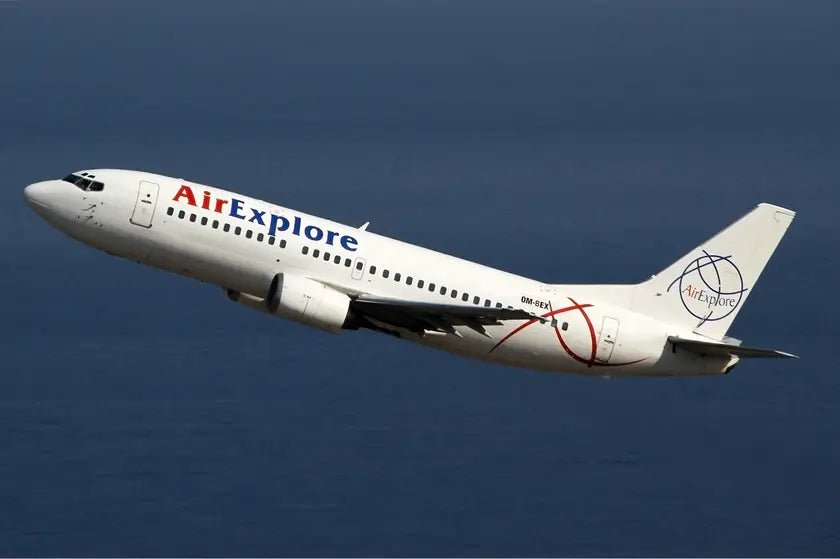
AirExplore is a Slovak Boeing 737-800 operator based at Bratislava Airport (BTS/LZIB), and it is the largest airline registered in Slovakia. It is not a scheduled network carrier, and understanding that distinction is the single most important thing for any pilot evaluating the company. AirExplore sells ACMI capacity: aircraft, crew, maintenance and insurance, supplied under contract to other airlines and tour operators. It flies almost entirely under other companies' commercial brands, on other companies' route networks, on contracts that are frequently seasonal.
The legal entity was registered on 19 August 2008 as SlovExplore, s.r.o., and adopted the AirExplore name in February 2010. The airline itself dates its operational start to 2010, when it received its Slovak Air Operator Certificate and began flying with a single Boeing 737-400. Its first significant ACMI partnership came in 2015 with Ryanair, which helped establish the Bratislava base. Since 2023 it has been wholly owned by Avia Solutions Group, the Lithuanian-founded aviation holding that describes itself as the world's largest ACMI provider.
By the end of 2024 the airline reported cumulative totals of 72,087 flights, 202,211 block hours, more than 9 million passengers carried and close to 30,000 tonnes of cargo moved since freighter operations began in 2022. It has operated across four continents, with disclosed work in Europe, Israel, Palau, Taiwan, Suriname and several African countries, and it holds approval from the US Department of Transportation for commercial operations to the United States. That geographic spread matters directly to pilots, because AirExplore crews follow the contracts rather than a fixed route map.
Financially, the picture is mixed and worth reading carefully. Slovak business register filings show revenue of approximately €117.8 million in 2024, an increase of around 45 percent year on year, but also a net loss of about €11.99 million for that year, against a profit of roughly €3.46 million in 2023. Full-year 2025 statutory accounts were not publicly available at the time of writing. Pilots who want to check the current position themselves can review the filed accounts on the Slovak business data service Finstat, which publishes the company's annual submissions.
Headcount grew from 359 staff in 2023 to 415 in 2024, and the company currently describes itself as having over 400 employees representing 26 nationalities. AirExplore does not publish a separate pilot headcount. With 12 aircraft on the current fleet list and typical crew ratios for a 737 charter and ACMI operation, a realistic estimate would be well under 200 line pilots, but that figure is an inference rather than a published number, and it should be treated as such.
Avia Solutions Group reported preliminary 2025 revenue of €2,189 million, up 4 percent, with adjusted EBITDA of around €350 million and guidance for roughly 10 percent growth in 2026. The group spans well over 200 aircraft and more than 12,000 staff across a large number of subsidiaries. For a pilot, group scale cuts both ways. It provides balance-sheet depth and internal mobility between operators. It also means AirExplore is one operating unit inside a portfolio, and portfolio decisions can be made above the airline's head. In February 2026 the group placed AirExplore and the Lithuanian business-jet operator KlasJet under combined management with integrated back-office and operational structures, while keeping both brands and both AOCs separate. Group chairman Gediminas Žiemelis framed the move as simplification rather than a legal merger, though Lithuanian reporting noted associated staff reductions in Lithuania.
Fleet Composition & Type Rating
AirExplore is a single-type operator. Every aircraft on its current published fleet list is a Boeing 737-800, split between passenger aircraft and converted freighters. There is no Airbus equipment, no regional jet, no widebody and, importantly for anyone assessing long-term equipment quality, no Boeing 737 MAX. No MAX order or delivery commitment has been announced. This is a pure 737NG operation.
For a pilot, single-type simplicity has genuine advantages: one set of standard operating procedures, one recurrent training stream, no fleet-transfer politics, and a logbook that accumulates concentrated 737NG time. The trade-off is equally clear. There is no path to a larger or newer aircraft within the company, and the airframes themselves are mature. The passenger fleet's build years span 2001 to 2010, which puts most of the aircraft in the 16 to 25 year age bracket. These are well-maintained aircraft operated under an IOSA-certified organisation with its own EASA Part 145 approval and CAMO certificate, but they are not new aeroplanes.
| Registration | Variant | Role | Build Year | Joined AirExplore |
|---|---|---|---|---|
| OM-IEX | Boeing 737-800 | Passenger | 2004 | 2016 |
| OM-JEX | Boeing 737-800 | Passenger | 2001 | 2017 |
| OM-KEX | Boeing 737-800 (scimitar winglets) | Passenger | 2004 | 2018 |
| OM-LEX | Boeing 737-800 (scimitar winglets) | Passenger | 2007 | 2019 |
| OM-MEX | Boeing 737-800 | Passenger | 2007 | 2022 |
| OM-NEX | Boeing 737-800 | Passenger | 2010 | 2022 |
| OM-OEX | Boeing 737-800 | Passenger | 2009 | 2024 |
| OM-PEX | Boeing 737-800 | Passenger | 2009 | 2025 |
| OM-EDB | Boeing 737-800BCF | Freighter | 2004 | 2025 |
| OM-EDC | Boeing 737-800SF | Freighter | Not published | Not published |
| OM-EDD | Boeing 737-800SF | Freighter | Not published | Not published |
| OM-EDH | Boeing 737-800SF | Freighter | Not published | Not published |
Registrations and variants taken from the official AirExplore fleet page. Build years are drawn from the airline's individual aircraft pages where published. AirExplore does not publish an official average fleet age.
Passenger cabin configurations vary by airframe. Several aircraft are configured at 189 economy seats, while others carry an 8 business plus 168 economy layout with a maximum certified capacity of 189. This matters less to pilots than to the commercial team, but it does indicate the aircraft are configured to serve both mainstream leisure charter customers and slightly more premium contract work.
Fleet counts reported in the press vary widely and this causes real confusion for candidates. During 2024 the airline's leadership described growth to 16 aircraft, and a May 2025 anniversary release repeated the 16 figure. An October 2025 press release announcing the arrival of OM-PEX described a fleet of nine passenger aircraft and two freighters. The airline's own current fleet page lists 12 aircraft. These are not contradictions so much as snapshots: freighter placements, lease returns and re-registrations move the number around. When assessing recruitment prospects, take the fleet page as the live figure and treat everything else as historical.
Every experienced-pilot vacancy AirExplore has published requires candidates to already hold a valid Boeing 737 type rating. The Captain advert specifies a B737 300-900/IR(A) rating on an EASA ATPL(A). The First Officer advert accepts either an EASA licence with a B737 rating or an ICAO ATPL(A) with a B737 rating subject to validation. There is no publicly documented pathway in which AirExplore funds an unbonded type rating for a direct-entry pilot who is not already rated, and no training bond amount or duration has ever been published. The one exception is the sponsored cadet route covered in section 08, where the type rating is embedded in the training programme. If you are unrated and applying as an experienced pilot, you should assume the rating is your problem to solve.
Four of the twelve aircraft are freighters (one BCF conversion and three SF conversions), and the airline has publicly said it was evaluating adding a further two to five 737-800 freighters, which would take the cargo fleet toward eight aircraft. That was described as an intention rather than a firm order, and the current fleet list does not reflect it. Cargo flying is a materially different lifestyle from passenger charter: more night work, more repetitive sector patterns, and deployments driven by logistics contracts rather than holiday seasons. AirExplore has disclosed at least one African freighter deployment supporting Air Ghana and DHL-related services. Candidates should ask at interview whether the contract on offer is passenger or cargo, because the published adverts do not always distinguish.
Pilot Salary & Compensation Breakdown
AirExplore does not publish a pay scale. There is no collective agreement, no seniority-linked salary ladder in the public domain, and no disclosed per diem schedule or block-hour rate card. What does exist is one concrete published figure from a recent First Officer vacancy, plus a set of regional and sector benchmarks that provide context. Everything below is labelled by source so you can judge its weight.
The one published AirExplore figure
The AirExplore B737NG First Officer advert states a "competitive salary starting from €3,200 gross per month", adding that "the final amount will be determined based on experience and contract type" and, critically, that "this figure includes DB, BH, and PD allowances customary to the aviation sector in the region." That last sentence is the one to read twice. DB, BH and PD stand for duty-based, block-hour and per-diem components. In other words, €3,200 is not a fixed base salary with variable pay on top. It is an all-in entry figure that already absorbs the flying-dependent elements. A month with low utilisation is unlikely to produce meaningfully more, and the fixed floor beneath it is not disclosed.
| Compensation element | AirExplore published position | Notes for candidates |
|---|---|---|
| First Officer entry salary | From €3,200 gross / month | Stated to include duty-based, block-hour and per-diem allowances. |
| Captain salary | Not disclosed | Advert says "competitive salary" only. No figure published in any campaign. |
| Guaranteed minimum / base credit | Not disclosed | No minimum guaranteed hours or salary floor published. |
| Block-hour rate | Not disclosed separately | Bundled into the headline figure per the advert wording. |
| Per diem schedule | Not disclosed separately | No published domestic, European or long-range rates. |
| Overtime / above-threshold pay | Not disclosed | No published threshold or multiplier. |
| Seasonal, retention or command bonus | Not disclosed | No bonus table published in any campaign reviewed. |
| Profit sharing | None published | The airline recorded a net loss in 2024. |
| Instructor (TRI / TRE) premium | Not disclosed | No published instructor pay policy. |
Compiled from AirExplore and Avia Solutions Group recruitment material published between 2023 and 2026. Items marked "not disclosed" were not found in any public source and should be raised directly with the recruitment team.
Regional and sector benchmarks
Because AirExplore publishes so little, the honest approach is to place the one known figure against verifiable external reference points rather than to invent a scale. These are benchmarks for the market AirExplore operates in, not AirExplore pay promises.
| Benchmark | Figure | Source and caveat |
|---|---|---|
| European 737NG ACMI Captain / TRI vacancy ceiling (2026) | Up to €12,500 gross / month | Specialist European pilot recruiter advertisement. An upper limit for a specific role, not a market median. |
| European 737NG ACMI First Officer vacancy ceiling (2026) | Up to €7,130 gross / month | Same recruiter source. Reflects experienced FOs on premium contracts. |
| Slovak "pilot" occupational survey range | €1,452 – €9,930 gross / month | Platy.sk survey covering the middle 80 percent of respondents. Not airline, rank or type specific. |
| Slovak "pilot" survey median at 5 years | ≈ €5,929 gross / month | Same source. Broad occupational category, mixes commercial and non-commercial roles. |
| Slovak airline pilot annual estimate | ≈ €44,720 / year (range €21,380 – €71,020) | Aggregator estimate with unclear methodology. Treat as secondary only. |
| Sister ACMI operator Avion Express, A320 Captain basic | €6,000 – €10,000 / month depending on scale | Published terms and conditions document, 2025. Different airline, different fleet, useful as a group reference. |
| Sister ACMI operator Avion Express, A320 First Officer basic | €3,500 – €5,500 / month depending on scale | Same source. Illustrates the spread between contract tiers inside one ACMI operator. |
External benchmarks only. None of these figures is an AirExplore rate and none should be quoted back to the company as an entitlement.
Gross to net: the Slovak tax reality
If your contract is Slovak and you are insured in Slovakia, the deductions are significant and became heavier under the 2026 consolidation package. Employees pay 9.4 percent social insurance (1.4 percent sickness, 4 percent old-age, 3 percent disability, 1 percent unemployment) plus 5 percent health insurance. Income tax runs on bands of 19, 25, 30 and 35 percent, with the 25 percent band starting above a monthly tax base of roughly €3,665. The tax-free allowance is €497.23 per month and phases out entirely once annual income exceeds approximately €43,983. The social insurance assessment base is capped at €16,764 per month.
| Gross monthly salary | Employee social (9.4%) | Employee health (5%) | Income tax | Estimated net |
|---|---|---|---|---|
| €3,200 | €300.80 | €160.00 | ≈ €427 | ≈ €2,312 |
| €8,000 | €752.00 | €400.00 | ≈ €1,613 | ≈ €5,235 |
Estimates based on Slovak 2026 payroll rules as summarised by Slovak tax advisory publications. Assumes standard employment, no dependants, no additional deductions. Employer contributions (24.4 percent social, 0.8 percent accident, 11 percent health) sit on top of gross and do not affect take-home.
The practical translation: an entry First Officer on the published minimum takes home roughly €2,300 per month net if taxed in Slovakia. Bratislava living costs are well below Western European hub cities, which softens that figure, but it remains modest by European airline standards and is roughly comparable to the lower contract tier at sister operator Avion Express. Pilots posted to another EU country under an A1 certificate may have a different social security and tax position, and that should be confirmed in writing before signing.
AirExplore has never published a Captain pay figure. Any specific Captain salary you encounter online for this airline is an inference, a recruiter estimate or a single unverified report, and this article deliberately does not present one. The €3,200 First Officer figure is directly quoted from an AirExplore vacancy and is the only company-published number available. Before accepting an offer, get the following in writing: the fixed guaranteed monthly amount, what triggers the variable portion, whether per diems are separate or absorbed, the currency and country of payment, your tax residency and social security state, and whether the contract is permanent employment or something else. Compensation at ACMI operators varies substantially by contract tier, and the headline advert figure is a starting point for negotiation rather than a scale.
Roster, Duty Limits & Quality of Life
This is the section where AirExplore is least transparent, and where the gap between what candidates want to know and what is publicly available is widest. AirExplore publishes no roster pattern. No 5/2, no 6/3, no 15/13, no 21/10, no 28/14. No guaranteed days off above the legal minimum. No roster publication date, no roster change notice period, no reserve or standby rules. None of it is in the public domain, and this article will not invent it.
What can be established is the regulatory framework AirExplore must roster within, plus the operational shape of the job as described in its own vacancy adverts. Both are informative.
The EASA framework that bounds your month
As an EASA operator, AirExplore rosters under the flight time limitation rules in Regulation (EU) 965/2012, published and maintained by the European Union Aviation Safety Agency. These are hard ceilings rather than targets, but they define the outer edge of what a demanding ACMI summer can look like.
The seven-days-free-per-month figure is the one candidates most often misread. It is an EU legal floor for mobile workers in civil aviation, not an indication of what AirExplore actually rosters. A well-run operator will give considerably more. A stretched summer contract might sit closer to the floor. Without a published roster or a collective agreement, there is no way to verify which applies here, and asking directly in interview is the only reliable route.
Slovak annual leave provides a firmer anchor. The Labour Code sets a minimum of four weeks, rising to five weeks for employees who reach the age of 33 during the calendar year or who permanently care for a child. This is a statutory entitlement for anyone on a Slovak employment contract, and AirExplore's advertised Captain role is explicitly permanent full-time employment, which means these protections apply. That is a genuinely meaningful point in the airline's favour compared with agency and self-employed arrangements common elsewhere in the ACMI sector.
The shape of the job as described by the airline
AirExplore's Captain vacancy names Bratislava as the contractual home base but states that deployment bases may include Israel (Tel Aviv), Palau and various European locations. The airline undertakes to arrange and pay for tickets from the assigned deployment base back to the contractual home base. That single sentence tells you most of what you need to know about the lifestyle: you are contractually attached to Bratislava, but your actual flying may be based somewhere else entirely for the duration of a contract, and the company moves you between the two.
Recent deployment history illustrates the pattern. In summer 2024 four AirExplore 737-800s flew for Enter Air, with two based at Katowice, one at Wrocław and one at Poznań. For summer 2026, AirExplore has contracted two 189-seat 737-800s to Enter Air based at Katowice from 1 May to 31 October 2026. Freighter deployments have reached West Africa. This is not commuting from a stable base to a stable route network. It is contract-following, with base assignment set by where the customer needs capacity.
Most airline profiles include a four-week roster grid. This one does not, because AirExplore publishes no roster pattern, no guaranteed days off figure and no example month, and no verifiable crew-sourced pattern was found in any public source. Producing a plausible-looking grid would mean inventing it. The absence itself is the finding: at an ACMI operator whose deployments change with each contract season, roster predictability is genuinely lower than at a scheduled carrier, and the company's own recruitment material does not commit to a pattern. Treat any website that shows you a specific AirExplore roster pattern with scepticism unless it cites a named source.
Bratislava is a small, affordable Central European capital roughly an hour from Vienna by road, with Vienna International Airport a practical commuting gateway for pilots living elsewhere in Europe. Cost of living is well below Paris, London or Amsterdam, which materially improves what a €2,300 net monthly salary buys. Bratislava Airport itself is a modest operation, which means short commutes and light traffic on report. The counterweight is that being nominally Bratislava-based does not guarantee you will spend much of the year there. Candidates with families who need geographic stability should weigh the deployment clause carefully, and should ask specifically about the maximum duration of a single away-base assignment and how frequently home-base rotations are provided.
Benefits, Insurance & Social Protection
AirExplore's benefits package is functional rather than generous. It covers the practical costs of being deployed away from home and provides the statutory Slovak social protections that come with permanent employment. What it does not include, at least publicly, are the retirement, loss-of-licence and staff-travel benefits that pilots at legacy carriers take for granted.
No public AirExplore source describes a loss-of-licence benefit, a disability scheme or life cover beyond statutory social insurance and duty travel insurance. This is a substantive difference from legacy carriers, where a dedicated aircrew fund or a negotiated group policy is standard. It is also the single most consequential benefit a professional pilot can lack. If AirExplore does not provide one, arrange private loss-of-licence cover independently and budget for it out of net salary. Ask the question explicitly at offer stage and get the answer in writing, including the sum insured and whether the cover follows you during overseas deployments.
If you hold a Slovak contract but are deployed to a base in another EU state for an extended period, your social security position is governed by EU coordination rules and normally documented by an A1 certificate. The European Cockpit Association has repeatedly flagged that posted-crew arrangements in the wet-lease sector can affect remuneration, working time treatment and which state's social security applies, and that pilots are frequently unclear on their own status. Before a deployment starts, confirm in writing which country you are insured in, who issues your A1, and whether host-state posting rules alter your pay or duty entitlements. This is administrative housekeeping that becomes very expensive to fix retrospectively.
Career Progression & Command Upgrade
AirExplore operates no published seniority system. There is no seniority list, no bidding structure, no published base-award mechanism and no documented order of upgrade. This is normal for a small ACMI operator and it is neither inherently good nor bad, but it changes how you should think about career planning entirely. At a legacy carrier, your progression is a function of your number. Here, it is a function of vacancies, performance, training capacity and timing.
The airline does accept direct-entry Captains, and has advertised permanent full-time B737NG Captain positions. That is a significant structural difference from carriers that upgrade exclusively from within, and it cuts both ways for First Officers. It means an experienced 737 commander can join straight into the left seat. It also means internal First Officers compete with the external market for command slots rather than holding a protected queue position.
| Career step | Published AirExplore position | What this means in practice |
|---|---|---|
| Entry as First Officer (experienced) | 500 hours on type required | Not a first-job entry point unless via the cadet programme. You need existing 737 line experience. |
| Entry as First Officer (cadet) | Pilot Runway MPL, ~24 months | Sponsored route with a secured FO position on graduation. Covered in section 08. |
| Internal upgrade to Captain | No published policy | No minimum company service, assessment standard or guaranteed timeline is public. |
| Direct-entry Captain | Accepted, actively recruited | 3,000 total hours, 1,500 multi-pilot, 500 PIC on B737 300-900. |
| Instructor progression (TRI / TRE / LTC) | No published policy | No selection criteria or pay premium published. |
| Seniority list | None published | Base and route assignment appear to be management-allocated. |
| Group mobility | Not formalised publicly | Avia Solutions Group operates multiple AOCs, but no published internal transfer scheme exists. |
Compiled from AirExplore recruitment publications 2023 to 2026. "No published policy" means no public source was found, not that no internal policy exists.
The arithmetic of command at a twelve-aircraft operator deserves blunt treatment. A fleet of that size supports a limited number of command positions, and those positions turn over slowly unless the fleet grows. Anyone who tells you AirExplore delivers a two-year or three-year upgrade is speculating: no AirExplore command timeline has ever been published, and none can be verified. Realistically, upgrade prospects here depend on whether the freighter expansion the company has discussed actually materialises, whether passenger contracts grow, and whether the direct-entry Captain pipeline is filling those seats before internal First Officers reach eligibility.
Where AirExplore does deliver clear career value is hour building on a mainstream type. A First Officer here accumulates Boeing 737NG line hours across varied European, Middle Eastern, African and occasional long-range operations, in an IOSA-certified organisation with US DOT operating approval. That logbook travels extremely well. Many European operators, from low-cost carriers to other ACMI providers to national charter airlines, hire directly off exactly that profile. Reading the company as a career springboard rather than a career destination is the more realistic frame, and it is a legitimate one.
The European ACMI market remains active. AirExplore renewed its Enter Air relationship for summer 2026 and continues to place freighters on cargo contracts. However, the collapse of the much larger SmartLynx operation in November 2025, and the February 2026 combination of AirExplore's management with KlasJet under Avia Solutions Group, both indicate a period of consolidation rather than expansion inside the group. At the time of writing, the Avia Solutions Group careers portal listed no open AirExplore pilot vacancies, with recruitment appearing to run in periodic campaigns rather than continuously. Candidates should monitor the AirExplore careers page rather than assume rolling recruitment.
Recruitment Process & Requirements
AirExplore recruits through two routes: experienced type-rated pilots hired into either seat, and ab initio cadets through the sponsored Pilot Runway programme. Vacancies are routed through the Avia Solutions Group careers portal, and historic campaigns have also invited direct applications to the company recruitment address. Recruitment is campaign-based, so absence of a live vacancy does not mean the airline has stopped hiring.
B737NG Captain, published requirements
B737NG First Officer, published requirements
The ICAO ATPL validation route in the First Officer advert is worth noting, because it is unusually open for a European operator. It creates a theoretical pathway for non-EASA licence holders, but it is conditional on validation and does not remove the EU right-to-work requirement. Without unrestricted EU work rights, a non-EU pilot cannot proceed regardless of licence quality, and AirExplore publishes no visa sponsorship pathway.
Selection stages for experienced pilots
Application & document screening
Applications are submitted through the Avia Solutions Group careers portal or, in historic campaigns, directly to the AirExplore recruitment address. Licence, medical, ELP certificate, logbook summary and proof of EU work rights are checked against the advertised minima. Applicants who do not hold a current 737 rating are generally filtered here.
Theoretical testing
The Captain campaign describes a screening phase that includes theoretical testing. Expect aircraft systems, performance, operational procedures and general technical knowledge relevant to the 737NG, alongside standard aviation general knowledge. AirExplore has not published the format, duration or pass mark.
Interview
A structured interview forms part of the same screening phase. Given the deployment-driven nature of the operation, candidates should be prepared for questions on mobility, willingness to be based abroad for extended periods, adaptability to different customer procedures, and experience operating into non-standard or challenging airfields.
Simulator evaluation
A simulator assessment completes the screening phase. Handling, instrument flying, non-normal management and multi-crew cooperation are the standard assessment areas for a 737NG evaluation of this kind. The specific profile, simulator location and whether a briefing pack is issued in advance have not been published.
Operator Conversion Course & OPC
The Captain advert states that the contract commences following a successful Operator Proficiency Check completed within the Operator Conversion Course. This is an important contractual detail: the employment relationship formally begins after the OPC is passed, not on the first day of the conversion course. Candidates should clarify what they are paid during the conversion period and what happens contractually if the OPC is not passed first time.
Three points distinguish this selection from a scheduled-carrier assessment. First, demonstrate genuine mobility. The airline is explicitly recruiting for a role that may place you in Tel Aviv, Palau or a Polish regional base, and hesitancy on that point is a realistic disqualifier. Second, prepare for procedural flexibility. ACMI crews operate under the customer's commercial requirements while remaining under AirExplore's AOC and operating procedures, so evidence that you can adapt without drifting from SOP is valuable. Third, get your paperwork genuinely current before applying: EASA licence, Class 1, ELP certificate with the correct level, yellow fever vaccination, and unambiguous proof of EU work rights. Small operators run lean recruitment teams and incomplete files stall.
No AirExplore recruitment material reviewed for this article advertises a pay-to-fly line training scheme, and no self-funded line training product was found. Equally, no training bond amount or duration has ever been published for experienced hires. That silence is not evidence of absence. Before signing, ask directly whether any bond applies to the operator conversion course, what the repayment schedule and trigger events are, and whether the bond survives a company-initiated termination or the end of a customer contract.
The Pilot Runway Cadet Programme
AirExplore's most notable feature for aspiring pilots is that it runs a genuine sponsored ab initio pathway, which is unusual for an operator of its size. The programme is delivered through Pilot Runway, the airline cadet framework operated by BAA Training, and it leads to a Multi-Crew Pilot Licence with a secured First Officer position at AirExplore on successful graduation.
This is a competency-based MPL programme of approximately 24 months. Unlike a modular ATPL, an MPL is designed from the outset around multi-crew airline operations and is structured around the nine ICAO core competencies rather than a set of discrete flight tests. It is also, by regulatory design, tied to a specific operator: an MPL is not a freely portable licence in the way a frozen ATPL is, which is the central trade-off candidates need to weigh.
| Programme phase | Content | Environment |
|---|---|---|
| ATPL theory | Air law, aircraft systems, navigation, meteorology, operational procedures, principles of flight, human factors, emergency procedures | Classroom / academy |
| Ab initio flying | VFR and night VFR on single-engine piston aircraft | Flight school, BAA Training locations |
| Instrument phase | IFR training on FNPT simulators | Simulator |
| B737 type rating | Classroom theory plus Boeing 737 FNPT and simulator training | Training academy |
| Base training | Circuits and landings on the actual Boeing 737 aircraft | Live aircraft at an airport |
| Line training / LIFUS | Line flying under supervision in normal AirExplore operations | Revenue flights |
Programme structure as published by Pilot Runway and BAA Training. BAA Training delivers across multiple locations including Spain, Lithuania, France and Vietnam.
Entry requirements and selection
Selection runs through a first consultation with an assigned personal manager, a medical check and document screening, an assessment battery covering personality profiling, English, cognitive ability, logic, multitasking, reaction speed, mathematics and physics, and finally interviews with a psychologist review before a selection committee decision. Candidates seeking financing may also have their credit history examined.
Pilot Runway states that the training fee "is no longer a barrier" and that candidates may either self-fund or apply for a financing solution from AirExplore, described by BAA Training as an airline loan covering the majority of training costs. What is not published anywhere is the actual price of the programme, the interest rate, the repayment period, the security required, the training bond length, or what happens if a cadet fails a phase, loses their Class 1 medical mid-course, or leaves voluntarily. The job guarantee is also explicitly conditional on successful selection, completion and graduation. These are large financial commitments and the terms should be obtained in full, in writing, and ideally reviewed independently before signing anything. Do not treat "financing available" as equivalent to "risk removed."
An MPL delivers you to a right-hand seat faster and with a training syllabus purpose-built for airline flying, and the AirExplore route attaches a conditional job to that. The cost is portability. An MPL restricts you to multi-pilot operations and is tied to the operator you trained for, so if the airline changes course, loses contracts or your employment ends early, converting to a full ATPL involves additional requirements. A frozen ATPL costs more up front in job uncertainty but leaves you free to apply anywhere. Given that AirExplore recorded a net loss in 2024 and its parent group has recently consolidated operations, candidates should weigh the operator-tied nature of an MPL against that context rather than treating the job guarantee as unconditional security.
Deployment Bases & Wet-Lease Life
A scheduled carrier profile would normally list layover destinations here. That framing does not fit AirExplore. As an ACMI operator flying short and medium-haul 737-800 sectors under other airlines' brands, the relevant question is not "where do you night-stop" but "where will you be based, for how long, and flying for whom." The cards below cover the deployment locations AirExplore has publicly disclosed or confirmed through contract announcements.
Three practical realities define this job. First, you fly under AirExplore's AOC and operating procedures while serving another airline's commercial schedule, so you carry your own SOPs into someone else's operation. Second, contract seasonality drives everything: a summer contract from May to October has a defined end date, and where you go afterwards depends on the next contract. Third, hotel accommodation is provided during duty periods and positioning back to Bratislava is company-arranged and paid, but the frequency of home rotation is not published and varies by contract. Pilots who value novelty, varied airfields and international exposure tend to thrive here. Pilots who need a predictable school-run and a fixed base will find it difficult, and should be honest with themselves about that before applying.
How AirExplore Compares: Airline Radar Chart
The right comparators for AirExplore are not flag carriers. They are the operators a Central European 737 pilot would realistically weigh against it: Avion Express, the larger Airbus A320-family ACMI operator inside the same Avia Solutions Group, and Enter Air, the Polish Boeing 737 charter airline that is simultaneously AirExplore's largest disclosed customer and its most direct alternative employer. Scores are editorial estimates built from the research in this article and the equivalent published data for each comparator.
| Metric | AirExplore | Avion Express | Enter Air |
|---|---|---|---|
| Business model | B737-800 ACMI & charter | A320-family ACMI | B737 charter for tour operators |
| Fleet | 12 (8 pax, 4 freight) | A320 family, all-Airbus | 34 (24 × 737-800, 10 × 737 MAX 8) |
| Newest-generation aircraft | None (all 737NG) | None published (A320ceo) | Yes (737 MAX 8) |
| Published pay scale | FO from €3,200 gross only | Yes, Captain and FO scales published | Not published |
| Published roster pattern | None | Yes: 20/8 Europe, 30/15 and 33/13 outside Europe | Not published |
| Direct-entry Captain | Yes | Yes, with €10,000 joining bonus advertised | Not published |
| Ownership | Avia Solutions Group | Avia Solutions Group | Listed on the Warsaw Stock Exchange |
| Latest disclosed result | Net loss €11.99m (2024) | Not separately published | Profitable, quarterly reporting |
| Union / CBA | None publicly identified | None publicly identified | None publicly verified |
Compiled from company publications, recruitment material and financial disclosures current to mid-2026. "Not published" indicates no public source was located.
Key takeaways from the comparison
Avion Express wins on transparency, which is a real benefit. Its careers material publishes actual roster options (20 days on with 8 off in Europe, 30 on with 15 off outside Europe from April to October, 33 on with 13 off outside Europe from November to March) and its 2025 terms document sets out Captain, Senior First Officer and First Officer basic pay across contract tiers, with estimated annual income above €117,000 for Captains and above €67,000 for First Officers on the upper scale. Whether or not those numbers appeal, knowing them before you apply is worth something. AirExplore publishes neither.
Enter Air offers the better structural position. It is a Warsaw Stock Exchange listed company reporting quarterly results, operating 34 aircraft including ten Boeing 737 MAX 8, with an established Polish charter franchise and its own commercial relationships rather than dependence on other carriers' contracts. For a 737 pilot in Central Europe, it represents a more conventional and more stable employment proposition. Its pilot pay scales, roster patterns and command policy are not publicly documented either, so verification is still required, but the underlying business is demonstrably stronger.
AirExplore's advantage is accessibility and type concentration. A 500-hour 737 First Officer can realistically be hired here. The airline runs a genuine sponsored ab initio route, which neither comparator advertises in the same form. It flies a single mainstream type across a geographically varied portfolio, which builds a distinctive logbook quickly. For a pilot at an early stage who values getting airborne on a 737NG over maximising immediate compensation and predictability, that is a legitimate proposition.
Job security is the weakest column across the ACMI comparison, and AirExplore sits at the lower end. The 2024 net loss, the twelve-aircraft scale, the seasonal contract dependence and the November 2025 collapse of the group's much larger SmartLynx operation all point the same way. Enter Air's profitability and listed-company disclosure regime put it in a different category.
Scores are editorial estimates on a common five-axis scale, built from published company material, recruitment advertisements, financial filings, EASA regulation, Slovak payroll rules and European Cockpit Association research. They are not survey results and no pilot testimonials were used, because none could be independently verified. Two of the three airlines publish no Captain pay scale, so salary scoring relies partly on the recruitment figures each company does disclose and on sector benchmarks. Individual experience will vary substantially by contract tier, deployment and timing. Scores will be revised as dedicated guides for Avion Express and Enter Air are published.
Union & Industrial Relations
There is no publicly identified pilot trade union at AirExplore and no collective agreement in the public domain. There is no recorded pilot strike, no known works council pay negotiation and no published grievance mechanism specific to the airline's flight crew. For pilots coming from a unionised environment, this is the most significant cultural difference and it deserves a clear-eyed assessment rather than either alarm or dismissal.
The Slovak representation landscape
The Slovak Association of Transport and Commercial Pilots (SATCP) was established during the COVID-19 pandemic and describes itself as an association supporting Slovak airlines and professional flight and ground personnel through education, advocacy and cooperation. Its own material presents it as a professional association rather than a trade union, and it does not appear in European Cockpit Association member listings. It is a useful professional network and a voice in Slovak aviation policy, but it is not a collective bargaining body for AirExplore pilots and should not be relied upon as one.
The ACMI labour debate, and where AirExplore actually sits
European ACMI employment has become one of the most contested areas of aviation labour policy, and any pilot considering this sector should understand the argument. The European Cockpit Association has campaigned for years against wet-lease providers that engage crew through staffing agencies or ostensible self-employment structures rather than direct employment, arguing that this avoids employer social contributions and weakens safety reporting. Its position is that where a pilot works under an airline's subordination and control, that is employment regardless of how the payment is structured.
In June 2026, Reuters reported that ECA planned to formally call on European regulators to close this loophole. The report cited a Ghent University study finding that nearly 14 percent of more than 4,000 surveyed pilots were not directly employed by an airline, and that 65 percent of that atypically employed group worked for ACMI operators. Those pilots reported poorer mental health, greater job insecurity and reduced willingness to report fatigue, which is a safety issue as much as a labour one.
Here is the important nuance for AirExplore specifically: the airline's own published Captain vacancy specifies permanent, full-time employment, and its First Officer material describes company benefits consistent with direct employment rather than an agency or contractor structure. That places AirExplore on the better side of the ECA critique on the central question. No AirExplore freelance or agency pilot contract has been verified in public sources. General criticism of the ACMI sector should not be reflexively applied to this operator, and this article does not do so. Equally, the First Officer advert's reference to the final amount depending on "experience and contract type" indicates that more than one contract structure exists, and candidates should establish exactly which one they are being offered.
Sector events that shape the risk picture
SmartLynx is not AirExplore. It operated a different AOC, a different fleet and a substantially different employment model, and it had been sold out of Avia Solutions Group before it failed. Nothing in the public record indicates AirExplore uses the outsourced crewing contracts Reuters reviewed in that case. But the episode is directly relevant risk information for anyone joining an ACMI operator inside a large aviation holding: it demonstrated how quickly a subsidiary can be divested and wound down, how intra-group debt can accumulate inside one entity, and how exposed crew can be when it happens. The practical response is not to avoid the sector. It is to read your contract carefully, verify your employer of record, understand your notice and severance position, confirm your social security state, and maintain independent loss-of-licence cover and financial reserves.
Without a union or a collective agreement, your terms are whatever your individual contract says, and there is no negotiated scale to fall back on and no representative body to escalate a dispute through. That places the burden of due diligence entirely on you. Read every clause on bonding, notice, base assignment, contract-end provisions and pay composition. Ask for the fixed guaranteed element in writing. Confirm the country of employment and tax residency. Join a professional pilot association for independent advice and legal support even where it holds no bargaining mandate. And keep your own records of duty, rest and pay, because at an operator without a union, your documentation is your only evidence.
Verdict: Who Is AirExplore For?
🎯 Our Take
AirExplore is a competent, IOSA-certified, US DOT approved Boeing 737-800 operator that has run continuously since 2010 and grown into Slovakia's largest airline. It offers something genuinely valuable and increasingly rare: an accessible entry point onto a mainstream jet type, with a published First Officer minimum of 500 hours on the 737, permanent employment contracts, and a real sponsored ab initio pathway through Pilot Runway. For a pilot whose priority is accumulating 737NG line hours in a varied international operation, it does the job.
The trade-offs are substantial and should not be minimised. Compensation is modest, with a published First Officer entry of €3,200 gross per month that already absorbs duty, block-hour and per-diem allowances, translating to roughly €2,300 net under Slovak 2026 payroll rules. No Captain pay figure has ever been published. There is no roster pattern in the public domain, no guaranteed days off above the EU legal floor, no seniority system, no published command timeline, no loss-of-licence benefit, no supplementary pension and no union or collective agreement. Deployment can place you in Tel Aviv, Palau or a Polish regional base for the duration of a contract. The fleet is twelve mature 737NGs with no MAX and no widebody, so there is no equipment progression within the company. The airline recorded a net loss of €11.99 million in 2024, and its parent group's much larger SmartLynx operation collapsed in November 2025.
Read correctly, AirExplore is a career step rather than a career. It is a place to build hours, gain international operating experience, and move on with a logbook that opens doors across the European market. Pilots who understand it in those terms tend to get value from it. Pilots expecting legacy-carrier stability, transparency and protection will be disappointed, because the airline has never claimed to offer them.
1 How much does an AirExplore pilot actually earn?
The only figure AirExplore has published is a First Officer salary "starting from €3,200 gross per month", and the advert explicitly states that this includes duty-based, block-hour and per-diem allowances. Under Slovak 2026 payroll rules that equates to roughly €2,312 net per month. No Captain salary has ever been published by the airline in any campaign. For context, a European recruiter advertised EASA 737NG ACMI Captain and TRI positions at up to €12,500 gross per month in 2026, and First Officer roles at up to €7,130, but those are vacancy ceilings elsewhere in the market and not AirExplore rates. Any specific AirExplore Captain figure you find online is an estimate, not a company disclosure.
2 Does AirExplore pay for the Boeing 737 type rating?
Not for experienced hires. Every published Captain and First Officer vacancy requires candidates to already hold a valid Boeing 737 type rating, either on an EASA licence or on an ICAO ATPL(A) subject to validation. There is no public evidence of AirExplore funding an unbonded type rating for a direct-entry pilot who arrives unrated, and no training bond terms have ever been published. The exception is the Pilot Runway cadet programme, where the 737 type rating is built into the 24-month MPL syllabus and may be covered by an airline financing arrangement, the terms of which are not published.
3 What roster pattern does AirExplore fly?
AirExplore publishes no roster pattern, and none could be verified from any public source. There is no confirmed 5/2, 6/3, 15/13, 21/10 or 28/14 rotation, and no published figure for guaranteed days off. What is known is the legal framework: EASA flight time limitations cap duty at 60 hours per 7 days, 110 per 14 days and 190 per 28 days, and flight time at 100 hours per 28 days, 900 per calendar year and 1,000 per 12 consecutive months. EU rules require a minimum of 7 local days free of duty per calendar month and 96 per year. That is the floor, not the airline's actual practice. This is a specific question to raise directly at interview, and to get answered in writing.
4 Will I actually be based in Bratislava?
Contractually yes, operationally perhaps not. AirExplore's Captain vacancy names Bratislava as the contractual home base but states that deployment bases may include Israel (Tel Aviv), Palau and various European locations. The company arranges and pays for tickets from the assigned deployment base back to the contractual home base, but the frequency of those rotations is not published. Recent deployments have placed aircraft and crews at Katowice, Wrocław and Poznań for Enter Air, and freighters into West African cargo networks. If a stable physical base matters to you, treat this as the single most important clause in the contract.
5 Does AirExplore accept direct-entry Captains, and how long is the upgrade?
Yes, AirExplore actively recruits direct-entry B737NG Captains on permanent full-time contracts, with published minima of 3,000 total hours, 1,500 multi-pilot hours and 500 hours PIC on the Boeing 737-300 to -900, plus an EASA ATPL(A), valid 737 rating, Class 1 medical and ICAO English Level 5. There is no published internal upgrade policy, no minimum company service requirement, no seniority list and no published command timeline. With twelve aircraft, command positions are limited and turnover depends on fleet growth and the rate at which direct-entry Captains fill vacancies. Any specific upgrade timeline quoted for this airline is speculation.
6 Can non-EU pilots apply?
Only if they already hold unrestricted legal right to live and work in the European Union. Every AirExplore pilot vacancy reviewed states this requirement explicitly, and the cadet programme requires EU citizenship or equivalent unrestricted rights. AirExplore publishes no visa sponsorship or work permit pathway. The First Officer advert does accept an ICAO ATPL(A) with a 737 rating subject to validation, which helps pilots holding non-EASA licences, but that provision addresses licensing only and does not substitute for work authorisation.
7 Is AirExplore financially stable, and should the SmartLynx collapse worry me?
AirExplore has operated continuously since 2010 and is backed by Avia Solutions Group, which reported preliminary 2025 revenue of €2,189 million. However, AirExplore itself recorded a net loss of approximately €11.99 million on revenue of €117.8 million in 2024, against a small profit the year before, and full-year 2025 accounts were not publicly filed at the time of writing. SmartLynx was a different airline with a different AOC and employment model, and it had already been divested from Avia Solutions Group before ceasing operations on 24 November 2025, leaving over 1,200 staff affected and some unpaid. Nothing links that outcome to AirExplore's contracts. It is nonetheless legitimate context on how quickly a subsidiary in this sector can be restructured, and it justifies careful contract review rather than avoidance.
8 Is there a union or collective agreement at AirExplore?
No recognised pilot trade union and no collective agreement have been publicly identified at AirExplore. The Slovak Association of Transport and Commercial Pilots exists as a professional association rather than a bargaining body, and does not appear in European Cockpit Association member listings. Your terms are therefore governed by your individual contract plus the Slovak Labour Code, which provides statutory minimums including four weeks annual leave rising to five from the year you turn 33. On the positive side, AirExplore's published Captain vacancy specifies permanent full-time employment rather than the agency or self-employment structures the European Cockpit Association has criticised elsewhere in the ACMI sector.
9 Is the Pilot Runway cadet programme a good way in?
It is a real, structured 24-month competency-based MPL programme delivered with BAA Training, covering ATPL theory, ab initio flying, the Boeing 737 type rating, base training and line training, with a First Officer position at AirExplore secured on successful graduation. That is a legitimate offer and few operators of this size provide one. The caution is on the terms that are not published: the programme price, the interest rate and repayment period of the AirExplore financing option, any bond length, and what happens if you fail a phase, lose your Class 1 medical or leave early. The job guarantee is explicitly conditional on successful selection, completion and graduation. An MPL is also tied to multi-pilot operations and to the sponsoring operator, so it is less portable than a frozen ATPL. Get the full terms in writing and have them reviewed independently.
Official Links & Resources
Because AirExplore publishes so little on pilot terms, verification matters more here than at a carrier with an open collective agreement. These are the primary sources used for this article and the places to check before applying or accepting an offer:
For an operator with no published pay scale, no roster pattern and no collective agreement, the interview is not just a selection event, it is your only opportunity to establish terms. Go in with a written list: fixed guaranteed monthly amount versus variable, per diem treatment, roster pattern and days off, roster publication and change notice, maximum single deployment duration and home rotation frequency, loss-of-licence provision, notice period on both sides, any training bond, employer of record, and country of tax and social security. Ask for the answers in the written offer rather than verbally. Then cross-check the airline's financial filings on Finstat and its live fleet page before you sign.
- 01Overview & Company Profile
- 02Fleet & Type Rating
- 03Salary & Compensation
- 04Roster & Quality of Life
- 05Benefits & Social Protection
- 06Career Progression
- 07Recruitment & Requirements
- 08Cadet Programme
- 09Deployment Bases
- 10Airline Comparison
- 11Union & Industrial Relations
- 12Verdict & FAQ
- 13Links & Resources