

Air Arabia Egypt Overview & Company Profile
Air Arabia Egypt (IATA E5, ICAO RBG, callsign AIR ARABIA) is an Egyptian low-cost carrier operating under its own Egyptian Air Operator Certificate while using the commercial platform, brand, distribution systems and operating model of the Sharjah-based Air Arabia Group. It is one of six operating hubs in a group that describes itself as the first and largest low-cost carrier operator in the Middle East and North Africa.
The joint venture was announced on 9 September 2009 by Air Arabia PJSC and Egypt's Travco Group. The company received its Egyptian operating licence on 22 May 2010 and began commercial services on 1 June 2010. Travco announced the sale of its entire 50% interest in 2016, so descriptions still naming Travco as the Egyptian shareholder are out of date. According to Air Arabia PJSC's 2025 annual reporting, the parent's stake in the Egyptian company rose from 40% to 49%. The identity and split of the Egyptian shareholders holding the remaining 51% are not publicly disclosed in the group's reporting.
That ownership structure matters for a pilot evaluating the airline. Air Arabia Egypt is not a wholly owned subsidiary of a large Gulf carrier. It is a minority-owned, locally controlled associate that trades under a strong regional brand. Employment is Egyptian, the AOC is Egyptian, the licences are Egyptian, and the contract is governed by Egyptian labour law rather than by UAE terms.
The airline's registered address is at Florida Mall, Sheraton Al Matar, Cairo, and Air Arabia's own company information page names Emad Salem as General Manager. Air Arabia's press room describes the operator as "an Alexandria-based Air Arabia Group company," reflecting that its formally identified Egyptian hub is Borg El Arab International Airport (HBE) serving Alexandria. Cairo International Airport (CAI) is nonetheless a major origin for E5 services and has been advertised as the base location for at least one Air Arabia Egypt captain vacancy, so it should be treated as an active operational and crew location.
Air Arabia Egypt does not publish its employee count, pilot headcount, passenger numbers or financial results separately. Everything published at company level is consolidated into Air Arabia PJSC's group reporting. For the 2025 financial year, the group reported revenue of AED 7.79 billion, net profit before tax of AED 1.83 billion, net profit after tax of AED 1.63 billion, 21.8 million passengers and a 85% load factor. In the first quarter of 2026 the group reported AED 1.8 billion in revenue, AED 278 million net profit, 4.7 million passengers and a load factor of around 86%. On the people side, Air Arabia's group careers portal refers to "over 1,200 pilots across our multi-hub network," while the group's 2025 sustainability disclosure reported 1,582 pilots among 5,686 aviation professionals. The two figures have different scopes and should not be added together.
Where Air Arabia Egypt sits inside the group
Understanding the group structure is essential, because Air Arabia's recruitment marketing sells mobility across the network. The parent company holds different stakes in each operating company, and each one hires under its own local jurisdiction.
| Operating company | Air Arabia PJSC interest | Base | Employment jurisdiction |
|---|---|---|---|
| Air Arabia PJSC (G9) | Parent / listed company | Sharjah, Ras Al Khaimah | UAE |
| Air Arabia Abu Dhabi (3L) | 49% | Zayed International (AUH) | UAE (Etihad Aviation Group holds 51%) |
| Air Arabia Maroc (3O) | 44.13% | Casablanca and Moroccan bases | Morocco |
| Air Arabia Egypt (E5) | 49% | Borg El Arab (HBE), Cairo (CAI) | Egypt |
| Fly Jinnah (9P) | 45% | Karachi and Pakistani bases | Pakistan |
Shareholdings as disclosed in Air Arabia PJSC reporting for the year ended 31 December 2025. Fly Jinnah operates under Pakistani rules limiting foreign equity and requiring local control.
Air Arabia Egypt publishes no pilot pay scale, no roster agreement, no seniority list and no crew headcount. This is normal for a small privately held Egyptian operator, but it means a candidate cannot benchmark the offer before applying. Every figure in this guide that comes from Air Arabia's UAE, Saudi, Moroccan or Pakistani operations is labelled as such, because those are separate legal employers with separate pay structures and separate tax treatment. The only reliable source for Egyptian terms is the offer letter itself.
Fleet Composition & Type Ratings
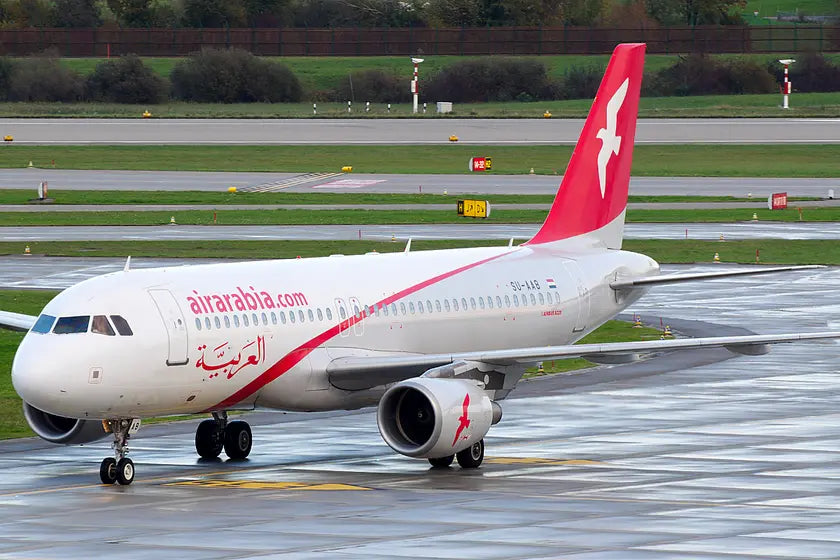
Air Arabia Egypt operates a single-type, four-aircraft fleet of Airbus A320-200s in a single-class, high-density configuration. Air Arabia's group results presentation for the first quarter of 2026 confirms four aircraft allocated to the Egyptian hub out of 90 across the group. The aircraft carry Egyptian SU- registrations and are leased from within the Air Arabia group rather than owned locally.
For a pilot, the practical consequence is straightforward. This is a pure Airbus narrowbody operation with no fleet choice, no type transition to bid for, and a very small local aircraft pool. It also means an unusually consistent operating environment: one type, one set of standard operating procedures, one training footprint, and a cockpit that is directly interchangeable with the rest of the Air Arabia group's A320 family.
| Registration | Exact type | MSN | Build year | Joined Air Arabia Egypt |
|---|---|---|---|---|
| SU-AAD | Airbus A320-214 | 4890 | 2011 | December 2017 |
| SU-AAE | Airbus A320-214 | 4958 | 2011 | November 2018 |
| SU-AAF | Airbus A320-214 Sharklet | 6444 | 2015 (first flight January 2015) | November 2019 |
| SU-AAI | Airbus A320-214 Sharklet | 6782 | 2015 | December 2022 |
Registrations, manufacturer serial numbers and current RBG operator status are reflected in the Middle East Regional Monitoring Agency RVSM approval list. Aircraft ages sit in the roughly 11 to 15 year band as of mid-2026.
No new-generation aircraft in Egypt yet
Air Arabia PJSC placed an order for 120 Airbus A320 family aircraft at the 2019 Dubai Airshow, comprising 73 A320neo, 27 A321neo and 20 A321XLR. Deliveries were deferred and eventually began in September 2025, when the first aircraft (A6-ARA) arrived and entered service on 1 October 2025 on the Sharjah to Bangkok route. Five A320neos were delivered during 2025 and further aircraft followed through 2026, including one recorded in July 2026. The first A321XLRs are expected from 2027.
Air Arabia has stated that the order supports fleet strength across all six hubs, including Egypt, but it has not published a hub-by-hub allocation for the new aircraft. As of the Q1 2026 group disclosure, none of the A320neos or A321neos were allocated to Egypt. Any candidate hoping to fly a new-generation Airbus should treat an Egyptian neo allocation as a possibility rather than a plan.
| Group fleet metric | Detail |
|---|---|
| Group fleet, 31 Dec 2025 | 90 aircraft: 76 A320ceo, 5 A320neo, 3 A321ceo, 6 A321neo LR |
| Sharjah | 54 aircraft |
| Abu Dhabi | 12 aircraft |
| Morocco | 10 aircraft |
| Pakistan (Fly Jinnah) | 8 aircraft |
| Egypt | 4 aircraft |
| Ras Al Khaimah | 2 aircraft |
| Outstanding Airbus order | 120 A320 family (73 A320neo, 27 A321neo, 20 A321XLR) |
Hub allocation as published in Air Arabia's Q1 2026 results presentation. The A321neo LRs currently in service were acquired on lease between 2019 and 2021 and are separate from the 2019 direct order.
Air Arabia Egypt's published pilot vacancies have been advertised as type-rated positions. Recent listings include an "Airbus A320 Captain (Type-Rated)" and an "A320 Family First Officer (Type-Rated) permanent opportunity" based in Egypt. Where Air Arabia has advertised direct-entry captain roles with the type rating provided, those postings have been for the Saudi Arabian operation, not for Egypt. The realistic assumption for an E5 application is that you arrive holding a current A320 rating with recent experience on type, funded by you or by a previous employer. The only Air Arabia pathway that includes a funded rating is the cadet programme covered in section 09, and that is self-financed training rather than a sponsorship.
The four Egyptian A320s were built between 2011 and 2015, placing the fleet meaningfully older than the group average now that A320neos are entering service in the UAE. Older ceo airframes mean classic Airbus flight deck ergonomics, no sharklets on two of the four aircraft, and more maintenance-driven schedule disruption than a young fleet. On the other hand, a four-aircraft single-type operation is a low-complexity flying environment with predictable recurrent training. Pilots seeking varied equipment or a widebody path will not find it here.
Network, Bases & What You Actually Fly
Air Arabia Egypt is a short and medium-haul point-to-point operator. There is no long-haul, no widebody, no augmented crew flying and, on most rotations, no layover. The network is built around Egyptian labour and visiting-friends-and-relatives traffic to the Gulf, supplemented by a small number of leisure and diaspora routes into Europe and Türkiye. Understanding the sector mix matters more here than at a legacy carrier, because it defines the daily rhythm of the job.
Schedule databases identified roughly 16 airports in the E5 network during mid-2026: two in Egypt and around 14 international points. Saudi Arabia accounts for the largest share by a wide margin. Route lists published by third parties vary because Air Arabia adjusts frequencies seasonally and because Air Arabia's own Egypt network announcements combine E5 services with Air Arabia PJSC (G9) and Air Arabia Abu Dhabi (3L) flights into Egyptian airports.
| Country | Points identified in 2026 E5 schedules | Typical sector character |
|---|---|---|
| Egypt (domestic base points) | Cairo (CAI), Alexandria Borg El Arab (HBE) | Origin airports rather than a domestic network |
| Saudi Arabia | Jeddah, Riyadh, Dammam, Abha, Taif, Tabuk, Ha'il, Gassim, Jizan | Core of the operation. Sectors of roughly 2 to 3 hours |
| Jordan | Amman | Short sector, around 1h30. Alexandria service launched 15 June 2026 with four weekly flights |
| Kuwait | Kuwait City | Around 2h30, Gulf labour traffic |
| Oman | Muscat | Longer Gulf sector, around 4 hours |
| Türkiye | Istanbul Sabiha Gökçen | Around 2h30, leisure and trade traffic |
| Italy | Milan Bergamo | Longest regular sector, around 4h30. Diaspora and leisure |
Network snapshot compiled from 2026 schedule databases and Air Arabia route announcements. Published lists have at various points also included Marseille, Khartoum, Beirut and Sohag from Cairo. Frequencies and destinations change seasonally, so verify current routes on the airline's booking site before drawing conclusions about rostering.
Base structure: Alexandria and Cairo
Air Arabia formally identifies Borg El Arab (HBE) as its Egyptian hub, and the airline maintains a dedicated Borg El Arab page on its website. Aviation Week reported in 2025 that four A320s were stationed at the Alexandria hub. At the same time, Cairo is a substantial E5 origin and has appeared as the advertised base location on an Air Arabia Egypt captain vacancy, which indicates a working crew presence there.
Two clarifications are worth making, because both are common sources of confusion among candidates:
- Sphinx International Airport (SPX) is not a verified E5 crew base. The Air Arabia flights published at Sphinx are Air Arabia PJSC (G9) services to Sharjah, operated by the UAE company with UAE-based crew.
- "Alexandria" means Borg El Arab. Borg El Arab became Alexandria's principal airport in December 2010, so older references to Alexandria International Airport do not represent a separate current base.
Air Arabia's group pilot careers page advertises the ability to "choose your base hub across our multi-hub network" and mentions commuting options at select hubs. It does not state which hubs those are, and no Egypt-specific commuting policy has been published. Treat base mobility as a stated group ambition rather than a contractual entitlement until it appears in writing in an offer.
An Egypt to Saudi Arabia network is heavily shaped by the Umrah and Hajj calendar and by the movement of Egyptian workers in the Gulf. Expect pronounced peaks around Ramadan, Eid and the Hajj season, and expect leave to be harder to secure in those windows. The European routes add a summer leisure peak on top. In a four-aircraft operation, seasonal peaks are absorbed by the existing crew body rather than by extra aircraft, which tends to concentrate the workload rather than spread it.
Pilot Salary & Compensation Breakdown
This is the section where honesty matters most. Air Arabia Egypt does not publish a pilot pay scale. No verified public source specifies an E5 basic salary in Egyptian pounds or US dollars, no sector pay, no block hour rate, no housing allowance, no transport allowance and no end-of-service formula. Salary figures circulating on aggregator sites and salary-estimate pages are secondary compilations, not contract data, and several of them silently reuse Air Arabia's UAE numbers.
What can be documented are two things: the compensation structures Air Arabia has published for other operating companies in the group, and the broader Egyptian market context. Both are useful reference points. Neither is a substitute for an actual E5 offer letter.
Air Arabia Group published contract data (not Egyptian terms)
Air Arabia published detailed pay in a series of 2025 fixed-term pilot vacancies covering UAE and Pakistan-sourced crew, and in permanent Fly Jinnah and Moroccan postings. The structure is consistent across the group: a fixed monthly package covering flying up to a threshold, plus a variable block hour rate above it, plus a per diem.
| Air Arabia Group contract, 2025 | Training period | Post-training fixed | Annualised fixed | Variable flying pay |
|---|---|---|---|---|
| First Officer, fixed-term UAE contract | AED 12,853/month net | AED 20,199/month net | ~AED 242,400/year | AED 275 per block hour above 60 |
| Captain, fixed-term UAE contract | AED 22,000/month net | AED 33,800/month net | ~AED 405,600/year | AED 475 per block hour above 60 |
Figures taken from Air Arabia's own 2025 vacancy postings for 15-month fixed-term contracts. The fixed package covers up to 60 block hours per month. A per diem of approximately AED 184 per day was published for layover and training days. These are UAE-employment terms and are not evidence of Egyptian pay.
| Other group companies | Rank | Published monthly package | Notes |
|---|---|---|---|
| Fly Jinnah (Pakistan, permanent) | First Officer | PKR 1,053,200 to 1,825,400 | Banded by factored A320 hours. Gratuity of one month's fixed gross per 12 months of service |
| Fly Jinnah (Pakistan, permanent) | Captain | PKR 1,594,000 to 2,035,000 | Includes PKR 200,000 housing and PKR 100,000 conveyance allowances |
| Air Arabia Maroc (2017 published terms) | Captain | MAD 47,820 to 57,820 | Includes MAD 8,000 housing and MAD 2,500 transport. Dated terms, retained for structural reference only |
| Air Arabia Egypt | First Officer and Captain | Not published | No verified public figure exists in any currency |
Cross-company comparison illustrating that Air Arabia sets pay locally, per jurisdiction, with materially different absolute values in each market. Applying Sharjah numbers to an Egyptian contract is not a valid inference.
Egyptian market context
Because E5 does not publish, the fairest available benchmark is what Egyptian airline flying pays generally. The picture is fragmentary and no Egyptian carrier publishes a current scale, but several reference points exist.
| Reference point | Reported figure | Source character and caution |
|---|---|---|
| EgyptAir First Officer | Approximately USD 4,500 to 5,500/month base plus EGP allowance and per-sector pay | Community and career-summary reporting, not an official scale |
| EgyptAir Captain | From approximately USD 7,500/month base plus EGP allowance and per-sector pay | Same caveat. Older 2015 dispute reporting quoted USD 5,000 to 11,000 for captains |
| Egypt airline pilot, salary database average | Around EGP 192,600/year, median EGP 176,800 | Aggregated database covering all pilot roles, likely including non-airline flying. Treat as a floor indicator only |
| Egypt pilot, survey monthly gross band | EGP 19,364 to 75,083/month, with the top decile above EGP 75,083 | Paylab salary survey. Wide band reflecting mixed seniority and employer |
| Air Cairo, Nile Air | No published scale | Neither carrier publishes pilot pay |
Egyptian airline pay is commonly structured as a mix of USD and EGP components, which makes single-number comparisons misleading. None of the figures above should be read as Air Arabia Egypt pay.
The tax question
One structural difference deserves emphasis because it is frequently overlooked. Air Arabia's UAE-employed pilots are paid net in a jurisdiction with no personal income tax. An Egyptian contract is taxed under Egyptian personal income tax, which for the 2025 to 2026 period runs on a progressive scale from 0% up to 27.5% on the highest band, with the top rate applying above EGP 1.2 million per year. Egyptian social insurance contributions apply on top. A candidate comparing an Air Arabia Egypt offer against an Air Arabia Sharjah offer is therefore comparing a taxed local package against an untaxed expatriate one, and the gross-to-net gap is significant.
No verified Air Arabia Egypt pay scale exists in the public domain for either rank. The AED figures above are drawn directly from Air Arabia's own published vacancy postings for its UAE and Pakistan operations, and the Moroccan figures come from a 2017 terms and conditions document. They are included to show how the group structures pay, not to imply that an Egyptian pilot earns them. Egyptian market figures come from salary databases and career reporting of varying reliability. Any candidate should request a written breakdown of basic salary, flying pay rate and threshold, per diem, housing and transport allowances, medical cover, loss-of-licence cover and end-of-service treatment before accepting an offer, and should confirm the currency of each component.
Roster Rules & Quality of Life
Air Arabia Egypt has not published its roster construction rules, its average days off, its typical monthly block hours or any crew agreement. That absence is itself informative: it means the operative constraint on a pilot's month is the Egyptian regulatory ceiling plus whatever the company's operations manual adds on top, rather than a negotiated collective agreement of the kind that shapes life at European legacy carriers.
The applicable framework is ECAR Part 121 Subpart Q, "The Avoidance of Excessive Fatigue in Aircrew," published by the Egyptian Civil Aviation Authority through its legislation portal. Every pilot considering an Egyptian AOC should read this document rather than assume EASA-equivalent protection, because several of the limits are materially less generous than the EASA flight time limitation scheme that European pilots are accustomed to.
| Limit | ECAR Part 121 Subpart Q rule | Practical read |
|---|---|---|
| Flight time, 30 consecutive days | 100 hours maximum | Higher monthly ceiling than the 90-hour EASA rolling 28-day figure many pilots are used to |
| Flight time, 12 months | 900 hours maximum | Comparable to the EASA annual limit |
| Average weekly duty | 50 hours averaged over four consecutive weeks | Counts flying, ground duty, standby and positioning |
| Days off | Minimum 6 days in any four consecutive weeks | Substantially below the 12 to 15 days per month typical at European legacy carriers |
| Consecutive working days | Maximum 7 | Plus at least 2 consecutive days off in any 14 days |
| Rest at home base | Greater of 12 hours or the preceding duty length | Standard structure |
| Rest away from home base | 11 hours | Applies on any night stop |
| Two-pilot flight duty period | Generally 9 to 14 hours depending on report time and sectors | Sector count drives the reduction |
| Commander's discretion | Up to 3 hours extension | Subject to reporting requirements |
| Standby plus FDP | Normally capped at 20 hours combined | Relevant on a small fleet where standby cover is thin |
ECAR Part 121 Subpart Q, version dated 1 January 2016. These are legal ceilings and statutory minima. They describe what an Egyptian operator is permitted to do, not what Air Arabia Egypt actually rosters.
Other airline guides on this site include a four-week roster grid. That grid is deliberately omitted here. Air Arabia Egypt publishes no roster pattern, no average days off and no typical block hours, and no reliable secondary source documents them. Constructing an illustrative month would mean inventing data, which would be worse than useless to a pilot making a career decision. If you reach interview stage, ask directly for: average days off per month over the last 12 months, average block hours per month by season, standby days per month, and whether the six-day-per-four-weeks regulatory minimum is ever the operative figure in peak season.
What the group does advertise
Air Arabia's group careers portal makes several quality-of-life claims that apply to pilots across the network. They are worth quoting accurately because they set expectations, but none of them is quantified and none is Egypt-specific:
- "Generous annual leave, roster-bidding and swapping options, and schedules designed around mostly same-day turnarounds." The same-day turnaround point is credible given the E5 network structure, and it is a genuine advantage over airlines built on multi-day pairings.
- "Transparent rosters, commuting options at select hubs, and dedicated Chief Pilots." Roster transparency and direct access to a Chief Pilot matter more at a small operator than at a large one, because there is no union intermediary.
- "The ability to choose your base hub across our multi-hub network." No mechanism, seniority rule or entitlement is published behind this claim.
For reference, a 2025 Air Arabia fixed-term group contract (UAE terms, not Egyptian) provided 30 calendar days of annual leave per completed year and at least seven consecutive duty-free days per month once leave and rostered days off were combined. That contract structure is the closest published indication of what an Air Arabia roster month is designed to look like, though it cannot be assumed to apply in Egypt.
Living costs in Alexandria and Cairo are far below Gulf or European levels, which is the practical counterweight to lower nominal pay. Borg El Arab sits roughly 40 kilometres southwest of central Alexandria, so a base there generally means living in or near Alexandria with a commute to the airport. Cairo offers a much larger expatriate and professional community, a wider choice of international schooling and better onward connectivity for commuting, but heavier traffic and higher living costs than Alexandria. Air Arabia's group careers page mentions relocation assistance and help with housing and settling-in logistics, though the scope of that support for an Egyptian local contract is not published.
Benefits, Allowances & Egyptian Employment Law
Two layers determine a pilot's benefits at Air Arabia Egypt. The first is whatever the company offers contractually, which is not published. The second is Egyptian statutory employment law, which sets a floor no employer can go below. Since the first layer is opaque, the second is where a candidate should start.
What Air Arabia advertises at group level
The group careers portal lists the following for pilots across the network. These are marketing statements rather than contractual guarantees, and their application to an Egyptian local contract needs to be confirmed in writing:
Egyptian statutory floor: Labour Law No. 14 of 2025
Egypt replaced its long-standing Labour Law No. 12 of 2003 with Labour Law No. 14 of 2025, which came into force on 1 September 2025. This is the current governing framework for a private-sector Egyptian employment contract, and it sets the minimum entitlements below which no Air Arabia Egypt offer can legally fall.
| Entitlement | Under Law No. 14 of 2025 | Comparison note |
|---|---|---|
| Annual leave, year 1 | 15 days | Reduced from 21 days under the previous law, once six months of service is completed |
| Annual leave, year 2 onwards | 21 days | Unchanged from the 2003 law |
| Annual leave, 10+ years or age 50+ | 30 days | Unchanged from the 2003 law |
| Annual leave, employees with disabilities | 45 days | New provision introduced by the 2025 law |
| Notice period | Three months in the relevant contract categories | Substantial. Factor this into any exit planning |
| End-of-service payment | Gratuity on termination after at least one year of service, calculated from final salary and years of service | The precise formula and its interaction with aviation contracts should be confirmed with a written contract review |
| Maternity protections | Reduced daily hours from the sixth month of pregnancy, overtime restrictions during pregnancy and for six months after childbirth | Directly relevant to rostering for pregnant crew |
| Social insurance | Employer contributions apply. Employers with 30+ staff contribute 0.25% of the minimum insurance wage, EGP 10 to EGP 30 per employee per year, under the new law's additional levy | Standard Egyptian social insurance also applies separately |
Summary of Labour Law No. 14 of 2025 as reported by EY, Deloitte and Egyptian legal commentators. This is a general summary and not legal advice. Aviation-specific derogations, if any, should be checked in the individual employment contract.
The pension gap
There is no Egyptian equivalent of France's CRPN, the UK's NAPA arrangements, or the dedicated aircrew pension funds found in several European jurisdictions. Egyptian pilots are covered by the general national social insurance system. Air Arabia has not published any supplementary pension or provident fund arrangement for its Egyptian pilots. For a long-term career decision, this is one of the most important structural differences between an Air Arabia Egypt contract and a European legacy carrier contract, and it should be modelled explicitly rather than assumed away.
Air Arabia's group careers page describes loss-of-licence insurance as optional, which implies a pilot-funded or opt-in arrangement rather than an automatic employer-provided benefit. Loss of licence is the single largest financial risk in a professional flying career, and in a jurisdiction without a dedicated aircrew fund it becomes the pilot's own problem. Establish before signing: whether cover is included or optional, who pays the premium, the sum insured, whether it is a lump sum or an income replacement, what the exclusions are, and whether cover continues during unpaid leave or medical suspension. If the answer is that cover is optional and self-funded, price an independent policy into your salary calculation.
Career Progression & Upgrade Prospects
Air Arabia Egypt publishes no seniority list, no upgrade policy and no average time to command. What can be assessed is the structural arithmetic of the operation, which is unusually easy to reason about because the fleet is so small.
Four aircraft generate a correspondingly small pilot body. A four-aircraft A320 operation typically supports somewhere in the region of ten to fourteen crews depending on utilisation, standby cover and leave provision, which puts the total pilot establishment in the low tens rather than the hundreds. The operational implication is direct: internal command vacancies at Air Arabia Egypt arise only when an existing captain leaves, retires or transfers, or when the Egyptian fleet grows. Neither event is frequent, and neither is scheduled publicly.
This is the single most important career fact about the airline, and it cuts both ways. A First Officer who joins expecting a predictable seniority-driven upgrade is likely to be disappointed. A type-rated Captain looking for a command without a decade of internal seniority accrual will find one of the easier routes into an Airbus left seat in the region, because Air Arabia Egypt accepts direct-entry Captains.
| Career milestone | Position at Air Arabia Egypt | Notes |
|---|---|---|
| Direct-entry Captain | Accepted | A 2025 Egypt-based vacancy required ATPL, 4,000 total hours, 800 PIC and 800 hours on type, open to Egyptians and non-Egyptians |
| Direct-entry First Officer | Accepted, type rating required | Recent listings include a permanent "A320 Family First Officer (Type-Rated)" role based in Egypt |
| Internal upgrade timeline | Not published | No seniority list, no published average, no guaranteed pathway. Depends on vacancies and command assessment |
| Fleet transition | Not applicable | Single type. No widebody, no second fleet, no long-haul path within E5 |
| Instructor and examiner roles | Available across the group | Air Arabia advertises progression to instructor roles and operates its own academy with simulator facilities |
| AOC transfer within the group | Advertised, mechanism not published | Careers page cites "AOC transfers to broaden experience across the group." No published seniority protection or transfer right |
| Group fleet growth | 120 aircraft on order | 73 A320neo, 27 A321neo, 20 A321XLR. No published Egyptian allocation |
Compiled from Air Arabia Group vacancy postings, the group careers portal and Air Arabia PJSC investor disclosures. Items marked "not published" reflect a genuine absence of public information, not an omission from this guide.
The group mobility question
Air Arabia markets multi-hub mobility as a core part of the pilot proposition, and on paper the group offers something few small carriers can: six hubs across four countries, all operating the same aircraft type under the same brand. In practice, three things need verifying before a candidate treats that as a career plan:
- There is no published seniority list, in Egypt or group-wide. Without one, a transfer is a new hiring decision rather than a bid, and there is no documented protection for accrued service or command position.
- Each operating company is a separate legal employer. Moving from Air Arabia Egypt to Air Arabia PJSC means a new contract, a new jurisdiction, new tax treatment, and potentially a new licence validation. It is not an internal transfer in the sense a legacy-carrier pilot would understand the term.
- Local hiring rules differ by hub. Fly Jinnah roles have commonly been restricted to Pakistani nationals, and Saudi and UAE postings carry their own eligibility conditions. Group mobility is real but conditional.
The honest framing is that Air Arabia Egypt offers optionality rather than a ladder. A pilot who joins, builds solid A320 command time in a group-standard operating environment, and performs well is well positioned to be considered for opportunities elsewhere in the network. That is genuinely valuable. It is not the same as a contractual progression path.
Air Arabia Group has been recruiting actively. Through 2025 and 2026 the group ran A320 Captain and First Officer campaigns for Dammam (Saudi Arabia) and Karachi (Pakistan), including 15-month fixed-term contracts, and in January 2026 launched a First Officer recruitment drive targeting A320-rated pilots resident in Argentina and Chile with a minimum of 800 hours on type. Egypt-based vacancies have appeared for type-rated Captains and type-rated First Officers, though at lower frequency than the Gulf and Pakistan campaigns, consistent with the size of the Egyptian operation. The group added 30 new routes across its six hubs in 2025 and took delivery of five new aircraft plus nine additional aircraft during the year, so the underlying growth trajectory is real even if the Egyptian share of it has so far been static at four aircraft.
Recruitment Process & Requirements
Air Arabia Egypt recruits through the Air Arabia Group careers portal, which handles vacancies for every operating company in the network. Egyptian vacancies appear alongside Sharjah, Abu Dhabi, Dammam, Casablanca and Karachi roles, and a candidate applies to a specific requisition rather than to the group in general. The legacy careers.airarabia.com domain now redirects to the group portal.
The defining feature of Egyptian recruitment is that it is experienced and type-rated only. There is no Egyptian ab-initio intake, no locally funded type rating pathway, and no cadet programme run out of Cairo or Alexandria. The ab-initio route into the group is the Air Arabia Academy in Sharjah, covered in the next section.
Direct-entry Captain, Egypt: published requirements
Direct-entry First Officer: group standards
Air Arabia has not published a separate Egyptian First Officer requirement set in the same detail as the captain role, but recent group-wide A320 First Officer campaigns provide a consistent picture of the standard. Verify the live requisition, since minimums vary by hub and by campaign.
Selection stages
Air Arabia does not publish an official step-by-step selection document. The sequence below is reconstructed from vacancy text, group recruitment announcements and consistent candidate reporting. Treat it as the likely format rather than a fixed script, since campaigns run both online and as in-person roadshows.
Application and document screening
Submission through the Air Arabia Group careers portal with CV, licence copies, logbook summary, type rating certificate, medical certificate and English proficiency evidence. Screening checks licence validity, hours, recency on type, medical status and eligibility to work in the relevant jurisdiction. Air Arabia also recruits through regional roadshows, with recent events reported in Karachi, Dammam, Bogotá, Colombo and across Argentina and Chile.
Technical assessment
Vacancy text explicitly requires candidates to pass a technical assessment. Candidate reporting consistently describes Airbus A320 systems questions combined with ATPL-level general subject matter including meteorology, performance and memory items. Familiarity with A320 limitations and abnormal procedures is the core of preparation.
Psychometric and aptitude testing
Air Arabia vacancies require candidates to pass psychometric assessment alongside the technical test. Reported formats include cognitive ability batteries, reasoning tests and personality profiling. Some preparation material references COMPASS-style testing or similar computer-based aptitude formats.
Interview and group exercise
A structured competency-based interview covering CRM, decision-making, situational awareness, teamwork and motivation for low-cost operations. Candidate accounts also report a group or team exercise as part of assessment day at some intakes. Low-cost carrier experience is explicitly listed as an advantage in Air Arabia's own vacancy text, so be ready to discuss high-utilisation, quick-turnaround operations concretely.
Simulator assessment
A full-flight A320 simulator check. Candidate reporting commonly describes a normal departure, engine failure after takeoff, and an ILS recovery and landing, assessed on SOP adherence, manual handling, CRM and management of abnormal situations. For a type-rated applicant this is an assessment of current standard, not a training event.
Medical, document verification and contract
Class 1 medical validation to the standard required by the employing authority, plus verification of licences, logbook and references. For an Egyptian contract this includes ECAA licence validation or conversion where the candidate holds a foreign licence. A conditional offer is typically issued pending medical clearance, followed by a training and integration period at the assigned base before line release.
Three points make a material difference. First, your A320 currency is the gatekeeper: recent flying on type within the last six months is repeatedly preferred across group campaigns, and a lapsed rating will usually stop an application before assessment. Second, Air Arabia's requisitions list quality assurance, safety and security audit familiarity as required competencies, which is unusual in a pilot advert and signals that the airline expects line pilots to engage with its safety management system. Prepare examples. Third, the Egyptian role is an Egyptian local contract, so clarify at offer stage which currency each pay component is denominated in, how ECAA licence validation will be handled and funded, and whether any bond applies. No universal Air Arabia Egypt direct-entry bond has been publicly disclosed, but the absence of a published bond is not the same as confirmation that none exists.
Air Arabia's own job postings carry an explicit warning not to provide bank or credit card details when applying. Aviation recruitment fraud targeting Middle East and North Africa carriers is common. Apply only through airarabiagroupcareers.com, and treat any request for payment, "processing fees" or banking details during selection as fraudulent.
Air Arabia Academy: The Cadet Pathway
Air Arabia Egypt runs no cadet scheme of its own. The group's ab-initio route is the Air Arabia Academy in Sharjah, which delivers an Airbus A320-oriented airline pilot training programme. It is included in this guide because it is the only Air Arabia pathway that takes a candidate from zero experience to an A320 flight deck, and because Egyptian applicants regularly ask whether it leads to a job at E5. The honest answer is that it leads to a possible First Officer opportunity somewhere in the group, not to a guaranteed Egyptian position.
| Programme element | Published detail |
|---|---|
| Location | Sharjah, UAE, at the Air Arabia Academy near Sharjah International Airport |
| Licence route | MPL (Multi-crew Pilot Licence) airline pilot training programme. The Academy separately offers CPL training and A320 type rating courses |
| Age | 17 to 35 years |
| Education | Minimum high school or 10+2 equivalent |
| Selection | Interviews, medical examination, computer-based aptitude testing, spoken and written English assessment |
| Aircraft outcome | Qualification on the Airbus A320 type |
| Duration | Reported at approximately 20 to 24 months |
| Funding | Self-funded. Reported at around AED 700,000 with instalment options, with earlier published structures in the AED 645,000 to 675,000 range plus VAT |
| Employment outcome | Air Arabia states cadets who meet company standards will have the opportunity to continue as a First Officer after completing the training contract |
| Training contract | Reported as involving 1,500 flying hours before permanent First Officer employment is considered. A CPL-entry variant providing an A320 type rating plus 750 group flying hours has also been reported, leading to Second Officer consideration |
Compiled from Air Arabia's official cadet programme page, the Air Arabia Academy site and recent industry summaries. Fee figures come from secondary reporting and change over time. Confirm current fees, instalment terms and any bond directly with the Academy before committing.
Air Arabia's own wording is that cadets meeting company standards "will have the opportunity to continue with the company as a First Officer." That is not a job guarantee, and it is not a sponsorship. The programme is self-funded at a cost in the region of AED 700,000, which is a substantial sum in any currency and an especially heavy one measured against Egyptian earning levels. Secondary documentation references a five-year continuation or bond option for cadets, but no current official document reviewed for this guide specified a universal bond amount or repayment schedule. Before any payment, obtain in writing: the total all-in cost including VAT and examination fees, the precise employment commitment offered on successful completion, the bond amount and its release schedule, what happens if you fail a phase, and whether the resulting MPL is portable to another employer or effectively tied to Air Arabia. An MPL is, by design, a licence structured around a specific airline's operation and is significantly harder to carry elsewhere than a conventional CPL/ATPL.
For a candidate specifically targeting Air Arabia Egypt, the Academy is an indirect path. The programme is based in Sharjah, delivers a UAE-regulated MPL, and feeds the group's requirements rather than a specific hub. The more direct route into E5 is the conventional one: obtain a CPL and ATPL theory, complete an A320 type rating, build hours on type at another operator, and apply to an Egyptian type-rated requisition once you meet the published minimums. That path is slower to the first jet seat but produces a more portable licence and avoids tying a six-figure training investment to one employer's hiring plans.
How Air Arabia Egypt Compares: Airline Radar Chart
The two most relevant comparators for a pilot weighing an Air Arabia Egypt offer are EgyptAir, the state-owned flag carrier and the country's dominant employer of pilots, and Air Cairo, the nearest Egyptian narrowbody peer. Both operate in the same regulatory environment, under the same ECAA rules, in the same labour market and with the same tax treatment, which makes the comparison meaningful in a way that benchmarking against Gulf or European carriers is not.
| Metric | Air Arabia Egypt | EgyptAir | Air Cairo |
|---|---|---|---|
| Fleet | 4 Airbus A320-200 | 72 aircraft, expansion plan toward 125 | Around 36 to 42 aircraft, growth plan toward 82 |
| Types | A320 only | Mixed narrowbody and widebody | Mainly A320 family, plus ATR 72-600 and Embraer E190 |
| Ownership | Air Arabia PJSC 49%, Egyptian investors 51% | 100% Government of Egypt | EgyptAir Holding 60%, Egyptian financial investors 40% |
| Main base | Borg El Arab (HBE), plus Cairo | Cairo International | Cairo International, plus Sharm El Sheikh and Hurghada |
| Long-haul path | None | Yes, widebody and Star Alliance network | None |
| Direct-entry Captain | Yes | Not a standard route | Yes, type-rated recruitment |
| Published pay scale | None | None current | None |
| Collective representation | No public agreement found | Documented history of collective pilot action and negotiation | No public agreement found |
Fleet and ownership data from 2026 public reporting including Egyptian transport ministry statements on Air Cairo and EgyptAir fleet plans. No Egyptian carrier in this comparison publishes a current pilot pay scale, so the salary axis reflects reported market position rather than verified contract data.
Key takeaways from the comparison
EgyptAir wins decisively on career ceiling and representation. A 72-aircraft flag carrier with a widebody fleet, a Star Alliance network and an announced expansion toward 125 aircraft offers something neither LCC can match: a long-haul career path, internal fleet transitions, and a documented history of organised pilot bargaining. EgyptAir pilots have used collective resignations, sit-ins and go-slow action over pay and duty rules, and a 2016 dispute concluded with an announced phased 40% pay increase. That leverage does not exist at a four-aircraft private operator.
Air Cairo offers a bigger version of the same job. Majority-owned by EgyptAir Holding, Air Cairo operates roughly ten times Air Arabia Egypt's aircraft count across A320, ATR and Embraer fleets, with a leisure and charter-weighted network through Cairo, Sharm El Sheikh and Hurghada. More aircraft means more command vacancies, more type variety and more resilience to a single aircraft going technical. It also means a more complex operation and, in the charter segment, a more seasonally volatile one.
Air Arabia Egypt's advantage is operational quality, not scale. Where it genuinely leads is the operating environment: a single modern-generation-adjacent Airbus type, group-standard SOPs shared with a profitable multi-hub operator, an established training academy, a network built around same-day turnarounds, and the credibility of an Air Arabia line on a CV in the MENA market. The group reported record results in 2025 and continues to expand, which is a stronger financial backdrop than most Egyptian private carriers can offer.
All three share the same core weakness for a candidate: opacity. None publishes a pay scale, a roster agreement or a seniority list. The Egyptian market as a whole requires a pilot to negotiate individually and to verify everything at offer stage.
Radar scores are editorial estimates, not measured values. They are derived from verified structural facts (fleet size and age, ownership, network breadth, published recruitment minimums, regulatory framework, documented labour representation) combined with the limited public salary reporting available for each carrier. Because no Egyptian airline publishes a current pilot pay scale, the salary axis in particular is a market-position estimate and should carry the lowest confidence of the five. Scores are calibrated within the Egyptian market rather than against European or Gulf carriers. Individual experience will vary by rank, base, seniority and personal priorities.
Regulator, Unions & Industrial Relations
A pilot moving into the Egyptian market from a European or North American background should recalibrate expectations here. Egypt has pilot representation bodies, but there is no publicly documented collective bargaining agreement covering Air Arabia Egypt pilots, no recognised bargaining unit, no published pay agreement and no recorded industrial action at the airline. Membership of a national pilots' body does not automatically translate into airline-level bargaining power at a private carrier.
The institutional landscape
The regulator is the practical centre of gravity for a line pilot's working conditions in Egypt. The ECAA portal hosts the ECAR rule set, licensing procedures, the aeromedical council governing Class 1 certification, and the language proficiency testing framework. Because there is no collective agreement to negotiate above the regulatory baseline at Air Arabia Egypt, ECAR Part 121 Subpart Q effectively defines the outer boundary of what can be asked of you, and the company's operations manual defines the rest.
Egyptian aviation labour timeline
None of the events below involve Air Arabia Egypt. They are included because they illustrate how pilot disputes have actually played out in the Egyptian market, and because they explain why representation is stronger at the flag carrier than at private operators.
A quiet industrial relations record at Air Arabia Egypt should be read carefully. It reflects a small, non-unionised private operator rather than a demonstrably harmonious one, because there is no public record either way. In practice this means your terms are individually negotiated and individually enforced, and there is no collective mechanism to improve them once signed. Two consequences follow. First, negotiate hard at offer stage, because that is your only real leverage point. Second, get every material term in writing: annual leave, days off methodology, block hour thresholds and rates, medical and loss-of-licence cover, notice period, bond terms and end-of-service treatment. Membership of EGYCPS or the relevant national body is worth considering for professional support and licence-related advocacy, but do not assume it delivers airline-level bargaining at a private carrier.
Verdict: Who Is Air Arabia Egypt For?
🎯 The Assessment
Air Arabia Egypt is a small, focused, single-type operation attached to one of the most consistently profitable low-cost groups in the Middle East and North Africa. It offers a stable A320 flying job in a group-standard operating environment, a network built around same-day turnarounds rather than multi-day pairings, an established training academy behind it, and the reputational value of an Air Arabia line on a regional CV. For a type-rated Egyptian pilot, or a type-rated expatriate willing to work on an Egyptian contract, it is a credible and accessible airline job. Notably, it accepts direct-entry Captains, which is one of the shorter routes to an Airbus command in the region for a pilot who already holds 4,000 hours with 800 PIC and 800 on type.
The limitations are structural and should not be minimised. Four aircraft is a very small operation, and it constrains almost everything that follows: command vacancies are rare and unpredictable, there is no fleet transition to bid for, no long-haul path, and little resilience when an airframe goes technical. The aircraft themselves date from 2011 to 2015, and none of Air Arabia's incoming A320neos have been allocated to Egypt. Most significantly, the airline publishes no pay scale, no roster agreement, no seniority list and no crew headcount, and there is no collective agreement to fall back on. That opacity is the single biggest obstacle to evaluating this employer, and it is the reason several sections of this guide state "not published" rather than offering a number.
The financial framing also needs care. Air Arabia's headline pilot packages that circulate online are UAE figures, paid net in a jurisdiction with no personal income tax. An Air Arabia Egypt contract is an Egyptian local contract, taxed on a progressive scale up to 27.5% with social insurance on top, and governed by Labour Law No. 14 of 2025. Anyone comparing an E5 offer to a Sharjah package is not comparing like with like.
1 How much does an Air Arabia Egypt pilot earn?
Air Arabia Egypt does not publish a pilot pay scale, and no verified public source states an E5 salary in Egyptian pounds or US dollars for either rank. Figures circulating online almost always originate from Air Arabia's UAE postings, where a First Officer was advertised at AED 20,199 per month net after training and a Captain at AED 33,800 per month net, both covering up to 60 block hours with variable pay above that threshold. Those are UAE-employment terms in a tax-free jurisdiction and are not evidence of Egyptian pay. Request a full written breakdown at offer stage, including the currency of each component.
2 Does Air Arabia Egypt hire non-Egyptian pilots?
Yes. The 2025 Egypt-based A320 Captain vacancy explicitly welcomed applications from both Egyptians and non-Egyptians. The requisition specified ECAA licence acceptance, so a foreign licence holder needs to plan for Egyptian licence validation or conversion, and should clarify at offer stage who handles and funds that process. Other Air Arabia group hubs apply different nationality conditions, with Fly Jinnah roles in Pakistan commonly restricted to Pakistani nationals.
3 Does Air Arabia Egypt pay for the A320 type rating?
Generally no. Egyptian vacancies have been advertised as type-rated positions for both Captains and First Officers, meaning candidates are expected to arrive holding a current A320 rating with recent experience on type. Where Air Arabia has advertised direct-entry roles with the type rating provided, those postings covered the Saudi Arabian operation rather than Egypt. The only Air Arabia pathway that includes a type rating is the Air Arabia Academy cadet programme in Sharjah, and that is self-funded training rather than airline sponsorship.
4 What are the minimum hours for a Captain position?
The published Egypt-based Captain requisition specified 4,000 total flight hours, 800 hours pilot-in-command and 800 hours on the A320 family, alongside an ATPL, a valid Class 1 medical and ICAO English Language Proficiency Level 4 or above. Low-cost carrier experience was listed as an advantage. Group-wide captain campaigns have used similar or slightly higher figures, commonly 4,000 to 5,000 total hours with around 800 PIC on type. Always check the live requisition, since minimums vary between hubs and campaigns.
5 How long does it take to upgrade to Captain at Air Arabia Egypt?
No average upgrade time has been published, and no seniority list exists in the public domain. The structural reality is that a four-aircraft operation supports a small pilot body, so internal command vacancies arise only when an existing captain departs, retires or transfers, or when the Egyptian fleet grows. Air Arabia has not published any allocation of its 120-aircraft Airbus order to Egypt. A pilot whose primary goal is a command upgrade on a defined timeline should treat this as a significant uncertainty and ask directly at interview how many internal upgrades have occurred in the last three years.
6 Where are Air Arabia Egypt pilots based, and is Sphinx Airport a base?
Air Arabia formally identifies Borg El Arab International Airport (HBE) serving Alexandria as its Egyptian hub, and four A320s have been reported stationed there. Cairo International (CAI) is a major E5 origin and has been advertised as the base location on an Egyptian captain vacancy, so it functions as an active crew location. Sphinx International Airport (SPX) is not a verified Air Arabia Egypt crew base: the Air Arabia flights published there are Air Arabia PJSC (G9) services operated by the UAE company. References to "Alexandria International Airport" refer to Borg El Arab, which became Alexandria's principal airport in December 2010.
7 Can I transfer to Air Arabia in Sharjah or Abu Dhabi later?
Air Arabia's group careers portal advertises "AOC transfers to broaden experience across the group" and the ability to choose a base hub across the network, but no mechanism, seniority protection or entitlement has been published. Each operating company is a separate legal employer in a separate jurisdiction, so a move means a new contract, new tax treatment and potentially a new licence validation rather than an internal bid. Treat group mobility as genuine optionality worth having, not as a contractual career path.
8 How many days off per month will I get?
Air Arabia Egypt has not published its roster pattern or average days off, which is why this guide contains no sample roster grid. The binding legal framework is ECAR Part 121 Subpart Q, which requires a minimum of six days off in any four consecutive weeks, at least two consecutive days off in any 14 days, and no more than seven consecutive working days. Those are statutory minima, not a description of the airline's actual rostering. A 2025 Air Arabia group contract for UAE-based crew provided 30 calendar days of annual leave and at least seven consecutive duty-free days per month, which gives an indication of how the group designs a roster month, but it cannot be assumed to apply to an Egyptian contract.
9 Is Air Arabia Egypt a financially secure employer?
The parent group is in strong financial health. Air Arabia PJSC reported record 2025 results with AED 7.79 billion in revenue, AED 1.63 billion in net profit after tax, 21.8 million passengers and an 85% load factor, followed by AED 278 million net profit in the first quarter of 2026. However, Air Arabia Egypt is a 49%-owned associate rather than a wholly owned subsidiary, it publishes no separate financial results, and it operates just four aircraft. Group profitability is a supportive backdrop, not a guarantee for the Egyptian entity. Egyptian Labour Law No. 14 of 2025 provides the statutory employment protections, including a three-month notice period in the relevant contract categories.
10 Are Air Arabia Egypt pilots unionised?
No public collective bargaining agreement, recognised bargaining unit or pay agreement covering Air Arabia Egypt pilots was identified. Egypt's IFALPA member association is EGALPA/EGYCPS, the Egyptian Air Line Pilots Association and Egyptian Civil Pilots' Syndicate, and a General Union for Air Transport Workers is also active across the sector. Documented pilot collective action in Egypt has centred on EgyptAir rather than private carriers. In practical terms, terms and conditions at Air Arabia Egypt are individually negotiated, which makes the offer stage your main point of leverage.
Official Links & Resources
Because so little Air Arabia Egypt data is published, verifying directly with primary sources matters more here than at a large carrier. These are the official portals relevant to an Air Arabia Egypt pilot career:
Before signing, cross-check three documents against each other: the written offer letter, ECAR Part 121 Subpart Q on the ECAA legislation portal, and Egyptian Labour Law No. 14 of 2025. Confirm that the contract's leave, notice and end-of-service provisions meet or exceed the statutory floor, and that the rostering language does not simply restate the regulatory maximum as the operating norm. Ask specifically for the average days off and average block hours actually achieved over the previous 12 months, and for written confirmation of medical and loss-of-licence cover. At an airline with no published scale and no collective agreement, the offer letter is the only enforceable document you will have.