

Wizz Air Overview & Company Profile
Wizz Air is Europe's fastest-growing ultra-low-cost carrier (ULCC), headquartered in Budapest, Hungary. Founded in September 2003 by CEO József Váradi, the airline operated its first commercial flight on May 19, 2004, from Katowice, Poland, just 19 days after Poland and Hungary joined the European Union. What started as a small Central European budget carrier has grown into a continent-spanning operation with over 1,100 routes across 50 countries.
Wizz Air Holdings Plc is listed on the London Stock Exchange (LSE: WIZZ) and reported €5.27 billion in revenue for its fiscal year ending March 2025, with a net profit of €213.9 million. During the same period the airline carried a record 63.4 million passengers at a load factor of 91.2%. The group employs approximately 8,000 people, including around 2,800 pilots across its subsidiaries: Wizz Air Hungary (the main AOC), Wizz Air UK (based at London Luton), and the now-discontinued Wizz Air Abu Dhabi (closed September 2025).
Wizz Air is not a member of any airline alliance and operates exclusively point-to-point services with no connecting flights, codeshares, or interline agreements. The airline's business model is built around ultra-low base fares supplemented by ancillary revenue from baggage, seat selection, priority boarding, and its WIZZ Discount Club membership. Its primary markets are Central and Eastern Europe, though it has expanded aggressively into Western Europe, the Middle East, and parts of North Africa.
Fleet Composition & Aircraft Types
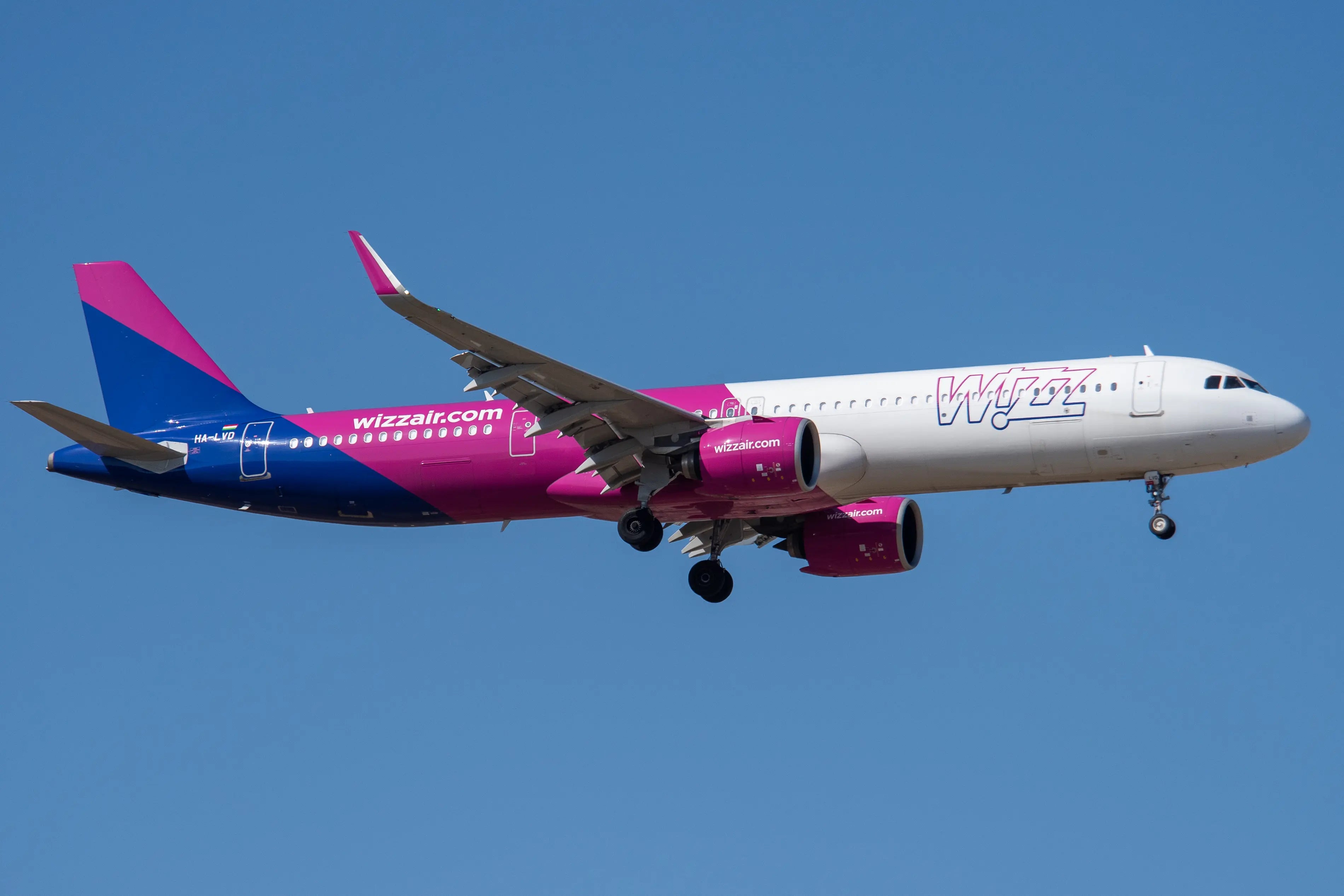
Wizz Air operates an all-Airbus, single-family fleet composed exclusively of A320 and A321 variants. This monotype strategy keeps training costs down, simplifies maintenance, and allows pilots to transition between aircraft variants without a full type rating course. The fleet is also the youngest among major European airlines, with an average age of just 4.7 years as of March 2025. The airline took delivery of 26 new A321neo aircraft during FY2025 and expects 42 more A321neo deliveries plus 8 A321XLR aircraft during FY2026.
The fleet renewal plan is aggressive: all older A320ceo and A321ceo aircraft are scheduled for phase-out by fiscal 2029, with a target of an all-A321neo fleet (including XLR variants) by 2033. This transition is part of the revised "Wizz 500" strategy, now targeting 379 aircraft (368 A321neo + 11 A321XLR) by fiscal 2033, with annual capacity growth moderated to 10-12% from the earlier 15-20% ambition.
| Aircraft Type | Role | In Service | Notes |
|---|---|---|---|
| Airbus A320-200 (ceo) | Narrowbody | ~30 | 180-186 seats. Oldest type, phase-out by FY2029. V2500 engines. |
| Airbus A320neo | Narrowbody | 6 | 180 seats. Small batch retained through 2033. PW1100G engines. |
| Airbus A321-200 (ceo) | Narrowbody | 41 | 230 seats. Being phased out by FY2029. |
| Airbus A321neo | Narrowbody | ~163 | 239 seats. Fleet backbone. 253 more on order. PW1100G-JM engines. |
| Airbus A321XLR | Narrowbody (LR) | 3 | 239 seats. Extended range variant. 47 on order (reduced from initial plans). |
Fleet composition as of September 2025 (H1 FY2026). Total: ~243 aircraft. Numbers fluctuate with ongoing deliveries, returns, and GTF engine groundings.
A significant operational challenge for Wizz Air has been the Pratt & Whitney GTF engine inspection program, which has grounded 35-42 aircraft at various points during 2024-2025. As of September 2025, 35 aircraft were grounded for engine-related inspections, with the average shop visit taking approximately 300 days. Wizz Air negotiated a commercial support agreement with Pratt & Whitney covering direct costs for 2025-2026. The airline expects groundings to reduce to 25-30 aircraft during FY2027, with additional spare engines being delivered to support operations.
All Wizz Air pilots fly the Airbus A320 family. The A320ceo and A320neo share a common type rating with the A321ceo and A321neo, meaning pilots can operate across all variants without additional conversion training. For new joiners, Wizz Air typically requires an A320 type rating or covers the cost through its cadet/training programs. The single-type fleet is a major advantage for career mobility within the airline, as there is no complex fleet bidding or transition process.
Pilot Salary & Compensation Breakdown
Wizz Air pilot compensation follows a variable pay model typical of ultra-low-cost carriers. Rather than a single fixed salary, earnings are composed of a monthly base salary plus per-kilometre pay, per-landing allowances, and various bonuses. Because Wizz Air operates multiple AOCs (Hungary, UK, Malta), actual pay varies significantly depending on which subsidiary employs the pilot, the base location, and local tax/social security regulations. Country multipliers may apply: for example, pilots on Hungarian contracts based in Austria may receive a 1.25x multiplier.
First Officer Pay Scale (Wizz Air Hungary, 2025)
| Experience Level | Monthly Base | Per-km Rate | Per Landing | Est. Annual Gross |
|---|---|---|---|---|
| Entry F/O (Year 1) | €3,500 | €0.020/km | €12 | ~€50,000 - €60,000 |
| F/O (Year 2-3) | €4,500 - €5,500 | €0.025 - €0.035/km | €12 | ~€60,000 - €75,000 |
| Senior F/O (1500+ hrs) | €5,500 - €6,500 | €0.035 - €0.040/km | €12 | ~€75,000 - €90,000 |
Captain Pay Scale (Wizz Air Hungary, 2025)
| Experience Level | Annual Base | Per-km Rate | Per Landing | Est. Annual Gross |
|---|---|---|---|---|
| New Captain | €45,000 | €0.062/km | €30.00 | ~€108,000 - €130,000 |
| Captain (2,500+ PIC hrs) | €52,000 - €58,000 | €0.068 - €0.072/km | €34.00 | ~€135,000 - €160,000 |
| Senior Captain (5,000+ PIC hrs) | €58,000 - €65,000 | €0.072 - €0.077/km | €37.20 | ~€155,000 - €180,000 |
Wizz Air UK Pay Ranges (2025)
| Role | Annual Base (GBP) | Sector Duty Pay | Est. Total (GBP) |
|---|---|---|---|
| First Officer | £35,700 - £55,000 | £15 - £22/sector | ~£50,000 - £75,000 |
| Captain | £97,550 - £145,700 | £37/sector | ~£130,000 - £200,000+ |
All figures are gross estimates based on publicly available data and pilot reports from 2024-2025. Actual earnings depend on hours flown, sectors operated, base location, and applicable country multiplier.
Wizz Air's variable pay model means earnings fluctuate month to month based on the number of kilometres flown and landings completed. There are no guaranteed flight hours, though pilots can typically expect around 850 hours per year. Additional income streams include office duty pay (€225-€450/day), loyalty bonuses, performance bonuses, and sign-on/retention bonuses ranging from €5,000 to €50,000 at certain bases. Tax treatment varies significantly by country of residence and employment contract (Hungarian, UK, or Maltese AOC). Always verify current pay scales directly with Wizz Air recruitment before making career decisions.
Roster Patterns & Quality of Life
Wizz Air introduced a revamped roster system in late 2023, offering pilots a choice between fixed and flexible patterns depending on their base and lifestyle preferences. This was a significant departure from the previous random-roster-only model and was designed to improve pilot retention during a period of intense industry competition for crew. The available patterns vary by subsidiary and base location, but the core options are outlined below.
📅 Sample Month: 5 on / 4 off Fixed Roster (Budapest F/O)
The quality-of-life picture at Wizz Air is mixed. The introduction of fixed rosters was a welcome change, giving pilots predictability that was previously absent. However, peak-season blackouts (Christmas, Easter, summer) can disrupt patterns, and the airline's high utilization model means flying days tend to be intensive, often with two or more sectors per duty day. Pilots report that the 5/4 pattern delivers the best work-life balance, while the 14/7 commuter pattern is popular among pilots who live far from their assigned base but comes with a demanding two-week on-duty block.
Wizz Air operates from 40+ bases across Europe, giving pilots more geographic flexibility than most LCCs. The base change policy is transparent: new joiners can submit a base transfer request after their line check release, and changes are processed on a first-come, first-served basis. Retention bases in Romania (Craiova, Suceava, Iasi), North Macedonia (Skopje), and Georgia (Kutaisi) offer cash bonuses of €30,000-€50,000 to attract and retain crew. The airline's free network commuting benefit (for 14/7 pilots) and discounted staff travel help offset the challenge of being based in less convenient locations.
Benefits, Travel Perks & Pension
As an ultra-low-cost carrier, Wizz Air's benefits package is leaner than what legacy airlines offer. The airline focuses on competitive variable pay and fast career progression rather than generous long-term benefits. That said, the package has improved in recent years as Wizz Air competes for pilots in a tight European market.
The pension provision at Wizz Air is one of the most commonly cited drawbacks among current and former pilots. Unlike easyJet (which offers meaningful employer contributions) or legacy carriers with dedicated aircrew pension funds, Wizz Air provides only the minimum legally required pension contributions in each jurisdiction. For UK-based pilots, this translates to a maximum employer contribution of around £110 per month. Pilots considering Wizz Air as a long-term career should factor in the need for significant private pension planning to ensure adequate retirement income. This is particularly relevant for pilots based in countries with weaker state pension systems.
Career Progression & Upgrade Timeline
Career progression is one of Wizz Air's strongest selling points. The airline's rapid growth creates frequent upgrade opportunities, and the path from First Officer to Captain is significantly faster than at legacy carriers. Wizz Air uses a factorized flight hours system to determine upgrade eligibility, meaning prior experience (even from single-engine or military flying) counts toward the requirements, albeit at reduced factors.
| Career Milestone | Requirement | Typical Timeline |
|---|---|---|
| Cadet: Start WAPA Programme | High school diploma, age 18+, English fluent, Class 1 Medical | Application to enrollment: 3-6 months |
| Cadet: Release as First Officer | Complete 18-month integrated ATPL + 2-4 months airline training | ~20-24 months from start |
| First Officer → Senior First Officer | 1,500 factorized total hours | ~2 years (at 850 hrs/year) |
| Senior F/O → Captain | 3,300 factorized total hours (500 with Wizz Air) | ~2-4 years from SFO |
| Direct Entry Captain (Airbus FBW exp.) | 3,000 actual hours + 100 landings on A320/A330/A340/A350/A380 | Immediate (subject to assessment) |
| Direct Entry Captain (General) | 1,500 hours on certified MPA jet with MTOW > 50T in CAT ops | Immediate (subject to assessment) |
| Training Captain / TRE / TRI | Varies. Separate selection and instructor training program. | After command experience |
The factorized hours system works as follows: single-engine PIC hours are multiplied by 0.3, multi-engine PIC hours from non-airline or military fast jet flying are multiplied by 0.7, and airline multi-crew jet hours count at full value. This means a pilot with significant prior experience can reach the SFO and Captain thresholds faster than someone building hours entirely at Wizz Air.
The Direct Entry Captain Program is another distinctive feature. Wizz Air actively recruits experienced Captains from other airlines, offering them the opportunity to join directly in command. This is unusual in European aviation where many carriers restrict command positions to internal upgrades. For experienced A320 pilots, this can be a fast track to a well-compensated Captain position.
Wizz Air has committed to training 1,200 new pilots by 2028, including 240 from the UK. The airline's fleet is expected to grow to 379 aircraft by 2033, which translates to a continuous need for new Captains. This growth trajectory means upgrade timelines are likely to remain compressed compared to legacy carriers, where wait times of 10-15+ years are common. According to Wizz Air UK's Head of Operations, pilots can expect to earn £40,000 during training, £60,000 upon completion, £90,000 after two years, and £145,000-£200,000 upon promotion to Captain.
Recruitment Process & Requirements
Wizz Air recruits pilots through two main pathways: the Wizz Air Pilot Academy (WAPA) for ab-initio cadets, and the Direct Entry stream for experienced pilots. Both pathways lead to the same fleet and career progression, though entry requirements and costs differ significantly. The airline recruits year-round and processes applications through its online careers portal.
Wizz Air Pilot Academy (WAPA) - Requirements
Direct Entry Experienced Pilot - Requirements
Selection Process
Online Application
Submit application via the Wizz Air careers portal with CV, cover letter, scanned passport, license, Class 1 Medical, and logbook details. For WAPA cadets, a €130 recruitment fee grants access to preparation materials for the aptitude test.
Stage 1: Pilot Aptitude Test (TestAir 360)
Online proctored assessment lasting approximately 3-4 hours. Covers cognitive ability, spatial reasoning, multitasking, and coordination. Candidates can practice for up to four months before the final supervised test. This is the primary screening stage for cadets.
Stage 2: Psychological Assessment
Online psychological evaluation assessing personality traits, stress management, decision-making style, and CRM aptitude. Designed to identify candidates suited to the demands of commercial aviation.
Stage 3: Group Exercise (Budapest)
In-person group assessment held at Wizz Air's headquarters in Budapest. Evaluates teamwork, communication, leadership, and interpersonal skills. For experienced pilots, a simulator assessment may also be included at this or a subsequent stage.
Stage 4: Personal Interview & Offer
Individual interview with recruitment panel. Successful candidates receive a conditional offer subject to background checks, security vetting, and valid Class 1 Medical. Cadets are assigned a training start date; experienced pilots proceed to type rating or line training.
Unlike many legacy carriers, Wizz Air does not require specific nationality or language beyond English for most positions, making it one of the most accessible airlines for international pilots with EU work rights. The airline recruits year-round with no fixed campaign windows. For WAPA cadets, the aptitude test is the biggest hurdle: invest time in the four-month practice window. If you cancel an assessment within one week of the date, there is a two-week cooldown before rebooking. The "freezing period" after an unsuccessful attempt varies and is determined by assessors on a case-by-case basis.
How Wizz Air Compares: Airline Radar Chart
How does Wizz Air stack up against Europe's two other major low-cost carriers, Ryanair and easyJet? These three airlines compete for many of the same pilots, and the choice between them is one of the most common career decisions facing European aviators. Below is a comparative analysis across five key dimensions, scored on a 0-100 scale.
Key Takeaways from the Comparison
Wizz Air leads on fleet modernity and career speed. With the youngest fleet in European aviation (4.7 years average) and a fast-track upgrade system based on factorized hours, Wizz Air offers the quickest path to command among the big three LCCs. A pilot can realistically go from First Officer to Captain in 4-6 years, compared to 6-10+ at Ryanair or easyJet.
easyJet offers the strongest overall package for quality of life and benefits. With established union representation, meaningful pension contributions, superior loss-of-medical coverage (6+ months full salary), and a network concentrated on Western European airports, easyJet consistently ranks highest among LCC pilots for long-term satisfaction. Salaries are also competitive, particularly for Captains at bases like London Gatwick or Geneva.
Ryanair provides the most predictable roster. The stable 5 days on, 4 days off pattern holds year-round (including peak seasons), which is a significant advantage over Wizz Air's peak blackout periods and easyJet's variable summer scheduling. Ryanair has also improved its union relations considerably since 2017, with structured pay agreements now in place across most bases.
Benefits are Wizz Air's weakest category. The minimal pension contributions, absence of collective bargaining, and variable employment terms (different AOCs, country multipliers, training bonds) create uncertainty that neither Ryanair nor easyJet matches. Pilots seeking long-term financial security and structured career protections will find better provisions at the other two carriers.
Scores are editorial estimates based on publicly available salary data, pilot testimonials, union publications, FlightDeckFriend reviews, and industry benchmarks from the European Cockpit Association (ECA). They represent a general assessment for a mid-career pilot. Individual experiences vary significantly based on base, seniority, AOC, and personal priorities. These scores will be updated as market conditions evolve.
Union & Industrial Relations
This is perhaps the most controversial aspect of working for Wizz Air. The airline has a well-documented anti-union stance that sets it apart from virtually every other major European carrier. Understanding the labor relations landscape is essential for any pilot evaluating Wizz Air as a potential employer.
Wizz Air's Position on Unions
CEO József Váradi has publicly stated that unions were "killing the business" and that Wizz Air's response to unionization attempts is to leverage its operational flexibility, including the ability to close bases and relocate operations. The airline maintains what has been described as a "zero-tolerance policy for unions", and multiple reports from pilot advocacy groups have documented allegations of retaliatory actions against pilots who attempted to organize. The European Transport Workers' Federation (ETF) has publicly criticized Wizz Air's approach, and Danish pension fund AkademikerPension divested its shares in the company citing the airline's refusal to engage in collective bargaining.
In 2024, the US pilot union ALPA (Air Line Pilots Association) formally protested Wizz Air's application to operate flights to the United States, citing the airline's labor practices as a threat to pilot working standards. This protest brought international attention to Wizz Air's employment model and could have implications for the airline's transatlantic ambitions with the A321XLR.
No Established Collective Bargaining
Unlike Ryanair (which now works with pilot unions across most of its bases) and easyJet (which has long-established union membership and crew committees), Wizz Air has no structured collective bargaining agreements with pilot unions. Pay scales, working conditions, and roster rules are set unilaterally by management. This means pilots have limited formal channels to negotiate terms collectively, and any changes to compensation or conditions are at the company's discretion.
What Pilots Report
Pilot forums and advocacy organizations have described an environment where high utilization is prioritized and there are concerns about pressure on pilots who refuse overtime, call in sick, or request their scheduled days off. The airline also makes extensive use of subcontracted "agency pilots" who work alongside directly employed crew but under different (often inferior) employment terms. These agency arrangements create a two-tier workforce that can undermine solidarity and bargaining power.
The absence of union representation is a double-edged sword. On one hand, Wizz Air can move quickly on pay adjustments, roster changes, and new benefits without lengthy negotiations. On the other hand, pilots lack the collective protections that unions provide at carriers like Ryanair and easyJet: structured grievance procedures, protection against arbitrary dismissal, negotiated minimum rest provisions beyond legal minimums, and a collective voice in company decisions that affect working conditions. Pilots who value these protections should weigh them carefully against Wizz Air's strengths in career progression and fleet modernity.
Verdict: Who Is Wizz Air For?
🎯 Our Take
Wizz Air is a compelling option for pilots who prioritize fast career progression, fleet modernity, and geographic flexibility above all else. The airline's rapid growth, youngest fleet in Europe, multiple base options across 40+ locations, and factorized-hours upgrade system mean that ambitious pilots can reach command significantly faster than at legacy carriers or even other LCCs. The Direct Entry Captain program adds another pathway for experienced pilots seeking immediate command opportunities.
The trade-offs are substantial and well-documented. The anti-union stance, minimal pension provisions, variable pay model with no guaranteed hours, training bonds, and reports of a high-pressure operational culture are genuine concerns that every prospective pilot should consider carefully. The benefits package trails both Ryanair and easyJet in most categories, and the absence of collective bargaining means pilots have limited formal recourse when conditions change unfavorably.
For early-career pilots looking to build hours quickly and reach command, or for experienced pilots seeking a Direct Entry Captain position with competitive pay, Wizz Air offers real advantages. For pilots prioritizing long-term career stability, strong pension provisions, and the security of union representation, other carriers may be better suited.
1 How long does it take to become a Captain at Wizz Air?
The upgrade timeline depends on your factorized flight hours. You need 1,500 factorized hours to become a Senior First Officer and 3,300 factorized hours (including 500 with Wizz Air) to become a Captain. At the typical rate of 850 flying hours per year, a pilot joining with no prior experience could reach Captain in approximately 4-6 years from their first day as an F/O. Pilots with significant prior experience can reach command faster due to the factorization of previous hours.
2 Do I need to be an EU citizen to fly for Wizz Air?
Not necessarily an EU citizen, but you do need unrestricted work rights in a Wizz Air operational country. For the main Hungarian AOC, this includes EU/EEA citizens plus nationals of Albania, Armenia, Bosnia and Herzegovina, Bulgaria, Cyprus, Georgia, Hungary, North Macedonia, Poland, Romania, and Serbia. For Wizz Air UK, you need UK work rights. Wizz Air does not sponsor work visas.
3 How much does the Wizz Air Pilot Academy cost?
The total cost of the WAPA integrated ATPL program is €61,460. An upfront payment of €13,950 is required before enrollment, and the remaining balance is repaid through monthly installments over five years after the cadet is released as a First Officer. Candidates with prior flight experience (e.g., a PPL) may receive credit of up to 20 hours toward the training fee following an assessment flight, though the initial enrollment fee must still be paid in full.
4 What roster options are available?
Wizz Air offers multiple roster patterns depending on your base: 5 on/4 off (fixed), 6 on/4 off (UK), 14 on/7 off (commuter with free network commuting), 20 on/10 off (floating with allowances), and random/flexible with extra pay. Part-time options are also available at selected bases. Not all patterns are available at all bases, and peak-season blackouts may affect fixed roster predictability during July, August, and December.
5 Is there a training bond at Wizz Air?
Yes. WAPA cadets repay their training costs (€61,460 minus the upfront fee) over five years. For experienced pilots who receive company-funded type rating or conversion training, bonds of €10,000-€20,000 have been reported, though the exact amount depends on the training provided and the contract terms. Training bonds are a common practice across European LCCs and are not unique to Wizz Air.
6 Can I change my base after joining?
Yes. Wizz Air has a base change policy that allows pilots to request a transfer after their line check release. The process is first-come, first-served, with a transparent waiting list. With 40+ bases across Europe, the geographic flexibility is one of Wizz Air's genuine advantages over carriers with fewer base options. However, transfers are subject to operational requirements and are not guaranteed.
7 How does Wizz Air pay compare to Ryanair and easyJet?
At the First Officer level, pay is broadly comparable across all three airlines, typically in the €42,000-€80,000 range depending on experience and base. Captain pay at Wizz Air Hungary (€108,000-€180,000) is competitive but can fall below Ryanair and easyJet at senior levels. Wizz Air UK Captains (£97,550-£145,700 base) are roughly in line with competitors. The key difference is in the total package: easyJet offers significantly better pension and loss-of-medical coverage, while Ryanair provides more stable year-round rosters. Wizz Air compensates with faster upgrade timelines and retention bonuses at certain bases.
8 Does Wizz Air have a pilot union?
No. Wizz Air does not have established union representation or collective bargaining agreements for its pilots. The airline's management has been publicly critical of unions, and the company has been criticized by organizations including the European Transport Workers' Federation and ALPA for its approach to labor relations. Pay and working conditions are set by management. This is one of the most significant differences between Wizz Air and its competitors Ryanair and easyJet, both of which now work with pilot unions.
Official Links & Resources
Before applying or making career decisions, always verify information directly with official sources. Pilot pay scales, roster options, and recruitment requirements change frequently. Here are the key websites and organisations relevant to Wizz Air pilot careers:
The Wizz Air pilot careers page is the single best source for current information on pay scales, base options, and open positions. The page is updated frequently and includes the factorized hours calculator, roster pattern details, and the full list of eligibility requirements for each pilot category. Bookmark it and check back regularly, as new bases and incentive packages are added throughout the year.