History and Development of the Lockheed Model 18 Lodestar
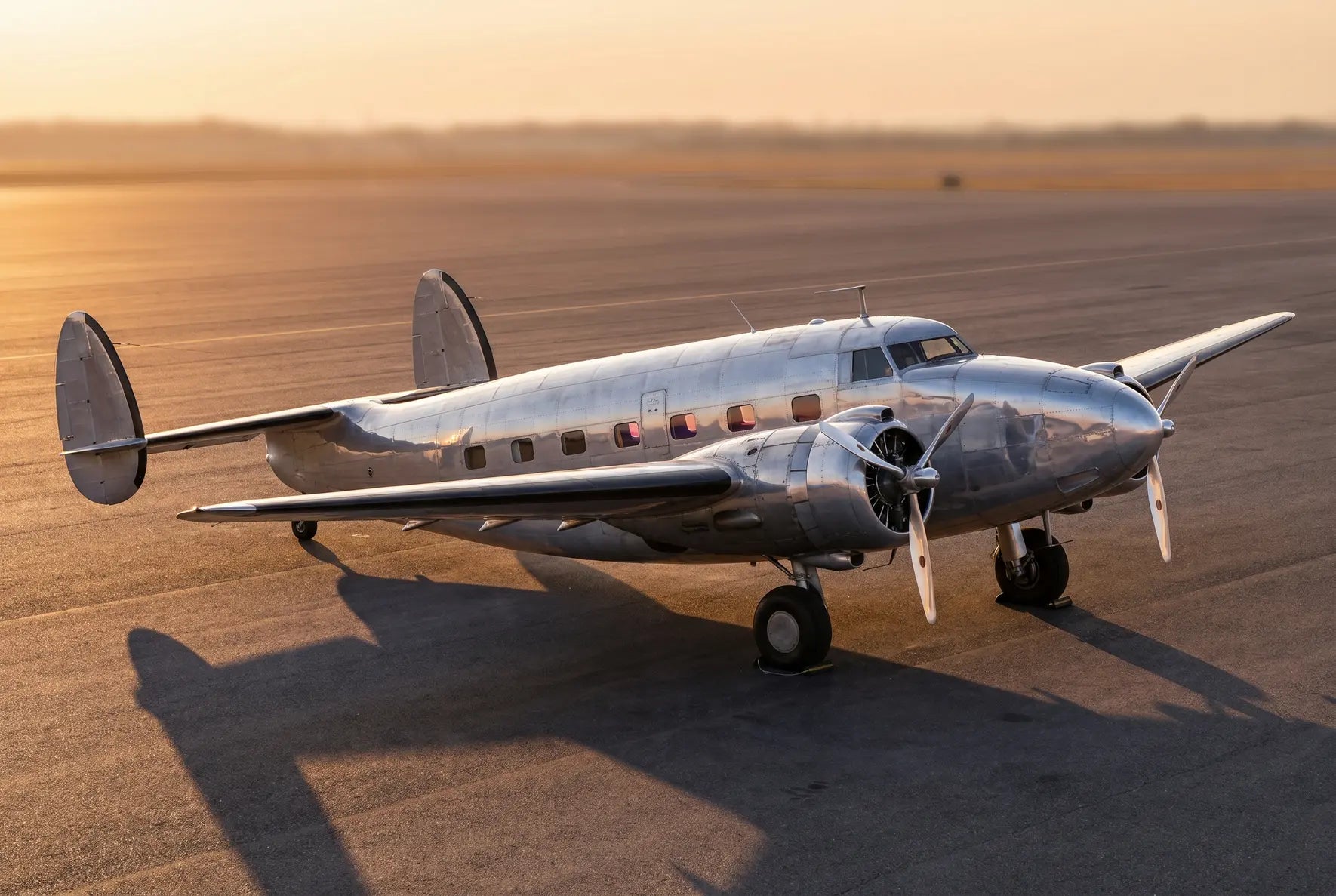
The Lockheed Model 18 Lodestar is a twin-engine passenger and military transport aircraft developed in the late 1930s by the Lockheed Aircraft Corporation in Burbank, California. It belongs to the Electra family of all-metal, low-wing monoplanes that began with the Model 10 Electra in 1934 and continued with the Model 14 Super Electra in 1937. Designed to address the commercial shortcomings of its immediate predecessor, the Lodestar became one of the most versatile twin-engine transports of the World War II era, serving airlines, armed forces, and corporate operators across several decades.
From the Model 14 Super Electra to the Model 18
The direct predecessor of the Lodestar was the Lockheed Model 14 Super Electra, which first flew in 1937. While the Super Electra offered excellent speed and performance, it suffered from high operating costs relative to its main competitor, the Douglas DC-3, which dominated the airline market of the era. The Model 14 also experienced a series of accidents in 1938 and 1939 involving Northwest Airlines, damaging its commercial reputation. Northwest returned several airframes to Lockheed, and the manufacturer saw an opportunity to salvage the basic design by creating a more economical variant.
Lockheed's engineering team, led by Hall Hibbard, chose to stretch the Model 14 fuselage by approximately 5 feet 6 inches (1.68 m), adding two additional rows of seats. This increased typical seating from around 12 passengers on the Super Electra to approximately 18 passengers on the Lodestar, significantly improving revenue per flight and reducing seat-mile costs. The wing, tailplane, and forward fuselage structure remained broadly similar to the Model 14, though the Lodestar incorporated enlarged landing flaps to accommodate higher operating weights.
Key Milestones and Certification
In early 1939, Lockheed converted the fourth production Model 14 (one of the airframes returned by Northwest Airlines) into the Lodestar prototype. The first flight of the Model 18 took place on 21 September 1939. A first newly built (non-converted) Model 18 flew on 2 February 1940. The aircraft received its U.S. Type Certificate on 30 March 1940, and Mid-Continent Airlines of Kansas City became the first airline operator that same month. Other early civil customers included Continental Airlines, National Airlines, and several Latin American carriers.
Military Adoption and Wartime Production
As the United States began its military build-up in 1940 and 1941, the Lodestar quickly transitioned from a commercial airliner to a critical military transport. Many American-operated civilian Lodestars were impressed into service under the C-56 designation. Purpose-built military variants followed rapidly, including the C-57, C-59, C-60, and C-66 for the U.S. Army Air Forces, and the R5O series for the U.S. Navy and Marine Corps. The most numerous variant was the C-60A, powered by Pratt & Whitney R-1830 Twin Wasp engines, with approximately 325 built as paratroop and personnel transports. In total, Lockheed produced around 625 Lodestars of all variants at its Burbank facility. The type also served with the Royal Air Force, Royal Australian Air Force, Royal New Zealand Air Force, South African Air Force, and Brazilian Air Force, among others. In 1942, a specially configured Lodestar was purchased as the personal transport of Brazilian President Getulio Vargas.
Post-War Life and Legacy
After 1945, large numbers of surplus military Lodestars were sold back into the civilian market. Many were converted into executive transports by firms such as Howard Aero and PacAero (the latter producing the Learstar conversion designed by Bill Lear). Some conversions included tricycle landing gear retrofits. A number of Lodestars returned to airline service with smaller regional carriers worldwide, while others found roles in agricultural aviation, particularly topdressing operations in New Zealand during the 1950s. The type remained in active use into the 1970s and 1980s with private owners and skydiving operations. Today, fewer than 20 Lodestars remain airworthy. For a contrast with a modern high-capacity transport, see this overview of the Airbus A380-800, which represents the opposite end of the passenger aircraft spectrum.
What Distinguishes the Lockheed Model 18 Lodestar
The Lodestar occupied a unique position in the Lockheed Electra family. Unlike the Model 14 Super Electra, from which it was directly developed, the Model 18 offered greater capacity and improved economics. Unlike the Lockheed Hudson, which was a maritime patrol bomber derived from the Model 14, the Lodestar remained an unarmed transport throughout its career. And unlike the later Lockheed Ventura (Model 37), which used far more powerful Pratt & Whitney R-2800 Double Wasp engines in a purpose-built bomber configuration, the Model 18 was optimised for passengers and cargo.
Key variant identifiers for the Lockheed Model 18 Lodestar include:
- Engine options: Pratt & Whitney R-1690 Hornet (~875 hp), Pratt & Whitney R-1830 Twin Wasp (~1,200 hp), and Wright R-1820 Cyclone (~1,200 hp), depending on sub-variant.
- Fuselage stretch: approximately 5 ft 6 in longer than the Model 14 Super Electra, allowing 18 passengers versus 12.
- Maximum take-off weight: approximately 21,000 lb (9,525 kg) on later variants such as the C-60A.
- Military designations: C-56, C-57, C-59, C-60, C-66 (USAAF) and R5O (USN/USMC).
- Total production: approximately 625 aircraft across 7 commercial, 18 USAAF, and 7 USN variants.
- Enlarged flaps: compared to the Model 14, to support higher operating weights.

A Lockheed Lodestar aircraft is pictured taking off from an airfield at Goderich, with its landing gear visible and another plane in the background. Crowds watch from the ground below in an open area with trees and buildings in the background.
Lockheed Model 18 Lodestar: Technical Specifications and Systems Overview
The Lockheed Model 18 Lodestar was a twin-engine, low-wing monoplane transport developed from the Lockheed Model 14 Super Electra. Its primary design objective was to improve seat-mile economics by stretching the Model 14 fuselage by approximately 5 ft 6 in (1.68 m), raising typical passenger capacity from around 12 to 18 seats while retaining superior cruise speed compared with its chief rival, the Douglas DC-3. This trade-off between commonality with the existing Model 14 structure and increased payload capacity defined the Lodestar's engineering character: a fast, relatively high-wing-loading transport with more demanding handling than slower, larger-wing contemporaries.
The Lodestar was offered with multiple engine configurations spanning both Wright R-1820 Cyclone and Pratt & Whitney radial families. Civil variants ranged from the Hornet-powered Model 18-07 to the Wright Cyclone-powered Model 18-56, which was built in the largest numbers. Military designations (C-56 through C-60 for the USAAF, R5O for the U.S. Navy) reflected differences in powerplant and interior layout. Performance figures therefore vary considerably depending on the specific variant, engine installation, and operator configuration. A total of 625 Lodestars were produced across all variants. While many modern airliners such as the Airbus A350-900 rely on fly-by-wire controls and advanced composite structures, the Lodestar represents the pinnacle of 1930s all-metal, manually controlled transport design.
- Length: 49 ft 10 in (15.19 m)
- Wingspan: 65 ft 6 in (19.96 m)
- Height: 11 ft 10 in (3.61 m)
- Wing area: 551 sq ft (51.2 sq m)
- Typical crew: 3
- Passenger capacity: up to 18 (civil configuration)
- Empty weight: approximately 12,500 lb (5,670 kg)
- Maximum takeoff weight: up to 21,000 lb (9,525 kg) for civil variants; military examples ranged from 18,500 to 19,200 lb depending on sub-type
- Engines: two radial piston engines, either Wright R-1820 Cyclone (1,200 hp each) or Pratt & Whitney R-1830 Twin Wasp (1,050 to 1,200 hp each), depending on variant
- Maximum speed: 253 to 266 mph (407 to 428 km/h), variant-dependent
- Cruise speed: approximately 200 mph (322 km/h) in typical configuration
- Rate of climb: approximately 1,600 ft/min (488 m/min)
- Service ceiling: 25,000 to 30,100 ft (7,620 to 9,175 m), variant-dependent
- Range: 1,600 to 2,500 mi (2,575 to 4,023 km), depending on fuel load and configuration
- Propellers: three-bladed Hamilton Standard hydromatic constant-speed units (e.g., 23E50-473)
- Flaps: Fowler-type trailing-edge flaps, inherited from Model 14 design
- Landing gear: retractable conventional (tailwheel) undercarriage, main gear retracting into engine nacelles
Flight Controls, Systems, and Handling
The Lodestar employed a fully conventional, manually operated flight control architecture. Ailerons, elevators, and rudder were actuated through cables, pulleys, and bellcranks with no powered boost. Trim tabs on the elevator and rudder allowed pilots to relieve control forces in cruise. The Fowler flaps, extending rearward and then deflecting downward to increase both wing area and camber, were actuated hydraulically. The hydraulic system also operated the retractable landing gear. Electrical power came from engine-driven generators feeding a DC bus for lighting, instrumentation, radio navigation, and engine starters. The cabin was unpressurised, with heated and ventilated interiors in airline configurations.
Published performance figures for the Lodestar vary significantly across sources because of the number of engine options, differing maximum takeoff weights between civil and military variants, and varying interior configurations. A C-60A at the National Museum of the USAF lists a maximum speed of 257 mph and a range of 1,700 miles, while general Model 18 data quotes up to 266 mph and 2,500 miles in maximum-fuel civil trim. Atmospheric conditions, altitude, gross weight at departure, and runway surface further affect real-world takeoff and en-route performance. Any comparison between variants should account for these differences rather than treating published figures as absolutes.
Engines: Wright R-1820 Cyclone and Pratt & Whitney Alternatives
The most widely produced Lodestar variant, the Model 18-56, was powered by two Wright R-1820 Cyclone engines, a nine-cylinder, single-row, air-cooled radial with a displacement of 1,823 cu in (29.9 L). The R-1820 featured a bore of 6.125 in and a stroke of 6.875 in, and delivered 1,200 hp for takeoff in the variants fitted to the Lodestar (including the R-1820-87 and R-1820-G205A). Developed by Wright Aeronautical from the late 1920s, the R-1820 Cyclone evolved through decades of service, with early models producing around 575 hp and later wartime versions exceeding 1,500 hp. It was one of the most important American radial engines, also powering the Boeing B-17 Flying Fortress, Douglas SBD Dauntless, early Douglas DC-2 and DC-3 variants, North American T-28B Trojan, and the Grumman S-2 Tracker. Military C-60 and C-60A Lodestars used Wright Cyclone engines exclusively.
Several earlier Lodestar variants used Pratt & Whitney powerplants instead. The Model 18-07 was fitted with two P&W R-1690 Hornet radials rated at 875 hp each, while the Model 18-08 and 18-14 used P&W R-1830 Twin Wasp engines producing 1,050 to 1,200 hp per unit. The R-1830 Twin Wasp was a 14-cylinder, twin-row radial displacing 1,829 cu in (30.0 L), and became one of the most produced aircraft engines in history with over 173,000 units manufactured. The same engine family powered the Douglas C-47 Skytrain, Consolidated B-24 Liberator, Consolidated PBY Catalina, and Grumman F4F Wildcat. In the USAAF inventory, C-57 Lodestars were assigned R-1830 Twin Wasp engines, while C-59 variants retained the older R-1690 Hornet. This engine flexibility allowed operators and military logistics to match available powerplants to operational needs throughout the war.
Lockheed Model 18 Lodestar vs DC-3 vs Beech 18 vs Model 14 Super Electra: Specs Comparison
Scroll horizontally to see more →
| Parameter | Lockheed Model 18 Lodestar | Douglas DC-3 | Beechcraft Model 18 | Lockheed Model 14 Super Electra |
|---|---|---|---|---|
| Entry into service | 1940 | 1936 | 1937 | 1938 |
| Engines | 2 × Pratt & Whitney R-1690 Hornet radial | 2 × Pratt & Whitney R-1830 Twin Wasp radial | 2 × Pratt & Whitney R-985 Wasp Junior radial | 2 × Pratt & Whitney R-1690 Hornet radial |
| Length | 15.2 m | 19.7 m | 10.4 m | 13.5 m |
| Wingspan | 20.0 m | 29.0 m | 15.6 m | 20.1 m |
| Height | 3.6 m | 5.2 m | 3.0 m | 3.5 m |
| Typical seating and layout (short description + approximate passengers) | Single-class: 15–18 passengers | Single-class: 21–32 passengers | Single-class: 6–11 passengers | Single-class: 12–14 passengers |
| MTOW | 8.4 t | 12.7 t | 4.1 t | 7.8 t |
| Range | 2,200 nm | 1,500 nm | 1,200 nm | 1,600 nm |
| Cruise speed | 0.26 Mach | 0.24 Mach | 0.22 Mach | 0.25 Mach |
| Service ceiling | 30,100 ft | 23,200 ft | 20,000 ft | 24,000 ft |
| Program note | Stretched derivative of the Model 14 Super Electra, developed to rival the DC-3 with higher capacity and better economics. | Benchmark pre-war twin-engine airliner and military transport that set the standard the Lodestar was designed to compete against. | Smaller twin-engined utility transport of the same era, widely used for feeder services, training, and executive transport. | Baseline Lockheed twin-engined airliner from which the Lodestar was developed, offering slightly smaller capacity and fuselage length. |
Scroll horizontally to see more →
The table compares four classic twin‑engine aircraft across era, dimensions, capacity, and performance. The Lodestar (1940) sits between the larger DC-3 and smaller Beech 18, carrying 15–18 passengers versus 21–32 and 6–11. It offers the longest listed range at 2,200 nm and the highest ceiling (30,100 ft), while the DC-3 is biggest by wingspan and has the highest MTOW.
Lockheed Model 18 Lodestar Operations: Routes, Airlines and Missions Worldwide
The Lockheed Model 18 Lodestar was designed as a short- to medium-range airliner, stretching the earlier Model 14 Super Electra fuselage by five feet to accommodate two additional rows of seats and compete directly with the Douglas DC-3. With a cruising speed of approximately 200 mph (320 km/h) and a practical range of around 1,600 miles with payload, the aircraft typically flew stage lengths of 200 to 600 miles, covering sectors of one to three hours. Airlines used it on multi-stop itineraries linking medium-sized cities to major hubs, a pattern common across both domestic and international networks during the late 1930s and 1940s.
Despite solid performance, the Lodestar faced significant operational challenges. By the time it received its type certificate in March 1940, most major U.S. carriers had already committed to the Douglas family of airliners, and only 31 Lodestars reached American airline fleets. Its seat-mile cost was comparable to the DC-3 rather than decisively lower, and its maximum capacity of 18 passengers fell short of the DC-3's 21 to 28 seats in typical airline configurations. Operators running mixed fleets faced higher parts costs, separate crew training pipelines, and limited spares availability, since only around 625 Lodestars of all variants were built compared to more than 10,000 DC-3/C-47 airframes. After World War II, thousands of cheap surplus C-47s flooded the market, further marginalising the Lodestar in scheduled airline service. Many airframes transitioned into corporate transport, cargo, charter, and even agricultural roles.
Where the Lockheed Model 18 Lodestar Operated
The Lodestar saw its widest airline adoption outside the United States, particularly in Africa, South America, and Oceania, where its speed and twin-engine reliability suited regional networks with moderate traffic. In Europe, several colonial-era carriers deployed it on routes linking metropolitan territories to overseas possessions, while in North America, a handful of trunk and regional airlines used it briefly before wartime impressment diverted most airframes to military service. Across Asia, direct civil airline use was limited, though BOAC and Dutch military authorities operated the type in the region.
In each region the Lodestar generally served as a point-to-point or feeder aircraft on lower-density routes where a smaller twin was more economical than larger equipment. It connected secondary airports to main hubs and carried passengers, mail, and light freight on sectors that did not justify the capacity of a DC-3 or larger type.
- Europe: BOAC operated nine new-build Model 18-07s plus 29 second-hand Lodestars, primarily on medium-range empire routes and feeder services in Africa and the Middle East. Air France received three Model 18-07s for short- and medium-haul services, likely including routes to North Africa. SABENA used Lodestars mainly in the Belgian Congo for scheduled passenger, mail, and freight operations. Karhumaki Airways in Finland ran domestic passenger services, and Linjeflyg in Sweden flew the type on secondary domestic routes from 1957 to 1960. Aero Portuguesa connected Portugal with its colonial territories.
- North and South America: In the United States, Mid-Continent Airlines became the first customer in 1940, operating Lodestars on Midwestern routes. Continental Air Lines, National Airlines, Pan American Airways, and United Air Lines each took small numbers for regional and feeder services. In Canada, Trans-Canada Air Lines was one of the largest airline customers with 12 Model 18-10s on domestic routes, and Canadian Pacific Air Lines inherited two from Yukon Southern Air Transport for western and northern services. Further south, Panair do Brasil operated six Lodestars on domestic and regional routes, while Lloyd Aereo Boliviano used them on high-altitude Andean services. LAN Chile flew the type from 1943 to 1953, and Linea Aeropostal Venezolana added one to its fleet for domestic operations. TACA Airways used Lodestars on Central American regional services.
- Asia and Oceania: The most significant operator in this region was National Airways Corporation (NAC) of New Zealand, which accumulated around 13 Lodestars for domestic trunk and regional routes, later converting several to agricultural topdressing aircraft. Union Airways of New Zealand preceded NAC with the type from 1945 to 1947. Trans-Australia Airlines briefly operated two Lodestars on domestic routes in 1952-1953. In the Netherlands East Indies, the Dutch military acquired 29 airframes, some of which supported quasi-civil transport roles between islands.
- Africa: South African Airways was the single largest airline customer worldwide, purchasing 29 Model 18-08 Lodestars for domestic and regional services during and after WWII, according to historical fleet records. East African Airways received six ex-BOAC Lodestars in 1948 for scheduled regional services across Kenya, Tanganyika, Uganda, and Zanzibar. DETA (Mozambique Airways) operated the type on internal routes, and Air Afrique (the pre-war French-controlled airline) used five Model 18-07s on colonial routes within French West and Equatorial Africa.
Typical Seating Configurations and Cabin Layouts
The Lockheed Model 18 Lodestar featured a compact cabin measuring approximately 1.70 m (5 ft 7 in) wide, 1.90 m (6 ft 3 in) high, and 8.54 m (28 ft) long. The standard airline arrangement was a single-class layout with 1+1 seating, placing one seat on each side of a central aisle. In an eight-row configuration, this yielded 16 passengers at a seat pitch of approximately 87 cm (34 inches), a relatively generous spacing compared with later high-density airliners. The maximum advertised capacity was 18 passengers, achievable by tightening pitch or adjusting galley and lavatory space. The U.S. Navy R5O-5 variant, identical to the civil version, was configured as a 14-seat transport.
There is no documented evidence that any airline operated the Lodestar with separate cabin classes. It was a single-class cabin throughout its scheduled service life. Post-airline conversions, however, varied greatly. Many surplus Lodestars were refitted as executive transports with as few as 8 to 12 luxury seats, sofas, writing tables, and leather interiors. The cabin included a toilet, a small pantry, soundproofing insulation, and a basic air-conditioning system, making it a reasonably well-appointed small airliner for its era, though modest by any modern standard.
In this video, explore the Lockheed Lodestar, a forgotten WWII twin-engine transport aircraft developed from the Model 14 Super Electra, and learn its key role and design features in wartime service.
Lockheed Model 18 Lodestar Safety Record: How Safe Was This Classic Twin?
The Lockheed Model 18 Lodestar served airlines, military forces and corporate operators from 1940 through the 1970s, with a total production run of 625 airframes. Over more than three decades of active flying, the type accumulated a significant operational footprint across scheduled airline routes, wartime military transport duties and post-war charter and corporate missions. The Aviation Safety Network database records approximately 171 hull-loss accidents and 78 fatal accidents for the Lodestar fleet. While those numbers appear high in absolute terms, they must be viewed against the era in which the aircraft operated. During the 1940s and 1950s, navigation aids were rudimentary, weather forecasting was limited, and operating standards for non-airline flights were far less rigorous than today. Most Lodestar losses were driven by operational and environmental factors rather than inherent structural weaknesses in the design.
Notable Accidents and Their Impact
On 22 March 1958, a privately owned Lodestar carrying film producer Mike Todd crashed in the Zuni Mountains near Grants, New Mexico, killing all four occupants. The aircraft encountered severe icing and turbulence at night, leading to a loss of control and in-flight break-up. The accident, investigated by the Civil Aeronautics Board, underscored the risks of operating older piston transports in marginal weather without the operational support structure of a scheduled airline. It contributed to growing CAB emphasis on weather avoidance, de-icing equipment and improved pilot decision-making standards in corporate and charter aviation.
On 4 September 1962, a Lockheed 18-56 Lodestar operated by Ashland Oil and Refining Company broke apart in flight near Lake Milton, Ohio, killing all 13 occupants. The Bureau of Aircraft Accidents Archives and other compilations of the CAB findings attribute the probable cause to a malfunction of the electric elevator trim tab unit, which generated uncontrollable pitch forces and led to structural overstress. This accident highlighted the critical importance of trim-system redundancy and inspection, and it supported tighter maintenance and airworthiness oversight for ageing control-system components on vintage transports.
On 21 August 1983, a heavily modified Lodestar (designated Learstar) operated by Landry Aviation crashed near Silvana, Washington, during a sport parachute flight. Twenty-four jumpers and two pilots were on board. As jumpers moved toward the rear exit, the centre of gravity shifted dangerously aft, causing an uncontrolled descent. Fifteen jumpers exited safely, but nine parachutists and both pilots were killed. The NTSB report (AAR-84-06) determined the probable cause was the failure to ensure proper load distribution during the exit procedure. The resulting safety recommendations led to formal weight-and-balance protocols for jump flights, limits on the number of jumpers moving aft at any time and increased FAA oversight of parachute operations.
How Safe Is the Lockheed Model 18 Lodestar?
Assessing the Lodestar's safety requires historical context. Its accident record mirrors the risk profile common to 1940s-era piston-engine transports: sensitivity to aft centre-of-gravity loading, limited single-engine performance margins and reliance on pilot skill in weather conditions that modern aircraft handle with advanced avionics and redundant systems. Lockheed designed the Model 18 with a robust semi-monocoque fuselage evolved from the proven Model 14 Super Electra, and its twin-engine layout provided a measure of redundancy that was standard for transports of the period. The type was not singled out by regulators as having systemic airframe defects; instead, recurring causal themes across its accident history include overloading, inadequate weather avoidance, CG mismanagement and, in later decades, deferred maintenance on ageing airframes.
Today, only a handful of Lodestars remain airworthy worldwide. Those still flying do so under strict maintenance regimes and are typically operated at airshows or by warbird preservation organisations. For anyone fascinated by the economics and regulations surrounding vintage aircraft ownership, the Ready for Takeoff resource page offers practical insight. Modern aviation, shaped by decades of lessons from aircraft like the Lodestar, has evolved into one of the safest modes of transport. According to ICAO safety data, global accident rates for commercial operations have declined steadily, a trend built on the very design improvements, procedural reforms and regulatory standards that accidents involving classic types such as the Lodestar helped to establish.
01 What kind of routes and missions did the Lockheed Model 18 Lodestar typically fly?
The Lockheed Model 18 Lodestar was used primarily on short- to medium-haul routes, typically in the 500–1,000 mile range, connecting regional cities and secondary airports. Before and during World War II it served as both a civilian airliner and a military transport, carrying passengers, freight, or troops depending on configuration. Its combination of range and payload made it suitable for routes across North America, South America, Africa, and the South Pacific. After the war, many surplus Lodestars continued in service on charter, cargo, and bush operations where paved runways and ground support were limited.
02 What was the cabin layout and passenger experience like on the Lockheed Model 18 Lodestar?
In typical airline configuration, the Lockheed Model 18 Lodestar seated around 14 to 18 passengers in a single-aisle cabin with 2-abreast seating, offering more legroom per passenger than many larger, later airliners. The cabin was relatively narrow but felt intimate, with large oval windows that gave good outside visibility. Noise levels were high by modern standards because of the twin radial engines and minimal acoustic insulation, but for its era the Lodestar was considered comfortable and reasonably well-appointed. Passengers could expect a basic level of comfort with simple upholstery, limited overhead storage, and no pressurization, meaning flights were usually conducted at lower altitudes with more sensation of weather and turbulence.
03 Which airlines and operators used the Lockheed Model 18 Lodestar and on what kinds of routes?
The Lockheed Model 18 Lodestar was operated by a wide range of airlines such as Trans-Canada Air Lines, BOAC, South African Airways, and several carriers in Latin America, Australasia, and Europe, often on secondary or feeder routes. In the United States, it saw service with smaller regional and charter operators rather than the largest trunk carriers, which tended to adopt larger types like the Douglas DC-3. Military versions were used by the USAAF, US Navy, RAF, and other air forces for transport, training, and liaison roles across global theaters. Postwar, many Lodestars transitioned to cargo work, corporate transport, and bush flying, especially in remote areas where their sturdy construction and good field performance were valuable.
04 How does the performance of the Lockheed Model 18 Lodestar compare with similar aircraft of its era?
The Lockheed Model 18 Lodestar offered cruise speeds in the region of 190–210 mph (around 305–340 km/h), making it competitive with the Douglas DC-3 and often slightly faster on similar sectors. Its range, typically around 1,200–1,500 miles depending on load and fuel, was appropriate for regional routes and allowed flexible payload-versus-range trade-offs. The aircraft’s twin Pratt & Whitney or Wright radial engines provided robust performance and good short- and rough-field capabilities for the time. While the DC-3 ultimately became more commercially dominant due to capacity and operating economics, the Lodestar was appreciated for its speed, climb performance, and adaptability to passenger, cargo, and military roles.
05 What is known about the safety record and design features of the Lockheed Model 18 Lodestar?
The Lockheed Model 18 Lodestar was designed as an all-metal, low-wing monoplane with retractable landing gear and twin engines, incorporating proven Lockheed structural and aerodynamic concepts from the earlier Electra series. Its safety record reflects the standards of pre- and World War II aviation, with accidents usually linked to weather, navigation, or operational factors rather than inherent design flaws. The robust airframe, conventional control layout, and reliable radial engines made it a dependable aircraft when operated within its limits. Unlike modern airliners, it lacked advanced avionics, pressurization, and systems redundancy, so safe operation depended heavily on pilot skill, maintenance quality, and conservative operating procedures.
06 What should a passenger expect if flying on a preserved Lockheed Model 18 Lodestar today?
A flight on a preserved Lockheed Model 18 Lodestar would feel closer to a vintage adventure than a modern airline trip, with a noticeable engine roar, vibration, and the smell of piston engines. Seating would likely be in a restored historic layout, with fewer passengers, generous window views, and a more personal, hands-on style of crew interaction. There would be no modern amenities such as air conditioning, pressurization, or in-flight entertainment, and temperature and turbulence changes would be more noticeable during the flight. The experience is best approached as a historically significant ride in a classic airliner, offering insight into how regional air travel felt in the late 1930s and 1940s.