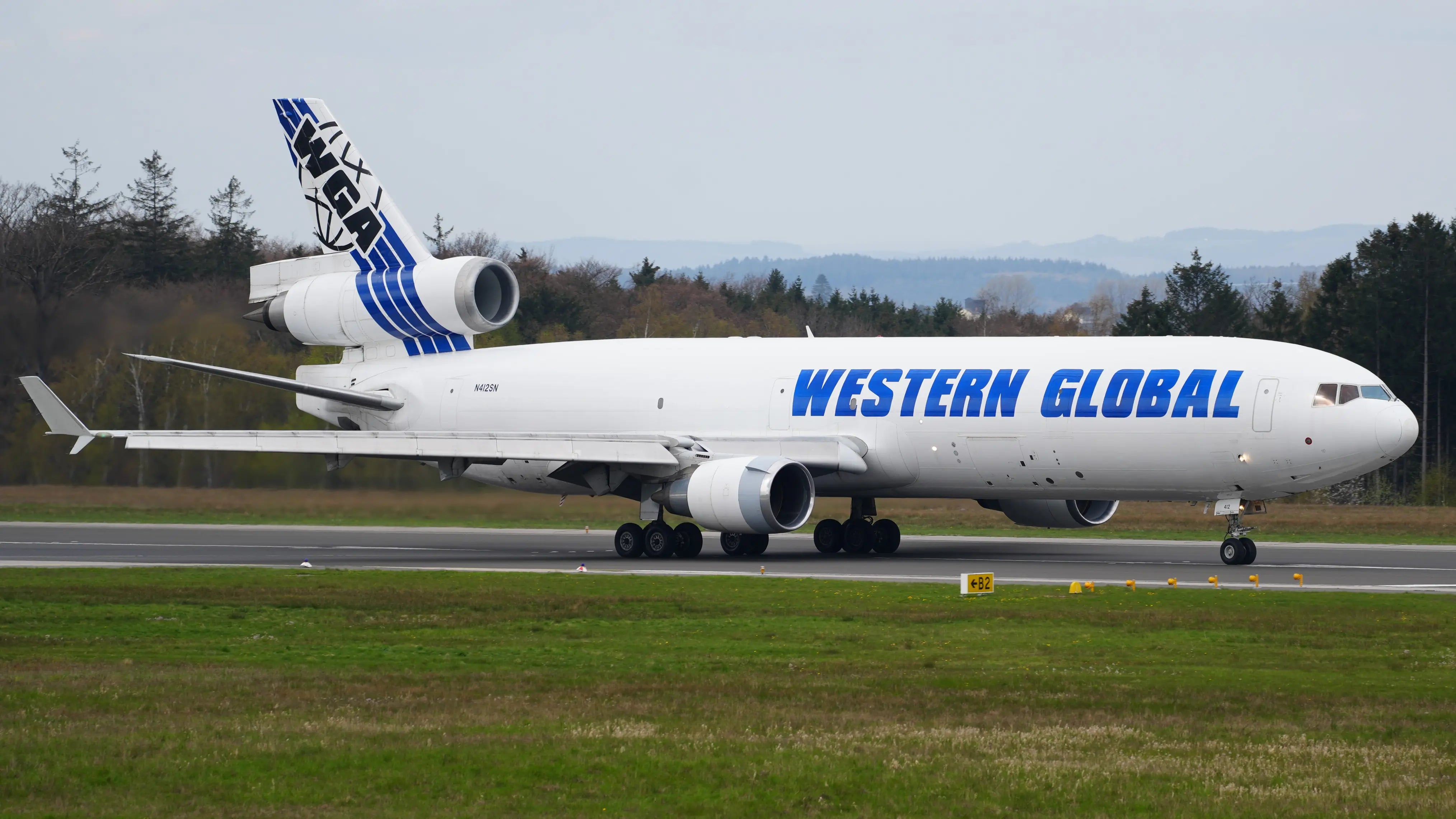
Western Global Overview & Company Profile
Western Global Airlines (IATA: KD, ICAO: WGN, callsign "Western Global") is a privately held American cargo carrier headquartered in Estero, Florida, with its main crew domicile at Southwest Florida International Airport (RSW) in Fort Myers. Founded by Jim Neff on March 6, 2013, the airline received its FAA operating certificate and began revenue flying on August 1, 2014. It is a pure freight operator: it owns and crews its aircraft, then leases that capacity to other airlines, freight forwarders, integrators, and governments under ACMI (Aircraft, Crew, Maintenance, and Insurance), wet-lease, and charter contracts.
Unlike a scheduled passenger airline, Western Global does not sell tickets or fly a published timetable. Its business is moving other people's freight wherever the contract sends it. Over its history the carrier has flown to more than 400 cities across roughly 135 countries on six continents, and it has been a participant in the U.S. Civil Reserve Air Fleet (CRAF) program since 2016, which makes it eligible for U.S. military and government airlift charters. For a pilot, that means genuinely global, long-haul widebody flying from day one, but on an irregular, contract-driven pattern rather than a predictable line.
The company is small and has had a turbulent recent history. It filed for Chapter 11 bankruptcy protection on August 7, 2023 amid a post-pandemic cash crunch and a softening air-cargo market, then exited the restructuring in December 2023 with, in its own words, less than US$100 million in debt. According to the Air Line Pilots Association (ALPA), the pilot group rebuilt to around 147 pilots after the restructuring. As detailed later in this guide, an FAA grounding of the MD-11 fleet in late 2025 then triggered the first furloughs in the company's history, so anyone evaluating Western Global today must weigh strong global flying against a real question mark over stability.
Western Global is a classic "freight dog" operation. You will not see passengers, peak summer schedules, or hub-and-spoke connections. Instead, you fly heavy widebody freighters on long international sectors that follow the cargo, often on multi-day or multi-week trips far from home. The upside is widebody command and worldwide flying at relatively low total-time minimums. The trade-off is irregularity, a great deal of time on the road, and exposure to the health of a single small company. The rest of this guide breaks down exactly what that looks like in pay, schedule, and stability terms.
Fleet Composition & Type Ratings
Western Global flies an all-widebody, two-type freighter fleet built around the three-engine McDonnell Douglas MD-11F and the four-engine Boeing 747-400 freighter. As of late 2025 the fleet stood at roughly 19 aircraft: approximately 15 MD-11F and 4 Boeing 747-400F (converted 747-400BCF airframes). The MD-11 is the backbone of the operation, which is precisely what made the 2025 grounding so disruptive, since the company is far more dependent on a single type than giants like FedEx or UPS.
Both types are mature, out-of-production widebodies. Boeing ended MD-11 production in 2000, and the type now survives almost exclusively as a freighter. The 747-400F is likewise no longer built. For a pilot, this is a double-edged sword. On one hand, you gain experience on iconic heavy aircraft and, in the case of the MD-11, a demanding three-crew-era cockpit that many aviators consider a genuine "stick and rudder" airplane. On the other hand, older airframes mean higher maintenance exposure, a shrinking global pool of operators, and type ratings that transfer to fewer and fewer future employers as these aircraft retire.
| Aircraft Type | Role | Approx. In Fleet | Notes |
|---|---|---|---|
| McDonnell Douglas MD-11F | Long-haul freighter | ~15 | Core of the fleet. Three-engine widebody. Subject to the FAA grounding from November 2025 (see Section 11). |
| Boeing 747-400F (BCF) | Heavy long-haul freighter | ~4 | Converted 747-400 freighters. Continued flying through the MD-11 grounding. |
Fleet figures are approximate and drawn from public records as of late 2025. Numbers shift as aircraft are stored, returned to service, or parked. Several MD-11F airframes were in storage even before the grounding.
Western Global trains and pays for the type rating of pilots it hires through its official process, with initial training based in the Miami, Florida area. New First Officers are assigned to either the MD-11F or the 747-400F based on company need rather than personal preference. Because the airline operates only two types, there is limited fleet movement compared with a major carrier, and your type assignment is effectively dictated by where the company needs crews. Note that an MD-11 type rating, while valuable on the line today, applies to an aircraft family that is contracting worldwide, so factor long-term type marketability into your decision.
The MD-11's structural design returned to the spotlight after a fatal accident in late 2025 (covered in detail in Section 11), and the U.S. FAA subsequently issued inspection and repair requirements before allowing the type back into service in 2026. Pilots considering Western Global should treat the age and regulatory status of the MD-11 fleet as a central part of their evaluation, not a footnote. Always check the current FAA airworthiness status of any type before accepting a position built around it.
Pilot Pay & Compensation
Western Global pays its pilots on a day-rate structure rather than the per-flight-hour model common at U.S. passenger airlines. Each pilot is guaranteed a minimum number of paid days per month, and additional days beyond that guarantee are paid at a premium. According to public pay data compiled by industry resource AirlinePilotCentral, the structure rests on a 17-day monthly minimum guarantee, which the company can involuntarily extend up to 20 days, with days beyond the guarantee paid at roughly double the base day rate.
Crucially, these are pre-first-contract rates. Western Global pilots are still negotiating their initial collective bargaining agreement with ALPA (see Section 10), and the union has publicly stated that current pay lags behind industry peers. Treat the figures below as a baseline that the pilot group is actively trying to raise, not as a settled scale.
First Officer Pay Scale (Day Rates)
| Seniority | Base Day Rate | Annual Est. (17-day gtee) | Premium Day (18+) |
|---|---|---|---|
| Year 1 | $527 | ~$107,500 | $1,054 |
| Year 3 | $558 | ~$114,000 | $1,116 |
| Year 5 | $592 | ~$120,800 | $1,184 |
| Year 8 | $649 | ~$132,400 | $1,298 |
| Year 12 (top) | $697 | ~$142,200 | $1,394 |
Annual estimates assume the 17-day monthly minimum across 12 months and exclude per diem, premium (day 18+) pay, and any profit or incentive elements. Actual earnings vary with the number of days flown.
Captain Pay Scale (Day Rates)
| Seniority | Base Day Rate | Annual Est. (17-day gtee) | Premium Day (18+) |
|---|---|---|---|
| Year 1 | $743 | ~$151,600 | $1,486 |
| Year 3 | $786 | ~$160,300 | $1,572 |
| Year 5 | $834 | ~$170,100 | $1,668 |
| Year 8 | $915 | ~$186,700 | $1,830 |
| Year 12 (top) | $983 | ~$200,500 | $1,966 |
Day 18 onward pays at roughly double the base rate, so pilots who fly extended or company-extended schedules earn meaningfully above the annual estimates shown. A senior Captain working close to a 20-day month can push well past $210,000.
On top of day rates, pilots receive per diem for time on the road, reported at $2.50 per hour (roughly $60 per day), rising to about $100 per day on schedules that span a calendar-month boundary. Because Western Global trips keep crews away from home for long stretches, per diem can add several thousand dollars per year in largely untaxed money. Initial training pay is reported at $6,000 per month during the Miami-based course, with full line pay starting after initial operating experience.
For market context, third-party aggregators such as Glassdoor have estimated an average Western Global pilot total of roughly $116,000 per year across all seats and seniority, which is consistent with a junior-heavy group flying near the minimum guarantee.
The pay figures above are compiled from public pilot-pay databases (notably AirlinePilotCentral) and salary aggregators, and they reflect rates published before the conclusion of the first ALPA contract. Annual totals are estimates only: they depend on actual days flown, premium days, per diem, training status, and the outcome of ongoing contract negotiations. They do not constitute an offer or a guarantee. Always verify current rates directly with the company and with the Western Global ALPA pilot group before making a career decision.
Schedule, Rotations & Quality of Life
Quality of life at Western Global is defined by the ACMI freight model, not by a fixed monthly line. Pilots work to a 17-day minimum guarantee, with the company able to involuntarily extend a trip up to 20 days in a month. In practice this usually means long, continuous rotations away from base followed by a block of days at home, rather than the day-trip-and-overnight rhythm of a domestic passenger pilot. Cargo flying also skews heavily toward nights and back-of-the-clock departures, because freight tends to move when passenger aircraft are on the ground.
A significant feature of the operation is international home basing. Western Global positions crews at overseas bases (reported to include Amsterdam, Seoul-Incheon, Dubai, and Bogotá), with the company paying to get pilots to and from those bases. This can be a positive for pilots who like international living and travel, but it also means time zones, jet lag, and distance from family are constant companions. There is effectively one U.S. domicile (Fort Myers, RSW), so commuting logistics depend heavily on where the company needs you.
📅 Illustrative Monthly Rotation — Widebody Freighter Pilot
Illustrative only. Western Global does not publish a fixed bid line; this graphic represents a typical long-trip-plus-recovery shape implied by the 17-day guarantee, not an official roster. Actual rotations vary widely with contract demand.
The single biggest quality-of-life factor at Western Global is time on the road. A 17-day guarantee at a worldwide ACMI operator typically translates into long continuous trips, irregular sleep, and frequent time-zone shifts. For pilots who value international adventure and don't mind extended stretches away, this can be genuinely appealing. For pilots prioritizing predictable home time and a stable monthly calendar, it is one of the harder lifestyles in the industry. This is a personal-fit question as much as a numbers question.
Benefits & Retirement
As a small private cargo operator, Western Global offers a functional rather than lavish benefits package. The headline retirement benefit is a 401(k) plan with a company match of 50% of employee contributions up to 5% of base salary, which works out to a maximum employer contribution of about 2.5% of base. That is modest compared with the larger U.S. passenger and cargo carriers, several of which contribute well into double-digit percentages, and it is one of the economic items ALPA has flagged in contract talks.
Where Western Global does take care of its crews is in the logistics of getting them to and from a worldwide operation. The company is reported to cover travel to and from international home bases, hotels, visas, and even the cost of a second passport for pilots who need one for high-volume international flying. Pilots also keep hotel and travel reward points earned on the road, which over a year of heavy international travel can add up to a meaningful informal perk.
Read the benefits package through the lens of company size and stage. Western Global is a privately held carrier that recently restructured and is negotiating its first union contract, so several benefit lines (health-plan details, retirement contributions, sick and vacation accrual, and loss-of-license protection) are exactly the items being defined or improved at the bargaining table. If these matter to you, ask for the current benefits summary in writing during the interview process, and compare it against the contract status described in Section 10. Health, disability, and retirement specifics can change materially once a first agreement is signed.
Career Progression & Seniority
Like virtually all U.S. airlines, Western Global runs on a seniority system: your hire date sets your position for upgrades, fleet, base, and schedule preference. The distinguishing feature here is scale. With roughly 147 pilots and only two aircraft types, the seniority list is tiny by industry standards. That cuts both ways. In a growing phase, upgrades to Captain can come quickly because the company simply needs commanders. In a contracting phase, the same small size means almost no buffer and a stalled list.
Historically, Western Global's growth produced relatively fast command opportunities for a widebody operator, and the airline has at times hired directly into either seat depending on a candidate's experience. Because the company flies heavy international freighters, a pilot can reach a widebody Captain seat far sooner here than at a major airline, where the same upgrade can take a decade or more behind a long seniority list. That speed-to-command is one of Western Global's genuine attractions for experienced pilots.
| Career Stage | Typical Path | Notes |
|---|---|---|
| New-hire First Officer | Day 1 after training | Assigned MD-11F or 747-400F per company need. Company-funded type rating. |
| Senior First Officer | Seniority-based | Better trip, base, and schedule bids as you move up the list. |
| Captain upgrade | Faster than at majors (varies) | Historically quick during growth; depends entirely on company size and demand at the time. |
| Widebody Captain | MD-11F or 747-400F | Worldwide heavy command. Top of the day-rate scale. |
| Check Airman / Instructor | By selection | Additional training and company appointment required. |
The flip side of fast upgrades is fragility. A 147-pilot list offers little protection when demand drops, and Western Global had no furloughs in its first twelve years only to furlough roughly half of its MD-11 pilots when that single fleet was grounded in late 2025 (see Section 11). For career planning, treat Western Global as a place where you can build widebody command experience quickly, but where long-term security depends on the company winning and keeping ACMI contracts and on the health of two aging aircraft types. Many pilots historically have used carriers like this as a stepping stone to a larger, more stable airline.
Hiring Requirements & Selection
Western Global hires experienced, already-licensed pilots; it does not run an ab-initio cadet program. Candidates must already hold a U.S. FAA Airline Transport Pilot (ATP) certificate and a current First-Class medical. The published minimum experience is 2,500 hours of total flight time, which is low for a widebody freighter operator and reflects the carrier's appetite for pilots who are ready to move into heavy international flying without a long résumé. Prior Part 121 airline experience is preferred but not strictly required.
Core Requirements
Typical Selection Stages
Application & Screening
Submit your application and résumé through the company's careers channel. Recruiters screen for the ATP, total-time minimum, medical, passport eligibility, and a clean record. International mobility is essential given the worldwide operation.
Interview
Expect a structured interview covering technical knowledge, experience, and the realities of long international freight rotations. Fit for a small-company, time-away-heavy lifestyle is a genuine selection factor, so be honest with yourself about the schedule before applying.
Simulator / Skills Assessment
A simulator evaluation is standard for widebody freighter hiring, assessing instrument flying, procedures, and crew coordination. Preparation on raw-data instrument skills and standard callouts pays off here.
Conditional Offer, Medical & Background
Successful candidates receive a conditional offer subject to a current First-Class medical, background and drug screening, and verification of certificates and history. CASS and jumpseat eligibility are handled at this stage.
Type Rating & Initial Training
New hires complete company-funded type-rating and initial training in the Miami, Florida area (training pay reported around $6,000/month), followed by initial operating experience on the line before full pay begins.
Because Western Global hires in waves tied to contract demand, hiring can pause or surge with little notice, and the late-2025 MD-11 grounding froze recruitment for the affected fleet. Monitor the company's own careers page and reputable pilot-hiring trackers, and apply when a wave opens. Emphasize international flying, adaptability, and comfort with extended trips. If you are early in your career and just clearing the 2,500-hour mark, Western Global is one of the few routes into widebody command experience at relatively low total time, but weigh that opportunity against the stability questions raised throughout this guide.
Network, Bases & Layover Hubs
Western Global has no fixed passenger network, but its ACMI and charter work concentrates around a set of international operating hubs and home bases. Over its history the carrier has served more than 400 airports across roughly 135 countries, with strong activity on transatlantic, transpacific, Europe-to-Africa, and Latin American freight lanes. For pilots, the most relevant "destinations" are the home bases and hub cities where you will spend rotation time, not tourist stops. Layovers on a freighter follow the cargo and the duty limits, so rest stops are determined by the contract and the schedule rather than by bid preference.
On an ACMI cargo operation, rest stops are dictated by flight-time and duty limits and by where the freight is going, not by a layover bid. Western Global has also flown long-term contracts such as MD-11 service for Network Airline Management on Europe-to-Africa routes based out of Liège, Belgium, and has used Hong Kong as a major Asian gateway. Expect your time on the ground to be functional rest between sectors rather than sightseeing, with hotels arranged by the company. The upside is that, over a career here, you will see a remarkable cross-section of the world's airports.
How Western Global Compares: Airline Radar Chart
Western Global's most natural peers are the other U.S. widebody ACMI and charter freight operators: Atlas Air and Kalitta Air. All three crew heavy widebodies on worldwide contract flying, all three keep pilots away from home for long stretches, and all three compete for the same experienced cargo pilots. The radar below scores the three across the same six themes used in the scorecard. Scores are editorial estimates based on publicly available pay data, fleet information, and union and industry reporting.
Key Takeaways from the Comparison
Atlas Air leads on pay and scale. Atlas operates a large, diverse widebody fleet (747-400F, 747-8F, 767, and 777 freighters) and flies a ratified collective agreement under the Teamsters. Public data shows Atlas First Officer rates starting near $97 per hour and 747 Captain rates topping out above $330 per hour, with Glassdoor estimating an average Captain total around $225,000. Its much larger pilot list and blue-chip customers (including major express integrators and the U.S. military) give it more stability than a 147-pilot carrier can offer.
Kalitta Air is the privately held middle ground. Kalitta flies 747-400 freighters and 777Fs, with first-year First Officer pay reported around $117 per hour on a 64-hour guarantee. As a long-established, privately owned operator with a steady freight book, it scores well on stability relative to Western Global, while sharing the same demanding time-away lifestyle common to all ACMI flying.
Western Global's strengths are speed-to-command and accessibility. Lower total-time minimums (2,500 hours) and a small list mean a motivated pilot can reach widebody experience, and historically command, faster here than at the larger players. The trade-offs are clear on the chart: lower benefits, a two-type aging fleet, and a job-security score dragged down by the 2023 restructuring and the 2025 MD-11 grounding.
All three share the freight-dog lifestyle. None of these carriers is a fit for a pilot who wants predictable home time. Work-life scores cluster in the middle-to-lower band across the board, because long international rotations are the nature of the business, not a quirk of any single airline.
Scores are editorial estimates derived from public pay databases (AirlinePilotCentral, Glassdoor), fleet records, ALPA and Teamsters communications, and trade reporting (FreightWaves, Air Cargo News). They reflect a general assessment for an experienced pilot weighing a long-term career, as of mid-2026. Individual experience varies with seat, seniority, base, and personal priorities, and the figures for all three carriers move with new contracts and market conditions. Always verify current data directly with each airline and its pilot representatives.
Union & Labor Relations
Western Global pilots are represented by the Air Line Pilots Association, International (ALPA), the largest airline pilot union in the world. The Western Global pilots voted to join ALPA in 2021, and they have been working toward their first collective bargaining agreement ever since. That first-contract status is the single most important labor fact for any prospective applicant: pay, benefits, schedule rules, and job protections are still being defined, so much of what you experience day to day rests on company policy rather than an enforceable contract until the agreement is signed.
Where Things Stand
Formal negotiations opened in 2022. In July 2024, the pilots, through their ALPA Master Executive Council, jointly requested federal mediation from the National Mediation Board (NMB), and the talks moved into mediation in October 2024. ALPA stated that the move followed management slow-walking negotiations and backtracking on proposals, and that pilot pay had fallen behind industry peers. Bargaining dates have been scheduled out through 2026, with progress further complicated by external events including a U.S. government shutdown in October 2025 and, more dramatically, the MD-11 grounding crisis covered in the next section.
Recent Labor Timeline & Disputes
A unionized group with active first-contract talks is a mixed signal. On the positive side, ALPA representation gives pilots a structured voice, legal backing, and a path to enforceable improvements, and the pilots themselves have publicly pushed for pay closer to industry norms. On the cautious side, until the first agreement is ratified, your working conditions rest largely on company policy, and the recent furloughs show how exposed a small group can be. If you are considering Western Global, follow ALPA's Western Global pilot group updates closely, and ask in your interview where contract talks stand and how recalls from the 2025 furlough are being handled.
The MD-11 Grounding & Job Security
No honest guide to Western Global can skip the event that has dominated its recent history. On November 4, 2025, a UPS-operated MD-11F lost its left engine on takeoff from Louisville, Kentucky and crashed, killing people on board and on the ground. Investigators from the NTSB found fatigue cracks in a support structure (the pylon bearing race) connecting the engine and wing. Four days later, on November 8, 2025, the U.S. FAA grounded the entire MD-11 and MD-11F fleet pending inspection and repair.
For most operators the grounding was painful but survivable, because the MD-11 is a small slice of their fleets. For Western Global it was an existential blow: the MD-11 is the core of the airline. With its main aircraft type grounded, the company informed its MD-11 pilots that they were furloughed indefinitely effective November 22, 2025. Reporting indicated roughly 75 pilots were affected, out of a group of about 147. The company stated it had never furloughed or cut pay in its twelve-year history before this point, underscoring how unusual and severe the situation was.
The grounding was initially expected to be brief, but the inspections were upgraded from "noninvasive" to "highly invasive," requiring physical repairs and part replacements (including a key spherical bearing) before the type could fly again. That extended the timeline by months. The FAA approved Boeing's return-to-service protocol and lifted the grounding in May 2026, with FedEx operating the type's first post-grounding revenue flights around May 10, 2026. Western Global has signaled its intent to return its MD-11Fs to service, but the pace of bringing aircraft back and recalling furloughed pilots remained uncertain as of mid-2026, and the company is far smaller and more financially exposed than the integrators.
This is the area where Western Global scores lowest, and the reason is concrete rather than theoretical. The carrier emerged from Chapter 11 in late 2023, operates an aging two-type fleet concentrated on the MD-11, and then furloughed roughly half its MD-11 pilots when that single type was grounded. Even with the grounding lifted in 2026, an aspiring pilot should treat Western Global as a higher-risk employer whose fortunes ride on a narrow fleet and on winning ACMI contracts. That does not make it a poor choice for everyone: pilots seeking fast widebody command experience, or a bridge to a larger carrier, may still find real value here. But go in with eyes open, ask hard questions about recalls and fleet plans, and avoid betting your entire career on a single small operator.
If you reach an offer, get current answers to: How many MD-11Fs has Western Global actually returned to service? What is the recall status and seniority order for the November 2025 furloughees? Where do first-contract talks stand, and what pay and furlough-protection language is on the table? What does the forward ACMI contract book look like? The answers to these questions matter more for your decision than any historical pay table.
Verdict: Who Is Western Global For?
🎯 Our Take
Western Global Airlines is a niche, worldwide widebody freight operator that offers something rare: heavy international flying, and historically fast command, at relatively low total-time minimums. For the right pilot, that is a genuine opportunity. You can build MD-11 or 747-400 experience and see a remarkable slice of the world's airports far sooner than you could behind the long seniority lists of a major carrier.
The trade-offs are equally real and, right now, weigh heavily. Pay sits below larger peers and is still being negotiated in a first ALPA contract. Benefits are modest. The lifestyle involves long international rotations and a great deal of time away from home. And the airline's stability has been tested hard: a 2023 Chapter 11 restructuring was followed by the late-2025 MD-11 grounding that furloughed roughly half its MD-11 pilots, the first furloughs in company history. The MD-11 returned to service in 2026, but the carrier's narrow, aging fleet and contract-driven model keep job security as the dominant concern.
In short, Western Global can be a strong stepping stone or a good fit for adventurous, mobile pilots who value widebody time and worldwide flying, provided they understand and accept the elevated risk. It is not the place for a pilot whose top priorities are stability, predictable home time, and top-of-market pay and benefits.
1Is Western Global a stable place to work right now?
It is a higher-risk employer than most. Western Global exited Chapter 11 bankruptcy in December 2023, then furloughed roughly 75 of its approximately 147 pilots in November 2025 when the FAA grounded the MD-11 fleet, the carrier's first-ever furloughs. The grounding was lifted in May 2026 and the MD-11 is returning to service, but the company depends heavily on a single aging type and on winning ACMI contracts. Stability is the main reason its job-security score is low in this guide.
2What aircraft would I fly?
Western Global operates two widebody freighter types: the McDonnell Douglas MD-11F (the core of the fleet, roughly 15 airframes) and the Boeing 747-400F (about four aircraft). New hires are assigned to one type based on company need rather than personal choice. Both are mature, out-of-production aircraft, so factor the long-term marketability of an MD-11 type rating into your decision.
3How much do Western Global pilots earn?
Pay is structured on day rates with a 17-day monthly minimum guarantee. Public data shows First Officer base day rates running roughly from $527 (year one) to $697 (year twelve), and Captain rates from about $743 to $983, with days beyond the guarantee paid at roughly double. That works out to annual estimates of around $107,000 to $142,000 for First Officers and about $151,000 to $200,000-plus for Captains, before per diem and premium days. These are pre-first-contract figures that ALPA is working to raise, and aggregators estimate an all-pilot average near $116,000.
4What are the minimum requirements to get hired?
You need a current FAA ATP certificate, a valid First-Class medical, a minimum of 2,500 hours total time, ICAO English Level 4 or higher, an FCC radiotelephone permit, and a valid passport for unrestricted international travel. A clean accident and incident record is expected, and prior Part 121 airline experience is preferred but not strictly required. The 2,500-hour minimum is notably low for a widebody operator.
5Are Western Global pilots unionized, and is there a contract?
Yes, the pilots are represented by ALPA, having voted to organize in 2021. However, they are still negotiating their first collective bargaining agreement. Talks opened in 2022 and moved into federal mediation under the National Mediation Board in October 2024, with bargaining continuing into 2026. Until that first contract is ratified, many working conditions rest on company policy rather than enforceable contract language.
6Where are pilots based?
The primary U.S. domicile is Fort Myers, Florida (RSW). Because the operation is worldwide, the company also uses international home bases reported to include Amsterdam (AMS), Seoul-Incheon (ICN), Dubai (DWC), and Bogotá (BOG), with the company paying to position pilots to and from those bases. Expect international living and significant time in different time zones depending on where you are assigned.
7How long does it take to upgrade to Captain?
There is no fixed published timeline, and upgrade speed depends entirely on company size and demand at the time. Historically, Western Global's growth produced relatively fast command opportunities compared with major airlines, where widebody upgrades can take a decade or more. The caveat is that a small seniority list also stalls quickly when demand falls, as the 2025 furloughs demonstrated.
8Does Western Global pay for the type rating?
Yes. Pilots hired through the official process receive company-funded type-rating and initial training, conducted in the Miami, Florida area, with training pay reported around $6,000 per month. Full line pay begins after initial operating experience. The company is also reported to cover travel, hotels, visas, and second-passport costs associated with international flying.
Official Links & Resources
Before applying or making a career decision, verify everything against primary sources. Working conditions, fleet status, and hiring at a small carrier like Western Global can change quickly, so the links below are the most useful places to confirm current information.
For a fast-moving situation like Western Global's, the two most valuable bookmarks are the ALPA Western Global pilot group page for labor and recall news, and reputable air-cargo trade outlets such as FreightWaves and Air Cargo News for fleet and contract developments. Check both before any interview so you can ask informed questions about recalls, fleet status, and where the first contract stands.
- 01Overview & Company Profile
- 02Fleet & Type Ratings
- 03Pay & Compensation
- 04Schedule & Quality of Life
- 05Benefits & Retirement
- 06Career Progression
- 07Hiring & Selection
- 08Network, Bases & Layovers
- 09Airline Comparison
- 10Union & Labor Relations
- 11MD-11 Grounding & Job Security
- 12Verdict & FAQ
- 13Links & Resources