

West Atlantic UK Overview & Company Profile
West Atlantic UK Limited is a specialist British cargo airline built almost entirely around one thing: moving mail and express freight through the night. Based at East Midlands Airport (EMA) near Castle Donington, it flies a small, hard-worked fleet of Boeing 737 freighters and an ATR 72 turboprop on behalf of Royal Mail and integrated express customers, connecting UK sorting hubs and near-European destinations while most of the country is asleep. This is not a passenger carrier, not a glamour airline, and not a place to chase wide-body long-haul. It is a focused freight-dog operation, and for the right pilot that focus is exactly the appeal.
The company is the UK arm of the wider West Atlantic group, a European cargo platform created in 2011 through the merger of West Air Europe of Sweden and Atlantic Airlines of the United Kingdom, and now organised under the Swedish holding company West Atlantic AB. In group filings, West Atlantic AB is described as operating its European cargo business through two airline subsidiaries: the UK carrier (registered as Atlantic Airlines Ltd and trading as West Atlantic UK) and West Atlantic Sweden AB. The UK entity is registered with Companies House (company number 05059096), with its registered office at Osprey House, Pegasus Business Park, on the East Midlands Airport campus. Corporate details and the group's own description of its cargo business are published on the West Atlantic corporate website.
A note on identity codes, because they cause genuine confusion. The UK operator flies under the ICAO designator NPT and the radio callsign Neptune, as listed by specialist code registries and safety databases. The IATA two-letter code PT is a group and legacy designator that some databases attach to West Atlantic; in practice a contract cargo carrier that does not sell tickets or interline freight on a retail basis has little use for an IATA code, and the UK air operator's certificate is best identified by ICAO NPT / callsign Neptune. The older callsign "Night Express" belongs to predecessor operations and is not current for West Atlantic UK. Pilots researching the airline should search under both West Atlantic UK and NPT to find the most accurate operational records.
The scale here is modest and worth being honest about. Public business intelligence profiles estimate a UK workforce in the region of 100 to 200 people across all functions (pilots, engineers, ground staff, dispatch and administration), operating a fleet of roughly ten aircraft. Standalone revenue figures for the UK entity are not clearly disclosed and some third-party estimates look unreliable, so this guide does not quote a single revenue number; at group level, West Atlantic AB has historically described operating a European cargo fleet of around 40 aircraft across its two airlines. For a pilot, the takeaway is simple: this is a lean, contract-driven regional freight specialist, not a large network airline, and the culture reflects that.
West Atlantic UK is a small, privately held cargo operator that publishes relatively little pilot-facing information compared with major passenger airlines. The figures in this guide are compiled from company recruitment postings, specialist aviation databases (ch-aviation, Planespotters, Skybrary, CAPA), pilot job boards (Skybound, Pilot Jobs Network) and pilot forums (PPRuNe Freight Dogs). Where data is thin, such as detailed benefits or union recognition, that is stated plainly rather than filled with assumption. Always verify current terms directly with West Atlantic before making a career decision.
Fleet Composition & Type Ratings
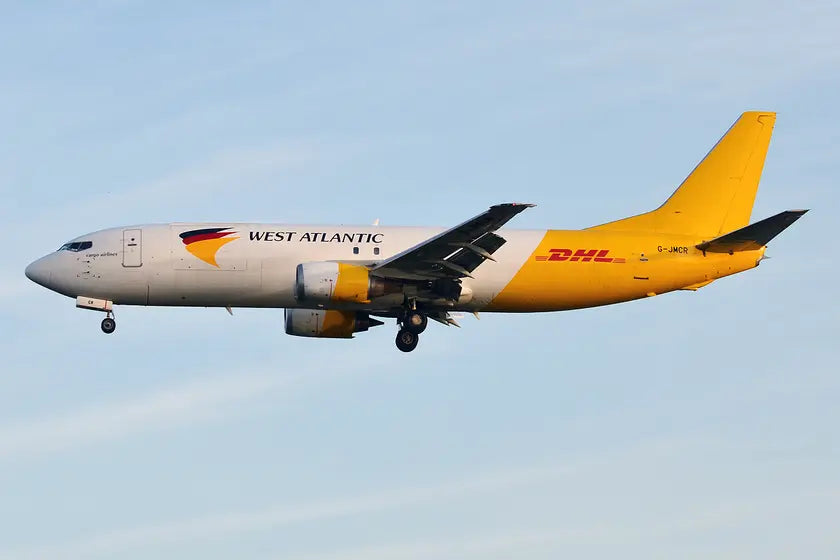
West Atlantic UK is, today, essentially a Boeing 737 freighter operator with a single ATR 72 turboprop attached. The fleet mixes older 737-400 classic freighters with newer 737-800BCF conversions, reflecting a slow but real modernisation away from the noisier, thirstier classic jets. As of late 2025 and into early 2026, the most consistent published snapshot puts the fleet at around ten aircraft: five Boeing 737-400F/SF, four to six Boeing 737-800BCF, and one ATR 72-200F. The exact 737-800 count varies between sources depending on delivery timing and how group aircraft are attributed, so treat the numbers as a live snapshot rather than a fixed census.
| Aircraft Type | Role | In Service (approx.) | Notes |
|---|---|---|---|
| Boeing 737-400F / SF | Narrowbody freighter | ~5 | Classic workhorse for UK & European night mail. Being gradually reduced. |
| Boeing 737-800BCF | Narrowbody freighter | ~4 to 6 | Converted Next-Generation freighter. Newer, quieter, more efficient. Fleet growing. |
| ATR 72-200F | Regional turboprop freighter | ~1 | Thinner and shorter sectors. Replaced the retired BAe ATP. |
| Boeing 737-300F | Narrowbody freighter | Retired | Oldest 737 classics phased out through 2023 to 2024. |
| BAe ATP (freighter) | Regional turboprop | Retired | Withdrawn from UK operations by September 2022; the group's last ATP went in early 2023. |
Fleet data reconciled from ch-aviation, Planespotters, Cargo Facts and Wikipedia entries dated late 2025 to February 2026. Numbers are approximate and shift with deliveries, lease returns and Royal Mail contract adjustments.
Two structural facts shape the flying. First, the average fleet age is high (Planespotters has cited around 28 years), because the 737-400F classics date from the late 1980s and 1990s. Older airframes mean more attention to corrosion control, structural checks and dispatch reliability, which the group supports through an EASA Part-145 maintenance organisation approved across its aircraft types. Second, the 737-800BCF programme is genuinely modernising the operation. East Midlands Airport was the stage for the unveiling of the world's first converted 737-800 cargo aircraft, and West Atlantic has continued to bring the type into service, giving pilots exposure to a modern NG flight deck that is highly portable across the global airline market.
Historically, both Atlantic Airlines in the UK and West Air Sweden built their networks on the BAe ATP freighter, supported by 737 classics. When the West Atlantic group won its multi-year Royal Mail contract, industry reporting described the group committing nine Boeing 737 freighters and three BAe ATP freighters to Royal Mail work, with the UK arm then operating a fleet built around 737-300F and 737-400F aircraft. The subsequent story, well documented in ch-aviation's reporting on the Royal Mail fleet cuts, has been one of consolidation: retire the oldest classics, retire the ATP entirely, and lean progressively on 737-800BCF economics.
Entry is normally onto the Boeing 737, either as an already type-rated First Officer or through a non-type-rated (NTR) scheme where West Atlantic provides the 737 freighter type rating. For turboprop roles, the ATR 72 is the entry type. Because the group runs both jet and turboprop fleets under a common maintenance and training umbrella, there is in principle scope to move between the ATR and the 737 as operational needs dictate, though the airline does not publish a formal cross-fleet bidding policy. Where West Atlantic funds a rating, it typically uses a training loan or bond agreement (explicitly stated for its ATR cadet intake).
Pilot Salary & Compensation Breakdown
Pay at West Atlantic UK follows a hybrid model that is common in night freight but unusual to a pilot arriving from a passenger airline. There is a fixed basic salary, and then two variable layers on top: an hourly allowance for time away from base (reported at £1.85 per hour, rising to around £2.80 per hour for captains on certain patterns), and a mileage or sector payment tied to distance flown. Because so much of the flying is done overnight and away from East Midlands, those allowances add up meaningfully over a seven-day tour. The structure rewards the pilots who actually spend the nights out on the line.
First Officer Pay
| Grade | Reported Basic | Variable Pay | Notes / Source |
|---|---|---|---|
| B737 First Officer (current) | £44,269 | + £1.85/hr away-from-base + air mileage | Current Skybound job listing figure. |
| First Officer (earlier reported) | ~£33,500 | Same allowance structure | Older PPRuNe report, pre-uplift. |
| Senior First Officer (earlier) | ~£38,600 | Same allowance structure | SFO grade = 500 hrs on type or 2 years, whichever first. |
First Officer basics have clearly risen: the current advertised B737 F/O basic of £44,269 is well above the low-to-mid £30,000s reported in older forum posts, reflecting a tighter market for experienced 737 crews.
Captain Pay
| Grade | Reported Basic | Variable Pay | Estimated Total |
|---|---|---|---|
| B737 Captain | ~£66,000+ | £1.85 to £2.80/hr away + £4.58 to £9.16 per 100 nm | ~£75,000+ all-in |
| ATR Captain (official figure) | £73,673 | £29.06 per sector + £1.85/hr away-from-base | Varies with sectors flown |
Captain figures are drawn from pilot forum reports (B737) and West Atlantic's own ATR Captain recruitment posting. The mileage rate varies with the time of night or early morning, which is characteristic of overnight mail flying.
How does this stack up? For a regional narrowbody freighter role, West Atlantic UK sits in the mid-range of the UK market. It will not match a wide-body cargo captain at an operator like DHL Air UK, and it will not touch a legacy passenger major or a Gulf carrier in gross terms. But the total package, once away-from-base and mileage pay are included, is competitive for the sector, and the pay comes attached to a genuinely lifestyle-friendly roster. Current advertised numbers can be cross-checked on the Skybound job board and on the crowdsourced Pilot Jobs Network pay pages.
These figures are compiled from public recruitment adverts and pilot forums, not from a published collective pay scale, and some captain figures are indicative rather than confirmed. Actual earnings depend heavily on how much a pilot is rostered away from base and on the mileage flown, so two pilots on the same grade can take home noticeably different amounts. UK income tax and National Insurance also apply. West Atlantic has not published a full B737 captain pay table publicly, so command-level numbers in particular should be confirmed directly with the airline.
Roster Pattern & Quality of Life
The single most talked-about feature of West Atlantic UK, and the reason many pilots choose it, is the 7-days-on / 7-days-off block roster widely reported for its 737 operation. You work a tour of duty (predominantly nights), then you get a full week off. Over a year that pattern means you are effectively working roughly half the calendar in duty weeks, on top of annual leave. For pilots who value large, predictable, uninterrupted blocks of home time, this is close to the best structure in UK commercial flying.
📅 Sample Month — Boeing 737 Freighter Pilot (7-on / 7-off, East Midlands)
The illustration above shows the principle rather than a literal published roster: alternating duty weeks and off weeks, with the duty days weighted toward night sectors and the occasional standby. Pilots on the fleet note that not every one of the seven duty days is necessarily a full flying day, and that many rotations concentrate around the mid-week mail peak, so a duty week can include lighter days or standby rather than five hard night sectors back to back. Annual leave is a documented 28 days, with the leave year running from 1 January to 31 December, consistent across West Atlantic UK's published pilot postings.
The trade-off is equally real, and no honest guide should soften it: this is night flying. Reports in the evening, on-chocks times in the small hours, and a body clock that flips every seven days. Approaches and departures cluster at circadian low points, often into secondary UK and European airports in poor weather. Fatigue management under UK Civil Aviation Authority flight time limitations (derived from the EASA framework) is central to how the roster is built, and the 7-on / 7-off block is itself a fatigue tool, giving a long continuous recovery window after each duty tour. Prospective pilots should be candid with themselves about how well they tolerate sustained night work before applying.
The home base is East Midlands Airport, in the heart of England with strong road and rail links to Nottingham, Derby, Leicester and Birmingham. Pilots living within driving distance can commute to each night's report and sleep at home during the day. Those living further afield often use the 7-on / 7-off pattern as a block-commuting rhythm: travel to base for the duty week, then return home for the entire week off. West Atlantic does not publish a base-bidding system, and East Midlands should be treated as the single realistic base for the UK operation.
Benefits, Training Bond & Retirement
Benefits are the area where West Atlantic UK publishes the least, so this section is deliberately cautious. What can be stated confidently is drawn from the airline's own recruitment postings and standard UK employment law; anything beyond that is flagged as not publicly confirmed. Prospective applicants should treat the benefits package as something to nail down in writing during recruitment rather than assume from this guide.
The most tangible pilot-facing benefit is the funded type rating on the non-type-rated route. For a pilot with a frozen ATPL and limited jet time, a company-provided Boeing 737 freighter rating is a substantial financial and career step, even when it comes attached to a loan or bond that is repaid or worked off over a defined period. West Atlantic's ATR cadet material is explicit that training costs are borne by the company against a signed loan agreement, and a similar bonded structure is the industry norm for its 737 NTR intake. Read any bond terms carefully, including the repayment schedule and what happens if you leave early.
Unlike a large legacy carrier with a published collective agreement, West Atlantic UK does not appear to publish the fine detail of its pension contributions, loss-of-licence cover, private medical arrangements, sick pay or death-in-service benefits. The absence of public information is not evidence that these benefits are poor or missing; it simply means they are not verifiable here. Before signing, request the full contract and benefits summary, and if possible speak to a current line pilot. This is standard diligence for any smaller operator.
Career Progression & Command
Career progression at West Atlantic UK is best understood through the lens of a small airline. On the plus side, the company advertises a structured pathway towards command, and the modernisation of the fleet toward the 737-800BCF creates ongoing training activity. On the realistic side, this is a roughly ten-aircraft operation, so the number of command seats is finite, upgrade timing depends on fleet stability and turnover, and there is no wide-body ladder to climb. Pilots who join should be clear about whether they want a stable long-term home on the 737 freighter, or a stepping stone to build solid jet hours before moving on.
West Atlantic fills command through a mix of internal upgrades and direct-entry captains. That dual approach is typical for a smaller cargo operator where fleet changes can outpace the internal pipeline. A documented internal milestone is the Senior First Officer grade, reached at 500 hours on type or two years with the company, whichever comes first, which brings a pay step. The jump from Senior First Officer to command then depends on vacancies, individual performance and meeting UK licensing minima for a multi-crew jet command.
| Career Milestone | Typical Route | Notes |
|---|---|---|
| Join as First Officer (NTR) | Frozen ATPL + 70 hrs PIC | Company-provided 737 freighter type rating, usually bonded. |
| Join as First Officer (type-rated) | 500 hrs total + 250 hrs jet | Current Boeing 737 rating required. Higher-time entry. |
| Senior First Officer | 500 hrs on type or 2 years | Defined grade with a pay step. |
| Captain (internal upgrade) | Vacancy-dependent | Command course plus simulator and line assessment. |
| Direct-entry Captain | ~3,000 hrs, UK ATPL | Inferred from ATR command minima (3,000 hrs total, 600 hrs PIC on type) and UK norms; 737 figures not publicly confirmed. |
| Cross-fleet (ATR <> 737) | Operationally driven | Group runs both fleets; no published bidding policy. |
Exact upgrade timelines are not published by West Atlantic UK and depend on fleet stability, contract volumes and staff turnover. Direct-entry captain minima are inferred from the airline's ATR command requirements and standard UK practice, not from a published 737 captain advert.
West Atlantic UK's trajectory in recent years has been one of consolidation rather than rapid growth: retiring the oldest 737-300F classics and the entire BAe ATP fleet, trimming some 737-400F capacity around adjustments to the Royal Mail network, and adding 737-800BCF aircraft. For pilots, fleet renewal generates recurrent and conversion training and can open command opportunities, but a contract-driven cargo airline also lives and dies by its contracts. Progression prospects are tied to the group holding and renewing its key mail and express business.
Recruitment Process & Requirements
West Atlantic UK recruits Boeing 737 First Officers through two distinct routes, and understanding which one you fit is the key to applying successfully. There is a higher-time, type-rated route for pilots who already hold a current 737 rating, and a non-type-rated (NTR) route for lower-time pilots with a frozen ATPL, where the company provides the type rating. Turboprop pilots enter separately on the ATR. All routes require a UK CAA licence, a UK Class 1 medical, and the right to live and work in the UK, with no visa sponsorship offered.
Type-Rated B737 First Officer — Requirements
Non-Type-Rated (NTR) B737 First Officer — Requirements
How the Selection Works
Application via the West Atlantic portal
Vacancies for both jet and turboprop roles are posted on the West Atlantic recruitment portal, and are frequently mirrored on pilot job boards such as Skybound and Pilot Jobs Network. Applications are submitted with a CV, licence and medical details, and a logbook summary. Confirm the exact route (type-rated or NTR) each advert refers to before applying.
Screening & document check
The airline verifies licence validity, hours against the advertised minima, medical status and the right to work in the UK. For the type-rated route this includes confirming a current 737 rating and the required jet time; for the NTR route it centres on the frozen ATPL package and PIC minimum.
Assessment & interview
Expect a competency-based interview and, in line with standard UK cargo practice, a simulator assessment appropriate to the role. West Atlantic does not publish the full detail of its selection day, so treat this stage as a typical airline assessment: technical knowledge, crew resource management and handling under a realistic night-freight scenario.
Type rating or line entry
NTR candidates proceed to a company-provided 737 freighter type rating, normally under a training loan or bond. Type-rated joiners move more directly to operator conversion and line training. Turboprop joiners complete ATR training. New hires should plan on being based at East Midlands.
Be precise about which stream you qualify for, because the hour and rating requirements differ sharply between the type-rated and NTR routes. If you are lower-time, the NTR scheme is the realistic door in, and a bonded rating on a modern 737 NG freighter is a strong hours-builder. Demonstrate genuine comfort with night operations and short-sector, high-cycle flying, since that is the entire job. Keep an eye on the official portal directly, as smaller operators open and close vacancies quickly and third-party listings can lag behind.
The Night Freight Operation & Network
Because West Atlantic UK is a cargo carrier, there are no passenger-style layover destinations to rank, and this guide deliberately does not invent glamorous crew stopovers that the operation does not have. What matters to a pilot here is a different thing entirely: the shape of the night, the nature of the sectors, and who the flying is for. This section replaces the usual layover feature with an honest picture of the actual working environment.
The heartbeat of the airline is the overnight mail cycle. Aircraft launch after the evening's post and parcels have been processed and sorted, run their sectors through the night, and land in time for the morning delivery cut-offs. The anchor customer is Royal Mail: the West Atlantic group secured a multi-year Royal Mail contract to operate a fleet of 737 freighters (originally alongside BAe ATP freighters) across the United Kingdom, and that network continues to define the UK schedule. Beyond Royal Mail, group marketing describes West Atlantic as a supplier to the integrated express and mail industries, the standard term for the global parcel integrators, so some flying supports express operators on ACMI or contract terms.
East Midlands is not a random choice of base. It is the United Kingdom's busiest dedicated air-cargo airport, home to the national hubs of major express integrators, which makes it the natural gravity well for a mail and parcel operation. From there, West Atlantic UK's own recruitment describes flying "throughout the UK and Europe," so First Officers should expect a blend of domestic trunk and feeder legs linking sorting hubs with regional points, plus intra-European sectors into continental integrator hubs. The specific route map is contract-dependent and changes over time, so this guide describes the pattern rather than naming a fixed list of stations.
For the pilots who thrive here, the appeal is precisely what a passenger operation lacks. There is no cabin service to manage and no delays chasing connecting passengers, just the aircraft, the cargo and the clock. The flying is operationally rich: frequent hand-flown approaches at night, real winter weather into secondary airfields, tight departure windows tied to mail deadlines, and a strong emphasis on accurate loading, weight and balance, and on-time performance. It rewards precise, self-reliant operators who like short-haul, high-tempo flying and who genuinely do not mind, or actively prefer, working while the rest of the country sleeps.
Night freight is a lifestyle choice as much as a job. The upside is a clean, focused operation, a highly predictable 7-on / 7-off rhythm, and long blocks of genuine home time. The downside is a reversed body clock during every duty week and the physiological cost of repeated night operations. Pilots who commute in, sleep well during the day, and value time off in large blocks tend to love it; those who need a stable daytime routine or dislike winter night approaches into regional airports should think carefully. Talk to a current West Atlantic line pilot before you commit.
How West Atlantic UK Compares: Cargo Operator Radar
How does West Atlantic UK measure up against the other UK-based cargo employers a pilot might realistically consider? The two most relevant comparators are DHL Air UK, the wide-body 767 operator flying DHL Express's own network, and ASL Airlines UK, a 737 operator running Amazon and DHL contracts across multiple European AOCs. The radar below scores the same five dimensions used in the scorecard. These are editorial estimates based on public data, fleet profiles and pilot feedback, not precise measurements.
Key Takeaways from the Comparison
West Atlantic UK wins on roster predictability. The reported 7-on / 7-off block, with genuine week-long chunks of time off and a single fixed base, is more lifestyle-friendly than the multi-day, more variable trips that wide-body cargo flying at DHL Air UK can involve. For a pilot whose priority is knowing exactly when they are home, this is West Atlantic's strongest card.
DHL Air UK generally leads on pay, fleet and stability. Wide-body 767 flying (with newer types entering DHL's wider fleet) typically pays more, especially at command, and DHL owns the network it serves, which tends to translate into strong job security and a well-resourced benefits package. The trade-off is longer sectors, more time away, and less of the tidy home-every-week rhythm.
ASL Airlines UK sits in the middle. As a 737 operator on Amazon and DHL contracts, its fleet is broadly comparable to West Atlantic's jet side but skews newer, and its scale across multiple European AOCs can offer more route and aircraft variety. Pay and conditions are broadly in the same regional-narrowbody band.
West Atlantic's soft spots are fleet age and scale. The 737-400F classics push the average fleet age high, and a roughly ten-aircraft operation offers a narrower command pipeline and no wide-body ceiling. The 737-800BCF programme is closing the fleet gap, but a pilot with wide-body or long-haul ambitions will find more room at a larger operator.
Scores are editorial estimates based on public fleet data, recruitment postings, pilot forums and general industry knowledge, not on audited internal figures from any of the three airlines. They reflect a general assessment for an experienced pilot weighing a UK cargo career, and individual experience will vary with fleet, seniority and personal priorities. DHL Air UK and ASL Airlines UK scores are indicative benchmarks and will be refined as dedicated guides for those carriers are published.
Union & Industrial Relations
Industrial relations is a genuinely thin area for public information at West Atlantic UK, and it would be dishonest to pretend otherwise. The principal trade union for airline pilots in the United Kingdom is the British Airline Pilots Association (BALPA), which represents crews at many UK carriers and offers legal, safety and negotiating support. However, the public sources reviewed for this guide do not confirm that BALPA holds a formal recognition agreement at West Atlantic UK, nor do they show a published collective bargaining agreement. That absence does not prove there is no representation; it means representation status is unclear and should be checked directly.
Smaller cargo operators sometimes rely on in-house pilot representation or company councils rather than a nationally recognised union, and sometimes have no formal recognition at all. Which of these applies at West Atlantic UK is not documented publicly. A pilot for whom collective bargaining and union backing is a priority should contact BALPA directly to ask about current recognition, and should raise the question with the airline during recruitment.
Strike History and Disputes
There is no evidence in public sources of strikes, formal pay disputes or major industrial conflict at West Atlantic UK. Pilot forum discussions do show that pay scales, day-off payments and roster patterns have been revised over time, which indicates that pay and conditions are actively managed and negotiated in some form, but those discussions do not describe industrial action or union-led bargaining. In the broader context, cargo airlines tend to have quieter, lower-profile industrial relations than passenger carriers, partly because disruptions do not strand holidaymakers and so attract far less media attention.
Treat the union picture at West Atlantic UK as unconfirmed rather than assuming either strong or weak representation. Independent BALPA membership is available to individual pilots regardless of whether their airline has a recognition agreement, and many pilots at smaller operators join for the individual legal and licence protection it provides. If collective representation matters to you, make it an explicit question during recruitment and verify the answer with BALPA. As with benefits, the responsible approach at a smaller carrier is to confirm in writing rather than assume.
Verdict: Who Is West Atlantic UK For?
🎯 Our Take
West Atlantic UK is a focused, no-nonsense night freight airline, and its value proposition is unusually clear. If you want a Boeing 737 jet seat at a UK operator, a genuinely predictable 7-on / 7-off roster, a single fixed base, and, for lower-time pilots, a realistic non-type-rated route into a company-funded (bonded) 737 rating, it is one of the more accessible and lifestyle-friendly doors in British commercial aviation.
The trade-offs are equally clear and should not be glossed over. This is relentless night flying with a body clock that resets every duty week. It is a small operation of around ten aircraft, so command depends on limited vacancies and there is no wide-body ladder. The 737-400F classics keep the fleet age high, even as the 737-800BCF modernises it. Pay is solid for the sector once away-from-base and mileage allowances are counted, but it will not rival wide-body cargo, a passenger legacy carrier or the Gulf. And several important details (full benefits, loss-of-licence cover, union recognition) are simply not published and must be confirmed directly.
For the right pilot, though, none of that is a dealbreaker. A UK-based pilot who values large blocks of home time, likes tight, self-reliant short-haul flying, and either wants to build serious 737 hours or wants a stable long-term freight career, will find West Atlantic UK a compelling and honest fit.
1 Does West Atlantic UK pay for the Boeing 737 type rating?
On its non-type-rated (NTR) First Officer route, yes: West Atlantic provides the Boeing 737 freighter type rating, normally under a training loan or bond agreement that is worked off or repaid over a defined period. On its type-rated route, applicants must already hold a current 737 rating and the funding does not apply. The company uses a similar bonded model for its ATR cadet training, where it states costs are borne by the company against a signed loan agreement.
2 What are the minimum requirements to join as a First Officer?
It depends on the route. The type-rated 737 First Officer route requires a UK CAA ATPL or frozen ATPL, a UK Class 1 medical, a current Boeing 737 rating, roughly 500 hours total time including about 250 hours on a CS-25 turbine multi-engine jet, and ICAO English Level 5 or above. The non-type-rated route requires a UK CAA frozen ATPL with IR, ME, MCC and UPRT, a UK Class 1 medical, a minimum of around 70 hours PIC, ICAO English Level 4 or above, and the right to work in the UK. No visa sponsorship is offered.
3 What is the 7-on / 7-off roster actually like?
The widely reported pattern is a duty week (predominantly night flying) followed by a full week off, repeating through the year. Pilots note that not every duty day is a full flying day, with some lighter days and standby, and that rotations often concentrate around the mid-week mail peak. The upside is very large, predictable blocks of home time; the downside is a reversed body clock during each duty week. Annual leave is 28 days on top of the roster pattern.
4 How much do West Atlantic UK pilots earn?
Recent public adverts put the Boeing 737 First Officer basic at £44,269, plus £1.85 per hour away from base and additional air mileage payments. Captain figures reported on pilot forums indicate a basic just over £66,000, with away-from-base pay of £1.85 to £2.80 per hour and mileage of roughly £4.58 to £9.16 per 100 nautical miles, for a total around £75,000 or more once allowances are counted. West Atlantic's own ATR Captain posting shows a £73,673 basic with per-sector and away-from-base pay. Total earnings vary with how much you fly away from base.
5 Is West Atlantic UK a good place to build jet hours?
For a lower-time pilot, it can be an excellent one. The non-type-rated scheme puts you onto a Boeing 737, including modern 737-800BCF aircraft, with a company-provided rating. Short-sector night freight generates a high number of cycles and plenty of hand-flown approaches into varied airports, which builds solid, transferable experience. Just go in understanding the bond commitment and the reality of sustained night flying, and weigh whether you want it as a stepping stone or a long-term home.
6 Does West Atlantic UK hire direct-entry captains?
The airline fills command through a mix of internal upgrades and, when fleet needs require it, direct-entry captains, which is typical for a smaller cargo operator. Specific 737 direct-entry captain minima are not published publicly. As a guide, its ATR command role requires around 3,000 hours total with 600 hours PIC on type, and standard UK practice would expect a full (unfrozen) UK CAA ATPL and substantial multi-crew jet PIC experience for a 737 command. Confirm exact requirements directly with the airline.
7 Do I need a UK licence and the right to work in the UK?
Yes. West Atlantic UK is a UK air operator regulated by the UK Civil Aviation Authority, so a UK CAA licence (or a licence validated or converted to UK CAA) and a UK Class 1 medical are required. Adverts also state that candidates must have the right to live and work in the UK, and that sponsorship is not available. Pilots holding an EASA licence would need to arrange UK CAA recognition or conversion, so check the current position with the CAA before applying.
8 Is all of the flying at night?
The core of the operation is overnight mail and express work: evening reports, sectors through the night, and arrivals timed for the morning delivery cut-offs. That means the majority of duty time is spent flying in darkness, on short UK and European sectors. It is a defining feature of the job rather than an occasional inconvenience, so a genuine tolerance for night operations is close to essential.
Official Links & Resources
Before applying or making any career decision, verify the details directly with official and primary sources. Because West Atlantic UK publishes limited pilot-facing information, cross-checking against the recruitment portal, regulator and reputable databases matters more than usual. These are the key resources for a West Atlantic UK pilot career:
Check the West Atlantic recruitment portal directly and often, and read each advert carefully to see whether it is the type-rated or the non-type-rated 737 route, since the requirements differ sharply. Pair that with the Pilot Jobs Network pay data and a conversation with a current line pilot to build an accurate, up-to-date picture before you commit. For a smaller operator, primary sources and first-hand contact beat any secondary summary, including this one.
- 01Overview & Company Profile
- 02Fleet & Type Ratings
- 03Salary & Compensation
- 04Roster & Quality of Life
- 05Benefits & Retirement
- 06Career Progression
- 07Recruitment & Requirements
- 08The Night Freight Operation
- 09Cargo Operator Comparison
- 10Union & Industrial Relations
- 11Verdict & FAQ
- 12Links & Resources