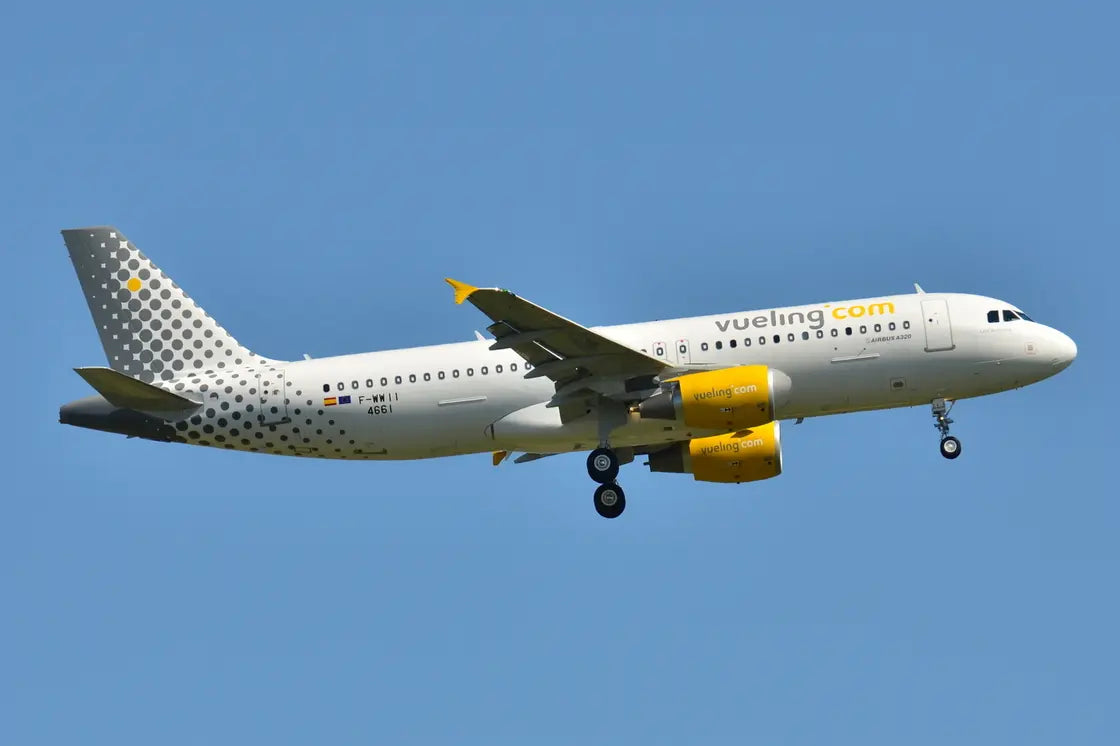
Vueling Overview & Company Profile
Vueling Airlines is Spain's largest low-cost carrier by fleet size and number of destinations, headquartered at Josep Tarradellas Barcelona-El Prat Airport (BCN). Founded in 2004 by Carlos Munoz and Lazaro Ros with just two Airbus A320s flying between Barcelona and Ibiza, the airline has grown into a pan-European operation serving approximately 99 destinations across 30 countries. Vueling merged with fellow Spanish low-cost carrier Clickair in 2009, and was acquired by International Airlines Group (IAG) in April 2013, placing it alongside British Airways, Iberia, and Aer Lingus within one of Europe's most powerful airline groups.
In 2024, Vueling achieved record financial performance: €3.26 billion in revenue and €400 million in operating profit, the best year in the airline's 20-year history. The airline transported 38.1 million passengers across more than 223,000 flights, cementing its position as Spain's leading carrier by both flight volume and destinations served. Vueling operates from its primary hub in Barcelona with secondary crew bases across Europe, including Rome Fiumicino, Paris-Orly, Amsterdam, and London Gatwick. The airline extends its reach through codeshare partnerships within the IAG portfolio, connecting passengers to long-haul destinations such as New York and Boston via partner carriers. With approximately 4,600 employees and an aggressive growth strategy backed by IAG's financial strength, Vueling is actively recruiting pilots and expanding capacity for the years ahead.
Fleet Composition & Modernization
Vueling currently operates an all-Airbus narrowbody fleet of approximately 142 aircraft, making it one of Europe's largest A320 family operators. The fleet is built around the proven Airbus A320 platform, with a growing proportion of fuel-efficient neo variants replacing older ceo models. For the 2025 summer season, Vueling added five additional aircraft, pushing total annual seat capacity above 27 million. The airline has significantly expanded capacity on key routes: Canary Islands services grew by 30.9%, Spain-UK connections by 16%, Spain-Italy by 13%, and Spain-Portugal by 19%.
| Aircraft Type | Role | In Service (approx.) | Seats | Notes |
|---|---|---|---|---|
| Airbus A319-100 | Narrowbody | 6 | 144 | Oldest type in fleet. Being phased out gradually. |
| Airbus A320-200 (ceo) | Narrowbody | ~92 | 180-186 | Fleet workhorse. High-density config on most frames. |
| Airbus A320neo | Narrowbody | ~22 | 186 | New-gen replacement. Improved fuel efficiency and range. |
| Airbus A321-200 (ceo) | Narrowbody | ~18 | 220 | Higher-capacity variant for busier routes. |
| Airbus A321neo | Narrowbody | ~4 | 236 | High-density stretched variant. Deliveries ongoing. |
Fleet data as of mid-2025. Numbers are approximate and change with ongoing deliveries and retirements.
Boeing 737 MAX: A Historic Fleet Shift
In a landmark decision ending Vueling's 22-year all-Airbus tradition, IAG confirmed in July 2025 that Vueling will receive 50 Boeing 737 MAX aircraft, comprising 25 Boeing 737 MAX 8-200 variants (200 seats, high-density) and 25 Boeing 737 MAX 10 variants (230 seats). Deliveries are expected to begin in late 2026, with the aircraft gradually replacing older A320ceo models. This represents a major strategic shift: Vueling will become a mixed Airbus-Boeing operator, requiring dual training infrastructure and type rating programs for pilots. The 737 MAX introduction creates new career opportunities for pilots seeking multi-aircraft qualification, and positions Vueling pilots favorably for future mobility across IAG carriers or to other 737 MAX operators.
All Vueling pilots currently fly the Airbus A320 family (A319/A320/A321, ceo and neo variants share a common type rating). New First Officers entering through cadet or experienced-hire pathways receive their A320 type rating as part of the onboarding process. With the 737 MAX arriving from late 2026, Vueling will need to train a significant number of pilots on Boeing equipment, creating new transition opportunities and potentially faster career progression for those willing to cross-train. Cockpit commonality within the A320 family means transitions between A319, A320, and A321 require only differences training rather than a full new type rating.
Pilot Salary & Compensation
Vueling pilot salaries are governed by the collective agreement negotiated with Sepla (Sindicato Espanol de Pilotos de Lineas Aereas), the Spanish Airline Pilots' Union. The most recent (fourth) collective agreement was finalized in late 2024 and provides salary stability through 2028. Compensation includes a monthly base salary, per diem allowances for domestic and international duties, overnight premiums, and variable performance-based bonuses. As a low-cost carrier, Vueling positions pilot pay in the lower-to-mid range of the European short-haul market, though total compensation improves meaningfully with seniority and the addition of allowances.
First Officer (F/O) Pay Scale
| Seniority | Annual Gross (est.) | Notes |
|---|---|---|
| Year 1 (entry) | ~€40,000 - €45,000 | Entry-level. Improved significantly after elimination of pay-to-fly schemes. |
| Year 3-5 | ~€50,000 - €58,000 | Regular increments per collective agreement steps. |
| Year 7-10 (senior F/O) | ~€60,000 - €70,000 | Top of F/O scale before Captain upgrade. |
Estimates based on multiple industry sources including Sepla data, pilot reports, and aviation salary databases. Actual figures vary by roster, base, and allowances.
Captain (Cpt) Pay Scale
| Seniority | Annual Gross (est.) | Notes |
|---|---|---|
| Entry Captain | ~€70,000 - €85,000 | Post-upgrade. Significant pay jump from senior F/O. |
| Captain, 5+ years | ~€90,000 - €105,000 | Mid-career Captain with established seniority. |
| Senior Captain (10+ yrs) | ~€105,000 - €115,000 | Top of scale. Highest base pay available. |
Captain figures include base salary plus standard allowances. Per diems and overnight premiums can add €15,000-€20,000 annually on top of these ranges for pilots flying predominantly international routes.
Per Diem & Allowance Rates
These figures are estimates compiled from multiple public sources including PilotJobsNetwork, aviation salary databases, and Sepla-referenced data. Actual compensation depends on the current collective agreement, individual seniority steps, roster patterns, and per diem accumulation. A notable development: Sepla successfully negotiated the elimination of "pay-to-fly" arrangements that previously required new-hire pilots to contribute up to €40,000 toward their type rating training. Spanish income tax rates (19-47% progressive scale) and social contributions (~6.5% employee share) reduce take-home pay. Always verify with the latest Sepla publications and Vueling HR for current figures.
Roster Pattern & Quality of Life
Vueling pilots operate under EASA Flight Time Limitation (FTL) regulations, which set strict limits on duty time, flight time, and rest requirements. Under EASA rules, pilots cannot exceed 60 duty hours in any 7 consecutive days, 110 hours in any 14 days, or 190 hours in any 28 days. Maximum flight time is capped at 100 block hours per 28 days. As a short-haul low-cost carrier, Vueling rosters tend to be intensive, with multiple sectors per day across the European and Mediterranean network. The 2024 collective agreement with Sepla included specific provisions addressing scheduling quality and fatigue management, reflecting union advocacy for improved roster conditions.
📅 Sample Month: First Officer (Barcelona Base)
As a short-haul operator, Vueling pilots typically fly 2-4 sectors per day across European and Mediterranean routes, with most duties starting and ending at the assigned base. Overnight layovers are less frequent than at long-haul carriers but do occur on some routes. Multi-sector days are common, particularly during peak summer scheduling when the airline ramps up capacity to Balearic and Canary Island destinations.
Barcelona is the primary crew base and home to the majority of Vueling pilots. Secondary bases include Rome Fiumicino, Florence, Paris-Orly, Amsterdam Schiphol, and London Gatwick, with seasonal variations in base activity. Base bidding is available but constrained by seniority and operational requirements. Junior pilots are typically assigned to Barcelona or wherever demand is greatest. Pilots based outside Spain should consider that local employment law, tax treatment, and social security contributions may differ. Barcelona offers a high quality of life with relatively moderate living costs compared to London or Paris, a Mediterranean climate, and excellent transport links.
Benefits, Travel Perks & Insurance
As part of the IAG group and operating under Spanish labor law, Vueling provides a benefits package that combines statutory Spanish employee rights with airline-specific perks. The airline was certified as a Top Employer 2025 for its HR practices, reflecting investment in employee wellbeing and professional development. While the benefits package is not as comprehensive as those at legacy carriers with long-established collective agreements, it covers the essentials and includes some attractive extras, particularly around staff travel and flexible benefits.
One of the most tangible benefits of working for Vueling is access to staff travel across the entire IAG network. This includes heavily discounted or standby travel on British Airways, Iberia, Aer Lingus, and LEVEL, in addition to Vueling's own network. For pilots and their families, this opens up access to long-haul destinations worldwide at a fraction of normal fares. This is a significant advantage compared to working at standalone LCCs like Ryanair or Wizz Air, where staff travel is limited to the airline's own short-haul network.
Career Progression & Seniority
Career progression at Vueling follows a seniority-based system, consistent with standard European airline practice. Advancement from First Officer to Captain, base assignment preferences, and scheduling priority are all determined by seniority (date of hire). The upgrade timeline from F/O to Captain varies depending on airline growth, retirement rates, and fleet expansion, but is generally estimated at 5-10 years under current conditions. Vueling's position within the IAG group adds an important dimension to career planning: pilots may have access to future internal transfer opportunities to Iberia, British Airways, or Aer Lingus, though these pathways are not formally guaranteed and remain subject to individual airline hiring policies.
| Career Milestone | Typical Timeline | Notes |
|---|---|---|
| Cadet training (if cadet path) | ~18-24 months | Via FTEJerez MAPS or CAE cadet programs. MPL or CPL/ATPL pathway. |
| Join as First Officer (A320) | Day 1 post-training | Entry fleet for all new-hire pilots. A320 family type rating included. |
| Senior First Officer | 5-7 years | Top of F/O pay scale. Building seniority for Captain upgrade bid. |
| Captain upgrade | ~5-10 years | Depends on growth and attrition. Command assessment required. |
| 737 MAX transition (from 2026) | Variable | New type rating opportunity. Multi-fleet qualification. |
| IAG group mobility (potential) | Variable | Possible internal transfers to Iberia, BA, or Aer Lingus. Not guaranteed. |
Vueling is in active growth mode: five new aircraft for summer 2025, capacity expansion of up to 30% on some route sectors, and 50 Boeing 737 MAX aircraft arriving from late 2026. This expansion creates significant demand for new pilots and should accelerate Captain upgrade timelines compared to periods of slower growth. The 737 MAX introduction also creates a second fleet stream, potentially opening up additional command positions as the airline builds a parallel Boeing operation. For career-minded pilots, joining Vueling during this growth phase offers timing advantages that may not recur once the fleet stabilizes. Additionally, the 2024 inter-union alliance between pilot unions across IAG airlines could eventually pave the way for more structured pilot flow programs within the group.
Recruitment Process & Requirements
Vueling recruits pilots through two main pathways: cadet programs (for candidates with little or no commercial flight experience) and experienced-hire recruitment (for pilots with existing CPL/ATPL and type rating or airline experience). Both pathways lead to First Officer positions on the Airbus A320 family. The airline has partnered with FTEJerez (Vueling MAPS program) and CAE for its cadet training programs.
Experienced Pilot Requirements
Cadet Pathway (FTEJerez MAPS / CAE)
Selection Stages (Experienced Pilots)
Online Application
Submit CV and credentials via the Vueling careers portal. Documentation includes license, medical, language certificates, and flight experience logs. Applications reviewed on a rolling basis.
Psychometric & Aptitude Testing
Computer-based assessments evaluating cognitive ability, spatial reasoning, multitasking, decision-making, and personality fit. Tests may be conducted remotely or at a designated testing center.
Technical Interview & Simulator Assessment
Interview covering technical knowledge, CRM competencies, and motivation. May include a simulator evaluation on A320 equipment to assess flying skills and standard operating procedures.
Final Interview & Medical Verification
Final HR/management interview at Vueling's headquarters in Barcelona. Confirmation of Class 1 medical, right-to-work documentation, and language proficiency certificates. Successful candidates receive an offer and training date.
Operator Conversion Course & Line Training
Company-specific ground school, A320 differences training (if applicable), and supervised line flying with a Training Captain. Duration varies but typically 4-8 weeks before release to unsupervised line operations.
Spanish language proficiency is a firm requirement for non-Spanish nationals, and ICAO Level 4 must be obtained before joining. Start language preparation early. A Spanish EASA license (or license validated by AESA) is mandatory before the Operator Conversion Course. The cadet programs (MAPS/CAE) offer an excellent fast-track entry point for aspiring pilots without prior airline experience, but availability is cyclical. Monitor both FTEJerez and CAE websites for program reopenings. For experienced pilots, having an existing A320 type rating significantly streamlines the process.
How Vueling Compares: Airline Radar Chart
How does Vueling stack up against two of Europe's other major low-cost carriers, easyJet and Ryanair? Below is a comparative analysis across five key metrics. Scores are editorial estimates based on publicly available salary data, pilot reports, union publications, and industry benchmarks.
Key Takeaways from the Comparison
Salary: Vueling trails both competitors. EasyJet Captains can earn £107,000-£157,000 (~€125,000-€184,000), while Ryanair Captains earn €114,000-€155,000+. Vueling's Captain range of €70,000-€115,000 positions it below both, though per diem allowances and lower Spanish living costs partly offset the gap. First Officer entry pay at Vueling (~€40,000) is particularly modest compared to easyJet (~€67,000) and competitive with Ryanair's lower ranges.
Work-life balance: easyJet leads. EasyJet generally offers superior roster predictability and more generous leave entitlements. Vueling's roster has improved under the 2024 collective agreement, but the airline's LCC scheduling intensity remains a factor. Ryanair's historically aggressive scheduling places it below both competitors on this metric.
Job security: Vueling's IAG backing is a major asset. Being part of IAG, one of the world's largest airline groups (€32+ billion revenue), provides Vueling with financial resilience that standalone carriers cannot match. During crises like COVID-19, IAG's balance sheet supported its subsidiaries. Ryanair's massive cash reserves provide similar stability, while easyJet is financially healthy but lacks the same group backing.
Career development: Vueling's IAG connection is unique. The potential for internal mobility to British Airways, Iberia, or Aer Lingus gives Vueling pilots a career development dimension that neither easyJet nor Ryanair can offer. This is an intangible but significant advantage for pilots with long-term career ambitions beyond short-haul LCC operations.
Scores are editorial estimates based on research into publicly available salary data, pilot testimonials, union publications, and industry benchmarks from sources including the European Cockpit Association, PilotJobsNetwork, and aviation salary databases. They represent a general assessment for an experienced pilot considering a long-term career. Individual experiences vary based on seniority, base, and personal priorities.
Union & Industrial Relations
Vueling pilots are represented by Sepla (Sindicato Espanol de Pilotos de Lineas Aereas), Spain's independent airline pilots' union founded in 1965. Sepla represents nearly 7,500 pilots across Spanish airlines, helicopter operators, and aerial work providers, making it one of Europe's most significant pilot unions. Within Vueling, Sepla maintains a dedicated company council (consejo de empresa) focused exclusively on Vueling pilot employment matters, collective agreement negotiations, and grievance representation.
Key Collective Agreement Milestones
The elimination of pay-to-fly requirements is a major win for pilots considering Vueling. Previously, new-hire pilots were expected to contribute up to €40,000 toward their type rating training, a significant financial barrier. Under the current collective agreement, these arrangements have been removed, making Vueling more accessible to early-career pilots. The 2024 Sepla inter-union alliance also signals a maturing labor relations environment where pilot interests are represented not just at the airline level but across the entire IAG group. Union membership is optional but strongly encouraged by Sepla.
Verdict: Who Is Vueling For?
🎯 Our Take
Vueling is a compelling option for pilots who want to combine the accessibility and growth dynamics of a low-cost carrier with the strategic depth of being part of IAG, one of Europe's most powerful airline groups. The airline offers a clear pathway from cadet to Captain on a modern A320 fleet, with the added prospect of 737 MAX operations from late 2026 and potential long-term career mobility to Iberia, British Airways, or Aer Lingus.
The trade-offs are real: compensation sits at the lower end of the European LCC range, particularly for entry-level First Officers. Roster intensity is typical of the low-cost model, and the benefits package, while solid, does not match what legacy carriers offer. Barcelona as the primary base is attractive for quality of life, but pilots based at secondary locations may face commuting challenges.
For pilots who value long-term career optionality, IAG group affiliation, access to multi-fleet experience (once the 737 MAX arrives), and the financial stability of a profitable, growing airline backed by a major group, Vueling deserves serious consideration. It may not be the highest-paying carrier in European short-haul, but it offers a strategic career platform that few other LCCs can match.
1 Do I need to speak Spanish to fly for Vueling?
Non-Spanish nationals must hold ICAO Level 4 Spanish language proficiency before joining. Spanish nationals are exempt from this specific requirement. All pilots must also hold ICAO Level 4 English. Spanish is used extensively in internal communications, ATC interactions within Spanish airspace, and daily operations at Barcelona and other Spanish bases.
2 Does Vueling still require pilots to pay for their type rating?
No. The controversial "pay-to-fly" model, which previously required new hires to contribute up to €40,000 toward training costs, has been eliminated through Sepla union negotiations. Under the current collective agreement (finalized late 2024), Vueling covers the cost of the Operator Conversion Course for pilots recruited through official channels. Cadets on the MAPS or CAE programs receive integrated type rating training as part of their program.
3 How long does it take to upgrade to Captain at Vueling?
The current estimated upgrade timeline is approximately 5-10 years, depending on fleet growth, attrition, and seniority position. Vueling's active expansion phase (new aircraft, 737 MAX introduction from 2026, route growth) should create additional Captain positions and potentially accelerate upgrade timelines in the coming years. A command assessment including interview and simulator evaluation is required for all Captain upgrades.
4 Can non-EU citizens apply to Vueling?
Vueling requires pilots to hold EU/EEA nationality or a valid legal right to live and work in Europe. In practice, the substantial pool of available EU/EEA pilot candidates means recruitment focuses predominantly on EU/EEA citizens. Non-EU pilots with valid long-term European residency and work permits may be considered, but securing such authorization independently is the candidate's responsibility.
5 Can I transfer from Vueling to British Airways or Iberia?
There is no formal guaranteed pilot transfer program within IAG. However, Vueling's position within the group creates potential opportunities for internal moves to Iberia, British Airways, or Aer Lingus, subject to those airlines' individual hiring policies and requirements. The 2024 inter-union alliance between Sepla, BALPA, and IALPA may eventually lead to more structured pilot flow mechanisms across the group, though this remains to be confirmed. Any such transfer would typically involve applying through the target airline's recruitment process.
6 What is the Vueling MAPS cadet program?
The Vueling Mentored Airline Pilot Scheme (MAPS) is a cadet program operated in partnership with FTEJerez flight training academy. It takes candidates with little or no flying experience through an integrated Multi-Pilot License (MPL) pathway including A320 type rating, preparing them for First Officer positions at Vueling. The program typically selects ~24 cadets per intake and lasts approximately 18-24 months. As of 2025, the MAPS program is temporarily closed for applications but is expected to reopen for future intakes. Vueling also runs a separate cadet program with CAE (Madrid/Oxford-based).
7 How does Vueling pilot pay compare to easyJet and Ryanair?
Vueling pilot pay sits at the lower end of the European LCC range. First Officer entry salaries (~€40,000) are below both easyJet (~€67,000) and Ryanair (~€53,000+). Captain pay (€70,000-€115,000) is also below easyJet (€125,000-€184,000) and approaching Ryanair levels (€114,000-€155,000). However, lower Spanish living costs (particularly in Barcelona vs. London), IAG staff travel benefits, and career development optionality within the group partially offset the compensation gap. Per diem allowances can add €15,000-€20,000 annually for international flying.
8 Will Vueling pilots need a Boeing 737 type rating?
Yes, once the 50 Boeing 737 MAX aircraft begin arriving in late 2026, pilots transitioning to 737 MAX operations will require a separate type rating. This represents a significant training commitment but also a career development opportunity: multi-fleet qualification on both Airbus and Boeing equipment enhances pilot marketability across the industry. Vueling will need to train a substantial number of pilots for the new fleet, which may create accelerated advancement opportunities.
Official Links & Resources
Before applying or making any career decisions, always verify information directly with official sources. These are the key websites and organisations relevant to Vueling pilot careers:
Bookmark the Sepla news page (sepla.es/en/noticias) for the latest updates on Vueling pilot collective agreement developments, inter-union alliance progress, and Spanish aviation industry news. Also follow the Vueling careers page closely, as pilot vacancies and cadet program reopenings are posted there first. Join aviation community forums like PPRuNe's Spanish Forum for candid pilot perspectives on current working conditions.