

Volaris Overview & Company Profile
Volaris (legally Concesionaria Vuela Compañía de Aviación, S.A.B. de C.V.) is Mexico's largest domestic airline by market share and one of Latin America's defining ultra-low-cost carriers (ULCCs). Founded in 2005 and flying since March 2006, the airline is headquartered in the Santa Fe business district of Mexico City and is publicly listed (NYSE: VLRS, BMV: VOLAR). It commands roughly 42% of the Mexican domestic market, and together with rival Viva Aerobus the two ULCCs account for more than 70% of all domestic passenger segments in the country, which makes Volaris one of the single largest employers of commercial pilots in Mexico.
The business model is built on high aircraft utilization, a single Airbus narrowbody fleet, unbundled fares, and tight cost control, including on labor. In full-year 2024 Volaris carried 29.5 million passengers and generated US$3,142 million in operating revenue at an 86.8% load factor, according to its official quarterly results; in 2025 it carried 31.0 million passengers on US$3,038 million in revenue. The network is point-to-point rather than hub-and-spoke, covering Mexico, the United States, and Central America (Costa Rica, Guatemala, and El Salvador), with separately certificated subsidiaries Volaris Costa Rica and Volaris El Salvador. Volaris is not a member of a global alliance but maintains a transborder codeshare with Frontier Airlines.
For a pilot, the most important consequence of this profile is the nature of the flying: short-haul, multi-sector days on a uniform Airbus A320 family, operated at intensity from a network of Mexican bases. There is no long-haul widebody flying, no global alliance route map, and very few overnight layovers compared with a legacy carrier. What Volaris offers instead is scale, one of the youngest fleets in the Americas, and a growth story that continues to create First Officer and Captain vacancies.
Operating and financial figures from Volaris investor relations disclosures (FY2024 results and 1Q 2026 fleet plan). Pilot headcount is an estimate scaled from the 1,453 unionized pilots last publicly disclosed in 2021.
Fleet Composition & Type Ratings
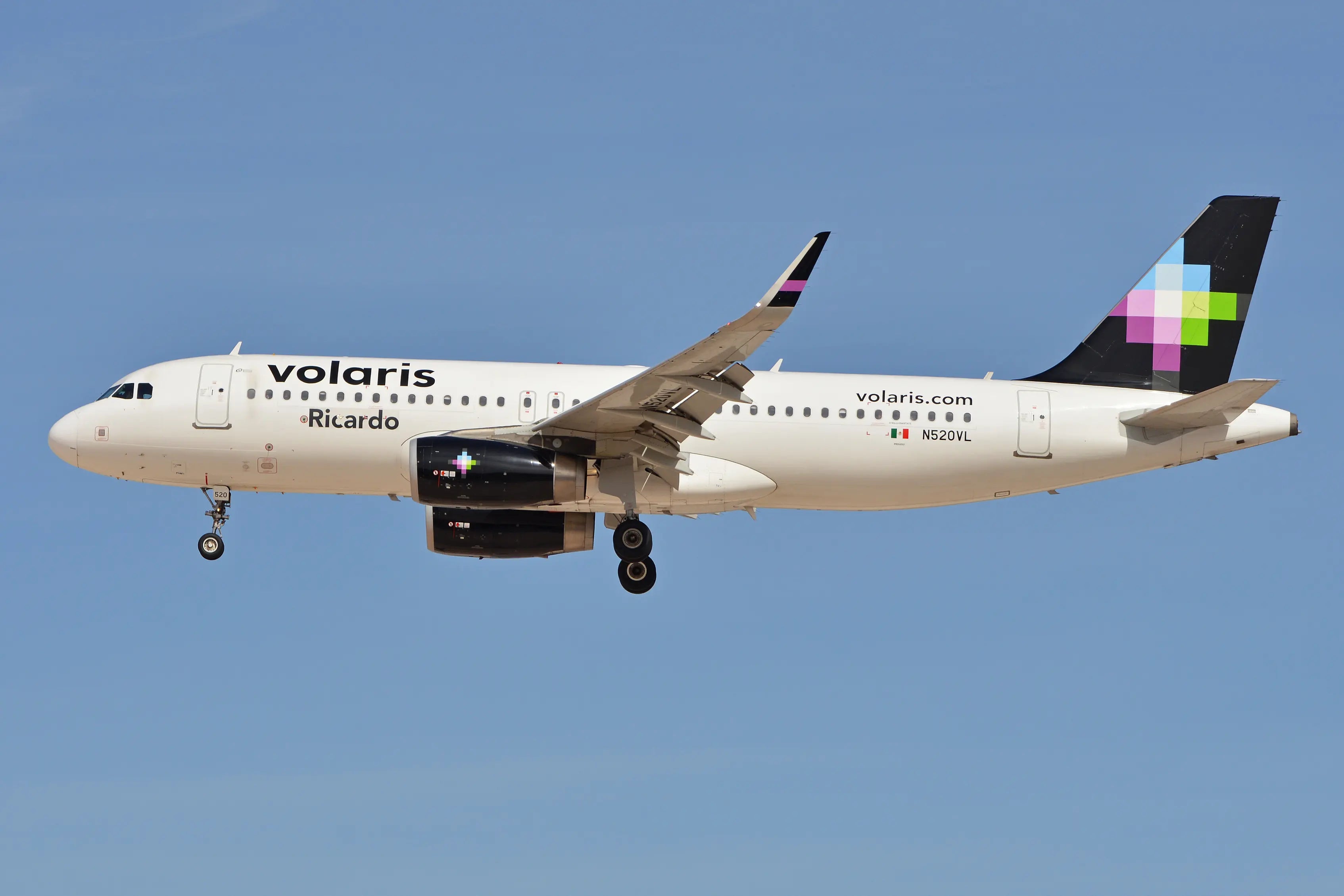
Volaris operates an entirely Airbus A320 family fleet, which is one of its biggest structural advantages for pilots. A single type rating covers every aircraft the airline flies, transitions between subtypes require only differences training rather than a full course, and crew scheduling is not constrained by fleet splits. According to the Volaris official fleet plan, the airline ended the first quarter of 2026 with 155 aircraft, of which NEO (New Engine Option) variants represented 66% of the total and 92% were fitted with sharklets. The average fleet age sits around 6.6 years, placing Volaris among the youngest fleets in the Americas.
The renewal program is aggressive. Volaris retired its last Airbus A319 during the fourth quarter of 2025, ending more than fifteen years of A319 operations, and the remaining A320ceo aircraft are scheduled to leave progressively as leases expire. The airline has publicly targeted a fleet that is roughly 97% NEO by the end of the decade, transitioning toward an all-NEO operation built around the larger, higher-density A321neo. Aircraft are being added quickly: Volaris took delivery of its 150th aircraft (an A320neo) in September 2025 and continued growing into 2026.
| Aircraft Type | Role | In Service (1Q 2026) | Notes |
|---|---|---|---|
| Airbus A320ceo | Narrowbody | 43 | ~179 seats. Core workhorse, being retired progressively as leases expire. |
| Airbus A320neo | Narrowbody | 64 | ~186 seats. Largest single subtype. Affected by Pratt & Whitney GTF engine issues. |
| Airbus A321ceo | Narrowbody | 10 | ~228 seats. High-density workhorse on trunk routes. |
| Airbus A321neo | Narrowbody | 38 | ~238 seats. Growth aircraft for trunk and longer transborder sectors. |
| Airbus A319 | Narrowbody | 0 | Last unit retired Q4 2025 after 15+ years of service. |
Fleet composition per the Volaris IR fleet plan (1Q 2026). Volaris carries a large order backlog of additional A320neo and A321neo aircraft (roughly 120+ units across published trackers), part of a broader Indigo Partners Airbus commitment shared with sister carrier JetSMART.
Every Volaris pilot flies the Airbus A320 family, so there is one common type rating across the airline. New First Officers typically begin on the A320, with the A321neo flown by more senior crews on higher-density and longer transborder routes. Because cockpit commonality across the family is very high, moving between the A320 and A321 involves differences training rather than a separate type course. Pilots recruited through the airline's process are trained and type-rated by the company; the distinctive ab-initio path is the Volaris pilot scholarship, covered in the recruitment section below.
The single biggest operational headwind for Volaris pilots is the well-documented Pratt & Whitney geared turbofan (GTF) issue affecting A320neo family engines. Volaris reported an average of around 36 engine-related groundings per month in the third quarter of 2025 and has signalled it expects to manage a meaningful number of aircraft on the ground (AOG) into 2026. For crews, grounded aircraft translate into schedule disruption, last-minute roster changes, and pressure on the available fleet. This same capacity squeeze is the direct cause of the foreign-pilot wet-lease controversy discussed in the union section.
Pilot Salary & Compensation Breakdown
Salary is the area where Volaris is least transparent and where prospective pilots should exercise the most caution. Unlike many US and European carriers, Volaris does not publish a pilot pay grid, and its collective agreement is negotiated by the STIA union rather than being openly available. As a result, the figures below are built from public salary aggregators (Glassdoor, ToFly7), Mexican media analyses (El Informador, El Universal, Infobae), and the structure of Mexican labor law, then organized by rank. They should be read as estimates and orders of magnitude, not official scales. Aggregator data for pilots is notoriously incomplete and often captures base pay only, so real total compensation, including flight pay, premiums, and profit-sharing, can sit above these ranges.
What the sources consistently show is the relative position: Volaris pilots earn less than legacy carrier Aeroméxico, are broadly comparable with or slightly below Viva Aerobus, and earn modest sums by US or European standards while remaining well above the Mexican national average. Compensation is paid in Mexican pesos (MXN); USD equivalents below assume roughly MXN 18–19 per US dollar and will move with the exchange rate. Under Mexican law, pay is supplemented by the statutory aguinaldo (year-end bonus of at least 15 days of salary), a vacation premium, and profit-sharing (reparto de utilidades).
First Officer (Copiloto) Estimated Pay
| Seniority | Est. Monthly Total (MXN) | Est. Annual Gross (MXN) | Approx. USD/yr |
|---|---|---|---|
| Entry (Year 1–2) | $22,000 – $30,000 | ~$290,000 – $400,000 | ~$16k – $22k |
| Mid (Year 3–6) | $30,000 – $38,000 | ~$400,000 – $510,000 | ~$22k – $28k |
| Senior F/O (7+ yrs) | $38,000 – $46,000 | ~$510,000 – $620,000 | ~$28k – $34k |
Estimates compiled from salary aggregators and Mexican media (2024–2025). Annual figures assume aguinaldo and standard premiums on top of monthly pay.
Captain (Comandante) Estimated Pay
| Seniority | Est. Monthly Total (MXN) | Est. Annual Gross (MXN) | Approx. USD/yr |
|---|---|---|---|
| Junior Captain | $45,000 – $55,000 | ~$600,000 – $740,000 | ~$33k – $40k |
| Senior Captain | $55,000 – $70,000 | ~$740,000 – $940,000 | ~$40k – $51k |
Captain pay is the least documented band publicly. These figures extrapolate from the upper end of aggregator data plus typical First Officer-to-Captain differentials, and should be treated as indicative only.
On a per-flight-hour basis, and assuming the typical ULCC roster of roughly 75–85 block hours per month, these monthly totals imply rough hourly rates of around MXN 320 per flight hour for a junior First Officer up to MXN 600 or more per flight hour for a senior Captain. Expressed in dollars, that is broadly USD 19 to USD 37 per flight hour. These hourly figures exclude per diems and do not account for the gap between block time and full duty time, which is significant on a multi-sector ULCC day.
Volaris does not publish official pilot pay scales, and no transparent collective agreement is available to the public. The numbers above are estimates triangulated from Glassdoor, ToFly7, El Informador, El Universal, and Infobae, cross-checked against Mexican labor law. Several of these aggregators report suspiciously low or inconsistent figures (one Glassdoor entry for Tijuana appears to mislabel currency), so individual data points are unreliable in isolation. Actual offers depend on rank, base, seniority step, and the STIA collective contract. Always verify directly with Volaris recruitment and, where possible, with current line pilots before making a career decision.
Roster Pattern & Quality of Life
Quality of life at Volaris is shaped by two forces pulling in opposite directions: relatively generous statutory protections under Mexican law, and an intense ULCC operating model that schedules crews close to the legal ceilings. Flight and duty time are governed by Mexican civil aviation regulation, principally NOM-117-SCT3-2016 on fatigue management, alongside the dedicated aeronautical-crews chapter of the Federal Labor Law (Ley Federal del Trabajo).
Those rules set hard limits: effective flight time may not exceed 90 hours per month and 1,000 hours per year, daily flight time is capped at 8 hours (day duty), 7 hours (night), and 7.5 hours (mixed), weekly flight time is capped at 30 hours in any 7 consecutive days, and total duty time (flight, route, and reserve) may not exceed 180 hours per month. On the positive side, the Labor Law grants aeronautical crews a substantial annual vacation entitlement of 30 calendar days, rising by one day per year of service up to 60 days, which is well above the Mexican statutory norm for most workers. Overtime beyond service limits and work on mandatory rest days carry premium pay (double and, in defined cases, triple time).
📅 Sample Month — Narrowbody First Officer (illustrative)
Illustrative only. Volaris does not publish roster templates; this grid reflects typical ULCC narrowbody patterns and Mexican FTL limits, showing roughly 8–10 days off and many multi-sector duty days. Actual rosters vary by base, season, and seniority.
The day-to-day reality is high-tempo flying. A typical duty day runs three to four short sectors with tight turnarounds, early starts and late finishes are common, and red-eye services to US and Central American destinations compress rest windows and challenge circadian rhythms. Independent labor-law commentary has criticized the STIA-negotiated arrangements at Volaris (and at Viva Aerobus) for scheduling crews near the legal duty limits without the more conservative fatigue protections that independent unions defend. In practice, pilots should expect to work toward the upper end of monthly block-hour limits, with days off clustered rather than evenly spread. Safety outcomes have nonetheless remained strong, with Volaris reporting zero passenger fatalities attributable to its operations.
Volaris assigns pilots to bases across its network, with major pilot contingents at Guadalajara, Mexico City, Tijuana, Cancún, and Monterrey, plus operations at cities such as Culiacán, Mexicali, and León. Guadalajara has been a particular focus for new-aircraft deliveries and route launches. Living at or near your assigned base materially improves quality of life, since tight ULCC rosters leave little buffer for long surface or air commutes. Base changes generally depend on seniority and operational need. Border bases like Tijuana double as gateways to the United States, which shapes the mix of domestic and transborder flying a pilot sees.
Benefits & Social Protection
Volaris pilot benefits are built on the foundation of Mexican statutory social protection, supplemented by company-provided insurance and the airline's "total compensation" philosophy, which it brands as combining pay, benefits, and a "salario emocional" (emotional salary) of growth and culture. As with salary, the airline does not publish a detailed benefits schedule, so the picture below combines statutory entitlements, the airline's integrated annual reports, and its careers materials. Pilots should confirm specifics directly with Volaris human resources and the collective agreement.
Two points deserve emphasis for any pilot comparing Volaris with a legacy or Gulf carrier. First, retirement at Volaris rests on Mexico's defined-contribution Afore system rather than a generous aviation-specific pension fund; there is no equivalent of the dedicated aircrew pension schemes found in some European countries. Second, loss-of-license protection is not clearly documented as a standalone, pilot-specific product in public materials, which means a candidate should ask pointed questions about what happens if a Class 1 medical is lost. On the positive side, the statutory floor in Mexico is real and enforceable: IMSS coverage, aguinaldo, profit-sharing, and a substantial legal vacation entitlement all apply.
Volaris frames benefits around "total compensation" and career development rather than headline pay. For pilots who value an Airbus type rating, rapid command opportunities, staff travel, and a young modern fleet, the non-cash side of the package can be genuinely attractive. For those prioritizing a strong defined-benefit pension, robust loss-of-license cover, or premium per diems from long-haul layovers, the package is thinner than at a legacy carrier. Treat the airline's "salario emocional" language as a real but partial offset to salary, not a substitute for verifying the hard numbers.
Career Progression & Seniority
Career progression at Volaris follows the classic narrowbody ULCC pattern: pilots enter as First Officers (copilotos) on the Airbus A320 family and, after building command experience and meeting regulatory requirements, upgrade to Captain (comandante) within the same fleet. Progression is governed by seniority lists embedded in the STIA collective agreement, which determine upgrade order and base-transfer priority. There is no widebody and no long-haul ladder, so the career arc is essentially First Officer to Captain to, for some, training or management roles, all on the A320 family.
The upside of a fast-growing ULCC is upgrade speed. Volaris has expanded its fleet from around 101 aircraft in 2021 to 155 in early 2026, and continues to add A321neos. Sustained growth, combined with retirements, tends to pull First Officers into the left seat faster than at a no-growth legacy carrier. Volaris does not publish a formal upgrade timetable, but industry norms and the airline's growth trajectory point to command becoming achievable in roughly 5 to 8 years for a steadily performing First Officer, materially quicker than the 10-to-15-year waits typical at large European legacy carriers. The exact timing depends on fleet growth, seniority position, and regulatory pilot-in-command requirements.
| Career Milestone | Typical Timeline | Notes |
|---|---|---|
| Cadet / ab-initio training (scholarship path) | ~18 months | Volaris scholarship at iFly Academy, Mérida. Leads to First Officer entry. |
| Join as First Officer (A320) | Day 1 post-rating | Company-provided A320 family type rating. Entry fleet is the A320. |
| A321 / A321neo transition | Seniority-based | Differences training only. Higher-density and longer transborder routes. |
| Captain upgrade | ~5–8 years (est.) | Faster than legacy carriers due to fleet growth. Command check required. |
| Senior Captain | 8+ years | Top of seniority list; priority on bases and bidding. |
| Training Captain / Instructor | Variable | Separate selection and instructor qualification. |
Timelines are estimates; Volaris does not publish an official upgrade schedule. Upgrade speed is sensitive to fleet growth, retirements, and engine-related capacity constraints.
First, the Pratt & Whitney GTF engine groundings that have parked aircraft can slow growth and, by extension, upgrade timelines if capacity is constrained for an extended period. Second, the temporary use of foreign wet-lease crews during the 2025–2026 peak season (detailed in the union section) raised pointed questions among Mexican pilots about whether external crews could displace internal opportunities. Neither factor changes the fundamental seniority structure, but both are worth monitoring. There is no evidence of routine direct-entry Captain hiring at Volaris; command normally comes from within.
Recruitment, Requirements & Cadet Program
Volaris recruits through two broad routes: direct hiring of licensed pilots (copilotos and, internally, captains), and an ab-initio pilot scholarship that takes selected candidates from little or no experience to the right seat. All applications run through the official careers portal at jobs.volaris.com, where current vacancies, profiles, and stage-by-stage requirements are posted. Licensing and medical certification are overseen by Mexico's civil aviation authority, the Agencia Federal de Aviación Civil (AFAC).
Direct-Entry First Officer — Typical Requirements
The Volaris Pilot Scholarship (Programa de Becas para ser Piloto)
Volaris' most distinctive entry route is its ab-initio scholarship, run in partnership with iFly Academy in Mérida, Yucatán. The program funds an approximately 18-month training path from zero experience to a First Officer position. Volaris welcomed its third generation of ten future pilots in February 2024, and earlier cohorts have already graduated and joined the line (a generation of 27 enrolled in 2022 completed training). Notably, several scholarship places have gone to children of Volaris employees and to cabin crew, reflecting the airline's "family" framing of the program. Exact eligibility (age, education, whether each intake is fully open to the public, intake size, and any service commitment) is set per campaign and should be confirmed against the current official call, since these details are not consistently published.
Selection Stages (typical structure)
Online Application & Document Screening
Submit your CV and license, hours, medical, and nationality documents through jobs.volaris.com. Postings specify the minimum hours and license for that campaign, which differ between low-hour cadet-style entry and experienced-copilot vacancies.
Aptitude & Psychometric Testing
Standard airline screening of cognitive ability, coordination, and personality, in line with global practice. For the scholarship route, this is the principal filter since candidates have little or no flight experience.
Interviews & English Assessment
HR and technical interviews conducted primarily in Spanish, with an English-proficiency check reflecting ICAO language requirements for transborder operations to the US and Central America.
Simulator Assessment (experienced pilots)
Experienced-pilot candidates may complete a simulator evaluation of handling skills and crew resource management before an offer is extended.
Medical, Training & Line Entry
A valid AFAC Class 1 medical is required. Scholarship cadets begin the ~18-month iFly Academy program; direct-entry pilots proceed to A320 family type rating and line training before being released to the line.
Spanish fluency is non-negotiable: it is the working language of the airline, briefings, and the selection process, while English is required for international flying. Because Volaris runs different campaigns with different hour minimums (postings have cited anywhere from 1,000 to 3,500 hours for copilot roles), check the exact requirements on the current vacancy rather than assuming a single threshold. Nationality matters too: Mexican-registered domestic operations traditionally require Mexican pilots by birth, while Volaris El Salvador is legally required to crew with local Salvadoran nationals. Monitor the careers portal directly, as Volaris recruits on a rolling, campaign-driven basis.
How Volaris Compares: Airline Radar Chart
How does Volaris stack up against its two most relevant Mexican peers: fellow ULCC Viva Aerobus and legacy flag carrier Aeroméxico? The radar below compares all three across the same six metrics used in the scorecard, condensed to five axes. Scores are editorial estimates based on public salary data, fleet information, union analysis, and industry benchmarks, intended for a pilot weighing a long-term career.
Key Takeaways from the Comparison
Aeroméxico leads on pay and benefits. Aggregator data consistently place Aeroméxico pilots at the top of the Mexican commercial tier (medians around MXN 40,000 per month and higher, with far higher figures for international long-haul operations), ahead of both ULCCs. Aeroméxico also offers widebody, long-haul flying and the stronger benefits typical of a legacy carrier. Volaris and Viva Aerobus sit close together below it, with Viva often shown a touch higher than Volaris on average pilot pay.
The two ULCCs are near-twins on flying and quality of life. Volaris and Viva Aerobus run very similar all-Airbus narrowbody, high-utilization operations, and both are represented through the STIA union structure. That means comparable intense rosters, similar fatigue-protection criticisms, and similar short-haul, multi-sector days. The choice between them often comes down to base geography and specific campaign terms rather than a fundamentally different lifestyle.
Volaris wins on fleet modernity. With an average fleet age around 6.6 years, 66% NEO, and an all-A320-family lineup heading toward an all-NEO future, Volaris flies one of the youngest fleets in the Americas. Aeroméxico operates a more diverse fleet including widebodies (Boeing 787, 737 MAX), which offers route variety but a higher average age and more type complexity. For a pilot who values modern, efficient narrowbody equipment and fleet commonality, Volaris is attractive.
Career speed favors the ULCCs; security and bargaining favor Aeroméxico. Rapid fleet growth at Volaris and Viva can mean faster command than at a slower-growing legacy carrier. But Aeroméxico pilots are represented by the independent ASPA union, which bargains more assertively on pay and rosters, as seen in its high-profile 2024–2026 contract negotiations. Volaris pilots, under STIA's protection-contract model, have historically had less leverage. Job security at all three is also shaped by external shocks: P&W engine groundings at the ULCCs and the cyclicality of legacy operations at Aeroméxico.
Scores are editorial estimates derived from public salary aggregators (Glassdoor, ToFly7), Mexican media (El Informador, El Universal, Infobae), Volaris investor disclosures, union and labor-law commentary, and fleet databases. They represent a general assessment for an experienced pilot considering a long-term career, not a precise measurement. Individual experiences vary by rank, base, and personal priorities. Figures will be revised as we publish dedicated guides for Viva Aerobus and Aeroméxico.
Union & Industrial Relations
The union landscape is one of the most important and most contested aspects of working at Volaris, and it is where the airline differs most sharply from legacy carrier Aeroméxico. Volaris pilots are covered by a collective contract held by the Sindicato de Trabajadores de la Industria Aérea (STIA), not by the prominent independent pilots' association ASPA. Understanding that distinction is essential for any pilot evaluating the airline.
STIA and the "Protection Contract" Critique
Labor-law analysts have repeatedly characterized STIA's collective agreements at Volaris (and at Viva Aerobus) as "contratos de protección" (protection contracts): agreements signed with the company, in some accounts before operations even begin, that pre-define working conditions with limited democratic input from the pilots they cover. Critics argue this model keeps pay controlled, permits rosters that run close to the legal duty limits with less generous fatigue protection than independent-union standards, and makes it harder for pilots to switch to a more assertive union even after Mexico's 2019 labor reform was designed to enable free union choice. Pilots at Volaris have at times operated "under protest" to signal discontent, though this has not, to date, escalated into a formal mainline pilot strike.
ASPA: The Independent Benchmark
The Asociación Sindical de Pilotos Aviadores de México (ASPA), founded in 1952, is the independent union that represents Aeroméxico pilots and serves as the national reference point for pilot labor advocacy. ASPA is internationally affiliated and has a track record of democratic ratification of agreements and assertive collective bargaining, including the closely watched Aeroméxico contract negotiations that ran through 2024 into 2026 and ultimately averted a strike via an approved contract revision. ASPA does not currently represent Volaris pilots, but its public positions, including on the foreign-pilot issue below, directly affect the Volaris workforce. Its website (web.aspa.org.mx) is a useful window into the independent-union perspective on Mexican aviation labor standards.
Recent Disputes & Key Issues
Volaris has largely avoided formal pilot strikes, which means schedule reliability for the airline but, according to labor critics, less bargaining power for the pilots. The foreign-pilot wet-lease episode, reported in outlets such as Mexico Business News, is the issue to watch: it was framed as temporary and seasonal, but it crystallized real concerns about job security and the willingness of regulators to flex nationality rules under commercial pressure. Before joining, a prospective pilot should understand that representation runs through STIA's collective contract, ask current line pilots how rosters and pay are negotiated in practice, and follow how the wet-lease and engine-capacity issues evolve.
Verdict: Who Is Volaris For?
🎯 Our Take
Volaris is a strong, accessible entry point into Airbus narrowbody airline flying, and for many Mexican pilots it is the most realistic path to a jet career. The airline offers one of the youngest fleets in the Americas, a single A320 family type rating, a genuine ab-initio scholarship route, and a growth story that keeps creating First Officer and Captain vacancies, with command potentially reachable in five to eight years. For a pilot who wants to build hours and command experience quickly on modern equipment, that combination is hard to beat in the region.
The trade-offs are equally real. Pay is modest by global standards and sits below legacy carrier Aeroméxico, the salary structure is opaque, and benefits rest on Mexico's statutory floor rather than a generous aviation-specific pension or clearly documented loss-of-license cover. The ULCC roster is intense, scheduled close to legal duty limits, and labor critics argue the STIA "protection contract" model leaves pilots with limited bargaining leverage. The Pratt & Whitney engine groundings and the 2025–2026 foreign-pilot wet-lease episode have added uncertainty around capacity and job security.
On balance, Volaris is best understood as a high-value career-building airline rather than a top-of-market destination. It rewards pilots who value rapid progression, fleet modernity, and getting into a jet, and who can accept lower pay and an intense, short-haul lifestyle in exchange.
1Do I need to be Mexican and speak Spanish to fly for Volaris?
For Volaris' Mexican-registered mainline operation, the traditional rule is that pilots must be Mexican by birth, reflecting constitutional and civil-aviation-law provisions on crewing Mexican aircraft. Spanish fluency is effectively mandatory, since it is the working language of the airline and the selection process, while English is required for transborder flying to the US and Central America. The subsidiaries operate under their own rules: Volaris El Salvador, for example, is legally required to crew with local Salvadoran nationals.
2How much do Volaris pilots earn?
Volaris does not publish official pay scales, so figures are estimates from salary aggregators and Mexican media. As a rough guide, First Officers earn an estimated MXN 22,000–46,000 per month depending on seniority, and Captains an estimated MXN 45,000–70,000 per month, before aguinaldo, profit-sharing, and per diems. In US dollar terms that is broadly USD 16,000–34,000 a year for First Officers and USD 33,000–51,000 for Captains at roughly MXN 18–19 per dollar. These are indicative ranges only; aggregator data is incomplete and often understates total pilot pay.
3How many flight hours do I need to join Volaris as a First Officer?
It depends on the campaign. Volaris postings have cited different minimums at different times, including 1,000, 1,500, and 3,500 total hours for copilot roles. Low-hour candidates generally enter through the cadet scholarship route rather than direct hiring. Always check the specific vacancy on jobs.volaris.com for the current hour requirement and the exact license needed (the Mexican Piloto de Transporte Público de Ala Fija, or a CPL/IR with ATPL theory).
4Does Volaris have a cadet program, and does it pay for training?
Yes. The "Programa de Becas para ser Piloto" is a Volaris-sponsored ab-initio scholarship run with iFly Academy in Mérida, Yucatán, taking selected candidates through roughly 18 months of training to a First Officer position. Volaris welcomed its third generation of cadets in February 2024, and several places have gone to relatives of employees and to cabin crew. Exact eligibility, intake size, and whether each campaign is fully open to the public vary, so confirm against the current official call. For directly hired pilots, the company handles the A320 family type rating through its process.
5How long does it take to upgrade to Captain at Volaris?
Volaris does not publish a formal timetable, but its rapid fleet growth (from about 101 aircraft in 2021 to 155 in early 2026) tends to accelerate upgrades. A realistic estimate is roughly five to eight years for a steadily performing First Officer, faster than the 10-to-15-year waits common at large legacy carriers. Timing depends on seniority position, fleet growth, retirements, and regulatory pilot-in-command requirements. Engine-related capacity constraints could slow this if they persist.
6Which union represents Volaris pilots, and what is a "protection contract"?
Volaris pilots are covered by a collective contract held by STIA (Sindicato de Trabajadores de la Industria Aérea), not by the independent pilots' association ASPA, which represents Aeroméxico. Labor-law analysts describe STIA's agreements as "protection contracts," negotiated with the company with limited pilot input, which critics say keeps pay controlled and rosters near legal limits. Mexico's 2019 labor reform was intended to give workers freer union choice, but switching representation at ULCCs has proven difficult in practice.
7What was the foreign-pilot wet-lease controversy?
To cover peak-season demand during a period of Pratt & Whitney engine groundings, AFAC authorized Volaris to operate up to 10 aircraft with foreign crews (via Avion Express, Malta/Lithuania) from December 1, 2025 to January 12, 2026, alongside a request to wet-lease several jets. ASPA strongly opposed it, arguing that foreign crews flying Mexican operations breach the Constitution and Civil Aviation Law and threaten Mexican pilots' jobs. The arrangement was presented as temporary and seasonal, but it raised lasting concerns about job security and regulatory flexibility under commercial pressure.
8How does Volaris pay compare to Aeroméxico and Viva Aerobus?
Aeroméxico, as the legacy carrier with widebody long-haul flying and ASPA representation, pays the most of the three, with aggregator medians around MXN 40,000 per month and substantially higher figures for international operations. Volaris and Viva Aerobus, the two ULCCs, sit close together below it, with Viva often shown slightly ahead of Volaris on average pilot pay. Where Volaris competes is fleet modernity and progression speed rather than headline salary.
Official Links & Resources
Before applying or making any career decision, verify information directly with official sources. These are the key websites and organizations relevant to a Volaris pilot career:
Because Volaris recruits on a rolling, campaign-driven basis and its pay and roster terms are not publicly documented, the single most valuable thing you can do is talk to current Volaris line pilots and watch jobs.volaris.com for live vacancies and the next scholarship call. Cross-check anything you read on salary aggregators, as the figures are frequently incomplete or mislabeled, and confirm hour requirements on the specific posting rather than assuming a fixed threshold.