

Viva Aerobus Overview & Company Profile
Viva Aerobus, now marketing itself simply as Viva, is a Mexican ultra-low-cost carrier (ULCC) founded in 2006 and headquartered at Monterrey International Airport in Apodaca, Nuevo León. Its legal operating entity is Aeroenlaces Nacionales, S.A. de C.V., and it flies under the IATA code VB and ICAO code VIV. The airline was launched by Grupo IAMSA, one of Mexico's largest intercity bus operators, which applied its experience in high-volume, low-margin passenger transport to the emerging low-cost aviation segment. That heritage still shapes the business: dense seating, low unit costs, ancillary revenue, and very high aircraft utilization.
Viva has grown into Mexico's third-largest airline by passengers, carrying 27.6 million travelers in 2024, up from 24.9 million in 2023. It serves roughly 60 destinations across Mexico, the United States, Central America, and South America, operating point-to-point short-haul routes rather than a hub-and-spoke long-haul network. The carrier reported quarterly operating revenue of US$612 million in the second quarter of 2024, and US$491 million in the first quarter of 2025, the latter down 20.7% year on year on softer unit revenue and peso effects. Investor disclosures are published through the airline's investor relations portal.
For pilots, three facts define the Viva environment. First, it is a genuine growth airline with a large Airbus order book, which tends to accelerate upgrades. Second, it is a cost-disciplined ULCC, which constrains pay and shapes demanding rosters. Third, as of this writing it is at the center of the biggest structural change in Mexican aviation history: a merger of equals with rival Volaris announced in December 2025, covered in detail in Section 10. Viva operates from five principal bases: Monterrey (its home hub), Mexico City, Cancún, Guadalajara, and Tijuana.
Fleet Composition & Type Ratings
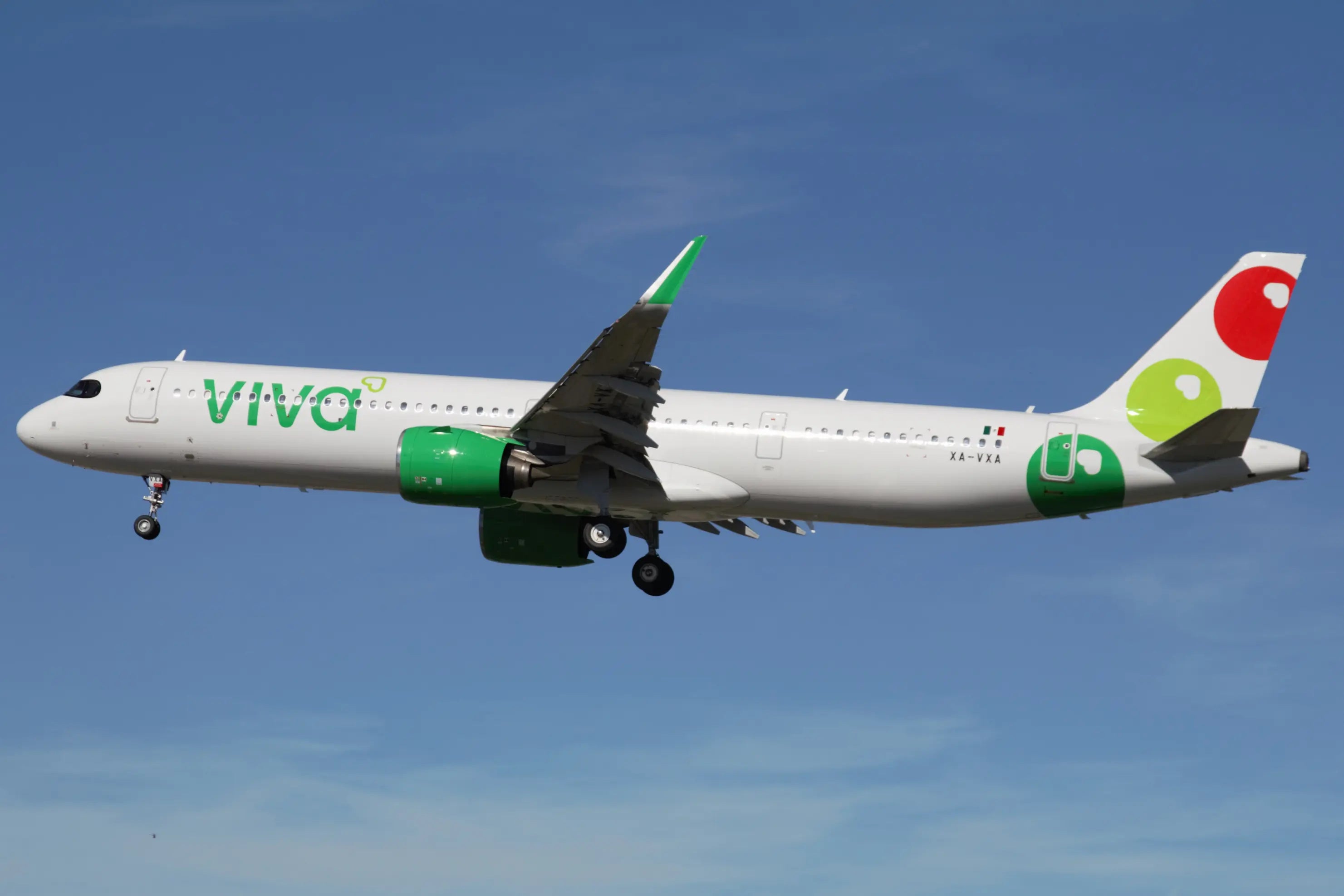
Viva Aerobus operates a 100% Airbus A320-family fleet, having completed its transition away from Boeing 737 aircraft in 2021. This single-family approach is the classic ULCC playbook (the same logic used by Wizz Air and easyJet in Europe): one training pipeline, one spares inventory, and maximum crew flexibility. For a pilot, it means your entire Viva career is spent inside the Airbus narrowbody ecosystem. The A320 and A321 share a common type rating, so pilots can be cross-utilized across subtypes under a single endorsement, subject to company differences training.
The fleet has expanded rapidly, from roughly 69 aircraft in 2022 to 81 in 2023, 90 at the end of 2024, and about 116 aircraft by mid-2025. The fleet is young, with an average age reported at around 5.3 years, meaning modern avionics, current-generation engines, and up-to-date cabin systems. Viva has one of the largest narrowbody order books in the Americas: in July 2023 it signed a memorandum of understanding with Airbus for 90 additional A321neo, lifting its cumulative A320-family order commitment to around 170 aircraft, per the manufacturer's official press release.
| Aircraft Type | Role | In Service | Notes |
|---|---|---|---|
| Airbus A320-200 (ceo) | Narrowbody | ~44 | Backbone of the early fleet. Gradually complemented by neo deliveries. |
| Airbus A320neo | Narrowbody | ~30 | Fuel-efficient variant, typically ~186 seats in Viva's single-class layout. |
| Airbus A321-200 (ceo) | Narrowbody | ~10 | Higher-capacity older variant used on denser trunk routes. |
| Airbus A321neo | Narrowbody | ~32 (14 on order) | Growth aircraft. Up to 240 seats, among the densest configurations in the world. |
Fleet data as of mid-2025, compiled from fleet-tracking and company disclosures. Totals are approximate and change with ongoing deliveries. A large A321neo order backlog (part of a ~170-aircraft A320-family commitment) supports continued growth through the late 2020s.
Unlike some legacy carriers, Viva Aerobus advertises pilot vacancies as A320-rated positions, and public job listings state that a valid Airbus A320 type rating is mandatory for both First Officer and Captain roles. In practice this means Viva primarily hires pilots who already hold, or can quickly obtain, the A320 endorsement rather than funding ab-initio type ratings at scale. Because the A320 and A321 sit under one type rating, a pilot hired on the A320 can be assigned to A321 operations with differences training, and the dense A321neo (up to 240 seats) forms an increasing share of the flying.
Pilot Salary & Compensation Breakdown
Viva Aerobus does not publish pilot pay scales, and its collective contract with the STIA union is not public. This makes precise salary reporting impossible, so the tables below are estimates built from Mexican national pilot salary data, ULCC market positioning, and pilot-community reports. They should be read as indicative ranges, not contractual figures. The general picture from every available source is consistent: as an ultra-low-cost carrier, Viva pays below the Mexican legacy carrier Aeroméxico, and well below United States and European airlines in absolute terms, though the gap narrows once Mexico's lower cost of living is considered.
For context, national labor data for the "airline pilot" occupation in Mexico shows wide dispersion, and salary-survey aggregators place the average First Officer in Mexico near 478,000 pesos per year (roughly 40,000 pesos per month, about US$230 per flight hour). Pilot-community reports have cited entry First Officer pay at Mexican ULCCs starting far lower, in some cases around 15,000 pesos per month for the most junior positions, before it rises with seniority and hours. Viva's structure typically combines a fixed monthly base with per-flight-hour pay, per diems, and statutory add-ons.
First Officer (Primer Oficial) — Estimated Pay
| Seniority | Monthly Gross (MXN, est.) | Approx. USD / month | Notes |
|---|---|---|---|
| Year 1 (entry) | MX$35,000 – 45,000 | ~US$1,900 – 2,500 | Junior line F/O, lower block-hour credit |
| Year 3–5 | MX$45,000 – 58,000 | ~US$2,500 – 3,200 | Established F/O, full seniority steps |
| Senior F/O | MX$58,000 – 72,000 | ~US$3,200 – 4,000 | Approaching command eligibility |
Estimates only. USD conversions use an approximate rate near 18 pesos per dollar and will move with the exchange rate. Actual pay depends on the current STIA contract, block hours, and base.
Captain (Comandante) — Estimated Pay
| Seniority | Monthly Gross (MXN, est.) | Approx. USD / month | Notes |
|---|---|---|---|
| Entry Captain | MX$80,000 – 100,000 | ~US$4,400 – 5,600 | New command after upgrade |
| Mid Captain | MX$100,000 – 125,000 | ~US$5,600 – 6,900 | Several years in command |
| Senior Captain | MX$125,000 – 155,000 | ~US$6,900 – 8,600 | Top of scale, high block hours |
Estimates only. Beyond base pay, Mexican pilots receive statutory extras (Christmas bonus, vacation premium) and legally mandated profit sharing (PTU), which can add meaningfully in profitable years.
These figures are estimates compiled from Mexican salary surveys, national labor statistics, and pilot reports, not official Viva Aerobus pay tables, which the airline does not disclose. The STIA collective agreement covering Viva pilots is not published, so external verification is limited. Aviation-labor commentary has argued that pay and benefits under STIA "protection contracts" at Mexican ULCCs are lower than those negotiated by the independent ASPA union at Aeroméxico. Treat every number here as a directional guide, and confirm any figure directly with Viva's HR department and current line pilots before making a career decision.
Roster Pattern & Quality of Life
Viva Aerobus flying is short-haul, high-frequency, and high-intensity. Pilots typically operate multiple sectors per duty day with quick turnarounds between predominantly domestic Mexican city pairs, plus a growing share of routes into the United States and Central America. Flight and duty time are governed by Mexico's Agencia Federal de Aviación Civil (AFAC), the national civil aviation authority whose rules broadly follow ICAO standards. In practical terms that places monthly block-hour ceilings in roughly the 90 to 100 hour range and daily duty limits near 12 to 13 hours depending on the number of legs and the time of day.
Because Viva is built around maximizing aircraft utilization, rosters tend to sit toward the upper end of what regulation allows. Pilot advocates have publicly criticized ULCC scheduling under STIA contracts as producing "jornadas extenuantes" (exhausting duty days) that push crews close to legal flight-hour limits with limited fatigue protection. Prospective pilots should weigh this: the flying builds hours and command experience quickly, but the day-to-day tempo of early starts, late finishes, and dense multi-leg days is demanding.
📅 Sample Month: Narrowbody First Officer (illustrative)
Illustrative only. Viva Aerobus does not publish rosters. This pattern represents a typical high-utilization ULCC short-haul month under Mexican AFAC flight-time rules and should not be read as an official Viva schedule.
Viva assigns pilots to one of five bases: Monterrey (MTY), Mexico City (MEX), Cancún (CUN), Guadalajara (GDL), and Tijuana (TIJ). Each has a distinct lifestyle profile: Monterrey combines the head office with lower housing costs; Mexico City offers the largest domestic market; Cancún is tourism-driven with seasonal peaks; Guadalajara mixes business and leisure; and Tijuana supports cross-border traffic near San Diego, which some pilots use to live on the United States side of the border. Viva has not published a formal seniority-based base bidding system, so assignment and any transfers are best confirmed directly during recruitment.
Benefits, Social Security & Retirement
Viva Aerobus pilots receive the benefits framework mandated by Mexican federal labor law, layered with airline-specific perks typical of a ULCC. The airline does not publish a detailed benefits brochure for pilots, so the items below reflect Mexican statutory standards that apply to formally employed airline crew, plus commonly reported airline perks. Compared with a legacy carrier like Aeroméxico, the overall package is leaner, which is consistent with the ULCC cost model.
Mexico does not have a dedicated aircrew pension fund comparable to systems in some European countries. Instead, Viva pilots save for retirement through an Afore, a privately managed individual retirement account under the national SAR system, with contributions from employer, employee, and government. The eventual pension depends heavily on salary level, contribution history, and investment returns, which means ULCC pay levels can translate into more modest accumulations than at higher-paying carriers. Pilots who value long-term retirement security should model their Afore contributions carefully and consider voluntary top-ups. Because retirement, loss-of-license cover, and any supplementary private insurance vary by contract, treat these as questions to raise explicitly with Viva before accepting an offer.
Career Progression & Seniority
Career progression at Viva Aerobus follows a seniority-based logic common across the airline industry, with First Officers advancing to command as they accumulate hours, demonstrate performance, and rise on the internal list. What makes Viva distinctive is the pace of fleet growth. An airline expanding from roughly 90 to a planned 170-plus aircraft needs a continuous supply of new Captains, which historically compresses upgrade timelines compared with static or shrinking carriers. Viva does not publish an official upgrade figure, but in a strong growth environment a well-performing First Officer can realistically reach command consideration in a few years rather than the decade-plus common at slow-growth legacy carriers.
Viva does not run a large publicized ab-initio cadet program of the kind seen at some United States regionals or European majors. Instead, it hires already-licensed, already-type-rated pilots, so the entry point assumes you have completed your own training and hold the required credentials (see Section 7). The airline has also, at times, brought in experienced command capacity from outside, including foreign pilots operating wet-leased aircraft during periods of fleet disruption, though that practice has been contentious with Mexican unions (see Section 9).
| Career Milestone | Typical Path | Notes |
|---|---|---|
| Join as First Officer | A320 family | Requires existing Mexican license and A320 type rating. |
| Build line experience | 2–4 years (growth-dependent) | High utilization accumulates hours quickly. |
| Command upgrade | Seniority + AFAC ATPL | Requires ATPL, command assessment, and company standards. Not guaranteed. |
| Senior Captain | Long-term | Top of the internal seniority list. |
| Instructor / Check Airman | Variable | Growing demand as the fleet expands; requires separate selection. |
Timelines are indicative, not contractual, and depend on hiring waves, attrition, fleet deliveries, and the outcome of the pending Volaris merger.
Viva's expanding order book and rising traffic have supported steady pilot recruitment and relatively quick command opportunities. However, two variables now cloud the medium-term outlook. First, the Pratt & Whitney GTF engine issues that have grounded aircraft across the global A320neo fleet forced Viva into temporary wet-lease arrangements, which affects capacity planning. Second, the pending merger with Volaris raises longer-term questions about how two separate pilot groups and seniority lists might eventually be harmonized. Neither has produced announced pilot furloughs, but both belong on any career-planning checklist.
Recruitment Process & Requirements
Viva Aerobus recruits experienced, already-qualified pilots rather than low-hour trainees. Public job listings for A320 First Officer and A320 Captain positions make clear that candidates must hold Mexican licenses issued by AFAC, an Airbus A320 type rating, and a valid Class 1 medical. There is no advertised sponsored cadet pathway, so aspiring Viva pilots generally finance their own training, build the required experience, and obtain the type rating before applying. Applications are handled through the airline's official pilot careers portal.
First Officer (Primer Oficial) — Requirements
Captain (Comandante) — Requirements
Typical Selection Stages
Online Application
Submit your CV, license and medical documentation, proof of A320 type rating, logbook summary, and language and identity documents through Viva's official jobs portal under the "Pilotos" department.
Eligibility Screening
Recruitment verifies your Mexican AFAC license, Class 1 medical, A320 type rating and time on type, language proficiency, and work eligibility. Candidates who do not meet the hard requirements are filtered out here.
Assessment & Interview
Viva does not publish its exact assessment flow, but standard airline practice applies: technical evaluation, a simulator check on the A320, and HR and panel interviews, often with an aptitude or psychological component. Prepare Airbus systems knowledge and crew resource management scenarios.
Medical & Background Checks
Verification of the Class 1 medical plus document and background checks. For international sectors, valid travel documents and any required United States visa are confirmed.
Induction & Line Training
Selected pilots complete company induction, any required differences and recurrent training, and supervised line training before being released to normal line operations under AFAC rules.
The single biggest gate is licensing. To work for a Mexican airline you generally need a Mexican AFAC license, and obtaining or converting to a Mexican CPL/ATPL in practice requires Mexican nationality. Foreign FAA or EASA licenses are not sufficient on their own for line operations, and Viva does not advertise visa sponsorship for foreign pilots. There is no published low-hours cadet route, so the practical path is: complete professional training, build "extensive experience," obtain the A320 type rating, and then apply. Confirm the current exact requirements on the airline's own careers portal, as ULCC hiring criteria shift with fleet and market conditions.
How Viva Aerobus Compares: Airline Radar Chart
How does Viva Aerobus stack up against its two most relevant Mexican peers: fellow ULCC Volaris (its announced merger partner) and legacy flag carrier Aeroméxico? The chart below compares all three across the same six themes used in the scorecard, condensed to five radar axes. Scores are editorial estimates based on publicly available data, salary surveys, union publications, and pilot feedback, not precise measurements.
Key Takeaways from the Comparison
Viva and Volaris are near-twins. As Mexico's two big ULCCs, they operate similar all-Airbus A320-family fleets, both represented by the STIA union, both cost-disciplined, and both offering comparable pay and roster intensity. Pilot-community and salary analysis consistently describe the two as broadly interchangeable on compensation, with Volaris sometimes rated fractionally ahead on scale and Viva fractionally ahead on fleet modernity. Their imminent merger only underlines how similar the two pilot propositions are.
Aeroméxico leads on pay, benefits, and stability. The legacy carrier, whose pilots are represented by the independent ASPA union, is widely regarded as offering the strongest overall conditions in Mexican aviation. Aeroméxico pilots secured a roughly 20% total compensation improvement in a 2024 to 2026 agreement, and enjoy richer benefits and more structured rosters. Aeroméxico also offers something the ULCCs cannot: widebody and long-haul flying to Europe, Asia, and South America, opening a broader long-term career.
Viva scores highest on fleet. A young, all-Airbus fleet averaging around five years old, with a large neo order book, gives Viva a genuine edge in equipment modernity, ahead of Aeroméxico's mixed narrowbody and widebody fleet on pure age. For a pilot who prioritizes flying current-generation aircraft in a fast-growth environment, this is a real draw.
The trade-off is clear. Viva (and Volaris) offer faster hour-building and quicker command in a modern cockpit, at the cost of lower pay, tougher rosters, and weaker union leverage. Aeroméxico offers higher pay, better protections, and long-haul horizons, but with a more competitive entry and traditionally slower progression.
Scores are editorial estimates drawn from publicly available salary surveys, national labor statistics, union publications, airline disclosures, and pilot-community reports. Because none of the three airlines publishes full pilot contract data, these ratings represent a general assessment for an experienced pilot weighing a long-term career, not audited figures. Individual experience varies with base, seniority, fleet, and personal priorities. The comparison predates completion of the Volaris merger, which could reshape both ULCCs' profiles.
Union & Industrial Relations
Union representation is one of the most important, and most contested, aspects of working at Viva Aerobus. Mexican aviation has a two-tier union landscape. At the legacy carrier Aeroméxico, pilots are represented by ASPA de México (Asociación Sindical de Pilotos Aviadores de México), a long-established, independent, and assertive pilots' union. At the big ULCCs Viva and Volaris, pilots are represented by STIA (Sindicato de Trabajadores de la Industria Aeronáutica), a broader industry union that aviation-labor commentators have criticized as functioning closer to a "protection" union, one whose contracts tend to favor employer cost control over aggressive pilot advocacy.
This distinction matters directly to pay and quality of life. Analyses of STIA "contratos de protección" argue that pilots at Viva and Volaris face a salary and benefits gap versus Aeroméxico, more demanding rosters that push toward legal flight-hour limits, and practical obstacles to switching unions despite Mexico's 2019 labor reform, which was designed to strengthen union democracy. For a pilot, the takeaway is not that Viva is lawless, it operates within Mexican labor law and AFAC regulation, but that the collective-bargaining counterweight to management is weaker than at a carrier represented by an independent union like ASPA.
Recent Disputes & Key Events
Viva Aerobus has not experienced the kind of large, headline pilot strikes seen at some legacy carriers, and there is no evidence of mass furloughs among its own pilots. But the union environment is genuinely weaker than at Aeroméxico, which affects pay, rosters, and how disputes get resolved. Aspiring pilots should go in clear-eyed: you gain fast hour-building and command opportunities, but with less collective leverage over conditions. It is worth following ASPA's public statements via the ASPA de México website to understand the wider industry debate, even though ASPA does not represent Viva's pilots directly.
The Volaris Merger & What It Means for Pilots
The single most consequential development for anyone considering a Viva Aerobus career is the merger of equals with Volaris, announced on December 18, 2025. The two ULCCs agreed to combine their holding companies under a new group, widely reported as Grupo Más Vuelos, creating by far the dominant force in Mexican domestic aviation. For pilots weighing Viva today, this is not background noise: it reshapes the long-term picture of fleet, seniority, and job security.
Under the announced structure, it is a 50/50 economic combination in which Viva legally merges into Volaris (with Volaris as the surviving, listed entity) and Viva shareholders receive newly issued Volaris shares valued at roughly US$1.08 billion. Crucially for employees, both airlines are set to keep their own brands, air operator certificates, and management teams, at least initially, meaning pilots would continue to be employed by their existing carrier rather than an instantly unified airline.
By spring 2026 the deal had cleared a major hurdle: Volaris shareholders approved it with about 91.8% in favor, and Viva's corporate approvals were secured. What remains is regulatory clearance, which is not a formality. The transaction requires antitrust review in Mexico by COFECE (Comisión Federal de Competencia Económica), plus filings in the United States and Colombia. Because the combined group would control an estimated two-thirds or more of domestic seats, that review is expected to be searching and could extend through the end of 2026. As of mid-2026 the merger is agreed and shareholder-approved, but not yet closed.
Official documents describe no immediate layoffs, no base closures, and no forced integration of the two pilot seniority lists at closing. That is reassuring in the short term. However, the harder questions, how (or whether) two separate STIA-covered pilot groups and seniority lists would eventually be harmonized, how bases and fleets might be rationalized, and how union representation evolves, are not yet answered and would depend on future implementation and regulatory outcomes. A larger, financially stronger group could improve job stability, but seniority-list integration is historically the most contentious part of any airline merger. If you are joining Viva now, treat the merger as a live, unresolved factor and ask direct questions about how it may affect your seniority and base.
Verdict: Who Is Viva Aerobus For?
🎯 Our Take
Viva Aerobus is a fast-growing ultra-low-cost carrier that offers a specific kind of value to pilots: rapid hour-building, quick command opportunities, and one of the youngest all-Airbus fleets in the Americas. For a Mexican pilot who already holds an AFAC license and an A320 type rating, Viva can be an efficient way to build a jet career and reach the left seat faster than at a slow-growth legacy carrier.
The trade-offs are equally clear. As a ULCC, pay sits below Aeroméxico and far below United States and European carriers in absolute terms, rosters are intense and criticized for pushing legal limits, and pilots are represented by STIA rather than the stronger, independent ASPA. Loss-of-license cover and other benefit details are not publicly documented and must be confirmed individually. On top of this, the pending Volaris merger introduces genuine uncertainty about the long-term shape of seniority, bases, and representation.
Viva is best understood as a career accelerator rather than a career destination for most pilots: a strong place to gain modern Airbus experience and command time, within a demanding, cost-disciplined environment, at an unusually pivotal moment in its history.
1 Do I need to be Mexican to fly for Viva Aerobus?
In practice, yes. Viva job listings require a Mexican license issued by AFAC, and obtaining or converting to a Mexican CPL or ATPL generally requires Mexican nationality. Foreign FAA or EASA licenses are not sufficient on their own for line operations at a Mexican airline, and Viva does not advertise visa sponsorship for foreign pilots. The airline has used foreign pilots only in limited, contested wet-lease situations, not as a standard hiring route.
2 Does Viva Aerobus have a cadet program or hire low-hour pilots?
There is no publicly advertised ab-initio cadet program of the kind offered by some United States regionals or European majors. Viva hires already-licensed, already-type-rated pilots. First Officer listings ask for a CPL with instrument and multi-engine ratings, an A320 type rating, and "extensive experience." You should expect to finance your own training and build hours before applying.
3 How much do Viva Aerobus pilots earn?
Viva does not publish pay scales, so exact figures are not verifiable. Based on Mexican salary data and ULCC positioning, First Officers likely earn somewhere in the tens of thousands of pesos per month (rising with seniority), and Captains materially more, into six figures in pesos monthly for senior commanders. In United States dollar terms these are modest by international standards. As a ULCC, Viva pays below Aeroméxico. Treat all published figures, including ours, as estimates and confirm with the airline directly.
4 Does Viva Aerobus pay for the type rating?
Public job listings advertise A320-rated positions and state that a valid A320 type rating is mandatory, which indicates Viva primarily recruits pilots who already hold the endorsement rather than funding type ratings at scale. Any bonded or self-funded arrangements for pilots who need the rating should be clarified directly with recruitment, as terms are not published.
5 How long does it take to upgrade to Captain?
Viva does not publish an official upgrade timeline. Because it is a high-growth airline adding aircraft rapidly, command opportunities have historically come faster than at static legacy carriers, potentially within a few years for a strong performer, subject to seniority, holding an AFAC ATPL, and passing command assessment. Timelines can shift with fleet deliveries, attrition, engine-related capacity issues, and the pending Volaris merger.
6 What does the Volaris merger mean for Viva pilots?
In December 2025 Viva and Volaris announced a 50/50 merger of equals under a new group (reported as Grupo Más Vuelos), with a combined fleet of about 251 Airbus aircraft. At the announced structure, both airlines keep separate brands, operating certificates, and management, so pilots stay with their current employer initially, and no immediate layoffs or seniority-list merger were announced. The deal was shareholder-approved by spring 2026 but still needs antitrust clearance (COFECE in Mexico, plus United States and Colombia) and had not closed as of mid-2026. Longer-term seniority integration remains the key open question.
7 Which union represents Viva Aerobus pilots?
Viva Aerobus pilots are represented by STIA (Sindicato de Trabajadores de la Industria Aeronáutica), the same union that covers Volaris pilots. This differs from Aeroméxico, whose pilots belong to the independent ASPA de México. Aviation-labor commentators have criticized STIA's ULCC contracts as employer-friendly "protection contracts" with lower pay, weaker benefits, and more demanding rosters than ASPA-negotiated agreements.
8 What bases can Viva Aerobus pilots be assigned to?
Viva operates from five principal bases: Monterrey (its headquarters hub), Mexico City, Cancún, Guadalajara, and Tijuana. Each offers a different lifestyle, from Monterrey's lower cost of living to Tijuana's cross-border options near San Diego. Viva has not published a formal seniority-based base bidding system, so confirm assignment and transfer rules directly during recruitment.
Official Links & Resources
Before applying or making any career decision, verify information directly with official sources. These are the key websites and organisations relevant to a Viva Aerobus pilot career:
Because Viva does not publish pilot pay scales or contracts, the most reliable intelligence comes from current line pilots. Combine the official careers portal with direct conversations, and follow both the airline's investor updates and independent union commentary to track how the Volaris merger and any seniority-list decisions develop, since those will matter more to your long-term career than today's roster.