

United Airlines Overview & Company Profile
United Airlines is one of the three U.S. legacy network carriers and traces its roots to 1926, formalizing as United Air Lines in 1931 following the consolidation of several airmail operators under the Boeing Air Transport umbrella. The airline is headquartered at the Willis Tower in Chicago and operates as the principal subsidiary of United Airlines Holdings, Inc. (NYSE: UAL). It was a founding member of the Star Alliance in 1997, the world's first global airline alliance, which today links 26 member carriers spanning every inhabited continent.
By early 2026, United's mainline fleet had grown to approximately 1,103 aircraft, making it the largest mainline fleet of any commercial airline in the world by aircraft count, according to industry fleet reviews. The airline operates roughly 4,500 daily departures to nearly 370 destinations across six continents, with around 17,000 active pilots represented by the Air Line Pilots Association (ALPA). United's parent company posted approximately $57.1 billion in operating revenue for full year 2024, and the carrier is on track to exceed that figure in 2025 thanks to capacity growth and premium revenue performance. For an overview of the parent's filings and investor materials, the United Airlines Holdings investor relations site is the authoritative reference.
United's hub-and-spoke network is built around eight crew bases: Chicago O'Hare (ORD), Denver (DEN), Houston Intercontinental (IAH), Los Angeles (LAX), Newark Liberty (EWR), San Francisco (SFO), Washington Dulles (IAD), and the smaller Pacific gateway at Guam (GUM). Among the U.S. "Big Three," United stands out for the depth of its international long-haul network, particularly across the Pacific and to Europe via EWR and IAD, where Star Alliance partner Lufthansa connects beyond Frankfurt and Munich.
Fleet Composition & Type Ratings
United operates the most diverse mainline fleet among the U.S. majors, combining Boeing 737NG and 737 MAX narrowbodies, the Airbus A319/A320/A321neo family on the short-haul side, and a long-haul widebody mix that spans the Boeing 757, 767, 777 and 787 families. This breadth gives pilots an unusually wide range of equipment to potentially fly across a single career, from a 737-700 on Florida shuttle work to a 787-10 on a Singapore rotation. The trade-off is that not every base offers every fleet, so equipment ambitions interact closely with base bidding decisions.
The fleet is in the middle of a generational refresh under the United Next plan announced in 2021, which committed the airline to one of the largest aircraft orders in commercial aviation history. Hundreds of new Boeing 737 MAX and Airbus A321neo / A321XLR aircraft are scheduled for delivery through the end of the decade, while older 757s, 767s and 777-200/200ERs are gradually being retired or repurposed. Even with Boeing's well-documented MAX delivery slippage during 2024, the carrier continued to add aircraft and reshape its capacity profile.
| Aircraft Type | Role | In Service | Routes / Notes |
|---|---|---|---|
| Airbus A319-100 | Narrowbody | 70 | Domestic / short transcon. Aging; expected to be replaced by A321neo and MAX 8. |
| Airbus A320-200 | Narrowbody | 62 | Domestic backbone. Sister fleet to A319. |
| Airbus A321neo | Narrowbody | 67 | Domestic and Caribbean. Growing rapidly; XLR variant on order for thin long-haul. |
| Boeing 737-700 | Narrowbody | 34 | Smaller domestic markets. Gradual retirement under United Next. |
| Boeing 737-800 | Narrowbody | 140 | Domestic workhorse. Includes the Guam (GUM) Pacific island fleet. |
| Boeing 737-900ER | Narrowbody | 136 | High-density domestic and transcon. Same type rating as MAX. |
| Boeing 737 MAX 8 | Narrowbody | 123 | Replacing 737NGs. Premium-heavy domestic and Hawaii flying. |
| Boeing 737 MAX 9 | Narrowbody | 79 | Longer-range narrowbody on transcon and Caribbean routes. |
| Boeing 757-200 | Mid-size | 40 | Transcon premium and select transatlantic. Slated for replacement by A321XLR. |
| Boeing 757-300 | Mid-size | 21 | Hawaii and high-density transcon. World's largest 757-300 operator. |
| Boeing 767-300ER | Widebody | 37 | Transatlantic mid-haul. Gradual replacement by 787-9. |
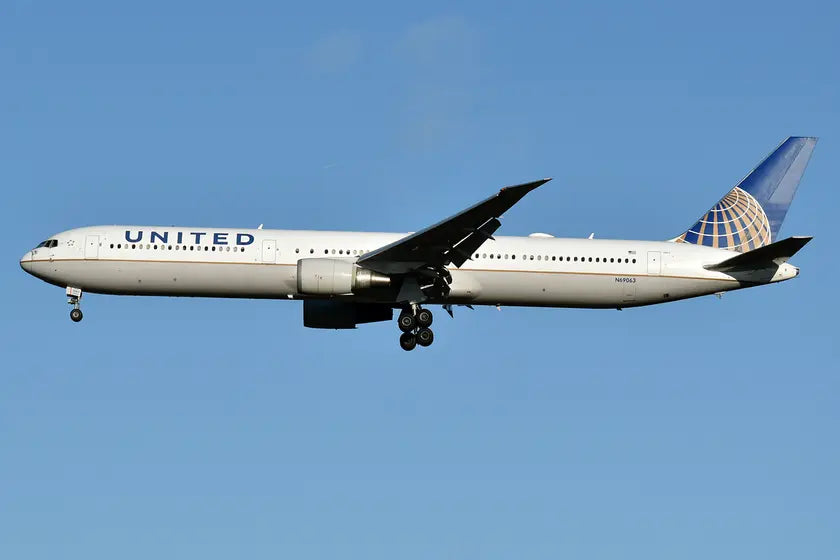
| Boeing 767-400ER | Widebody | 17 | Premium-configured transatlantic and Hawaii flying. |
| Boeing 777-200 | Widebody | 19 | Domestic high-density (premium transcon, Hawaii). |
| Boeing 777-200ER | Widebody | 55 | Long-haul international. Largest 777-200ER operator worldwide. |
| Boeing 777-300ER | Widebody | 20 | Premium Pacific and select Europe routes. Polaris-heavy cabins. |
| Boeing 787-8 | Widebody | 12 | Medium long-haul. Original Dreamliner variant. |
| Boeing 787-9 | Widebody | 48 | Long-haul backbone. Sydney, Tokyo, Tel Aviv-era routes. |
| Boeing 787-10 | Widebody | 21 | High-capacity long-haul. Europe trunk routes and select Asia. |
Fleet snapshot derived from public registry data through early 2026. Counts move month to month as deliveries and retirements progress.
United pays for type ratings on hire and pays first-officer rates during training, so there is no out-of-pocket type-rating cost for new pilots. Initial equipment assignment is driven by company need at the time of hire and the new pilot's base/equipment bid. The 737-700/-800/-900ER and 737 MAX 8/9 share a single type rating, as do the A319/A320/A321 family. Boeing 757 and 767 share a common type rating, an unusually pilot-friendly quirk that lets crews mix transcon flying with mid-haul Europe trips on the same certificate. The 777 and 787 are separate types.
Pilot Salary & Compensation Breakdown
United Airlines pilot pay is governed by the United Pilot Agreement (UPA 2023), ratified by ALPA-represented pilots in September 2023 after a 99% strike authorization vote earlier the same year. The deal was valued by ALPA and the airline at approximately $10.2 billion over four years and lifted hourly rates by roughly 40% on a cumulative basis with annual step-ups through 2027. The contract aligns United's pay structure closely with Delta and American following their respective 2023 deals, while preserving United's industry-leading direct retirement contribution.
United pilots are paid by the block hour with a monthly minimum guarantee set in the UPA, plus per diem, overtime, override pay for premium trips, holiday pay, and an annual profit-sharing distribution. Senior 777 and 787 Captains can earn well above $400,000 in salary alone, with total compensation pushing past $500,000 in profitable years once the 16% retirement contribution and profit sharing are added on top.
First Officer Hourly Pay Scale (UPA 2023)
| Seniority Step | Narrowbody F/O | Widebody F/O | Annual Gross (est.) |
|---|---|---|---|
| Year 1 | ~$116/hr | ~$129/hr | ~$110,000 – $130,000 |
| Year 3 | ~$175/hr | ~$190/hr | ~$165,000 – $190,000 |
| Year 6 | ~$210/hr | ~$235/hr | ~$200,000 – $235,000 |
| Year 12 (top) | ~$245/hr | ~$275/hr | ~$235,000 – $280,000 |
Estimated 2025 hourly rates under the UPA 2023 step-up schedule. Annual ranges assume the 73-hour monthly guarantee plus typical premium and per diem credits.
Captain Hourly Pay Scale (UPA 2023)
| Seniority Step | 737 / A320 (Narrowbody) | 757 / 767 | 777 / 787 (Widebody) |
|---|---|---|---|
| Year 1 Captain | ~$285/hr | ~$305/hr | ~$325/hr |
| Year 5 Captain | ~$315/hr | ~$340/hr | ~$390/hr |
| Year 12 (top step) | ~$335/hr | ~$385/hr | ~$444/hr |
| Top step, annual gross (est.) | ~$320,000+ | ~$370,000+ | ~$430,000+ |
Hourly rates reflect the publicly summarized UPA 2023 pay tables as of the 2025 step-up. AirlinePilotCentral lists top-step widebody Captain pay at approximately $443.85/hr by the final contract year, which is the figure most commonly used by recruiters for headline comparisons.
United pilots receive a guaranteed 73 hours of pay per month regardless of actual block, plus override pay on premium trips, holiday pay, and a per diem of roughly $3.00 per hour on domestic flying and slightly higher on international duty. The signature financial perk is the 16% direct contribution to the Pilot Retirement Account Plan (PRAP). United deposits 16% of pilot earnings into the retirement account with no employee contribution required, making it the highest direct contribution at any U.S. major. Annual profit sharing under the UPA formula has historically run in the high single digits to low double digits as a percentage of eligible earnings, depending on UAL's pre-tax profitability.
Figures above are derived from public summaries of UPA 2023, ALPA communications, and pilot pay databases such as AirlinePilotCentral. Actual take-home pay depends on individual seniority, federal and state income tax, base location, equipment, and the credit hours flown in a given month. Several U.S. carriers (including United) include cost-of-living mechanisms in the back half of their contracts; rates may step up again in 2026 and 2027. Always verify against the live MEC pay tables before making a career decision.
Roster Pattern & Quality of Life
United uses a Preferential Bidding System (PBS) for line construction. Each month pilots submit ranked preferences for trips, days off, layovers, equipment, report times, and weekends, and the system builds personalized lines in seniority order. Senior pilots get near-perfect schedules; very junior line holders take what the algorithm can fit; reserve pilots cover the rest. PBS is generally considered an improvement over fixed-line bidding because preferences can be expressed at the granular trip level, but it rewards careful pilots who learn to write effective bid logic.
Hard scheduling protections are anchored to FAR Part 117 flight and duty time limitations: a maximum of 1,000 flight hours per rolling 12 months, 100 flight hours per rolling 28 days, and minimum rest of 10 consecutive hours before any flight duty period (with an 8-hour sleep opportunity). The UPA 2023 layers additional contractual protections on top of Part 117, including improved reserve rest, soft-day language, and pay credits for reassignment.
📅 Sample Month — 737 First Officer (Denver Base)
Long-haul widebody patterns look different. A typical 787-9 trip from Newark to a European hub like Munich is a three-day pairing with a 24 to 30-hour layover; a Pacific rotation out of San Francisco to Tokyo Haneda is usually four days. Augmented crews of three or four pilots are used on flights beyond about 10 to 12 hours, allowing rest in onboard crew bunks. Widebody pilots typically fly fewer days but stack higher block hours per trip, with monthly credit hours often in the 80 to 90 range.
United's eight-base footprint is one of the broadest in U.S. commercial aviation, and the carrier maintains a pilot-friendly commuting culture: while commute time is the pilot's responsibility, the UPA contains specific commuter protection clauses (notably the "commuter policy") allowing pilots to call in for a missed commute under defined conditions. Denver and Houston are typically the easiest bases to commute to thanks to broad domestic frequencies; Newark tends to have the longest waits to hold a desirable line but the deepest transatlantic flying; Guam is a unique outpost flying 737-800s on Pacific island routes (Tokyo, Manila, Honolulu, Palau), and is generally bid by pilots who actually live in Guam or who treat the base as a long-term lifestyle choice.
Junior pilots at most United bases will spend time on reserve, typically with 12 to 14 reserve days per month and short-call windows of two to three hours from notification to report. The transition to line-holder status varies dramatically by base and fleet: a junior MAX First Officer in Denver may hold a line within months, while a junior 777 First Officer in EWR can sit on reserve for a year or more before a regular line opens.
Benefits, Travel Perks & Retirement
United's benefits package is one of the principal reasons pilots stay until age 65. The two headline items are the 16% direct PRAP contribution, the highest in the U.S. industry, and the global travel privileges that come from Star Alliance access. Combined with strong medical and disability coverage, the non-cash package adds materially to total compensation and is structurally protected through the term of the UPA 2023 agreement.
The Pilot Retirement Account Plan replaced United's old defined-benefit pension after the 2002–2006 bankruptcy and was structurally upgraded in the 2023 agreement. Because the 16% PRAP contribution is fully employer-funded, a top-step widebody Captain flying 80 hours per month effectively earns more than $80,000 per year in retirement contributions alone, fully separate from cash compensation. Combined with optional 401(k) deferrals (administered by Fidelity), United pilots routinely max out IRS annual additions limits, building seven-figure retirement balances within a single career.
Because United is a founding member of Star Alliance, employee non-revenue and ID90 / ZED fare privileges extend to Lufthansa, ANA, Singapore Airlines, Air Canada, Turkish Airlines, Avianca, and more than 20 other carriers. For pilots who want to commute internationally, build a family travel lifestyle, or position globally, this is significantly more network than what's available to pilots at Delta (SkyTeam) or American (oneworld), particularly across the Pacific and into secondary European cities. Details and the most current member list are available at staralliance.com.
Career Progression & Seniority
Career progression at United is governed by a single, system-wide seniority list. Date of hire (and class position on that date) determines every meaningful career decision: equipment, base, schedule, vacation, and Captain upgrade. The same list applies regardless of whether you fly the 737 in Houston or the 787-10 in San Francisco. United, like all U.S. legacy carriers, does not accept direct-entry Captains; every Captain upgrade happens internally and strictly by seniority once minimum experience requirements are met (typically 12 months of line flying as a First Officer at United).
Upgrade times have moved dramatically over the last five years. Pre-pandemic, holding a Captain bid often required 10 to 15 years. With heavy retirements at age 65, the United Next fleet expansion, and post-COVID growth, median upgrade time fell to between 3 and 7 years depending on fleet and base from 2022 to 2024. The 2024 hiring slowdown and Boeing delivery delays have pushed those timelines back out somewhat for new hires, but the structural pipeline of retirements remains the dominant tailwind through the end of the decade.
| Career Milestone | Typical Timeline | Notes |
|---|---|---|
| New-hire training | ~10 weeks | Indoctrination, systems, type rating, IOE. Paid at FO Year 1 rates. |
| Off probation | 12 months | First-year probation period. Full seniority once cleared. |
| Holding a regular line | 6 – 18 months | Highly base- and fleet-dependent. Junior bases can be quicker. |
| Captain upgrade (narrowbody) | ~3 – 7 years | Most common upgrade path. Heavy 737/A320 retirements driving timelines. |
| Wide-body F/O bid | 2 – 8 years | Choice between staying narrowbody for faster CA, or going widebody F/O for international flying and higher F/O pay. |
| Wide-body Captain (777/787) | 10 – 20+ years | Top of the pay ladder. Senior, premium-route bids. |
| Check Airman / Line Check Pilot | Variable | Separate selection. Augmented pay and overrides. |
According to the Future and Active Pilots Alliance (FAPA) hiring tracker, United hired roughly 2,500 pilots in 2022, 2,349 in 2023, and approximately 1,317 in 2024, the latter a deliberate slowdown driven primarily by Boeing 737 MAX delivery delays and training pipeline constraints. ATP Flight School's outlook projects United returning to roughly 2,500 hires in 2026 as deliveries normalize. With around 17,000 pilots on the list and mandatory age-65 retirements pushing approximately 800 to 1,000 pilots off the property each year through 2030, the structural demand for new pilots remains strong.
New hires face a real trade-off: upgrade quickly on a narrowbody (and earn Captain pay sooner) or stay First Officer on a widebody for international flying and higher F/O hourly rates. The "right" answer depends entirely on lifestyle and total expected career length. A pilot hired at 28 who plans to fly until 65 has very different math from a career-changer hired at 50. The single seniority list means you cannot accelerate progression by jumping fleets; every move re-trains you while keeping the same seniority number.
Recruitment Process & Requirements
United recruits pilots through three main pathways: direct-entry hiring (the classic "off the street" route for experienced military, regional, fractional, and corporate pilots), the United Aviate Program (a managed career pipeline through United Express partners and Part 135 operators), and the United Aviate Academy in Goodyear, Arizona (the ab-initio flight training school for zero-time candidates). All three converge on the same set of First Officer minimums and the same interview process at the mainline level.
Mainline First Officer — Minimum Requirements
Selection Stages
Online Application & Document Review
Apply through the United First Officer careers page. The application requires logbook totals, certificates, employment history, and three to five professional references. Aviate participants apply through their Aviate dashboard at unitedaviate.com.
Cognitive & Personality Assessments
Selected candidates complete online assessments covering cognitive ability, situational judgment, and personality. United uses these to short-list candidates before incurring travel costs for in-person interviews.
Panel Interview (Chicago)
Held at United's Network Operations Center near Willis Tower. A two-part interview with a Human Resources representative and a current United Captain. Expect technical questions (ATP-level systems, IFR procedures, regulations), Crew Resource Management scenarios, behavioral questions ("Tell me about a time..."), and a TMAAT-heavy structure.
Sim Evaluation (when required)
Some candidates, particularly those without recent jet PIC time, complete a fixed-base or full-motion simulator evaluation. Typical profile: raw data ILS, partial-panel work, and a single-engine missed approach. Scored on procedure adherence and basic stick-and-rudder.
Conditional Offer, Background & Medical
Conditional Job Offers (CJO) trigger PRIA records request, FAA records check, criminal background screening, 10-year work history verification, and an FAA First Class medical if not already current. United also runs a 5-panel drug screen.
Class Date, Training, IOE
Once cleared, new hires receive a class date at the United Flight Training Center in Denver. Indoctrination (about 1 week), ground school and full type rating (6 to 8 weeks), followed by Initial Operating Experience (IOE) on the line, typically 25 hours or more.
The United Aviate Academy is the airline's ab-initio flight school, opened in 2022 on a 28-acre campus at Phoenix Goodyear Airport (KGYR). The school is Part 141 and trains zero-time students through commercial multi-engine and CFI/CFII ratings. Published 2025 tuition is roughly $89,000 for the six core certificates, with a required minimum funding proof of $111,700 covering tuition, DPE fees, supplemental training, and FAA knowledge exams. Students must be at least 18, relocate to Goodyear, and pass background and drug screening. The academy graduated its first class of approximately 20 students in late 2022; United has stated a long-term target of training at least 5,000 new pilots by 2030, with a stated diversity goal of 50% women and people of color.
The Aviate Program is United's structured career pipeline that connects partner flight schools, United Express regional carriers, Part 135 operators, and corporate pathways to a mainline interview slot. Active United Express partners participating in Aviate include SkyWest, Air Wisconsin, CommutAir, GoJet, with Mesa's role winding down. Aviate participants typically need ~1,200 hours of PIC time at an Aviate UAX or Part 135 partner before being eligible to transition to United, generally requiring around 2 to 3 years at the regional level. Aviate is not a guarantee of a mainline job, but participation does provide a defined and managed transition path that experienced United Express First Officers do not have outside the program.
Top 5 Layover Destinations
United's long-haul widebody network is one of the deepest among U.S. carriers, with daily flying to every major Asian, European, and Oceania market. Layovers typically run 24 to 48 hours, longer on ultra-long-haul Pacific trips. Hotels are contracted by the company through Crew Logistics, generally at upper-upscale brands (Marriott, Hilton, Hyatt) located in or near city centers, with transportation provided. Senior pilots bid for the most desirable layovers; junior pilots take what's left. The following five destinations are widely considered among the most popular line bids on United's network.
All crew hotels are contracted by the company, not chosen by individual pilots. Transportation between hotel and airport is provided through Crew Logistics. Under FAR Part 117, pilots must receive a minimum 10-hour rest opportunity (with 8 hours of uninterrupted sleep) before any subsequent duty period. International long-haul flights typically operate with 3 or 4-pilot augmented crews when block time exceeds 8 to 12 hours, with onboard crew rest facilities. Note: United's Tel Aviv (TLV) service, previously a popular bid out of EWR and SFO, has been suspended since late 2023 due to the regional security situation; resumption dates have been repeatedly extended.
How United Compares: Airline Radar Chart
The natural comparison for United is its two closest competitors among the U.S. legacy "Big Three": Delta Air Lines and American Airlines. All three carriers ratified new pilot contracts in 2023 within a 12-month window, broadly normalizing top-line compensation across the legacy field. The differentiators today come less from headline pay and more from network design, fleet, contract specifics, and culture.
Key Takeaways from the Comparison
Retirement crown goes to United. The 16% direct PRAP contribution is the single biggest structural differentiator. Delta matches up to 16% as a 401(k) match, but the United plan is structured as a direct contribution that pilots cannot opt out of, locking in the benefit regardless of personal financial planning. American's retirement contributions are competitive but lower on a percentage basis.
Hourly pay is now near-identical across the Big Three. Delta's March 2023 PWA, the United UPA 2023, and the American APA contract from late 2023 each push top-step widebody Captain hourly pay into the mid- to high-$400 range. The order of magnitude is the same; the differences come from per diem rates, override structures, profit-sharing formulas, and equipment-specific premiums.
Network design distinguishes the three. United is the strongest U.S. carrier across the Pacific (Tokyo, Sydney, Hong Kong, Seoul) and competitive into Europe via the Atlantic Joint Venture with Lufthansa. Delta is dominant in the Atlantic (JV with Air France-KLM and Virgin Atlantic) and stronger to Latin America via LatAm partnership. American is deepest in the Caribbean and South America via Dallas and Miami, and partners with British Airways and Iberia across the Atlantic. For a pilot who specifically wants Asia and Australia flying, United is the clearest choice; for someone wanting consistent European widebody flying, all three deliver.
Fleet diversity favors United. United operates 18 distinct subtypes from the A319 to the 787-10, against more concentrated fleets at Delta (A220, A321, A330, A350, 717) and American (A319/320/321, 737, 787, 777). More fleets means more bidding options and more pathways to widebody flying, at the cost of more frequent recurrent training cycles.
Radar scores are editorial estimates synthesizing public contract summaries (United UPA 2023, Delta PWA 2023, American APA 2023), pay databases such as AirlinePilotCentral, FAPA hiring data, and industry coverage. They reflect a general assessment for a pilot evaluating a long-term career; individual experience varies dramatically by base, fleet, and seniority. Numbers will be updated as new contract amendments and amendable-date negotiations conclude.
Union & Industrial Relations
All United Airlines pilots are represented by the Air Line Pilots Association, International (ALPA), the largest pilot union in the world with more than 79,000 members at 41 U.S. and Canadian carriers. Within ALPA, United pilots are governed by the United Master Executive Council (UAL MEC), headquartered at 9550 W. Higgins Road, Suite 1000, Rosemont, IL 60018, immediately adjacent to Chicago O'Hare. The MEC's public website is ual.alpa.org.
In March 2025, the UAL MEC elected new leadership, with Captain Brian Noyes taking over as Master Chair. The MEC structure includes a Master Chair, Vice Chair, Secretary-Treasurer, and Local Council representatives elected from each pilot base (ORD, DEN, EWR, IAH, LAX, SFO, IAD, GUM). Committee work covers Scheduling, Safety, Jumpseat, Retirement, Hotel, Communications, Negotiating, and Professional Standards, with day-to-day pilot interaction handled by elected base representatives.
MEC Structure & Governance
Recent Strike History & Industrial Action
United pilots have not gone on strike since 1985, but the credibility of ALPA's strike threat is what produced the 2023 contract. ALPA membership is automatic upon hire at United (open-shop rules do not apply under the Railway Labor Act for U.S. airlines that are unionized). Monthly dues are roughly 1.95% of monthly earnings, capped at a defined ceiling. In return, members get a robust legal department, professional standards committee, ASAP and safety advocacy, federal lobbying, and direct contract enforcement through grievance procedures. For most new hires, ALPA participation is treated as a baseline professional expectation rather than an optional choice.
Verdict: Who Is United Airlines For?
🎯 Our Take
United Airlines is, in pure financial terms, one of the most lucrative pilot careers available in commercial aviation. The combination of UPA 2023 hourly rates that push top-step widebody Captain pay above $440 per block hour, a 16% direct PRAP retirement contribution that no other U.S. legacy matches structurally, robust profit sharing, and 35 to 42 days of vacation for senior pilots makes the total package extremely competitive. Layer on the largest mainline fleet in the world, eight crew bases including a true Pacific outpost in Guam, and global non-rev privileges via Star Alliance, and the long-term ceiling is hard to beat.
The honest trade-offs: upgrade times have stretched somewhat from the 2022 to 2023 peak as Boeing delivery delays cooled the hiring pace into 2024 (1,317 hires versus 2,349 the prior year). The single seniority list means new hires cannot accelerate progression by switching fleets or bases, and junior reserve life at the senior bases (EWR, SFO) can be difficult for several years before a line opens. International long-haul flying, while world-class, comes with the well-known challenges of circadian disruption, family separation, and the operational complexity of Pacific augmented crew schedules.
For pilots with the experience to interview competitively (1,000+ turbine PIC is the realistic floor for direct-entry), United represents one of the strongest "career-and-done" destinations in U.S. aviation. For pilots earlier in their journey, the Aviate program and Aviate Academy provide structured (if not guaranteed) pathways into the same career outcome.
1 What are United Airlines' minimum pilot hiring requirements?
An unrestricted FAA ATP with airplane multiengine class rating, a current FAA First Class Medical, FCC Restricted Radiotelephone Operator Permit (RR), and a minimum of 1,500 hours total time. United lists 1,000 hours of fixed-wing turbine time and 100 hours in the last 12 months as preferred (not strictly required) on its First Officer careers page. Candidates must be authorized to work in the United States and are effectively 23+ years old (driven by the ATP minimum age).
2 Does United pay for the type rating?
Yes. United pays for the type rating during initial new-hire training at the United Flight Training Center in Denver. New First Officers are paid at Year 1 hourly rates throughout indoctrination, ground school, simulator training, and Initial Operating Experience (IOE). There is no out-of-pocket cost to the pilot for the type rating.
3 How long does it take to upgrade to Captain?
Upgrade time at United is strictly seniority-based and varies by fleet and base. From 2022 through 2024, median upgrade time fell to between 3 and 7 years thanks to heavy age-65 retirements and the United Next fleet expansion. The 2024 hiring slowdown lengthened those timelines somewhat for new hires, but the structural retirement pipeline (roughly 800 to 1,000 pilots leaving per year through 2030) continues to drive upgrade opportunities. United does not accept direct-entry Captains; all upgrades happen internally.
4 Can non-U.S. citizens apply?
Candidates must be authorized to work in the United States. U.S. citizenship is not strictly required, but lawful permanent residency or other work authorization is. Many international pilots become eligible after green-card sponsorship or naturalization. United does not provide work-visa sponsorship for new pilot hires.
5 What is the difference between Aviate, Aviate Academy, and a direct hire?
The United Aviate Academy (Goodyear, AZ) is United's ab-initio flight school for zero-time students. The Aviate Program is a managed career pathway that ties partner flight schools, United Express regional carriers (SkyWest, Air Wisconsin, CommutAir, GoJet), and Part 135 operators together with a defined transition into a mainline interview slot. A direct hire is the traditional "off the street" route for experienced pilots (military, regional, fractional, corporate) who already meet the ATP minimums. All three pathways converge on the same mainline First Officer selection and the same seniority list.
6 Is the 16% PRAP retirement contribution really separate from a 401(k)?
Yes. The 16% direct contribution to the Pilot Retirement Account Plan is fully company-funded and deposited regardless of pilot contribution. Pilots can additionally contribute to a voluntary 401(k) plan up to IRS pre-tax and catch-up limits, with traditional and Roth options administered through Fidelity. In practice, most United pilots maximize IRS annual additions limits each year through the combination of PRAP and 401(k), making aviation careers at United among the most retirement-rich in the U.S. private sector.
7 What does United pilot pay actually look like in year one?
Under the UPA 2023, Year 1 narrowbody First Officer hourly pay is approximately $116 per block hour after the 2025 step-up, with widebody F/O rates slightly higher. With the 73-hour monthly guarantee and per diem, total annual gross is typically in the $110,000 to $130,000 range, plus profit sharing and the 16% PRAP contribution on top. By Year 12, narrowbody First Officer rates approach the mid-$240s per hour and widebody Captain top step reaches roughly $444 per hour, supporting total compensation of $400,000+ before retirement and profit sharing.
8 How does United compare to Delta and American on pilot pay?
Hourly pay at the three U.S. legacies is now broadly comparable following the 2023 contract cycle. Top-step widebody Captain hourly rates fall into the mid-$400 range at all three carriers under the United UPA 2023, Delta PWA 2023, and American APA 2023 contracts. United's biggest structural differentiator is the 16% direct PRAP retirement contribution, which is locked in regardless of personal 401(k) participation. Delta is generally considered the leader in profit-sharing distributions in profitable years; American often wins on Caribbean and Latin American flying opportunities. For a pilot evaluating long-term net worth, United's retirement structure is usually the deciding factor.
9 Which United base is best for a new hire?
It depends on personal goals. Denver is often considered the most pilot-friendly base, with relatively shorter reserve times, broad commuting options, and a heavy 737 and A320 operation. Houston offers similar advantages with deep Latin American and domestic flying. Newark has the deepest transatlantic widebody flying but typically the longest waits to hold a line. San Francisco is the gateway for Pacific widebody flying but extremely senior. Guam is a specialty base for pilots who actually want to live on Guam or commute to the Pacific island operation. The honest answer for most new hires: take the base that minimizes commute pain in your first 12 to 24 months.
Official Links & Resources
Before applying or making any career decision, always verify information directly with official sources. The following are the most relevant websites and organizations for pilots considering United Airlines.
Bookmark the United MEC communications page at ual.alpa.org and the FAPA hiring tracker. The MEC is the fastest source of contract changes, pay-table updates, and base-bid information; FAPA's monthly pilot hiring reports are the most reliable independent view of how many pilots United is actually putting through new-hire class each quarter.