

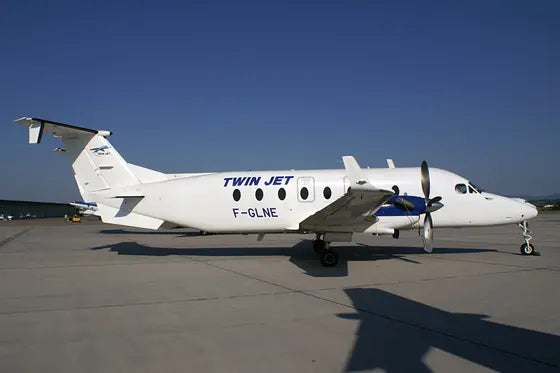
Twin Jet Overview & Company Profile
Twin Jet is a French regional airline registered on 28 May 2001 and headquartered in Aix-en-Provence, on the site of the former BA 114 air base at Les Milles, where its maintenance centre is located. Its first commercial flight, between Nîmes and Châteauroux, operated on 3 October 2001. Nearly a quarter of a century later, the airline still flies a single, homogeneous fleet of Beechcraft 1900D nineteen-seat turboprops, operating around 200 scheduled flights per week across France and a handful of Italian and Spanish points. It is a genuinely small carrier, and that scale defines every aspect of the pilot career it offers.
Twin Jet is owned through the Swiss holding company Fleet Management Airways (FMA) and was created by Olivier Manaut, who remains its president, with Éric Moret as managing director. Around it sit sister companies that matter to pilots: Kerozen Industrie handles maintenance, Air Qualifications handles pilot training, and Intairline handles charter activity. The airline is not a low-cost operator: it positions itself as a full-service regional carrier with all-economy cabins, and it is a partner of the Flying Blue loyalty programme (Air France–KLM), a relationship in place since March 2002. In June 2017 it signed a commercial agreement to connect its scheduled routes with Air France and HOP! via Paris-Orly, and in 2016 to 2017 it absorbed the routes and assets of the regional operator Hex'Air.
For an aspiring or transferring pilot, the honest headline is this: Twin Jet is a niche, family-scale turboprop operator, not a legacy or major airline. It offers rapid, hands-on multi-sector flying on a small aircraft, close contact with a tight-knit team, and the full protection of French labour law and the aircrew pension system. What it does not offer is a large network, a modern jet fleet, a widebody progression path, or the salary levels of a mainline carrier. Much of the operational and pay detail below is benchmarked against comparable French regional operators, because Twin Jet, like most small carriers, does not publish pilot pay scales, roster rules, or exact crew numbers.
Twin Jet does not publish pilot pay scales, roster patterns, or exact crew headcounts. Where figures below cannot be sourced directly to the airline, they are drawn from public aggregators (Wikipedia, ch-aviation, Pilot Jobs Network, corporate registries) and from directly comparable French regional turboprop operators such as Chalair Aviation and Amelia. These are clearly flagged as estimates or benchmarks, not official Twin Jet numbers. Always confirm the current position directly with the airline via its official recruitment page.
The Fleet: Beechcraft 1900D
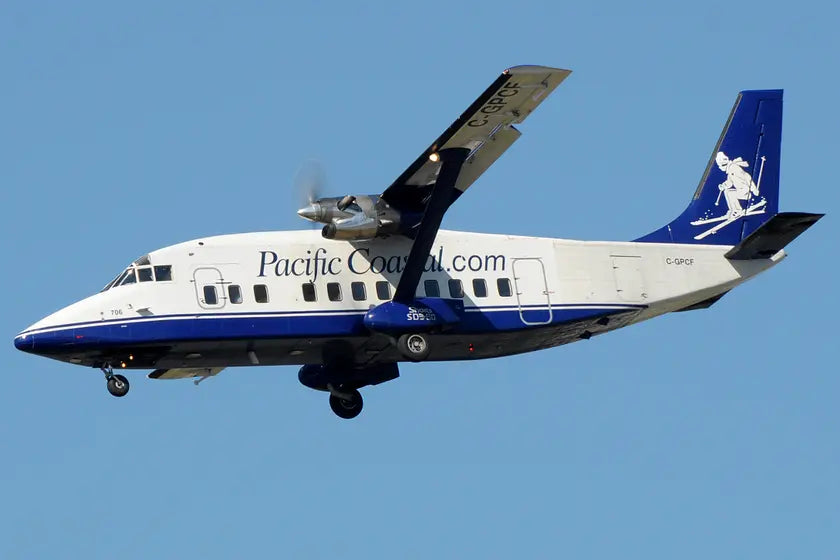
Twin Jet operates one of the simplest fleets in European commercial aviation: 13 Beechcraft 1900D aircraft and nothing else. The 1900D is an American twin-engine turboprop regional airliner, configured by Twin Jet with 19 passenger seats in a single-class, one-by-one cabin layout. It is powered by two Pratt & Whitney Canada PT6A-67D turboprops of roughly 1,279 shaft horsepower each, cruises at around 280 knots, and has a range in the region of 1,200 to 1,400 nautical miles, comfortably more than any sector Twin Jet flies. The 1900D is distinguished from earlier 1900 variants by its stand-up cabin, and although the type is certified for single-pilot operation, in scheduled airline service it is flown by two pilots, a captain (CDB) and a first officer (OPL).
Beechcraft ended production of the 1900D in 2002, so every airframe in service today is old. Twin Jet's aircraft were built across the 1990s and very early 2000s, which puts the fleet broadly in the 25 to 30-plus year age bracket. That age is not a safety concern in itself: the type is a proven, rugged short-runway workhorse maintained under French DGAC oversight, and Twin Jet keeps its engineering in-house through sister company Kerozen Industrie at Les Milles. But it does mean the flying experience is deliberately old-school. Cockpit avionics vary by airframe and retrofit, and the aircraft demands genuine hand-flying, raw-data instrument approaches, and turboprop engine management rather than the automation-heavy environment of a modern jet or a new-generation ATR.
| Specification | Detail | Relevance for Pilots |
|---|---|---|
| Type | Beechcraft 1900D | Single-type fleet: one type rating, one set of SOPs |
| In service | 13 aircraft | Small fleet caps the number of command seats |
| Seating | 19 passengers, 1-1 | No cabin classes; close pilot-passenger contact |
| Engines | 2 × P&W Canada PT6A-67D | Turboprop handling and engine-out training focus |
| Cruise speed | ~280 kt | Short sectors, frequent climb/descent cycles |
| Range | ~1,200–1,400 nm | Ample for all regional routes flown |
| Crew | 2 pilots (airline ops) | Captain + First Officer, strong CRM emphasis |
| Airframe age | ~25–30+ years | Mature type; hand-flying and older systems |
Fleet count per Twin Jet's official company page; specifications per public Beechcraft 1900D data. Figures approximate and subject to change.
A one-type fleet is a double-edged sword. On the positive side, training, recurrent checks, and standardisation are simple, and the step from first officer to captain happens on the same aircraft with no fleet transfer. On the negative side, there is no internal path to a larger turboprop or a jet, so pilots who want to fly an ATR 72, an Embraer, or an Airbus must eventually move to another airline. For many, Twin Jet is therefore a place to build solid multi-engine IFR command experience rather than a lifelong destination, though some pilots do build a full career on the type.
Pilot Salary & Compensation Breakdown
This is the section where honesty matters most. Twin Jet does not publish pilot salaries, and no reliable, airline-specific pay scale is available in the public domain. What can be done responsibly is to benchmark against French regional operators that fly the same or comparable equipment, using data compiled by Pilot Jobs Network and similar sources. The single most relevant comparison is Chalair Aviation, another small French regional that has flown the Beechcraft 1900D: its recorded pay snapshot lists roughly €2,100 gross per month for a 1900D first officer and €3,340 gross per month for a 1900D captain. Larger regional aircraft pay more (Chalair ATR captain around €4,500, Amelia captain base pay around €6,200), which underlines how modest 19-seat turboprop pay is.
Comparable French Regional Turboprop Pay (Benchmarks)
| Operator / Role | Aircraft | Gross Monthly (approx.) |
|---|---|---|
| Chalair, First Officer | Beechcraft 1900D | €2,100 |
| Chalair, Captain | Beechcraft 1900D | €3,340 |
| Chalair, First Officer | ATR 42/72 | €2,700 |
| Chalair, Captain | ATR 42/72 | €4,500 |
| Amelia, Captain (base) | ATR / Embraer | €6,200 |
Benchmark data compiled by Pilot Jobs Network for comparable French regional operators. These are NOT Twin Jet figures; they are used to bracket a realistic range for the same aircraft type.
Twin Jet Estimated Pay Range (Beechcraft 1900D)
| Role / Seniority | Est. Gross Monthly | Est. Annual Gross |
|---|---|---|
| First Officer (entry) | €1,900 – €2,400 | ~€23,000 – €29,000 |
| First Officer (senior) | €2,400 – €2,900 | ~€29,000 – €35,000 |
| Captain (Beechcraft 1900D) | €3,300 – €4,500 | ~€40,000 – €54,000 |
Estimates derived from comparable 1900D operators, not published by Twin Jet. Add per diems for duties away from base. French social charges (roughly 22 to 25 percent) and income tax reduce net take-home significantly.
Treat the Twin Jet figures above as an indicative bracket, not a quoted salary. Actual pay depends on the individual contract, seniority, whether the pilot already holds the type rating, and whether any training bond applies. Beechcraft 1900D pay across Europe is at the lower end of the professional airline pilot spectrum, because a 19-seat aircraft generates limited revenue per flight. Pilots who prioritise earnings typically use a carrier like this to build command hours before moving to a larger turboprop or jet operator. Confirm the current offer directly with Twin Jet during recruitment, and cross-check peer figures on the Pilot Jobs Network community.
Roster Pattern & Quality of Life
Twin Jet's flying is short-haul, high-frequency, and multi-sector. With around 200 flights a week spread over 13 aircraft on routes that are typically under two hours, a pilot's day usually means several takeoffs and landings rather than long cruise legs. This builds proficiency quickly, but it also concentrates workload: briefings, approaches, and turnarounds come thick and fast, and early starts and late finishes are common in regional operations. On the positive side, the network is built largely around out-and-back patterns from a home base, so Twin Jet pilots are more likely to sleep at home than long-haul or even many larger short-haul crews, which is a real quality-of-life advantage.
Working time is governed by EASA Flight Time Limitations (FTL, derived from EU Regulation 83/2014) and French labour law, which Twin Jet must apply under DGAC supervision. The hard regulatory ceilings are 100 flight hours in any 28 consecutive days, 900 flight hours per calendar year, and cumulative duty caps of 60 hours in 7 days, 110 hours in 14 days, and 190 hours in 28 days. Actual monthly block hours for a regional turboprop pilot generally sit well below the maximum, commonly in the 60 to 80 hour range depending on season and roster. France's statutory five weeks of paid annual leave applies, complemented by any collective arrangements.
📅 Illustrative Month — Regional First Officer (Beechcraft 1900D)
Illustrative only. Twin Jet does not publish rosters; this pattern reflects typical French regional turboprop operations within EASA FTL limits, not an official Twin Jet schedule.
Public sources identify Twin Jet operational bases at Lyon, Marseille, Toulouse, and Le Puy-en-Velay, with a Lille base opened in April 2019 and Strasbourg active in the network. Because rosters revolve around these regional airports and out-and-back flying, a pilot based in or near their home city can achieve a stable home life uncommon in aviation. The trade-off is geographic: your base is assigned to operational need, and living close to it is effectively required. Full, current FTL rules that govern your duty days are published by the French administration in its DGAC regulatory documents.
Benefits, Social Protection & Retirement
Where Twin Jet cannot compete with larger carriers on salary, the French social framework still gives its pilots a robust safety net. As a French employer, Twin Jet operates within national labour law, the statutory health and social security system, and, crucially for aircrew, the dedicated pilot pension scheme. These protections are largely statutory rather than airline-specific, which means a small carrier like Twin Jet delivers much the same core social package as a major French operator, even if the airline-funded extras are leaner.
The CRPN (Caisse de Retraite du Personnel Navigant) is a specialised, long-established fund managing a complementary retirement regime for French civil aviation aircrew, in addition to the basic state pension. Affiliation is standard for French-based pilots, with both employer and employee contributing based on earnings and flying activity. The scheme recognises the specific nature of an aviation career, including earlier retirement provisions and rights calculated on career earnings, and it also underpins loss-of-licence and survivor protections. For a Twin Jet pilot, CRPN membership is one of the most valuable structural benefits of flying for a French carrier. Contribution rates, benefit rules and retirement projections are published on the fund's official site, crpn.fr.
Career Progression & Seniority
Career progression at Twin Jet is shaped entirely by its size and single-type fleet. A pilot joins as a first officer on the Beechcraft 1900D, builds multi-engine IFR and turboprop hours through intensive short-haul flying, and, when a command seat opens and the pilot is ready, upgrades to captain on the same aircraft. Because there is no larger fleet, the upgrade is a promotion in seat rather than a change of type. This keeps progression simple, but it also caps it: with only 13 aircraft, the number of captain positions is finite, and the timing of upgrades depends heavily on attrition (pilots leaving for larger airlines, retirements) and on any network growth.
Unlike a big legacy carrier with a rigid, decades-long seniority ladder, a small operator tends to be more pragmatic. Twin Jet openly recruits direct-entry captains as well as first officers, provided candidates are qualified on the Beechcraft 1900. That means an experienced, type-rated captain can join straight into a command seat, while a lower-hour pilot can join as a first officer with a realistic prospect of command within a few years if they perform well. There is no publicly documented formal seniority list; in a company of this size, seniority mechanisms are likely to be relatively informal and driven by hire date, grade, and operational need.
| Career Milestone | Typical Timeline | Notes |
|---|---|---|
| Join as First Officer (1900D) | Day 1 | Type rating on the Beechcraft 1900 strongly preferred at hire. |
| Build multi-engine IFR / turboprop time | 2–4 years | High sector counts; strong hand-flying and CRM development. |
| Command upgrade to Captain | Varies | No fixed timeline; depends on attrition, growth and performance. |
| Direct-entry Captain | Immediate (if qualified) | Twin Jet openly recruits rated 1900 captains. |
| Instructor / examiner (TRI / TRE) | Variable | Possible via sister training company Air Qualifications. |
Realistically, most pilots treat Twin Jet as a place to gain command experience on a manageable aircraft before moving to a larger turboprop or jet operator, where pay and fleet variety are greater. That is a legitimate and common career strategy in European regional aviation. At the same time, for pilots who value stable home life, southern-France basing, and small-aircraft flying, Twin Jet can be a long-term home. What it cannot offer internally is progression to a bigger or newer aircraft, so set your expectations by your own priorities: fast hands-on command versus long-term fleet advancement.
Recruitment Process & Requirements
Twin Jet's recruitment reflects its scale: it is direct and low-bureaucracy rather than a large structured cadet programme. The airline's official recruitment page states that, as part of its expansion, it recruits Beechcraft 1900 captains and co-pilots, with applications sent by email to recrutement.pnt@twinjet.net. The wording, seeking pilots "qualified on Beechcraft 1900," signals a clear preference for candidates who already hold the type rating, which lets a small carrier integrate new hires quickly without funding a full type course.
Core Requirements
Typical Selection Path
Application by Email
Send CV, cover letter, licence and logbook summary to recrutement.pnt@twinjet.net. Recruitment is handled on a rolling basis in line with operational needs, rather than through a fixed annual campaign.
Screening of Qualifications
Verification of licences, medical, flight hours and, importantly, Beechcraft 1900 type-rating status. Candidates already rated on type have a clear advantage for quick integration.
Interview (Technical + HR)
Assessment of technical knowledge, motivation for a small regional operator, CRM aptitude and language ability. Fluent French is essential for a carrier whose operations and culture are French.
Simulator / Skill Assessment
A simulator check or supervised flight assessment on the type is common practice at regional operators to confirm handling and procedural competence before an offer.
Type Rating (if needed), Line Training & Class 1
Rated candidates move to company procedures and line training; non-rated hires may need a type rating, potentially through sister company Air Qualifications. A valid Class 1 medical is required throughout.
Whether Twin Jet funds the Beechcraft 1900 type rating is not publicly stated, and the "qualified on Beechcraft 1900" wording suggests self-funded or previously-held ratings are common at small carriers. A 1900D rating in Europe is typically a multi-week course costing in the region of €20,000 to €38,000. If sponsorship is offered, expect a training bond. Because a type rating is portable across other 1900 operators, weigh the investment against broader employability, not just a Twin Jet position. Always clarify funding, bonding, and contract terms directly during recruitment.
Route Network, Bases & Destinations
Because Twin Jet is a short-haul regional carrier, it has no long-haul layover culture: this is out-and-back flying, not overnight rotations in distant cities, which is why this guide replaces the usual "layover destinations" section with a look at the network you would actually fly. The airline serves roughly 11 to 15 destinations, overwhelmingly in France, with a small set of Italian and Spanish points. Its route map is built around regional connectivity, business links to and from Paris-Orly, and thin markets that larger carriers overlook. Marketing and connectivity are reinforced by its Flying Blue partnership, which lets passengers earn Air France–KLM miles on Twin Jet flights.
The core French airports in the 2025 to 2026 network include Lyon, Marseille, Toulouse, Strasbourg, Nice, Rennes, Nantes, Pau, Le Puy-en-Velay, and Paris-Orly, with Biarritz and Bordeaux appearing on newer or seasonal Marseille services. Recent network activity shows an airline still developing: Toulouse to Nice launched in April 2024, the Lyon to Strasbourg link resumed in March 2025, and a new Toulouse to Nantes route began on 8 September 2025, alongside new Marseille services. International scheduled points are focused on Milan Malpensa, Bologna, Venice, Olbia (Sardinia), and Menorca (Spain). Historic destinations such as Mende and Metz-Nancy have been discontinued.
| Route / Airport | Type | Notes for Pilots |
|---|---|---|
| Le Puy-en-Velay ↔ Paris-Orly | PSO (public service) | Subsidised lifeline route; a base for Twin Jet operations. |
| Lyon ↔ Bologna / Milan / Pau / Rennes / Strasbourg | Regional / international | Lyon is a core base and network node. |
| Marseille ↔ Toulouse / Biarritz / Bordeaux / Milan / Olbia | Regional / leisure | Marseille is a base; several 2025 additions. |
| Toulouse ↔ Nice / Rennes / Nantes / Marseille | Regional | Toulouse base; Nantes launched Sept 2025. |
| Nice ↔ Venice / Olbia / Menorca | Leisure / international | Southern leisure links, seasonal weighting. |
Representative 2025–2026 network based on public route data (Wikipedia, ch-aviation, AirServiceOne, Air-Journal). Routes change seasonally and with demand.
Part of Twin Jet's role is operating PSO (Public Service Obligation) routes: thin, socially important links that receive public subsidy because they would not be commercially viable otherwise. The clearest confirmed example is Le Puy-en-Velay (Loudes) to Paris-Orly, listed on the European Commission's PSO register as a Twin Jet route. For pilots, PSO flying means operating into small regional airfields, sometimes in challenging terrain and weather, which sharpens skills but adds operational demand. It also shapes job security: PSO contracts are periodically re-tendered, so the stability of some routes depends on winning those tenders.
How Twin Jet Compares: Airline Radar Chart
The fair comparison for Twin Jet is not a legacy giant but its actual peers: other small French regional operators. Below, Twin Jet is set against Chalair Aviation and Amelia (by Regourd Aviation), two French regionals in the same market segment. Scores are editorial estimates across the same six themes as the scorecard, based on publicly available data, comparable pay records, and fleet profiles. They describe the picture for a pilot considering each carrier, and they are relative to this regional peer group, not to mainline airlines.
Key Takeaways from the Comparison
All three sit at the modest end for pay. These are small French regionals, not mainline carriers. On the 19-seat Beechcraft 1900D, pay is lowest of all (Chalair's recorded 1900D captain figure is around €3,340 gross per month). Amelia, flying larger ATRs and Embraer jets, tends to pay more, which is why its salary axis scores highest of the three. Twin Jet's single-type 1900D operation places it at the bottom of the pay range.
Twin Jet's quality-of-life edge is home basing. Its out-and-back regional network means more nights at home than many peers, supporting a higher work-life score, even though multi-sector days are demanding. All three benefit equally from French labour protections and the CRPN pension, so their benefits scores are close.
Fleet is where Twin Jet ranks lowest. A single fleet of 25 to 30-plus year-old 19-seat turboprops scores below Chalair's ATR fleet and well below Amelia, which operates newer ATR 72-600s and regional jets and has even explored hydrogen retrofits. Pilots wanting fleet variety or a jet path will not find it at Twin Jet internally.
Job security is broadly comparable and route-dependent. All three depend on thin regional and PSO markets that are periodically re-tendered and are sensitive to demand shocks. Twin Jet has, however, demonstrated real resilience by operating continuously for over two decades.
Scores are editorial estimates based on public salary records (Pilot Jobs Network), fleet data, route information, and general industry benchmarks for French regional aviation. They are relative to this small-regional peer group, not to legacy carriers, and represent a general assessment for a pilot considering these operators. Individual experience varies by base, grade, and personal priorities. Because none of these carriers publishes full pilot conditions, treat the chart as indicative.
Union & Industrial Relations
Industrial relations at a carrier the size of Twin Jet are very different from those at a major airline. There is no publicly documented dedicated pilot union section or high-profile collective bargaining history at Twin Jet, and there is no record of the airline featuring in major national pilot strikes. In a company with only a few dozen pilots, working conditions tend to be shaped more by direct negotiation between staff and management, within the floor set by French labour law and EASA rules, than by formal, adversarial collective action.
That said, French pilots operate inside a strong national framework. The SNPL France ALPA (Syndicat National des Pilotes de Ligne) is the dominant union for airline pilots in France and represents crews across many carriers, not only the majors. Even where a small operator has limited formal union presence, the broader industry standards, agreements, and advocacy that unions such as SNPL drive influence the environment in which every French pilot works, including on issues like flight-time limitations, pension protection (notably defending the CRPN), and fair treatment.
Do not expect the collective muscle of a mainline pilot body at Twin Jet, and do not expect the friction that can come with it either. The upside of a small carrier is a direct, personal relationship with management and quick decisions. The downside is less formal collective protection and less leverage on pay and rostering. If union representation matters to you, ask during recruitment how staff representation works, and factor in that the strong national framework (DGAC, EASA FTL, French labour law, CRPN) still protects you regardless of company size. National developments are tracked by the SNPL.
Verdict: Who Is Twin Jet For?
🎯 Our Take
Twin Jet is a small, resilient French regional turboprop operator that offers a very specific kind of pilot job: intensive, hands-on, multi-sector flying on the 19-seat Beechcraft 1900D, from southern-France and regional bases, with the security of French labour law and the CRPN aircrew pension behind you. For a lower-hour pilot who already holds or is prepared to obtain a 1900 type rating, it can be an excellent way to build genuine multi-engine IFR and command experience relatively quickly, in a close-knit, family-scale company where you are a name, not a staff number.
The trade-offs are equally clear and should not be understated. Pay is at the low end of professional airline flying, because a 19-seat aircraft simply generates limited revenue; the fleet is a single type of 25 to 30-plus year-old turboprops with no internal path to a larger or newer aircraft; the network depends partly on subsidised PSO routes that are periodically re-tendered; and formal collective protection is thinner than at a major carrier. Twin Jet publishes very little about its pilot conditions, so due diligence during recruitment is essential.
For the right pilot, none of this is a deal-breaker. Many aviators would happily trade top-tier pay for stable home life, real flying, and a foot on the airline ladder. Just go in with clear eyes: for most, Twin Jet is a strong stepping stone or a lifestyle choice, rather than a maximise-your-earnings destination.
1 Do I need to speak French to fly for Twin Jet?
In practice, yes. Twin Jet is a French carrier operating primarily within French airspace and to French regional airports, with a French-speaking company culture and operation. Fluent French is effectively required for communication with ATC, ground staff, passengers, and colleagues, alongside ICAO English for aviation communications. A non-French-speaking candidate would be at a significant disadvantage.
2 Does Twin Jet pay for the Beechcraft 1900D type rating?
This is not publicly confirmed. Twin Jet's recruitment page seeks pilots "qualified on Beechcraft 1900," which strongly suggests it prefers candidates who already hold the rating, and that self-funded or previously-held ratings are common. Some regional carriers do sponsor ratings for selected candidates, usually with a training bond. Twin Jet's sister company Air Qualifications provides in-group training capability. Always clarify funding and any bonding terms directly during recruitment.
3 How many flight hours do I need to join Twin Jet?
Twin Jet does not publish exact hour minimums. Based on comparable Beechcraft 1900 operators in Europe, first-officer roles often look for several hundred hours total time (roughly 500 to 800-plus), while captain positions typically require around 1,500 hours total time or more with solid multi-engine IFR experience. These are market norms, not a Twin Jet-specific standard, so confirm the current requirement with the airline.
4 How much do Twin Jet pilots earn?
Twin Jet does not publish pay scales. Using comparable French 1900D operators as a benchmark (Chalair records roughly €2,100 gross per month for a 1900D first officer and €3,340 for a 1900D captain), a realistic estimate for Twin Jet is around €1,900 to €2,900 gross per month for first officers and €3,300 to €4,500 for captains, plus per diems. These are estimates, not quoted figures, and 19-seat turboprop pay is at the low end of professional airline flying. French social charges and tax further reduce net pay.
5 Is the Beechcraft 1900D a good aircraft to build experience on?
For skill-building, yes. The 1900D is a two-pilot turboprop flown on short, high-frequency sectors, which means a lot of takeoffs, landings, instrument approaches, and turboprop engine management in a real airline environment. That develops strong hand-flying, CRM, and decision-making. The limitation is that it is a single, ageing type with no internal progression to bigger aircraft, so it is best viewed as foundation-building rather than a career ceiling.
6 Where are Twin Jet pilots based?
Public sources point to operational bases at Lyon, Marseille, Toulouse, and Le Puy-en-Velay, with a Lille base opened in 2019 and Strasbourg active in the network. The corporate head office and maintenance centre are in Aix-en-Provence (Les Milles). Because the network is built on out-and-back regional flying, pilots often get more nights at home than at many airlines, but base assignment follows operational need, so living near your base is effectively required.
7 How long does it take to upgrade to Captain at Twin Jet?
There is no published, fixed timeline. With only 13 aircraft, command seats are limited, so upgrade timing depends on attrition, network growth, and individual performance rather than a rigid seniority ladder. On the other hand, Twin Jet openly recruits direct-entry captains, and a small carrier can promote pragmatically, so a strong first officer may reach command within a few years. Ask about the current outlook during recruitment.
8 Is Twin Jet a good long-term career or a stepping stone?
It can be either, depending on your priorities. Most pilots use a small 1900D operator to gain command experience before moving to a larger turboprop or jet airline with higher pay and fleet variety. But pilots who value a stable home life, southern-France or regional basing, small-aircraft flying, and a family-scale company can build a satisfying long-term career here. What Twin Jet cannot offer internally is progression to a bigger or newer aircraft.
Official Links & Resources
Before applying or making any career decision, verify details directly with official sources. Twin Jet publishes limited information, so cross-referencing the airline's own pages with regulatory and pension bodies is especially important. These are the key resources for a Twin Jet pilot career:
For a small carrier like Twin Jet, the most reliable intelligence comes from two places: the airline's own recruitment page and current or former pilots on community sites. Because pay, roster, and type-rating funding are not published, prepare specific questions on these points for your interview, and cross-check any figure you hear against comparable French regional operators before committing to a type rating or contract.