
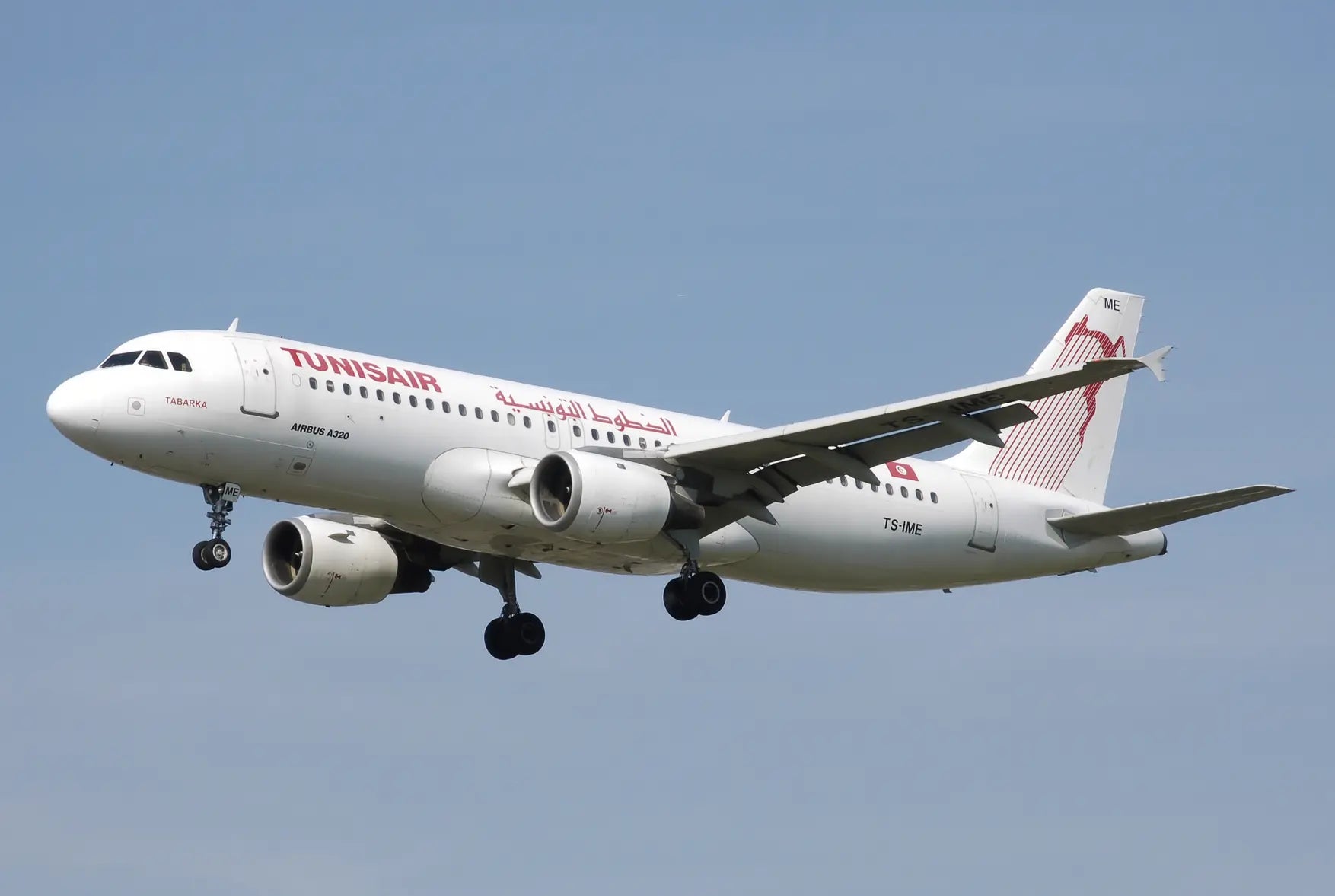
Tunisair Overview & Company Profile
Tunisair (Société Tunisienne de l'Air) is the flag carrier of Tunisia, founded on October 21, 1948, and headquartered at Tunis-Carthage International Airport (TUN). Originally established with joint capital from the Tunisian government and Air France, Tunisair has grown from a small regional operator flying Douglas DC-3s across the Mediterranean into an international carrier serving four continents. The airline is a member of the Arab Air Carriers Organization (AACO) and the African Airlines Association (AFRAA).
Today, Tunisair operates scheduled services to approximately 44 destinations across Europe, Africa, the Middle East, and North America. The European network is by far the largest segment, with France as the core market (Paris, Marseille, Lyon, Nice, Toulouse, Bordeaux, Strasbourg), followed by Italy, Germany, Spain, and the United Kingdom. The African network covers major capitals and hubs including Algiers, Casablanca, Dakar, Abidjan, and Bamako. The sole transatlantic route connects Tunis to Montreal, launched in July 2016 to serve the significant Tunisian diaspora in Canada.
Tunisair's ownership remains dominated by the state: the Tunisian government holds 64.86% of shares, three state-owned social funds (CNSS, CNRPS, CNAM) hold a combined 9.56%, Air France retains a historical 5.58% stake, and the remaining 20% trades publicly on the Tunis stock exchange under the ticker TAIR. This structure means the airline operates under close governmental oversight, with strategic decisions often influenced by national policy objectives rather than purely commercial logic.
The airline employs approximately 3,781 personnel and carried around 2.49 million passengers in 2025, with total annual revenue reaching 1,627 million Tunisian dinars. The load factor improved to 76.1% in 2025 (up from 73.1% the prior year), suggesting efficiency gains despite an overall decline in passenger numbers. Tunisair is currently undergoing a comprehensive restructuring plan for 2026-2030, which includes fleet expansion through leasing, new route development, and major airport infrastructure upgrades at Tunis-Carthage (capacity expansion from 5 million to 18.5 million passengers by 2031).
Fleet Composition & Type Ratings
Tunisair operates an all-Airbus fleet of 20 aircraft as of May 2025, built around the A320 family for short- and medium-haul European and regional services, supplemented by two A330-200 widebodies for the transatlantic Montreal route and high-density European sectors. The fleet is relatively modern, with an average age of approximately 10-11 years, though individual aircraft ages vary significantly. The five recently delivered A320neo aircraft represent the newest additions, featuring CFM LEAP-1A engines that offer roughly 20% fuel savings over the older A320-200 (ceo) variants.
| Aircraft Type | Role | In Service | Configuration & Notes |
|---|---|---|---|
| Airbus A319-100 | Narrowbody | 2 | 114 seats (12J + 102Y). Oldest in fleet (~18.8 yrs avg). Short/medium-haul European and domestic routes. |
| Airbus A320-200 | Narrowbody | 11 | 136-162 seats depending on configuration. Fleet backbone for European and regional services. Avg. age ~9.6 years. |
| Airbus A320neo | Narrowbody | 5 | 150 seats (12J + 138Y). Deliveries began December 2025. LEAP-1A engines, modern avionics. Key fleet renewal asset. |
| Airbus A330-200 | Widebody | 2 | 266 seats (24J + 242Y). Dedicated to Montreal transatlantic service and dense European routes. Avg. age ~10.7 years. |
Fleet data as of May 2025. Numbers reflect active operational aircraft only. Wet-lease aircraft may supplement capacity seasonally.
The fleet has evolved significantly over the decades. Tunisair transitioned from Douglas DC-3s and Sud Caravelles in its early years, through Boeing 727s and 737s in the 1970s-1990s, to an all-Airbus fleet beginning with the A319 delivery in 1998. The A330-200 widebody was introduced in June 2015, enabling the launch of transatlantic services the following year.
Fleet Expansion Plans (2026-2030)
Tunisair has launched an international tender for the long-term dry lease of two additional Airbus A320 aircraft starting in 2026, under six-year lease terms. The airline's restructuring plan envisions leasing four additional medium-capacity aircraft and two large-capacity (widebody) aircraft between 2027 and 2030. Management has also discussed plans for two additional widebody aircraft to support proposed new routes to the United States (New York and Washington D.C., targeted for 2028) and China (Beijing and Shanghai), though these routes face significant commercial viability questions. The airline previously held orders for three A350-800 widebodies but cancelled that order in 2013 due to financial constraints.
Tunisair's in-house training facility, ATCT (Aeronautical Training Center Tunisia), operates Level D full flight simulators for both the A320 and A330 families. Initial type rating courses for the A320 typically require 60-80 hours of simulator instruction plus 100-150 hours of classroom training. The A320 family (including the A319 and A320neo, which share a common type rating) is the most likely entry fleet for new First Officers. Transition to the A330 widebody is seniority-based. Cross-crew qualification (CCQ) courses are available for pilots moving between A320 and A330 within the same rank.
Pilot Salary & Compensation Breakdown
Tunisair pilot salaries are determined through a combination of Tunisian public sector wage frameworks and airline-specific collective agreements. As a state-owned carrier, compensation reflects Tunisian economic realities rather than international market rates. Pilot pay at Tunisair is significantly lower than Western European or Gulf carriers in absolute terms, but provides a solid income within the Tunisian context, where the cost of living in Tunis is a fraction of Paris, London, or Dubai.
Publicly available Tunisian aviation salary data, combined with industry estimates, provides the best available picture of pilot compensation at Tunisair. Note that these figures represent general Tunisian airline pilot compensation ranges; Tunisair-specific pay scales may vary based on internal collective agreements.
Estimated Pilot Pay by Seniority (Tunisian Market)
| Experience Level | Est. Annual Gross (TND) | Est. Annual Gross (EUR) | Typical Role |
|---|---|---|---|
| 0-2 years | ~46,400 TND | ~€13,500 | Junior First Officer |
| 2-5 years | ~60,400 TND | ~€17,600 | First Officer |
| 5-10 years | ~80,500 TND | ~€23,400 | Senior First Officer |
| 10-15 years | ~97,880 TND | ~€28,500 | Captain (narrowbody) |
| 15-20 years | ~109,000 TND | ~€31,700 | Senior Captain |
| 20+ years | ~117,520 TND | ~€34,200 | Senior Captain (widebody) |
EUR conversions based on approximate 2026 exchange rate of 1 EUR = 3.44 TND. Figures from Tunisian aviation industry salary surveys. Actual Tunisair-specific figures may differ.
Additional compensation components include annual bonuses (reported by approximately 77% of aviation employees in Tunisia, averaging 6-8% of base salary), per diem allowances for layovers, night and weekend flight premiums, and an estimated average annual pay raise of 7%. Public sector aviation employees (which includes Tunisair pilots) earn roughly 10% more than private sector counterparts, per available data.
Tunisair does not publicly disclose its pilot pay scales. The figures above are compiled from Tunisian aviation industry salary surveys, regional benchmarks, and public labor market data. They represent estimates for the broader Tunisian airline pilot market, not confirmed Tunisair-specific figures. Actual compensation depends on the current collective agreement, individual seniority steps, aircraft type, and flight hours logged. For reference, seasonal A320 Captain positions at Tunisian carrier Nouvelair were advertised in 2026 at approximately EUR 10,200-11,000 per month on 80+ block hours, suggesting that experienced Captains at comparable Tunisian airlines may earn in this range. Always verify directly with Tunisair's human resources department for current contract terms.
How Does Tunisair Pay Compare?
Tunisair pilot salaries are broadly in line with other North African flag carriers like Royal Air Maroc and EgyptAir, where compensation reflects local economic conditions rather than international pilot labor markets. By comparison, a senior long-haul Captain at Air France earns €220,000-€260,000 annually, and an equivalent position at a US major can exceed $350,000. Gulf carriers such as Emirates offer new First Officers roughly $68,000-$81,000 in base pay alone. Tunisair compensation must therefore be evaluated within the context of Tunisia's significantly lower cost of living: rent in Tunis is approximately 80% cheaper than Paris, groceries 50-60% lower, and overall living expenses roughly 65-70% less than in Western European capitals.
Roster Pattern & Quality of Life
Tunisair pilot rostering follows a pattern typical of medium-sized Mediterranean carriers, with schedules shaped by the airline's seasonal traffic profile (heavy summer tourism, reduced winter operations), EASA-aligned fatigue management rules, and Tunisian labor regulations. All pilots are based at Tunis-Carthage International Airport (TUN), with no alternative base options. This single-base structure simplifies commuting for pilots living in or near Tunis, but limits flexibility for those who might prefer bases elsewhere.
The airline's route network creates two distinct operational profiles. Short- and medium-haul pilots operating A319/A320/A320neo equipment fly European, North African, and Middle Eastern routes with typical block times of 1.5-3.5 hours, often completing two or three sectors per duty day. The Montreal transatlantic service, flown on the A330-200 with block times of approximately 8-9 hours, follows a different rhythm with longer duty periods, augmented crews, and extended layovers at destination.
📅 Sample Month: Medium-Haul First Officer (TUN Base)
Summer months (June through September) are the busiest period, with charter and scheduled services to European beach destinations driving high frequency and longer duty days. Winter schedules are considerably lighter, with reduced frequencies on most European routes. This seasonality creates a distinct work-life rhythm: demanding summers with potentially fewer days off, followed by quieter winters with more personal time.
Tunis offers an attractive quality of life for pilots, with a pleasant Mediterranean climate, rich historical heritage, and a cost of living that is a fraction of European capitals. The city's northern suburbs (La Marsa, Sidi Bou Said, Carthage) are popular residential areas for airline staff, offering proximity to the airport and a relaxed coastal lifestyle. Property prices and rental costs are very affordable by European standards. The main challenge is the single-base structure: there is no option to bid for an alternative base. Pilots who prefer to live abroad will need to commute, though Tunisair's extensive European network provides reasonable positioning options.
Benefits, Travel Perks & Retirement
As a state-owned Tunisian enterprise, Tunisair provides a benefits package rooted in Tunisia's social security framework, supplemented by airline-specific provisions. While the overall compensation level is lower than at Western carriers, the benefits structure offers a solid safety net within the Tunisian context, including social insurance, health coverage, and staff travel across the airline's network and codeshare partners.
The benefits package at Tunisair reflects Tunisian labor standards rather than Western European or Gulf carrier norms. Paternity leave, in particular, is minimal at one day. Loss of license insurance is not confirmed as an airline-provided benefit and may require individual pilot arrangement. The pension system (CNSS) provides a basic state pension but lacks the generous supplementary structures found at carriers like Air France (CRPN) or British Airways. Staff travel, while a valuable perk, is subject to standby availability on a relatively small fleet of 20 aircraft, which can limit practical usability during peak travel periods.
Career Progression & Seniority
Career progression at Tunisair follows a traditional seniority-based model common among state-owned North African carriers. Advancement from First Officer to Captain, and from narrowbody to widebody operations, depends primarily on years of service, accumulated flight hours, and the availability of positions as senior pilots retire or the fleet expands. Given Tunisair's relatively small fleet of 20 aircraft and modest growth trajectory, progression can be slower than at faster-growing carriers in the Gulf or Asia.
The airline does not operate a formal publicly documented cadet programme comparable to those at Air France or British Airways. Pilot recruitment typically targets candidates who already hold an ATPL or advanced CPL with instrument and multi-engine ratings, obtained through approved flight schools in Tunisia (such as ATCT or Airline Flight Academy) or abroad.
| Career Milestone | Typical Timeline | Notes |
|---|---|---|
| Join as First Officer (A320 family) | Day 1 | Most common entry fleet. A319/A320/A320neo share a common type rating. |
| Senior First Officer | 5-8 years | Increased responsibility, may begin operating denser routes. |
| Captain upgrade (narrowbody) | 10-15 years | Subject to seniority, position availability, and successful command assessment. |
| Widebody F/O transition (A330) | 5-10 years | Seniority-dependent. Cross-crew qualification (CCQ) training at ATCT. |
| Widebody Captain (A330) | 15-20+ years | Highest rank. Limited positions given only 2 A330s in fleet. |
| Training Captain / TRI / TRE | Variable | Requires separate selection and instructor qualification. |
Tunisair's 2026-2030 restructuring plan, if executed as announced, could significantly improve career progression prospects. The planned addition of six leased aircraft (four medium-capacity, two widebody) would create new Captain and training positions. Proposed long-haul routes to the United States and China would also generate widebody command opportunities currently limited by the two-aircraft A330 fleet. However, these expansion plans carry execution risk given Tunisia's economic constraints. Pilots considering Tunisair should factor in both the potential upside from fleet growth and the risk that expansion timelines may slip.
Recruitment Process & Requirements
Tunisair recruits pilots primarily through direct-entry positions for qualified holders of ATPL or CPL/IR-ME licenses. The airline does not currently operate a widely publicized ab-initio cadet programme, though partnerships with local flight training organisations (such as ATCT and partner academies) provide structured training pathways that can lead to airline employment. Recruitment tends to prioritize Tunisian nationals, reflecting government employment policy for state-owned enterprises, though international candidates may be considered when specific capability gaps arise.
Minimum Requirements
Typical Selection Stages
Application Screening
Submission of CV, licenses, logbook records, medical certificate, and supporting documents. Initial screening verifies minimum qualifications, flight hours, and eligibility requirements. Applications can be submitted via the Tunisair careers page or through direct contact with the HR department.
Technical & Aptitude Assessment
Written or computer-based tests covering aircraft systems knowledge, aviation regulations, meteorology, navigation, and general aeronautical knowledge. Psychometric assessments evaluating cognitive ability, spatial reasoning, multitasking capacity, and personality traits consistent with multi-crew operations.
Simulator Check (Experienced Candidates)
For candidates with prior jet experience, a simulator assessment on the A320 family evaluates standard operating procedures, CRM skills, handling of abnormal situations, and overall airmanship. Conducted at the ATCT facility in Tunis.
Interview & HR Assessment
Panel interview with airline management and flight operations representatives. Covers motivation, career goals, cultural fit, communication skills, and scenario-based questions. Conducted in French and/or English depending on the role.
Medical & Final Offer
Class 1 medical verification (if not already provided). Successful candidates receive a contract offer and proceed to type rating (if required) and line training under supervision of a Training Captain.
Tunisair recruitment campaigns are not always widely advertised internationally. Monitor the official Tunisair careers page and industry job boards such as Pilot Career Center and PilotJobsNetwork for postings. French language fluency is a significant advantage, as it is the primary working language alongside Arabic. Military pilots from the Tunisian Air Force may transition to Tunisair after completing their service commitment (typically 12 years), and this pathway has historically been a meaningful source of recruitment. Building connections through Tunisian flight training organisations can also facilitate access to recruitment information.
Top 5 Layover Destinations
Tunisair's route network is primarily short- and medium-haul, meaning most European services involve same-day turnarounds rather than overnight layovers. However, longer rotations on dense routes, the transatlantic Montreal service, and certain West African destinations do provide genuine layover opportunities. Below are the top destinations where Tunisair pilots are most likely to experience overnight stays away from base.
As a predominantly short/medium-haul operator with a small fleet, Tunisair offers fewer overnight layover opportunities than long-haul legacy carriers. Most European services are same-day return turnarounds. The Montreal route is the clear exception, providing genuine multi-day layovers. West African routes (Dakar, Abidjan, Bamako) also frequently involve overnight stays due to longer block times and scheduling constraints. Layover hotels are contracted by the airline and tend to be functional 3-star properties rather than luxury accommodation. Per diem allowances are modest by international standards.
How Tunisair Compares: Airline Radar Chart
How does Tunisair compare against its two closest regional competitors: Royal Air Maroc (Morocco's flag carrier) and EgyptAir (Egypt's flag carrier)? Below is a comparative analysis across five key metrics. All three are state-owned North African flag carriers operating Airbus and Boeing fleets with similar regional and intercontinental networks, making them natural benchmarks for pilot career evaluation.
Key Takeaways from the Comparison
Royal Air Maroc leads on fleet and network scale. RAM operates 64 aircraft (vs. Tunisair's 20 and EgyptAir's 68), with 60% of its fleet under 5 years old thanks to aggressive modernization with 737 MAX 8 and 787 Dreamliner deliveries. RAM serves 85 destinations with 145 daily flights, substantially exceeding Tunisair's operational scope. RAM's Casablanca hub is also being developed as a sub-Saharan Africa gateway, creating significant long-haul career opportunities.
EgyptAir offers the largest widebody fleet. With 14 A330-300s, 4 Boeing 777-300s, and 5 Boeing 787-9 Dreamliners, EgyptAir provides far more long-haul flying opportunities than Tunisair's two A330-200s. EgyptAir is also a Star Alliance member, offering pilots broader staff travel benefits. However, EgyptAir requires Egyptian nationality for all pilot positions, making it inaccessible to international candidates.
Tunisair offers the lowest compensation but also the lowest cost of living. Pilot salaries at all three carriers are well below Western European standards, but Tunisair's figures are at the lower end of the North African range. This is partially offset by Tunisia's very affordable cost of living, particularly compared to Casablanca or Cairo. Housing costs in Tunis are among the lowest in the Mediterranean basin.
Job security is moderate across all three. All three airlines face similar challenges: state ownership creating political interference, competition from European LCCs, volatile tourism markets, and periodic financial difficulties. RAM's aggressive pilot layoffs during COVID-19 (65 pilots terminated in 2019-2020) serve as a cautionary example of how quickly workforce reductions can occur at state-owned North African carriers.
Scores are editorial estimates based on research into publicly available salary data, pilot testimonials, airline financial reports, fleet data, and industry benchmarks. They represent a general assessment for a pilot evaluating long-term career prospects. Individual experiences will vary based on seniority, fleet assignment, and personal priorities. Scores for all three airlines will be updated as new data becomes available.
Union & Industrial Relations
Pilot union representation at Tunisair operates within the framework of Tunisian labor law, which grants workers the right to organize and engage in collective bargaining. The Syndicat des Pilotes de Tunisair (Tunisair Pilots' Syndicate) serves as the primary representative body for flight deck crew, engaging with airline management on issues of compensation, working conditions, roster rules, and career progression.
Tunisair's industrial relations environment has been relatively stable on the pilot side in recent years, though tensions periodically surface. In March 2025, the Syndicate of Pilots issued a formal statement refuting media reports of an undeclared strike action, indicating that while underlying dissatisfaction may exist, the union leadership has sought to manage disputes through official channels rather than disruptive work stoppages.
Notable Industrial Events
Tunisair's pilot union is active but operates within a more constrained framework than Western European pilot unions like the SNPL (France) or Vereinigung Cockpit (Germany). State ownership means that many compensation and working condition decisions involve government ministries in addition to airline management, adding layers of complexity to negotiations. Union activity has historically been moderate compared to the more militant labor actions seen at airlines like Royal Air Maroc (where 65 pilots were terminated during COVID-19 restructuring despite union protests). For prospective pilots, this suggests a relatively stable but not highly empowered labor environment, where incremental improvements are more likely than dramatic salary leaps or working condition overhauls.
Verdict: Who Is Tunisair For?
🎯 Our Take
Tunisair is Tunisia's flag carrier and a respectable employer within the North African aviation market, but it is not a destination airline for pilots seeking top-tier compensation or rapid career advancement. The fleet is small (20 aircraft), salaries are modest by international standards, benefits are rooted in the Tunisian social system rather than airline-specific enhancements, and career progression is constrained by the airline's limited growth trajectory and single-base structure.
The upside is real, however. Tunisair offers operational experience on modern Airbus equipment (including the latest A320neo), exposure to a diverse route network spanning Europe, Africa, and North America, and a base in Tunis with one of the most affordable and pleasant Mediterranean lifestyles available. The 2026-2030 restructuring plan, if executed, could transform career prospects with fleet expansion and new long-haul routes. For Tunisian nationals especially, Tunisair remains the most prestigious domestic aviation employer.
Pilots considering Tunisair should view it either as a long-term career within the Tunisian context (accepting lower compensation in exchange for quality of life, job stability, and cultural proximity) or as a stepping stone to gain multi-crew jet experience on Airbus equipment before transitioning to higher-paying carriers in Europe, the Gulf, or Asia.
1 Do I need to be Tunisian to fly for Tunisair?
Tunisian nationality is strongly preferred due to the airline's status as a state-owned enterprise. However, international pilots have been recruited in the past when specific operational needs arise, particularly for seasonal capacity or specialized fleet types. Non-Tunisian applicants should hold a valid ICAO-compliant ATPL and demonstrate strong French or Arabic language skills to maximize their chances.
2 What aircraft types does Tunisair operate?
Tunisair operates four Airbus types: the A319-100 (2 aircraft), A320-200 (11), A320neo (5), and A330-200 (2). The A320 family (A319/A320/A320neo) shares a common type rating, making it the most likely entry fleet. The A330 is used for the Montreal transatlantic route and dense European services.
3 How much do Tunisair pilots earn?
Tunisair does not publicly disclose pilot pay scales. Based on Tunisian aviation industry salary data, entry-level First Officers can expect approximately 46,000-60,000 TND annually (~EUR 13,500-17,500), while experienced Captains may earn 97,000-118,000 TND (~EUR 28,000-34,000). These figures are estimates and actual Tunisair compensation may vary. Seasonal Captain positions at comparable Tunisian airlines have been advertised at approximately EUR 10,000-11,000 per month.
4 Does Tunisair have a cadet programme?
Tunisair does not currently operate a widely publicized ab-initio cadet programme like those at Air France or British Airways. Pilot recruitment typically targets qualified ATPL or CPL/IR-ME holders. However, partnerships exist with local flight training organisations such as ATCT (Aeronautical Training Center Tunisia) and Airline Flight Academy, which offer structured training pathways that can lead to airline employment. Military pilots from the Tunisian Air Force also represent a meaningful recruitment source.
5 How long does it take to upgrade to Captain at Tunisair?
Captain upgrade at Tunisair is estimated at approximately 10-15 years for narrowbody operations and 15-20+ years for widebody command. Progression is strictly seniority-based and depends on the availability of positions. With only 20 aircraft in the fleet, command slots are limited. The planned fleet expansion under the 2026-2030 restructuring plan could accelerate upgrade timelines if executed.
6 What languages do I need to speak?
English proficiency at ICAO Level 4 minimum is mandatory for all airline pilot positions. French is the primary operational language at Tunisair (inherited from Tunisia's Francophone heritage) and is essential for internal communications, briefings, and much of the flight documentation. Arabic is the national language and highly advantageous for domestic operations and ATC communications within Tunisian airspace. Trilingual candidates (Arabic, French, English) have the strongest profile.
7 Is Tunisair financially stable?
Tunisair has faced persistent financial challenges, with operating losses reported in recent years and passenger numbers declining. The airline carried 2.49 million passengers in 2025, with revenue of 1,627 million TND. However, the load factor improved to 76.1%, and the government has committed to a comprehensive 2026-2030 restructuring plan including fleet expansion and airport infrastructure development. State ownership (64.86%) provides a degree of protection against outright closure, but does not guarantee against workforce reductions during periods of financial stress.
8 How does living in Tunis compare to other airline bases?
Tunis offers an excellent quality of life at a very affordable cost. Rent is approximately 80% cheaper than Paris, groceries 50-60% lower, and overall living expenses roughly 65-70% less than Western European capitals. The coastal suburbs (La Marsa, Sidi Bou Said, Carthage) provide a relaxed Mediterranean lifestyle with easy airport access. The climate is pleasant year-round, with warm summers and mild winters. The main limitations are the single-base structure (no alternative base options) and a less developed public transport system compared to European cities.
Official Links & Resources
Before applying or making any career decisions, always verify information directly with official sources. These are the key websites and organisations relevant to Tunisair pilot careers:
Tunisair recruitment campaigns are not always widely publicised on international job boards. Your best strategy is to regularly check the official Tunisair careers page and set up alerts on Pilot Career Center and PilotJobsNetwork. Networking through Tunisian flight training organisations (ATCT, Airline Flight Academy) and aviation communities on LinkedIn can also provide early access to recruitment information. For non-Tunisian applicants, demonstrating French language proficiency and North African operational experience significantly strengthens applications.