

TUIfly Overview & Company Profile
TUI fly Deutschland (legally TUIfly GmbH) is Germany's third-largest airline and one of Europe's leading leisure carriers. Headquartered at Hannover Airport in Langenhagen, Lower Saxony, the airline is a wholly-owned subsidiary of TUI Group, the world's largest tourism and travel company. TUIfly traces its origins to Hapag-Lloyd Flug, founded in 1972 as a subsidiary of the Hapag-Lloyd shipping conglomerate, which began flight operations on 30 March 1973 with a Boeing 727 on the Hamburg to Ibiza route.
The modern TUIfly brand was created in January 2007 through the merger of Hapag-Lloyd Flug and its low-cost sibling Hapag-Lloyd Express (HLX). Since then, the airline has undergone significant restructuring, particularly during the COVID-19 pandemic when the fleet was reduced from over 30 aircraft to a target of 22. Today, TUIfly operates approximately 24 Boeing 737 aircraft from five German bases, connecting holidaymakers to sun destinations across the Mediterranean, North Africa, the Atlantic islands, and increasingly the Middle East. The airline serves around 140 routes to approximately 45 destinations across 15 countries, with roughly 60% of seats sold directly, 30% as part of TUI holiday packages, and 10% through external agencies.
TUIfly is part of TUI Group's airline division, which encompasses five airlines: TUI Airways (UK), TUI fly Nederland, TUI fly Belgium, TUI fly Nordic (Sweden), and TUI fly Deutschland. Collectively, TUI's aviation arm operates approximately 150 aircraft, expanding to over 175 during peak season. The group reported €23.2 billion in consolidated revenue and €1.3 billion in underlying EBIT for the 2024 financial year (ending 30 September 2024), with EBIT growing 33% year on year. TUI transported 20.3 million customers during the same period.
Fleet Composition & Type Ratings
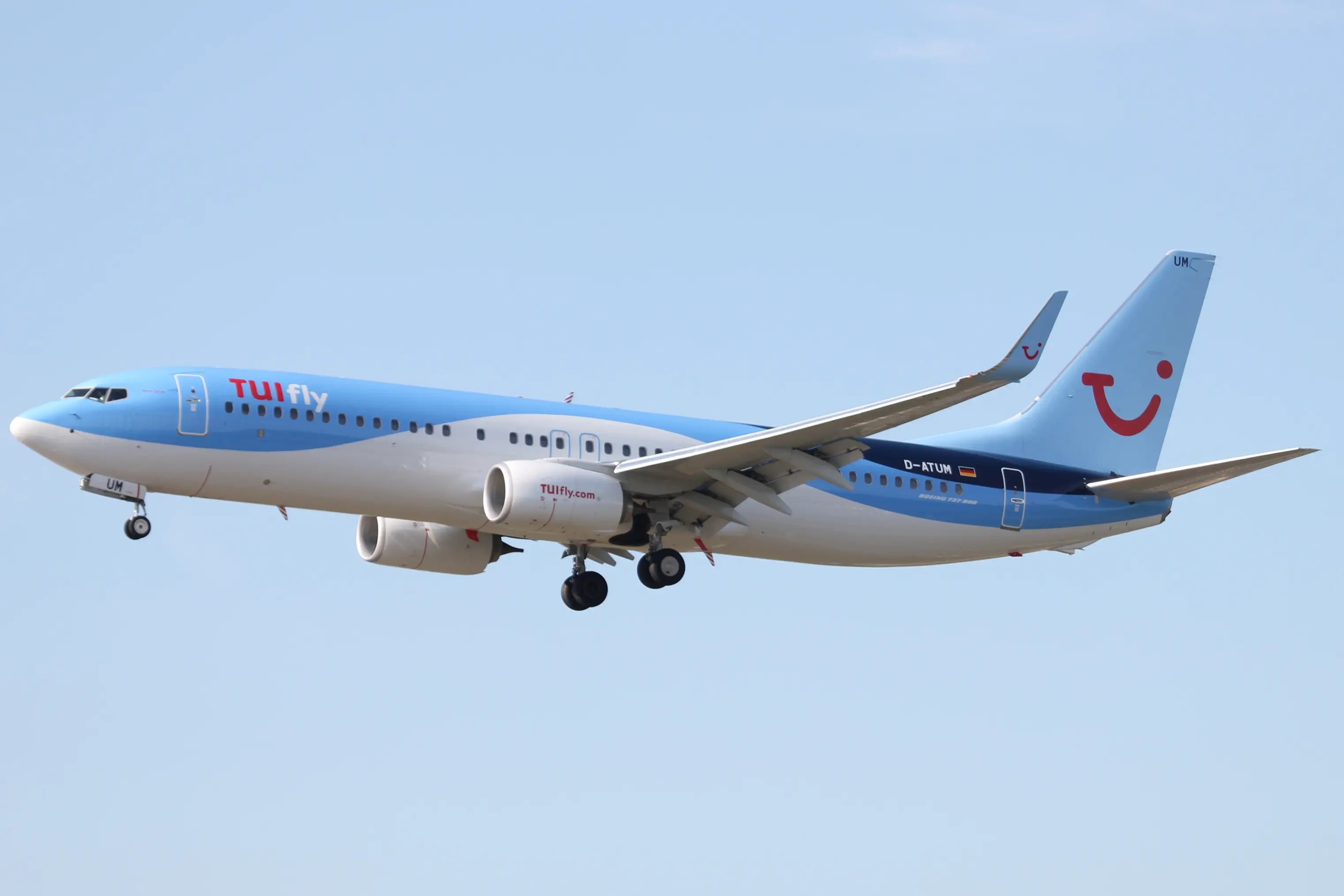
TUIfly operates an all-Boeing 737 fleet, consisting of two variants: the proven Boeing 737-800 Next Generation and the newer Boeing 737 MAX 8. As of February 2026, the fleet totals 24 aircraft with an average age of approximately 10.8 years. The fleet is standardized around the 737 family, which simplifies crew training, maintenance, and operational flexibility. Aircraft can be shifted between TUI Group airlines (UK, Belgium, Netherlands, Nordic, Germany) on short notice depending on seasonal demand.
The 737 MAX 8 entered TUIfly service in June 2021 when the first aircraft (D-AMAX) was delivered after the global MAX grounding. Originally, TUI Group had planned to deploy 25 MAX 8 aircraft with TUIfly Deutschland by 2023, but delays related to the grounding and the COVID-19 pandemic scaled this back significantly. As of early 2026, seven MAX 8 aircraft are assigned to the German operation, with the remaining fleet consisting of 737-800s, some of which have been in service since 2015 or earlier.
| Aircraft Type | Role | In Service | Notes |
|---|---|---|---|
| Boeing 737-800 | Short/Medium-haul | ~15 | 186-189 pax. Workhorse of the fleet since 2007. Last new delivery in 2015. |
| Boeing 737 MAX 8 | Short/Medium-haul | 7 | 189 pax. 14-16% more fuel-efficient than 737-800. First delivered June 2021. |
Fleet data as of February 2026. Numbers approximate; aircraft may be temporarily parked or shared with other TUI Group airlines.
TUI Group holds orders for approximately 70 Boeing 737 MAX aircraft across all its subsidiaries, including a mix of MAX 8 and MAX 10 variants. The MAX 10, a stretched version seating approximately 210 passengers, is expected to join the fleet as deliveries progress through 2028. These deliveries will gradually replace the remaining 737-800s, moving TUIfly toward an all-MAX fleet by the late 2020s. The modernization brings significant operational cost savings: the MAX offers approximately 14-16% lower fuel consumption, 40% noise reduction, and reduced CO2 emissions compared to the 737-800 variant.
Notably, TUIfly Deutschland does not currently operate any wide-body aircraft. Long-haul leisure operations within the TUI Group (Caribbean, Mexico, Indian Ocean) are handled by sister airlines, primarily TUI fly Nederland (Boeing 787-8 Dreamliner) and TUI Airways UK. However, these aircraft occasionally operate from German airports (particularly Düsseldorf) on behalf of TUI Deutschland's tour operations.
TUIfly covers the cost of type rating for pilots recruited through the official selection process, eliminating the typical €25,000-35,000 personal financial burden. All pilots are type-rated on the Boeing 737 family. Since the fleet consists of only 737-800 and 737 MAX 8 variants, a single type rating covers all aircraft in the fleet, with a short differences training module required when transitioning between the two variants. This fleet simplicity is a significant advantage for career planning: there are no complex fleet bidding dynamics or multi-type seniority considerations.
Pilot Salary & Compensation Breakdown
TUIfly pilot salaries are governed by collective agreements negotiated between the airline and Vereinigung Cockpit (VC), Germany's main pilots' union. A new compensation collective agreement (Vergütungstarifvertrag) was reached in February 2025, restoring annual seniority step increases and implementing linear pay scale improvements that, according to VC, appropriately compensate for purchasing power losses accumulated during the post-COVID restructuring period. Compensation includes a monthly base salary with annual seniority increments, supplemented by trainer pay and additional flight hour premiums.
First Officer (F/O) Pay Scale
| Seniority | Monthly Gross (est.) | Annual Gross (est.) |
|---|---|---|
| Year 1 (entry) | ~€6,500 | ~€78,000 - €85,000 |
| Year 4-5 | ~€7,800 - €8,500 | ~€95,000 - €102,000 |
| Year 8 | ~€9,000 | ~€108,000 - €115,000 |
| Senior F/O (Year 15-20) | ~€10,500 - €11,800 | ~€126,000 - €142,000 |
Figures are gross monthly estimates before tax and social contributions. Annual totals include base salary and standard allowances. Actual take-home pay is reduced by German income tax (up to ~42%) and social charges (~20%).
Captain (CPT) Pay Scale
| Seniority | Monthly Gross (est.) | Annual Gross (est.) |
|---|---|---|
| Entry Captain (Year 1) | ~€12,200 | ~€147,000 - €155,000 |
| Captain Year 5 | ~€14,000 - €15,000 | ~€170,000 - €180,000 |
| Captain Year 10 | ~€16,000 - €17,000 | ~€192,000 - €204,000 |
| Senior Captain (Year 20) | ~€18,700 | ~€225,000 |
Captain pay includes base salary and standard supplements. Training Captains receive an additional supplement of approximately €3,000-5,000 per year depending on training load.
These salary estimates are compiled from industry databases (PilotJobsNetwork, Kununu, Pilot Career Center), union publications, and pilot community reports. The exact terms of the February 2025 Vereinigung Cockpit collective agreement have not been fully disclosed publicly. Actual compensation depends on the specific collective agreement in force, individual seniority step, flight hour accumulation, and additional qualifications (e.g., trainer pay). German income tax and social contributions reduce take-home pay significantly compared to gross figures. Always verify current pay scales with VC or directly with TUIfly HR during the recruitment process.
How Does TUIfly Pay Compare?
TUIfly compensation sits firmly in the mid-range of the German airline pilot market. Entry F/O pay of approximately €6,500/month is broadly comparable to Condor (approximately €6,800-7,000/month according to available data) and substantially above Eurowings, where documented net F/O pay is around €2,500/month. At the Captain level, TUIfly's senior compensation of approximately €225,000 gross annually approaches Condor equivalents (~€218,000) while remaining below Lufthansa mainline senior Captains (~€230,000-250,000). The 2025 VC agreement restored annual seniority step progression that had been frozen since the 2021 restructuring, placing TUIfly on a positive trajectory relative to recent years.
Roster Pattern & Quality of Life
TUIfly operates under EASA Flight Time Limitations (FTL) combined with the conditions established in the Manteltarifvertrag (framework collective agreement) negotiated with Vereinigung Cockpit. As a leisure airline, TUIfly's operations are highly seasonal: summer (June through September) is the peak period with maximum crew utilization, while winter months see reduced flying, particularly on Mediterranean routes. The Canary Islands, Egypt, and Cape Verde provide year-round flying volume.
Roster scheduling at TUIfly follows a flexible (variable) pattern. Pilots receive their monthly schedule with limited advance notice, typically published mid-month for the following month. Specific flight assignments, sector sequences, and duty times are confirmed approximately 7-10 days before execution. This flexible model gives management maximum scheduling agility to respond to demand fluctuations, aircraft availability, and operational disruptions inherent to leisure flying. Pilots can express preferences through a computerized bidding system, with seniority determining priority.
📅 Sample Month: Summer Peak, First Officer (DUS Base)
TUIfly's operational model emphasizes same-day turnarounds on most routes. A typical duty might involve an early morning departure to a Mediterranean destination (Greece, Spain, Turkey), an 8-12 hour turnaround at the destination, then an evening return flight to the home base. This turnaround model means most pilots sleep at home rather than in hotels, which is a lifestyle advantage (or disadvantage, depending on perspective) compared to airlines with extensive overnight layover networks. Longer routes to the Canary Islands, Cape Verde, or Egypt may occasionally require overnight stops.
TUIfly's five bases provide geographic spread across Germany: Düsseldorf (largest, ~350,000 seats/season), Hannover (headquarters), Frankfurt, Munich, and Stuttgart. Base assignment is seniority-driven. Senior pilots typically hold their preferred base, while new hires accept what is available. Transfers are possible after a minimum seniority period (typically 12-24 months), subject to operational needs. Düsseldorf and Frankfurt offer the most diverse route networks, while Hannover benefits from proximity to the airline's headquarters and training infrastructure. Pilots are required to live within approximately 90 minutes of their base for reliable reporting.
Benefits, Travel Perks & Retirement
As a subsidiary of the world's largest tourism company, TUIfly offers a benefits package that extends well beyond standard airline perks. The combination of German statutory employee protections, the Vereinigung Cockpit collective agreement, and TUI Group's integrated travel business creates a package that adds meaningful value on top of the base salary.
The standout benefit of working for TUIfly is the TUI Group travel ecosystem. Unlike pilots at independent carriers, TUIfly crew can access heavily discounted holidays at TUI-owned hotels, resorts, and cruise ships across the Mediterranean, Caribbean, and beyond. This means your family holiday to a Robinson Club in Greece or a TUI Blue resort in Turkey can cost a fraction of the published price. For pilots with families, this benefit alone can represent thousands of euros in annual savings, effectively increasing the total compensation package well beyond the base salary figure.
Career Progression & Seniority
Career progression at TUIfly follows a seniority-based system with merit elements for the Captain upgrade. Advancement from First Officer to Captain depends on available vacancies (driven by fleet growth, retirements, and attrition), individual performance, and successful completion of command training. The airline does not routinely accept direct-entry Captains from external airlines, preferring internal promotion to maintain operational standardization and culture, though exceptions may occur during significant fleet expansion periods.
| Career Milestone | Typical Timeline | Notes |
|---|---|---|
| Join as First Officer (B737) | Day 1 | Type rating provided by TUIfly. 50-100 line training sectors under supervision. |
| Line check / Full F/O status | 3-6 months | After completing Initial Operating Experience (IOE) with Training Captains. |
| Senior First Officer | 5-8 years | Higher seniority bids, preferred trip selection, potential trainer role consideration. |
| Captain upgrade eligibility | 8-12 years | Subject to vacancy availability. Includes command assessment: interview + simulator check. |
| Training Captain / TRE / TRI | 5+ years as Captain | Separate selection and instructor training. Additional pay supplement of €3,000-5,000/year. |
With a fleet of approximately 24 aircraft and around 300 pilots, TUIfly creates roughly 2-4 Captain upgrade opportunities per year through natural attrition (retirements, departures to other airlines, management transitions). As further 737 MAX aircraft are delivered and older 737-800s are replaced, the fleet may grow modestly, creating additional vacancies. First Officers hired in 2025-2026 can reasonably anticipate Captain eligibility within 9-12 years, assuming stable fleet size and normal attrition patterns.
TUI Group's outstanding order book of approximately 70 737 MAX aircraft (across all five airlines) is the key variable for future upgrade timelines. If TUIfly Deutschland receives a meaningful share of these deliveries, fleet growth from 24 to 28-30 aircraft would generate 30-50 additional pilot positions and accelerate Captain vacancies significantly. Conversely, if the fleet remains stable at current levels, upgrade timelines will be longer. The 2025 collective agreement with VC and the group's strong financial results (33% EBIT growth in FY2024) suggest a positive trajectory, but pilots should plan conservatively and monitor fleet developments closely.
An important consideration: TUIfly's single-type fleet (Boeing 737 only) means there is no fleet transition pathway to wide-body aircraft within the airline. Pilots seeking long-haul flying on 787 Dreamliners would need to transfer to a sister airline (TUI fly Nederland or TUI Airways UK), which involves separate applications and may not preserve seniority. This is a structural limitation for pilots who aspire to intercontinental operations.
Recruitment Process & Requirements
TUIfly recruits pilots through two pathways: the TUI Cadet Programme (MPL pathway) for ab-initio candidates with little or no flight experience, and the experienced pilot stream for holders of a valid EASA ATPL or CPL/IR. Both pathways lead to a First Officer position on the Boeing 737. TUIfly covers the cost of type rating for all successful candidates, which represents a significant financial advantage.
Experienced Pilot Requirements
TUI Cadet Programme (MPL)
TUI Group operates a Multi-crew Pilot Licence (MPL) cadet scheme that feeds pilots into its five airlines, including TUIfly Deutschland. The programme is fully funded by TUI, with cadet applications typically opening once per year (most recently in early January 2025). According to the official TUI MPL page, the 2026 summer staffing requirements have already been met, with the next cadet intake expected to be announced when further fleet growth warrants additional recruitment. The cadet programme involves approximately 24 months of integrated training at partner flight schools, leading to a Multi-crew Pilot Licence and direct entry as First Officer on the Boeing 737.
Selection Stages
Online Application & CV Screening
Submit application via the TUI Group careers portal. Initial screening verifies licenses, medical certification, language proficiency, and minimum qualifications. Candidates meeting baseline requirements proceed to assessment.
Technical Assessment
Online questionnaire evaluating physics comprehension, mathematical reasoning, and aviation systems knowledge. Typically 90-120 minutes. This stage filters candidates on technical aptitude before the resource-intensive interview stages.
Interview & Behavioural Assessment
Formal HR interview with structured behavioural assessment, including situational judgement testing (SJT) evaluating decision-making under pressure and CRM skills. Panel typically includes HR representatives and senior pilots. Mandatory alcohol and drug screening at this stage.
Simulator Assessment
Conducted at an EASA-approved training facility (e.g., CAE). Evaluates fundamental piloting skills, instrument scan discipline, procedural adherence, and decision-making. Does not require existing 737 type rating. Candidates are assessed on raw aptitude, not type-specific knowledge.
Medical & Final Offer
Successful candidates receive a conditional offer subject to a valid Class 1 medical and background checks. Upon acceptance, type rating training begins (5-6 weeks for the Boeing 737), followed by 50-100 line training sectors before independent line flying authorization.
German language proficiency is not officially mandatory at the EASA level, but it is a strong practical advantage at TUIfly. Internal communications, crew coordination with German ATC, and company culture are predominantly German-language. Candidates with strong German (B2+) have a meaningful competitive edge. For the simulator assessment, focus on basic handling skills, instrument scan, and clear communication rather than 737-specific procedures. TUIfly typically recruits 2-4 First Officers per month during peak hiring periods (January-March and July-September), with reduced recruitment during shoulder months.
How TUIfly Compares: Airline Radar Chart
How does TUIfly stack up against its two most direct German competitors, Condor and Eurowings? Condor is a comparable leisure carrier (now Airbus A320/A321 fleet) operating from similar German airports to overlapping Mediterranean and Atlantic island destinations. Eurowings is Lufthansa's low-cost subsidiary, operating a much larger Airbus A320 fleet on both leisure and point-to-point routes. Below is a comparative analysis across five key metrics.
Key Takeaways from the Comparison
TUIfly leads on benefits and overall compensation balance. The TUI Group travel ecosystem (40-70% discounts on holidays, hotels, and cruises) gives TUIfly a unique advantage that neither Condor nor Eurowings can match. Combined with competitive salary positioning and the restored 2025 collective agreement, TUIfly offers the best total value proposition among the three.
Salaries are competitive with Condor, vastly superior to Eurowings. TUIfly and Condor F/O entry pay is broadly comparable at approximately €6,500-7,000/month, while Eurowings pays documented net figures of approximately €2,500/month for F/Os, representing a dramatic 60-65% gap. At the Captain level, TUIfly and Condor are near-parity around €18,000-19,000/month at senior levels, while Eurowings Captain net pay is approximately €4,000/month. Eurowings also imposes 3-year bonding agreements that restrict career flexibility.
Eurowings has the fleet diversity and growth advantage. With 200+ Airbus A320/A321 aircraft, Eurowings offers a much larger operation and more upgrade opportunities purely by scale. The Lufthansa Group backing provides long-term strategic stability despite lower individual pilot compensation. Condor's financial trajectory remains uncertain following its post-Thomas Cook restructuring.
Job security favors TUIfly over Condor, but Eurowings has Lufthansa backing. TUI Group's €23.2 billion revenue and strong profitability provide solid financial backing for TUIfly. Condor has faced repeated ownership changes and financial uncertainty. Eurowings benefits from the Lufthansa Group umbrella but has its own history of restructuring and subsidiary consolidation.
Radar chart scores are editorial estimates based on publicly available salary data, pilot community reports, union publications, and industry benchmarks. They represent a general assessment for an experienced pilot evaluating a long-term career. Individual priorities vary significantly: a pilot prioritizing maximum fleet diversity and long-haul opportunities would weight the comparison differently than one focused on total compensation and quality of life. Scores will be updated as new data becomes available.
Union & Industrial Relations
TUIfly pilots are represented by Vereinigung Cockpit (VC), Germany's dominant pilots' union. VC represents cockpit crew across multiple German airlines including Lufthansa, Eurowings, Condor, and TUIfly, and is a member of the European Cockpit Association (ECA) and the International Federation of Air Line Pilots' Associations (IFALPA). Union membership at TUIfly is optional under German labor law, but participation rates exceed 85%, reflecting the union's effectiveness in negotiating competitive terms.
Recent Collective Bargaining & Key Events
The post-COVID restructuring was painful, but the worst appears to be behind TUIfly. The successful February 2025 collective agreement restored pilot pay progression that had been frozen for four years, and the airline's fleet has stabilized at 22-24 aircraft with growth expected through 737 MAX deliveries. VC's track record at TUIfly shows effective negotiation: the union secured significant protections during restructuring (raising the protected headcount from ~270 to 370) and subsequently pushed for pay restoration as the airline recovered. For new recruits, VC membership is strongly recommended, as the collective agreements negotiated by the union form the legal basis for your salary, roster rules, and career protections.
Verdict: Who Is TUIfly For?
🎯 Our Take
TUIfly occupies a distinctive position in the German pilot job market: it offers substantially better compensation and working conditions than budget carriers like Eurowings, competitive pay with Condor, and unique lifestyle benefits through the TUI Group travel ecosystem. The all-Boeing 737 fleet is modern and straightforward, the five-base network provides geographic flexibility across Germany, and the restored 2025 collective agreement signals a positive trajectory after the difficult COVID restructuring period.
The trade-offs are clear: fleet diversity is limited to the 737 family with no wide-body pathway within the airline, the seasonal leisure operation creates variable monthly workloads, the flexible roster system offers less predictability than fixed-pattern carriers, and the relatively small fleet (~24 aircraft) means Captain upgrade opportunities are limited compared to larger operators. The airline's history of dramatic restructuring during COVID (fleet halved, bases closed, 130+ pilots lost) is a reminder that leisure aviation is cyclical and vulnerable to external shocks.
For pilots who value solid mid-range compensation, a modern single-type fleet, access to exceptional travel benefits, and the backing of Europe's largest tourism group, TUIfly is a strong choice, particularly as a career-building step or a long-term home for those content with narrowbody leisure flying.
1 Do I need to speak German to fly for TUIfly?
German is not formally mandatory at the EASA regulatory level, but it is a strong practical requirement. Internal communications, crew coordination, interaction with German ATC, and company culture are predominantly German-language. Candidates with at least CEFR B2 (upper intermediate) German proficiency have a significant competitive advantage during recruitment. English ICAO Level 5 minimum is formally required.
2 Does TUIfly pay for the type rating?
Yes. TUIfly covers the full cost of Boeing 737 type rating training for pilots recruited through the official selection process, both for cadet and experienced pilot pathways. This eliminates a personal financial burden of approximately €25,000-35,000. Type rating training takes approximately 5-6 weeks at an EASA-approved facility (e.g., CAE), followed by 50-100 line training sectors under supervision.
3 How long does it take to upgrade to Captain?
The typical Captain upgrade timeline at TUIfly is approximately 8-12 years from initial First Officer employment. This depends on fleet growth, natural attrition, and individual performance. With 24 aircraft and ~300 pilots, approximately 2-4 Captain vacancies arise per year. Future 737 MAX deliveries could accelerate this if the fleet grows. The upgrade process includes a command assessment (interview + simulator check) and is not guaranteed.
4 Can non-EU citizens apply?
No. TUIfly requires applicants to hold EU/EEA citizenship or Swiss nationality with unrestricted work authorization in Germany. There is no visa sponsorship or work permit pathway for non-EU candidates. This is standard across German airline employers due to employment law requirements.
5 Can I transfer to another TUI Group airline?
In principle, yes, but it is not a simple internal transfer. Each TUI Group airline (TUI Airways, TUI fly Nederland, TUI fly Belgium, TUI fly Nordic) operates under a separate Air Operator's Certificate with its own employment contracts and seniority lists. Transferring typically requires applying through that airline's recruitment process. TUI Group has discussed consolidating operations and potentially creating more integrated crew management by 2028-2030, but this remains subject to regulatory approval and union negotiations.
6 What are the main destinations TUIfly flies to?
TUIfly's network focuses on leisure destinations from its five German bases. The Canary Islands (Fuerteventura, Gran Canaria, Tenerife, Lanzarote) represent the largest share of capacity, operating year-round with approximately 50 combined weekly flights during peak periods. Other major destinations include Mallorca (up to 40 weekly flights in summer), Egyptian Red Sea resorts (Hurghada, Marsa Alam), Greek islands (Crete, Rhodes, Kos, Corfu), Turkish coast (Antalya, Bodrum), Portugal (Faro, Madeira), and Cape Verde. New winter 2025/26 routes include Abu Dhabi, Dubai, and Jeddah.
7 How does TUIfly compare to Condor as an employer?
TUIfly and Condor are the two primary German leisure airline employers and are broadly comparable on salary (TUIfly ~3-5% above at F/O level, near-parity at Captain level). TUIfly's key advantages are the TUI Group travel benefits, stronger parent company financial backing (€23.2B revenue vs. Condor's uncertain post-restructuring trajectory), and a simpler single-type fleet (Boeing 737 only vs. Condor's Airbus A320/A321 family). Condor offers a slightly larger fleet (~35-40 aircraft vs. 24) and occasionally longer routes, which may appeal to pilots seeking more block hours or variety. Both airlines negotiate with Vereinigung Cockpit.
8 Is TUIfly currently hiring?
As of early 2026, TUIfly maintains active recruitment for experienced First Officers on a rolling basis through the TUI Group careers portal. The TUI MPL cadet programme paused intake for 2026 summer staffing (already fulfilled), with the next cadet intake expected when further fleet growth warrants it. Experienced pilots interested in applying should monitor the official TUI pilot careers page for current openings.
Official Links & Resources
Before applying or making career decisions, always verify information directly with official sources. These are the key websites and organisations relevant to TUIfly pilot careers:
Set up job alerts on the TUI Group careers portal for pilot positions at TUIfly Deutschland. Openings are posted on a rolling basis and can fill quickly, particularly for preferred base assignments. Also follow Vereinigung Cockpit on LinkedIn for informal updates on collective agreement negotiations and industry developments that directly affect TUIfly pilot working conditions.