

Transavia France Overview & Company Profile
Transavia France (IATA: TO, ICAO: TVF) is the French low-cost subsidiary of the Air France-KLM Group, headquartered at Paray-Vieille-Poste near Paris-Orly Airport. Launched in 2007 as part of the group's strategy to compete in the budget leisure travel segment, Transavia France has grown into one of the largest low-cost carriers operating from France, serving approximately 9.5 million passengers annually across 86 international and 3 domestic destinations in 25 countries.
The airline's growth accelerated dramatically after a landmark August 2020 agreement between Air France management and the SNPL pilots' union, which permitted Transavia France to expand onto domestic French routes previously served by Air France and its regional subsidiary HOP!. This restructuring was central to Air France-KLM's post-COVID recovery plan, positioning Transavia as the cost-efficient arm for price-sensitive leisure and domestic traffic while Air France focused on premium and long-haul connecting services. As of 2024, Transavia France employed around 3,000 staff and recruited approximately 150 pilots per year through the Air France selection pipeline. The airline counts as the leading low-cost carrier at Paris-Orly by market share.
Fleet Composition & Renewal Plans
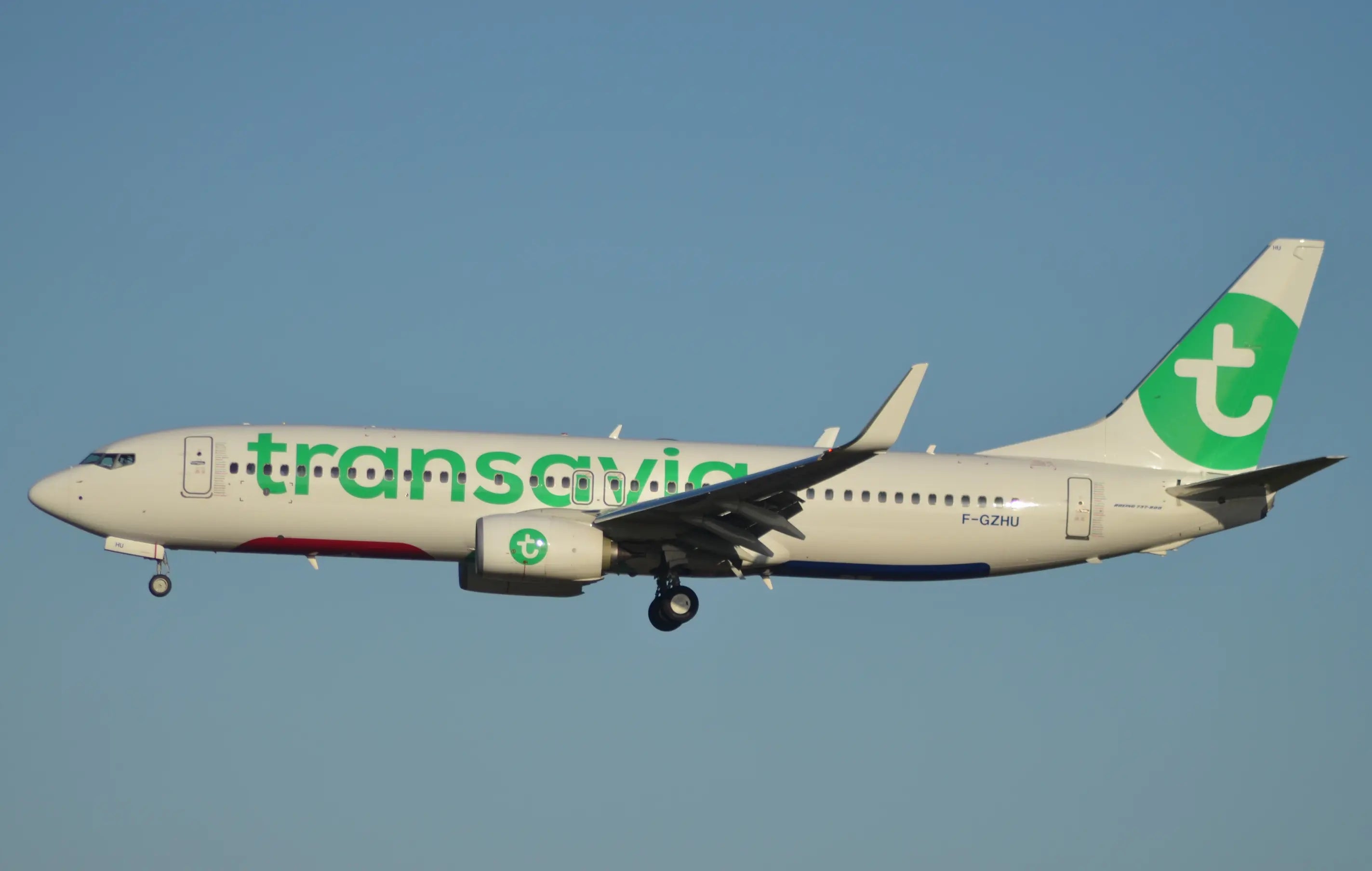
Transavia France operates a transitional fleet currently comprising two aircraft families: the legacy Boeing 737-800 and the new-generation Airbus A320neo/A321neo. The airline is in the middle of a major fleet modernization program. In December 2021, Air France-KLM ordered 100 Airbus A320neo family aircraft (with options for 60 more), shared across Transavia France, Transavia Holland, and KLM. The goal is to fully replace all Boeing 737 operations by 2031.
As of early 2026, Transavia France's fleet stands at approximately 86-90 aircraft. The Airbus A320neo and A321neo offer more than 15% reduction in CO2 emissions compared to previous-generation aircraft, lower noise levels, and modern avionics. For pilots, the fleet transition means type-rating training from Boeing to Airbus platforms, conducted at approved facilities. Training costs are covered by the airline.
| Aircraft Type | Role | In Service (approx.) | Notes |
|---|---|---|---|
| Boeing 737-800 | Narrowbody | ~67 | 189 seats. Legacy workhorse. Being phased out by 2031. |
| Airbus A320neo | Narrowbody | ~7 | 186 seats. New generation. LEAP-1A engines. 15%+ CO2 reduction. |
| Airbus A321neo | Narrowbody | ~15 | 232 seats. Larger capacity variant. High-density leisure config. |
Fleet data as of early 2026. Numbers are approximate and change with ongoing deliveries and retirements. 10 Boeing 737s had already been retired from the combined Transavia fleet by February 2026.
The Boeing-to-Airbus transition is the defining operational change at Transavia France for this decade. Pilots currently type-rated on the 737-800 will undergo full A320 family type-rating training (typically 3-5 weeks of ground school, 15-20 simulator sessions, and supervised line flying). New recruits entering after 2025 are increasingly likely to start directly on the A320neo. The transition does not affect seniority position. The complete A320neo/A321neo fleet target is expected to consist of 90+ aircraft for Transavia France alone by the early 2030s.
Pilot Salary & Compensation
Transavia France pilot salaries reflect the airline's position as a low-cost carrier within the Air France-KLM Group. Compensation is structured around a monthly base salary, flight-hour pay, allowances (typically 10% monthly premium), an end-of-year bonus (8.33% of annual salary), holiday allowance (8% of annual salary), and per diem payments for layovers. French social charges (approximately 22-25%) and income tax significantly reduce take-home pay compared to gross figures. Pilots on Transavia France contracts also contribute to the CRPN supplementary pension fund, which represents substantial long-term value.
While Transavia France is categorized as a low-cost carrier, its compensation sits at the higher end of the European LCC spectrum, significantly above Ryanair, Volotea, or Wizz Air. This is largely due to the Air France-KLM group backing and the SNPL-negotiated collective agreements. However, pay remains below Air France mainline levels, particularly for senior Captains on long-haul widebody operations.
First Officer (OPL) Pay Scale
| Seniority | Estimated Annual Gross | Notes |
|---|---|---|
| Entry F/O (Year 1) | ~€65,000 - €80,000 | Starting salary for new hires without prior Transavia experience. |
| Type-rated F/O (2,800+ hrs) | ~€110,000+ | Direct entry with type rating and experience. Includes secondary benefits. |
| Senior F/O (top of scale) | ~€140,000 - €169,000 | Top scale before tax and pension. Includes all allowances and bonuses. |
Captain (CDB) Pay Scale
| Seniority | Estimated Annual Gross | Notes |
|---|---|---|
| Entry Captain | ~€130,000 - €150,000 | After upgrade (currently ~7-8 years seniority). |
| Senior Captain (top of scale) | ~€160,000 - €171,000 | Top scale. Includes base, allowances, bonuses. |
Figures are estimated annual gross totals including base salary, flight pay, allowances, bonuses, and holiday pay. French social charges and income tax reduce net take-home significantly.
Salary figures are compiled from pilot job network listings, industry benchmarks, and pilot forum reports. Some figures may reflect combined Transavia (Dutch + French) averages rather than French-contract specifics. Actual compensation depends on the latest collective agreement, individual seniority steps, aircraft type, and flight hours logged. The differential between top F/O and Captain pay is narrower at Transavia than at legacy carriers, reflecting the compressed pay scales typical of low-cost operations. Always verify with current SNPL publications and Air France-KLM HR communications.
Roster Pattern & Quality of Life
Transavia France operates under EASA Flight Time Limitation (FTL) rules combined with the collective agreements negotiated through the SNPL. The standard rostering period is 35 days, comprising approximately 20 working days and 15 days off. The maximum consecutive duty period is 6 days, followed by a guaranteed minimum of 3 days off. As a predominantly short-haul, point-to-point carrier focused on leisure travel, Transavia's roster pattern is quite different from Air France mainline long-haul operations.
Pilots use a Jeppesen bidding system to express preferences regarding trip pairings and monthly schedule composition. Seniority influences bid outcomes: more senior pilots have greater flexibility in selecting preferred pairings, days off, and scheduling patterns. The airline's intensive weekend leisure operations mean that regular weekend flying is expected, though weekend off-days are distributed equitably across the pilot workforce.
📅 Sample Month: Short-Haul First Officer (Orly)
A typical duty day for a Transavia France short-haul pilot involves 2-3 sectors, with turnaround times of 25-35 minutes. Flight times average 90-180 minutes per sector on European routes. High aircraft utilization means the workload per duty day can feel intensive, particularly during peak summer operations (June through August) when the airline operates at maximum capacity.
The primary crew base is Paris-Orly, with additional bases at Nantes, Lyon, and Montpellier. Base assignment is determined by airline operational requirements rather than pilot preference, though preferences can be expressed during the bidding process. Paris-Orly is the dominant base, handling the majority of Transavia France operations. Living costs in the Paris region are high, but pilots benefit from French social protections, good public transport, and proximity to Europe's largest aviation market. Provincial bases (Nantes, Lyon) offer lower living costs and a different quality of life.
Benefits, Travel Perks & Retirement
As a subsidiary of Air France-KLM, Transavia France pilots benefit from the group's comprehensive benefits infrastructure combined with robust French labor law protections. The benefits package is one of the strongest differentiators compared to independent low-cost carriers like Ryanair, easyJet, or Wizz Air, where benefits are often more limited.
The CRPN is a private non-profit pension fund specifically for French-based aircrew, operational since 1951. It provides a supplementary pension on top of the basic French state pension, with contributions based on gross earnings. Pension calculations incorporate career-average indexed earnings and years of service. Members with 25+ years of contributions receive pensions without reduction factors. The scheme also includes a survivors' pension (for spouses) and an Insurance Fund component covering permanent unfitness for flying. This is one of the most generous aviation-specific retirement systems in Europe and a key reason why French airline pilot positions are highly sought after.
Career Progression & Seniority
Career progression at Transavia France is fundamentally shaped by its integration with Air France. Pilots are managed on a single unified seniority list shared between Air France and Transavia France. This means a pilot assigned to Transavia has the exact same career prospects as one flying Air France metal. Assignment to either airline is determined by group staffing needs, not by pilot preference. This unified system is one of the most important features for aspiring pilots to understand.
The current upgrade timeline from First Officer to Captain at Transavia stands at approximately 7-8 years as of 2025, down significantly from historical periods when the wait could extend to 13 years. The reduction reflects post-pandemic recovery, fleet expansion, and increased hiring. Air France-KLM does not accept direct-entry Captains for Transavia France: all Captains must upgrade from within through the internal seniority-based process.
| Career Milestone | Typical Timeline | Notes |
|---|---|---|
| Cadet training (if cadet path) | 24 months | Fully funded by Air France. Includes ATPL theory + practical flight training. |
| Join as F/O (B737 or A320neo) | Day 1 post-training | Assignment to Transavia or Air France based on group needs. |
| Senior F/O / fleet transition | 3-5 years | Opportunity for Boeing-to-Airbus transition as fleet modernizes. |
| Captain upgrade | ~7-8 years | Command assessment: interview + simulator check. Not guaranteed. |
| Transition to Air France mainline | Seniority-dependent | Possible move to A220, A320, or widebody fleet based on seniority. |
| Training Captain / TRE / TRI | Variable | Requires separate selection and instructor certification. |
The shared seniority list means that a pilot starting at Transavia can eventually transition to Air France mainline operations (narrowbody or widebody, including the A350 and 777) as seniority accumulates. This is a unique advantage compared to independent LCCs where career progression is limited to the airline itself. However, the timing of such transitions depends entirely on Air France staffing requirements and your position on the seniority list. The current hiring wave (approximately 300 pilots per year across the group) should create significant transition opportunities in the coming years as senior pilots retire.
Recruitment Process & Requirements
Transavia France recruits pilots exclusively through the Air France selection process. There are two pathways: the Cadet Programme (for candidates with little or no flight experience) and the Professional Pilot stream (for experienced pilots with a CPL/ATPL). Both pathways lead to the same unified seniority list and career progression. Approximately 150 pilots per year are recruited for Transavia France through this pipeline.
Professional Pilot Requirements
Cadet Programme Requirements
Selection Stages
PSY 0: Online Pre-selection
Remote test (~2 hours) within a 36-hour window. Includes logic, psycho-technical tests, aeronautical knowledge, and English proficiency. Webcam-proctored. Used to rank candidates for the next phase.
PSY 1: Psychotechnical & Psychomotor Tests
Full day at ENAC campus in Toulouse. Computer-based aptitude tests: spatial reasoning, multitasking, coordination, memory, cognitive ability. The majority of candidates are eliminated at this stage. 3 failures = definitive elimination (cadets); 2 failures = elimination (professional stream).
PSY 2: Group Exercise & Interview
Held at Roissy CDG, Air France Selection Center. Includes personality inventories, a group exercise, and an individual interview. Focus on CRM skills, leadership, cultural fit, and stress management. 2 deferrals in PSY 2 = elimination from the professional stream.
Recruitment Committee & Simulator
Files are reviewed by a committee. For professional pilots, a flight simulator assessment may be recommended. The committee decides: pass, deferral, or elimination.
Class 1 Medical & Contract
Successful candidates receive a training date (cadets) or direct assignment. Cadets begin the 24-month programme; professional pilots proceed to type rating and line training on Boeing 737 or Airbus A320neo.
French fluency is absolutely non-negotiable. All internal communications, briefings, and company culture are in French. The selection is conducted partly in French. Air France typically runs one cadet campaign per year (applications have historically opened around June). For professional pilots, positions are advertised on a rolling basis via the Air France careers portal. Competition is intense: approximately 3,000 applicants compete for roughly 100 cadet spots each year. Being eliminated twice from any Air France pilot selection permanently disqualifies a candidate from that stream.
How Transavia France Compares: Airline Radar Chart
How does Transavia France stack up against two major competitors in the French low-cost market: easyJet (Europe's largest LCC by network size) and Volotea (the Spanish specialist in secondary city routes)? Below is a comparative analysis across five key metrics. Scores are editorial estimates based on publicly available data, pilot reports, and industry benchmarks.
Key Takeaways from the Comparison
Transavia France wins on job security and benefits. Backed by the Air France-KLM Group with €33 billion in annual revenue, Transavia offers financial stability unmatched by independent LCCs. The CRPN pension, full French social protections, and SkyTeam staff travel represent a benefits package that Volotea and easyJet simply cannot replicate. The shared Air France seniority list adds long-term career security that no standalone LCC can offer.
Salary is competitive within the LCC segment. Transavia's top First Officer scale (~€169,000) significantly exceeds Volotea (~€78,000) and easyJet (up to ~€80,000 for F/Os in Europe). However, French social charges and income tax reduce take-home pay more than in Spain or the UK. The Captain-F/O pay differential is narrower at Transavia than at legacy carriers.
easyJet leads on fleet modernity and scale. easyJet operates a mature all-Airbus fleet across 35+ countries with over 1,000 routes. Transavia's fleet is smaller and still transitioning from Boeing to Airbus. However, Transavia's A320neo/A321neo deliveries are closing this gap rapidly. Volotea's fleet of A319s is older and more limited.
Career progression favors Transavia. The unified Air France seniority list means Transavia pilots can eventually transition to widebody flying at Air France (A350, 777). Neither easyJet nor Volotea offer comparable long-term career escalation. This makes Transavia uniquely attractive as both a starting point and a long-term career airline.
Scores are editorial estimates based on publicly available salary data, pilot reports, airline financial statements, and industry benchmarks. They represent a general assessment for a mid-career pilot evaluating long-term prospects. Individual experiences will vary based on seniority, base location, and personal priorities.
Union & Industrial Relations
The union landscape at Transavia France is complex, reflecting the airline's position as a subsidiary within the broader Air France-KLM group. The SNPL France ALPA (Syndicat National des Pilotes de Ligne) is the dominant union representing pilots, having negotiated the critical 2020 agreement that enabled Transavia France's domestic expansion. Understanding the union dynamics is essential for any pilot considering joining Transavia.
Key Unions Representing Transavia France Pilots
Key Disputes & Recent History
The union landscape at Transavia France can seem daunting, but it broadly works in pilots' favor. The SNPL's strong representation ensures aggressive negotiation on salary, roster protections, and career development pathways. The 2020 agreement that unlocked Transavia's domestic growth also embedded protections for pilot employment conditions and seniority. For new recruits, union membership is optional but widely adopted. The main tension to monitor is between Transavia-specific interests (faster growth, operational flexibility) and Air France mainline interests (route protection, seniority preservation). This tension has historically been managed through negotiation rather than prolonged disruption.
Verdict: Who Is Transavia France For?
🎯 Our Take
Transavia France occupies a unique position in European aviation: a low-cost carrier with the backing, benefits, and career infrastructure of one of Europe's largest airline groups. The combination of competitive LCC-segment salary, a shared Air France seniority list, the CRPN pension scheme, generous staff travel across the SkyTeam network, and the realistic pathway to Air France widebody flying makes Transavia France a compelling career choice, particularly for French-speaking pilots at the start of their careers.
The trade-offs are clear: short-haul LCC operations mean high daily workload with 2-3 sectors per day during peak seasons, Paris-only may not suit everyone (though provincial bases exist), and the Captain-F/O pay differential is narrower than at legacy carriers. Salaries are lower than Air France mainline, particularly at the Captain level. The Boeing-to-Airbus fleet transition adds a retraining requirement for current 737 pilots. And assignment to Transavia rather than Air France is not a choice, it is determined by group needs.
But for pilots who value long-term career security, the possibility of eventually flying A350s or 777s for Air France, French labor protections, and the financial backing of a €33 billion airline group, Transavia France is hard to beat among European LCCs.
1 Is Transavia France the same as Transavia Holland?
No. Transavia France (IATA: TO) and Transavia Holland (IATA: HV) are separate legal entities within the Air France-KLM Group. They share branding and fleet strategy but operate under different contracts, labor agreements, and regulatory frameworks. Transavia France pilots are on the Air France seniority list and are recruited through the Air France selection process. Transavia Holland pilots are recruited separately and operate under Dutch labor law and the VNV union framework.
2 Do I need to speak French to fly for Transavia France?
Yes, fluent French is mandatory for all pilot positions at Transavia France. Non-native speakers must hold FCL.055 Level 6 French proficiency. All internal communications, company culture, union interactions, and parts of the selection process are conducted in French. There is no English-only pathway.
3 Can I choose to fly for Transavia France instead of Air France?
No. Assignment to either Transavia France or Air France is determined by the group's operational staffing needs, not by pilot preference. Pilots recruited through both the Cadet and Professional streams enter the same unified seniority list and are deployed where the group needs them. Assignment to Transavia does not represent a second-tier placement: career prospects are identical.
4 How long does it take to upgrade to Captain at Transavia France?
The current Captain upgrade timeline is approximately 7-8 years as of 2025. This is significantly shorter than historical periods (up to 13 years). The upgrade is strictly seniority-based and includes a command assessment (interview + simulator check). It is not guaranteed, and the timeline fluctuates with group growth and retirement rates.
5 Can I transfer from Transavia France to Air France long-haul?
Yes, this is possible and is one of the key career advantages of joining Transavia France. Since both airlines share a single seniority list, pilots can transition to Air France narrowbody or widebody fleets (A220, A320, A350, 777, 787) as seniority allows and when staffing needs create openings. However, the timing depends entirely on your seniority position and the group's operational requirements.
6 Does Transavia France pay for the type rating?
Yes. For pilots recruited through the official Air France selection process (both cadet and professional pathways), type-rating training is fully funded by the airline. Cadets receive a completely funded 24-month training programme. Professional pilots receive company-funded type rating on their assigned aircraft (currently Boeing 737-800 or Airbus A320neo).
7 What aircraft will I fly at Transavia France?
Currently, Transavia France operates both Boeing 737-800 and Airbus A320neo/A321neo aircraft. The fleet is transitioning entirely to Airbus, with full Boeing retirement expected by 2031. New recruits entering after 2025 are increasingly likely to start on the A320neo. Pilots currently on the 737 will undergo Airbus type-rating training as the transition progresses.
8 How does Transavia France compare to other LCCs in France?
Transavia France offers significantly higher compensation than most European LCCs. Top F/O scale (~€169,000) exceeds easyJet (~€80,000) and Volotea (~€78,000). The Air France-KLM group backing provides superior job security, benefits (CRPN pension, SkyTeam staff travel), and long-term career progression (shared seniority list with Air France). The main trade-off is that French social charges reduce take-home pay, and the selection process through Air France is more rigorous and competitive than direct applications to independent LCCs.
Official Links & Resources
Before applying or making career decisions, always verify information directly with official sources. These are the key websites and organisations relevant to Transavia France pilot careers:
Bookmark the SNPL press releases page to stay informed about pilot-specific developments affecting both Air France and Transavia France, including salary negotiations, strike notices, and regulatory changes. For job alerts, create a candidate profile on the Air France careers portal to be notified when the next cadet or professional pilot campaign opens.