

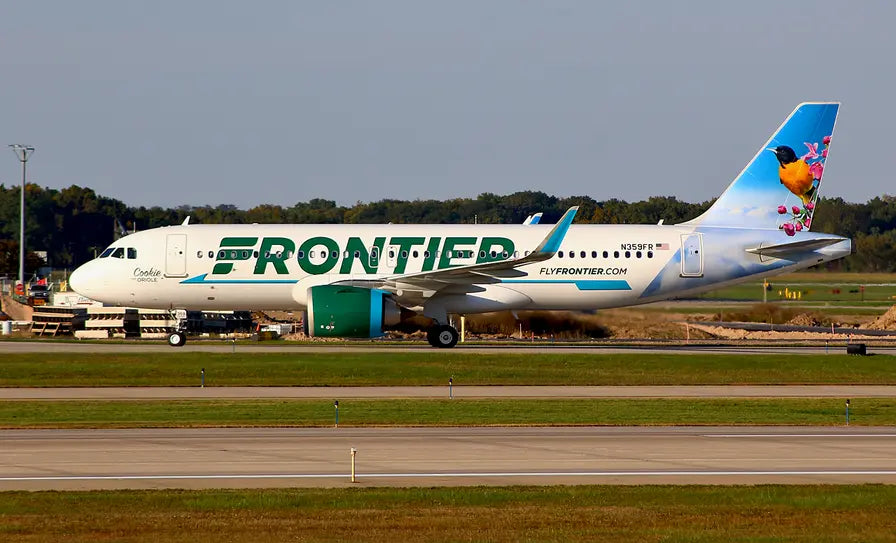
Frontier Airlines Overview & Company Profile
Frontier Airlines (IATA code F9, ICAO code FFT) is a United States ultra-low-cost carrier (ULCC) headquartered in Denver, Colorado. The current Frontier was founded in 1994, and over the following three decades it transformed from a conventional low-cost airline into a pure ULCC built around unbundled fares, high ancillary revenue, and aggressive aircraft utilization. For pilots, that business model defines almost everything about the job: a young all-Airbus narrowbody fleet, point-to-point domestic and near-international flying, fast command upgrades during growth phases, and the higher operational intensity that comes with squeezing 10 to 12 flying hours out of each aircraft every day.
The airline is operated by Frontier Airlines, Inc., a subsidiary of Frontier Group Holdings, Inc., which trades on the Nasdaq under the fitting ticker symbol ULCC. Frontier Group Holdings went public in 2021, and the private equity firm Indigo Partners, known for its global ULCC investments such as Wizz Air and Volaris, remains a major shareholder and strategic influence. Indigo's playbook of rapid capacity growth and a lean cost base shapes Frontier's order book, its hiring pace, and the tone of its labor relations, all of which matter directly to a pilot's career trajectory.
Frontier is not a member of any global airline alliance. According to the company's investor relations overview, the carrier generated roughly 3.7 billion US dollars of revenue in 2025 and carried about 33 million passengers across more than 440 nonstop routes serving over 100 airports in the United States, Mexico, and the Caribbean. Industry trackers place Frontier at approximately 474 daily departures. The pilot group has grown from 1,924 active pilots in January 2023, as reported by the Frontier ALPA Master Executive Council, toward an estimated 2,100 to 2,300 by 2025 to 2026, with the company publicly stating an intention to roughly double in size over a five-year horizon.
An ultra-low-cost carrier sells the lowest possible base fare and earns the rest through fees for bags, seats, and extras. For the flight deck, that translates into high aircraft utilization, tight turn times, a heavy mix of early-morning, late-night, and red-eye departures, and a network weighted toward leisure markets like Florida and Las Vegas. The upside is scale and growth, which historically has meant some of the fastest captain upgrades in the industry. The trade-off is a more demanding schedule than a legacy carrier, especially for junior pilots and those on reserve.
Fleet Composition & Type Ratings
Frontier operates one of the simplest fleets of any sizeable US airline: it is entirely Airbus A320 family, and it is one of the youngest in the country. As of December 31, 2025, Frontier reported a fleet of 176 single-aisle Airbus aircraft, with an average age generally estimated in the four-to-six-year range by third-party fleet databases. The fleet mix spans the A320ceo, A320neo, A321ceo, and A321neo, with the airline steadily shifting weight toward the higher-capacity, more fuel-efficient neo variants and especially the A321neo, which lowers seat-mile costs on dense leisure routes.
Frontier does not publish a model-by-model breakdown in its filings, so exact per-variant counts are not officially disclosed. Earlier reporting indicated the airline already operated more than 40 A320neo and a smaller block of A321ceo aircraft, and the in-service total grew from roughly 148 jets in mid-2024 to 176 by the end of 2025. The order book remains substantial: a June 2025 Pratt & Whitney announcement put Frontier's total commitment to GTF-powered A320neo-family aircraft at 235 jets including those already delivered, after the airline added 91 A321neo. Notably, Frontier cancelled its planned A321XLR order in 2024, converting those slots to standard A321neo, and deferred a block of deliveries from the 2025 to 2028 window into 2029 to 2031 to moderate its growth rate.
| Aircraft Type | Role | Status | Notes |
|---|---|---|---|
| Airbus A320neo | Narrowbody | In service | Core of the fleet. New-generation engines, lowest fuel burn per seat. |
| Airbus A321neo | Narrowbody | In service & growing | Higher-density variant, focus of deliveries. 91 added in 2025 order. |
| Airbus A320ceo | Narrowbody | In service (declining) | Older current-engine variant. Being phased toward neo over time. |
| Airbus A321ceo | Narrowbody | In service (declining) | Current-engine A321. Around 21 reported in earlier counts. |
| Airbus A321XLR | Long-range NB | Cancelled | 18 orders dropped in 2024 and converted to standard A321neo. |
Fleet snapshot as of late 2025. Frontier does not disclose exact per-variant quantities; figures are drawn from company statements, engine-supplier releases, and fleet databases, and change with ongoing deliveries and lease returns.
Because Frontier flies a single aircraft family, there is effectively one type rating to hold: the Airbus A320. New First Officers are trained on the type at company expense after hire, and the A320 and A321 are treated as a single pay and bidding category. There is no widebody, no second fleet, and therefore no cross-fleet seniority competition. The practical upside is that an A320 rating earned at Frontier is among the most transferable qualifications in world aviation. The downside for some pilots is the absence of any internal long-haul or widebody progression: a Frontier career is a narrowbody career.
For day-to-day flying, the commonality across the A320 family is a genuine advantage. Differences training between variants is minimal, dispatch reliability on the young neo fleet is high, and the modern flight decks keep pilots current on equipment used by hundreds of operators worldwide. The narrowbody-only profile also means short-to-medium sectors, multiple legs per duty day, and frequent returns to base rather than long overnight layovers in distant cities, a pattern some pilots prefer and others find fatiguing.
Pilot Salary & Compensation Breakdown
Frontier pilot pay is set by the collective bargaining agreement between the company and the Air Line Pilots Association (ALPA). The current pay scales come from the contract ratified in 2022, and they apply uniformly across the A320 family (there is no separate A321 rate). Pilots are paid by the credited flight hour against a monthly minimum guarantee, with additional per diem for time away from base, premium pay in certain situations, and a substantial company retirement contribution. The figures below are compiled from the contract summary published by Airline Pilot Central and corroborating pilot resources.
First Officer (FO) Pay Scale
| Longevity | Hourly Rate | Est. Annual at 75-hr Guarantee |
|---|---|---|
| Year 1 | $100 / hr | ~$90,000 |
| Year 2 | $118 / hr | ~$106,000 |
| Year 3 | $127 / hr | ~$114,000 |
| Year 5 | $142 / hr | ~$128,000 |
| Year 7 | $155 / hr | ~$140,000 |
| Year 10 | $170 / hr | ~$153,000 |
| Year 12 | $179 / hr | ~$161,000 |
Annual estimates assume the 75-hour monthly guarantee across 12 months. Most pilots credit more than the guarantee (80 to 90 hours is common), so real-world earnings typically run higher than the figures shown.
Captain (CA) Pay Scale
| Longevity | Hourly Rate | Est. Annual at 75-hr Guarantee |
|---|---|---|
| Year 1 | $202 / hr | ~$182,000 |
| Year 2 | $219 / hr | ~$197,000 |
| Year 3 | $222 / hr | ~$200,000 |
| Year 5 | $229 / hr | ~$206,000 |
| Year 7 | $235 / hr | ~$212,000 |
| Year 10 | $254 / hr | ~$229,000 |
| Year 12 | $270 / hr | ~$243,000 |
A senior Captain flying a typical 80-hour month earns roughly 260,000 US dollars per year before per diem and premium pay, according to a 2025 Business Insider comparison of ULCC pilot contracts.
Beyond the hourly rate, the headline of Frontier's package is its retirement contribution. The company pays a direct 15 percent of eligible earnings into the pilot's 401(k), a defined-contribution arrangement rather than a small match. For a senior Captain earning roughly 240,000 dollars in flight pay, that represents on the order of 36,000 dollars a year in employer retirement money before any personal contribution. Per diem is paid at approximately 2.15 to 2.20 US dollars per hour of time away from base for both domestic and international trips, and the contract includes the customary premium provisions for items such as junior assignment, holiday flying, and deadheading.
These figures reflect the pay scales of the 2022 contract, which became amendable in January 2024. Frontier pilots have been in Section 6 negotiations since mid-2023 and voted overwhelmingly to authorize a strike in October 2024, which means a new agreement (likely with higher rates) could land at any time. The numbers above are the current contractual rates as published by Airline Pilot Central and should be treated as a snapshot, not a guarantee. Actual annual income depends on credited hours, seniority, base, and how much open time a pilot picks up. Unlike Southwest, Frontier's pilot compensation is not built around a high-profile profit-sharing plan, so the 15 percent retirement contribution is the standout fixed benefit. Always verify the latest rates against the live contract and ALPA MEC publications.
Roster Pattern & Quality of Life
Frontier builds pilot schedules through a Preferential Bidding System (PBS), in which pilots submit preferences for trips, days off, and report times, and the software awards lines by seniority within each base. Senior pilots can shape schedules close to their ideal; junior pilots and those on reserve have less control, particularly in peak months. The monthly minimum guarantee is 75 credited hours for both lineholders and reserve pilots, and the operation runs under the FAA's Part 117 flight, duty, and rest rules, which set the regulatory floor for fatigue protection across the industry.
Days off generally land in the region of 12 to 14 per month for a typical lineholder, in line with industry norms under Part 117 and the contract. The reality of a ULCC roster, however, is intensity: high utilization produces a heavy share of early starts, late finishes, multiple legs per day, and occasional red-eye flying on transcontinental and Caribbean routes. As at every seniority-driven airline, the single biggest lever on quality of life is seniority itself. Moving off reserve and into a senior line position is what unlocks weekends, preferred trips, and protected days off.
📅 Illustrative Month — Narrowbody First Officer (Denver)
Illustrative only. Built to reflect typical ULCC line construction (a blend of two-to-four-day trips, a reserve block, and a training day). Actual lines are awarded by PBS and vary widely by base and seniority.
Frontier operates 13 pilot domiciles: Atlanta (ATL), Chicago (MDW/ORD), Cincinnati (CVG), Cleveland (CLE), Dallas-Fort Worth (DFW), Denver (DEN), Las Vegas (LAS), Miami (MIA), Orlando (MCO), Philadelphia (PHL, covering the Trenton area), Phoenix (PHX), San Juan (SJU), and Tampa (TPA). Pilots are not required to live in base, and the wide base footprint plus interline standby agreements make commuting feasible, though never effortless at a high-utilization ULCC. Denver, as both headquarters and a core hub, is the most established and stable domicile. Newer or smaller bases can open and close as the network shifts, so prospective pilots should weigh long-term base stability alongside the cost of living in each city.
Benefits, Travel Perks & Retirement
Frontier's benefits package reflects the post-2022 competitive environment in which US carriers raised pay and improved benefits to attract and retain pilots. The most distinctive element is the retirement contribution; the rest of the package is solid and competitive for a ULCC, if generally a step below the very richest legacy plans.
The most financially significant benefit at Frontier is the company's direct 401(k) contribution, set at 15 percent of eligible earnings under the current ALPA agreement. This is a non-elective, defined-contribution payment, meaning the money goes into the account regardless of whether the pilot contributes personally, and it is separate from the pilot's own elective deferrals. For a mid-career Captain crediting normal hours, this can amount to tens of thousands of dollars per year, and over a multi-decade career it compounds into one of the more valuable parts of total compensation. Pilots should confirm the precise plan mechanics (the split between non-elective contribution and any match) against the official plan documents.
On the disclosure front, two honest caveats are worth flagging. First, Frontier does not publish a detailed vacation-accrual table publicly, so the exact number of vacation days by year of service should be confirmed against the contract. Second, while pilots receive standard paid time off, there is no widely documented pilot profit-sharing formula comparable to those at Southwest or the legacy carriers. Where this guide cannot confirm a specific figure from official sources, it says so rather than estimating.
Career Progression & Seniority
Career progression at Frontier is governed entirely by seniority, the universal currency of a US airline pilot career. A pilot's date of hire fixes their seniority number, and that number drives schedule bidding, base assignment, vacation, and, above all, the timing of the upgrade to Captain. Because Frontier flies a single fleet, there is no widebody bid or fleet-swap competition: the seniority ladder runs from junior First Officer to senior Captain on the A320 family, and that is the whole of the in-house path.
The standout feature here is upgrade speed. During the growth-driven hiring of the mid-2020s, recent pilot reports placed the upgrade from First Officer to Captain at roughly two to three years, with some bases such as Atlanta and San Juan running closer to three years. That is dramatically faster than the 10-to-15-year upgrades typical at legacy carriers, and it is the single most compelling reason many pilots choose a ULCC. Crucially, Frontier does not hire Direct Entry Captains: every command seat is filled from within by seniority, which protects the upgrade prospects of pilots already on the property.
| Career Milestone | Typical Timeline | Notes |
|---|---|---|
| New-hire First Officer (A320 family) | Day 1 post-training | Company-funded type rating and indoc on the Airbus. |
| Off reserve to lineholder | Varies by base | Seniority-dependent; improves quality of life markedly. |
| Upgrade to Captain | ~2–3 years | Strictly seniority-based. Faster in growth phases, slower if hiring stalls. |
| Senior Captain (top of scale) | ~12 years | Pay tops out at Year 12 on the longevity scale. |
| Check Airman / Instructor (TRI/TRE-equivalent) | Variable | Requires separate selection and instructor qualification. |
Frontier's careers materials describe an airline "poised to double in size" over a five-year window, backed by a large Airbus order book. Sustained growth plus normal attrition is what produces short upgrades, so the outlook is genuinely favorable. The important caveat is cyclicality: Frontier deferred a block of deliveries from 2025 to 2028 into the end of the decade, and ULCC growth is sensitive to fuel prices, leisure demand, and the broader economy. Upgrade projections should be read as scenarios, not promises. A new hire should ask current pilots for the most-junior Captain's hire date at their target base to get a real-time reading.
Recruitment Process & Requirements
Frontier recruits First Officers directly from the experienced pilot pool and also runs structured pipelines for lower-time aspirants. All hiring runs through the official Frontier pilot careers portal and the AirlineApps platform. Like every Part 121 carrier, Frontier's baseline is anchored to the FAA's Airline Transport Pilot (ATP) framework, the rules for which are published by the Federal Aviation Administration.
First Officer Minimum Requirements
Only fixed-wing or rotary flight time counts toward these totals (simulator, flight-engineer, and UAV time do not). A four-year degree is preferred but not required; a high-school diploma or GED is the minimum. Candidates must be willing to work nights, weekends, holidays, and red-eyes, and to be based at any of the 13 domiciles.
Pathways for Lower-Time Pilots
Frontier Pilot Cadet Program (with ATP Flight School)
A zero-to-airline pathway run in partnership with ATP Flight School across more than 70 US locations. Cadets train from no experience to commercial and flight-instructor ratings, build hours, and join Frontier as a First Officer in roughly 24 months. The program pays monthly stipends (about 500 dollars per month while building to 750 hours, then about 1,000 dollars per month) plus travel benefits and mentorship, and Frontier sponsors the ATP-CTP course and an A320 jet transition before indoc. Applicants must be at least 19 at program start and hold a First Class Medical. Note: the cadet application window has at times been temporarily closed due to high demand.
University Pathway Program
A direct pathway for aviation students at partner universities such as Liberty University and Purdue University. Representative requirements include a B.S. in aviation, a strong GPA (3.2 at Liberty), faculty recommendations, a clean training record, a First Class Medical, and the FCC permit. Candidates can interview around 600 hours and must be ATP or R-ATP eligible at indoc (with a 1,000-hour minimum for B.S. aviation graduates). Frontier funds the ATP-CTP course for pathway students.
Rotor Transition Program
A structured route for military-trained helicopter pilots to transition into a fixed-wing First Officer seat at Frontier, bridging rotary experience toward the airplane ATP and the A320.
Interview & Assessment
The hiring process typically includes an application and qualifications review, an interview day with HR and pilot panel components, technical and behavioral/CRM questioning, and in some cases a simulator evaluation. Background checks include employment verification and PRIA-style records review, plus pre-employment drug testing.
Class Date & Training
Successful candidates receive a class date, complete company indoctrination and A320 type-rating training, and then fly initial operating experience (IOE) under a check airman before being released to the line.
Treat the "preferred" numbers seriously: with a competitive applicant pool, 2,500 total hours and meaningful turbine or multi-crew time strengthen an application well beyond the 1,500-hour floor. Keep your training record clean, as repeated checkride failures are scrutinized heavily, particularly on the university pathways. Monitor the official careers page for open windows, since First Officer and University Pathway applications open and close with hiring demand, and the cadet program periodically pauses intake when oversubscribed.
How Frontier Compares: Airline Radar Chart
How does Frontier stack up against its closest surviving peers in the US low-fare segment? The natural comparison once would have been Spirit and Allegiant, but Spirit ceased operations in May 2026 (covered in detail below). That leaves two living reference points: Allegiant Air, the other established A320-family ULCC, and Southwest Airlines, the dominant low-cost carrier that sets the upper benchmark on pay and stability. The radar below scores all three across the six scorecard dimensions. Scores are editorial estimates grounded in published contract data, fleet information, and industry reporting.
Key Takeaways from the Comparison
Frontier out-earns Allegiant but trails Southwest. A 2025 Business Insider comparison of verified ULCC contracts put a Frontier First Officer roughly 40,000 dollars ahead of an Allegiant First Officer in year one, and a Frontier Captain about 35,000 dollars ahead at both ends of the scale. Southwest, however, sits in a different tier: its 2024 SWAPA contract drives a 12-year Captain toward roughly 364 dollars per hour equivalent, far above Frontier's 270 dollars, with a retirement contribution near 20 percent. Frontier is the strong mid-point of the low-fare segment, not the top.
Frontier's fleet is the youngest of the three. Its all-Airbus A320neo-family fleet, averaging roughly four to six years, is younger and more uniform than Allegiant's mixed Airbus fleet (now adding Boeing 737 MAX) and is more modern on average than Southwest's very large but partly aging 737 fleet. For pilots who value new equipment and high dispatch reliability, this is a genuine Frontier advantage.
Career progression favors the ULCCs over the legacy-style wait, and Frontier leads on growth. Frontier's roughly two-to-three-year upgrade, backed by an explicit doubling ambition, is faster than Southwest's longer (though highly secure) ladder. Allegiant offers a distinctive out-and-back leisure lifestyle with more nights at home, but its pay lags and its pilots have been bargaining for a new contract since 2021.
Southwest leads decisively on job security and benefits. With no furlough history, a huge domestic network, and a mature benefits and profit-sharing structure, Southwest is the safest harbor of the three. Frontier scores moderately: it survived the ULCC shakeout intact and is growing, but the sector's exposure to fuel and leisure demand, plus an unresolved pilot contract, keep it short of Southwest's stability.
Scores are editorial estimates derived from published pilot-contract data (Airline Pilot Central, Business Insider's 2025 ULCC pay comparison), company filings and fleet databases, and ALPA and SWAPA materials. They describe a general assessment for an experienced pilot weighing a long-term career, not a precise ranking. Individual experience varies by base, seniority, and personal priorities. Allegiant and Southwest scores reflect their own situations and are not endorsements; they are reference points for understanding where Frontier sits.
Union & Industrial Relations
Frontier pilots are represented by the Air Line Pilots Association, International (ALPA), the largest pilot union in the world. Within ALPA, the Frontier pilot group is organized as a Master Executive Council (MEC), headquartered in Aurora, Colorado, near the Denver hub. The MEC handles collective bargaining, scheduling and quality-of-life issues, safety programs, and discipline and grievance representation, and it plugs into ALPA International's national resources, including legal counsel, accident-investigation expertise, and political advocacy. The union's public hub is the Frontier Pilots MEC website.
ALPA / Frontier MEC Structure
How Negotiations Work
US airline labor relations are governed by the Railway Labor Act (RLA), not standard labor law. Under the RLA, a contract never simply "expires"; it becomes amendable on a set date, after which either side can open Section 6 negotiations. If direct bargaining stalls, the National Mediation Board (NMB) steps in to mediate. Pilots cannot legally strike unless and until the NMB releases both parties and a 30-day cooling-off period elapses, which makes airline strikes rare but not impossible. This framework explains why Frontier pilots can vote to authorize a strike while still legally working under the old contract.
Recent Negotiation Timeline & Disputes
An open contract is a double-edged signal. On one hand, it reflects pilot dissatisfaction with current pay relative to peers and the broader post-2022 industry surge. On the other hand, it usually means the next agreement raises pay, since contracts are renegotiated upward, not downward, and the leverage from a 99% strike vote works in the pilots' favor. A strike itself remains unlikely under the RLA's high bar, but candidates should follow the MEC newsroom closely, because a new contract could meaningfully change the compensation picture described in this guide. Union membership at an ALPA carrier is the norm, and the overwhelming majority of Frontier pilots are members.
Job Security & the ULCC Shakeout
No factor matters more to a pilot choosing an ultra-low-cost carrier than stability, and the mid-2020s delivered a brutal lesson in why. The collapse of Spirit Airlines, once the largest pure ULCC in the United States and Frontier's nearest rival, reshaped the entire segment and put Frontier's relative resilience into sharp focus.
The history is worth understanding. In 2022, Frontier and Spirit announced a planned merger that would have created a single dominant ULCC. JetBlue then outbid Frontier for Spirit, the Frontier deal fell through, and JetBlue's acquisition was subsequently blocked on antitrust grounds, leaving Spirit independent and financially exposed. Spirit filed for Chapter 11 bankruptcy in November 2024, emerged in March 2025, then filed for Chapter 11 again in August 2025 (a so-called "Chapter 22"). On May 2, 2026, Spirit ceased all flight operations after 34 years and moved into an orderly wind-down and asset liquidation. Hundreds of Spirit pilots had already been furloughed during the turmoil.
The contrast is instructive. While Spirit was forced into repeated bankruptcies and ultimately shut down, Frontier stayed independent and solvent, avoided pilot furloughs, kept hiring, and is positioned to absorb demand and routes left behind by Spirit's departure. For a pilot weighing job security, that record through the worst ULCC downturn in recent memory is meaningful evidence of relative durability.
Frontier's survival should not be mistaken for immunity. The ULCC model is structurally exposed to fuel-price spikes, discretionary-travel downturns, and intense fare competition, and Frontier itself deferred aircraft deliveries to slow its growth rate. The same volatility that produces fast upgrades can also produce sudden pullbacks. Spirit's fate is the cautionary tale; Frontier's response is the counterpoint. A prospective pilot should treat Frontier as a comparatively resilient ULCC, not a guaranteed-stable legacy carrier, and plan a career with that cyclicality in mind.
Verdict: Who Is Frontier For?
🎯 Our Take
Frontier is one of the most compelling ultra-low-cost carriers in the United States for a pilot focused on rapid command and modern equipment. The combination of a young all-Airbus A320neo-family fleet, fast upgrades in the range of two to three years, no Direct Entry Captains protecting internal progression, a strong 15 percent company retirement contribution, and an explicit plan to roughly double in size makes it a powerful place to accumulate seniority and command time quickly.
The trade-offs are real and should be weighed honestly. Pay is solidly mid-tier: better than Allegiant, but well behind Southwest and the legacy carriers, which is precisely why the pilot group voted 99 percent to authorize a strike and remains in an open contract as of 2026. The schedule is a true ULCC schedule, with high utilization, early and late flying, and red-eyes, so quality of life leans heavily on seniority. And the fleet is narrowbody only, meaning no internal widebody or long-haul path.
The strongest argument for Frontier in the current environment is durability with upside. Through the ULCC shakeout that ended with Spirit's shutdown, Frontier stayed independent, avoided furloughs, kept hiring, and is now positioned to grow into the space its rival vacated. For the right pilot, that adds up to a fast, modern, comparatively resilient narrowbody career.
1 How much do Frontier Airlines pilots make?
Under the current ALPA contract, A320-family First Officers earn from about 100 dollars per hour in year one to roughly 179 dollars per hour at year 12. Captains run from about 202 dollars per hour in year one to about 270 dollars per hour at year 12. Against the 75-hour monthly guarantee, that works out to roughly 90,000 dollars for a first-year First Officer and around 240,000 to 260,000 dollars for a senior Captain flying a normal-to-busy month. A 15 percent company 401(k) contribution and per diem sit on top of those figures. Note that these rates are from a contract that became amendable in January 2024 and is being renegotiated, so they may rise.
2 How long does it take to upgrade to Captain at Frontier?
Recent pilot reports place the upgrade from First Officer to Captain at roughly two to three years, with some bases such as Atlanta and San Juan closer to three years. This is far faster than the 10-to-15-year waits common at legacy carriers and is one of the main reasons pilots choose Frontier. Upgrade timing is strictly seniority-based and tracks the company's growth and attrition, so it can lengthen if hiring slows. There is no official published upgrade time; the best real-time gauge is the most-junior Captain's hire date at your target base.
3 Does Frontier hire Direct Entry Captains?
No. As of 2025, Frontier does not hire Direct Entry Captains. Every command seat is filled internally by seniority through the upgrade process. All external pilot hiring is into First Officer positions (or via the cadet and pathway programs). This policy protects the upgrade prospects of pilots already on the seniority list.
4 What are the minimum requirements to be hired as a First Officer?
The published minimum is 1,500 hours total time (2,500 preferred), with 750 hours multi-engine, 500 hours pilot-in-command, and 500 hours jet or turboprop listed as preferred. Candidates need an unrestricted ATP (or ATP eligibility at hire), a current FAA First Class Medical, an FCC Restricted Radiotelephone Operator permit, a valid passport, and US work authorization, and must be at least 20 at application. Only fixed-wing or rotary time counts; simulator time does not. A degree is preferred but not required.
5 Where are Frontier's pilot bases?
Frontier operates 13 pilot domiciles: Atlanta (ATL), Chicago (MDW/ORD), Cincinnati (CVG), Cleveland (CLE), Dallas-Fort Worth (DFW), Denver (DEN), Las Vegas (LAS), Miami (MIA), Orlando (MCO), Philadelphia (PHL), Phoenix (PHX), San Juan (SJU), and Tampa (TPA). Pilots are not required to live in base, and the wide footprint plus interline standby agreements make commuting workable. Denver, as headquarters and a core hub, is the most established base; smaller bases can open or close as the network shifts.
6 Can I become a Frontier pilot with no flight experience?
Yes, through the Frontier Pilot Cadet Program run with ATP Flight School. It takes candidates from zero experience to a First Officer seat in roughly 24 months, training at more than 70 locations, with monthly stipends (around 500 dollars rising to 1,000 dollars), travel benefits, mentorship, and a Frontier-sponsored ATP-CTP course and A320 jet transition. There is also a University Pathway Program with partners such as Liberty and Purdue. Note that the cadet application window has periodically closed due to very high demand, so check the official careers page for current openings.
7 Are Frontier pilots unionized, and are they going to strike?
Frontier pilots are represented by ALPA through the Frontier Master Executive Council. Their contract became amendable in January 2024, and they have been in Section 6 negotiations under National Mediation Board mediation since 2023. In October 2024, 99 percent of pilots voted to authorize a strike if legally released. Under the Railway Labor Act, an actual strike requires the NMB to release both parties followed by a 30-day cooling-off period, so strikes are rare. As of 2026, no new agreement, tentative deal, or release had been publicly reported, meaning the contract remains open.
8 Is Frontier stable to work for after Spirit's collapse?
Relatively, yes. Through the ULCC crisis of the mid-2020s, which saw Spirit file for bankruptcy twice and cease all operations in May 2026, Frontier stayed independent and solvent, avoided pilot furloughs, kept hiring, and is positioned to grow into markets Spirit vacated. That record is a strong sign of resilience. The caveat is that the ULCC model remains structurally exposed to fuel prices, leisure-demand swings, and fare competition, so Frontier should be viewed as a comparatively resilient ULCC rather than a guaranteed-stable legacy carrier.
Official Links & Resources
Before applying or making any career decision, verify the latest information directly with official sources. Pay scales, hiring minimums, and base lists change with the market and with each new contract. These are the key websites relevant to a Frontier Airlines pilot career:
Bookmark the Frontier MEC newsroom and the official pilot careers page. With the contract open and being renegotiated, MEC updates are the fastest way to learn about pay changes, while the careers page is where hiring windows for First Officers, cadets, and the University Pathway open and close as demand shifts.