

Company Overview & the 2025 Air Algérie Takeover
Tassili Airlines (IATA: SF, ICAO: DTH, callsign "TASSILI AIR") is an Algerian carrier that occupies an unusual place in North African aviation. It was not born as a passenger airline at all. According to the airline's corporate history and the Wikipedia entry for its successor brand, Tassili was founded on 4 March 1998 as a joint venture between the national flag carrier Air Algérie (49%) and the state oil and gas giant Sonatrach (51%), with a single purpose: to fly Sonatrach's staff and contractors to the oil and gas fields scattered across the Sahara. Commercial service began on 8 April 1999 with a first flight from Hassi Messaoud, the heart of the Algerian oil industry, to the capital Algiers.
Over the following two decades the airline grew in two directions at once. It kept its core mission as an oil-sector charter and shuttle operator for Sonatrach, while gradually building a scheduled passenger network out of Algiers Houari Boumediene Airport (ALG). In April 2005, Air Algérie sold its stake and Sonatrach took full control, running Tassili as part of its logistics arm. By the early 2020s the carrier had settled into a stable niche: a compact fleet, a domestic network reaching desert towns that the mainline carrier under-served, and a steady stream of industrial charters into the Sahara.
The most important fact for any pilot researching this airline in 2026 is that Tassili Airlines has been absorbed into Air Algérie and rebranded. Per Sonatrach's own official announcement, on 19 June 2025 the company signed a property transfer agreement handing 100% of Tassili's shares to Air Algérie. The memorandum was signed in Algiers by Air Algérie CEO Hamza Benhamouda and Sonatrach Holding CEO Mohamed Tira, in the presence of Transport Minister Saïd Sayoud. On 3 July 2025, Air Algérie unveiled a new visual identity and announced the airline would be renamed Domestic Airlines, positioned as the group's dedicated domestic and regional subsidiary. The first flight under the new brand operated on 22 August 2025, with full scheduled services from 25 August 2025.
In practice this means the "Tassili Airlines" brand has been retired, but the operation continues under the same IATA and ICAO codes as Air Algérie's regional arm. For a prospective pilot, that reshapes the whole picture: pay, seniority, staff travel, and union representation are now tied to the Air Algérie group rather than to an independent oil subsidiary. Because the integration is very recent, many details of the new structure (harmonised seniority, contract migration, and group-wide pay scales) are not yet published. This article therefore treats Tassili Airlines and Domestic Airlines as one continuous operation, and flags clearly where reliable data does not yet exist.
Tassili Airlines is a small, formerly state-owned oil subsidiary that has never published pilot pay scales, roster rules, or crew headcounts, and it is now mid-way through a corporate merger. Where hard figures on salary, rostering, or benefits do not exist in public sources, this guide says so plainly and uses documented Air Algérie group data as the nearest reliable benchmark rather than inventing numbers. Aspiring pilots should confirm every figure directly with the airline and the Algerian civil aviation authority (ANAC) before making career decisions.
Fleet Composition & Type Ratings
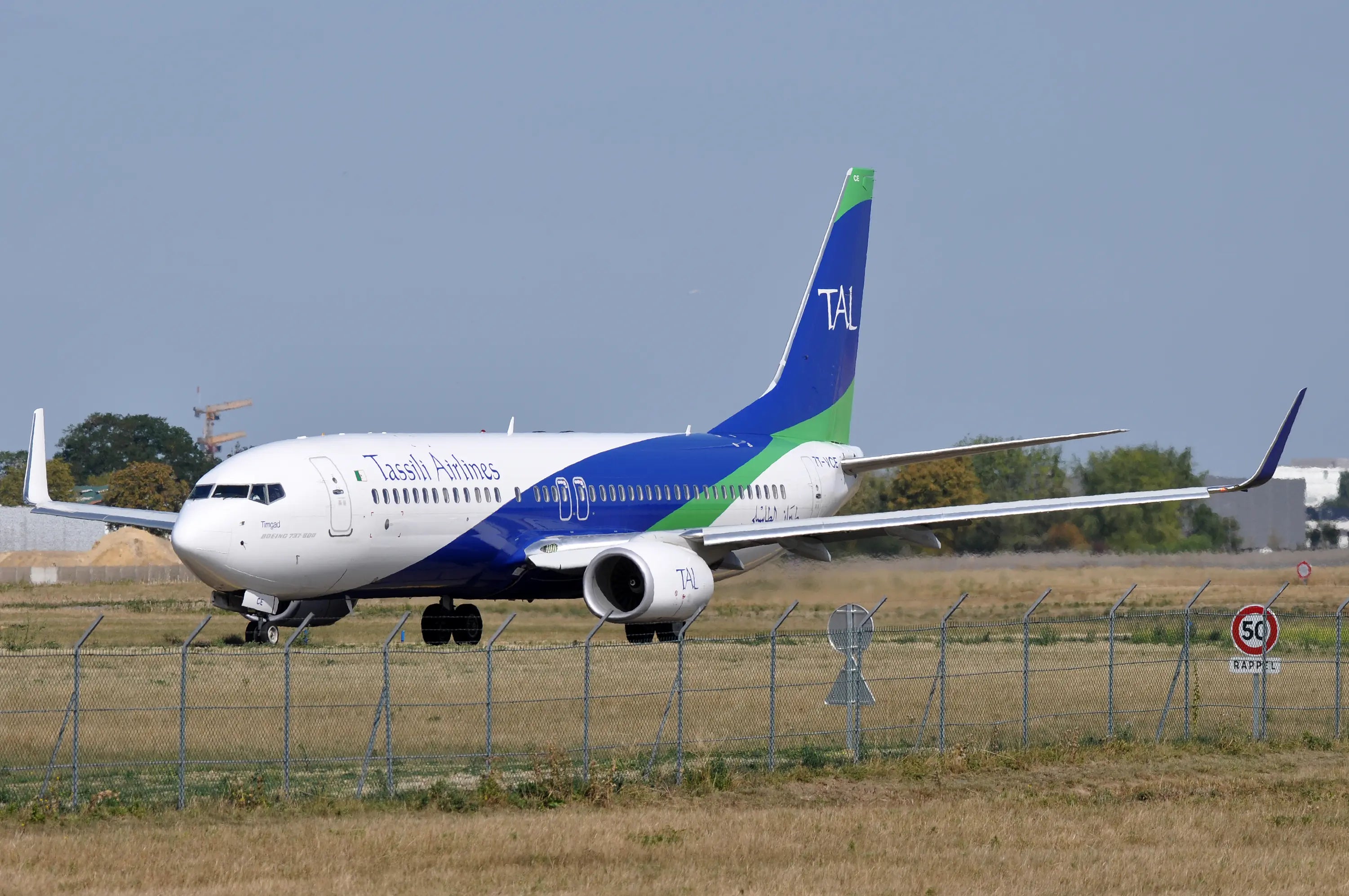
Tassili Airlines runs a small, two-family fleet built around a single jet type and two turboprop variants. According to the African Airlines Association (AFRAA) member profile and the Domestic Airlines fleet records, the 2025 fleet totals 15 aircraft: seven Boeing 737-800 narrowbodies, four Bombardier Dash 8 Q400 turboprops, and four Bombardier Dash 8 Q200 turboprops. There are no ATR aircraft in the documented fleet, despite some consumer travel sites claiming otherwise. The airline is IOSA certified, the industry safety audit standard, which matters for pilots because it signals standardised operating procedures and training documentation.
The two aircraft families map onto two very different flying jobs. The Boeing 737-800 is the jet backbone, used for domestic trunk routes and the airline's limited international services, principally to France. Tassili built up its 737 fleet with orders in the mid-2000s and a further order for three Next-Generation 737-800s announced with Boeing in June 2017. The turboprops handle the regional and desert side of the operation: the larger Q400 flies scheduled domestic sectors and desert routes, while the smaller Q200 is used heavily for the oil-and-gas charters and shuttles into remote Saharan airstrips that gave the airline its original reason to exist.
| Aircraft Type | Role | In Service | Notes for Pilots |
|---|---|---|---|
| Boeing 737-800 | Narrowbody jet | 7 | Domestic trunk routes and international services to France. Around 155 seats in a two-class layout. Three added via a 2017 Boeing order. |
| Bombardier Dash 8 Q400 | Regional turboprop | 4 | Scheduled domestic and desert sectors. High climb rate and good hot-and-high performance for Saharan airfields. |
| Bombardier Dash 8 Q200 | Regional turboprop | 4 | Oil-and-gas charters and shuttles to short, remote desert strips. Intensive multi-sector days. |
Fleet data as reported by AFRAA and Domestic Airlines fleet records for 2025. No official average fleet age is published; airframes are generally in the 10-to-20-year band based on delivery histories.
No source publishes an official average fleet age. Given the mid-2000s to early-2010s delivery dates of most airframes, the fleet sits broadly in the 10-to-20-year range, which is typical and unremarkable for a regional carrier. There has been no announced large-scale renewal programme specific to Tassili, so the maintenance-and-refurbish approach has been the norm. That said, industry reporting (ch-aviation, Aviation Week) around the 2025 takeover indicates Air Algérie intends to grow the regional and domestic fleet under the Domestic Airlines brand, which could bring additional turboprops and, over time, fleet harmonisation with the parent group. For pilots, that direction of travel is the most relevant fleet story: the type mix you join today may broaden as the group builds out its domestic strategy.
Entry-level First Officers are most likely to start on a turboprop (Q200 or Q400) before progressing toward the Boeing 737-800, which is the senior, higher-earning fleet. Type rating and line training are provided by the airline in the Algerian state-carrier model, but candidates must already hold the required Algerian licences validated by ANAC before applying. Because the fleet is small (only seven jets), 737 seats are limited and movement between fleets is governed by seniority and vacancies rather than by pilot choice. Turboprop flying here is not a stepping stone that quickly disappears: the Q200/Q400 desert charter mission is central to the business and will remain a large share of the flying.
Pilot Salary & Compensation
This is the section where honesty matters most. Tassili Airlines has never published pilot pay scales, and employee-review platforms carry only a handful of anonymous entries that describe compensation as "stable" without usable numbers. Any precise Tassili salary figure circulating online should be treated with caution. Because the airline is now part of the Air Algérie group, the most defensible approach is to use documented Air Algérie pilot pay as a reference ceiling, then note that a small regional subsidiary has historically paid at or slightly below the mainline for equivalent rank.
Two independent data points anchor the Air Algérie benchmark. Pilot Jobs Network's 2024 snapshot lists top-of-scale figures of roughly €10,000 per month for a Captain, €6,200 for a base Captain, and €5,100 for a top First Officer, all paid in Algerian dinars at an implied rate near 145 DZD to the euro. A more granular estimate compiled by pilot-conditions researchers gives monthly gross bands by rank and fleet, shown below. These are estimates for the parent carrier, not confirmed Tassili contracts, and they are expressed in Algerian dinars because that is the currency pilots are actually paid in.
First Officer Pay Benchmark (Air Algérie group reference)
| Stage / Fleet | Monthly Gross (est.) | Approx. EUR/month | Notes |
|---|---|---|---|
| Entry F/O (turboprop) | ~200,000 DZD | ~€1,300 | Starting rank on ATR/Dash-class turboprops. |
| Confirmed F/O (Boeing 737) | ~500,000 DZD | ~€3,300 | After transition to the jet fleet. |
| Senior F/O (Boeing 737) | ~650,000 - 800,000 DZD | ~€4,300 - €5,300 | Top of the First Officer band. |
Air Algérie group estimates used as the nearest available benchmark. Euro conversions use the official rate of roughly 145-150 DZD per euro. Tassili/Domestic Airlines does not publish its own scales.
Captain Pay Benchmark (Air Algérie group reference)
| Stage / Fleet | Monthly Gross (est.) | Approx. EUR/month | Notes |
|---|---|---|---|
| Captain (Boeing 737) | ~800,000 - 1,000,000 DZD | ~€5,300 - €6,700 | Narrowbody command. |
| Senior Captain (widebody A330) | ~1,000,000 - 1,500,000 DZD | ~€6,700 - €10,000 | Top of scale at the parent carrier's long-haul fleet. |
Widebody figures apply to Air Algérie mainline, which operates the A330; Tassili/Domestic Airlines itself has no widebody fleet, so the top band is a group ceiling, not a Domestic Airlines role.
The critical caveat is the currency. These salaries look modest in euros and much smaller still if converted at Algeria's parallel-market exchange rate, which can run far weaker than the official rate. Within Algeria, however, a confirmed 737 First Officer or Captain earns well above the national average and enjoys a level of stability that private-sector employment rarely offers. The trade-off is clear: strong local purchasing power and job security, but pay that is not internationally competitive in hard-currency terms and cannot be freely converted or exported. Pilots comparing Tassili against Gulf or European carriers should weigh that carefully.
No figure in this section is a confirmed Tassili Airlines or Domestic Airlines pay scale. All numbers are estimates for the wider Air Algérie group, compiled from Pilot Jobs Network and independent pilot-conditions research, used here only because the subsidiary publishes nothing of its own. Actual pay depends on rank, fleet, seniority step, allowances, the collective framework negotiated with the SPLA union, and the exchange rate applied. Because integration into Air Algérie is ongoing, group pay harmonisation could raise or restructure these bands. Always verify with current official sources before relying on any number.
Roster Pattern & Quality of Life
Roster quality at Tassili is defined by the airline's split personality. One half of the flying is conventional scheduled service from Algiers to domestic cities and a few French destinations, which runs on published timetables with predictable duty start times. The other half is oil-sector charter work: shuttles into the Sahara, driven by industrial demand rather than a passenger timetable, often to remote strips with limited ground support in high heat and dust. A pilot's quality of life depends heavily on which side of that operation they are assigned to, and assignment follows fleet and seniority.
Algeria applies flight-time-limitation (FTL) rules through ANAC in line with ICAO Annex 6 standards, capping daily flight time, cumulative block hours, and requiring minimum rest. Specific Tassili roster metrics (days off, average block hours) are not published, so the figures below are region-typical ranges for a mixed scheduled-and-charter regional operation, not confirmed company data. On the positive side, one concrete, verifiable point is annual leave: the Algerian Labour Code guarantees a statutory minimum of 30 calendar days of paid annual leave, and workers assigned to the southern (Saharan) regions are legally entitled to additional leave days, a benefit directly relevant to crews rotating into the desert.
📅 Illustrative Month — Domestic & Desert-Charter First Officer (Algiers)
This grid is illustrative of a mixed regional pattern and is NOT an official Tassili roster. The airline does not publish crew schedules. Desert-charter rotations can cluster flying days and remote overnights differently from the pattern shown.
The desert charter mission is what sets working conditions here apart from a normal regional airline. Q200 and Q400 crews flying Sonatrach shuttles fly short sectors with frequent takeoffs and landings, in ambient temperatures that force careful performance planning and payload limits, over terrain with few usable alternate airports. Rest on some rotations may be taken in oil-field camps rather than city hotels, with the comfort and connectivity that implies varying by site. This is demanding, high-vigilance flying, and human-factors fatigue from heat, dust, and repetitive routing is a genuine consideration. Pilots without family obligations sometimes accept desert rotations for the operational experience and any remote allowances; others find the separation and environment a real cost.
The airline is headquartered at Algiers Houari Boumediene, and Algiers is the effective home base for most crews, giving access to the capital's amenities, schooling, and healthcare. Hassi Messaoud, the main Saharan oil hub, functions as a secondary operational point where crews may be temporarily stationed for charter work. There is no multi-city base-bidding system of the kind seen at large Western carriers, so pilots should expect to live in or around Algiers and to rotate south as required. For non-Algerians the point is moot: the airline recruits Algerian citizens, so relocation from abroad is not a realistic pathway.
Benefits & Social Protection
Tassili's benefits story is really the story of Algerian state-sector employment. The airline does not publish a benefits brochure, but its ownership lineage (first Sonatrach, now Air Algérie) places its pilots inside a framework of national social insurance, employer health coverage, and pension entitlement that is more secure than most private-sector jobs in the region. The trade-off, consistent with the salary picture, is that these benefits are solid and dependable rather than lavish, and they are denominated in local terms.
Two benefits deserve a realistic note. First, staff travel: as an independent oil subsidiary Tassili's network was small and domestic, so travel perks were limited. Integration into Air Algérie should, in principle, give Domestic Airlines pilots access to the flag carrier's far larger international network, but the group has not yet published the eligibility or fare rules, so this remains a reasonable expectation rather than a confirmed benefit. Second, loss-of-licence protection: unlike some European carriers that carry a dedicated aviation loss-of-licence fund, no such scheme is documented for Tassili, and a career-ending medical would fall back on national social protection. Pilots who value that cover should ask about it explicitly and consider private arrangements.
The value proposition here is stability, not headline numbers. State-linked Algerian aviation employment offers durable social protection, pension accrual, and a level of job security that is genuinely rare in the wider industry. What it does not offer is the portable, hard-currency benefits package of a Gulf or European major. For a pilot planning a long, settled career in Algeria, the benefits are a strong point. For a pilot planning to build hours and move on internationally, they are less relevant, and the citizenship and licensing requirements make Tassili a poor fit for that path anyway.
Career Progression & Seniority
Career progression at Tassili follows the classic state-carrier, seniority-driven model, but with the small-fleet constraints of a regional operator. A typical path starts as a First Officer on a turboprop (Q200 or Q400), builds command experience, and progresses either to turboprop Captain or to a First Officer seat on the Boeing 737-800, with jet command as the senior goal. Because the airline operates only seven jets, movement onto and up the 737 is bounded by how often those seats open, which is a function of retirements, growth, and now the group's expansion plans.
There is no published, Tassili-specific upgrade timeline. Regional benchmarks are the best available guide: across comparable North African state and legacy carriers, upgrade to narrowbody Captain commonly takes on the order of 10 to 15 years, and it can run longer where vacancies are scarce, because command comes from within on seniority rather than through direct-entry hiring. The 2025 integration into Air Algérie is the wildcard. If the group builds out the domestic fleet as reported, it could create more command and transition opportunities. It could also, in principle, open cross-group mobility toward Air Algérie mainline fleets, including the widebody A330, though whether seniority lists will be merged or kept separate has not been announced.
| Career Milestone | Typical Timeline | Notes |
|---|---|---|
| Join as F/O (turboprop) | Entry | Q200 or Q400. Type rating and line training provided by the airline. |
| Transition to Boeing 737-800 F/O | Seniority-dependent | Limited jet seats; bid governed by seniority and vacancies. |
| Turboprop Captain | ~10-15 yrs (region est.) | Command assessment; internal upgrade only, no direct-entry captains. |
| Boeing 737-800 Captain | Senior seniority | Top narrowbody command at the airline. |
| Cross-group / widebody (potential) | Not yet defined | Possible Air Algérie A330 pathway post-integration; rules unpublished. |
Timelines are regional estimates, not confirmed Tassili/Domestic Airlines figures. Progression is seniority-based and subject to fleet size and group restructuring.
The takeover reframes career planning. Air Algérie's stated aim, reported by Aviation Week and others, is to use Domestic Airlines to overhaul Algeria's domestic and regional network, which implies fleet growth and hiring. For an incoming pilot that is broadly positive for long-term progression, but the near-term uncertainty is real: seniority harmonisation, contract migration, and whether existing Tassili pilots are protected in a merged list are all unresolved. Pilots evaluating an offer should ask specifically how seniority and upgrade rights will be treated under the new group structure.
Recruitment Process & Requirements
Recruitment at Tassili is built around one non-negotiable filter and a standard set of Algerian licensing requirements. The filter, stated explicitly on pilot-career profiles of the airline, is that applicants must be Algerian citizens. This is the norm for state-owned Algerian carriers and it effectively closes the door to expatriate pilots: there is no documented work-permit or sponsorship route into the flight deck. If you are not an Algerian national, Tassili is not a realistic option, and this article should be read as a career guide for Algerian pilots and cadets rather than for the international market.
Beyond nationality, the licensing standards mirror those the parent group applies. Based on Air Algérie group recruitment information and general Algerian regulation, a candidate needs an ATPL theoretical pass and a practical CPL with Instrument and Multi-Engine ratings (progressing toward full ATPL privileges for command), issued or validated by the Algerian civil aviation authority ANAC. A licence obtained abroad must be converted through ANAC before it can be used. Other core requirements include an MCC (Multi-Crew Cooperation) certificate, a valid Class 1 medical certificate, and at least ICAO English Level 4. In practice, working fluency in French and Arabic is also expected, reflecting Algeria's operational and administrative environment.
Core Requirements Summary
How Applications Work
Obtain and validate your licence
Complete flight training (in Algeria or abroad) and hold, at minimum, an ATPL theoretical pass with CPL/IR/ME. If trained abroad, convert the licence through ANAC. A valid Class 1 medical and ICAO English Level 4 must be in place before applying.
Watch the official recruitment portals
Vacancies are posted on the airline's recruitment channels. The dedicated portal historically used is Tassili Travail Aérien (tassilitravailaerien.dz), which the company describes as the reference point for recruitment information. Under group integration, Air Algérie channels may increasingly carry openings too.
Screening, assessment and interview
Expect the standard state-carrier sequence: document and licence verification, aptitude and technical assessment, an interview, and, for pilots, a simulator evaluation. Selection is competitive and conducted in a French/Arabic working environment.
Medical, type rating and line training
Successful candidates complete a Class 1 medical, then the company-provided type rating on the assigned aircraft (usually a turboprop for new entrants), followed by supervised line training before flying the line.
Tassili has invested in structured cadet-style training in the past: a documented graduation ceremony records Tassili students completing training at the SMATSA Aviation Academy. This shows the airline has used external academies to build its pilot pipeline rather than running a fully self-contained ab-initio school. Prospective Algerian pilots typically combine local theoretical study with flight training at approved schools at home or abroad, then convert and apply. Confirm the current pathway and any sponsored programmes directly with the airline, as the details are evolving under the new group structure.
Route Network & Desert Operations
Tassili is not a long-haul carrier with glamorous overseas layovers, so the honest version of the "destinations" question is about the network you would actually fly. That network has three parts: a domestic scheduled web out of Algiers reaching cities and desert towns across Algeria; a small international operation, principally to France; and the oil-and-gas charter shuttles into the Sahara that remain the airline's operational backbone. Counts vary by source because charters are counted differently from public schedules: AFRAA's operational profile cites around 53 domestic and 6 international points, while consumer schedule data (KAYAK, FlightRoutes) shows roughly 14 to 21 publicly bookable airports. Overnight stays are mostly domestic, and international layovers, where they occur, are modest by legacy-carrier standards.
Unlike a widebody legacy carrier, the reward here is not exotic long-haul layovers, it is operational variety and purpose. A pilot's month can mix predictable domestic scheduled flying, a French sector or two on the 737, and demanding desert charters into the Sahara. Layover quality ranges from capital-city and French hotels down to industrial oil-field accommodation, and which you get depends on your fleet and assignment. Pilots who enjoy challenging, hands-on flying in a tough environment will find this network more rewarding than a spreadsheet of city names suggests; those seeking classic long-haul lifestyle should look elsewhere.
How Tassili Airlines Compares: Airline Radar Chart
The most useful comparisons for Tassili Airlines are its own parent, Air Algérie, and the neighbouring flag carrier Tunisair, both North African state-linked airlines that a regional pilot might realistically weigh against it. The radar below scores the same five metrics used elsewhere in this guide. These are editorial estimates based on the research in this article, publicly available salary data, and union reporting, not precise measurements, and they describe the picture for an experienced pilot planning a long-term regional career.
Key Takeaways from the Comparison
Air Algérie leads on pay and fleet reach. As the flag carrier, Air Algérie operates a much larger, more diverse fleet, including widebody A330s on long-haul routes, and its documented top-of-scale pay (around €10,000 per month for a senior Captain) sits above what a small regional subsidiary typically offers. A pilot chasing the highest local earnings and widebody command would look to the mainline rather than to Domestic Airlines, though the two are now part of the same group.
Tassili's edge is stability and a distinctive mission. Backed first by Sonatrach and now by Air Algérie, it offers strong state-sector job security and a genuinely different flying job built around Saharan operations. Its weaker scores on salary, work-life balance, and career progression reflect modest pay, the fatigue and remoteness of desert charter work, and a small jet fleet that limits fast upgrades.
Tunisair is the cautionary comparison. Tunisia's flag carrier has faced well-documented financial strain and restructuring, which weighs on its job-security and fleet-age scores despite a broader international network and comparable pilot pay estimates. Private Tunisian carrier Nouvelair, by contrast, advertised A320 Captain roles for 2026 at roughly €10,200 to €11,000 per month on 80-plus block hours, showing the higher-intensity, less-secure end of the regional market.
Career structure differs sharply. All three carriers use internal, seniority-based upgrades rather than direct-entry command, with narrowbody Captain typically 10 to 15 years out in the region. Air Algérie's larger fleet offers more internal movement; Tassili's small fleet offers less, though the 2025 integration could change that if the group expands domestic flying as planned.
Radar scores are editorial estimates derived from the sourced research in this article: AFRAA and fleet databases, Pilot Jobs Network and independent pilot-conditions salary estimates, SPLA union communications, and industry reporting on the 2025 Air Algérie takeover. They represent a general assessment for an experienced pilot and will vary by rank, fleet, and personal priorities. Because Tassili publishes little of its own data and is mid-merger, its scores carry more uncertainty than those of the larger carriers and should be read as directional, not definitive.
Union & Industrial Relations
Algerian airline pilots are represented by the SPLA (Syndicat des Pilotes de Ligne Algériens), the national pilots' union. Its own website (spla.dz) describes its mission as maintaining the highest standards of flight safety and employment and representing the collective interests of professional pilots in Algeria. Pilot-career profiles confirm that Tassili is a unionised workplace, and while the SPLA's public activity centres on Air Algérie, the 2025 integration means Domestic Airlines pilots increasingly fall within the same representational and bargaining orbit as the flag carrier's crews.
How Representation Works
The industrial-relations climate in Algerian aviation has been tense but, in recent reporting, oriented toward dialogue rather than open conflict. Through 2024 and 2025, the SPLA publicly criticised Air Algérie's management for "laxisme" and "mauvaise gestion" (laxity and poor management), warning that these had degraded working conditions and service quality. Union statements carried by Algerian media flagged concrete grievances relevant to any pilot: crew fatigue, staffing and rostering problems, and large backlogs of untaken leave (one report cited pilots owed around 14 months of accumulated leave). At the same time, the union emphasised cooperation with the new administration and called for calm and social dialogue, signalling negotiation over confrontation.
Recent Disputes & Key Context
Union representation here is a genuine asset: the SPLA gives pilots a real voice on safety, fatigue, and pay, and its recent posture favours negotiation. The flip side is that the grievances it has raised (fatigue, rostering strain, leave backlogs) are exactly the conditions a prospective Domestic Airlines pilot should probe before signing. The single biggest open question created by the 2025 merger is how pilot seniority and contracts will be treated across the group. Ask about it directly, and follow the SPLA's own communications for the most current picture.
Verdict: Who Is Tassili Airlines For?
🎯 Our Take
Tassili Airlines, now flying as Domestic Airlines under Air Algérie, is a niche Algerian carrier best understood as a stable, state-backed regional and oil-charter operator rather than a glamorous legacy airline. Its strengths are real and specific: strong job security as part of the national flag-carrier group, a distinctive and demanding flying mission across the Sahara, statutory Algerian labour protections including generous annual leave, and a modern-enough two-family fleet of Boeing 737-800s and Bombardier Dash 8 turboprops.
The limitations are just as clear. Pay is modest in hard-currency terms and denominated in dinars that are hard to convert or export, career progression is slow and seniority-bound within a small jet fleet, and work-life balance is squeezed by desert charter operations and the fatigue and staffing issues the SPLA has publicly flagged. On top of that sits genuine transitional uncertainty: the June-to-August 2025 absorption into Air Algérie has not yet resolved how seniority, contracts, and pay will be harmonised across the group.
Above all, this is a career for Algerian nationals. The mandatory citizenship requirement means Tassili is not a route into aviation for international pilots. For an Algerian pilot who wants a secure, long-term home carrier and does not mind challenging desert flying, it is a solid and improving option, especially if Air Algérie follows through on expanding domestic operations.
1 Is Tassili Airlines still hiring, or is it now Domestic Airlines?
The operation continues, but the brand has changed. On 19 June 2025 Sonatrach transferred 100% of Tassili Airlines to Air Algérie, and from 3 July 2025 it was renamed Domestic Airlines, operating as Air Algérie's domestic and regional subsidiary from late August 2025. Recruitment now sits within the Air Algérie group, though the historical Tassili Travail Aérien portal has been the airline's dedicated recruitment channel. The same IATA (SF) and ICAO (DTH) codes continue in use.
2 Do I need to be an Algerian citizen to fly for Tassili Airlines?
Yes. Pilot-career profiles of the airline state explicitly that applicants must be Algerian citizens, which is standard for state-owned Algerian carriers. There is no documented work-permit or sponsorship pathway for foreign pilots, so Tassili (now Domestic Airlines) is effectively a career option for Algerian nationals only.
3 What licence and qualifications do I need?
Based on Air Algérie group requirements, you need an ATPL theoretical pass with a practical CPL including Instrument and Multi-Engine ratings, issued or validated by the Algerian authority ANAC, plus an MCC certificate, a valid Class 1 medical, and at least ICAO English Level 4. A licence earned abroad must be converted through ANAC. Working French and Arabic are expected in practice. Full ATPL privileges are required for command.
4 How much do Tassili Airlines pilots earn?
The airline does not publish pilot pay, so no confirmed figure exists. Using the Air Algérie group as a benchmark, monthly gross estimates range from roughly 200,000 DZD for an entry turboprop First Officer to around 800,000 to 1,000,000 DZD for a Boeing 737 Captain, with senior widebody mainline command higher. In euros at the official rate that is roughly €1,300 up to €6,700 or more, but the local exchange-rate gap and dinar-denomination mean hard-currency value is limited. Treat all figures as estimates and verify directly.
5 What aircraft would I fly?
The 2025 fleet is 15 aircraft: seven Boeing 737-800 jets, four Bombardier Dash 8 Q400 turboprops, and four Dash 8 Q200 turboprops. New entrants most often start on a turboprop, with the 737-800 as the senior jet fleet. The Q200s in particular carry much of the Saharan oil-and-gas charter flying, while the 737 handles domestic trunk routes and services to France.
6 What is it like flying oil charters to the Sahara?
It is demanding, hands-on flying. Desert shuttles involve short sectors with frequent takeoffs and landings, high ambient temperatures that require careful performance and payload planning, remote strips with limited infrastructure and few alternates, and overnights that may be in oil-field or industrial accommodation rather than city hotels. It builds strong operational skills but carries real fatigue and lifestyle costs, which is one reason crew fatigue has featured in union concerns.
7 How long does it take to upgrade to Captain?
There is no published Tassili-specific timeline. Progression is strictly seniority-based with no direct-entry captains, and regional benchmarks put narrowbody command at roughly 10 to 15 years, potentially longer where vacancies are scarce because the jet fleet is small. The 2025 integration into Air Algérie could improve prospects if the group expands domestic flying, but the seniority rules for the merged structure have not yet been announced.
8 How does the Air Algérie takeover affect pilots?
Significantly, and not all of it is settled. Integration ties pay, seniority, staff travel, and union bargaining to the Air Algérie group rather than to a standalone oil subsidiary. Potential upsides include a wider network for staff travel, group-wide career mobility, and fleet growth. The open risks are how seniority lists will be merged, whether existing Tassili pilots are protected, and how contracts will be harmonised. Any pilot considering an offer should ask these questions explicitly and monitor SPLA communications.
Official Links & Resources
Because Tassili Airlines is mid-transition and publishes limited pilot information, verifying details directly with official sources is essential. These are the key working links relevant to a pilot career with Tassili Airlines and its successor, Domestic Airlines, under the Air Algérie group:
Because this airline is being folded into Air Algérie, the single best habit is to cross-check three sources before acting on any claim: the airline's own recruitment portal (Tassili Travail Aérien) for vacancies, ANAC for the licensing and medical rules, and the SPLA for the real state of pay, rostering, and the seniority questions raised by the merger. Salary and roster figures in any third-party guide, including this one, should be treated as estimates until confirmed against these official channels.