Swift Air Overview & Company Profile
Swift Air (IATA: WQ, ICAO: SWQ), trading as iAero Airways since 2020, ceased all flight operations on April 6, 2024. The carrier filed for Chapter 11 bankruptcy in September 2023, then converted to Chapter 7 liquidation in April 2024 after the proposed restructuring failed. This article documents pilot working conditions during the airline's operational period as a reference for former crew members, as a case study for pilots considering similar Part 121 supplemental carriers, and to track where displaced pilots and aircraft went after shutdown. All employment and recruitment information described here is historical. The IATA code WQ is no longer assigned to active passenger operations.
Swift Air LLC was a United States Part 121 supplemental (charter) carrier founded in 1997. At its peak, it was one of the largest independent operators of Boeing 737 Classic aircraft in North America, providing on-demand passenger and cargo charter services across a wide spectrum of customers: National Basketball Association and National Hockey League team transportation, U.S. Department of Homeland Security and Immigration and Customs Enforcement (ICE) deportation flights (commonly known as "ICE Air"), DHL Express cargo feed, casino junkets, college sports programs, and ad-hoc passenger work for tour operators serving Cuba and the Caribbean.
Swift Air was originally owned by Jerry Moyes, founder of trucking giant Swift Transportation. In May 2019, the company was acquired by iAero Group, a Miami-based aviation services platform that combined Swift Air's flight operations with iAero Thrust (engine MRO, formerly AeroThrust) and iAero Tech (airframe MRO, formerly Miami Tech). The carrier was rebranded as iAero Airways in 2020 to align with the parent group's identity, although the FAA operating certificate continued to read "Swift Air, LLC" and the IATA/ICAO codes WQ/SWQ remained unchanged through cessation. The corporate headquarters was located in Miami, Florida, with significant operational footprint at Greensboro, North Carolina.
By the time of bankruptcy, the operator was running approximately 30 active aircraft from a fleet of around 40, employed roughly 230 pilots, and had positioned crew bases at Miami (MIA), Phoenix (PHX), Cincinnati (CVG), San Antonio (SAT), Houston Hobby (HOU), and Alexandria, Louisiana (AEX), the last two reflecting heavy ICE Air operations in the southern United States. Debtor-in-possession financing of $22.5 million from Synovus Bank kept the wheels turning during the Chapter 11 process, supplemented by a further $5 million in March 2024, but a viable restructuring plan never materialised.
Understanding the Swift Air case matters even today because the supplemental carrier segment, in which charter operators serve government, sports, and cargo customers under FAR Part 121 supplemental authority, remains structurally fragile. The lessons of Swift Air's collapse, particularly around aging fleets, debt servicing, and customer concentration, are directly relevant to pilots evaluating offers from other charter operators such as Eastern Airlines, Global Crossing Airlines (GlobalX), Omni Air International, Western Global, and Avelo's seasonal charter arm.
Fleet Composition & 737 Classic Operations
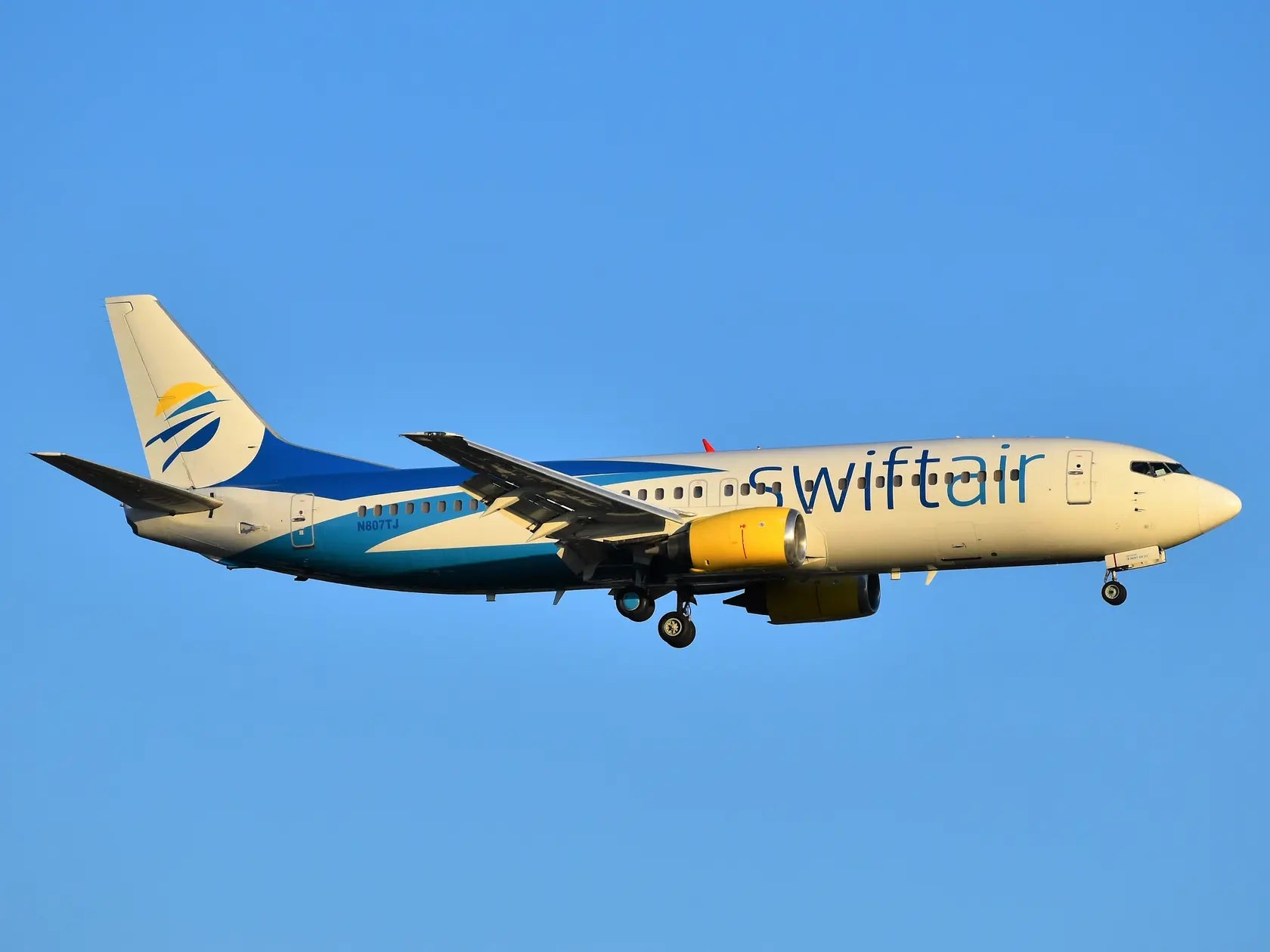
Swift Air's fleet was an all-Boeing 737 operation built around 737 Classic generation aircraft (the 737-300 and 737-400, originally produced in the 1980s and early 1990s) and a smaller Next Generation 737-800 contingent. This made the carrier the largest single operator of 737 Classics in the United States during its final years, and one of the last sizeable users of the type anywhere in the developed world. Pilots flying for Swift Air were therefore among a shrinking group still type-rated on a generation of aircraft that mainline carriers had largely retired by 2010.
The mix served two distinct missions. The 737-300 and 737-400 fleet, with several in dedicated freighter (737-300F / 737-400F) configuration, formed the backbone of DHL Express feeder operations and ICE Air deportation flights. The 737-800s were used for higher-spec passenger charters where 28-pitch classic seats would not satisfy customer expectations, including some sports team transports.
| Aircraft Type | Role | In Service (2024) | Notes |
|---|---|---|---|
| Boeing 737-300 | Passenger / Freighter | ~8 | Including 1 dedicated 737-300F freighter. Average age 30+ years. |
| Boeing 737-400 | Passenger / Freighter | ~18 | Largest single sub-fleet. Heavily used on DHL CMI and ICE charters. |
| Boeing 737-800 | Passenger | ~3-4 | Higher-end passenger charters and sports team work. |
| Stored / Inactive | Various 737 | ~10 | Held for parts, return-to-service, or scrap. |
Fleet snapshot at the time of bankruptcy filing (September 2023) and through cessation (April 2024). Numbers compiled from ch-aviation, Planespotters, and bankruptcy court filings.
The Swift Air fleet had an estimated average age of 28 to 32 years at cessation, among the oldest commercial 737 fleets in the United States. This aging profile drove three pilot-relevant realities: maintenance reliability issues that translated into delays and cancelled trips, type-rating value that was limited (no major US airline still recruits 737 Classic experience as a differentiator), and a regulatory tailwind from the FAA's increasing scrutiny of high-cycle airframes. Pilots leaving Swift Air with only 737 Classic time often required transition simulator training before being competitive at carriers operating 737NG or 737 MAX equipment.
After the asset auction in April 2024, 28 Boeing 737s from the Swift Air fleet, comprising 7 737-300s, 17 of the 18 737-400s, 2 737-800s, and 1 737-300F, were acquired by Eastern 737 Asset Holdings (an affiliate of Eastern Airlines) for approximately $71.2 million, alongside 79 spare engines and 40 APUs. The transaction was approved by a U.S. bankruptcy judge in Miami on April 13, 2024, with Synovus Bank assuming the first-lien debt. Importantly, this was an asset sale only: Eastern did not acquire the Swift Air operating certificate, the seniority list, or the labour agreements. Swift Air's certificate was effectively retired with the company.
Eastern Airlines absorbed most of the airframes into its own Part 121 certificate, with several entering DHL Express CMI service that Swift Air had previously flown, and others returning to passenger charter work. A small number of additional aircraft were parted out for spares. No 737s from the Swift Air fleet went to Kalitta Air, despite early speculation. Pilots whose seniority numbers, training records, and 737 Classic type ratings became suddenly worthless overnight is a separate story, and one of the recurring lessons of Part 121 supplemental aviation in the United States.
Pilot Salary & Compensation (Historical)
Swift Air pilot compensation was governed by a collective bargaining agreement between the company and the Airline Professionals Association, Teamsters Local 1224 (APA / Local 1224), which represents pilots at multiple US Part 121 charter and supplemental carriers. The structure was hourly-pay plus a monthly minimum guarantee, plus per diem for time on the road, training pay, and a 401(k) match. There was no profit-sharing scheme of the kind found at major US carriers, and there was no signing bonus during the carrier's final hiring waves.
Compared to the rapid pay escalation seen at the Big Four US majors after 2022, Swift Air rates remained considerably lower throughout the carrier's final years. The 70-hour minimum monthly guarantee provided income stability when charter demand was soft, but pay-by-credit hour rules at major airlines often produced higher effective hourly compensation for similar block-hour productivity.
First Officer Pay Scale (Pre-Cessation Estimates)
| Seniority | Hourly Rate | Annual Gross (70 hr guarantee) | Annual Gross (85 hr typical) |
|---|---|---|---|
| Year 1 | ~$85 / hr | ~$71,000 | ~$87,000 |
| Year 3 | ~$95 / hr | ~$80,000 | ~$97,000 |
| Year 6 | ~$110 / hr | ~$92,000 | ~$112,000 |
| Year 10+ | ~$125 / hr | ~$105,000 | ~$128,000 |
Estimates compiled from Airline Pilot Central, APA 1224 disclosures, and pilot reports current to early 2024. Actual earnings depended on flight credits, premium, and reserve buy-back.
Captain Pay Scale (Pre-Cessation Estimates)
| Seniority | Hourly Rate | Annual Gross (70 hr guarantee) | Annual Gross (90 hr productive) |
|---|---|---|---|
| Year 1 Captain | ~$170 / hr | ~$143,000 | ~$184,000 |
| Year 5 Captain | ~$200 / hr | ~$168,000 | ~$216,000 |
| Year 8 Captain | ~$220 / hr | ~$185,000 | ~$238,000 |
| Year 12 Captain | $235 / hr | ~$197,000 | ~$254,000 |
Captain Year 12 hourly rate of $235 documented on Airline Pilot Central's iAero Airways page. Earlier scales interpolated. Day-off premium paid at 4.5 hours times seat rate times 2.
Swift Air did not publish its full collective agreement publicly, and detailed year-by-year pay scales were never released after the 2020 iAero rebrand. The figures above reflect industry-standard estimates compiled from Airline Pilot Central, APA Teamsters Local 1224 communications, and pilot-reported data on pilot career sites. Per diem was approximately $1.97 per duty hour, and the monthly guarantee was 70 hours. Training was paid from day one, including company-provided housing and travel. These conditions are no longer in effect, as the airline ceased operations on April 6, 2024.
For pilots evaluating today's Part 121 supplemental market, the Swift Air pay scale sat at the lower end of the charter industry. Western Global Airlines, an ALPA-represented widebody cargo charter operator, paid materially higher per diem ($2.50/hr) and offered $6,000 monthly training pay, half tax-free. Omni Air International First Officers earned approximately $128 per hour in Year 1 with a 64-hour guarantee, well above the Swift Air entry rate. The Big Four US majors (American, Delta, United, Southwest) entered 2024 with first-year narrowbody First Officer rates above $100 per hour and a path to $300+ per hour in the left seat, dwarfing the Swift Air ceiling.
Roster Pattern & Quality of Life
Swift Air operated under FAA Part 117 flight and duty time limitations, the same rule set that applies to mainline US passenger carriers. However, the day-to-day rhythm of life at a charter operator is fundamentally different from a scheduled airline. There is no published timetable, customer demand drives aircraft positioning, and pilots spend a high proportion of their duty time on reserve or short-call standby. Reports from former crew members consistently described the schedule as the single biggest quality-of-life negative at the carrier.
Lines were typically built around 13 to 15 days off per month with the remainder split between active flying and reserve. Block hour productivity averaged in the 65 to 90 hours per month range depending on customer demand, with strong peaks during the NHL/NBA regular season (October to April) and around major federal contract surges. Trip lengths varied widely: a sports team charter could be a single overnight, while ICE Air rotations and DHL CMI lines often ran four to six days with multiple legs per duty period.
📅 Sample Month — Swift Air 737 First Officer (Phoenix Base)
The reserve system was the defining feature of life at Swift Air. Junior First Officers commonly held reserve lines for the first one to three years of seniority, meaning blocks of standby duty during which an assignment could come at any time within the contractual call-out window. Reserve was less predictable than at major scheduled carriers because the underlying customer requests were themselves last-minute. Sports team charters often had stable repeating schedules across an NBA or NHL season, and senior pilots tended to bid these for the predictability they offered. ICE Air and ad-hoc DHL flying produced the most volatility.
Swift Air operated up to six pilot bases simultaneously: Miami (MIA), Phoenix (PHX), Cincinnati (CVG), San Antonio (SAT), Houston Hobby (HOU), and Alexandria, Louisiana (AEX). The southern bases reflected ICE Air operations out of facilities such as the Alexandria Staging Facility. The Cincinnati base supported DHL Express CMI flying through DHL's CVG superhub. Commuting was permitted but unusually difficult given the unpredictable charter schedule and the small footprint of each base. Pilots who tried to commute long-distance to a Swift Air base often found themselves consuming significant unpaid travel time around short-call reserve windows.
Benefits, Pension & Retirement
Swift Air's benefits package was unusually substantial for a Part 121 charter operator of its size, in part because of the labour protections negotiated by Teamsters Local 1224. The defining feature was the existence of a defined benefit pension plan (the so-called "A Fund"), a rarity in modern US aviation outside the Big Four mainline carriers and FedEx. This was supplemented by a 401(k) match, full medical, jumpseat reciprocity, and standard ID90 / ID75 industry travel.
The Swift Air defined benefit pension was a tangible draw for career pilots, but the bankruptcy and Chapter 7 conversion in 2024 raised serious questions about plan funding. Single-employer defined benefit pension plans in the United States are insured by the federal Pension Benefit Guaranty Corporation (PBGC), which steps in when an underfunded plan terminates. PBGC guaranteed benefits are subject to maximum benefit caps, which for early retirees can be considerably below the full accrued benefit. Pilots near retirement at the time of cessation may have seen significant haircuts depending on plan funded status and PBGC limits. Former Swift Air pilots considering early retirement decisions or Social Security elections should consult both the PBGC and a qualified pension actuary, not rely on pre-bankruptcy plan documents.
The 401(k) plan, by contrast, was a defined contribution arrangement and was not affected by the corporate bankruptcy in the same way. Pilot account balances remained the property of the individual participants, and the plan administrator was required by ERISA to terminate the plan in an orderly fashion and roll funds out to participants' chosen successor accounts. Health insurance, life insurance, and other welfare benefits ceased on the cessation date, with COBRA continuation rights triggered for affected pilots and dependents.
Career Progression & Seniority
Career progression at Swift Air was, like most US Part 121 carriers, governed by a strict seniority list. Date of hire determined every meaningful career decision: base bid, line vs. reserve, vacation pick, and Captain upgrade. However, two features distinguished the Swift Air career path from a major US airline. First, the carrier accepted direct-entry Captains, with separate hiring channels and qualifications for left-seat applicants. Second, with only a single fleet type (737 Classic plus a small NG contingent), there were no widebody upgrade opportunities and no progression beyond the narrowbody Captain seat.
Time to upgrade for First Officers hired into the right seat varied with the hiring cycle and attrition rate. During the post-2021 majors hiring boom, when senior Swift Air Captains departed in significant numbers for American, Delta, United, Southwest, and FedEx, junior First Officers reported upgrade opportunities in as little as 2 to 4 years. In quieter cycles, upgrade times stretched to 6+ years. The carrier's relatively small size (around 230 pilots) meant that a single retirement or major-airline departure could move several seniority numbers at once.
| Career Milestone | Typical Timeline | Notes |
|---|---|---|
| Direct-Entry First Officer hire | Day 1 | 1,500 hr ATP minimum, 100 hr multi-engine. |
| Type rating & line training | ~6-10 weeks | 737 Classic or NG type rating, company-paid. |
| Off reserve, line-holder | 1-3 yrs | Junior FOs typically held reserve until enough attrition. |
| Captain upgrade | 2-6 yrs | Highly cycle-dependent. Direct-entry Captains hired separately. |
| Direct-Entry Captain | Day 1 | 3,500 TT, 2,000 PIC, 1,500 ME, 500 turbine, 1,000 hr Part 121. |
| Check Airman / Sim Instructor | Variable | Separate selection. Limited slots. |
Throughout the post-COVID hiring boom, Swift Air functioned for many pilots as a stepping stone rather than a destination. Pilots used the carrier to build Part 121 turbine PIC time on a 737 type rating, then moved to legacy or low-cost majors where pay and benefits substantially exceeded Swift Air's scales. The pattern was visible across the supplemental segment: Swift Air, Omni Air, GlobalX, and Eastern all saw significant outflow to American Airlines, Delta, United, Southwest, FedEx, UPS, and Alaska. After cessation in April 2024, displaced Swift Air pilots benefited from a still-active hiring environment at most majors and at active charter operators, although a 737 Classic-only background sometimes required a transition course before line work could begin elsewhere.
Recruitment Process & Requirements
Swift Air recruitment was structured along two distinct streams: First Officer hires (the standard right-seat entry path) and Direct-Entry Captains (left-seat command pilots brought in laterally). Both were managed through the AirlineApps online application system used widely across US Part 121 carriers, and both required a US Class 1 medical and the full ATP licensing package. There was no cadet program at Swift Air; the carrier did not hire pilots without an existing ATP and prior turbine experience.
First Officer Requirements
Direct-Entry Captain Requirements
Selection Stages
Online Application
Submission via the AirlineApps platform, including logbook export, license documentation, FAA records, and references. Swift Air reviewed applications on a rolling basis throughout the year, with monthly hiring classes when demand warranted.
Telephone Screen
An initial screening call with a pilot recruiter, focused on professional history, current FAA records, recency of experience, and motivation. Candidates with FAA enforcement histories or recent failed checkrides were typically filtered at this stage.
Virtual / In-Person Interview
A structured interview covering technical knowledge (jet aerodynamics, regulations, weather, automation philosophy), HR / behavioural questions framed in the situation-task-action-result format, and a TMAAT-style scenario block. CRM was a recurring theme reflecting the charter customer-service environment.
Conditional Offer & Background Check
Successful candidates received a conditional job offer pending background check, drug test, FAA Class 1 medical verification, and PRIA (Pilot Records Improvement Act) records review across all prior employers.
Indoc, Type Rating & IOE
Approximately 6 to 10 weeks of company indoctrination, ground school, full motion simulator training, and Initial Operating Experience (IOE) on revenue flights. Pilots without an existing 737 type rating completed it as part of this process at company expense, with full pay from day one.
For pilots who interviewed at Swift Air during the 2021-2023 hiring boom, recruiters consistently emphasised three themes: a clean Pilot Records Database (PRD) profile, demonstrated tolerance for the unpredictability of charter work, and a clear understanding of Part 121 supplemental versus scheduled service. The carrier was less concerned with raw flight hours beyond the regulatory minimum and more concerned with whether candidates would still be at the company in three years rather than treating it as a stop-gap before the majors. Although the recruitment process described here is no longer active, the same selection philosophy applies at active charter operators today.
Major Operations & Customer Base
Unlike a scheduled airline with consistent passenger traffic on fixed routes, Swift Air's flying portfolio was defined by a small number of large, repeating customers. Five operations dominated the carrier's mission profile, each with very different demands on flight crews. Pilots could often anticipate the type of flying they would do simply by knowing their base assignment.
Hotel quality, layover length, and meal arrangements were highly variable across operations. Sports charters generally produced the best layovers, with 4 and 5 star team hotels and longer rest opportunities. ICE Air rotations typically used standard contract hotels near operating centres, with shorter turn times. DHL CMI flying was night-only with relatively short ground time. Pilots could not freely choose between operations: line bidding within a base was seniority-based, but the underlying mix of trips at any given base reflected the customer contracts that base supported.
How Swift Air Compared: Airline Radar Chart
How did Swift Air rank against its closest US Part 121 charter peers? Two operators are the natural comparison set. Eastern Airlines (the post-2018 reincarnation, not the legacy carrier) acquired most of the Swift Air fleet in 2024 and is now an active 737 / 767 / 777 charter operator. Global Crossing Airlines (GlobalX) is an Airbus A320-family charter and ACMI carrier that absorbed much of the ICE Air market share after Swift Air ceased operations. Together, they represent the realistic landing zones for former Swift Air pilots and the most directly comparable working conditions.
Key Takeaways from the Comparison
Eastern Airlines wins on salary and job security. Following its 2022 ALPA contract and the 2024 Swift Air asset acquisition, Eastern Airlines moved to a 72-hour monthly guarantee with First Officer hourly pay reportedly around $108 per hour at entry. Captain Year 1 totals at Eastern reportedly cleared $200,000 annually with active charter flying. The carrier's defined revenue mix (sports charters, leisure, and now substantial ex-Swift cargo) gives it a more stable customer base than Swift Air ever achieved.
GlobalX wins on fleet modernity. Operating an all-Airbus A320 / A321 narrowbody fleet built up since 2021, with growing widebody A330 ambitions, GlobalX offers pilots a current-generation aircraft type rating that is directly transferable to most major carriers globally. Salaries at GlobalX have been the subject of public dispute, with Indeed and Glassdoor reports placing First Officer base pay materially below the legacy industry average, although Airline Pilot Central tracks the live updated rates.
Swift Air's relative weakness was structural, not operational. The 737 Classic fleet was the single most damaging factor for the airline's pilot value proposition: maintenance reliability was poor, the type rating had limited transferability, and the airframes themselves were depreciating into scrap value. Combined with the lowest pay scale of the three carriers and the lowest job security score (vindicated by the 2024 cessation), Swift Air consistently scored lowest on the radar across most axes.
Benefits were Swift Air's one bright spot. The defined benefit pension and 5% 401(k) match created a benefits package that, on paper, was richer than most charter peers. The bankruptcy and PBGC scenarios that played out in 2024 illustrate why "on paper" benefits at a financially weak employer can be misleading.
Radar chart scores are editorial estimates based on Airline Pilot Central data (2023-2025 snapshots), Teamsters Local 1224 / ALPA contract disclosures, Indeed/Glassdoor reports, and pilot career community discussions. Swift Air scores reflect conditions during the airline's final operating year (2023-early 2024). Eastern Airlines and GlobalX scores reflect their 2025-2026 operating profile. Individual experiences vary by base, fleet, seniority, and trip mix. Scores will be updated as we publish dedicated guides for Eastern Airlines and GlobalX.
Union & Industrial Relations
Swift Air pilots were represented by the Airline Professionals Association (APA), Teamsters Local 1224, an affiliate of the International Brotherhood of Teamsters' Airline Division. Local 1224 is one of two main pilot unions operating in the US Part 121 charter and supplemental segment, alongside the Air Line Pilots Association International (ALPA). Local 1224 represents pilots at multiple charter and cargo operators, and represented Swift Air pilots from before the iAero rebrand through to the 2024 cessation.
APA / Teamsters 1224 Structure
Pilot representation under the Railway Labor Act, which governs US airline labour relations rather than the National Labor Relations Act, produces an extended cycle of negotiation, mediation, super-mediation, and (rarely) cooling-off periods leading to potential self-help (strike or lockout). Swift Air's collective bargaining history with Local 1224 produced a contract that, while never publicly published in full, included the 70-hour monthly guarantee, the defined benefit pension, the day-off premium structure, and the per diem rates referenced earlier in this article.
Industrial Relations Snapshot
Local 1224 remains an active force in the US Part 121 charter segment after the Swift Air shutdown, representing pilots at carriers including multiple operators across the cargo and supplemental space. Pilots considering charter employment should specifically ask whether the carrier is unionised, which union, whether the contract is amendable or duration-locked, and what scope clauses exist around fleet composition. The Swift Air case shows that strong union representation is necessary but not sufficient: a unionised carrier with a weak balance sheet is still vulnerable to the events that ended Swift Air's operations.
Bankruptcy, Cessation & Aftermath
The collapse of Swift Air / iAero Airways is the central event in the carrier's recent history and the most important context for any pilot who held a seniority number there. The timeline ran approximately seven months from initial Chapter 11 filing to full cessation, with significant operational continuity attempts in between.
Timeline of the Collapse
Where Did Swift Air Pilots Go?
Swift Air's roughly 230 pilots faced the prospect of unemployment with very little advance notice. The exit pattern observed in the months following cessation broadly tracked seniority and qualifications:
- Senior Captains with strong Part 121 PIC time generally found rapid placement at major US carriers (American, Delta, United, Southwest, FedEx, UPS) or at major-adjacent operators (Alaska, JetBlue, Hawaiian).
- Mid-seniority Captains and senior First Officers often moved to active Part 121 charter operators including Eastern Airlines (which had just acquired the fleet), Omni Air International, GlobalX, Sun Country, and Allegiant.
- Junior First Officers with limited turbine PIC time often took longer to place, particularly if their experience was 737 Classic only. Some moved into corporate or fractional operations as a bridge to a major airline application.
- Pilots near retirement faced the most complex decisions: how the PBGC takeover of the defined benefit pension would affect lifetime income, whether to re-enter line flying at a junior seniority elsewhere, or to retire fully.
The Swift Air case illustrates three structural realities of the US Part 121 supplemental segment that any pilot considering a charter career should weigh carefully. First, customer concentration creates revenue cliffs: losing a single major customer (a sports league contract, an ICE Air solicitation, or a DHL CMI agreement) can move a balance sheet from healthy to insolvent within a quarter. Second, an aging fleet combined with rising MX costs forms a slow squeeze on operating margin that is difficult to reverse without a fleet renewal capex commitment that most charter operators cannot finance. Third, even well-funded benefits like a defined benefit pension can be substantially reduced by PBGC limits if a plan terminates while underfunded. None of these factors are unique to Swift Air, and pilots evaluating offers from Eastern Airlines, GlobalX, Avelo, Sun Country, Omni Air, Western Global, and similar operators should ask the same questions: customer concentration, fleet age, debt service coverage, pension funded status.
Verdict: Lessons from a Defunct Charter Operator
🎯 Our Take
Swift Air's 27 year history makes it a representative case of the United States Part 121 supplemental segment: small, specialised, customer-concentrated, and financially fragile. For most of that history, the carrier delivered a credible mid-tier pilot career: 737 type rating, Teamsters representation, a defined benefit pension that the major US low-cost carriers do not offer, sports charter prestige, and a path to Captain that was often shorter than at major airlines. Hourly pay was lower than at the majors and lower than peer charter operators, but a stable schedule of NBA, NHL, ICE, and DHL Express flying provided enough block hour productivity to make the role financially viable.
The cessation in April 2024 reframes the entire retrospective. Swift Air ultimately could not transition off its 737 Classic fleet, could not service its iAero Group debt, and lost its restructuring window when no going-concern buyer emerged. Pilots holding seniority numbers in early 2024 faced involuntary unemployment, defined benefit pension uncertainty, and a sudden need to interview elsewhere with a 737 Classic type rating that was rapidly losing market value.
For pilots today evaluating any US Part 121 charter offer, Swift Air should be studied not as a destination (it no longer exists) but as a checklist of risks to ask about at any active charter operator: customer concentration, fleet age, parent-company debt, and the realistic transferability of the type rating you will hold three years from now.
1 Is Swift Air still hiring pilots in 2026?
No. Swift Air, operating as iAero Airways, ceased all flight operations on April 6, 2024 and converted from Chapter 11 reorganisation to Chapter 7 liquidation shortly thereafter. The FAA operating certificate is retired, the IATA code WQ is no longer assigned to active passenger operations, and there is no successor carrier under the Swift Air or iAero name. Any current job posting referencing Swift Air should be treated as suspect or out of date.
2 What was Swift Air pilot pay before the airline shut down?
Swift Air operated under a Teamsters Local 1224 collective bargaining agreement with a 70 hour monthly minimum guarantee. Year 1 First Officer rates were estimated around $85 per hour (~$71,000 to $87,000 annually depending on actual block hours), and Captain rates topped out at approximately $235 per hour in Year 12 (~$197,000 to $254,000 annually). Per diem was approximately $1.97 per duty hour. These rates were below most major US carriers and below peer charter operators such as Omni Air International.
3 Did Eastern Airlines acquire Swift Air?
Partially. Eastern Airlines (the post-2018 operator, not the legacy carrier) acquired 28 of Swift Air's Boeing 737s, 79 spare engines, and 40 APUs through a bankruptcy court approved asset sale on April 13, 2024 for approximately $71.2 million. This was an asset purchase only. Eastern did not acquire the operating certificate, the seniority list, the union contract, or the Swift Air customer agreements, although Eastern subsequently picked up some of the DHL Express CMI work that Swift Air had previously flown.
4 What aircraft did Swift Air operate?
Swift Air operated an all-Boeing 737 fleet, predominantly 737 Classic generation aircraft. At the time of cessation, the active fleet included approximately 8 Boeing 737-300s (with at least one 737-300F freighter), 18 Boeing 737-400s (some in freighter configuration), and 3 to 4 Boeing 737-800s for higher-end passenger charters. Average fleet age was approximately 28 to 32 years, making it among the oldest operating commercial 737 fleets in the United States.
5 Where did Swift Air pilots go after the airline closed?
The displaced pilot group dispersed across the US airline industry. Senior Captains with strong Part 121 PIC time generally placed at major carriers (American, Delta, United, Southwest, FedEx, UPS) or at near-major operators (Alaska, JetBlue, Hawaiian). Mid and junior pilots commonly moved to active charter operators including Eastern Airlines, Omni Air International, GlobalX, Sun Country, and Allegiant. The 2022-2024 industry-wide hiring boom mitigated the worst employment outcomes, although pilots with 737 Classic only experience sometimes required transition training to be competitive at carriers operating 737NG or 737 MAX.
6 What happened to the Swift Air defined benefit pension?
Swift Air's defined benefit pension plan (the "A Fund") was subject to standard ERISA termination procedures following the bankruptcy. If the plan was underfunded at termination, the Pension Benefit Guaranty Corporation (PBGC) would step in as guarantor, subject to maximum benefit limits that vary by retirement age. Pilots near retirement may have seen reductions in expected lifetime benefits, while younger pilots with smaller accrued benefits were less affected. Former Swift Air pilots should consult the PBGC directly and a qualified pension actuary for individual benefit calculations.
7 Was Swift Air the same company as Spanish carrier Swiftair?
No. Swift Air LLC (United States, IATA WQ, ICAO SWQ) was a separate and distinct company from Swiftair S.A., the Madrid-based Spanish cargo and passenger charter operator (IATA WT, ICAO SWT) that has operated since 1986 and remains active. The two companies had no corporate relationship despite the similar names. Spanish Swiftair is a major DHL Express 737-800F operator in Europe and continues to recruit pilots.
8 Who is the best alternative US charter operator for former Swift Air pilots?
The closest direct equivalents are Eastern Airlines (which absorbed most of the Swift Air fleet and a portion of its customer base, and which now flies a similar 737 charter mission profile), Global Crossing Airlines (GlobalX, an A320-family charter and ICE Air operator), Omni Air International (a passenger and government charter specialist with widebody equipment), and to a lesser extent Sun Country Airlines (which combines scheduled service with substantial Amazon Air cargo and Department of Defense charter flying). For pilots with 737 type ratings specifically, Eastern Airlines is the closest equivalent operationally and the most natural transition.
9 Did Swift Air operate ICE Air deportation flights?
Yes. Swift Air was historically one of the largest providers of US Department of Homeland Security ICE Air charters, primarily through subcontractor CSI Aviation. Operations were concentrated at Alexandria International (AEX), San Antonio (SAT), and Houston Hobby (HOU), with the carrier flying as many as 60 ICE charter missions per month at peak, generating revenue of approximately $4 million per week during peak periods. After Swift Air's cessation, GlobalX became the dominant ICE Air operator under federal contracting arrangements.
Official Links & Resources
The Swift Air corporate websites, careers portal, and recruitment infrastructure ceased operating in 2024. The links below cover the bankruptcy, the union, and active alternative operators where former Swift Air pilots are most likely to land. They also include the regulatory and pension authorities relevant to former Swift Air employees managing their post-cessation paperwork.
If you held a seniority number at Swift Air or iAero Airways at the time of cessation, three actions are worth completing if you have not already: (1) request a complete copy of your FAA Pilot Records Database (PRD) record to ensure all training events, checkrides, and FAA actions are correctly recorded; (2) contact the PBGC to confirm your defined benefit pension plan status and the projected guaranteed benefit at your retirement age; and (3) verify that your final 401(k) plan distribution rolled correctly to your chosen IRA or successor employer plan, since plan-administrator letters from terminated carriers can be misrouted years after the fact.
- 01Overview & Company Profile
- 02Fleet & 737 Operations
- 03Salary & Compensation
- 04Roster & Quality of Life
- 05Benefits & Pension
- 06Career Progression
- 07Recruitment & Requirements
- 08Major Operations & Customers
- 09Airline Comparison
- 10Union & Industrial Relations
- 11Bankruptcy & Aftermath
- 12Verdict & FAQ
- 13Links & Resources