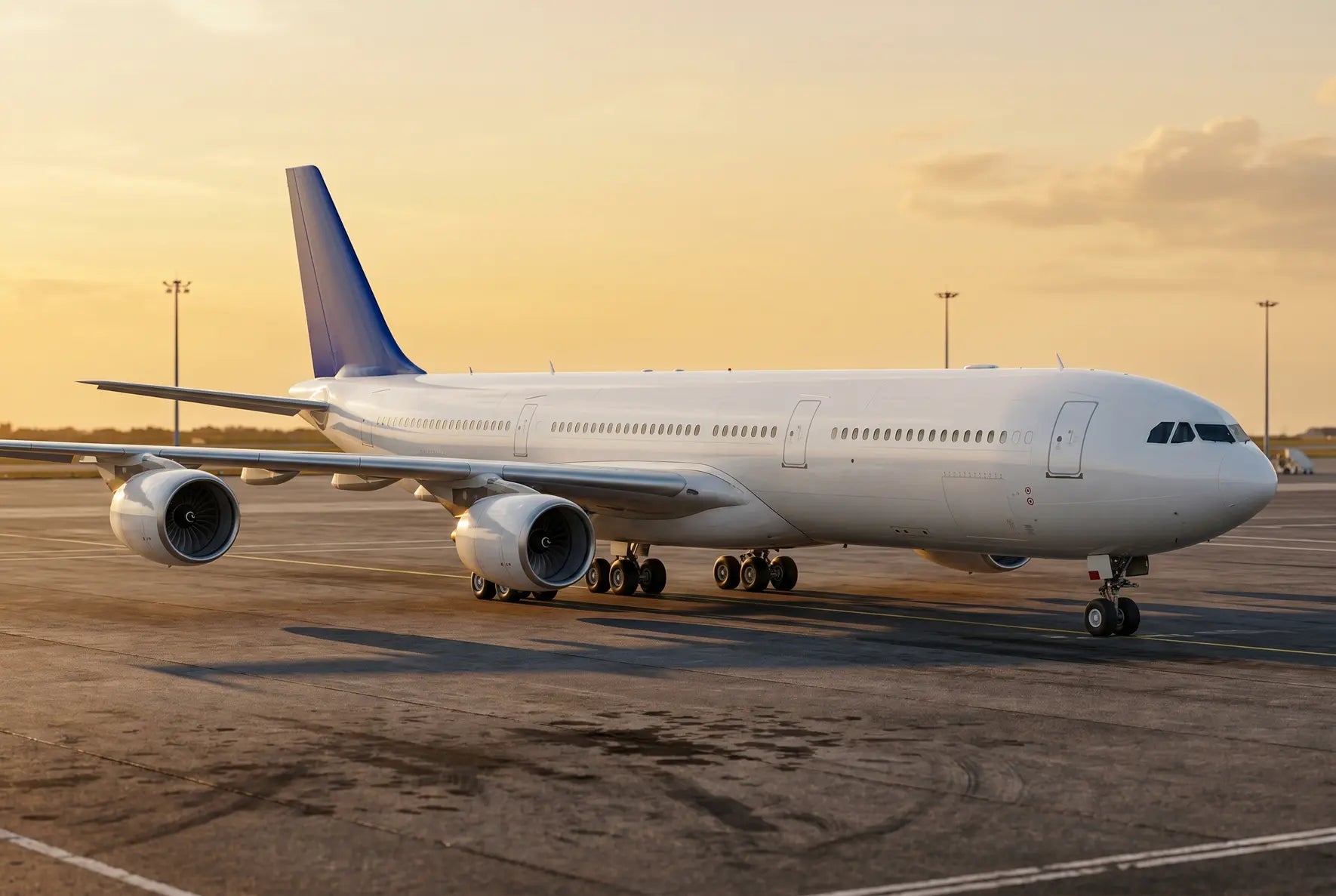
Airbus A340-600: History, Program Launch, and Development of the Longest A340
The Airbus A340-600 is the largest and longest member of the A340 wide-body family, a four-engine long-range airliner developed by Airbus to serve high-capacity intercontinental routes. Understanding how this stretched variant came to be requires looking at the broader A340 programme and the market forces that shaped the decision to push the airframe well beyond its original dimensions.
The A340 programme was officially launched on 5 June 1987, alongside the twin-engine A330. Both types shared a common wing, fuselage cross-section, and cockpit philosophy, which allowed airlines to benefit from fleet commonality and reduced crew training costs. The initial A340-200 and A340-300 were powered by four CFM56-5C engines and entered service in 1993. They filled a gap for airlines that needed four-engine reliability on long over-water and remote-area routes where twin-engine ETOPS rules were still restrictive during the 1990s.
By the mid-1990s, Airbus recognised growing airline demand for even more capacity and range. Boeing's 747-400 dominated the high-capacity, long-haul segment, and Airbus had no direct competitor in that class. In response, Airbus launched two second-generation variants in December 1997: the ultra-long-range A340-500 and the high-capacity A340-600. Both featured a substantially redesigned, larger wing with a span of approximately 63.45 metres (compared with 60.3 m on the -200/-300) and were powered by the new Rolls-Royce Trent 500 engine family, delivering roughly 56,000 lbf of thrust per engine, a significant increase over the 34,000 lbf of the CFM56-5C.
The A340-600 stretched the fuselage to approximately 75.36 metres, making it the longest commercial airliner in the world at the time of its introduction. It could seat around 380 passengers in a typical three-class layout, putting it squarely in 747 territory while offering about 25% more underfloor cargo volume than the 747-400 in passenger configuration. The maximum take-off weight rose to approximately 368 tonnes, compared with roughly 275 tonnes for the earlier A340-300.
The first A340-600 completed its maiden flight from Toulouse-Blagnac on 23 April 2001. Three test aircraft accumulated approximately 1,600 flight hours during the certification campaign. The variant received its EASA type certificate (TCDS A.015) on 3 May 2002, as a derivative of the existing A340 type certificate. Virgin Atlantic Airways was the launch customer and placed its first A340-600 into revenue service on 1 August 2002, operating the London Heathrow to New York JFK route.
A notable later development was the A340-600 High Gross Weight (HGW) version, launched in 2003 with Qatar Airways and Emirates as lead customers. This variant offered increased maximum take-off weight and extended range. The HGW version completed its first flight in 2005 and received certification in mid-2006. Airlines operating the A340-600 ranged from Lufthansa and Iberia to South African Airways and Etihad Airways. In total, 97 A340-600 aircraft were ordered and delivered. Production effectively ended in 2011 when Airbus ceased taking new A340 orders, with the final airframe delivered from storage in April 2012. The commercial decline of the programme was driven largely by the rise of more fuel-efficient twin-engine competitors, notably the Boeing 777-300ER, and the relaxation of ETOPS regulations that had historically favoured four-engine aircraft. Many operators, including airlines employing crews under varied contractual arrangements similar to those found across regional and cargo carriers, eventually transitioned their long-haul fleets to newer twin-engine types.
What Distinguishes the A340-600 from Other A340 Variants
The A340-600 occupies a unique position within the A340 family as the high-capacity variant. While the A340-500 prioritised ultra-long range (approximately 9,000 nm) with fewer passengers, the A340-600 traded some range (approximately 7,500-7,800 nm) for significantly greater seating and cargo capacity. Compared with the original A340-300, the -600 added roughly 20 fuselage frames, resulting in a fuselage over 11 metres longer. This stretch required substantial structural reinforcement of the fuselage, floor beams, and frames. The wheelbase increased from approximately 25 metres on the -300 to about 32.9 metres on the -600, necessitating the introduction of a Taxiing Aid Camera System (TACS), which was standard equipment on the -600 but only optional on the -500. This system used two external cameras to provide pilots with a composite taxi view on the cockpit displays, compensating for the significantly longer airframe. The -600 also introduced a fully electric rudder control architecture, removing the mechanical linkages between rudder pedals and actuators that were still present on the A340-200/300. The electrical system was upgraded from 75 kVA to 90 kVA integrated drive generators, and a new Electrical Load Management System (ELMS) was added to handle the higher power demands.
Key variant identifiers that define the Airbus A340-600:
- Engines: 4x Rolls-Royce Trent 556 (approximately 56,000 lbf thrust each)
- Fuselage length: approximately 75.36 m, the longest of any A340 variant
- Wingspan: approximately 63.45 m with larger wing versus the -200/-300
- MTOW: up to approximately 380 tonnes (HGW version)
- Typical capacity: 380 passengers (three-class), up to 475 (high-density)
- Range: approximately 7,500-7,800 nm (three-class configuration)
- Unique systems: Taxiing Aid Camera System (TACS) standard, fully electric rudder, 90 kVA IDGs, ELMS
- Wingtip type: Wingtip fences (consistent with A340-500/-600 wing design)

A Lufthansa Airbus A340-313 aircraft in flight, showcasing its sleek design and the characteristic blue and white livery against a clear blue sky.
Airbus A340-600 Technical Specifications, Systems and Engine Overview
The Airbus A340-600 was designed as the ultra-long-range, high-capacity member of the A340 family. Stretched to 75.36 metres, it became the longest commercial airliner in the world at the time of its introduction. The variant trades some of the A340-500's range for additional passenger volume, seating up to 380 passengers in a typical three-class layout or around 475 in high-density configurations. It retains the four-engine, twin-aisle philosophy that defined the A340 programme, while incorporating a larger wing, a reinforced structure and a third main landing gear leg on the fuselage centreline to handle the higher operating weights.
Like other large four-engine widebodies such as the Bristol Brabazon, the A340-600 was conceived to cover the world's longest city pairs with ample payload. Its design philosophy prioritised range and redundancy over twin-engine economics, a trade-off that shaped both its market niche and its eventual retirement from most fleets as fuel costs rose.
- Overall length: 75.36 m (247 ft 3 in)
- Wingspan: 63.45 m (208 ft 2 in)
- Height: 17.22 m (56 ft 6 in)
- Cabin width: 5.28 m (17 ft 4 in), standard twin-aisle cross-section
- Maximum take-off weight (MTOW): 368,000 kg (standard); up to 380,000 kg for the A340-600HGW variant
- Maximum landing weight (MLW): approximately 259,000 kg
- Operating empty weight (OEW): approximately 179,000 kg
- Fuel capacity: approximately 147,850 litres (usable)
- Range: approximately 7,900 nm (14,600 km) with a typical three-class payload
- Typical cruise speed: Mach 0.82 (approximately 890 km/h); maximum operating Mach number (MMO) Mach 0.86
- Service ceiling: 41,000 ft (12,500 m)
- Take-off field length: approximately 3,100 m at standard MTOW conditions
- Engines: 4 x Rolls-Royce Trent 556 turbofans, rated at 249 kN (56,000 lbf) each
- Landing gear: tricycle configuration with three main gear legs (two wing-mounted, one centreline body gear), all braked
- Cockpit: two-crew glass cockpit with LCD displays and Airbus sidestick controllers
Fly-by-Wire Systems and Handling Technology
The A340-600 uses the standard Airbus digital fly-by-wire (FBW) architecture, evolved from the system first introduced on the A320 family. All primary flight control surfaces are electrically signalled and hydraulically actuated, managed by redundant Primary Flight Control Computers (PRIMs) and Secondary Flight Control Computers (SECs). In normal law, the system provides full flight-envelope protections including load factor limiting, angle-of-attack protection and bank angle limiting.
A significant upgrade over the earlier A340-200/300 is the introduction of full fly-by-wire rudder control on the -500/-600 variants, eliminating the mechanical rudder linkage used on earlier models. The autopilot inner-loop functions (damping, stabilisation) were also moved directly into the flight control computers for tighter integration. The A340-600 further introduced an Electrical Load Management System (ELMS) that optimises generator output against real-time electrical demand, feeding continuous monitoring data into the centralised maintenance system. Given the aircraft's exceptional fuselage length (75.36 m), Airbus equipped the -600 with ground-manoeuvring taxi cameras displayed in the cockpit to assist pilots during taxiing.
Braking is managed by digital brake control units with full anti-skid, locked-wheel protection and touchdown inhibit logic. All three main gear legs, including the centreline unit, are braked and integrated into the same control scheme. The centralised maintenance system collects fault data from avionics, flight controls, hydraulics, engines and landing gear, supporting condition-based maintenance and airline trend monitoring.
Published performance numbers for the A340-600 can vary depending on operator-specific configuration choices such as cabin density, installed galley and lavatory count, optional auxiliary fuel tanks, and selected MTOW. Atmospheric conditions, runway elevation, temperature and surface state all affect demonstrated take-off and landing distances. Range figures quoted by the manufacturer assume specific payload and reserve fuel policies, meaning that real-world operational range may differ from catalogue values.
Rolls-Royce Trent 500: The A340-600's Sole Powerplant
The A340-600 is powered exclusively by the Rolls-Royce Trent 500, a three-spool, high-bypass turbofan from the broader Trent engine family. Unlike the earlier A340-200/300, which used CFM56-5C engines, the stretched -500/-600 variants required substantially more thrust, and the Trent 500 was selected by Airbus in June 1997 as the sole powerplant for both models. No alternative engine option from another manufacturer was ever offered or certificated for the A340-500 or A340-600.
The Trent 500 completed its first engine run in May 1999, first flew in June 2000, and achieved EASA type certification on 15 December 2000. It entered commercial service on the A340-600 with Virgin Atlantic in July 2002. The engine features a single-stage fan with a diameter of approximately 2.47 m (97.4 in), a bypass ratio of around 7.6:1 at the design point (rising to approximately 8.5:1 at cruise), and a dry weight of approximately 4,990 kg per the EASA type-certificate data sheet.
Within the Trent 500 family, two principal ratings exist: the Trent 553, rated at 236 kN (53,000 lbf), used on the standard A340-500; and the Trent 556, rated at 249 kN (56,000 lbf), used on the A340-600. The higher-gross-weight A340-600HGW uses a further uprated variant producing approximately 275 kN (60,000 lbf). The Trent 500 is exclusive to the A340-500 and A340-600 and has not been used on any other airframe. Its three-spool architecture, shared conceptually with other Trent variants such as the Trent 700 (A330) and Trent 900 (A380), allows each compressor spool to run at its optimum speed, contributing to fuel efficiency and operational flexibility on ultra-long-haul sectors.
Airbus A340-600 vs A340-500 vs A330-300 vs Boeing 777-300ER Specifications Comparison
Scroll horizontally to see more →
| Parameter | Airbus A340-600 | Airbus A340-500 | Airbus A330-300 | Boeing 777-300ER |
|---|---|---|---|---|
| Entry into service | 2002 | 2002 | 1994 | 2004 |
| Engines | 4 × Rolls-Royce Trent 556 | 4 × Rolls-Royce Trent 553 | 2 × Rolls-Royce Trent 772B or GE CF6-80E1 | 2 × GE90-115B |
| Length | 75.30 m | 67.90 m | 63.70 m | 73.90 m |
| Wingspan | 63.45 m | 63.45 m | 60.30 m | 64.80 m |
| Height | 17.30 m | 17.00 m | 16.80 m | 18.50 m |
| Typical seating and layout (short description + approximate passengers) | 3-class: 350–380 passengers | 3-class: 270–310 passengers | 2-class: 250–300 passengers | 3-class: 340–365 passengers |
| MTOW | 368 t | 372 t | 242 t | 351 t |
| Range | 7,500 nm | 9,000 nm | 6,350 nm | 7,370 nm |
| Cruise speed | 0.82 Mach | 0.82 Mach | 0.82 Mach | 0.84 Mach |
| Service ceiling | 41,000 ft | 41,000 ft | 41,000 ft | 43,100 ft |
| Program note | Stretched, high-capacity long-haul member of the A340 family, designed as a quad-jet replacement for early Boeing 747 variants. | Ultra-long-range A340 variant optimized for very long sectors with lower capacity but maximum range within the family. | Earlier-generation twin-engine Airbus wide-body optimized for medium- to long-haul routes with strong efficiency and versatility. | High-MTOW, long-range twin-engine flagship of the 777 family, key benchmark competitor to large A340 variants on long-haul routes. |
Scroll horizontally to see more →
The table compares key specs of the A340-600, A340-500, A330-300 and 777-300ER. The A340s are four-engine types, while the A330 and 777 are twins. A340-500 leads range at 9,000 nm, but carries fewer passengers than the stretched A340-600 (350–380). The 777-300ER is nearly as long as the A340-600, cruises slightly faster (Mach 0.84) and has the highest ceiling (43,100 ft).
Airbus A340-600 Operations: Typical Routes, Missions and Airlines Worldwide
The Airbus A340-600, the longest variant of the A340 family and once the world's longest commercial aircraft at 75.36 metres, was designed for high-capacity, long-haul intercontinental missions. With a maximum range of approximately 7,500 nautical miles (13,900 km) in a typical three-class configuration, this quadjet typically operates sectors of 7 to 10 hours in block time, covering distances between 3,000 and 5,000 nautical miles. According to UK Civil Aviation Authority utilisation data, the A340-600 averages around 9.5 block hours of daily utilisation, consistent with long-haul widebody patterns where aircraft complete one major intercontinental rotation per day.
Operationally, the Airbus A340-600 has been deployed almost exclusively in hub-and-spoke networks, connecting major intercontinental gateways. Airlines positioned the type at their primary long-haul hubs to serve trunk routes with strong premium and cargo demand. Its four-engine configuration offered ETOPS-independent routing over water, which was a meaningful advantage before modern twin-engine aircraft received extended-range certifications. However, this same four-engine layout became the aircraft's principal challenge: fuel burn and maintenance costs per seat are significantly higher than those of twin-engine competitors such as the Boeing 777-300ER, Boeing 787, or Airbus A350. As fuel prices rose and ETOPS rules matured, the economic case for the A340-600 weakened considerably. Most operators retired the type early or retained it only as transitional capacity while awaiting delivery of more efficient replacements. Lufthansa, for example, has delayed its A340-600 phase-out into 2026 specifically because of Boeing 787 and 777-9 delivery delays.
The aircraft's sensitivity to cabin configuration also posed challenges. Heavy premium-class installations could shift the centre of gravity forward, reducing cargo capacity and increasing fuel consumption. Airlines with particularly large and heavy first- or business-class cabins sometimes experienced performance shortfalls compared to lighter configurations. Combined with rising heavy-check and engine-overhaul costs on ageing airframes, these factors have made the Airbus A340-600 increasingly difficult to justify in today's operating environment, except where fleet constraints leave no alternative.
Where the Airbus A340-600 Operates and Key Airlines by Region
Of the 97 Airbus A340-600 aircraft built, only a small number remain in scheduled passenger service. The type's operational footprint has contracted significantly since its peak in the late 2000s, when airlines in Europe, Asia, Africa and the Americas deployed it on prestigious intercontinental routes. Today, Lufthansa remains the largest active operator, using the type from its Frankfurt hub on a handful of transatlantic routes plus a seasonal Middle East service. In Asia and the Middle East, Mahan Air continues to operate the A340-600 on long-haul routes from Tehran, largely because international sanctions limit access to newer Western-built aircraft. In South America, Conviasa uses the type on services from Caracas. Across Africa, South African Airways historically operated nine A340-600s on flagship intercontinental services from Johannesburg, though the type has been largely phased out following the airline's restructuring. Several European carriers that once formed the backbone of the A340-600 fleet, including Virgin Atlantic, Iberia and Etihad Airways, have fully retired the type in favour of modern twins.
- Europe: Lufthansa is the last major European scheduled operator, with approximately five to six active A340-600s based at Frankfurt. As of 2026, planned routes include Frankfurt to Boston, Chicago, New York JFK, and a seasonal Frankfurt to Riyadh/Dammam service. Virgin Atlantic was a launch customer and operated 19 A340-600s from London Heathrow on routes to New York, the Caribbean, South Africa and Hong Kong before retiring the fleet in favour of Boeing 787-9s and Airbus A350-1000s. Iberia operated 17 A340-600s as its primary long-haul type from Madrid, serving Latin American destinations such as Buenos Aires, São Paulo, Lima, Bogotá and Mexico City, along with transatlantic routes to New York and Miami. All were phased out and replaced by A330s and A350-900s. Other European operators included Plus Ultra Líneas Aéreas on leisure routes from Madrid to Latin America and the Caribbean.
- Asia and Middle East: Mahan Air operates multiple A340-600s on long-haul services from Tehran to destinations including China, Bangkok, Moscow and India. Etihad Airways operated seven A340-600s between 2007 and 2017 from Abu Dhabi to European hubs such as Frankfurt, Munich and Seoul. Thai Airways operated six A340-600s from Bangkok on European routes to London, Frankfurt, Paris and Zurich, as well as services to Sydney and Perth. Qatar Airways leased four A340-600s for services from Doha to European capitals and select North American gateways. Cathay Pacific operated three A340-600s on ultra-long-haul routes from Hong Kong, including the nonstop Hong Kong to New York JFK service inaugurated in 2004. Finnair operated the closely related A340-300 variant on long-haul services from Helsinki to Asia, though it did not fly the A340-600.
- Americas: Conviasa, the Venezuelan state carrier, operates A340-600 aircraft on services from Caracas to Moscow and St. Petersburg, as well as Caribbean routes. Surinam Airways has used A340-600 equipment on the Amsterdam to Paramaribo transatlantic link via wet-lease arrangements. Most A340-600 flying to the Americas was historically operated by European carriers such as Iberia, Lufthansa and Virgin Atlantic on inbound services from their respective hubs.
- Africa: South African Airways was the continent's only A340-600 operator, with a fleet of nine aircraft used on flagship routes from Johannesburg. Key services included Johannesburg to New York JFK, London Heathrow, Frankfurt, Perth and Hong Kong. Following the airline's restructuring, A340-600 operations have been significantly reduced, with remaining A340 flying limited to regional long-haul routes such as Johannesburg to Perth and Lagos.
Typical Seating Configurations on the Airbus A340-600
Cabin layouts on the Airbus A340-600 vary considerably depending on operator type and market positioning. Network carriers typically configured the aircraft in three or four classes with 280 to 380 seats. The standard economy section uses a 2-4-2 layout across eight abreast, which passengers often find more comfortable than the nine-abreast configurations common on competing widebodies. Lufthansa operates two documented four-class configurations: one with 281 seats (8 First, 56 Business, 28 Premium Economy, 189 Economy) and another with 297 seats featuring a larger economy cabin. Both layouts include a dedicated First Class cabin in a 1-2-1 arrangement and Business Class in 2-2-2.
Virgin Atlantic configured its A340-600s in three classes with approximately 255 to 311 seats, featuring its signature Upper Class business cabin with fully flat beds, a substantial Premium Economy section, and economy. The absence of a first-class cabin allowed for a more generous business and premium economy offering. Iberia and South African Airways generally used two- or three-class layouts optimised for their respective long-haul markets, typically seating around 300 to 340 passengers. Charter and VIP operators, by contrast, have configured the type with far fewer seats for bespoke private or government use. According to Airbus, the A340-600 can accommodate up to 380 passengers in a standard three-class layout and up to 419 in a high-density two-class arrangement.
In this video, you will get an honest look at flying Lufthansa’s A340-600 in Economy Class, with practical impressions of the onboard experience and what to expect on this long-haul aircraft.
Airbus A340-600 Safety Record: How Safe Is This Four-Engine Widebody?
The Airbus A340-600 holds one of the most remarkable safety records in commercial aviation. With 97 aircraft delivered between 2002 and 2010, and over two decades of long-haul service across airlines such as Lufthansa, Virgin Atlantic, Iberia, Etihad Airways and South African Airways, the A340-600 has accumulated millions of flight hours and cycles without a single passenger fatality. In fact, the entire Airbus A340 family, spanning the -200, -300, -500 and -600 variants, has recorded zero fatal accidents involving passengers in scheduled airline service. That places the A340 programme among the safest widebody aircraft families ever produced.
While no aircraft type is immune to incidents, the events involving the A340-600 have been limited in number and severity. The Aviation Safety Network database for the A340-600 lists a range of occurrences from minor technical events and diversions to a small number of more significant incidents, none of which resulted in loss of life among passengers or crew during commercial operations.
Notable Incidents Involving the Airbus A340-600
Two events stand out in the operational history of the A340-600, both occurring in late 2007:
- Airbus ground test accident, Toulouse, 15 November 2007. A brand-new A340-642X (registration F-WWCJ, MSN 856), not yet delivered to Etihad Airways, was undergoing a high-power engine ground run at Toulouse-Blagnac Airport. All four engines were running at high thrust without wheel chocks in place. The aircraft began creeping forward, overran the parking area and struck a blast wall, causing catastrophic structural damage to the forward fuselage. Four of the nine people on board sustained serious injuries, but there were no fatalities. The French Bureau of Enquiry and Analysis for Civil Aviation Safety (BEA) attributed the accident to conducting high-power runs without adequate restraint, organisational shortcomings under commercial pressure, and the crew member's failure to reduce thrust promptly. The aircraft was written off. Following this event, Airbus and operators reviewed ground-test procedures, reinforcing the requirement for proper chocking, thrust limitations and personnel protocols during static engine runs.
- Iberia flight IB6463, Quito, 9 November 2007. An Iberia A340-642 (registration EC-JOH) operating a flight from Madrid overran the runway at the old Mariscal Sucre Airport in Quito, Ecuador, a notoriously challenging high-elevation airfield. At least one tyre burst during the landing roll, and the aircraft came to rest beyond the runway end with the left main landing gear collapsed and two left-side engines in contact with the ground. All 345 passengers and 14 crew members evacuated safely with no fatalities. The aircraft sustained severe structural damage and was ultimately written off. The event prompted further scrutiny of approach and braking procedures at high-altitude airports and reinforced the importance of stabilised approach criteria for heavy aircraft operating in demanding terrain environments.
Beyond these two hull losses, the A340-600 has experienced a number of minor and moderate incidents over the years, including occasional hard landings, technical diversions and galley equipment malfunctions. None resulted in fatalities or serious injuries to passengers. For comparison, other widely operated aircraft types such as the Boeing 737-500 have experienced a broader range of incidents over their service lives, highlighting how fleet size, operational environments and years in service all influence an aircraft type's incident tally.
How Safe Is the Airbus A340-600?
By any meaningful measure, the Airbus A340-600 is an exceptionally safe aircraft. Its zero-fatality record in commercial passenger service, maintained across more than two decades of operation, places it in an elite category. The type benefits from several layers of safety built into the Airbus design philosophy:
- Fly-by-wire flight controls with multiple redundant flight control computers and built-in flight envelope protections that guard against excessive angle of attack, overspeed and unusual attitudes.
- Four-engine redundancy, providing continued safe flight and landing capability even after the loss of one or two engines, with generous performance margins for oceanic and remote-area operations.
- Extensive system redundancy, including multiple independent hydraulic circuits, several electrical power sources and triplicated critical sensors for air data and inertial reference.
- Common cockpit philosophy shared with other Airbus fly-by-wire types, including the ECAM (Electronic Centralized Aircraft Monitor) system that provides prioritised, checklist-driven procedures during abnormal situations.
These design features, combined with rigorous regulatory oversight from EASA and other aviation authorities, continuous airworthiness directives and standardised airline operating procedures, contribute to the A340-600's strong safety profile. According to data compiled by the Aviation Safety Network, the global fatal accident rate for modern western-built jet transport aircraft continues to decline, and the A340 family's clean record in passenger fatalities sits firmly within this positive trend. Aviation remains, statistically, one of the safest modes of long-distance transport available, and the Airbus A340-600 exemplifies that standard.
01 What kind of routes and range is the Airbus A340-600 typically used for?
The Airbus A340-600 was designed for long-haul, high-capacity routes, with a typical range of around 14,000 km depending on configuration and payload. Airlines have used it on intercontinental flights such as Europe to South America, Europe to Southern Africa, and some Europe–Asia services. Its four-engine design made it popular for very long overwater routes before twin-engine ETOPS rules expanded. Today it is mainly found on select trunk routes where airlines still need a large cabin or additional cargo capacity.
02 What is the cabin layout and passenger experience like on the Airbus A340-600?
The Airbus A340-600 usually features a 2-4-2 layout in economy class, which many travellers consider more comfortable than 3-4-3 layouts on some newer widebodies. Typical seating capacity is in the 350–380 seat range, with multiple cabin classes and a relatively long cabin that can feel spacious when well designed. The aircraft is known for a relatively quiet cabin, particularly ahead of the wings and away from the engines mounted farther from the fuselage. Some airlines also used the extra fuselage length to add larger premium cabins or social spaces in certain configurations.
03 Which airlines still operate the Airbus A340-600 and on what kinds of routes?
Most Airbus A340-600s have been retired, but a few airlines and charter operators still use them, often based in Europe and the Middle East. They are typically deployed on seasonal high-demand routes, pilgrimage and religious charter flights, and ad-hoc charter services for tour operators, sports teams, or large group travel. Because the type is no longer in large-scale scheduled service, travellers are more likely to encounter it on special or niche routes rather than daily flagship services.
04 How does the Airbus A340-600 compare in performance and fuel efficiency to similar aircraft?
The Airbus A340-600 offers strong takeoff performance, long range, and excellent high-altitude cruise characteristics, but it is less fuel-efficient than newer twin-engine aircraft such as the Boeing 777-300ER or Airbus A350-900. Its four-engine configuration increases fuel burn and maintenance costs compared with modern twins, which is one of the main reasons many airlines phased it out. However, the A340-600 still offers valuable cargo volume and reliable performance on challenging hot-and-high or long overwater routes where some operators value its capabilities. For enthusiasts, it remains an iconic example of the last generation of long-range four-engine airliners.
05 What is the safety record and what are notable design features of the Airbus A340-600?
The Airbus A340 family, including the A340-600, has a strong safety record in commercial service, with very few serious hull-loss incidents relative to total flight hours. Key design features include four high-bypass turbofan engines, a long fuselage with additional overwing exits, and advanced flight deck systems shared with other Airbus types, which simplify pilot training and fleet commonality. The A340-600 also uses a modern fly-by-wire control system and multiple redundant systems for flight controls and hydraulics. Its four-engine layout was originally attractive for long oceanic flights before extended-range twin-engine operations became standard.
06 As a passenger, what are useful seat and comfort tips for flying on an Airbus A340-600?
On the Airbus A340-600, many travellers prefer window or aisle seats in the 2-4-2 economy layout, as no one is more than one seat away from the aisle. Seats ahead of the wings, especially in the forward cabin sections, are typically quieter and experience slightly less engine noise. Over-wing seats can offer a smoother ride in turbulence, while those further from the engines may feel slightly less vibration. Because this is a relatively long aircraft, choosing a seat closer to the center of the cabin can reduce the sensation of pitch and yaw in rough air, which some passengers find more comfortable.