

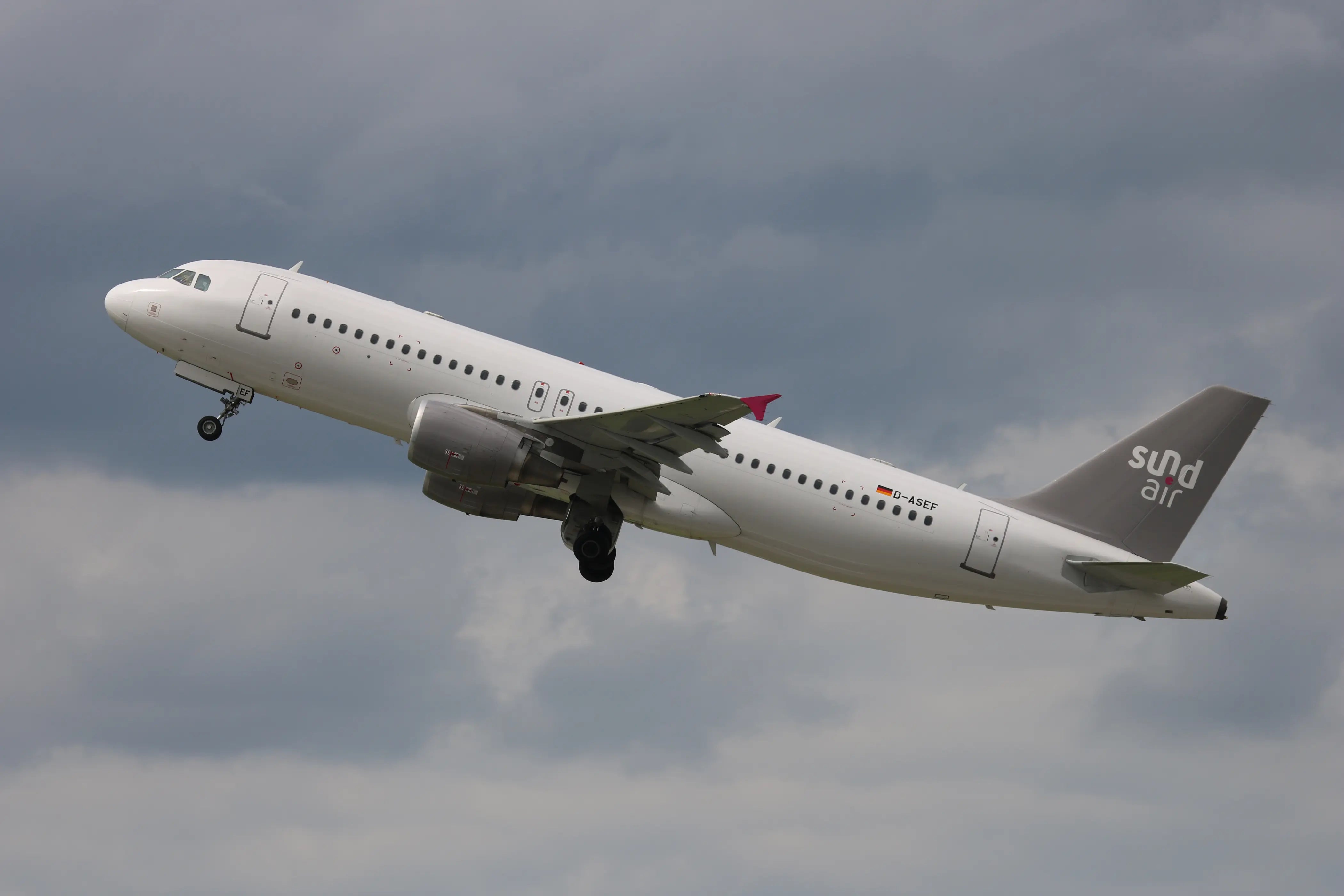
Sundair Overview & Company Profile
Sundair GmbH is a small German leisure and charter airline that flies Airbus A320-family jets from bases in Berlin, Bremen and Dresden to holiday destinations around the Mediterranean, the Canary Islands and the Red Sea. It is not a legacy network carrier, and it is not a large low-cost operator. It sits in a specific niche: a lean, tour-operator-focused carrier that sells most of its seats through package holidays. For a pilot, that identity shapes almost everything that follows in this guide, from the type of flying (short and medium-haul, high summer intensity) to the employment model (company contracts rather than a union collective agreement).
The company was founded in 2016 by Marcos Rossello and operated its first revenue flight on 27 September 2017, according to airline history records and the founder's own public statements. Its registered headquarters are in Stralsund, a Hanseatic city in the north-eastern state of Mecklenburg-Vorpommern, well away from its main flying base at Berlin Brandenburg Airport (BER). Rossello remains the driving figure behind the airline as CEO and managing director, and in 2024 to 2025 he also acquired the trademark rights to the dormant Air Berlin brand, a development widely reported in the German aviation press.
A pivotal corporate change came on 30 May 2023, when the German tour operator Schauinsland-Reisen acquired a majority stake in both Sundair and its Croatian sister airline, Fly Air41 Airways, according to reporting by CAPA (Centre for Aviation). That ownership link is significant for pilots: it ties Sundair's flying to a tour operator's seat demand, which supports schedule stability during the summer season but also concentrates the airline's fortunes in the leisure market. Employee-count estimates across business databases vary widely, from roughly 85 to a few hundred, so the workforce is best described as a compact organisation of an estimated 100 to 200 staff rather than a precisely audited figure.
Sundair belongs to no global alliance and operates no frequent-flyer network of its own in the legacy sense. Its aircraft are frequently supplemented by Fly Air41, a Croatian-registered carrier that flies in Sundair livery and also provides ACMI (Aircraft, Crew, Maintenance, Insurance) capacity to other airlines such as Condor. Understanding this two-AOC group structure is essential context before evaluating any single figure below.
Sundair and Fly Air41 Airways operate as a group under common majority ownership. Fly Air41 holds a separate Croatian AOC and flies A319 and A320 aircraft, some in Sundair colours, on charter and ACMI work. Two of the A319s counted in Sundair's own fleet listing are actually operated on Sundair's behalf by Fly Air41. For a pilot, this means the "Sundair experience" can involve either the German AOC or the Croatian one depending on the contract offered, and career mobility inside the group is a real feature of the setup.
Fleet Composition & Type Ratings
Sundair operates a single-family, single-manufacturer fleet built entirely around the Airbus A320 platform. According to Planespotters fleet data (updated for 2026) and the Sundair entry on Planespotters.net, the airline's active fleet is small, roughly five aircraft, and comparatively old, with an average age near 19 years. This is typical for a leisure carrier that acquires used aircraft and operates them on flexible leases to keep capital costs low. There are no next-generation A320neo aircraft in the fleet, and no publicly confirmed order for them: Sundair continues to rely on classic-engine A320ceo aircraft powered by CFM56-5B engines, as reflected in CFM International's own press material about Sundair's engine order.
| Aircraft Type | Role | In Service | Notes |
|---|---|---|---|
| Airbus A320-200 (ceo) | Narrowbody | ~3 | Core Sundair-operated fleet. CFM56-5B engines. Short and medium-haul leisure sectors. |
| Airbus A319-100 (ceo) | Narrowbody | ~2 | Listed in the Sundair fleet but operated on Sundair's behalf by Fly Air41 Airways (Croatian AOC). |
| Fly Air41 A319 / A320 (group) | Narrowbody | Additional | Sister-airline capacity. Flies charter and ACMI, including some flights for Condor. Partly Sundair-branded. |
| Airbus A320neo | Narrowbody | 0 | None in service and none publicly confirmed on order as of 2025 to 2026. |
Fleet data compiled from Planespotters, Airfleets and Wikipedia, as of 2025 to 2026. Numbers are approximate and shift with seasonal leasing and Fly Air41 allocation.
Because Sundair and Fly Air41 pool aircraft, the exact tail count seen flying under the Sundair name changes through the year. During the peak summer schedule, Fly Air41 machines are added to lift tour-operator demand, and at least one Fly Air41 aircraft has worn a dedicated Sundair-style livery (registration 9A-BER) to reinforce the shared brand. In practical terms, a Sundair pilot works within a group that controls a modest but flexible pool of single-aisle Airbus jets rather than a large standardised mainline fleet.
The entire operation runs on one type rating: the Airbus A320 family (A319/A320/A321 share a common type rating under EASA). Sundair actively recruits non-type-rated First Officers and provides the A320 type rating and transition training to selected candidates, which is a genuine draw for lower-hour EASA pilots trying to convert a licence into a paid jet job. Captains, by contrast, are expected to arrive already type-rated on the A320. Because the fleet is so compact, a pilot flies the same family throughout, and there is no widebody or long-haul step to progress toward inside Sundair itself.
The relatively high average fleet age (around 19 years) is the single biggest reason for the low Fleet & Equipment score in the scorecard above. Older A320ceo airframes are proven and reliable, but they lack the fuel efficiency, cabin systems and flight-deck refinements of neo-generation aircraft that competitors such as Marabu operate. Pilots who prioritise modern equipment and glass-cockpit upgrades should weigh this against the accessibility of the job.
Pilot Salary & Compensation Breakdown
Sundair does not publish official pilot pay scales, and it is not covered by a public collective bargaining agreement. As a result, the salary picture has to be reconstructed from crowd-sourced pilot data, principally the Sundair entry on PilotJobsNetwork, cross-referenced with the company's known block-hour pay model. The figures below should be read as indicative ranges rather than contractual guarantees. They are gross figures under German employment, before income tax and social contributions, which together can absorb a large share of a pilot's headline pay.
The pay structure has two parts: a monthly base salary tied to rank and grade, and additional block-hour pay that kicks in above a monthly threshold. According to the crowd-sourced data, the rank ladder runs from Cadet through First Officer grades (F/O G1, F/O G2), Senior First Officer grades (SFO G2, SFO G3), and then Captain grades (CPT G1, CPT G2), Junior Captain and Senior Captain grades (SCP G1 to G3). A portion of monthly pay is also structured as a tax-free allowance, a common German practice for duty-related expenses within legal limits.
First Officer Pay Scale (indicative)
| Rank / Grade | Monthly Base (gross) | Annual Gross (est.) | Notes |
|---|---|---|---|
| Cadet / entry | ~€2,000 | ~€24,000 – €28,000 | Line training phase, no block-hour incentive. |
| First Officer (F/O G1) | ~€3,150 | ~€40,000 – €46,000 | Junior F/O with block-hour pay above 45 hrs. |
| First Officer (F/O G2) | ~€3,650 | ~€47,000 – €53,000 | Second-grade F/O. |
| Senior F/O (SFO G2 / G3) | ~€4,400 – €4,650 | ~€58,000 – €66,000 | Experienced right-seat pilots pre-command. |
Indicative gross ranges from crowd-sourced pilot data, including base plus typical block-hour pay. Actual pay depends on grade, flight hours and contract type.
Captain Pay Scale (indicative)
| Rank / Grade | Monthly Base (gross) | Annual Gross (est.) | Notes |
|---|---|---|---|
| Captain (CPT G1, entry) | ~€5,075 | ~€68,000 – €78,000 | Newly promoted or direct-entry command. |
| Captain (CPT G2 / Junior Captain) | ~€5,500 – €6,800 | ~€80,000 – €95,000 | Mid-grade command, rising with seniority. |
| Senior Captain (SCP G1 – G3) | up to ~€8,875 | ~€110,000 – €125,000 | Top of the grade ladder; may hold training roles. |
Top Captain figures reflect the highest basic grade recorded in crowd-sourced data. Real totals vary with block hours, allowances and the German tax-free component.
Block-Hour Pay Above the Threshold
On top of base salary, pilots earn a per-block-hour rate once they fly beyond a monthly threshold reported at 45 block hours. The rate rises in bands as monthly hours climb, which rewards the intense summer flying that defines leisure operations. The table below reflects the crowd-sourced structure.
| Block-Hour Band (per month) | First Officer Rate | Captain Rate |
|---|---|---|
| 45 to 60 hrs | ~€20 / hr | ~€30 / hr |
| 60 to 75 hrs | ~€25 / hr | ~€35 / hr |
| 75 to 90 hrs | ~€40 / hr | ~€50 / hr |
| Above 90 hrs | ~€60 / hr | ~€80 / hr |
Block-hour pay bands from crowd-sourced Sundair pilot data. For context, Sundair's cabin-crew adverts describe a base built around 65 block hours plus overtime of about €40 per hour from the 65th hour and €55 from the 80th, illustrating the same productivity-linked philosophy for the company as a whole.
These figures come from crowd-sourced databases (notably PilotJobsNetwork) and company advertising, not from an official Sundair pay scale or a union agreement. Some underlying entries date back several years, so treat every number as an estimate. Because Sundair has no publicly documented collective bargaining agreement, individual contracts can vary, and pay is not protected by negotiated annual increases the way it is at Condor. All amounts are gross under German employment: income tax plus social-security contributions (pension, health, unemployment and long-term care insurance) reduce take-home pay substantially. Always confirm current terms directly with Sundair recruitment before making a career decision.
Roster Pattern & Quality of Life
Sundair does not publish its rostering rules, so the honest position is that precise days-off patterns are not publicly documented. What can be stated with confidence is the framework that governs them. All Sundair flying operates under German labour law and the European Union Aviation Safety Agency flight time limitations (EASA FTL), which set maximum duty periods, minimum rest and cumulative flight-hour ceilings. You can review the underlying rules on the EASA website. Company planning appears to target roughly 65 block hours per crew member per month, a figure drawn from Sundair's own crew adverts, which sits squarely in the normal European short-haul range of about 60 to 80 block hours.
The defining quality-of-life feature is seasonality. As a leisure charter carrier, Sundair flies hard in summer and during school holidays, then eases off in the shoulder and winter months (except for year-round sun routes such as the Canary Islands and Egypt). In practice this means high-intensity blocks of early starts, long turnaround days and late returns during peak season, balanced by quieter winter rosters. The block-hour pay bands described above are structured precisely to reward the busy months, so monthly income tends to rise and fall with the flying season.
📅 Representative Month — Short/Medium-Haul First Officer (BER)
Illustrative only. This pattern represents a typical EASA short-haul leisure summer month and is not a Sundair-published roster. Real rosters vary with season, base and staffing.
A structural advantage of the leisure charter model is route predictability: many flights follow the same weekly tour-operator pattern, so specific outbound and inbound days repeat through a season. That regularity can make personal planning easier than at an airline with constantly shifting schedules. The counterweight is that a very small fleet leaves little slack, so a single technical issue or a tour-operator change can trigger last-minute roster adjustments and standby call-outs.
Sundair's pilot vacancies state an explicit condition: applicants must live within 50 km (about one hour) of their assigned base. This is unusual to see written so plainly, and it has direct lifestyle consequences. There is no commuting culture or air-commute agreement of the kind found at some larger carriers. If you are based at Berlin Brandenburg, Bremen or Dresden, the expectation is that you actually live in that catchment area and can report reliably for early and standby duties. Prospective applicants should be ready to relocate to their base region.
Benefits & Employment Conditions
Because Sundair is a German employer, the foundation of its benefits package is German statutory social protection rather than a bespoke airline scheme. Pilots on German contracts are enrolled in the national social-security system: statutory or private health insurance, the state pension (Deutsche Rentenversicherung), unemployment insurance and long-term care insurance, with employer and employee sharing contributions. On top of this baseline, the clearest window into Sundair's own benefits comes from the airline's published crew adverts, which list a defined set of perks. Several of these are documented specifically for cabin crew; where a benefit has not been separately confirmed for pilots, this guide flags it rather than assuming parity.
The training benefit is arguably the most valuable single item for the target audience of this guide. A funded A320 type rating for a selected non-type-rated First Officer removes one of the largest financial barriers in a pilot's early career. Combined with pay during training and a company pension contribution, the package is respectable for a carrier of this size, even if it cannot match the negotiated benefit structures of a large unionised airline.
Two benefits that pilots often value highly, subsidised staff travel and airline-funded loss-of-licence insurance, are not documented in public Sundair sources. Their absence from public material does not prove they do not exist, but it does mean you should not assume them. Any pilot evaluating an offer should ask Sundair HR directly about staff travel entitlements, loss-of-licence protection, sick-pay arrangements beyond the statutory minimum, and whether the company pension applies to cockpit crew on the same terms as cabin crew. These are exactly the details that separate a good offer from an average one.
Career Progression & Seniority
Career progression at Sundair follows a grade ladder that is visible in the crowd-sourced pay structure: Cadet, First Officer (G1 and G2), Senior First Officer (G2 and G3), Captain (G1 and G2), Junior Captain and Senior Captain (G1 to G3). Movement up this ladder is grade and experience based, with pay rising at each step. Unlike a large legacy carrier, Sundair does not publish a formal, union-protected seniority list, so progression is governed by company policy and operational need rather than a transparent bidding system.
The most important structural fact for career planning is fleet size. With only around five aircraft flown under the Sundair name, the number of command seats is inherently limited, which can slow internal upgrades in a steady state. Two factors work in the other direction. First, the group's Croatian sister airline, Fly Air41, adds A319 and A320 capacity and therefore additional command and mobility opportunities inside the same corporate family. Second, and importantly for ambitious First Officers, Sundair does accept direct-entry Captains: type-rated command vacancies are advertised externally, which tells you the airline fills the left seat both from within and from the wider market rather than exclusively through internal upgrade.
| Career Milestone | Typical Path | Notes |
|---|---|---|
| Join as First Officer (A320) | Entry point | Non-type-rated candidates accepted; type rating provided to selected applicants. |
| F/O grade progression | Experience-based | F/O G1 to G2, then Senior F/O grades, with rising base and block-hour pay. |
| Command upgrade (internal) | Seniority + slots | Limited by the small fleet; group capacity via Fly Air41 can help. |
| Direct-entry Captain | Open externally | Requires A320 type rating and command-level experience (see recruitment). |
| Senior Captain / trainer roles | Variable | Instructor and Nominated Person positions advertised; often permanent contracts. |
An A320 type rating and jet hours logged at Sundair are fully transferable across the European market. That makes Sundair a credible stepping stone: low-hour First Officers can convert a licence into command-track jet experience, while the group structure with Fly Air41 offers internal movement. Pilots seeking a decades-long, single-airline career with a protected seniority list and a widebody ceiling will find that ceiling elsewhere, because Sundair is a focused narrowbody leisure operator, not a legacy carrier with a long internal ladder. The realistic framing is a strong early-career or Germany-based command opportunity rather than a lifetime seniority home.
Recruitment Process & Requirements
Sundair recruits pilots directly through its own careers channel and through pilot job boards, and the current vacancies are unusually clear about what is required. There are two main cockpit streams: A320 First Officer (with non-type-rated candidates explicitly welcome) and A320 Captain (type-rated). Applications are made through the airline's careers page, where candidates upload their licence, medical, language evidence and supporting documents. All flying is under a German AOC overseen by the German civil aviation authority, the Luftfahrt-Bundesamt (LBA), so EASA licensing standards apply throughout.
First Officer — Requirements
Captain — Requirements
Application Stages
Online Application
Apply via the Sundair careers page for the relevant A320 vacancy. Candidates submit a CV with a total flight-time summary, copies of the EASA licence (frozen ATPL with IR and ME) and Class 1 medical, proof of ICAO English Level 4 and German proficiency, a valid passport, and a short note confirming residence within 50 km of the base and earliest availability.
Screening & Document Check
Recruitment reviews licences, ratings, hours and language evidence against the vacancy. Non-type-rated First Officers are assessed on aptitude and background rather than A320 experience; Captains are screened against the CS-25 and A320 PIC minimums.
Interview & Assessment
Shortlisted candidates attend interview and, in line with standard airline practice, a simulator or aptitude assessment appropriate to the role. Expect crew-resource-management and scenario-based evaluation conducted in both German and English.
Type Rating & Line Training
Selected non-type-rated First Officers proceed to A320 type-rating and transition training, followed by supervised line flying to company and regulatory standards. Type-rated Captains move to conversion and line checks as required.
Contract & Basing
First Officer roles are advertised on roughly 24-month fixed-term contracts, renewable, with basing at Berlin Brandenburg, Bremen or Dresden. Relocation to within the 50 km catchment of the assigned base is expected before line operations begin.
German language ability is not optional: Sundair lists "very good German and English" for cockpit roles, so this is a serious constraint for non-German speakers. Be ready to state your residence relative to the base up front, because the 50 km rule is a firm filter. For non-type-rated First Officers, the reference point of roughly 300 hours on CS-25 jets suggests some prior jet or turbine time strengthens an application, even though the airline funds the type rating. Confirm the exact current requirements on the official careers page before applying, as leisure carriers adjust hiring quickly with the seasons.
Route Network & Base Structure
Sundair is a short and medium-haul carrier, so this guide deliberately does not include a long-haul layover section. For a pilot, the more relevant question is where the airline flies from, because basing determines where you must live under the 50 km rule, and what the day-to-day flying actually looks like. Sundair operates a classic German outbound-leisure network: sun-and-sea destinations reached on day-return or short-turnaround patterns from a handful of German airports.
The current base structure, per the airline's public profile, centres on three airports:
The airline's footprint has shifted over the years. Earlier operations included Berlin Tegel (which closed in 2020, with traffic migrating to BER) and Kassel, and Sundair announced the withdrawal of its Kassel-based aircraft in 2024. Leipzig/Halle has appeared as an occasional seasonal charter point rather than a core crew base. This flexibility is normal for a tour-operator-driven carrier, but it also means base stability is not guaranteed over a multi-year horizon, a point worth weighing given that Sundair expects pilots to live locally.
On the destination side, the network concentrates on three leisure regions. In the Mediterranean, Sundair serves Greek islands and mainland points such as Heraklion (Crete), Kos, Rhodes and Thessaloniki, together with Beirut in the eastern Mediterranean. In the Canary Islands, Gran Canaria (Las Palmas) and Tenerife South are staples that keep flying alive through the winter. On the Red Sea, Hurghada in Egypt is a core sun destination. Turkish and Balearic resorts such as Antalya and Palma de Mallorca round out the typical seasonal mix. Sundair also appears as a named partner airline on Condor's website, reflecting the commercial ties in the German leisure market.
Expect sectors of roughly two to five hours each way, often flown as out-and-back day duties or short overnight patterns rather than multi-day trips with long layovers. Summer brings early reports, full duty days and back-of-the-clock returns from popular resorts; winter is lighter apart from year-round routes to the Canaries and Egypt. Pilots who enjoy hands-on, high-cycle short-haul flying to holiday airports will find the operation rewarding; those seeking long-haul time zones and extended layovers will not find them here.
How Sundair Compares: Airline Radar Chart
To put Sundair in context, it helps to compare it with two other players in the German leisure market: Condor, the large, established, unionised leisure carrier, and Marabu Airlines, a newer leisure start-up flying modern A320neo-family jets. The chart below uses the same six-metric logic as the scorecard (shown here on five axes). Scores are editorial estimates based on the research behind this article, not audited figures.
Key Takeaways from the Comparison
Condor sets the pay and security benchmark. Condor pilots are covered by a collective agreement with Vereinigung Cockpit that delivered a 7% rise from January 2024 and committed further 5% increases in 2025 and 2026, per the union and industry reporting. Reported Condor First Officer pay runs from roughly €6,789 per month at entry into the €9,000-plus range with seniority, and Captains from about €12,388 up to €18,708 per month. Sundair's crowd-sourced ranges sit well below this, and without a CBA there is no guaranteed annual uplift. On salary and job security, Condor leads clearly.
Marabu wins on fleet, Sundair loses on it. Marabu, launched in 2023 and based in Tallinn but flying the German leisure market, operates an all-A320neo-family fleet (growing toward around ten aircraft), whereas Sundair flies older A320ceo airframes averaging close to 19 years. On equipment, both Condor (modern mixed fleet including A330neo) and Marabu are ahead of Sundair.
On work-life and benefits, the gap narrows. Sundair's documented 35 vacation days, company pension and German statutory protections are respectable, and the leisure short-haul pattern can be predictable within a season. Condor still edges ahead with a fixed roster, around 11 days off per month and 42 days of annual leave. Marabu advertises comparable leisure-sector conditions (35 vacation days, base salary from day one) but, like Sundair, without a large unionised framework.
Accessibility is Sundair's real edge. The comparison metrics do not capture the one area where Sundair genuinely stands out for the target reader: it hires non-type-rated First Officers and funds the A320 rating. For a lower-hour EASA pilot, that open door can matter more than a few points of salary or fleet age.
Scores are editorial estimates derived from the research in this article, including crowd-sourced pay data (PilotJobsNetwork), union and press reporting on Condor and Marabu, and fleet databases (Planespotters, Airfleets). They represent a general assessment for a pilot weighing a role, not a precise ranking, and individual experience will vary with grade, base and contract. Condor and Marabu figures are used for comparison only and will be refined as dedicated guides are published.
Union & Industrial Relations
The dominant pilot union in Germany is Vereinigung Cockpit (VC), the German Air Line Pilots' Association, founded in 1969 and representing roughly 9,000 flight-crew members across German commercial aviation. VC negotiates pay and conditions at the major carriers, campaigns on flight safety, and represents German pilots at European and international level. You can read more about its role and current bargaining on the Vereinigung Cockpit website. Its influence is visible in landmark agreements, including the 2023 to 2026 pay deal at Condor and negotiations over pension structures at Lufthansa.
Sundair's position in this landscape is straightforward but important: there is no publicly documented collective bargaining agreement between Sundair and Vereinigung Cockpit, and Sundair is not named among VC's primary bargaining airlines in public sources. In practice this means pilot pay and conditions at Sundair are set through company policy and individual contracts rather than a negotiated, union-protected framework. This is common for small leisure carriers, but it is a meaningful difference from Condor or the Lufthansa Group airlines, where collective agreements provide structured pay scales, guaranteed increases and formal seniority protections.
What the German Framework Still Guarantees
There is no notable recent history of pilot strikes at Sundair, which reflects both its small size and the absence of the large-scale collective negotiations that periodically trigger industrial action at bigger carriers. The German leisure sector as a whole has seen VC-led disputes at Condor and TUIfly over pay and rostering, and VC has publicly voiced concern that newer, less-unionised operators could be used to pressure sector labour standards. For a Sundair pilot, the practical takeaway is that collective leverage is limited, but statutory and safety protections remain firmly in place.
Joining Sundair means accepting a company-contract model rather than a union-negotiated one. That brings less collective protection on pay progression and seniority, but often a more direct relationship with management at a small carrier. If collective bargaining, guaranteed annual increases and a protected seniority list are priorities for you, a VC-covered airline such as Condor will suit better. If your priority is accessible entry into A320 jet flying with the backing of German labour law and EASA duty protections, Sundair's non-CBA status is a manageable trade-off. Individual VC membership remains available and worthwhile for legal and professional support.
Verdict: Who Is Sundair For?
🎯 Our Take
Sundair is a small, focused German leisure carrier, and it should be judged as one rather than against legacy or Gulf benchmarks. Its stand-out strength for the readers of this guide is accessibility: it actively hires non-type-rated First Officers and funds the A320 type rating, backed by German statutory protection, a company pension and 35 days of annual leave. For a lower-hour EASA pilot trying to turn a licence into real jet experience, that open door is genuinely valuable and increasingly rare.
The trade-offs are equally real and should not be glossed over. Pay is modest and, without a collective agreement, is not protected by guaranteed increases the way it is at Condor. The fleet is small (around five aircraft) and old (roughly 19 years on average), with no neo-generation jets. First Officer contracts are fixed-term, the operation is highly seasonal, and the firm 50 km residence rule means you must live at your base. Command opportunities are limited by fleet size, though the Fly Air41 group structure and direct-entry Captain hiring add flexibility.
Read as a stepping stone or a Germany-based command roster rather than a lifetime seniority home, Sundair holds up well. It offers a legitimate, paid route into A320 flying for German-speaking pilots who value proximity to home and a small-operator environment over scale, modern metal and union protection.
1 Do I need an A320 type rating to apply as a First Officer?
No. Sundair actively welcomes non-type-rated First Officers and provides the A320 type rating and transition training to selected candidates, followed by supervised line flying. Holding an active A320 rating is treated as an advantage and can earn preferential consideration, but it is not a prerequisite. Captains, however, are expected to already hold the A320 type rating.
2 Do I need to speak German to fly for Sundair?
Yes. Sundair's pilot vacancies specify "very good German and English," alongside ICAO English Level 4 or higher. German and English are the working languages on board. This makes fluent German effectively a hard requirement for cockpit roles, which is an important filter for non-German-speaking applicants to consider before applying.
3 What are the minimum requirements for a Sundair First Officer?
An EASA frozen ATPL with valid multi-engine and instrument ratings, a valid EASA Class 1 medical, ICAO English Level 4 or above, and very good German. Recruitment material references around 300 hours on CS-25 (large jet) aircraft as a competitive experience point, though the type rating itself can be provided. Applicants must also confirm they live within 50 km (about one hour) of their assigned base.
4 Does Sundair hire direct-entry Captains?
Yes. Type-rated A320 Captain vacancies are advertised externally, which indicates Sundair fills command seats from the wider market as well as through internal upgrades. Reference requirements include an EASA ATPL, an A320 type rating, roughly 2,500 hours on CS-25 aircraft and about 500 hours pilot-in-command on the A320 family, plus a Class 1 medical and German and English proficiency.
5 Where are Sundair pilots based, and is there a residence rule?
The current bases are Berlin Brandenburg (BER, the main hub), Bremen and Dresden. There is an explicit condition that pilots live within 50 km (about one hour) of their assigned base, and applicants are asked to confirm this in writing. There is no commuting or air-commute culture, so relocating to your base region should be expected. Older bases such as Kassel have been withdrawn, so base stability over the long term is not guaranteed.
6 How much do Sundair pilots earn?
Sundair does not publish official pay scales, and there is no collective agreement. Crowd-sourced data suggest monthly base pay of roughly €3,150 to €4,650 gross for First Officers and about €5,075 up to the high €8,000s for Captains by grade, plus block-hour pay above a monthly threshold. These are estimates only, some based on older data, and are gross before substantial German tax and social contributions. Pay is not protected by negotiated annual increases as it is at Condor. Always confirm current terms with Sundair directly.
7 Is there a union or collective agreement at Sundair?
There is no publicly documented collective bargaining agreement between Sundair and Vereinigung Cockpit, the main German pilots' union. Conditions are set through company policy and individual contracts. Pilots retain full German statutory protections and EASA duty-and-rest limits, and can join Vereinigung Cockpit individually for legal and professional support, but they do not benefit from a company-level negotiated pay scale or protected seniority list.
8 What is Fly Air41, and how does it affect my career?
Fly Air41 Airways is Sundair's Croatian sister airline, brought under common majority ownership by Schauinsland-Reisen in 2023. It flies A319 and A320 aircraft, some in Sundair livery, on charter and ACMI work, including flights for Condor. Two A319s in Sundair's fleet listing are actually operated by Fly Air41. For pilots, the group structure adds capacity, command opportunities and internal mobility, but it also means a role may fall under either the German or the Croatian AOC depending on the contract, so clarify which one any offer refers to.
Official Links & Resources
Before applying or making any career decision, verify the details directly with primary sources, because leisure-carrier hiring, pay and basing change quickly with the seasons. These are the key websites and organisations relevant to a Sundair pilot career:
Because Sundair does not publish pay scales or roster rules, the most reliable information comes from the live vacancy text on the official careers page and from asking direct questions during recruitment. When you reach the interview stage, request written clarity on contract length and renewal, the company pension for cockpit crew, staff travel, loss-of-licence cover, and whether the role sits under the German or the Croatian (Fly Air41) AOC. These specifics matter more at a small carrier than at a large one with a public collective agreement.