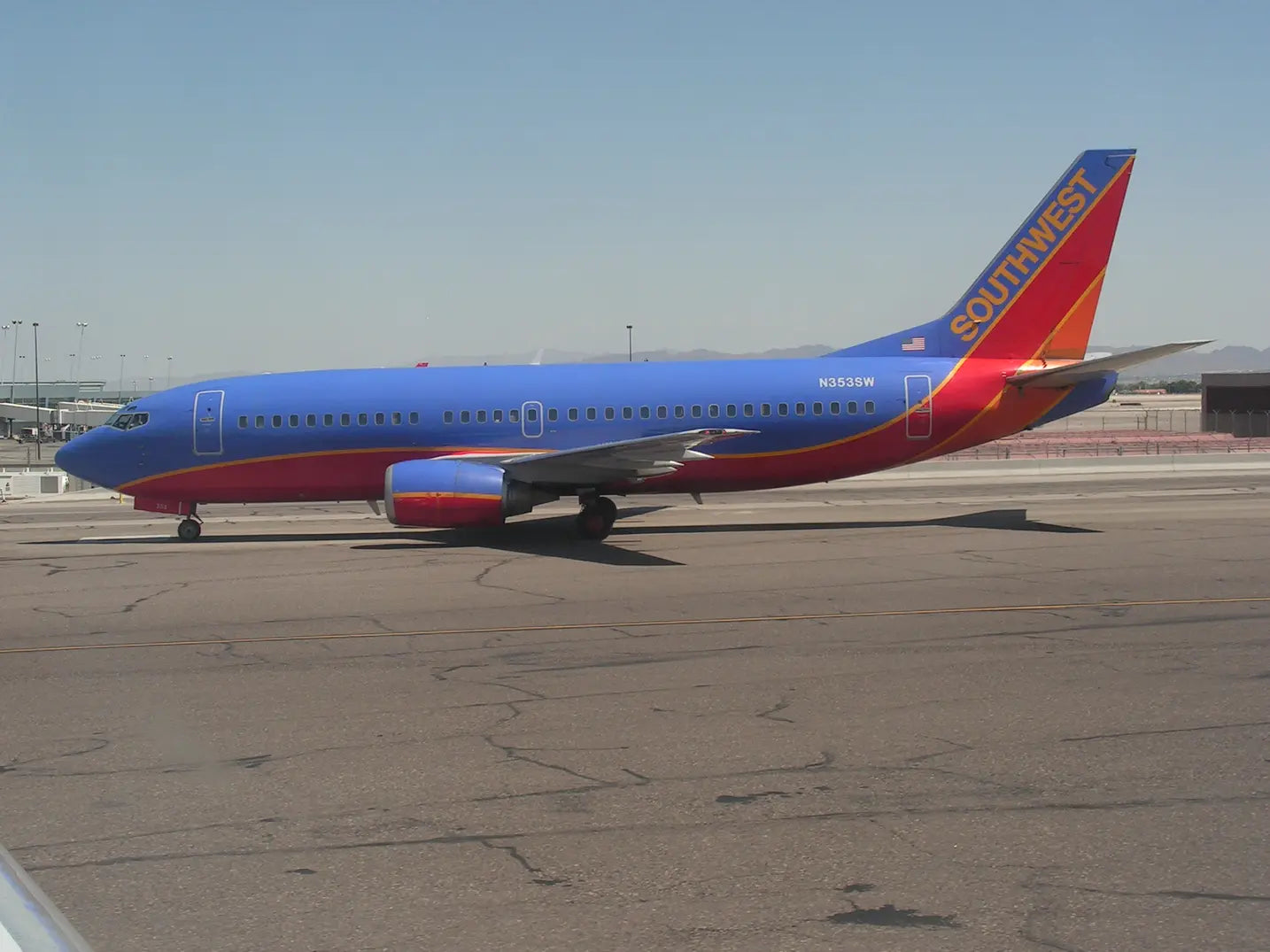
Southwest Airlines Overview & Company Profile
Southwest Airlines (IATA: WN, ICAO: SWA) is the largest low-cost carrier in the world and the fourth-largest U.S. airline by passengers carried. Founded in 1966 by Herbert Kelleher and Rollin King, with operations commencing in 1971, the airline pioneered the modern low-cost, point-to-point business model. It is headquartered at Love Field in Dallas, Texas, and trades on the New York Stock Exchange under the ticker LUV. Unusually for a global airline of its scale, Southwest is fully independent: it has no parent company and belongs to no airline alliance.
The carrier employs roughly 11,000 active pilots who fly an all-Boeing 737 fleet of approximately 800 aircraft, operating more than 4,000 flights per day to over 100 destinations across 42 U.S. states, Puerto Rico, Mexico, Central America, and the Caribbean. Total employment sits near 72,800 across the company. In 2024, Southwest posted record operating revenue of $27.5 billion and full-year net income of $465 million, with $9.7 billion in cash and short-term investments at year-end, according to the airline's official investor relations disclosures.
The carrier is in a transformative period. After more than five decades of open seating, free checked bags, and single-class boarding, Southwest is rolling out assigned seating from January 27, 2026, ended its iconic "two bags fly free" policy on May 28, 2025, expanded into red-eye flying in 2025, and ratified a five-year, $12 billion pilot contract with the Southwest Airlines Pilots Association (SWAPA) in January 2024. Activist investor Elliott Management held up to 16% of outstanding shares at peak, though by early 2026 it had reduced its position to about 9%.
Fleet Composition & Aircraft Strategy
Southwest operates the largest single-type fleet in commercial aviation. Every aircraft in the operation is a Boeing 737, a model continuity that defines training, scheduling, and career economics at the airline. The total active fleet stands at roughly 800 aircraft as of late 2025, making Southwest the fifth-largest commercial fleet in the world and by far the world's largest 737 operator, per the Southwest Airlines fleet records.
| Aircraft Type | Role | In Service | Notes |
|---|---|---|---|
| Boeing 737-700 | Narrowbody | ~294 | Workhorse for thinner routes. Being retired progressively through 2031. |
| Boeing 737-800 | Narrowbody | ~196 | Higher-density flying. Will be replaced by 737 MAX 8. |
| Boeing 737 MAX 8 | Narrowbody | ~310 | Largest active type. 186 additional MAX 8 firm orders. |
| Boeing 737 MAX 7 | Narrowbody | 0 | 269 firm orders. Awaiting FAA certification (expected 2026). |
Approximate counts as of late 2025. Southwest plans to retire all 571 Next-Generation (NG) 737s by 2031 to operate an all-MAX fleet.
The fleet renewal plan targets a complete shift to the 737 MAX family by year-end 2031. Once executed, the average fleet age is forecast to fall from roughly 11.5 years today to approximately 5 years, with substantial gains in fuel burn and maintenance economics. However, the program is constrained by Boeing production challenges and FAA certification delays affecting the MAX 7. Southwest disclosed in its 2025 annual report that it expects zero MAX 7 deliveries in 2026, with all 66 contracted MAX deliveries that year being the MAX 8 variant.
Because every Southwest aircraft is a 737, every pilot holds the same type rating. There is no fleet transition decision, no narrowbody-to-widebody bid window, and no wide-body Captain payband. Pilots are hired directly into the Boeing 737, and all training, recurrent, and currency requirements stay on one airframe family for an entire career at Southwest. This simplifies progression but also caps the variety of equipment a pilot will experience.
Pilot Salary & Compensation Under the 2024 Contract
Southwest pilot compensation is governed by the collective bargaining agreement between the airline and the Southwest Airlines Pilots Association (SWAPA), ratified on January 26, 2024 with 92.73% support on a 98.8% turnout. The five-year deal is valued at approximately $12 billion. It delivered an immediate 29.15% pay increase on ratification, followed by 4% raises in each of 2025, 2026, and 2027, and a final 3.25% raise in 2028. The contract becomes amendable on January 1, 2029.
Southwest uses a distinctive "trip-for-pay" structure rather than pure block-hour pay. A standard segment is defined as 243 statute miles; for each additional 40 miles, the pilot earns an extra 10% of segment pay. A monthly minimum guarantee protects income at 89 segments in a 31-day month or 87 in shorter months. Comparable hourly equivalents are widely published by SWAPA and reference sites such as Airline Pilot Central.
First Officer Pay Scale (2025)
| Seniority | Hourly Rate | Annual Gross (est.) | Notes |
|---|---|---|---|
| Year 1 (entry) | ~$133/hr | ~$90,000 – $115,000 | Baseline minimum guarantee applies. |
| Year 3–5 | ~$175 – $210/hr | ~$130,000 – $165,000 | Pay rises step-wise with longevity. |
| Year 7–10 | ~$230 – $250/hr | ~$170,000 – $220,000 | Mature F/O wage band; average ~$236/hr. |
| Senior F/O (12+ yrs) | ~$255/hr (top) | ~$200,000 – $240,000 | Top of F/O scale before upgrade to Captain. |
First Officer figures reflect 2025 rates post-29.15% raise plus the 4% adjustment. Actual annual earnings depend on segments flown and trip pickups.
Captain Pay Scale (2025)
| Seniority | Hourly Rate | Annual Gross (est.) | Notes |
|---|---|---|---|
| Year 1 Captain | ~$334/hr | ~$200,000 – $250,000 | Entry Captain rate, post-upgrade. |
| Captain, 5 yrs | ~$345 – $355/hr | ~$240,000 – $280,000 | Standard mid-career Captain band. |
| Senior Captain (12+ yrs) | ~$364/hr (top) | ~$260,000 – $310,000 | Top-of-scale longevity rate. |
| Senior Captain + max picks | N/A | $330,000 – $350,000+ | With heavy trip pickups and profit sharing. |
Captain hourly rates are post-2024 ratification. Annual totals scale strongly with extra flying since the line-minimum guarantee is conservative.
Per-diem rates are modest because the network is overwhelmingly domestic: $2.90/hr CONUS and $3.45/hr OCONUS, with a 2.5% escalator on each January 1. The bigger lifters of total compensation are profit sharing (12.2% of pilot eligible compensation, an industry pioneer originating in 1973) and the company's industry-leading retirement contribution (17% of pay rising to 18% in 2026; see Section 5).
Figures above are estimates compiled from SWAPA contract publications, Airline Pilot Central, Aviation A2Z reporting, and pilot forum disclosures. Actual earnings depend on segments flown, override pay, training pay, vacation pay, and profit sharing. Southwest's contract was benchmarked against Delta's 737 Captain pay plus 1% and Delta's 757 First Officer pay; in legacy comparisons it still trails Delta and United wide-body senior Captains, who routinely exceed $400,000 in base pay. Always verify against the latest SWAPA contract documents.
Roster Pattern & Quality of Life
The roster experience at Southwest is shaped by three structural facts: a single-type Boeing 737 fleet, a point-to-point (not hub-and-spoke) network, and a Preferential Bidding System (PBS) introduced under the 2024 contract with an 18-month implementation runway. Together they produce a schedule profile that many pilots regard as the best of any U.S. mainline carrier for work-life balance. Most trips are 1 to 4 days in length, the great majority of flying is domestic, and an unusually large share of pilots return to base every night or stay overnight in a domestic U.S. city within a short flight of home.
Line-holding pilots typically work 16 to 19 days per month, with the remaining days off. Reserve pilots are guaranteed a minimum of 15 days off per month. Pilots who pick up open time can substantially exceed base-line earnings, which has historically been a structural feature of Southwest pay culture. U.S. flight and duty rules under FAA Part 117 apply: maximum 100 flight hours in any 30 consecutive days and 1,000 in any 12 consecutive months, plus duty period limits driven by report time and segment count.
📅 Sample Month — Southwest 737 First Officer (Domestic Line Holder)
Trips in this sample are largely 2-day pairings with one overnight, a common Southwest pattern. Because the network is point-to-point, an overnight is usually a major U.S. city served by Southwest itself, hotels and ground transport are well established, and crew rest minimums under Part 117 are honored even on the tightest turnarounds.
Southwest pilots can bid any of the 12 published bases by seniority and a high proportion live outside their base, commuting via jumpseat or staff travel. Because the network has so many high-frequency city pairs, commuting is often easier than at carriers with concentrated hubs. The trade-off introduced in 2025 is the launch of red-eye flying (33 overnight flights in summer 2025), which adds a small share of circadian-disruptive pairings the airline historically avoided.
Benefits, Profit Sharing & Retirement
Southwest's benefits package is widely regarded as one of the strongest in U.S. commercial aviation. Two features stand out: the original employee profit-sharing program created in 1973 (the first of its kind at any U.S. airline) and the defined contribution retirement plan, where Southwest's non-elective company contributions for pilots are among the highest in the industry. The 2024 SWAPA contract added enhanced parental leave, improved disability benefits, and stepped up retirement contributions.
The combined 18% B-Fund plus 2% MBCBP starting in 2026, layered on top of the 12.2% profit sharing accrual and pilot deferrals, can drive total retirement contributions well above $60,000 a year for senior pilots, subject to the 2026 IRS 401(a)(17) limit of $360,000 and the 415(c) annual additions limit. By comparison, many U.S. peer carriers contribute 16% to 17% B-Fund without the MBCBP layer, per Creative Planning's published Southwest retirement guidance.
Southwest's domestic non-rev product is famously generous: free unlimited standby travel on Southwest for the pilot and immediate family, plus access to ZED fare programs across most major carriers. In 2025 Southwest tightened jumpseat policy to limit access to flight crew (pilots and flight attendants) only, ending broader non-flying employee jumpseat use. Pilots retain their cockpit jumpseat reciprocity through CASS.
Career Progression & Seniority
Career progression at Southwest is entirely seniority-based. Bid lines, vacation, base assignments, and Captain upgrade are all determined by seniority list position. The single-fleet operation means there is no "fleet upgrade" decision (no narrowbody-to-widebody jump), so a pilot's career is structured around two main milestones: passing initial line check as a First Officer, then upgrading to Captain when seniority allows.
Upgrade timing has historically averaged 10 to 15 years at Southwest, depending on retirement waves and hiring cycles. Demand is the swing factor. With Boeing MAX delivery shortfalls in 2024 to 2025, Southwest paused hiring and roughly 500 First Officers were placed on Extended Time Off (ExTO) status, which lengthened upgrade timelines temporarily. SWAPA's published projections show 313 mandatory retirements in 2025, 378 in 2026, 399 in 2027, and 395 in 2028: a combined ~1,485 Captain seats opening over four years, which will progressively absorb displaced F/Os and resume Captain progression.
| Career Milestone | Typical Timeline | Notes |
|---|---|---|
| Initial new-hire training | ~2 months | At Southwest's LEAD Center in Dallas. Type rating, sim, IOE. |
| First Officer line operation | Day 1 post-training | Direct entry on the Boeing 737. Bidable base. |
| F/O top of scale | ~12 years | Reach ~$255/hr longevity rate. |
| Captain upgrade | ~10 to 15 years | Subject to seniority and hiring/retirement waves. |
| Top-of-scale Captain | +12 years post-upgrade | Reach the ~$364/hr cap. |
| Check Airman / TRE / Instructor | Variable | Separate selection at the LEAD Center. |
Southwest paused active pilot hiring through most of 2024 and into 2025 in response to Boeing delivery delays and capacity discipline. By late 2025 the airline began signaling a possible return to limited hiring as MAX deliveries stabilized and mandatory retirements created absorption capacity. New hires can expect a longer wait before upgrade than at the height of the 2022 to 2023 hiring boom, but the structural demographics (retirement wave through 2028, plus a 269-aircraft MAX 7 order book on the horizon) point to an improving pipeline by the late 2020s.
Recruitment Process & Requirements
All pilot positions at Southwest are direct-entry First Officer roles on the Boeing 737. There is no cadet program of the European style. The closest equivalent is Destination 225°, Southwest's structured pathway program developed with partner flight schools, university programs, and military transition organizations, which provides a defined route to a Southwest interview for qualifying candidates. Applications are managed through the official Southwest Airlines pilot careers portal.
Core Requirements
Critically, Southwest counts only fixed-wing aircraft time. Simulator time, helicopter time, RIO/WSO/NAV/FE/EWO/UAV roles do not count toward the minimums. Military pilots can apply but must convert flight time to qualifying fixed-wing hours.
Selection Stages
Application via Pilot Credentials
Apply through the Southwest pilot careers portal during open application windows (historically opening on the 7th of each month). Submit logbook flight hour grid, certificates, medicals, and educational records.
References & Documentation Review
Applicants must collect three professional pilot recommendations through Southwest's automated reference system, plus submit transcripts, training records, and FAA records. Files are screened for completeness and competitiveness.
Online Technical Assessment
A computerized assessment evaluates aeronautical knowledge, jet systems, situational awareness, and basic personality factors. Pass rate is the gateway to the in-person interview.
Panel Interview & Simulator Evaluation
Conducted at the LEAD Center in Dallas. A panel of Southwest pilots and HR representatives assesses interpersonal skills, decision making, CRM, and cultural fit. A simulator evaluation (typically in a 737 fixed-base device) checks basic instrument flying, ATC compliance, and standard callouts.
Conditional Offer & Training
Successful candidates receive a conditional offer pending FAA Class 1 medical, background checks, DOT drug testing, and FAA records review. Class start dates depend on staffing needs. Initial training at the LEAD Center runs roughly two months: ground school, CPT/FBS, full-motion simulator, and Initial Operating Experience (IOE) on the line.
Southwest's interview emphasizes cultural fit and "Servant's Heart" leadership values as much as technical skill. Candidates should prepare structured behavioral answers (STAR format) and study the airline's history, route map, and 2024 SWAPA contract context. The simulator portion rewards stable instrument scan and verbal CRM, not aggressive maneuvering. The Destination 225° pathway program remains a strong differentiator: 225° is the runway heading from Love Field, an internal nod to the carrier's Dallas roots.
Pilot Bases & Top Overnight Cities
Southwest operates a network of 12 pilot crew bases across the United States, all served by Southwest's own flights, which makes commuting practical for many pilots even from outside their assigned base city. Unlike traditional layover culture at international carriers, Southwest's overnight pattern is overwhelmingly domestic, typically 10 to 16 hours, often in a city that the pilot will return through later in the same trip. Below is the current base list followed by the top overnight cities crews rotate through.
| Base | Airport | Profile |
|---|---|---|
| Dallas | DAL (Love Field) | Headquarters base. Largest, most senior. Heavy Texas/Central network. |
| Houston | HOU (Hobby) | Gulf Coast and southern operations hub. |
| Chicago | MDW (Midway) | Midwest operations hub; high frequency point-to-point. |
| Baltimore | BWI | Northeast and mid-Atlantic flying. SWAPA strike center in 2023. |
| Atlanta | ATL | Southeast operations. |
| Orlando | MCO | Florida leisure traffic; family-friendly base for many pilots. |
| Las Vegas | LAS | Largest western base. High pickup opportunity. |
| Los Angeles | LAX | California operations. |
| Oakland | OAK | San Francisco Bay Area base. |
| Phoenix | PHX | Southwest US hub with year-round flying. |
| Denver | DEN | Rocky Mountain region; fastest-growing recent base. |
| Nashville | BNA | Newest base, opened Q4 2024. Grew to 500-600 pilots in growth phase. |
Overnights are short, focused on rest, and concentrated in a handful of high-frequency cities. The five cities below are the most common overnight destinations for Southwest crews based on route frequency and operational structure.
Hotels are negotiated by Southwest and assigned automatically; pilots do not book their own accommodations. Transportation between hotel and airport is provided. Most overnights fall in the 10 to 16 hour range, supporting full FAR 117 rest opportunities. Because of the point-to-point network, many overnight cities are also bases, meaning the next leg back to home base is typically straightforward and well-staffed.
How Southwest Compares: Airline Radar Chart
How does Southwest stack up against the two U.S. legacy benchmarks, Delta Air Lines and American Airlines? Below is a comparative analysis using the same six metrics from the scorecard (five plotted on the radar). Scores are editorial estimates based on publicly available salary data, union publications, and industry benchmarks.
Key Takeaways from the Comparison
Southwest wins on quality of life and retirement benefits. The point-to-point network produces predictable, short pairings with most pilots either home each night or in a familiar domestic city. The 17% B-Fund (rising to 18% in 2026) and 1973-origin profit sharing combine for retirement contributions that are difficult to match elsewhere in U.S. aviation. The trade-off is a single-fleet operation: no wide-body upgrade window and no international long-haul pairings.
Delta leads on top-end salary and fleet diversity. Delta 737 Captain pay served as a benchmark for the 2024 SWAPA contract, and Delta's wide-body pay (A350, 767, 777) reaches around $405,000 to $460,000 in base hourly pay, with totals frequently exceeding $500,000 a year for the most senior pilots. Delta also offers a multi-fleet career path: a pilot can move from narrowbody to wide-body, captaining either side over time.
American is the middle path. American narrowbody 737 Captain hourly rates of $324 to $410 are competitive with Southwest's $334 to $364. American adds wide-body options (777, 787, A350-1000 on order) and a global long-haul network, but with a more traditional hub-and-spoke roster pattern and more multi-day international pairings.
Career progression is closer than it looks. All three majors have substantial retirement waves through 2028. Upgrade timelines have lengthened across the industry post-2022 hiring boom. The single-fleet structure at Southwest means there is no fleet-transition decision, but it also means Captain upgrade is the only major progression event in a Southwest career.
Scores are editorial estimates based on research into publicly available salary data, SWAPA contract publications, ALPA Delta and APA American Airlines contract comparison documents, airline 10-K filings, and industry benchmarks such as Airline Pilot Central and FlightDeckFriend. They represent a general assessment for an experienced pilot considering a long-term career. Individual experiences vary by seniority, base, and personal priorities. Scores for all three carriers will be revised as later contract updates and 2026 fleet plans are published.
SWAPA Union & Industrial Relations
The Southwest Airlines Pilots Association (SWAPA) is the sole certified bargaining representative for Southwest pilots, representing approximately 11,000 active members. SWAPA was formed in 1978 when Southwest pilots voted to leave the Air Line Pilots Association (ALPA) and establish an independent in-house union. It remains unaffiliated with ALPA, the AFL-CIO, or any other national labor body, making it one of the largest independent pilot unions in the United States. The organization is headquartered in Dallas at 1450 Empire Central Drive, near Love Field.
SWAPA Structure & Governance
Pilot labor agreements at Southwest are negotiated under the federal Railway Labor Act, which governs U.S. airline and rail labor relations. Contracts do not technically expire; they become "amendable" on a stated date, at which point either side may invoke renegotiation. The current contract, ratified January 26, 2024, is amendable on January 1, 2029.
Recent Industrial Relations Timeline
SWAPA is one of the most active and well-resourced independent pilot unions in the U.S. The 2024 contract substantially closed the historical wage gap with legacy peers and added meaningful gains on parental leave, retirement, and scheduling. Pilots remain under firm contract protection through end-2028, with the next negotiation cycle opening in 2029. Union dues are mandatory under the contract's union security clause. Engagement with SWAPA committees (Safety, Scheduling, Professional Standards) is a recognized path for pilots to influence working conditions over a career.
Verdict: Who Is Southwest Airlines For?
🎯 Our Take
Southwest Airlines is one of the strongest pilot careers available in the United States, particularly for pilots who prioritize quality of life, retirement security, and predictable domestic flying over wide-body progression or international long-haul flying. The combination of an all-737 fleet, point-to-point network, industry-leading 17 to 18% B-Fund contribution, 12.2% profit sharing, and a freshly ratified five-year contract through 2028 makes Southwest a top-tier U.S. mainline career.
The trade-offs are real: there is no wide-body upgrade, no long international pairings, and no fleet-diversity bid window. Captain upgrade has historically taken 10 to 15 years, currently lengthened by the 2024 to 2025 hiring pause linked to Boeing delivery delays. Strategic shifts in 2025 (assigned seating, end of free checked bags, red-eye flying, Elliott Management activism) introduce a degree of cultural uncertainty about the Southwest of the late 2020s. Senior wide-body Captains at Delta or United still earn meaningfully more in absolute terms.
For U.S.-authorized pilots who meet the FAA ATP and turbine minimums, who prefer a single-airframe career, and who place a premium on being home most nights, Southwest delivers one of the most balanced packages in the industry.
1 How much do Southwest pilots make in 2025?
Under the 2024 SWAPA contract, a Year 1 First Officer earns around $133 per hour (roughly $90,000 to $115,000 annually with the line minimum guarantee), rising to about $255 per hour at the top of the F/O scale. Captains start at around $334 per hour and reach $364 per hour at top of scale, with annual base earnings between $200,000 and $310,000 depending on tenure. Profit sharing and retirement contributions add substantially more on top.
2 What are the minimum requirements to apply?
Pilots need an unrestricted FAA ATP certificate, a current First Class Medical, at least 2,500 hours of fixed-wing total time or 1,500 hours of turbine time (1,000 hours turbine PIC preferred), 500 hours fixed-wing turbine (or Destination 225° graduate), age 23 or older, U.S. work authorization, three professional pilot recommendations, and a clean record. A bachelor's degree is preferred but not strictly required.
3 How long does it take to upgrade to Captain?
Historically 10 to 15 years, depending on retirement waves and hiring cycles. The 2024 to 2025 hiring pause and roughly 500 displaced First Officers have lengthened timelines in the short term. SWAPA projects ~1,485 mandatory retirements across 2025 to 2028, which should progressively reopen upgrade flow. Upgrade is strictly seniority-based and requires a sim check and oral.
4 Does Southwest accept direct-entry Captains?
No. All pilots are hired as First Officers and upgrade internally by seniority. The single-fleet operation means there is one pilot list and one progression path: F/O on the 737, then Captain on the 737.
5 What is Destination 225° and how does it help?
Destination 225° is Southwest's structured pathway program developed with partner flight schools, university aviation programs, and the U.S. military. Named after the runway heading at Dallas Love Field, it provides participants with a defined route to a Southwest interview after meeting milestones. It satisfies the 500-hour fixed-wing turbine requirement and is recognized as a strong differentiator for younger candidates.
6 What does Southwest contribute to retirement?
Through December 31, 2025, the B-Fund non-elective contribution is 17% of eligible pay, rising to 18% from January 1, 2026. The Market-Based Cash Balance Plan (MBCBP) adds 1% in 2025 and 2% in 2026. Layered on top is profit sharing at 12.2% of pilot eligible compensation, with the first 10% going to retirement and the rest as cash. Combined, this is among the most generous retirement architectures at any U.S. airline.
7 Where can I be based?
Southwest currently operates 12 pilot bases: Dallas (DAL), Houston (HOU), Chicago Midway (MDW), Baltimore (BWI), Atlanta (ATL), Orlando (MCO), Las Vegas (LAS), Los Angeles (LAX), Oakland (OAK), Phoenix (PHX), Denver (DEN), and Nashville (BNA, opened Q4 2024). Base assignment is awarded by seniority, and pilots can re-bid base on the regular bid cycle. Many pilots commute via jumpseat from outside their base.
8 Is Southwest hiring pilots right now?
Active hiring was paused through 2024 and most of 2025 due to Boeing 737 MAX delivery delays and Southwest's capacity discipline. As of late 2025, the airline was signaling cautious resumption tied to MAX delivery cadence and the eventual certification of the MAX 7. Aspiring candidates should check the official Southwest pilot careers page and the Pilot Credentials portal for current status.
9 How does Southwest compare to Delta and American?
Southwest leads on retirement contributions and quality of life. Delta leads on top-end salary, fleet diversity, and wide-body Captain pay. American sits between the two on pay and fleet, with global long-haul options Southwest does not offer. Captain progression timelines are broadly similar across the three (post-hiring boom), though Southwest's strictly seniority-based single-fleet model is the most predictable.
Official Links & Resources
Before applying or making any career decisions, always verify information directly with official sources. These are the key websites and organizations relevant to a career at Southwest Airlines:
Bookmark the SWAPA Fast Facts and Press Releases pages (swapa.org) for live updates on Southwest contract administration, retirement projections, hiring status, and base growth. The annual SWAPA Fast Facts PDF is the single most useful at-a-glance reference for prospective applicants. Also follow Southwest's quarterly earnings calls for fleet and headcount guidance.