

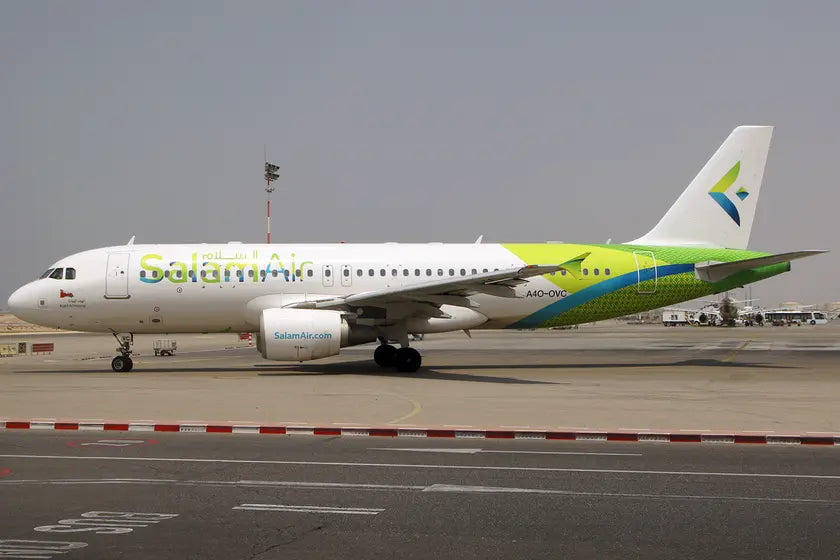
SalamAir Overview & Company Profile
SalamAir is the low-cost carrier of the Sultanate of Oman, headquartered and based at Muscat International Airport (MCT). It was created after the Muscat National Development and Investment Company (known as ASAAS) won a government tender in January 2016, and it launched commercial operations in 2017. From day one it has been positioned explicitly as a no-frills, high-utilisation budget airline rather than a full-service competitor to the flag carrier Oman Air. According to SalamAir's corporate profile, the airline today operates a modern all-Airbus narrowbody fleet and employs over 700 staff across flight operations, cabin crew, engineering, and ground functions.
The single most important recent development for any pilot weighing up SalamAir is its change of ownership. On 26 March 2026, the Government of Oman acquired a 90% stake in the airline, a transaction confirmed by the Oman News Agency, ch-aviation, and Aviation Week. The state framed the move as a step toward a more integrated national aviation sector sitting alongside Oman Air, although ch-aviation reported that Muscat intends to keep SalamAir running as a separate carrier rather than merging the two. For pilots, this shift matters: a majority state-owned low-cost carrier generally carries more financial backing and stability than a privately financed start-up, even though it does not on its own guarantee against future restructuring.
Commercially, SalamAir has grown quickly. The airline carried 3.2 million passengers in 2024 and publicly targeted more than four million in 2025, a roughly 25% year-on-year increase tied directly to fleet growth and aggressive seasonal scheduling. Its network, summarised on the airline's route map, spans the Gulf, the Indian Subcontinent, East Africa, and selected European points, with heavy domestic capacity to Salalah during the Khareef monsoon season. The airline does not belong to any global alliance, which is typical for a budget operator and means its interline reach is narrower than Oman Air's (which joined oneworld in 2025). Current leadership and milestone announcements are tracked on the airline's official press room.
SalamAir offers something increasingly rare: a young, single-family Airbus operation in a tax-free Gulf jurisdiction, attached to a growth plan that runs to 2028, and now underpinned by state ownership. It will not match the headline salaries of flydubai, Emirates, or Qatar Airways, but for pilots who value a stable Muscat base, modern aircraft, and predominantly home-based short and medium-haul flying, it is a credible Gulf option. The trade-off is transparency: SalamAir publishes far less about pay, rosters, and benefits than the region's listed majors, so any candidate must verify the specifics in writing during recruitment.
Fleet Composition & Type Ratings
SalamAir runs one of the youngest and most homogeneous fleets of any Gulf carrier. It flies the Airbus A320 family exclusively, and it was the first Omani operator to introduce the new-generation A320neo and A321neo. As of early 2026, ch-aviation counted 15 aircraft: six A320neo and eight A321neo passenger jets (a mix of standard A321-200N, the higher-thrust A321-200NX, and longer-range A321-200NX(LR) variants), plus one A321-200P2F freighter listed as inactive. The airline's own fleet page describes the same A320neo and A321neo backbone, and independent trackers such as Planespotters corroborate the fleet size and age.
That homogeneity is good news for pilots. A single-type operation means one type rating, one set of standard operating procedures, simpler recurrent training, and no competitive bidding between radically different aircraft families. The tilt toward the larger A321neo also signals where the airline is heading: more seats per departure on dense trunk and labour routes, with the smaller A320neo handling thinner sectors. SalamAir reported in mid-2025 that adding its 14th aircraft cut the average fleet age from 5.6 years to roughly 4.8 years, which is exceptionally young by world standards and tends to translate into strong dispatch reliability and modern, fuel-efficient flight decks.
| Aircraft Type | Role | In Service | Notes |
|---|---|---|---|
| Airbus A320neo | Narrowbody | 6 | Thinner regional and domestic sectors. First neo type at the airline. |
| Airbus A321neo (A321-200N) | Narrowbody | ~5 | Higher-density trunk routes such as Muscat to Salalah. |
| Airbus A321neo (A321-200NX) | Narrowbody | ~1 | Higher-thrust variant for performance-limited fields. |
| Airbus A321neo LR (A321-200NX(LR)) | Narrowbody | ~3 | Longer-range sectors into South Asia and Europe. |
| Airbus A321-200P2F | Freighter | 1 | Listed as inactive. Cargo also moves in passenger belly holds. |
Fleet breakdown as of early 2026 per ch-aviation and Wikipedia. Variant counts are approximate and shift with deliveries.
Fleet growth is central to the SalamAir story and to its career proposition. In February 2025 the airline announced an order for 10 additional aircraft, with deliveries beginning in the second quarter of 2026, aiming to grow the fleet to 25 aircraft by 2028. Wikipedia's fleet table (dated August 2025) additionally lists a planned Embraer E195-E2 order that has been deferred, so the practical expansion path remains firmly Airbus narrowbody. A near-70% fleet increase over three years is the kind of expansion that drives recruitment and, in time, command opportunities, though it also keeps existing aircraft and crews working hard during the ramp-up.
Pilots join SalamAir on the Airbus A320 family. Experienced applicants must already hold a current A320 type rating, while cadets and non-type-rated First Officers are brought on and type-rated by the airline before line operations. Because the operation is single-type, there is no widebody transition to bid for and no separate long-haul fleet: the entire career at SalamAir is flown on the A320 and A321. Candidates should confirm in writing whether any type-rating cost is bonded, as is standard practice across the Gulf (covered in the recruitment section).
Pilot Salary & Compensation Breakdown
This is the section where honesty matters most. SalamAir does not publish pilot pay scales, and there is no collective agreement to reference because Oman does not permit pilot unions. The only specific salary figures in the public record come from anonymous submissions aggregated by Pilot Jobs Network and a small number of self-reported entries on Glassdoor. Everything below should therefore be read as indicative, not as an official scale. The one structural advantage is unambiguous and significant: salaries in Oman are paid free of personal income tax, and the Omani rial is pegged to the US dollar at roughly 1 OMR to 2.60 USD, so gross pay converts almost one-for-one to net.
First Officer (FO) Pay
| Component | Reported Figure | Approx. USD (tax-free) | Source / Note |
|---|---|---|---|
| Monthly base salary | 2,300 – 2,450 OMR | ~$5,980 – $6,370 / mo | Pilot Jobs Network (anonymous, 2022/2024) |
| Reported annual range | 26,000 – 29,000 OMR | ~$67,600 – $75,400 / yr | Glassdoor self-reported, Muscat |
| Estimated total (with flying pay & allowances) | n/a | ~$70,000 – $85,000 / yr | Editorial estimate, benchmarked vs Air Arabia |
First Officer figures are indicative only. Base salary is the most consistently reported number; total earnings depend on hourly flying pay, allowances, and block hours flown.
Captain (Commander) Pay
No reliable fixed Captain base salary is published. What the anonymous data do show is a tiered hourly flying supplement that rises sharply with monthly block hours, rewarding pilots in high-utilisation months. Combined with a fixed base and allowances, this points to a total package that sits below flydubai and the top Gulf majors but is broadly competitive with Air Arabia.
| Monthly Block-Hour Band | Extra Pay per Block Hour | Approx. USD | Note |
|---|---|---|---|
| 0 – 30 hours | 5 OMR / hr | ~$13 / hr | Lowest tier |
| 31 – 60 hours | 10 OMR / hr | ~$26 / hr | Mid tier |
| 61 – 90 hours | 20 OMR / hr | ~$52 / hr | Most common operating band |
| 91+ hours | 40 OMR / hr | ~$104 / hr | Premium tier, capped by FTL rules |
| Estimated total package | n/a | ~$110,000 – $140,000 / yr | Editorial estimate (between Air Arabia and Oman Air) |
Captain block-hour tiers per Pilot Jobs Network (anonymous, dated 2022). The total-package figure is an editorial estimate, not a published number.
The tiered structure has a real effect on monthly take-home. A Captain flying around 75 block hours could earn roughly 1,050 OMR (about $2,730) in variable flying pay on top of base and allowances, and the highest 40-OMR band only applies once monthly hours pass 90, which the Oman Civil Aviation Authority duty limits keep in check. The same kind of escalating hourly structure is understood to apply to First Officers at lower rates. In short, total pay at SalamAir is base plus hours, so a pilot's earnings track how busy the roster is in any given month.
SalamAir publishes no official pilot pay scales. The figures here are compiled from anonymous pilot submissions (Pilot Jobs Network), self-reported data (Glassdoor), and comparison with peer Gulf carriers (Air Arabia, flydubai, Oman Air). They should be treated as a starting point for negotiation, not as confirmed contract terms. The genuine advantages, tax-free income and a stable OMR-USD peg, are well documented; the precise base salaries, allowance values, and any sign-on or productivity payments are not. Always request a full written breakdown from SalamAir recruitment before making a decision.
Roster Pattern & Quality of Life
SalamAir does not disclose detailed roster parameters, but its operating profile and the regulatory framework give a clear picture. As an all-A320 family low-cost carrier flying more than 80 sectors a day from a single Muscat base, it aims for high aircraft utilisation, which in turn drives relatively high pilot block hours. Working by analogy with Oman Air's narrowbody operations under the same regulator, SalamAir pilots can reasonably expect roughly 65 to 80 block hours per month, edging higher during seasonal peaks but staying within the Civil Aviation Authority of Oman flight time limitation (FTL) rules. Those rules, modelled on ICAO Annex 6 and broadly aligned with EASA and FAA philosophy, cap daily flight duty periods (generally in the 11 to 13 hour range depending on report time and sector count) and mandate minimum rest.
The day-to-day texture is classic short-haul: multiple sectors per duty, quick turnarounds, a high ratio of take-offs and landings to cruise time, and a mix of early and late report times across the month. The upside is that most trips begin and end in Muscat, so pilots sleep at home far more often than long-haul colleagues. The Khareef monsoon season brings a domestic surge: during Khareef 2025 the airline operated 962 flights between Muscat, Sohar, and Salalah (up 46% year-on-year), so summer months can mean intense rotations on the Salalah shuttle interspersed with mandated rest days.
📅 Sample Month — A320 First Officer (Muscat)
Illustrative roster only. SalamAir does not publish crew rosters; this pattern is modelled on typical Gulf LCC narrowbody operations and CAA Oman FTL limits, not on a confirmed SalamAir schedule.
All SalamAir pilots are based in Muscat. There is no published out-station base system and no formal commuting contract, so living in or near Muscat is effectively required. Oman's capital is regarded as safe and relaxed, with lower living costs than Dubai or Doha, good healthcare, and a modest but growing expatriate community. For pilots who prefer a quieter Gulf lifestyle over the intensity of the big hubs, Muscat is a genuine draw; for those who want extensive commuting flexibility or a choice of bases, the single-base model is a constraint to weigh carefully.
Benefits, Allowances & End of Service
SalamAir has not published a full pilot benefits schedule, so this section combines the airline's known position with the statutory rights every Omani employer must provide and the standard practices of peer Gulf carriers. The headline point is that as a lean low-cost carrier, SalamAir's package is likely closer to Air Arabia's LCC model than to Oman Air's more generous flagship offering, but the tax-free environment and Omani labour protections still make it competitive in real terms.
Omani labour law entitles private-sector expatriate employees to an end-of-service gratuity calculated on the last basic salary, not total pay including allowances. The standard formula is 15 days of basic salary for each of the first three years of service, then one full month of basic salary for each subsequent year, paid as a tax-free lump sum on departure. Over a long stay this is a meaningful wealth-building feature. The catch is structural: if SalamAir sets a low basic salary and loads compensation into allowances and flying pay, the gratuity base is correspondingly smaller. Ask exactly how "basic salary" is defined in your contract, because it directly determines this payout.
Confirmed for SalamAir: tax-free income, the OMR-USD peg, and the statutory end-of-service gratuity that applies to all Omani employers. Inferred from peer carriers and general Gulf practice: housing support, medical cover scope, schooling allowance, per diems, and staff-travel terms. Loss-of-licence insurance is not confirmed as company-provided. Because benefit detail is the least transparent part of SalamAir's offer, candidates should treat the recruitment conversation as the moment to pin down every line item in writing.
Career Progression & Seniority
Career progression at SalamAir is shaped by two forces: a structured cadet-to-First-Officer pipeline that feeds local talent into the airline, and a fleet expansion plan that should open command opportunities over the coming years. The airline has not published a formal seniority list or upgrade policy, so the picture is less codified than at large unionised carriers, and management discretion likely plays a larger role in upgrades and bidding than at airlines with collective agreements.
On upgrade timing, SalamAir has not stated a figure. As a guide, new-hire First Officer to Captain timelines of roughly five to eight years are common across rapidly growing Gulf low-cost carriers, and they shorten during fleet expansion and lengthen during downturns. SalamAir's plan to grow from about 15 to 25 aircraft by 2028 is precisely the kind of expansion that creates command vacancies, so a First Officer joining now and performing well could reasonably expect a realistic upgrade path within that band, subject to meeting the regulator's command experience thresholds and positive internal assessment. This remains an estimate rather than a published commitment.
| Career Milestone | Typical Timeline | Notes |
|---|---|---|
| Cadet / non-type-rated entry | Day 1 | Frozen ATPL with ~200 hrs. Airline provides A320 type rating. |
| Type-rated direct-entry F/O | Day 1 | 1,000 hrs total, 500 on A320, current A320 rating. Expat-friendly. |
| Line First Officer | After line training | A320/A321 short and medium-haul out of Muscat. |
| Senior First Officer | Hours-dependent | Higher flying-pay tiers as experience and block hours build. |
| Captain upgrade | ~5 – 8 yrs (est.) | Subject to command requirements, fleet growth, and assessment. Not a published figure. |
| Training / instructor roles | Variable | TRI/TRE positions require separate selection and instructor training. |
Timelines for senior milestones are editorial estimates based on Gulf LCC norms, as SalamAir does not publish upgrade or seniority data.
The 2026 acquisition of a 90% stake by the Government of Oman raises an open question for long-term career planning. With SalamAir and Oman Air now both state-controlled, closer coordination could, in time, create movement between the two carriers, for example a path from SalamAir's A320 operation toward Oman Air's widebody fleets. However, no joint seniority list or cross-fleet transfer policy has been announced, and ch-aviation reported the government intends to keep the two airlines separate. For now, treat SalamAir as a standalone employer with its own ladder, while noting that the broader Omani aviation strategy could reshape options later this decade.
Recruitment Process & Requirements
SalamAir recruits along two tracks: experienced, type-rated pilots who apply directly as First Officers (and Captains), and a lower-time pathway for cadets and non-type-rated First Officers that doubles as the airline's local-talent pipeline. Vacancies are posted through the airline's Careers portal (linked in the footer of salamair.com) and through specialist recruitment platforms such as PilotAssessments and SkyBound, which host SalamAir's A320 First Officer adverts and manage the assessment process.
Experienced A320 First Officer — Requirements
Cadet / Non-Type-Rated First Officer — Requirements
Indicative Selection Stages
Online Application & Screening
Apply through the SalamAir Careers portal or a partner platform (PilotAssessments, SkyBound). Licences, hours, medical, and English level are screened against the relevant track before any invitation to assess.
Aptitude & Technical Assessment
Computer-based aptitude testing and aviation technical knowledge are typical for both tracks, often administered through the recruitment platform. Cadets face a stronger emphasis on raw aptitude; experienced pilots on technical and type knowledge.
Simulator Assessment
A simulator check evaluates handling, procedures, and crew cooperation. For type-rated First Officers this is on the A320; for cadets it assesses trainability and basic flying skills.
Interview & HR Review
A competency and CRM-focused interview, plus document and background verification. SalamAir's adverts stress situational awareness, a safety-led mindset, and compliance with company SOPs.
Offer, Type Rating & Line Training
Successful candidates receive an offer; non-type-rated joiners complete the A320 type rating before line training. Confirm any training bond, contract length, and licence-conversion steps with the Civil Aviation Authority of Oman at this stage.
SalamAir's cadet scheme is framed as a national-development programme. Its 9th cadet batch comprised 17 cadets, 15 of them Omani nationals, reflecting a strong (though not absolute) preference for Omani citizens on the cadet track. Experienced type-rated First Officer and Captain roles, by contrast, are openly expat-friendly and advertise visa sponsorship. The practical takeaway: international pilots should target the experienced, type-rated routes, while the cadet pathway is primarily geared toward developing local Omani talent.
SalamAir's current adverts do not spell out a training bond, but Gulf carriers routinely bond expensive type ratings, typically for two to three years with pro-rated repayment if a pilot leaves early. Given the cost of an A320 type rating, prospective joiners (especially cadets and non-type-rated First Officers) should assume a service commitment exists and request the exact bond amount, duration, and waiver conditions (for example, medical loss of licence or company-initiated termination) in writing before accepting an offer.
How SalamAir Compares: Airline Radar Chart
The most useful comparisons for SalamAir are its direct low-cost peers in the Gulf: Air Arabia, the established Sharjah-based A320 operator, and flydubai, the Dubai government-backed Boeing 737 carrier. Both fly a similar short and medium-haul model and compete for the same narrowbody pilots. The chart below scores all three across the six scorecard metrics. Scores are editorial estimates based on published data, anonymous pay reports, and industry benchmarks.
Key Takeaways from the Comparison
flydubai leads on pay. A flydubai First Officer's total monthly compensation runs to roughly $11,800 (around $140,000 to $145,000 a year), and Captains approach $195,000, well ahead of both Air Arabia and SalamAir. Air Arabia First Officers earn roughly $78,000 to $92,000 and Captains about $131,000 to $150,000 a year. SalamAir's estimated First Officer earnings of around $70,000 to $85,000 and Captain packages near $110,000 to $140,000 place it broadly alongside Air Arabia and below flydubai, all tax-free.
SalamAir's standout strength is its fleet. An all-A320neo and A321neo fleet averaging under five years old is younger than Air Arabia's A320 family fleet and avoids the 737 MAX program complications that have touched Boeing operators. For pilots who value modern flight decks and reliable, fuel-efficient aircraft, SalamAir scores at the top of this group.
Benefits favour the bigger operators. flydubai's package is widely regarded as the most generous of the three in raw numbers, and Air Arabia's LCC package is well documented. SalamAir, as a smaller carrier outside any global alliance, likely offers leaner benefits and narrower staff travel, which is why it scores slightly lower here despite the tax-free baseline shared across the Gulf.
Job security has improved at SalamAir. The 2026 acquisition by the Government of Oman puts state backing behind the airline, comparable in principle to flydubai's Dubai government ownership. Air Arabia is privately held but consistently profitable and well established. All three rate solidly, with SalamAir's score reflecting both its new state support and the cost-focused, non-unionised environment in which it operates.
Scores are editorial estimates drawn from publicly available salary data, anonymous pilot pay reports (Pilot Jobs Network), peer airline guides, fleet databases, and industry coverage. They represent a general assessment for an experienced narrowbody pilot considering a long-term Gulf posting. SalamAir's lower transparency means its scores carry more uncertainty than those of the larger comparators. Individual experiences will vary with seniority, monthly hours, and personal priorities.
Regulation, Labour Framework & Job Security
Oman has no independent pilot union and does not permit collective bargaining in the way common in Europe or North America. That single fact reshapes how working conditions are set: there is no SalamAir collective agreement to point to. Instead, pilot terms are governed by individual employment contracts operating within Omani labour law, company policy, and the safety regulations enforced by the Civil Aviation Authority of Oman. For pilots used to union-negotiated protections, this means more reliance on the regulator's safety floor and on personal due diligence at the contract stage.
The Regulatory Framework
The Civil Aviation Authority of Oman (which replaced the former Public Authority for Civil Aviation) oversees licensing, medical standards, and operator approvals. Its Civil Aviation Regulations cover Flight Crew Licensing (CAR-FCL) and Commercial Air Transport Operations (CAR OPS-1), the latter updated to reflect ICAO Annex 6. In practice this gives SalamAir pilots an FTL and rest framework broadly aligned with EASA and FAA principles: defined maximum flight duty periods, minimum rest, cumulative limits, and fatigue management. Foreign pilots must convert their licences to Omani licences through the CAA, and the authority's pilot licensing service sets out the process.
Milestones Shaping Job Security
2016 — Tender Won
Muscat National Development and Investment Company (ASAAS) wins a government tender to launch Oman's first low-cost carrier, anchoring SalamAir within national transport strategy from the outset.
2017 — Operations Begin
SalamAir starts commercial flying, building a domestic and regional network from its Muscat base on an Airbus A320 family fleet.
Feb 2025 — 10-Aircraft Order
The airline orders 10 additional Airbus narrowbodies, targeting a fleet of 25 by 2028 and signalling sustained recruitment and command demand.
2025 — Record Growth
SalamAir reports 3.2 million passengers in 2024 and targets four million-plus in 2025, with a 46% jump in Khareef-season domestic flying.
Mar 2026 — Government Acquires 90%
The Government of Oman takes a 90% stake, placing SalamAir within a state-backed aviation sector alongside Oman Air while keeping it a separate carrier.
State ownership and a clear growth plan strengthen SalamAir's medium-term stability, and the CAA framework provides a genuine safety and rest baseline. But state backing is not a guarantee against restructuring (Oman Air itself cut jobs between 2024 and 2025), and the absence of a union means individual pilots have limited formal leverage over rostering and pay. The practical advice is consistent: rely on the regulator for safety protections, and on a carefully reviewed individual contract for everything else, including roster guarantees, bond terms, and gratuity calculation.
Verdict: Who Is SalamAir For?
🎯 Our Take
SalamAir is a credible, mid-tier Gulf low-cost carrier with two clear strengths: an exceptionally young, single-family Airbus fleet, and a tax-free Omani pay environment now backed by majority government ownership. For a narrowbody pilot who wants modern aircraft, a stable Muscat base, predominantly home-based short and medium-haul flying, and a growing airline with command potential through 2028, it is a sensible place to build or continue a career.
The trade-offs are real and should not be glossed over. Pay sits below flydubai and the top Gulf majors, and is broadly in line with Air Arabia. Transparency is limited: the airline publishes no official salary scales, roster parameters, or benefit schedules, so candidates must verify the specifics in writing. There is no pilot union and no collective agreement, the operation is single-base in Muscat with no formal commuting scheme, and the cadet track is primarily reserved for Omani nationals.
For experienced, type-rated A320 pilots who value financial efficiency, a quieter Gulf lifestyle, and a young fleet over the highest possible salary, SalamAir is worth serious consideration. For those chasing maximum earnings, widebody flying, or union-backed protections, the larger Gulf carriers will fit better.
1How much do SalamAir pilots earn?
SalamAir does not publish pay scales. Anonymous data from Pilot Jobs Network indicate a First Officer base of roughly 2,300 to 2,450 OMR per month (about $5,980 to $6,370), with Glassdoor self-reports suggesting around 26,000 to 29,000 OMR a year. With hourly flying pay and allowances, total First Officer earnings likely land near $70,000 to $85,000 a year, and Captain packages are estimated around $110,000 to $140,000, all tax-free. Treat these as indicative and confirm with the airline directly.
2Does SalamAir hire expat pilots or only Omani nationals?
Both, but the tracks differ. Experienced, type-rated First Officer and Captain roles are openly expat-friendly and advertise visa sponsorship, with no nationality restriction. The cadet and non-type-rated pathway is heavily focused on developing Omani talent: SalamAir's 9th cadet batch had 15 Omani nationals out of 17. International pilots should therefore aim at the experienced, type-rated routes.
3What are the requirements to become a SalamAir First Officer?
For the experienced, type-rated First Officer role, recruitment adverts list a current ICAO CPL or frozen ATPL, a minimum of 1,000 hours total time and 500 hours on the A320 family, a current A320 type rating, a valid Class 1 medical, ICAO English Level 4 or above, and a clean safety record. The minimum age is 18. Foreign licences must be converted to Omani licences through the Civil Aviation Authority of Oman.
4Does SalamAir have a cadet pilot programme?
Yes. SalamAir runs a cadet and non-type-rated First Officer pathway for lower-time pilots holding a frozen ATPL (around 200 hours), with ICAO English Level 4 and IELTS 5.0 minimum, an age limit under 36, and the A320 type rating provided by the airline. The programme has graduated multiple cadet batches and is framed as a national-development scheme, so it strongly favours Omani nationals in practice.
5Is SalamAir a stable employer after the government takeover?
The Government of Oman acquired a 90% stake on 26 March 2026, placing SalamAir within a state-backed aviation sector alongside Oman Air while keeping it a separate carrier. State ownership plus a fleet growth plan to 2028 generally support stability. However, state backing does not rule out restructuring (Oman Air cut jobs in 2024 to 2025), and there is no pilot union, so pilots rely on individual contracts and the regulator's safety framework rather than collective protection.
6What aircraft does SalamAir fly?
SalamAir operates an all-Airbus A320 family fleet: roughly six A320neo and eight A321neo passenger aircraft (in standard, NX, and long-range variants), plus one A321 freighter listed as inactive, for about 15 aircraft in total. The average fleet age is under five years. The single-type operation means one type rating and one set of procedures, and the airline plans to grow to 25 aircraft by 2028.
7Where are SalamAir pilots based, and is commuting possible?
All SalamAir pilots are based in Muscat. There is no published out-station base and no formal commuting contract, so living in or near Muscat is effectively required. The flying is predominantly short and medium-haul out of a single base, which means pilots are home most nights rather than spending long periods on layover, a quality-of-life plus for many crews.
8How long does it take to upgrade to Captain at SalamAir?
SalamAir does not publish an upgrade timeline. Across rapidly growing Gulf low-cost carriers, First Officer to Captain progression of roughly five to eight years is common, and it tends to shorten during fleet expansion. SalamAir's plan to grow from about 15 to 25 aircraft by 2028 should help, but upgrades depend on meeting command experience requirements, internal assessment, and fleet needs. Treat any specific figure as an estimate, not a guarantee.
Official Links & Resources
Before applying or making any career decision, verify the details directly with official and authoritative sources. Because SalamAir publishes limited pilot-specific information, the recruitment conversation and the regulator's pages are your most reliable references. These are the key links relevant to a SalamAir pilot career:
Follow the SalamAir press room for the most reliable, dated company announcements (fleet, network, and ownership), and cross-check fleet movements on Planespotters. Because the airline publishes little on pay and rosters, the single most valuable thing you can do is request a complete written breakdown of base salary, flying pay, allowances, bond terms, and gratuity calculation during recruitment, then compare it against the Air Arabia and flydubai benchmarks in this guide.