

Qatar Airways Overview & Company Profile
Qatar Airways is the state-owned flag carrier of the State of Qatar, founded in 1993 and relaunched under new ownership in 1997. It is wholly owned by the Qatari government through the Qatar Investment Authority and operates exclusively from Hamad International Airport (DOH) in Doha, a US$16 billion purpose-built hub that replaced the former Doha International Airport in 2014. Qatar Airways joined the oneworld alliance in October 2013, becoming the first Gulf carrier to do so, and serves as a key feeder for partners such as British Airways, American Airlines, Cathay Pacific, and Qantas.
The airline currently operates a fleet of roughly 237 active aircraft serving close to 180 destinations across six continents, with intercontinental services that consistently rank among the highest in passenger surveys. According to recent corporate disclosures, the Qatar Airways Group generated approximately US$22 to 24 billion in revenue for the 2024 to 2025 reporting period, having staged a powerful post-pandemic recovery driven by cargo strength, premium cabin yield, and the airline's flagship Qsuite business product. Badr Mohammed Al-Meer assumed the role of Group Chief Executive Officer in November 2023, succeeding Akbar Al Baker after his 27-year tenure.
For pilots, Qatar Airways represents one of the most demanding yet financially rewarding postings in commercial aviation. The carrier operates one of the youngest widebody fleets in the world, with the Airbus A350 and Boeing 777 forming its long-haul backbone. The hub-and-spoke model centred on Doha allows for direct connections between Europe, Africa, Asia, the Americas, and Oceania within a single transit window. All pilots are based in Doha, with no satellite bases or commuting options.
Qatar Airways is not a publicly traded company. As a wholly state-owned enterprise under the Qatar Investment Authority, it operates without the quarterly shareholder pressure that shapes most Western carriers. This sovereign backing has historically translated into stable funding for fleet renewal and major orders, including the 2022 acquisition contract for additional Boeing 787-9s and the December 2023 fleet announcements at the Dubai Airshow. For pilots, this means a financially robust employer, but also one whose strategic direction is closely linked to Qatari government policy.
Fleet Composition & Type Ratings
Qatar Airways operates one of the most modern and most widebody-heavy fleets among the world's major carriers. Approximately three-quarters of the active fleet consists of long-haul twin-aisle aircraft, reflecting the airline's role as a sixth-freedom transit hub connecting Europe, Africa, the Americas, and Asia-Pacific via Doha. The narrowbody operation is comparatively small and used predominantly for short to medium-range regional flying within the Middle East, the Indian subcontinent, and parts of Europe and Africa. According to fleet trackers cross-referenced with the official Qatar Airways fleet pages, the current composition breaks down approximately as follows:
| Aircraft Type | Role | In Service | Routes / Notes |
|---|---|---|---|
| Airbus A320-200 | Narrowbody | ~27 | Regional and short-haul flying. Mostly Middle East, India, North Africa. |
| Airbus A321-200 | Narrowbody | ~6 | Higher-density regional routes. Limited number in operation. |
| Airbus A330-200 / -300 | Widebody | ~16 | Older long-haul type. Progressively retired as A350 deliveries arrive. |
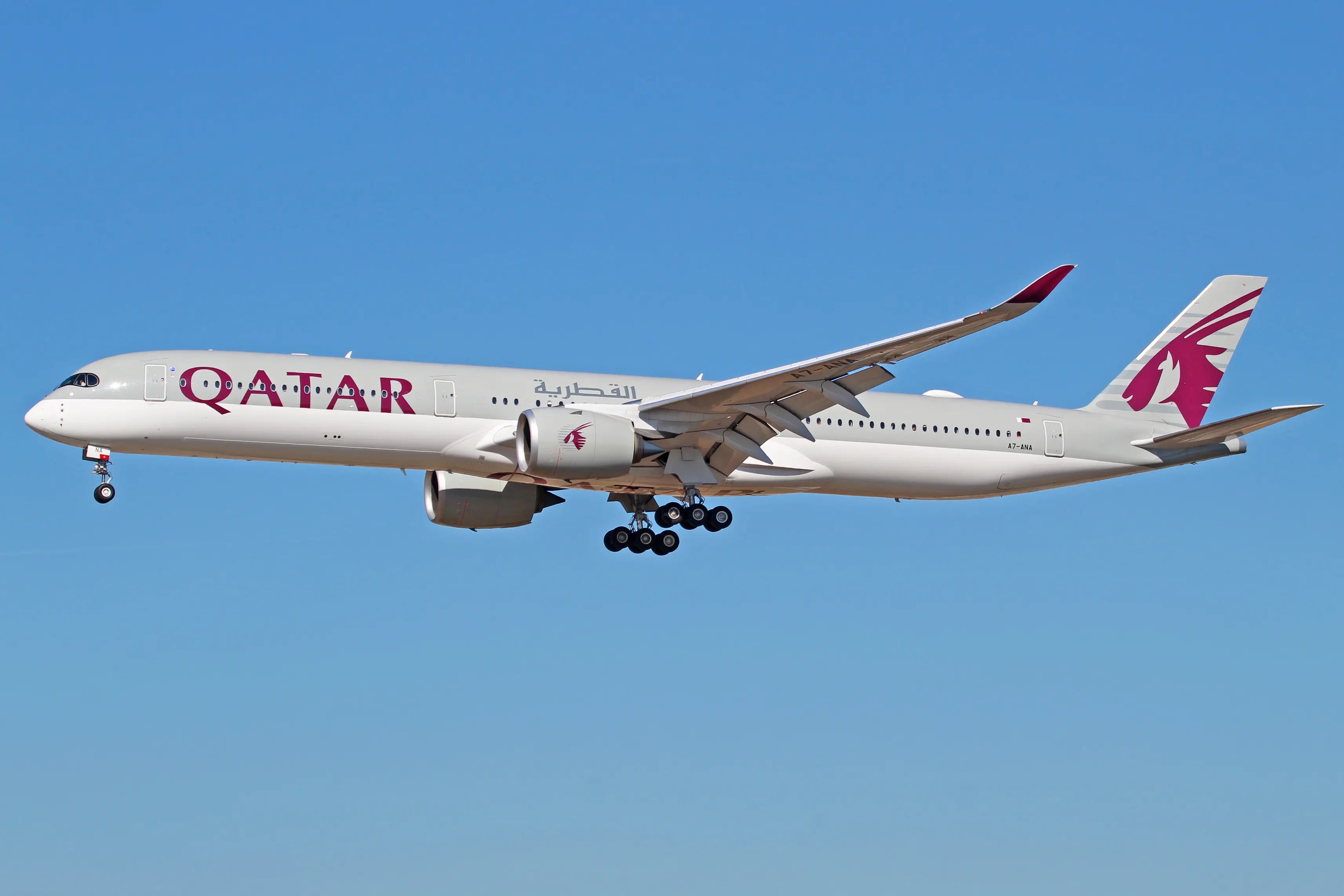
| Airbus A350-900 | Widebody | ~34 | Long-haul backbone. Routes to North America, Asia, Australasia. |
| Airbus A350-1000 | Widebody | ~25 to 28 | Flagship long-haul. Qsuite cabin. London, New York, Sydney, Doha hub flying. |
| Boeing 777-200LR | Widebody | ~35 | Ultra long-haul. Auckland, Houston, Buenos Aires connections. |
| Boeing 777-300ER | Widebody | ~57 | Long-haul workhorse. High density and premium configurations. |
| Boeing 787-8 | Widebody | ~32 | Medium long-haul. Mix of European, African, and Asian routes. |
| Boeing 787-9 | Widebody | ~23 | Recent additions. Suite-equipped on most frames. |
| Boeing 777F | Freighter | ~28 | Qatar Airways Cargo. Separate operation. Doha cargo hub. |
| Airbus A380-800 | Widebody | Stored / minimal use | Largely grounded since 2021. Future uncertain; no formal permanent retirement. |
Fleet numbers as of late 2025 to early 2026. Figures vary slightly between Planespotters, Flightradar24, and the official Qatar Airways fleet page depending on stored aircraft and timing of new deliveries.
The fleet is in an active renewal phase. Qatar Airways placed a major order for additional Boeing 777-9 aircraft at the Dubai Airshow, with deliveries expected as the type achieves FAA certification in the late 2020s. The airline also added an order for additional Boeing 787-9 aircraft and is taking delivery of Airbus A350-1000s alongside continuing 787 deliveries. The Airbus A380 fleet, which once peaked at ten frames, has been largely sidelined since 2021, although the airline has not announced a formal permanent retirement of the type.
Qatar Airways covers the cost of type rating for all pilots recruited through its official Direct Entry programmes. Direct Entry First Officers (DEFOs) typically receive their assignment based on operational need rather than personal preference, with new joiners frequently placed on the Airbus A350, Boeing 787, or Boeing 777 family. Direct Entry Captains can apply for specific fleets where they hold prior type experience. Once on type, transitions to other fleets generally happen as operational requirements dictate, with seniority and qualifications driving bid eligibility. There is no permanent narrowbody-only career path for most international hires.
Pilot Salary & Compensation Breakdown
Qatar Airways pilot pay is structured around a fixed monthly base salary, an hourly flying pay rate, and a substantial package of cash and in-kind allowances. The single most important financial fact is that all income earned in Qatar is tax-free at source: Qatar imposes no personal income tax on residents. This significantly amplifies the value of every dollar earned compared to equivalent positions at European or North American carriers, although individual tax residency in the pilot's home country may still apply depending on national law.
Qatar Airways does not publish detailed pay tables on its public careers portal. The figures below are drawn from a combination of industry reporting (notably AviationA2Z's 2025 Qatar Airways pilot salary review), the PilotCareerCenter Qatar Airways pay profile, and pilot reports on the PPRuNe Middle East forum. Treat them as well-supported estimates rather than published contractual figures.
First Officer Pay Scale
| Element | Amount | Notes |
|---|---|---|
| Monthly base salary | ~US$6,500 | Reported entry-level base, paid in QAR equivalent. |
| Flying pay (hourly) | ~90 QAR / hr (~US$24.7) | Per block hour, on top of base. |
| Typical 75-hour month total | ~US$8,350 | Base plus flying pay at 75 block hours. |
| Estimated annual cash gross | ~US$100,000 to 105,000 | Tax-free in Qatar. Excludes housing, education, end-of-service. |
First Officer figures based on November 2024 data cited by AviationA2Z and consistent with payslip-based PPRuNe reports. Excludes allowances and benefits paid separately.
Captain Pay Scale
| Element | Amount | Notes |
|---|---|---|
| Monthly base salary | ~US$9,100 | Reported Captain base, applicable across fleets. |
| Flying pay (hourly) | ~120 QAR / hr (~US$33) | Per block hour above the monthly minimum. |
| Typical 75-hour month total | ~US$11,600 | Base plus flying pay at 75 block hours. |
| Estimated annual cash gross | ~US$139,000 to 250,000 | Low end at entry. Senior widebody Captains with high block hours can approach US$250,000. |
Captain pay range varies significantly with seniority, fleet, monthly block hours, and overtime. Widebody long-haul Captains on the A350-1000 or 777-300ER typically sit in the upper part of the range.
Cash Allowances on Top of Salary
In addition to base and flying pay, Qatar Airways pays significant cash allowances. Reported figures from industry sources include:
- Housing allowance: approximately US$2,000 per month, or the equivalent of fully provided company accommodation.
- Transport allowance: around 1,500 QAR per month (approximately US$410).
- Utilities allowance: reported as a separate stipend covering electricity and water in private housing.
- Education allowance: tuition support for pilots' children at recognised international schools, up to age 21 according to multiple recruitment summaries.
- Annual leave passage: paid return ticket(s) to the pilot's home country each year.
Qatar Airways pay is structured as confidential individual contracts. The figures above are compiled from publicly available pilot reports, recruiter summaries, and forum data, and should be read as indicative ranges rather than guaranteed amounts. Actual compensation depends on fleet assignment, seniority, allowances, monthly block hours, and individual contract terms. Personal income tax may apply in the pilot's home jurisdiction even though Qatar itself levies none. End-of-service gratuity (a lump-sum payment based on years of service) is governed by Qatar Labour Law and the individual employment agreement; the precise formula is not publicly disclosed by Qatar Airways. Always validate figures with the airline at offer stage.
Roster Pattern & Quality of Life
Qatar Airways pilots are rostered under flight and duty time limitations set by the Qatar Civil Aviation Authority (QCAA), which broadly align with ICAO standards and have been progressively brought into line with updated Gulf Cooperation Council aviation safety regulations. Public sources, including job network summaries on PilotJobsNetwork, report an average of 12 to 14 days off per month and 42 days of annual leave, although individual experience varies significantly with fleet, seniority, and operational pressure during peak seasons.
📅 Sample Month — Widebody First Officer (Doha)
Illustrative widebody roster pattern based on public pilot reports. Actual schedules vary with fleet, route mix, and bidding outcomes.
Operational reality often differs from the published averages. Long-haul trips are typically structured as out-and-back rotations of 2 to 4 days including the layover, followed by recovery days off in Doha. Ultra long-haul sectors such as Auckland, Houston, or Buenos Aires use augmented crews of three or four pilots to comply with rest requirements during flight. Narrowbody pilots flying regional rotations into the Middle East and Indian subcontinent often see denser, multi-sector days with shorter layovers and faster turnarounds.
In 2022 the Thomson Reuters Foundation published a major investigation citing Qatar Airways pilots and cabin crew who reported what they described as dangerous fatigue, with concerns about how duty hours were being recorded and how "inactive" time was treated in scheduling. The report, summarised by Middle East Eye and the Business & Human Rights Resource Centre, drew attention to the limited channels available for pilots to raise concerns formally. The airline has since refined fatigue management procedures and crew pairing, but prospective applicants should ask candid questions during the interview stage about current rostering practice and FRMS implementation.
All Qatar Airways pilots are based in Doha. There is no satellite base structure and no commuting policy of the type offered by some US carriers. Pilots and their families typically live in compound housing or apartments in West Bay, The Pearl, Lusail, or other expat-friendly districts. Doha offers a high standard of living, excellent international schools, year-round sun, and zero personal income tax, balanced against summer temperatures that regularly exceed 45°C and a social environment that is more conservative than typical Western postings. Female pilots and partners should research the local legal and cultural context before relocating.
Benefits, Travel Perks & Allowances
Outside of base pay and flying pay, Qatar Airways offers a substantial package of cash allowances and in-kind benefits that materially affect the value of the employment offer. For expatriate pilots, the combination of tax-free salary, employer-provided or subsidised housing, education support, and a generous staff travel programme on a global alliance is often the decisive factor when comparing Gulf carrier offers.
Staff Travel Through oneworld
Staff travel is one of the most tangible perks of working at Qatar Airways. According to the PilotJobsNetwork profile for the airline, the structure includes:
- A Buddy Pass programme allowing unlimited nominees and up to 15 standby tickets per year.
- For the pilot, spouse, and children: one complimentary annual leave ticket per year, increasing to two after 10 years of service.
- After 3 months of service: unlimited Qatar Airways ID90 / ID50 standby tickets in Business or Economy class.
- After 6 months of service: unlimited ID90 / ID50 Business or Economy standby travel on most partner carriers worldwide, leveraging Qatar Airways' oneworld alliance membership and Zonal Employee Discount (ZED) agreements.
ID90 and ID50 are industry-standard standby fare codes that typically discount the base fare by 90% and 50% respectively, with taxes paid by the traveller. Combined with oneworld reach across more than 100 countries, this is one of the most valuable staff travel programmes in commercial aviation.
End-of-service gratuity is a lump-sum payment made when a pilot's employment ends, set in accordance with Qatar Labour Law for private-sector workers. The precise number of days of base salary per year of service applied to Qatar Airways pilots is not publicly disclosed and is set in each individual contract. For long-tenure pilots, this lump sum can be a meaningful portion of total career earnings. It is one of the figures that is consistently flagged in pilot forum discussions as worth clarifying carefully at offer stage, particularly because reported gratuity formulas vary across Gulf carriers.
Qatar Airways provides medical insurance for pilots and their immediate family while resident in Qatar. Doha hosts internationally accredited hospitals, including Hamad Medical Corporation and Sidra Medicine, and the airline's medical package typically gives access to private healthcare networks. Education allowances cover registered international schools across Doha. Combined with full relocation and a paid annual leave ticket home, the package is designed to support pilots making a long-term move with families, which is consistent with the airline's preference for stable, multi-year postings.
Career Progression & Seniority
Career progression at Qatar Airways differs structurally from European or US legacy carriers in two important ways. First, the airline actively recruits Direct Entry Captains (DECs) from outside, meaning command does not depend solely on internal seniority. Second, the absence of a formal pilot union or collective seniority list means that fleet assignment, upgrade timelines, and route bidding are governed by company procedures rather than negotiated agreements. This produces faster upgrade timelines than at most Western carriers, but also less procedural protection for any individual pilot.
Qatar Airways' standard pathways are:
- Cadet Pilot Programme: An ab-initio pathway for Qatari nationals primarily, run via the airline's Cadet Pilot Programme page. Cadets enter as Second Officers after integrated training.
- Direct Entry First Officer (DEFO): Experienced pilots with airline jet experience join as First Officers and progress through internal evaluation toward command.
- Direct Entry Captain (DEC): Experienced jet airline Captains with the required type and total time enter directly into command on the assigned fleet.
| Career Milestone | Typical Timeline | Notes |
|---|---|---|
| Cadet / Second Officer training | ~24 months | For Qatari national cadets via partner training organisations. |
| Direct Entry First Officer line check | ~3 to 4 months post-type rating | Includes type rating, sim, and supervised line training. |
| Upgrade to Captain from F/O | Variable, typically a few years | Subject to command course and operational need. Faster than most Western carriers. |
| Direct Entry Captain to line | ~2 to 3 months post-arrival | Base training plus line indoctrination on assigned widebody. |
| Widebody fleet transfer | Operational and seniority driven | No formal bid list of the type used at unionised carriers. |
| Training Captain / TRI / TRE | Variable | By selection, after multi-year command experience on type. |
Following the COVID-era retrenchment in which Qatar Airways laid off staff and made experienced pilots redundant, the airline has been in an active rehiring and growth phase. As reported by Simple Flying, the carrier sought to re-employ redundant pilots as demand returned, and recruitment has continued in line with fleet expansion through 2024 and 2025. The arrival of additional A350-1000 and 787-9 aircraft, plus the eventual entry of the 777-9, means a sustained need for both DEFOs and DECs over the medium term, particularly on Boeing widebody types.
Because Qatar Airways pilots are not represented by a collective bargaining agreement, seniority protections for things like upgrade order, base assignment, and fleet bidding are not codified in the same way they are at unionised carriers in the US or Europe. The company sets and applies its own procedures. This is one of the most important structural facts for anyone considering a long-term career at Qatar Airways: career outcomes depend more on company decisions and individual performance than on a published, enforceable list.
Recruitment Process & Requirements
Qatar Airways recruits pilots through three principal channels: Direct Entry Captain, Direct Entry First Officer, and Cadet / Second Officer (primarily targeted at Qatari nationals). All current opportunities are posted on the official careers.qatarairways.com portal, with assessments conducted both remotely and in Doha. The carrier accepts applicants from a wide range of nationalities and converts ICAO/EASA/FAA licences to QCAA certification as part of the joining process.
Direct Entry Captain (DEC) Requirements
The widely-cited Qatar Airways DEC advertisement for Boeing widebody types (B777, B787, plus historical B747) lists the following minimum criteria, as captured by PilotCentral and discussed extensively in pilot forums:
Airbus DEC opportunities, when published, follow a broadly similar structure substituted for Airbus FBW types (A320, A330, A340, A350). Always check the live advert for the precise wording.
Direct Entry First Officer (DEFO) Requirements
Cadet / Second Officer Pathway
The Qatar Airways Cadet Pilot Programme is the airline's main ab-initio pipeline. It is primarily oriented toward Qatari nationals as part of the broader nationalisation strategy. Candidates without prior flight experience complete integrated theoretical and practical training at partner organisations, then return to Doha for type rating and line training as Second Officers.
Selection Stages
Online Application
Applications are submitted through the official Qatar Airways careers portal. The system performs an initial filter on flight hours, licence type, and basic eligibility. Applicants are encouraged to ensure all logbook totals, type endorsements, and licence numbers are correctly entered.
Online Aptitude Testing
Shortlisted candidates complete remote aptitude tests, typically including numerical reasoning, situational judgement, and aviation-specific assessments delivered through industry-standard platforms. Verbal and English language proficiency are evaluated.
Simulator Assessment
Candidates progress to a full-motion simulator evaluation. For DECs this is performed in command; for DEFOs in the right seat. Examiners assess handling, instrument flying, multi-crew cooperation, decision-making, and adherence to standard operating procedures. Performance on this stage typically eliminates the largest portion of remaining candidates.
Competency-Based Interview
Personal and competency-based interview focused on operational experience, decision-making under pressure, CRM behaviour, and motivation to relocate to Doha. References and background verification typically run in parallel.
Medical & Joining Formalities
Successful candidates complete a QCAA-compliant Class 1 medical examination and visa formalities. The airline then issues a joining offer, schedules type rating training, and arranges relocation logistics to Doha for the pilot and family.
Standardise your logbook totals against the categories used in the advert (multi-crew, multi-engine, MTOW above 50,000 kg) before applying. Practise the sim profile on the relevant Boeing or Airbus type with realistic SOPs, since the assessment tends to focus on raw handling under non-normal conditions rather than the latest avionics tricks. For DEFOs without an aviation degree, demonstrating jet airline experience and clean type recency tends to weigh more heavily than total time alone. Engage with current Qatar Airways pilots through professional networks before committing, particularly to validate the current rostering and quality-of-life picture rather than relying on older forum threads.
Top 5 Layover Destinations
Layovers are one of the defining quality-of-life features of a long-haul widebody career. Qatar Airways' hub-and-spoke model from Doha generates rotations across six continents, and the airline's premium product (notably the award-winning Qsuite Business class on many widebody types) reflects the strong network. Hotels are contracted by the airline; pilots do not select their own accommodation. Layover durations range from short overnights on regional rotations to multi-day rests on ultra long-haul sectors that use augmented crews. The five destinations below are consistently cited as among the most popular Qatar Airways routes for crew quality of life.
Crew hotels are contracted by the airline. Pilots do not choose where to stay, although hotel quality on long-haul rotations is generally high. Transport between hotel and airport is provided. Augmented crews (3 or 4 pilots) are used on ultra long-haul sectors such as Auckland and Houston, allowing in-flight rest in dedicated crew rest compartments on the A350 and 777. Layover allocations are driven by roster bidding and operational need, with seniority playing a meaningful role over time. Crews report that overall hotel standards and per diem treatment compare favourably with Gulf peers.
How Qatar Airways Compares: Airline Radar Chart
How does Qatar Airways measure up against its two main Gulf rivals, Emirates and Etihad? The three carriers collectively known as the ME3 share many structural features: tax-free salary, single home base, expat-heavy workforce, no formal pilot union, and aggressive widebody fleet strategies. The differences lie in the detail. The radar below summarises an editorial assessment across the same six metrics used in the scorecard at the top of this article. Scores are estimates derived from publicly available data, industry benchmarks, and pilot reports.
Key Takeaways from the Comparison
Salary is broadly comparable across the ME3, with Emirates often leading at the top end. Long-haul Captains at all three carriers earn tax-free packages that typically place them in the US$150,000 to US$300,000 range depending on seniority and fleet, with allowances stacked on top. Emirates' larger fleet and seniority depth often translate into higher long-tenure earnings, while Qatar Airways closes the gap through faster command progression for DECs and a broader oneworld staff travel network.
Fleet quality favours Qatar Airways for absolute modernity. Qatar Airways' widebody fleet is among the youngest in the world, with a heavy concentration of A350-900, A350-1000, 787-9, and a substantial 777 sub-fleet. Emirates' fleet is dominated by the Airbus A380 and Boeing 777 with an A350 ramp-up underway. Etihad operates a smaller mixed fleet centred on 787 and A350 types.
Benefits structures are similar in scope but differ in detail. All three offer tax-free salary, housing support, education allowances, medical cover, and staff travel. Emirates is generally considered to offer the most generous end-of-service gratuity calculation, while Qatar Airways offers strong oneworld staff travel reach and competitive education benefits.
Quality of life and industrial relations remain the most sensitive comparison. All three operate under labour frameworks that do not permit independent collective bargaining, and all have been the subject of working-conditions reporting. Recent published reporting has been particularly pointed regarding Qatar Airways fatigue and reprisal allegations (2022). Etihad has invested heavily in pilot wellbeing programmes following its mid-2010s restructuring. Emirates retains a deep seniority list that some long-tenure pilots value despite the size of the operation.
Scores in the radar above are editorial estimates synthesised from publicly available data including PPRuNe Middle East threads, recruiter summaries (PilotJobsNetwork, PilotCareerCenter, PilotsGlobal), official airline pages, AviationA2Z reporting, and the 2022 Thomson Reuters Foundation investigation. They represent a general view for an experienced widebody pilot considering a long-term Gulf carrier posting. Individual experience varies materially with fleet, seniority, family circumstances, and the year of joining.
Labour Framework & Industrial Relations
The labour environment at Qatar Airways is materially different from what most European, North American, or Australian pilots will be used to. Qatar's labour framework does not provide for independent trade union representation in the same form found in most Western jurisdictions, and pilot representation through collective bargaining is therefore not part of the employment package. The Oneworld Cockpit Crew Coalition explicitly notes that Qatar Airways employees are not represented by a formal pilot union.
How Issues Are Handled in Practice
In the absence of union representation, pilot concerns regarding rostering, fatigue, scheduling, fleet assignment, and disciplinary matters are resolved through internal company processes. The airline operates internal advisory and management channels through Flight Operations, the Chief Pilot's office, and Human Resources. The QCAA acts as the safety regulator and is the appropriate authority for any flight safety reporting that cannot be resolved internally. Outside Qatar, international bodies such as ICAO and IFALPA can be reference points for benchmarking standards, but they do not have direct enforcement authority over Qatar Airways pilot contracts.
Recent History & Key Issues
Going into Qatar Airways with eyes open is essential. The financial package, fleet, and global network are world-class. The flip side is that without union representation, individual pilots rely heavily on their contract terms and on the airline's own procedures for any disputes. Recent reporting on fatigue and reprisal is part of the public record and should be raised at interview rather than ignored. Pilots considering the move are well-advised to speak with current and former Qatar Airways pilots, scrutinise the contract, and stress-test their family's quality of life in Doha before committing.
Verdict: Who Is Qatar Airways For?
🎯 Our Take
Qatar Airways is one of the most attractive postings in commercial aviation for an experienced widebody pilot willing to relocate to Doha. The combination of a young, premium-product widebody fleet (A350-900, A350-1000, 787-9, 777-300ER, with 777-9 to come), tax-free salary, comprehensive allowances, oneworld staff travel reach, and one of the world's strongest hub networks is genuinely compelling. Direct Entry Captain pathways with relatively accessible hour requirements (6,000 total, with structured PIC options) mean experienced Captains can step directly into widebody command in the Middle East without the long internal climb required at most Western legacy carriers.
The trade-offs are real and should not be glossed over. There is no pilot union, which means contractual and procedural protections rest on individual employment terms. Recent reporting on fatigue and working hours, while disputed by the airline, is on the public record. The only base is Doha, with no commuting option, meaning every pilot and family must commit to life in Qatar. Living and working in Qatar is a cultural change that suits some pilots and families well and others much less so. Pay, while strong, sits at the upper end of regional norms rather than dominating; Emirates is generally considered comparable or slightly ahead at long tenure.
For experienced jet airline pilots prepared to commit to a long-term Doha base, Qatar Airways offers a level of fleet quality, network reach, and tax-free earning power that few carriers can match. Going in with realistic expectations is the single most important factor in a successful posting.
1 Is Qatar Airways pilot salary really tax-free?
Yes. Qatar imposes no personal income tax on residents, so all base salary, flying pay, and allowances are paid gross with no Qatari tax withheld. However, your home country may still tax you depending on your tax residency status. Pilots from countries such as the UK, France, Germany, or Canada should obtain professional tax advice before joining to confirm whether residency in Doha breaks tax residency at home, and to understand any ongoing reporting obligations.
2 How many hours do I need for a Direct Entry Captain role?
Published Qatar Airways DEC advertising for Boeing widebody types (B777, B787) requires a minimum of 6,000 hours total flight time on multi-crew, multi-engine jet airline aircraft (MTOW above 50,000 kg), 2,000 hours PIC on jet aircraft (or 1,000 hours PIC plus current B777 / B787 / B747-400 flying), and at least 500 hours PIC on a qualifying Boeing type. You also need an ICAO ATPL with valid IR, Class 1 Medical, ICAO English Level 4 or higher, and recent flying on a qualifying type within the past 12 months. Airbus DEC requirements follow a broadly similar structure.
3 How long is the upgrade to Captain from First Officer?
Qatar Airways upgrades First Officers to Captain through internal evaluation rather than a rigid seniority list. Because there is no formal union seniority system and the airline also hires Direct Entry Captains externally, the upgrade timeline is variable and depends on operational need, individual performance, and recruiting cycles. As a general benchmark, internal upgrades are typically faster than at most Western legacy carriers, but slower than they were during peak post-COVID recruitment surges.
4 Do Qatar Airways pilots have a union?
No. Qatar's labour framework does not allow for independent pilot trade union representation in the way that exists in Europe, North America, or Australia. The Oneworld Cockpit Crew Coalition explicitly notes that Qatar Airways employees are not represented by a formal labour union. Pilot concerns are addressed through internal channels including Flight Operations, the Chief Pilot's office, and Human Resources, with the QCAA acting as the safety regulator.
5 Can I commute to Doha or do I need to live there?
Qatar Airways pilots are required to be based in Doha. There is no satellite base structure and no commuting policy of the type offered by some US carriers. Most pilots and their families live in compound housing or apartments in expat-friendly districts of Doha. The airline either provides accommodation directly or pays a housing allowance (reported at approximately US$2,000 per month) sufficient to rent comparable accommodation independently.
6 What does the staff travel benefit actually look like?
Qatar Airways' staff travel package is one of the strongest in the industry. After 3 months of service, pilots receive unlimited Qatar Airways ID90 / ID50 standby tickets in Business or Economy. After 6 months, that extends to ID90 / ID50 standby travel on most worldwide partner airlines via oneworld and ZED agreements. There is also a Buddy Pass programme allowing up to 15 standby tickets per year for nominees, plus one complimentary annual leave ticket per year for the pilot, spouse, and children (rising to two after 10 years).
7 Is Doha a good place to live with a family?
Doha is a major destination for expat aviation families and supports a well-developed network of international schools, healthcare, and family amenities. The tax-free salary, generous education allowance, employer-supported housing, and safe environment make it a practical choice for many. The trade-offs include very high summer temperatures, a more conservative social and legal environment than typical Western postings, and a high cost of living in some sectors. Most pilots and families either adapt well or do not, and personal cultural fit matters as much as the financial package.
8 Should I be concerned about the fatigue reports?
The 2022 Thomson Reuters Foundation investigation, summarised by Middle East Eye and Context, is a serious piece of journalism that included on-the-record concerns from Qatar Airways pilots and cabin crew. Qatar Airways disputed elements of the reporting. The honest answer is that prospective applicants should treat fatigue and working hours as a legitimate area to investigate carefully during the recruitment process, ask candid questions about current rostering and fatigue risk management, and speak to current pilots in your network before committing. The fact that there is no union to escalate scheduling concerns to externally makes due diligence at offer stage particularly important.
Official Links & Resources
Before applying or accepting an offer, always verify the latest information through official and authoritative sources. The list below is a curated starting point covering Qatar Airways, Qatari aviation authorities, the alliance, and the most useful pilot-focused references for benchmarking.
Before applying, cross-check the live Qatar Airways DEC or DEFO advertisement against the version archived on third-party recruiter sites such as PilotCentral, and then validate the picture against current pilot discussion on PPRuNe's Middle East forum. Adverts change, recruiting cycles vary, and the most useful information often comes from the most recent posts of pilots actually inside the operation.